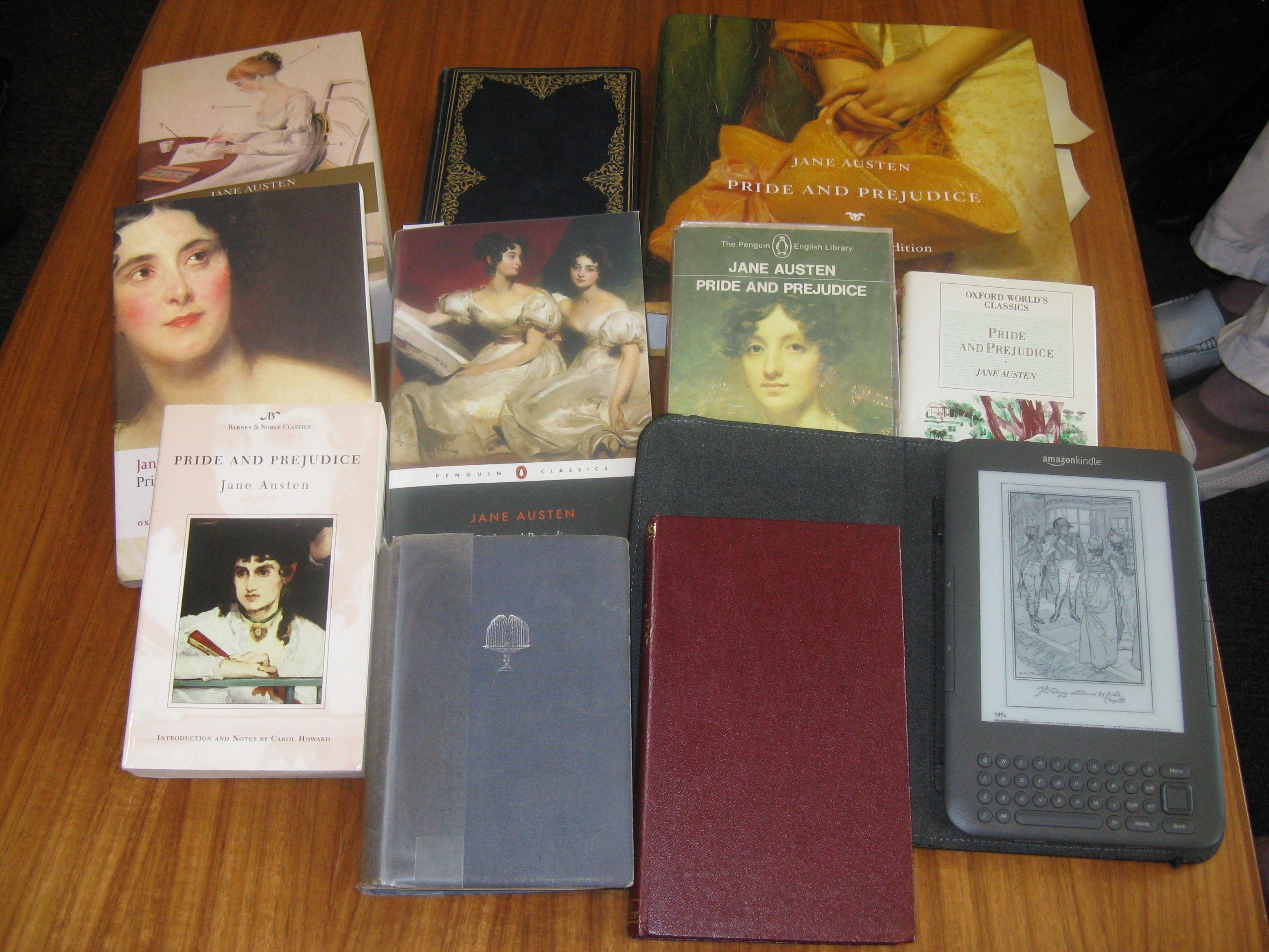
Back in the early to mid-2010s, my local Jane Austen group undertook a program of slow reading Jane Austen’s novels, coinciding with those books’ 200th anniversaries. Given that began around a decade ago, we decided last year that it was time to do another slow read program, and to stick with a chronological approach – that is, chronological in terms of publication. This meant that we did Sense and sensibility last year, and have just completed this year’s book, Pride and prejudice.
It is truly amazing just how much “new” we can find to talk about with books most of us have read not once, not twice, but multiple times, proving I suppose Italian writer Italo Calvino’s definition of a classic. Hmmm, no, not “definition” but “definitions”. He has fourteen of them, but here are the two that are most applicable to my post:
4. A classic is a book which with each rereading offers as much of a sense of discovery as the first reading.
6. A classic is a book which has never exhausted all it has to say to its readers.
These explain why slow reads can be particularly enjoyable with classics: once you know the plot, you are freed to discover how the author did it, to think about why they did it, and to notice more of the things they were telling you that you didn’t notice on the first read in your rush to find out what happens.
So, over the last three months, my group’s discussions have ranged across all of these, including finding some questions that we hadn’t thought to ask before. In Austen there are always those things she doesn’t tell us because they were known to her audience. These are the things we gradually pick up over years of Austen reading and research, such as the entail. But on this read, members raised questions regarding plot events that many of us hadn’t thought to ask before. For example, when Mr Darcy tells Elizabeth, on their meeting accidentally at Pemberley, that his sister “wishes to be known” to her, we wondered what had he told her about Elizabeth? Had he unburdened his heart to this shy young girl? Or, was it just an excuse to encourage Elizabeth to hang around a bit longer? And, when Lady Catherine visits Elizabeth because she fears there’s an engagement (or “an understanding”) between her and Darcy, where had she got this idea from?
We also found – yet again – that we had changed our minds about some of the characters, though sometimes these were diametrically opposed. For example, one remembered that when she first read the book as a schoolgirl, she felt “enormously sorry for ‘poor misunderstood Mrs Bennet’” but now she “would willingly strangle her”. For me, it’s the opposite. I had little sympathy for Mrs Bennet in my first readings, but now, understanding her worries about her daughters’ futures and Mr Bennet’s negligence in providing for them, I feel some sympathy for her – though her behaviour, all the same, is ridiculous. By contrast, in my early readings of Pride and prejudice I was far more sympathetic to Mr Bennet than I am now.
In fact, many of us in fact had little epiphanies regarding different characters that we shared with the group. Sweet Jane Bennet was thought just far too saccharine by one member, but she read some analyses that likened the angelic Jane to the sentimental 18th century heroines. Philosophers David Hume and Adam Smith argued, she told us, that feeling rather than reason provides the grounding for morality – and Jane exemplifies this. She sympathises with everyone, and behaves graciously to all. Our member wondered whether she should temper her view of Jane – though by the end she still felt Jane was just “too nice (to be real)”.
Some of these changes are due to the way slow reading exposes subtle clues that we don’t see on early reads, but some, I’m sure are due to life experiences. Austen is the perfect writer for illuminating (and then informing) our individual experiences of life.
We discussed which characters changed over the course of the novel, and, surprise, surprise, we didn’t all agree. No, let me rephrase that: we all agreed that Elizabeth and Darcy change, but some felt Mr Bennet did too, while others of us felt not – or, perhaps, only for a moment!
And then there’s the writing and the plotting. On each read we find more examples of just how beautifully, and cleverly, Austen writes. As one member said this week, as soon as he starts reading her sentences he’s drawn in – more than with any other writer. And then he shared a funny little quote from the novel that I had picked out too. It’s when Elizabeth first sees Pemberley from the outside, and takes in its beauty and grandness,
and, at that moment she felt that to be mistress of Pemberley might be something!
Such an understatement … but of course the novel is full of statements like these, of satire and little ironies, of big and little insights. We also found interesting parallels, such as between those two ridiculous women, Mrs Bennet and Lady Catherine, who, said one member, are silly and illogical in different ways. Which brings me back to sweet Jane. Writing to Elizabeth to tell her about Lydia’s running off with Wickham, she says of her mother’s overwrought behaviour that “Could she exert herself, it would be better; but this is not to be expected.” “But this is not to be expected” tells us that Jane knows her mother very well – and more, I’d argue, that Jane, while generous towards people, is not so taken in that she doesn’t see what’s what when it’s there in front of her. She just gives people the benefit of the doubt. I like that.
I fear this has been a self-indulgent ramble that hasn’t said much of substance, but it’s the best I can do right now!
Meanwhile, to those of you who do slow reads, why do you like doing them, and what you most get out of them?
 Whispering Gums
Well, as you know, I’ve read Ulysses a number of times, and I blogged my last slow reading of it. I think most people would probably say that once was enough, but I’m up for another read one of these days!
I do remember that Lisa … so why would you be up for that one, one of these days? What is it that you get out of it on subsequent readings?
Same as you, I discover new aspects of the text.
I absolutely agree about Mr Bennet – I didn’t really P&P (or any Austen other than Mansfield Park) until I was an adult, but I did love his character when I was a teenager. Rereading the book as an adult, though, I found it really interesting to see how Lizzie has to acknowledge his faults as part of recognising and beginning to deal with her own.
Interesting isn’t it Lou, how our brains manage to miss things that later seem so obvious.
Hmm. I do a lot of rereading and the effect of that is what you get from slow reading.
Thanks Jeanne … are there certain authors that you reread? Or, do you just like rereading any books you like? I’d like to do more rereading than I do but it’s such a balancing act isn’t it.
Balancing act ? – for you to read MORE ??
I’d call it a .. a .. a superhuman feat !!! [grin]
I wish M-R. I’m not reading much right now. It’s a big struggle to find time, but I’ll be back to it soon.
When I was teaching, I reread anything I was thinking about assigning that semester as I chose the book list. Something I talked to my students about is that most of their professors reread the books they assign–sometimes annually for a quarter of a century. So of course they see meanings that are “hidden” to some of the students, who are reading for the first time.
Now I still reread favorite authors, not all of them classics. I like to reread Margaret Atwood and Douglas Adams as often as I reread Jane Austen. My son recently told me that he found it rewarding to read Mansfield Park out loud and I should try it.
Oh yes, of course, teachers would do that. If I were a teacher I would like to change texts every few years! Even if you are doing classics there are a lot to pick from – unless you are doing classics in a narrow field I suppose! But of course there’s pleasure in getting to know a text intimately.
I love that your son found reading Mansfield Park our loud rewarding. Did he read it TO someone, or to himself?
My son and his fiance read out loud to each other; they took turns with Mansfield Park.
I love that. I think Grab-the-Lapels Melanie does that, and also, perhaps Stefanie (used to be So Many Books).
Lord knows whence your group came nor how; but you must know one another’s minds inside and out by now. 🙂
Haha M-R … not sure about that but we do have a sense of who likes what, and who is going to approach some of the issues in what ways. There are always surprises though because, you know, humans!
I’m intruiged by the idea of slow reading, having not come across it before. I almost always gallop through a book then feel bereft when it is finished (if it’s a very good book)
On a recent trip around England I spent several days in Bath, and went to the Jane Austen centre there. which was so wonderful. I brought home several gifts for friends including some bookmarks with the inscription, ‘Obstinate, headstrong girl!’ From that memorable scene between Lady Catherine and Elizabeth. Loved it.
Wow, that’s interesting Denise. I rarely gallop through books these days. I did when I was a child, but now I really do like to think about what I’m reading and I can’t do that if I’m galloping ahead.
Haha, love that Lady C quote. It’s a long time since I’ve been in Bath, before the 1995 Pride and prejudice which I think heralded the current Austenmania phase, so, while Austen was present back then, I suspect she is front and centre there now.
Serendipity as I finished reading P&P last night, not slowly, but certainly for the umpteenth time. It can still make me laugh out loud – Mr Collins , visiting Mrs Philips for the first time, ‘declared he might almost have supposed himself in the small summer breakfast parlour at Rosings; a comparison that did not at first convey much gratification …’
I played Mr Bennet at school (high point of those years) and have enjoyed him ever since. In my reading he is a lynchpin of the novel, flaws and all.
Snap, eh, Margaret. It’s unbelievable really how she can still make you laugh on the umpteenth read. As for Mr Bennet, my group had many ideas about what or who was or were the lynchpin of the novel. but he does play a significant role. In the end we decided it was an ensemble affair with every character playing a role in the resolution.
Yes – a mosaic!
Nice!
Please update my email address in your address book/contacts to biffward88@gmail.com
From 6 June 2023 biffward@homemail.com.au will no longer be in use. Thank you
Biff Ward Author http://www.biffward.com.au http://www.biffward.com.au/ https://www.facebook.com/biffwardauthor https://themoshshop.com.au/products/the-third-chopstick-by-biff-ward Buy Book https://themoshshop.com.au/products/the-third-chopstick-by-biff-ward
Biff Ward Author http://www.biffward.com.au http://www.biffward.com.au/ https://www.facebook.com/biffwardauthor https://themoshshop.com.au/products/the-third-chopstick-by-biff-ward Buy Book https://themoshshop.com.au/products/the-third-chopstick-by-biff-ward
>
I enjoyed reading this article. Though I’ve never read Jane Austen past the first few pages, I completely understand the benefits of slow reading which is what I do as a translator, reading and rereading and rereading, trying to comprehend why the author made a certain point with certain words. I almost always love the writing much more after umpteen reads of it.
Oh yes, of course, translators would do a lot of rereading, Your skill impresses – and interests – me so much. But, I agree with you, that with most books that have some depth, I pretty much always love them more on each read. I think that’s why I enjoyed studying literature.
I was only talking about slow redaing this morning in relation to my Moby Dick reading a few years ago. It was such a rich experience I will be repeating it one day.
Jane Austen has been reread by me so often and always will be – I do love how you see different things each time. The other regular reread is Jane Eyre – I seem to read her once every decade.
I’ve been prevaricating about slow (re)reading Middlemarch later this year, but this discussion could be tipping me over to the yes do it side.
Repeating it with Moby Dick, you mean Brona? I’m loving hearing the books people like rereading – Ulysses for Lisa, Moby Dick for you. My “little” Austens seems small by comparison (except, for me, she is never small!) Middlemarch would be another good one. It has been partly read next to my bed for a decade, but is now in a box somewhere! I’ll have to start again.
I love the idea of doing a slow read with a group. Your blog post is a wonderful advertisement for it. Thank you. For the foreseeable, I’ll be doing it solo, which I find a very rich experience, both for rereads like Middlemarch, and first readings, like Proust. I’m tempted by Moby Dick or Ulysses, which I’m sure would yield up new riches, but will probably go for something I haven’t read before. I hope you’ll have plenty of time for reading once again soon
Thanks Jonathan … and sorry for the delayed reply. I’m head down tail up on decluttering at the moment and struggling to keep up with blogging across whatever device I have to hand at the moment. They all display comments different ways and I’ve missed a couple on this post, I’ve just seen.
I’m really glad this discussion is a good advertisement for group slow reads, but any slow read is valuable I think – as you clearly agree.
PS: One day, I’ll read Pride and Prejudice for the first time!
I hope so!
PS My brother did so only a few years ago and was, I think, pleasantly surprised though I’m not sure he’s gone on to read them all.
I found this post really interesting, not self indulgent. I don’t often reread, so hearing the things that people discovered along the way was surprising to me, and kind of makes me want to go back and reread other books that I love. And your photo at the top, there’s a larger book in the upper right hand corner. I think I read an addition of Sense and sensibility by the same publisher. Did that book have notes along the margins. Kind of like footnotes, but more like side notes? I think the only reason I enjoyed Sense and Sensibility was because the editor had included information about how much money was relative to the time, what people were wearing and why it was important, and other historical tidbits that made the reading come to life for me, which I lacked without the context of the time period.
Well spotted Melanie. Yes, that’s an “annotated edition” – not mine – and I think there’s one for each of the Austen novels. I’d love it, but how many more Pride and prejudices can I justify?! I think I remember your commenting on those notes when you posted on the book.
You don’t re-read at all? Or, not very much? I’d love to do more but then there are all those books I want to read out there too.
Oh, I would love to reread — it’s not on principle or anything — it’s, as you say, all the unread books. The more “fluffy” the novel is, the more likely I am to re-read it, though, because I can do it with little focus. The annotated edition with all the pictures and examples and sidenotes is totally the way to go. Footnotes and endnotes are not helpful to me, and a picture is endlessly clarifying.
Understand completely… and yes I agree re those sidenote annotations.
I loved your ramble! And I love all you had to say about the slow reading! Where indeed did Lady Catherine get the idea that Darcy and Elizabeth might have an understanding? I have thought maybe Mr. Collins? But I have never considered how Darcy’s sister got information about Elizabeth. I would have had to come from Darcy or maybe Bingley? I’ve never had much sympathy for Mrs. B, but now you have me thinking. And Jane too. So much fun to think about!
I thought I replied to this, Stefanie … I think we decided that there’s a hint it came from the Lucases, which would then have gone to Mr Collins? I would have thought Mr Collins too.
Jane Austen is always fun to think about isn’t she. At every stage of our lives, she has something to offer.
I loved your ramble that is not really a ramble! And I love all you had to say about the slow reading! Where indeed did Lady Catherine get the idea that Darcy and Elizabeth might have an understanding? I have always thought it was Mr. Collins. But I have never considered how Darcy’s sister got information about Elizabeth. I would have had to come from Darcy or maybe Bingley? I’ve never had much sympathy for Mrs. B, but now you have me thinking. And Jane too. So much fun to think about!
At the end of P&P, Mr Bennet asks Elizabeth to consider carefully before accepting Darcy’s proposal. He concludes: “My child, let me not have the grief of seeing _you_ unable to respect your partner in life. You know not what you are about.”
I did not grasp this at first reading(s), but now I believe Mr Bennet is referring indirectly to his own marriage, and probably Elizabeth understands this as well. This is a very kind piece of advice – think of the long-term prospects.
Thanks Tuuli – yes, I think that is a big part of what he is thinking. Isn’t it wonderful how, as we experience more in life, we see more depth and breadth in what she says.