Little did I know when I wrote my last Six Degrees, that I would have just completed three weeks of lockdown when writing my September edition, but that’s, indeed, where I am. I am aware that among most eastern state Australians, the ACT has been relatively lucky. However, we have been feeling for some time that we’ve been living on borrowed time and that time ran out. Australia did a great job last year of suppressing the virus but the Delta variant, combined with problems in vaccine supply and delivery, left us exposed. We can only hope that … oh well, what more can I say. Let’s get onto our Six Degrees of Separation meme, which, as most of you know, is run by Kate. Check her blog – booksaremyfavouriteandbest – to see how it works.

We start, of course, with the book chosen by Kate and this month it’s another book I’ve not read, Rachel Cusk’s Booker Prize longlisted Second place. I haven’t read Cusk yet but she’s been on my radar, and is even moreso now.
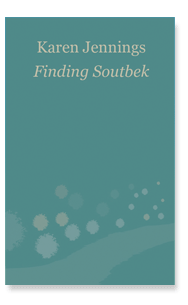
I haven’t, in fact, read any of the longlisted books, but I’ve read previous works by some of them, so this is where I’m going first. The author I’ve chosen is South African author, Karen Jennings. I’ve read two of her books, but as I recently linked on one of them, I’m democratically selecting the other, Finding Soutbek (my review), which I remember enjoying for adding to my knowledge and understanding of her country.

Another South African-born writer who has provided me with insights into his country, is JM Coetzee. He has also been longlisted for the Booker prize and, in fact, has won it twice. But they are not the books I’ve chosen here. That one is Diary of a bad year (my review), mainly because it’s the only one of his I’ve reviewed on my blog, although I have read a couple of others, including the unforgettable Disgrace.
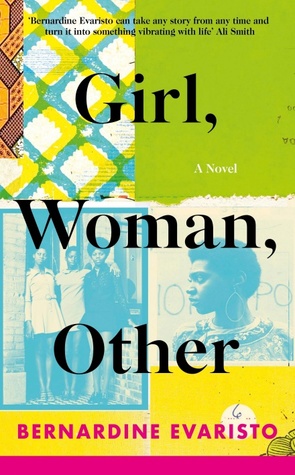
Those of you who have read Diary of a bad year will know that it is quite challenging to read, not so much because of its language but its structure: it has three storylines, one running at the top, one in the middle, and the other at the bottom of each page. How do you read that? In fact, once you decide your way to read it, it’s perfectly readable. Another book that seemed confronting to read – this one because of its almost complete lack of punctuation – is Bernadine Evaristo’s Booker Prize-winning, Girl, woman, other (my review). It, too, turned out to be easy to read.
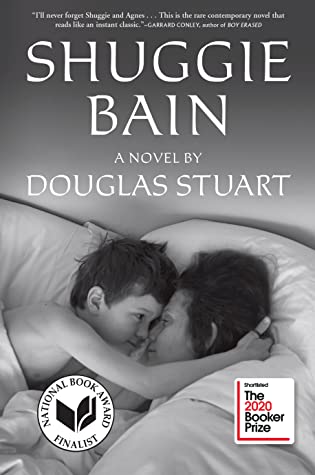
Sticking with potentially challenging books, I’m next linking to my latest read, Douglas Stuart’s Booker Prize winning Shuggie Bain (my review). It is set in Glasgow, and much of its dialogue is in Glaswegian vernacular. This was off-putting for many English readers, a commenter on my post said, but I found it much easier to read than I expected, and quite musical in fact.

For my next link, we are leaving this little subterranean linking of Booker-related books, and delving back into the past with Sir Walter Scott’s Waverley (my review of volume 1). I’m sure you’ve guessed my link – yes, Sir Walter Scott, like Douglas Stuart, was born in Scotland. There’s not much else to link these books on except, I suppose, that both are named for their male protagonists!
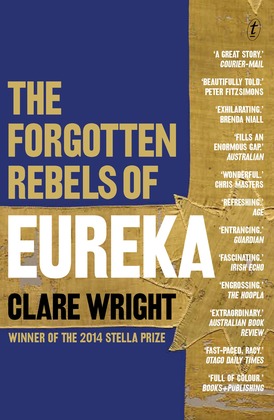
And finally, for something completely different, we are going from Waverley the novel, to a work of history that in 2014 won the previously named Nib Waverley Award (but which since 2017 has been known as the Mark & Evette Moran Nib Literary Award.) Waverley is the name of the municipal council which manages this interesting award which focuses on research as well as writing. 2014’s winner was Clare Wright’s The forgotten rebels of Eureka (my review).
I haven’t read our starting book, so can’t comment on whether there’s much to link back to, but I think I could say that Clare Wright wrote her book because, for too long, women in history have taken second place! How does that sound?
Now, the usual: Have you read Second place? And, regardless, what would you link to it?
 Whispering Gums