Six degrees of separation, FROM How to be both TO …

I don’t think I’ve read one Six Degrees of Separation meme starting book yet this year! But that hasn’t stopped me giving it a go. Who said you have to read a book to write about it! Many a student has known that’s not necessary! (Never fear though, I always read the books I review on my blog. I’m not that brazen!) But now, before we get onto the post proper, I need to tell you to click on meme leader Kate’s blog name – booksaremyfavouriteandbest – if you don’t know the rules.
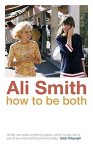
Ali Smith, How to be bothSo, this month’s starting book is Ali Smith’s How to be both, a book I’d love to read, particularly given I read and loved, long before blogging, her second novel, Hotel world. Smith is an inventive writer, and this book was shortlisted for and/or won several prizes, including, in 2015, the Bailey’s Women’s Prize for Fiction
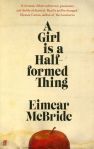
Eimear McBride, A girl is a half-formed thingI have, over the years, read several of the winners of this Women’s Prize (under its various names), one of which being the 2014 winner, Eimear McBride’s moving, confronting, A girl is a half-formed thing (my review). It tells of a dysfunctional Irish family, comprising a mother, a daughter (the titular “girl”), and her brother whose mental capacity has been compromised due to surgery for brain cancer when he was young. Our girl is emotionally neglected as the mother struggles to care for her son’s needs.
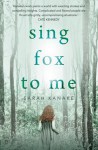
Sarah Kanake, Sing Fox to meAnother novel exploring the impact on a sibling of living with a disabled brother is Sarah Kanake’s Sing fox to me (my review), though in this book the challenge is Down Syndrome and the brother is a twin. Kanake’s book is set in Tasmania, and with its forbidding – and mysterious – forest setting, it falls within a sub-genre we know here as Tasmanian Gothic.
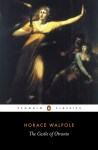
Horace Walpole, The castle of OtrantoNow it just so happens that I’ve read, since blogging, the book generally regarded as the first Gothic novel, Horace Walpole’s The castle of Otranto (my review). It’s quite a story, about the lord of a castle who … well, I’m not going to spoil it here, am I?
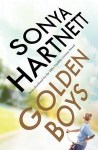
Sonya Hartnett, Golden boysBut, we all love a castle don’t we – even scary Gothic ones. We don’t have many castles in Australia – not surprisingly, given our relatively short built-history – but Sonya Hartnett does use a castle motif in her novel Golden boys (my review). There’s no real castle in her suburban setting but one of the main characters starts to

see that the world is a castle, and that a child lives in just one room of it. It’s only as you grow up that you realise the castle is vast and has countless false floors and hidden doors and underground tunnels …

I liked that metaphor, particularly because it suggests that life can be pretty “gothic” at times!
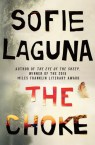
Sofie Laguna, The chokeSonya Hartnett is an Australian author who has managed to successfully straddle writing for children and adults. Another Aussie who has done this is Sofie Laguna, and it’s to her most recent book for adults, The choke (my review), that I’m linking next. The choke refers, literally, to the Barmah choke in the Murray River – a place where the river narrows  and then pushes through, creating a paradoxical metaphor for both being squeezed and for pushing forward. It’s also, for protagonist Justine, a place of escape and tranquility.
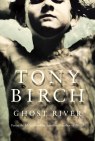
Tony Birch, Ghost riverTony Birch’s Ghost river (my review) is a semi-autobiographical novel which, too, is set on a river – and a river which also has a physical presence as well as a spiritual and metaphorical one. This novel, though, has an additional environmental story about saving the river from a freeway development.

So, this month, I’m back to my usual gender division of four women and two men, and to my strong focus on Australia, with only two forays (excluding the starting book) to the United Kingdom. We’ve also spent almost all our time in the contemporary era, with a quick dip of our toes into Walpole’s 18th century. Not very varied I’m afraid, so

… over to you: Have you read How to be both? And, regardless, what would you link to? 
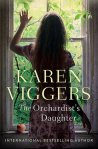
Karen Viggers, The orchardist’s daughter (#BookReview)

Karen Viggers, The orchardist's daughterThe orchardist’s daughter is local author Karen Viggers’ fourth novel, but the first that I’ve read. She has, however, appeared on my blog before, being the person who conversed with Sofie Laguna about her novel, The choke. It was one of the most entertaining conversations I’ve ever attended.

Now, if you haven’t read or heard of Karen Viggers before, there are some facts worth knowing about her. Firstly, she’s a vet with special training in native wildlife health – and this background informs most if not all of her novels, I believe. It certainly informs The orchardist’s daughter. Another significant fact is that she’s a best-selling author in France! How wonderful that a novelist who writes strongly Australia-centric books does so well in France! Her previous novel, The lightkeeper’s wife, was, in fact, awarded the Les Petits Mots de Libraires literary prize.

So, an interesting author, and The orchardist’s daughter is an interesting, enjoyable book. It is set in a small logging town in Tasmania, and has quite a formal structure, starting with a Prologue, followed by four parts – Seeds, Germination, Growth, Understorey – and ending with an Epilogue. It is told third person through the perspective of three characters – Miki, the titular orchardist’s daughter who is 17 years old for most of the novel; Leon, a Park Ranger, who is 25 years old at the novel’s start; and Max, a 10-year-old boy who is Leon’s neighbour. Miki and Leon are relative newcomers to the town, Miki arriving with her older brother Kurt to run the town’s takeaway shop after they lose their home, farm and parents in a fire, and Leon moving from his Ranger job on Bruny Island to the mainland. All three are outsiders and serve to illuminate the tensions existing in the town.

Around these characters is a community comprising mainly logging families, Max’s being one of them. However, there are others who round out the town a little, including policeman Fergus and his sons, Geraldine who runs the information centre, and vet Kate. The narrative develops around a couple of situations. One is a mystery surrounding Miki’s brother Kurt. What does he do by himself in the forest when he insists that Miki wait in the ute, and what does he do during his weekly solo trips to Hobart (during which he locks Miki inside their shop/home)? The other concerns logging, and the dangerous unrest that develops when a temporary ban is placed on logging around a certain ancient tree. Jobs are at risk, the loggers believe, and the butt of their anger is of course Parkie Leon. From these two situations, Viggers builds tension slowly but inexorably, with the Kurt-and-Miki story becoming the prime focus, of course, given the book’s title.

So, there is a strong plot to the novel, but this plot, while driving us on to read, is there to serve some issues that Viggers wants to explore. These concern logging and the environment, bullying and domestic violence, not to mention more personal ones like freedom. These are big issues, and not only is Viggers clearly passionate about them, but her writing about them feels authentic. The characters may be a little less complex than, say, those in Lucashenko’s Too much lip, but they are believable. Logger and vicious bully Mooney is offset against Robbo, who is equally single-minded about logging but seeks more peaceful, law-abiding means of protest. Similarly, Max’s father Shane, another logger who is violent, is offset against colleague Tobey who has a tender, caring relationship with his wife. All of this is observed by Miki from her shop-counter – and she makes her own little attempts to lighten the lives of the bullied and the ostracised, by sneaking treats into their take-away bags. Through this little subversive action, we sense Miki’s inner strength and resourcefulness, something she takes to another level when she works out ways of escaping her “prison” while Kurt is away.

Freedom is one of the novel’s underlying drivers. Miki’s imprisonment is literal, but imprisonment takes many forms – the wives who are abused but feel incapable of escaping, and young Max who is bullied to behave in ways antithetical to his nature. Some of these are resolved, but Viggers recognises that there’s no magic wand for domestic abuse. The first step is moving from passive awareness (or acceptance, even) to taking action, and this starts to happen in the novel.

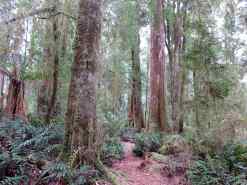
In the Tarkine, NW Tasmania

The book really stands out, however, in its writing about nature. A Booktopia interview with Viggers tells us that she grew up in the Dandenongs and has been to Antarctica. She has also spent time in Tasmania (and immersed herself in Tasmanian-set books, including two I’ve read, Anna Krien’s Into the woods, and Louis Nowra’s Into that forest). All of this has given her a sure feel for the wilderness, so much so that it’s difficult to choose an excerpt to share, but here’s one:

Miki loved the trees and the birds, but what she loved most couldn’t be seen. The way she felt in the forest. The scent of the bush after the rain. The sound of bark crackling. Branches squeaking. The feeling of patience and agelessness, growth and renewal. The aura of trees. The sense of connectedness. Of everything having its place. She could stay here all day, breathing with the tree, drawing its life into her lungs.

These forest descriptions move into Tasmanian Gothic realms during the climactic chase. The experience is both “terrifying and surreal” for our character who crawls and runs through, burrows and squats in the forest, “slipping from the thicket and weaving though the trees, ducking under tree ferns, past the tipped-up end of a fallen tree whose buttressed roots made a wall he could hide behind.” It’s muddy and dangerous with sword grass that scratches you and bark mounds that can trip you up. Viggers knows this landscape – and how to make it terrifying.

In the end, The orchardist’s daughter is about community and compromise, and about the courage to break free. It straddles the boundary between commercial and literary fiction. It is accessible, it has a strong plot and easy-to-engage-with characters, and it is hopeful (not that literary fiction can’t be!!) But, it is also gritty in subject matter and doesn’t offer neat solutions to the important environmental and social issues it raises. I like that in my reading!

Theresa (Theresa Smith writes) also loved the novel.

AWW Challenge 2019 BadgeKaren Viggers
The orchardist’s daughter
Crows Nest: Allen & Unwin, 2019
389pp.
ISBN: 9781760630584

Review copy courtesy the author, Karen Viggers.

Monday musings on Australian literature: Pianos in Australian literature

A rather left-of-field topic for Monday Musings, but did you know that last Friday, March 29th, was World Piano Day? The Piano Day site asks how we are going to celebrate it. Well, three days late, I’m celebrating it by talking about Australian literature that features pianos. Why not?

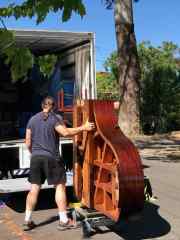
Farewelling my late aunt’s precious Bechstein

World Piano Day is new – the first being 2015 – and it is a slightly shifting feast in that its date is related to the number of keys on a piano, 88. That is, it occurs on the 88th day of the year which is, except for leap years, the 29th of March.

Why do we need a World Piano Day? Its creator, the German musician Nils Frahm, says:

For many reasons. But mostly, because it doesn’t hurt to celebrate the piano and everything around it: performers, composers, piano builders, tuners, movers and most important, the listener.

Any keen reader of Australian fiction will know that pianos abound in Australian literature – hmm, “abound” might be pushing it a bit, but they do occur more frequently than you might think. In John Lang’s mid-19th century novel The forger’s wife (1853) (my review), the wife Emily tries to support herself by giving piano lessons. Elizabeth Jolley features piano teachers and piano playing in many of her novels. And so on…

Consequently my list is an eclectic selection, presented chronologically.

Fiction

Miles Franklin’s My brilliant career (1901) (Karen’s BookerTalk review): Protagonist Sybylla loves music and the piano. For her music represents the life/world she desires. When she is exiled to work at the M’Swats’ farm she finds their piano produces only “jarring, clanging, discordant clatter” and their neighbours “lived the same slow life, and their soul’s existence fed on the same small ideas. I was keenly disappointed that none of them had a piano, as my hunger for music could be understood only by one with a passion for that art.” Harry Beecham, however, is a “fine pianist”, but unfortunately for him, Sybylla’s desire for independence outweighs even that!

Henry Handel Richardson’s Maurice Guest (1908)(Lisa’s ANZLitLovers review) and The young Cosima (1939) (Bill’s TheAustralianLegend review): Both feature pianists, which is not surprising given Richardson was a keen musician who studied music at the Leipzig Conservatorium. Although it barely references the music, I can’t resist this contemporary review of Maurice Guest (from The Sydney Morning Herald, 24 October, 1908):

Maurice Guest (Heinemann) is an elaborate study of the soul progress of a young student of music in Leipzig. It is very long for a modern novel, but it shows a finished style and considerable powers of analysis. The picture of life in Leipzig is very minute, and though the detail is rather overwhelming, it all fits in Its place. Mr. [sic] Richardson is to be congratulated on a fine and careful piece of work of more than ephemeral Interest.

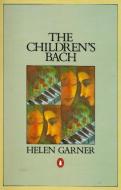
Helen Garner, The children BachHelen Garner’s The children’s Bach (1984) (my review): Protagonist Athena has a piano in her kitchen:

There was a piano in the kitchen and during the day Athena would shut herself in there under the portrait of Dexter’s father and pick away at Bartok’s Mikrokosmos or the easiest of Bach’s Small Preludes. Preludes to what? Even under her ignorant fingers those simple chords rang out like a shout of triumph, and she would run to stick her hot face out of the window.

Peter Goldsworthy’s Maestro (1989): Goldsworthy is a writer, doctor and music lover, who has also written libretti. His daughter Anna, see below, is a concert pianist. Maestro, his debut novel, is a coming-of-age novel about a young boy who is taught the piano by the titular maestro (for whom the piano provides sustenance and escape.)

Sonia Orchard’s The virtuoso (2009) (Lisa’s ANZLitLovers review): While Richardson’s The young Cosima draws on the life of Richard Wagner, and the pianist Cosima von Bülow whom he married, Sonia Orchard’s debut novel draws on the life of the much lesser known Australian pianist Noel Mewton-Wood, who committed suicide when he was 31 years old, and was found next to his Steinway.

Murray Bail’s The voyage (2012) (my review): Most of the books here are about pianists, but Bail’s is about an Australian piano inventor who goes to Vienna to try to sell his piano. It’s a clever motif – an inventor from the New World taking his new piano to sell to the Old World. It goes to the heart of some of Bail’s thoughts about the challenges we face as Australians, not to mention the challenges artists face.

Zoe Morrison’s Music and freedom (2016) (Lisa’s ANZlitLovers review): Morrison is a professional musician, who learnt the violin and piano, but she is also a feminist interested in social justice. Music and freedom, which tells the story of concert pianist Alice from childhood through marriage to old age, combines these two interests.

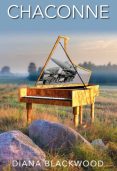
Diana Blackwood, ChaconneDiana Blackwood’s Chaconne (2018) (my review): Blackwood’s debut novel features a harpsichord on the front cover – next to a Pershing missile – the harpsichord referencing protagonist Eleanor’s piano-playing childhood and love of Baroque music, and the missile, the novel’s Cold War setting. This novel is about a young “lost” woman whose reconnection to music helps her get her life together.

Justine Ettler’s Bohemia Beach (2018) (Bill’s TheAustralianLegend review): Another novel about a concert pianist, written by a writer who is also an accomplished musician. Protagonist Catherine Bell’s life has run off the rails and she is self-medicating with alcohol.

Non-fiction

My main interest here, really, is fiction, but I’ll list a few non-fiction books which feature pianos or pianists:

  • Anna Goldsworthy, Piano lessons (memoir) (2009) (Lisa’s ANZLitLovers review): Goldsworthy’s life in music from childhood piano lessons to becoming an internationally successful concert pianist.
  • Michael Atherton, A coveted possession: The rise and fall of the piano in Australia (2018) (history) (Lisa’s ANZLitLovers review): a cultural history of the piano in Australia, from their arrival with the first boats in the late 18th century.
  • Virginia Lloyd’s Girls at the piano (2018) (memoir): Lloyd muses on learning the piano as a child, and the role the piano and music played in her subsequent life.

And, I have to mention Diane Bell’s Generations, in which she discusses, in the chapter “Familiar things”, the way pianos are passed down through generations of women. The piano was seen, she writes, as a symbol of “civilisation, status and sociality”. It provided an opportunity to learn to play music, a way of socialising with people, and of “keeping alive the folk music” of the countries from which people had emigrated. Bell writes that at the turn of the 20th century Australia’s population was under 4 million, but “there was about one piano for every six people.” No wonder, she says, there are many stories about buying and moving them, playing them, and socialising around them.

All these books are very different, but all have one thing in common, the capacity for music to incite some passion or vision for life. Irresistible.

Do you like reading about music? If so, please share your favourites.