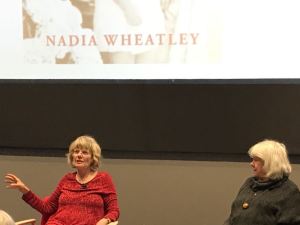
Nadia Wheatley and Marion Halligan, ANU Meet the Author
Nadia Wheatley is, I fear, not as well-known in Australia’s literary firmament as she should be because her credentials are excellent. Not only is there My place (1987) – a wonderful multi-award-winning children’s book about the history of place – but her biography of Charmian Clift, The life and myth of Charmian Clift, has been described by critic Peter Craven as “one of the greatest Australian biographies.” She has appeared here in a Monday Musings list of books recommended by indigenous writers (even though she is not indigenous) for her book, with Ken Searle, The Papunya School book of country and history. And these are just a few of her literary credentials.
All this is to say that when I saw that she was to be a “Meet the author” subject this week at the ANU – on a free night for me, no less – I didn’t hesitate to book. It didn’t hurt, too, that her Conversation partner was to be Marion Halligan (who has appeared here several times, in various guises.)
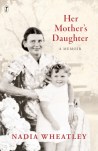
Now, I don’t want to discuss in detail her latest book – Her mother’s daughter: A memoir – which was the reason for this event, because I have almost finished it and will discuss it in my soon-to-come post, so I’ll just share, briefly, some of the main points from the conversation.
“Caught between an independent woman and a controlling man”
The book’s title suggests that the book is Wheatley’s memoir of her life with her mother (Nina, familiarly called Neen.) However, this is only part of the story. The book is, in fact, like a few I’ve read recently, a sort of hybrid biography-memoir, because it is as much a biography of her mother, who died in 1958 when Nadia was 9, as it is a memoir. Three others I’ve discussed here in recent years are Susan Varga’s Heddy and me, Anna Rosner Blay’s Sister, sister, and Halina Rubin’s Journeys with my mother. Interestingly, the mothers in all of these books experienced World War 2 in some way, though Wheatley’s mother differs from the other three European-born women in that she was an Australian who went over to work in the war.
Marion Halligan commenced the conversation by commenting that the book was a difficult read, and that it must also have been difficult to write. Wheatley agreed, commenting that people under-estimate children’s ability to suffer, but also their ability to survive…
… and both suffer and survive, Wheatley did. She was caught, she said, “between an independent woman and a controlling man”, but that was only the half of it. She wasn’t helped by a family which – only partly because it was the 1950s – did not feel the need to tell Wheatley what had really happened to her mother, resulting in the young Nadia hoping (if not totally believing), for some years, that one day her mother would return. She was abandoned by her father, whom she described as “a strange, sadistic person.” The family dynamics are complex, and I’ll discuss some of them a little more in my post on the book.
I will say, however, that the underlying biographer’s question for Nadia in writing the book was:
Why would a nice person like Neen marry an awful person like my father?
Because, awful he was … though not, it seems, to Neen in the early years of their relationship when they were working for/with refugees and displaced persons in post-war Europe!
What lifts this book above what could so easily have been a misery memoir is that it also works as social history of an era – of life in Australia in the first half of the twentieth century, and of the work Australian nurses did during and after the Second World War. The pictures Wheatley draws of the joys (yes) and challenges of the War for Nina are vivid, and ring true. Nina was a truly independent woman, despite the demands home and family exerted on unmarried “girls” at the time. The pictures Wheatley then draws of Nina post-marriage are, consequently, even more devastating – because of the gap between what could (should) have been and what was. Nina’s dire situation was compounded by the confluence of a controlling, sadistic husband and a time, the 1950s, when women had little agency in the face of such a situation. Even so, Nina did her best …
At one point during the conversation, Wheatley made the interesting – and obvious, if you know their stories – point that there are some parallels between her and her mother’s stories. Both were motherless from a young age, and both became involved in social justice action. There was discussion in fact about how her mother’s work with refugees is relevant to today’s refugee situation. Nina worked for the short-lived UNRRA and was involved in the early definition of just what a refugee is and in the practice of placing them.
Telling the story
 In the Q&A, I asked Wheatley about the structure she chose to use in the book, about the fact that while is it generally chronological, she inserts herself into this chronology at times when she herself wouldn’t have been alive. For example, she describes the young Nadia asking her mother about a photo in an album. This enables us to see Nadia’s interest in her mother’s story, her reaction to her mother’s story, and her mother’s later reaction to the events in her life, at least in terms of how she wants to present them to Nadia. From the reader’s point of view, it makes reading this book far more engaging.
Wheatley answered that felt she needed to be in there “on the quest”, and referred us to AJA Simon’s biography A quest for Corvo: An experiment in biography, as one of her inspirations. She wanted the book to be her journey of discovery – “to have the detective story of her unravelling her mother’s story” – rather than just be a presentation of the evidence. Again, I will talk more about this in my post, but Wheatley did share some of the stories about how she went about this unravelling. I like this approach to non-fiction, not only because it’s usually engaging, but because it can strengthen the authority or integrity of the work.
There was more to the conversation – but some of it, as I’ve already said, will come out in my post, and some of it is best left for you to read yourselves in the book. I mustn’t give it all away!
Vote of thanks
To conclude, MC Colin Steele introduced The Canberra Times’ past – and, distressingly, to date, last – literary editor, Gia Metherell, to give the vote of thanks. In doing so, she said that Wheatley’s book shows why childhood biographies can be so potent. She quoted the late Australian critic Geraldine Pascall* (I think) who said that Australian writers write more often and more potently about their childhood than anyone else, besides English and French writers. What an interesting thought on which to end a thoroughly engaging conversation.
* Gia Metherell clarifies this in the comments below saying that it wasn’t Geraldine Pascall to whom she was referring but English academic Roy Pascal. However, on checking later, she realised she had misremembered and it was Richard Coe, in “Portrait of the Artist as a Young Australian: Childhood, Literature and Myth”, Southerly, 41, no. 2, 1981. Thanks Gia.
ANU/The Canberra Times Meet the Author
MC: Colin Steele
Australian National University
8 October 2018






 Whispering Gums