Don Miller, Will to win: The West at play (Review)

Sport is probably not the first subject you expect to find here, but it is in fact the focus of my latest read, Don Miller’s Will to win: The West at play. Published by independent Melbourne press, Hybrid Publishers, it was offered to me after my Monday Musings post a few months ago on Australian Rules in literature. In that post, I wrote that Australian Rules “can over-emphasise competitiveness to the point that winning overrides being fair and just”. I said this of Australian Rules because that was the subject of my post, but the statement is true of much sport – that is, of elite, professional sport – and it’s this “truth”, this issue of winning, that Don Miller examines in Will to win.

Who is Don Miller? He’s not familiar to me, but he apparently worked in the Department of Political Science at the University of Melbourne for 30 years until 1995, and then in 2006 he established an organisation called the Melbourne Centre of Ideas. I’m not sure what his academic credentials are, exactly, but “creative thinking”, particularly on society and values, is his mantra.

Miller writes in his Introduction that the book was inspired by two ideas. One is anthropologist Claude Lévi-Strauss’s statement in his book The savage mind that when football was introduced to New Guinea the locals changed one rule: the game was to be played until both teams were equal. Love it! Miller read this a few decades ago, but the second notion is far more recent: it’s the “failure” of Australia’s swimmers at the 2012 London Olympics. There was such a hue-and-cry about this during and after the Games, including blaming post-mortems, apologies galore, and the commissioning of a review! I remember being horrified. Well, so was Miller. He had, unsuccessfully, tried to write about sport many times before, but the London situation gave him the angle he was seeking: he would write about “contemporary professional sport” and frame it with a reference to New Guinea.

So, this is what he does, approaching it, he says, in a spirit of enquiry:

to follow my own thoughts; to see where they take me; to consider new questions as they periodically erupt. A journey of discovery, clarification, and pleasure.

Several themes run through the book, the main ones stemming from Western culture and civilisation, from the way the West looks at the world. Western thinking he argues tends to be dichotomous (that is, to see issues as black/white, or, in this case, win/lose). The West is focused on the measurable, believes actions should be purposeful, and admires progress. He explores these ideas in terms of their relationship to sport – of how they frame the way we view, practice and understand sport. 

Sport’s excesses

The overriding motif is – as you can tell from the title – that winning is everything. The logical extension of this is the idea of “excess”. To win, sportspersons push themselves – physically, emotionally and mentally – to a point beyond endurance, to, in fact, self-harm. Take hurdler Sally Pearson, who, Australians know, is a tough, determined competitor. She said after the London Olympics:

My back was killing me. It’s just a matter of telling your body that you have to do it, no matter what – I know I am not an old athlete. I’m only 26, but just the way my body is ageing at the moment and my disc is degenerating, it’s just a matter of trying to keep it intact so I can compete at least until Rio.

But, the more sensible (value judgement here!) of us think, what about your post-sport life?

So, there are the punishing regimes athletes put themselves through in order to be the best, to win, regimes that Miller likens to training for and partaking in war. Is such self-harm worth it, he poses. He quotes the infamous Lance Armstrong who famously said “losing and dying; they’re both the same”. Tour de France athletes, we know, undertake punishing training to compete in a gruelling race. But mention of Armstrong of course raises another by-product of competitive sport, that of cheating and corruption. There is a fine line between “winning” and “winning at any cost”, with the latter referring not only to the aforementioned physical and mental cost to the athlete, but to crossing over the line of fairness and ethics to something more ruthless. Armstrong epitomises this crossover, but is by no means the only sportsman to have been so lured. In his discussion of Armstrong’s behaviour, Miller suggests that his behaviour could be seen as “the exemplary model of a Western businessman”. A fair analogy?

Sport’s truths

Miller also explores some “truths” that have been promulgated about the value of competitive sport, arguing that some are false (such as “the practice of sport is a human right*”) and others overstated (such as that sport will set you up for life). Really, he questions? Sport a human right, like food, shelter and security? As for setting you up for life, Miller asks that, even if we agree that sport can have these benefits, “does it have a monopoly?” What about being an oboe player in the Australian Youth Orchestra, or part of a multidisciplinary team pushing the boundaries of science, or even being a wheat farmer or apprentice plumber? Don’t the skills learned here also train you for life? Life, he suggests, is complex, and to propose otherwise, to propose there is a “singular model or formula”, is grossly misleading.

Then there’s that ultimate “truth” about losers, that they are, well, losers, that even second place is losing. Miller quickly puts paid to that idea. We all know winners who do not “succeed” and losers who learn valuable skills. Indeed, it’s worth considering, he says, Jean Cocteau’s statement that “to succeed is to fail”, a statement that “breaks from conventional dualistic thinking”.

Will to win is not so much an academic work, as a clearly written, personal investigation of a topic that has long interested Miller. It is not footnoted, though he does cite sources as he goes, particularly from newspapers, and there is a bibliography. Does it have a conclusion? Yes, and no. This is what he says near the end:

This book returns again and again to the excess in modern sport – to its ubiquity and impact. Whatever it does, it goes too far, and the cumulative consequences can be disturbing. The book is a call for moderation of all its qualities, a change of emphasis, a shift towards a more expansive range of values.

The challenge is to think and imagine other ways of engaging in sport – a challenge that he suggests we should take up now. Can we Westerners, for example, see our way to a win-win value? I enjoyed the read – but, in me, he was preaching to the converted. I’d love to know what those more passionate about competitive sport think, those who expected and accepted the apologies of Australia’s 2012 London Olympics Swimming Team. What would they answer to Miller’s questions?

* The Olympic Charter

Don Miller, Will to win, book coverDon Miller
Will to win: The West at play
Melbourne: Hybrid Publishers, 2014
123pp.
ISBN: 9781925000580

(Review copy courtesy Hybrid Publishers)
Monday musings on Australian literature: Serendipitous finds in Tasmania

Well folks, I’ve not posted here for a week. As I wrote last Monday, I’ve been travelling in Tasmania, and have only returned home this afternoon. I have some ideas for future Monday Musings, and could have researched one for today, but I can’t resist sharing a few more of my Tasmanian literary experiences.

Tasmania is home to many Australian writers including Booker Prize winner Richard Flanagan (see my review of his The narrow road to the deep north), National Biography Award winner Alison Alexander, commentator and memoirist Robert Dessaix, and novelist Danielle Wood (see my review of her Mothers Grimm). But there are other, quieter, literary treasures to be had here.

Take gravestones for example …

We visited the historic Bothwell Cemetery, and read some poetically poignant (or, do I mean, poignantly poetic?!) gravestones. Poor Elizabeth, wife of Edward Simon Arnett, died in 1841 at the age of 33. Here are the words on her gravestone:

Now husband dear my life is past
My love was true while life did last.
Bereaved of me no sorrow take
But love our children for my sake.

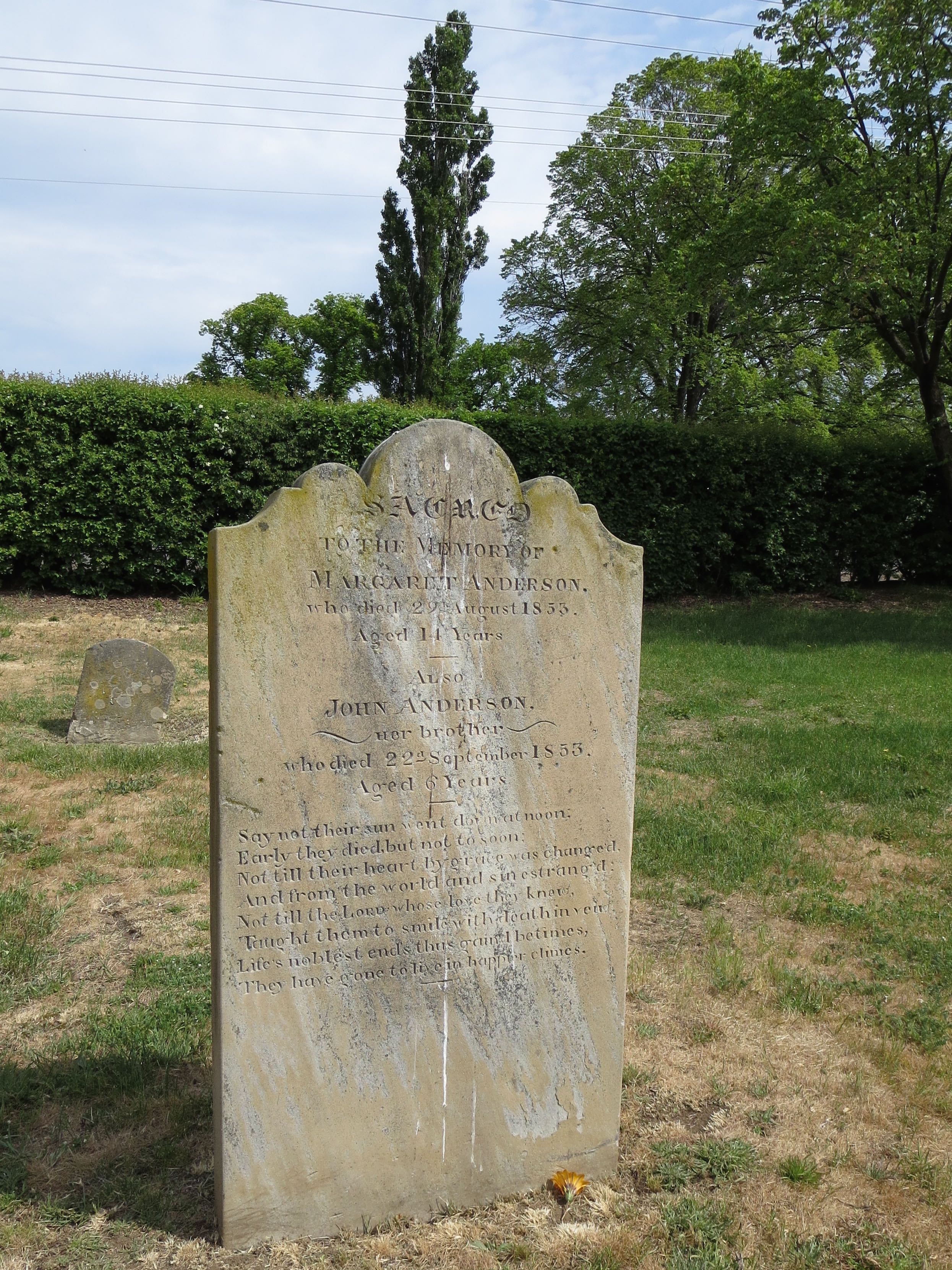
I wonder who wrote that? Did she, knowing she was dying, write it? So sadly, but probably, typically, self-effacing if she did. And then there’s the grave for siblings Margaret and John Anderson, 14 and 6 years old respectively, who died within a month of each other in 1853. On their grave is:

Margaret and John Anderson, Bothwell Cemetery

Margaret and John Anderson, Bothwell Cemetery

Say not their sun went down at noon.
Early they died, but not too soon,
Not till their heart by grace had changed
And from the world and sun estranged.
Not till the Lord whose love they knew
Taught them to smile with death in view.
Life’s noblest ends thus gain’d betimes
They have gone to live in happier climes.

Poor little things. Presumably they died of an illness contracted one from the other, but did they really learn to “smile with death in view”? These and the other gravestones – and I know I’m not telling you anything here – provide such insight into nineteenth century life and thinking.

Then there’s the urban environment

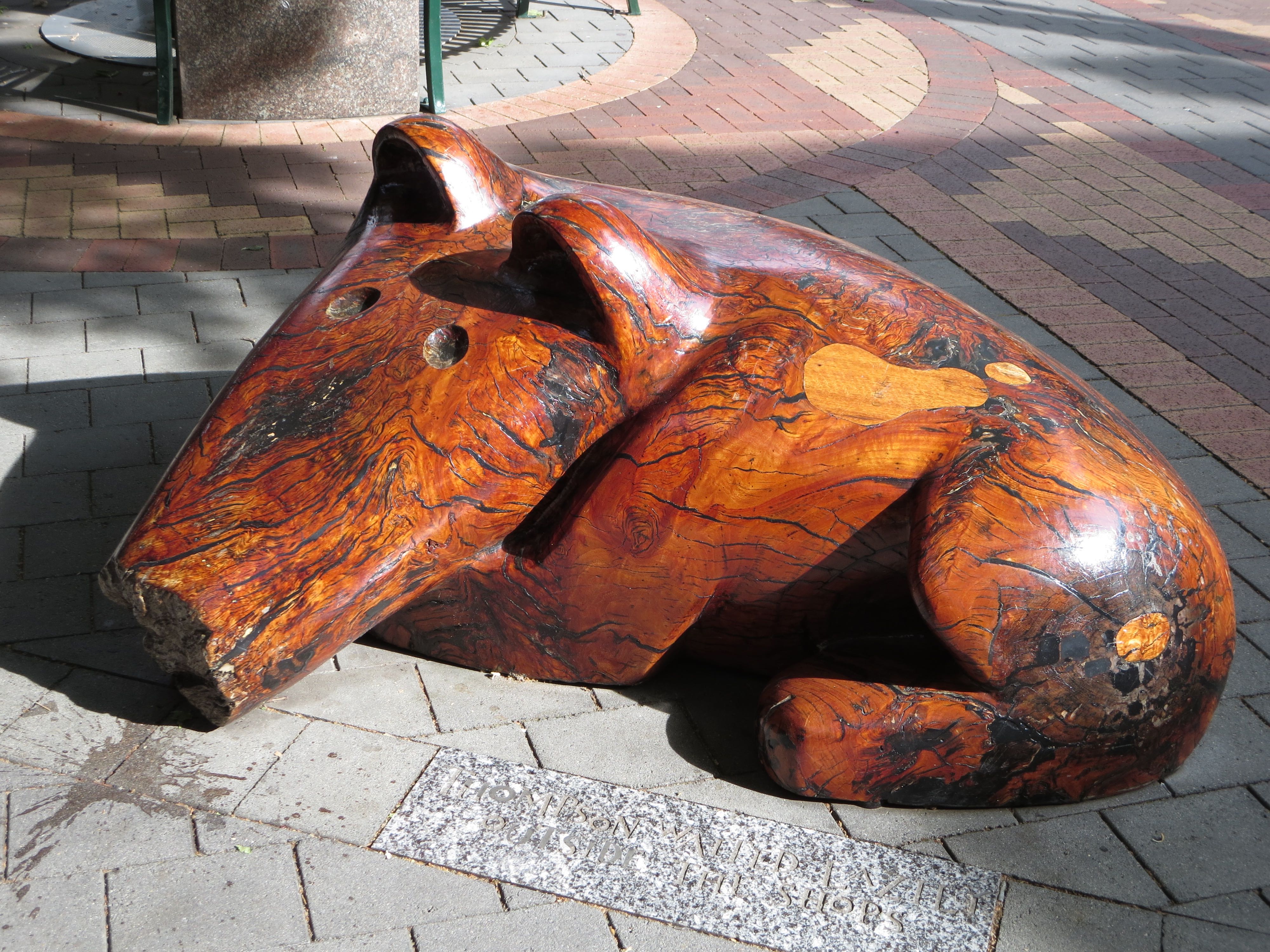
Wooden dog sculpture

Thompson waited lazily outside the shops

The redevelopment of Elizabeth Street Mall in Hobart’s CBD in the 1990s was carried out with a view to humanising the space, to, if I understand correctly, making it aesthetically appealing and artistically interesting, not to mention fun and a little bit provocative too. Much of the art was, I understand, commissioned from the versatile Tasmanian artist Patrick Hall. He did street signs, sculptures, and “granite stories”. The sculptures include a “fish out of water” drink fountain (metalwork), Maurice the pig (moulded hebel) and Thompson the dog (woodcarving).

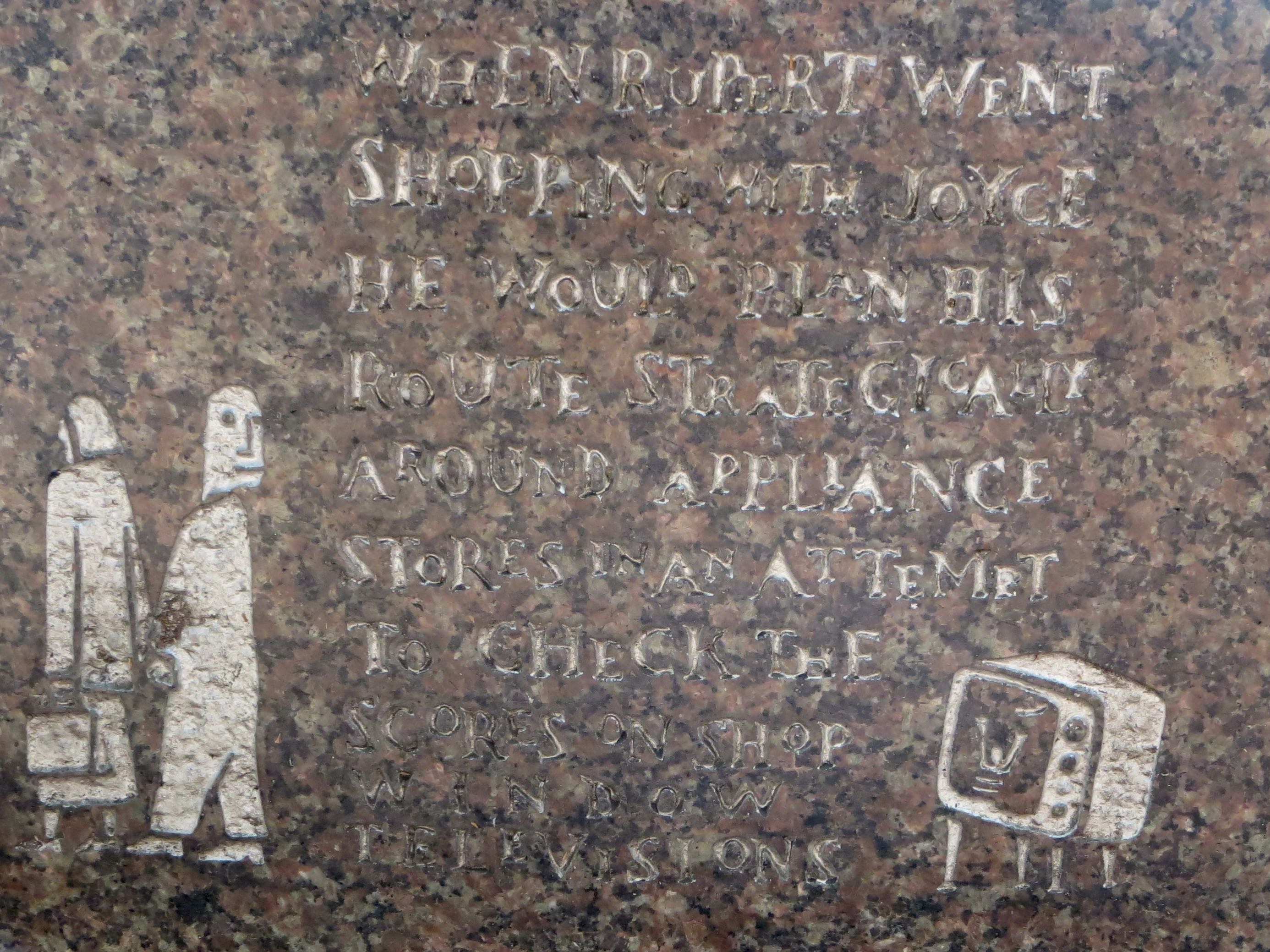
The sculptures would be hard to miss by anyone walking through the mall, but not so obvious are the tiny stories and images etched into the granite pedestals supporting the mall’s public seating. I suspect these are mostly discovered by word of mouth, but they are addictive once you discover them – that is, you want to find and read them all. Here are a few:

Rupert going shopping etching

Rupert going shopping

Beneath their feet lay buried the intersecting tracks and paths of the lives that went before.

AND

To the casual observer Hubert seemed lost in thought, when in fact he was trying not to tread on the cracks.

AND

Zoe tied her bicycle next to a pole and said “stay” before she went shopping.

AND

When Rupert went shopping with Joyce he would plan his route strategically around appliance stores in an attempt to check the scores on shop window televisions.

AND

They would sit with their collars rolled up against the chill winds & imagine they could peer over the edge of the planet.

I love the mix of whimsy, commentary and philosophy here. They are universal, but also seem to be very much of Tasmania.

Just around the corner, more or less, from Elizabeth Street Mall is Mathers Place. Unfortunately I didn’t have my camera when my trusty guide took me through it, but displayed there, on large billboards, are some of the stories by young writers produced under the Young Writers in the City program, which is run by the Tasmanian Writers Centre and the City of Hobart. The idea was that the young writers (under 30 years old) would sit somewhere in the city, and “compose an essay between 1500 to 5000 words … in an observational or experimental style inspired by the [chosen] space”. Not surprisingly, I enjoyed Claire Jensen’s piece about a space where older people meet. Only the beginning of it is displayed on the billboard:

In Hobart’s CBD there is a place where retired women and men meet their friends. They play scrabble, take art and writing classes, computer and ukulele lessons, hold book clubs, discuss family history and grey nomad road trips. For the last few weeks I have been invited into this secret society. They tell me stories, let me eat lunch with them, and beat me at scrabble. In the quiet afternoons, I escape the chatter to sit typing by the windows.

Ben Armstrong, in his piece, “Unified Mall Theory”, tackled the challenge to be inspired head on. (I can’t recollect whether his is displayed in Mathers Place). I like his tongue-in-cheek-up-frontedness:

I have a set of assumptions about the form my benefactors hope this inspiration will take. They want me to contribute to the cultural landscape. They expect me to write about history and stories and the interweaving of history and stories. The phrase “nooks and crannies” has not been explicitly mentioned, but I feel it is implied. Place and context also seem like things I should probably mention. Probably something about David Walsh* as well.

And now, since it is half-an-hour or more into Tuesday on my clock, I shall publish this, without a proper conclusion but hoping you have enjoyed my two little idiosyncratic Tasmanian posts. Normal Monday Musings will resume next week!

* David Walsh is the owner/benefactor of Hobart’s famous, and very popular, private art museum, MONA.

Monday musings on Australian literature: A Tasmanian interlude

You may have noticed that it’s been fairly quiet here at the Gums over the last week or so. This is because I’ve been travelling for nearly two weeks now in Australia’s island state of Tasmania. I scheduled last week’s Monday Musings in advance and had planned to also schedule a Tasmanian “Let’s get physical” post before I left, but it didn’t happen. Once here, I’ve been so busy catching up with my brother and then road-tripping with Mr Gums that I’ve not had time to do the necessary research to do such a post justice, so today I’m just going to post three photos, each with an associated quote to at least give you a taste of this gorgeous place.

IMG_8328

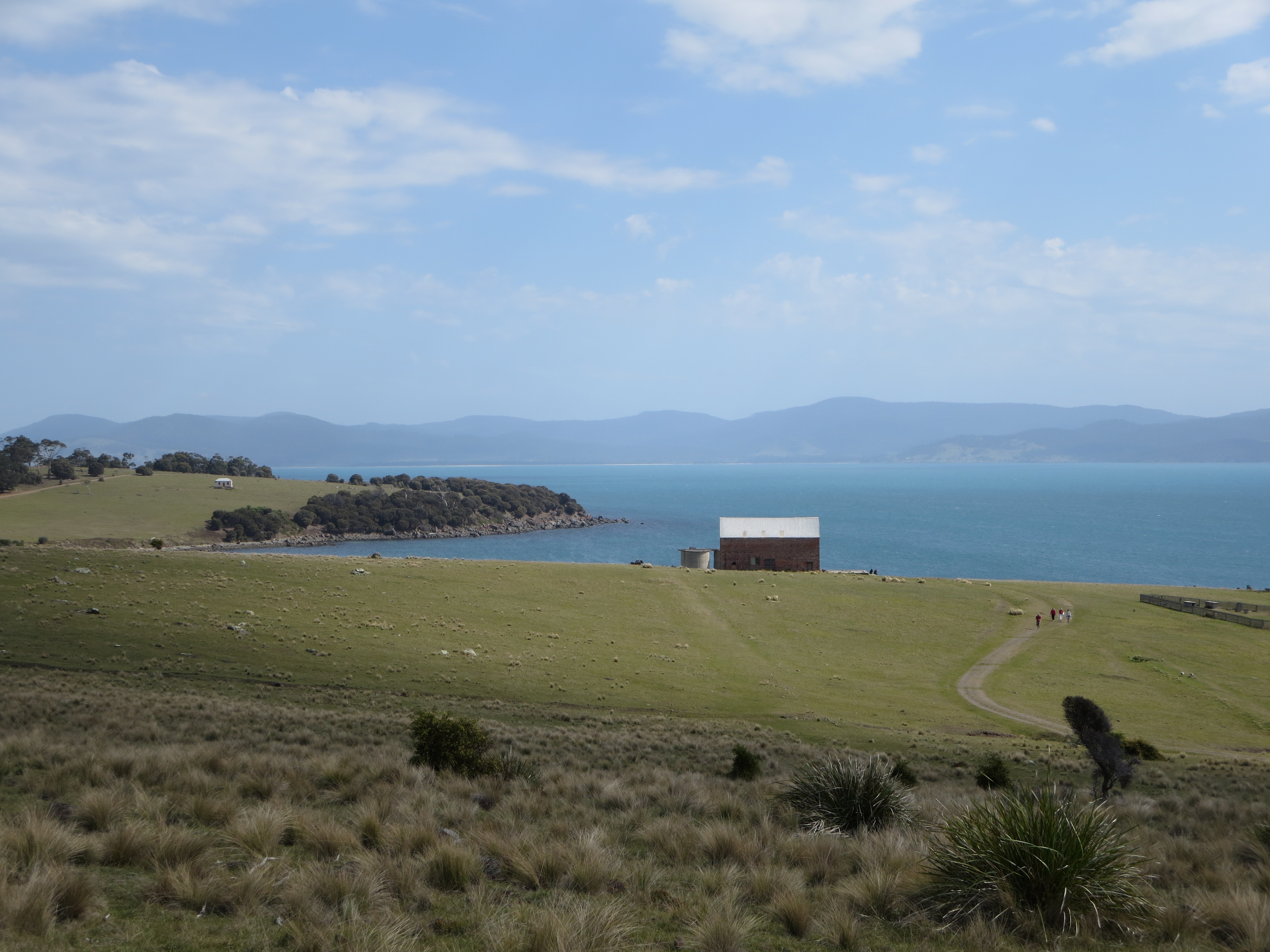
Looking across western Maria Island to the main island of Tasmania

Maria Island, off south-east Tasmania, was a convict settlement, with two waves, the first from 1825 to 1832, and the second from 1842 to 1850. An inmate of that time was William Smith O’Brien, a leader of the Young Irelander Rebellion of 1848. He is quoted as saying, as he arrived at Maria Island:

To find a gaol in one of the loveliest spots formed by the hand of Nature in one of her loneliest solitude creates a revulsion of feeling I cannot describe.

Sarah Island

Sarah Island

Macquarie Harbour and the Gordon River on the west coast was also a convict settlement, at least Sarah Island, which is located in the river, was. It was infamous for its brutality, and is in fact the setting for Marcus Clarke’s classic move, For the term of his natural life. However, the Gordon River has another claim to infamy. From the late 1970s to early 1980s it was the centre of a bitter conservation battle when the Tasmanian government proposed building a dam as part of its ongoing hydroelectricity program. But this is wilderness of high order. In fact, when the Tasmanian Wilderness was granted World Heritage status for which you need to satisfy at least one of ten cultural and/or natural criteria, it satisfied 7. Only one other site has apparently achieved this. Like many people our age we supported the protest, donating to the Australian Conservation Foundation and sporting the yellow “No Dams” sticker on our car. The conservationists won, in a landmark decision that had Australia’s High Court supporting the Federal Government’s case for stopping the dam, overruling the State Government. What a joyful day that was. One of the supporters of the movement was the historian Manning Clark. He said in 1980:

Keep this treasure and hand it on to posterity so that those who come after will learn about beauty, about awe, about wonder, because it is in the southwest of Tasmania that you will have a chance to solve the mystery at the heart of things.

Winegalss Bay to the left, and Hazards Beach just visible to the right

Wineglass Bay to the left, and Hazards Beach just visible to the right

Finally, though I only say finally because I have to stop somewhere, there’s Freycinet National Park, which takes us back to the east again, a little north of Maria Island. This is a stunningly beautiful place of clear bays, pristine beaches and pretty pink granite mountains. Australian poet James McAuley loved this area. Here are some lines from his poem “Coles Bay Images”:

Turquoise – coloured waters in small bays
Shawling towards the beach say shalom, peace.

And that is exactly the feeling you get walking in this part of the world – a sense of peace.


Prison post: Letters of support for Peter Greste

GresteNewSouthIf you’re Australian, you’ll know who Peter Greste is. If you’re not, you may know. He was one of three Al Jazeera English journalists* who were arrested in Cairo in late 2013 for “spreading false news, belonging to a terrorist organisation and operating without a permit”. It was a ridiculous charge and we all thought they’d be released quickly, but instead, in June 2014, they were convicted of “spreading false news and supporting the Muslim Brotherhood”, and Greste was sentenced to 7 years in prison. At that point, Peter Greste’s family set up an email account encouraging people to send messages of support to Peter that they would then print out and deliver to him in prison.

After 400 days in prison, in February 2015, Greste was released, that is, deported. His conviction was not overturned. In September 2015, his two colleagues, who had been kept in prison, were pardoned and released. Australia’s Foreign Minister, Julie Bishop, understands that Greste will be pardoned too, but I don’t think this has formally happened yet.

However, this book is not specifically about the legal story. Rather, it comprises a selection of the emails sent to Peter between his conviction on 24 June 2014 and the time of his deportation in early February this year. I have a copy of the book because my wonderful octogenarian mother was one of the correspondents. Some of her messages are included in the book.

To be honest, although I rather enjoy reading letters – you’ve seen posts about them here before – I wasn’t sure I’d enjoy a 200-plus-page book of letters (emails) to one person about one topic. But, I was bowled over, not simply because of the quantity of emails that were written, but because of their warmth, generosity and eloquence. Some are from Peter’s friends, acquaintances and colleagues, past and present, and a few are from well-known people like Julie Bishop and Wendy Harmer. But many are from complete strangers like my mother and, at the other end of the age spectrum, 9-year-old Grace. Grace writes:

Do you like to read? I love reading because when you are stressed or are worried or angry, reading takes you to a completely different world, where all your worries and fears are drowned away from your mind. (Grace Worthing, 11 July 2014)

Some of the strangers are journalists and journalism students. Many of these want to emulate him, while a few admit to lacking the necessary bravery to do so. All of the writers, though, strangers or not, are outraged by the idea and fact of Greste and his colleagues being imprisoned for doing their job, and many express appreciation for the work journalists like him do in telling the truth:

However small, I hope it is some consolation that your cause has given a voice to those of you in the business of giving others a voice. Your situation has highlighted the risks you take, the dangers you face, knowingly, in your dedication to shedding light on injustice and human suffering, and to exposing the truth, from all angles. (Lulu Nana, 25 July 2014)

Some writers tell of tweeting about the injustice of his imprisonment. They describe writing letters to government, diplomats, Amnesty International, or the editor of their local newspaper. They talk of taking part in fund-raisers and benefit shows. They will not, they say, let it rest until he is free.

Not all letters, however, are specifically political. Some are more personal. They want to cheer Peter up, offer him hope or sympathy, or just take his mind off where he is for a moment or two. They do this by telling him stories from their own lives, and or by sharing little jokes, proverbs or inspirational quotes. They quote from Shakespeare, the Bible, or poets like Robert Frost, but you probably won’t be surprised to hear that by far the most commonly quoted is Nelson Mandela. What is perhaps a little more surprising is that these Mandela quotes are all different!

Another common feature of the letters is praise for Greste’s family – his mother and father, his brothers, and his sisters-in-law. They are described as “diamond grade”, as inspirational in their strength, cohesion and dignity. One correspondent even went so far as to write, after Greste’s release:

I hope we don’t lose the Greste family from public life entirely. If any of our leaders, in various fields, have been paying attention they could’ve picked up some excellent lessons. (Amy Denmeade, 8 February 2015)

The letters are presented chronologically, but the chronology is broken into sections: section one, for example, comprising spontaneous responses to the announcement of his conviction; section two, the establishment of the email address and “call to arms”; and section five being letters written in December for his birthday and Christmas. (Several correspondents, including my mum, in fact, sat down and wrote an email on Christmas Eve or Christmas Day.) Each of these sections has a brief introduction describing what is happening at that point in the chronology. There are also a timeline of events at the beginning of the book, a foreword by Greste himself, and an acknowledgement statement by editor-publisher Charlotte Harper.

What more can I say? The book could so easily have been schmaltzy, but it’s not, mainly because the writers, those selected for inclusion anyhow, are too unselfconsciously themselves. After all, when they wrote, they had no expectation that their letters would ever be published, so they wrote from their hearts. This is a book of its time, and yet is also timeless. That is, it relates to a very specific event involving very specific people, and yet it is really about big principles, like justice and truth, and about human values, like empathy and compassion. It is, in other words, a darned good read.

PS: Just in case you are interested, profits from the first year’s sales are going to the Foreign Prisoner Support Service. Digital copies can be ordered for $9.99 from Editia; and print copies for $24.99 from NewSouth Books.

Prison post: Letters of support for Peter Greste
Braddon: Editia, 2015
229pp.
ISBN: 9781942189022

* The other two were journalist Mohamed Fahmy, and their producer Baher Mohamed.

Monday musings on Australian literature: Writer-in-residence programs

I’ve written before about Writers’ Retreats, which are sometimes framed as writer-in-residence programs. However, for this post, I want to focus not on those programs that are designed for writers to withdraw (retreat) to focus on a personal project, but on those for which engagement with the community in which they reside is a significant part of their role. I don’t know about you, but I come across these quite often out of the blue and love that they exist. Some of them are ongoing programs, while others are one-offs. Some are specifically targeted to writers while others, usually described as artist-in-residence, are open to any arts practitioner. The most common ones I’ve seen are those offered at schools and universities, but they can be offered by anyone. They can vary greatly in purpose, targeting all sorts of people from school students to other writers, from potential clients to the general public. And they range from non-profit programs to rather commercial ones. All of this will become obvious from the small selection below:

Accor Hotels MGallery Literary Collection is a program in collaboration with Melbourne’s The Wheeler Centre. It involved providing eight award-winning Australian writers with a short residence in one of Accor’s boutique MGallery hotels and commissioning those authors to write a short story which will be published in a book which will be “presented exclusively to guests at MGallery Hotels”. Associated with these are author events at the hotels, such as that with Favel Parrett at Mount Lofty House in Adelaide in April 2015.

Bayside City Council Artist-in-Residence is open to visual artists, multimedia practitioners, writers and composers. They describe it as a public program in which the resident artist is “required to be involved in community engagement activities. This may take the form of artist’s talks, community workshops, master classes for local artists, participation in Bayside festivals or exhibitions or other activities agreed upon”.

Birrong High School Writer-in-residence was part of the ASA’s (Australian Society of Authors) Authors in Priority Schools program which aims to build “the narrative and literacy skills of school students, from K-12.” It involves authors running creative writing courses at a school, but the exact style of program varies a little in each school in accordance with the school’s needs. The Birrong program involved author Laurene Croasdale who has worked both in publishing and as a writer.

Cocoon Floatation floating writer-in-residence program is a program that runs in partnership with the Wollongong Writers’ Festival. The program involves the Festival choosing an author from the festival line-up  “to receive two free floats in exchange for producing a piece of work to be donated back to WWF and Cocoon Floatation”. The 2015 writer is Candy Royalle, who is “a performance artist, poet, storyteller and educator”.

Editing in Paradise writer-in-residence is part of the organisation’s business of running workshops and retreats for writers. The writer-in-residence is their program for including a writer on their retreats to give “an added dimension to the teaching and sharing of industry knowledge”. So, for example, at their Bali retreat, this October, they will have Ashley Hay whose most recent novel was The Railwayman’s Wife. Previous writers have included Charlotte Wood and Susan Wyndham. I’m assuming the writer is paid to attend and provide expertise at the retreat.

Lotus Asian-Australian Playwriting Project is a project aimed at bringing more Asian-Australian stories to the Australian stage, by “installing” an Asian-Australian resident playwright in three theatre companies by 2017. Supported, at least initially, by the Australia Council and Arts Victoria, this program also includes other initiatives including salon-style play-readings

RMIT Writers-in-residence program is a fairly typical university program. The program aims to make “a significant contribution to RMIT, its writing program and to Melbourne’s broader literary culture”. RMIT writers-in-residence have included Robert Dessaix, Chloe Hooper and Nam Le. It was supported from 2009 to 2012 by the Copyright Agency Limited (CAL)’s Cultural Fund. The web-page implies that it is an ongoing-program, but it is not clear whether this really is the case or not.

I found references to programs in several universities, such as the University of Adelaide and UTS (the University if Technology Sydney), but no clear evidence that they were ongoing programs. Indeed it seems that these programs often have short lives, which is a shame. I wonder why they seem often to be flashes-in-the-pan?

Despite this uncertain history, whenever I come across these programs I feel a little excited – even if I’m not going to have any involvement – because I imagine the stimulation, excitement and creativity that the participants will experience. A little starry-eyed, I suppose, but I hope this is the common outcome!

Have you experienced a writer-in-residence program, either as a writer or a “consumer”? If so, what value did you get out of it?

Delicious descriptions: Danielle Wood on mothering

Danielle Wood, Mothers Grimm, book cover

Courtesy: Allen & Unwin

In my post on Danielle Wood’s Mothers Grimm I focused on how mothers feel about being mothers, but the book is also about the need to BE mothered. So, I thought I’d share a couple of short excerpts from the book about this aspect. It will also give you a better sense of Wood’s wry but resigned tone, which is part of what made the book for me.

June Wishart was – to Liv – a kind of first position, the default against which mothers of all other sorts were defined. If Liv sometimes looked hungrily at the mothers with long, messy curls and jeans – the ones who kissed and hugged their grown daughters and made easy, stupid jokes with them, borrowed their earrings and shoes – it was only with an understanding of how far they deviated from June Wishart with her ash blonde hair that rolled under, quite naturally, at her jaw, who always wore skirts and never went out with our pantyhose, whose public manner towards her daughters was just one or two notches more intimate than the cheerful, well-brought-up formality with which she treated everyone else. (“Sleep”)

Liv, you might remember from my review, is the teen mother.

The other excerpt I’ve chosen comes from the last story. Stella’s mother died soon after she moved west. She, and her nurse friend Reggie with whom she’d moved, both marry within a year. Reggie makes the better marriage on pretty much all measures, but for Stella there’s really only one that counts:

Of all the things Reggie had and I didn’t, it was her mother-in-law I might almost have been jealous about. Mrs Kingsmith … managed her own angora stud and I had it from Reggie that she also did clever things with buying and selling shares. She treated all us young ones as if we were somehow her business, and I thought her warm and wise. It seemed all wrong to me that the daughter-in-law she’d been given to love was Reggie, who had a mother of her own still, while I had only Mrs Palfrey, who wanted nothing I had to give. When Colin and I told his mother that we were expecting Mark, she nodded resignedly and went back to worrying in the gloom behind her curtains. (“Nag”)

I might almost …! Love it. Anyhow, this made me feel very sad. It reminded me that you don’t stop mothering just because your children have grown up. How lucky I am that my mother knows and my late mother-in-law knew that.

Danielle Wood, Mothers Grimm (Review)

Danielle Wood, Mothers Grimm, book cover

Courtesy: Allen & Unwin

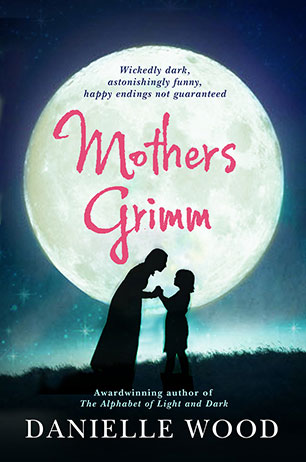
If you thought from the title of Danielle Wood’s latest novel, Mothers Grimm, that it comprises a retelling of fairytales you’d be right – and wrong. Right, because the stories contained within do springboard from specific fairytales, but wrong if you expect the new stories to be retellings. The wordplay on the title – Mothers Grimm/Brothers Grimm/Grim Mothers – sets the tone. This is a clever, wicked, funny but also heartrending look at modern motherhood.

Now, if you’re not an expert in fairytales, you might be relieved to know that it’s not necessary to know the source story to understand Wood’s “version”. While knowing the source story may add a lovely (and clever) fillip to our understanding, Wood’s stories stand well on their own. The collection starts with a prologue, which also draws from a fairytale, Hans My Hedghog. Here, Wood puts on a pedestal and then takes apart the idea of “the good mother” showing it for the myth it is, that is, an idea primarily concocted by advertisers to show us the way to perfect family life. Wood writes this opening section in second person, gathering us effectively into her wisdom. She shows us the “truth” behind the myth but assumes that, deep down at least, we already know it: “You could tell them [the literary scholars and psychoanalysts, she means] exactly why it is, in fairy tales, the Good Mother is always dead”. I knew by the end of the Prologue that I was going to like this book.

The thing about the myth, of course, is that no matter how much we might see its falsity, we still get pulled in. Why? Because we want to be the best mothers we can, we want to do the best for our children, we want them to be better and happier than we were/are. It’s a big ask, as life has a way of showing – and if life hasn’t, Wood certainly does. So, how does she do it? After the prologue, there are four stories: Lettuce (“Rapunzel“), Cottage (“Hansel and Gretel“), Sleep (“Sleeping Beauty“), and Nag (“The Goose Girl“). In each, Wood takes the original concept and spins a tale that can be darkly funny at times, but that is always devastatingly honest. This is a book which must surely bring a rueful laugh to most parents, but is perhaps best kept away from potential or new ones – though, if I remember my own youth, I probably wouldn’t have believed it anyhow. Sometimes empathy really does spring best out of one’s own experience!

In “Lettuce”, a beautiful pregnant woman is envied by the other women in a pregnancy yoga class. She seems perfect and becomes the focus of their obsession and envy. The story is told, third person, through the eyes of one of the mothers, Meg. Now Meg grew up with an earnest, sheltering mother who somehow missed the point about joy and pleasure. So when young Meg is introduced by a school friend to the delights of eating only the cream out of cream biscuits (Orange Slices, to be exact), she is shocked. She

couldn’t have said what exactly it was that was so profoundly bad about eating only the cream out of the biscuit, but she knew it was worse than just the waste.

Through gorgeous descriptions of familiar actions – such as how you twist a biscuit to separate its two parts and thus expose the cream – and by conveying often inchoate feelings or longings, Wood manages to expose the quiet deceptions and jealousies, but also the fear, confusion and love, on which motherhood is often built.

If “Lettuce” focuses on imagining an impossibly ideal “good mother”, “Cottage”, explores the guilt mothers feel about leaving their children in childcare. Nina makes a deal with her husband: he will support her staying home until their son goes to school, and she will not ask for another child. Best-laid plans – but of course we all know what happens to them. In this story Wood explores that still-familiar territory – the vexed question of child-care and the distressing way women judge each other. Indeed, mothers judging each other is one of the darker, sadder themes of the book. In this story, Nina’s dreams and ideals of motherhood are brought down, partly by her own unrealistic expectations (and oh, how I recognised those), but partly too by the economic pressures of modern life.

In “Sleep”, Wood turns to a teenage Mum. While the previous two stories are told third person from the perspective of one mother, in “Sleep” the perspective, though still third person, is shared, mainly between two sisters, Liv and Lauren. This is a well-to-do family, shamed by a teen pregnancy. There are wicked twists and wordplay here on the main motifs of “Sleeping Beauty” – the prick, and sleep – but in the end the story is about new mothers who do it alone. It’s about how easy it is to lose self and perspective when you have no support and don’t get enough sleep. It’s the most shocking of the stories – particularly because Liv doesn’t get the support she needs from the one she most needs it from, her mother.

And then there’s “Nag”, about Stella, a young woman who, trained as a nurse, goes about as far away as she can from her loving, but long-suffering mother. The story starts in 1958, and unlike the previous three, is told first person by Stella, who is telling her story to her daughter. She describes how she married:

He was twenty-two years old and starting to look about for a wife and I came to him like a lost banknote on a windy street: a windfall that he quite reasonably thought he may as well put in his wallet as throw back on the ground.

Stella finds herself, lonely, on a dusty farm with a remote, unsupportive mother-in law, and a nagging (I won’t reveal the gorgeous wordplay on this one) voice that tells her “If your mother could see you now, it would break her heart in two”. The focus here is the often fraught mother-daughter relationship.

What Wood shows is that grandmothers, mothers, and daughters are all complicit in maintaining and perpetuating the myth of “the good mother”. There is the occasional subversive mother, or the one who seems to steer an easy course through the minefield, or the one who manages to rise above the competition to reach out to a sister-mother, but for most the gap between ideal and reality defeats them. The “F” word – Feminism I mean – is not explicitly discussed but it lurks underneath. Indeed, I suspect many of the characters would eschew the word, but their lives and expectations are shaped by it nonetheless – and not, it seems for the better.

The accommodations and compromises, together with the emotional and physical losses, are grinding. I’m making it all sound rather grim (excuse the pun), and there is that, but it’s not what I came away with. The humour, warmth and lack of judgement with which Wood delivers her truths suggest that her aim is not to be negative but to shine a light on the issues and encourage discussion. If there’s a lesson to learn, it’s that there are many ways of being good mothers … and they start with being easy on yourself.

awwchallenge2015Danielle Wood
Mothers Grimm
Sydney: Allen & Unwin, 2014
214pp.
ISBN: 9781741756746

Monday musings on Australian literature: Literary fellowships

In past Monday Musings I’ve written about Writers’ retreats and Writers’ development programs. Related to these are fellowships. They involve providing a writer with money and/or resources to enable them to develop a new work. Fellowships usually involve a significant amount of money, and tend to be granted for specific projects.

Australia Council Fellowships are offered across a wide range of arts practice. They are worth $80,000 and support “outstanding, established artists’ creative activity and professional development for a period of up to two years”. Applicants must be Australian practising artists, such as writers, dancers, musicians, and visual artists.

CAUL-ASA Fellowship is offered by the Council of Australian University Librarians and the Australian Society of Authors. As far as I can work out it was first offered in 2014. Its aim is to support creative projects that use one or more of the university libraries’ special collections. Although it’s jointly offered by the ASA, it is in fact open to Australian artists, authors, scholars and researchers. It offers $15,000 which can be used for “travel, accommodation or other project-related expenses”.  From what I can tell, the outcome doesn’t have to be a book.

Copyright Agency Author Fellowship was established in 2014 to mark the Agency’s 40th anniversary “honouring the courage and imagination of the author, publisher and copyright lawyer founders that came together in 1974 to stand up for creators”. The inaugural Author Fellowship was targeted at mid- to late-career authors, because the Agency believed there were many prizes and awards available for new and emerging talent, but fewer opportunities for financial support for authors further along in their careers. The inaugural award, worth $40,000 and announced in September, was given to Mark Henshaw to enable him to work on his third novel, Missing. (I recently reviewed Henshaw’s second novel, The snow kimono, which I understand had its origins in a story Henshaw wrote in 1990 while in Paris on an Arts Council Fellowship.)

Creative Arts Fellowship for Australian Writing is offered by the National Library of Australia, with the support of the Eva Kollsman and Ray Mathew Trust (which I’ve referred to before). It is open to established and emerging writers, working in any literary genre. It enables the writer to undertake an intensive period of creative development at the Library, using the the Library’s collections “as inspiration or to incorporate or transform sources into new creative work”. It includes $10,000 which can be used for travel, accommodation, project costs, as needed. I searched to find the names of past fellows but it looks like this is a new fellowship, one of several replacing the old Harold White and Japan fellowship schemes.

The Kit Denton Fellowship was established in 2007 by the Australian Writers Foundation and Zapruder’s Other Films (the company owned by Kit’s son Andrew Denton). This award offers $30,000 and aims “to promote courage, to champion bold and challenging ideas, and to reward talent and excellence in performance writing”. The winner must be “a writer who has shown courage in their work and demonstrated a willingness to challenge the status quo with their writing”. That sounds like Andrew Denton!  In 2011 it was relaunched as the Kit Denton Disfellowship “because winning it may mean that your nan disowns you, your neighbours shun you and the shock jocks call for you to be locked up”. There is a list of winners on Wikipedia, but only up to 2012. I hope it is still being offered.

Have you heard of any other literary fellowships that sound interesting? Or are you a writer who has benefited from one? What did it mean for you?

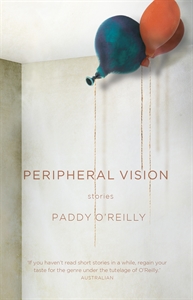
Paddy O’Reilly, Peripheral vision: Stories (Review)

Paddy O'Reilly, Peripheral vision Book cover

The title of Paddy O’Reilly’s latest collection of short stories, Peripheral vision, comes from the story “Restraints”, in which the narrator, standing in a robotics lab where things have gone awry, says:

… and I caught again a flicker in my peripheral vision.

It’s a good title for the book because the stories are about people or events that happen to the side of “ordinary” life, however we might frame that. (I don’t talk enough about titles in my reviews, but they are important.) O’Reilly’s characters vary greatly – in gender and age. Short story writers, I’ve noticed, pay little attention to the criticism novelists often face regarding the voice they write in, like, can a man write a woman, can an anglo-Australian write an indigenous or immigrant person, and so on. Short story writers frequently range far and wide in the voices they write in. As I was reading this collection, I found myself thinking about short story writers, and what writing short stories might mean to them. While some people see short stories as a training ground for the “real” thing, novels, the writers themselves, I suspect, see them as a form in which they can let their imaginations fly. They can try being anyone or anything, anywhere, and are less likely to be taken to task for it. Certainly, in Peripheral vision, O’Reilly’s characters range from a teenage schoolgirl to a homeless man, from a twenty-something brother to a ten-year-old step-daughter, from a Filipino man to a young Australian teacher in Japan.

There are 18 stories in this collection, of which 12 have been published before. I had in fact read two of them: “The salesman”, a powerful and confronting story that I reviewed here as an individual story, and “Serenity prayer”, which was published under the title “Reality TV” in Angela Meyer’s The great unknown (my review). Another story also underwent a title change, from “Friday nights” to “Territory”. Titles! Clearly important. Well, I presume these title changes are O’Reilly’s and that she thought the same story presented in a different collection would work better under a different title. “Reality TV”, for example, is a straightforward descriptive title, with a little hint of irony, for an anthology about inexplicable things. “Serenity prayer” is a more subtle title encouraging multiple readings, particularly if you consider the ways in which this prayer is, and has been, used. This story, about a publicly betrayed wife, gets you in, and then, at the end, makes you wonder.

Simplistically speaking, the stories can be divided into two types, plot-driven and character-driven. “Territory” is a fairly traditional plot-driven story about a group of six girls out on the town on a Friday night, but, there are clues that there’s something more going on. For one, there’s the way they dress:

That was the one thing you might question about us. Other girls who went out in a group looked more alike. Arty types with arty types; girls who knew how to pick up wearing the uniform of short hip-hugging skirt, skyscraper heels, mascara and lipstick … We were a mixed-up crowd …

Then there’s the reference to a seventh girl, Suze, and the suggestion that everything might be alright now she’s been accepted into medical studies. Gradually hint upon hint is dropped suggesting that these girls aren’t just out for a good time. A very effective story. “Serenity prayer”, mentioned above, is another with a strong plot line. “One good thing”, one of the longer but still nicely sustained stories, is about the friendship between two school girls, and a violent act that occurs during a holiday visit. Its resolution, as in most of the stories, is open, leaving us to consider the short and long-term ramifications of such acts. Each of these explores a core idea – but sharing that idea could spoil the plot, so I’ll leave it here.

I can though talk about the ideas underpinning the character-focused stories. “Caramels”, for example, is about a homeless man. The ideas underpinning it relate to pride and dignity. It has a story of course, describing his life, but in these character-focused stories, plot is not the driving force. “After the Goths” is about a young twenty-four-year-old man working through guilt about something that happened in his teens. It makes him behave meanly to his older brother but, in a nice touch, his brother doesn’t rise to the occasion. Not everything, O’Reilly knows, has to be high drama to be interesting.

Other stories are perhaps better described as slice-of-life. “Deja vu”, set in a small town in France known for its medicinal hot springs, is one. It’s about holiday relationships. There’s Anthony with unexplained concerns of his own, who meets an older couple and finds himself drawn into their company against his will, as can happen when you travel. And there’s the older couple, comprising a whining dissatisfied wife and a long-suffering husband. It’s, partly anyhow, about the accommodations you make. Martin “had never been able to speak rudely to anyone” and George, the husband, seems to do a good job of accommodating his wife. The language here is delicious. The whining wife’s “mouth held the shape of a drawstring purse”. A little later, “her lips grew tighter, as if someone had pulled the drawstring”.

There’s wry humour in some of the stories, like “Breaking up” and “The word”, and a couple of the stories, “Procession” and “Restraints”, tip, intriguingly, into the speculative genre. In all, though, O’Reilly presents humans facing challenging situations – some violent, some threatening or risky, and others confusing or unsettling. Whatever it is, she rarely fully resolves the tension, leaving it instead to the reader to think about the morality, the values, the accommodations at play. This can be disconcerting if you like closure. But I like it, not only because closure can be boring and, frankly, not realistic, but also because it means you can read the stories again and again, and come to a slightly different conclusion or, should I say, understanding, each time.

Peripheral vision is exciting to read. Each story is so different that I was driven on to the next one, wondering what I’d find there. What I invariably found was a new world with another challenge to my way of seeing. I wonder what her peripheral vision will pick up next.

awwchallenge2015

Paddy O’Reilly
Peripheral vision
St Lucia: UQP, 2015
200pp.
ISBN: 9780702253607

(Review copy supplied by UQP)