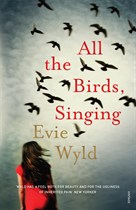
Evie Wyld, All the birds, singing (Review)

Evie Wyld, All the birds, singing

Courtesy: Random House Australia

Quite by coincidence, I read Evie Wyld’s second novel All the birds, singing straight after Eleanor Catton’s The luminaries. I was intrigued by some similarities – both have a mystery at their core, and both use a complex narrative structure – but enjoyed their differences. Wyld’s book is tightly focused on one main character while Catton’s sprawls (albeit in a very controlled way) across a large cast. Paradoxically, Wyld’s 230-page book spans a couple of decades while Catton’s 830-page one barely more than a year. And yet both convey, through their structures, an idea of circularity, of the close relationship between beginnings and endings. But, enough prologue. On with All the birds singing.

The book opens powerfully:

Another sheep, mangled and bled out, her innards not yet crusting and the vapours rising from her like a steamed pudding. Crows, their beaks shining, strutting and rasping, and when I waved my stick they flew to the trees and watched, flaring our their wings, singing, if you could call it that. I shoved my boot in Dog’s face to stop him from taking a string of her away with him as a souvenir, and he kept close by my side as I wheeled the carcass out of the field and down into the woolshed.

And so we are introduced to Jake and the things that dominate her life – Dog, sheep and birds. Soon, we learn there’s another thing – fear. But fear of what, or whom, we don’t know. From this opening, Wyld tells her story in alternating chapters: the odd ones, set in England, move forward, and the even ones, in Australia, move back to what started it all. It’s an effective structure that explores the ongoing impact on Jake of whatever it was that happened. We see what’s happening now, and we slowly see how she has got to this point.

Jake, at the start of the novel, is in her 30s. She’s a loner, capably running a sheep farm on a remote British island. Her nearest neighbour, Don, keeps a bit of a fatherly eye on her, and tries to encourage her to engage with the local community, to go to the pub for example, but Jake is not interested. As we move back in time we learn snippets about various significant people in her life – a lover while she was a shearer, a controlling man whom she’d initially seen as her rescuer, a female friend and co-worker. We also learn that she’s estranged from her Australian family, and we discover that she has scars on her back, but how they were caused are part of the mystery.

Wyld’s writing is marvellous. The imagery is strong but not heavy-handed because it blends into the story. The rhythm changes to suit the mood. The plot contains parallels that you gradually realise are pointing the way. There’s humour and irony. I love the fact that our Jake, on the run from whatever it is, smokes “Holiday” brand cigarettes.

There’s a bleakness to the novel, but it’s not unremitting. Jake, always the outsider, is tough and resourceful. She sleeps with a hammer under her pillow, but she has a soft side that is revealed mostly through her tenderness towards her animals. She talks to Dog, and losing a sheep always brings “a dull thudding ache”. The imagery is focused. Black, shadows, and fire in various permutations recur throughout the novel. They provide possible clues to what started it all; they contribute to the menace she feels now; and they help create an unsettling tone for the reader. We are never quite sure whether the shadow she sees out there, watching, following her, is real or a figment of her imagination. Jake is not an unreliable narrator, but we see through her eyes, and her eyes are influenced by her very real fears. She is “damaged goods”, though not in the sense meant by the paying customer (if you know what I mean!) offended by her scarred back.

And of course, there are the birds. They’re omnipresent. Sometimes they reflect her mood (“the birds sing and everything feels brand new”); sometimes they break tension; sometimes they suggest death. There are specific birds – butcher birds, night jars, galahs, merlins, currawongs and crows – and there are birds in general. The imagery references the real and metaphorical, from the crows hovering over the dead ewe in the opening paragraph to the birds near the end that attend the defining event:

[…] and the birds scream, they scream at me, Chip, chjjj, cheek, Jaay and jaay-jaay notes, Tool-ool, twiddle-dee, chi-chuwee, what-cheer … Wheet, wheet, wheet, wheet […]

awwchallenge2014It’s deafening. But it’s the silence and the dead birds afterwards that impresses the full horror on us:

The trees don’t want me there … There’s not a single bird to make a sound.

All the birds, singing is about how the past cannot “be left alone”. “We’ve all got pasts”, the shearers’ boss tells Jake early in the novel, but for some people the past must be dealt with before they can move on. The novel is also about redemption. It’s not the first novel about the subject, and neither will it be the last, but it is a finely told version that catches you in its grips and makes you feel you are reading it for the first time.

John at Musings of a Literary Dilettante loved the book too. Thanks to my brother and family for a wonderful Christmas gift!

Evie Wyld
All the birds, singing
North Sydney: Vintage Books, 2013
232pp
ISBN: 9781742757308

Monday musings on Australian literature: The Bread and Cheese Club

I bet that title has you wondering! It was certainly new to me when I came across a book in my late mother-in-law’s collection titled Fellows all: The chronicles of the Bread and Cheese Club. Published in 1943, and written by HW Malloch, this book is a history of  the early years of the club by its first voted-in member.

I was intrigued, of course, so did some research. The Bread and Cheese Club, as it turns out was formed in Melbourne in June 1938. Its motto was “Mateship, Art and Letters”, and it was particularly active in promoting Australian writers. The Club apparently published around “40 volumes of verse and tributes” as well as a journal titled Bohemia. The founder* and Knight Grand Cheese (oh dear!) was John Kinmont Moir (1893-1958), a Melbourne book-collector. He apparently died in 1958, and the club gradually declined, finally ending in 1988. I wonder how many Melburnians know about it now?

Delving further, I learnt a little more about Moir and the club. Moir, in particular, is a rather significant man in Australian letters. According to the State Library of Victoria, Moir, from the 1930s to 1950s, “set himself the daunting task of collecting one copy of every work of fiction, poetry and drama ever published by an Australian author.” This, they said, at a time when Australian literary authors were neither fashionably read nor collected. The result was “one of the finest private libraries of Australian literature ever assembled”, one that he donated to the State Library in the 1950s. It remains one of their most significant collections. You can read more about him – and it’s an interesting story – online in the State Library’s La Trobe Journal.

John Shaw Neilson

John Shaw Neilson (Presumed Public Domain, via Wikipedia)

But, back to the Club. It was male only. The twelve founding members included the poet John Shaw Neilson (1872-1942) and balladist Edward Harrington. According to Malloch, the unusual name was chosen because they wanted something “Bohemian” and “arresting”, and it had the desired effect: it made people curious and provided an opportunity for members to explain their aims. Malloch tells a lovely story, too, about one of its practices – quaint to our point of view but indicative of their era – which was making it “a penal offence” to address each other as “Mister”.  Doing so incurred a fine of one penny which helped, in the early days at least, to swell the club’s coffers!

John Arnold in the La Trobe Journal says that Moir was conservative – right-wing, in fact. But the club was not political – though I suspect from my reading of Malloch that it leaned more right than left. Its goals were:

To promote mateship and fellowship among persons of mutual interests, to foster a knowledge of Australian Literature, Art and Music and to cultivate an Australian sentiment … (Malloch, p. 17)

It did this not only through publishing but by undertaking a wide range of projects and activities such as art exhibitions, song of the year competitions, short story competitions, and lobbying government. Malloch describes some of the earliest activities, including a short story competition which was judged by Nettie Palmer. Searching the National Library of Australia’s digitised newspaper database in Trove provides a fascinating picture of the breadth of the Club’s** activities. One report states that the Bread and Cheese Club was behind the Commonwealth Government’s providing a grant for the writing of a biography about JF Archibald, the founder of The Bulletin.

The club also invited guest speakers, and often opened those meetings to the public. Malloch tells us that these speakers included artist Max Meldrum, indigenous Australian activist, pastor and state governor Doug Nicholls, and journalist-author Frank Clune.

I could go on … it’s a fascinating story of passion and commitment to Australian culture. They even printed 50,000 stickers with such slogans as “Combine Pleasure and Patriotism and Read Australian Books” and “Let Your Christmas Gift be an Australian Book”. Where are these people now!

Finally, before I go, I can’t resist sharing one of those odd little reading synchronicities. I have, as my regular readers know, just read Eleanor Catton’s The luminaries. It starts with 12 men gathered in a hotel room, but they became 13 when a hotel guest wanders in. The Bread and Cheese Club started when 12 men met in a studio with the aim of “fostering Australian Art and Literature”. Having had their meeting, they adjourned to a nearby “city hostelry” where they met Malloch, and promptly asked him to join them. And so, he writes, there were 13. I know, I’m being silly, but I enjoy such, dare I call them, coincidences!

* POSTSCRIPT: While some reports describe Moir as the founder, Malloch’s book doesn’t state this. On page 10, he writes that: “Twelve turned up at the studio of Fellow E. J. Turner, 132 Cubitt Street, Richmond, and set the ball rolling with the definite aim of fostering Australian Art and Literature”. And on page 13, he specifically names these twelve as “the founders”. Moir was elected president (aka Knight Grand Cheese) and Turner secretary (or Worthy Scribe).

** Searching Trove surprisingly retrieves another Bread and Cheese Club in Melbourne! Malloch tells us briefly about that too. It was a very small club of solicitors and in 1859 merged into the Law Institute of Victoria.

Delicious descriptions: More on Eleanor Catton’s The Luminaries

Rightly or wrongly, I try to keep my reviews to a reasonable length. When they start creeping up to 1200 words, I worry that readers will be discouraged from reading. There’s so much to read out there – so many books, so many blogs, so many articles. And so, when my review of The luminaries started to close in on 1100 words, I decided that it was time to stop. There’s always my Delicious Descriptions series I thought …

So here I am. I’m going to introduce my follow-up with another character description, this time of the young banker:

Charlie Frost was no great observer of human nature, and as a consequence, felt betrayed by others very frequently. The air of cryptic strategy with which he often spoke was not manufactured, though he was entirely sensible of its effects; it came, rather, out of a fundamental blindness to all experience exterior to his own. Frost did not know how to listen to himself as if he were somebody else; he did not know how to see the world from another man’s eyes; he did not know how to contemplate another man’s nature, except to compare it, either enviously or pitiably, to his own. He was a private hedonist, perennially wrapped up in the cocoon of his own senses, mindful, always, of the things he already possessed, and the things he had yet to gain; his subjectivity was comprehensive, and complete.

An important aspect of the novel I omitted in my review was its relationship to the 19th century Victorian novel. I just couldn’t do it justice in a few words … Since writing my review, I’ve been roaming around blogs and reviews, reading various responses. I’m finding a fascinating array of ideas: it’s rich, it’s hollow, it’s tedious, it’s exciting, it’s innovative … and so on. Many discuss this 19th century novel aspect – and one of the issues raised is Catton’s characterisation. Some suggest, as I have too in other reviews, that the novelist should show not tell. They argue that Catton’s character descriptions, such as the one above, do too much telling. They don’t like it. I don’t see it that way, though. For me, it’s a matter of what you show and what you tell. No amount of her “showing” me Charlie Frost would result in my being able to describe his character the way she has here. I’m more than happy to read such delicious descriptions as this, and then watch the character acting it out.

Catton also invokes other stylistic features of the Victorian novel – the coincidences, the red herrings, the mixed identities, the large cast of characters, the gritty realism, and the omniscient and sometimes intrusive narrator. Is Catton being anachronistic or has she offered a fresh take? I feel the latter. For one thing, there is no clear protagonist until, perhaps, towards the end when the chapters shorten and the focus narrows to the two who we realise are the luminaries. That’s a subversion of expectations. Maybe it’s this that creates the problem.  With no protagonist for us to hang our hat on, we feel adrift, uncertain. We thought the stranger, Walter Moody, would be our protagonist but he disappears midway after the trial. Furthermore, Victorian novels tend to have clear moral arguments. This novel has themes and moral concerns, but the conclusion does not, really, resolve them. That’s not particularly subversive, but it is more modern.

Another way Catton has nodded to the 19th century tradition is through using descriptive chapter summaries to open each chapter, as in “In which a stranger arrives in Hokitika …”. You need, with this book, to be a reader who reads such details. Some readers tend to ignore  features like chapter headings, seeing them as superfluous, but in The luminaries you ignore them at your peril. As the novel draws to a close, the “in which” chapter summaries become longer as the chapters themselves, following her waning-moon astrological structure, become shorter. By the last few chapters, these so-called summaries contain information that is not further elaborated in the chapter itself. If you don’t read them, you miss some plot. I liked this playing with the form, this reminder that the book is a holistic thing. It, too, is subversive.

However, I mustn’t be too holier than thou, because I didn’t put the effort into understanding the astrological charts, which represent another nod to the 19th century (though not so much to the 19th century novel.) As I understand it, astrology, an ancient school of thought, experienced a resurgence in the 19th century after being generally discarded during the 17th-18th centuries’ Age of Enlightenment (or Reason). Goethe, no less, was an enthusiast, as was, later in the century, Jung. For me, though, reading all the text in the novel is one thing; leaving the novel to go research astrological signs and their meanings is a whole different ball-game. If such knowledge added meaning to the novel, then I’m afraid I missed it.

All this brings us to one question. Why did Catton choose to write her novel in this style? Is it riff, pastiche, reworking, or homage? I’m not sure, but it sure seems to have got a lot of people talking. As for me … I’m still puzzling!

PS One of the most interesting analyses I’ve read of the novel is by Julian Novitz in the Sydney Review of Books.