There were many ideas I wanted to discuss or share in my review of Helen Trinca’s biography, Madeleine: A life of Madeleine St John, but it was starting to get too long … so I thought I’d save some points for another post or two.
Madeleine St John it seems had some very strong ideas about how to live one’s life – in both the more superficial areas, such as manners and customs, and in those areas to do with values, with morals and ethics. In terms of the former, Trinca writes at one point, when describing how Madeleine churned through friends:
It was ‘so very easy to do the wrong thing around Madeleine’. Her taste was perfect and her manners were sublime, but she felt no shame in making others feel ill-at-ease about their own behaviour.
I must say that my view of manners is that the first mark of good manners is making the other person feel comfortable, but, there you go, I’m not a member of the upper class so what would I know! Trinca provides many examples of the erratic way Madeleine treated her friends and family – and there are too many examples from a wide variety of sources for us not to believe them. She would cut them off and then want them back. And back they usually came because, as one, David Bambridge, said, she was “quite cutting and prickly … rather grand at times, but also kind, generous and funny”.
With all this in mind, I was fascinated by the excerpt Trinca provides from the obituary written by Christopher Potter, her publisher at Fourth Estate which published her last three novels. He wrote:
Language and a questioning of faith are the two poles of St John’s created world, as may also have been true of her domestic world … Beneath the sly and witty veneer of her writing, she explores questions that are basically theological: we must do the right thing, but how can we tell what the right thing is? This question is at the heart of all her novels … She lived by a strict moral code, the rules of which were only truly clear to herself.
All I can say is, curiouser and curiouser. She was one interesting woman … and I look forward to testing this proposition when I read the next book of hers in my pile.
Regular readers here know that while I generally do not do challenges I am taking part in the Australian Women Writers’ Challenge – because it’s what I like to read anyhow. The challenge, which began last year, was so successful that the initiator Elizabeth Lhuede, decided to continue it this year – and called on other bloggers to help. I am one of those bloggers and have responsibility for overseeing the Literary (fiction and non-fiction) area. We have now completed the first quarter of 2013 – how can that be, by the way (!) – and I thought it might be interesting to produce a bit of a report card.
Before I continue, I need to explain that the “Literary” category isn’t easy to define. The Challenge’s policy is that reviewers allocate the category/ies to the books they review, though the AWW Blog Team does do the occasional editing or tweaking where there are glaring errors. Given that proviso, on with my quarterly report – and I’ll start by providing some perspective. In 2012 some 1526 reviews were logged for the challenge. So far, in the first quarter of 2013, 614 reviews have been logged. Clearly, the challenge is gaining momentum, which is really exciting. These reviews cover the whole gamut of women’s writing – all genres, non-fiction, poetry, short stories, and even some self-published works.
Kate Grenville, Cambridge, January 2012 (Photo credit: Chris Boland, via Wikipedia)
In the “literary” area, which for the purposes of my survey here includes “Classics”, 112 reviews (or more) were logged in the first quarter, representing over 20% of the reviews posted. These reviews cover 71 authors, which means of course that several authors have been reviewed multiple times. The most frequently reviewed authors are:
Kate Forsyth whom I must admit I don’t know: Six reviews for her novel The wild girl
Karen Foxlee whose Anatomy of wings I read before I started blogging: Six reviews, including five for her current novel The midnight dress
Miles Franklin, of course: Five reviews ranging across her work, including one for her diaries
Madeleine St John, the subject of Helen Trinca’s biography which I’ve just reviewed: Three reviews for The women in black
ML Stedman whose debut novel The light between oceans is winning or being shortlisted for many awards: Four reviews for The light between oceans
Amy Witting, a late bloomer: Three reviews ranging across her work
Besides these, there are also reviews for well-known writers like Helen Garner, Anna Funder and Ruth Park and for writers not known to me. There are reviews for poetry, including verse novels by Lisa Jacobson and Dorothy Porter, and poetry collections by Amy Witting and Suzanne Edgar. There are of course gaps, but overall it’s encouraging to see such a diverse range of Aussie women writers brought together in one place. It can only be good for them, and for Australian literature in general, to be so clearly identified.
While the challenge is about reviewing women writers, this does not mean the reviewers have to be women. It’s encouraging to see several men actively contributing to the challenge. Some men are clearly not averse to reading books written by women!
If you are interested in the challenge and would like to take part – it’s never too late – or would like to check out some of the reviews, click here for the challenge site and have a look around. I’d be surprised if you didn’t find something to interest you. And, if you see any major discrepancies in categorisation, please let us know.
Are you taking part in the Challenge? And if so, is it changing what you read?
I wanted to read Helen Trinca’s biography Madeleine for several reasons. First, of course, being a reader, I’m interested in biographies and autobiographies of writers. Secondly, Madeleine St John belongs to that group of Australians, half a generation or so older than I am, that has made quite a mark on the literary and arts world. Her friends and acquaintances included Sydney University peers Clive James, Bruce Beresford, Robert Hughes, Richard Walsh, most of whom lived ex-pat lives like she did. Thirdly, her father Edward St John, was a controversial conservative politician (and then barrister) who fought injustice and whom Justice Michael Kirby described as “a contradictory, restless, reforming spirit”. And finally, I was hoping to find out more about what happened to Bruce Beresford’s plan to film her first novel, The women in black. Trinca covers all these bases and more in her biography.
Madeleine was – as Trinca ably, but fairly it seems, demonstrates – a complicated and difficult woman. She could be called a tragic figure if we define that as a person brought down by a flaw in their character or make-up. Trinca’s Madeleine, though, would probably not agree with that assessment. As far as she was concerned, her troubled life was solely caused by her father, “the ghastly Ted”. More on that anon. First I’d like to quote from a letter Madeleine wrote as she was trying to write her first novel:
I somehow feel (not for quite the first time) that life is beyond my capacities … meanwhile am trying to write some fiction, which is abominably difficult & and therefore terrific – but horrifying.
This quote says a lot about St John – about how hard she found life, and about the heightened way she lived it.
Madeleine was born in 1941 to Edward St John (Ted) and his lively, sophisticated wife Sylvette. Sylvette did not, for several reasons carefully explored by Trinca, adjust well to the life of wife and mother. She became an alcoholic and mentally unstable, to the point that Ted, apparently in order to protect his two daughters, placed them in boarding school in 1953. They didn’t understand, and were miserable. The next year their mother took her life, a fact which was not made clear to the girls at the time and which Madeleine never accepted. Ted remarried the next year a women ten years his junior, 27-year-old Val Winslow. Madeleine never accepted this either and at the age of 18 was told to leave home. While she saw and communicated with her family, on and off, for the rest of her life she never reconciled with them and believed to the end that they were the architects of all that was wrong with her life. We will never know the truth of course, and many records have been destroyed. However, while mistakes were made, partly due to individual personalities and family dynamics and partly as a consequence of the childrearing practices and patriarchal attitudes of the time, Ted and Val, Trinca argues, did their best to support Madeleine but she never gave them an inch, never saw things from any other perspective but her own. Tragic, really, however you define it …
… and making her, I think, a tricky subject to write about. Madeleine was, and there is documentation from a variety of sources to support this, a controlling and emotionally erratic friend who would, as one said, “just destroy everything, destroy a relationship”. She was, as we’d say now, high maintenance, and wanted, needed, to call the shots. And yet, people stuck with her, because she was witty, intelligent company, and also because people saw her need. Trinca handles this minefield with a clear, even-handed but sensitive eye, enabling us to feel Madeleine’s pain while being frustrated at her inability to lift herself out of it.
St John moved to London in the 1960s, leaving, more or less by mutual agreement, her first and only husband behind in the USA, and eventually took out English citizenship. She was horrified when, on being shortlisted for the Booker Prize in 1997 for her novel The essence of the thing, she was hailed as an Australian writer. She didn’t want to be aligned with the place, but she was the first Australian woman to be shortlisted for the Booker, so no wonder she was hailed that way.
Trinca’s biography is a traditional, chronologically told one. It’s tight, with little superfluous detail but enough examples to provide a good picture of Madeleine and her life. I particularly enjoyed the chapters covering the writing and publication of her novels. The book is very well documented, using clear but unobtrusive numbers linked to extensive notes at the end. In her acknowledgements, Trinca details what records she had available and where the gaps are. In addition to the oral history St John recorded (covering the first couple of decades of her life), Trinca had access to letters by and to Madeleine (though many were destroyed) and other documentation such as wills, and obituaries written by those who knew her. Trinca also interviewed many of the significant people in her life. I was intrigued to discover names familiar to me in other contexts, such as filmmaker Martha Ansara. The older we get, it seems, the more we discover our paths have crossed in interesting ways with others.
If you need any proof that Madeleine is worth reading, Clive James’ statement made in 2006, the year she died of emphysema, may convince you:
Sometimes, when I’m reading one of the marvelous little novels of Madeleine St John, part of whose genius was for avoiding publicity, I think the only lasting fame for any of the rest of us will reside in the fact that we once knew her. (quoted by Trinca from his memoir North Face of Soho)
A slight exaggeration perhaps, given who the “us” are, but James clearly believed that this complex late bloomer who produced four novels in six years deserved more recognition than she was getting. Thanks to Text Publishing, all four of her novels are back in print and we have this thorough and highly readable biography. All we need now is to see The women in black in film!
Helen Trinca Madeleine: A life of Madeleine St John Melbourne: Text Publishing, 2013 280pp ISBN: 9781921922848
Water, water, everywhere,
And all the boards did shrink
(from The rime of the ancient mariner by Samuel Taylor Coleridge)
I suppose it could be seen as clichéd to hear these words in a concert called “Water” but when the performers are the Griffyn Ensemble, cliché would be the furthest word from your mind.
“Water” was the last performance in the Water into Swine Festival, 28 March to 5 April, which was the result of an “exchange” between Canberra’s Griffyn Ensemble and Sweden’s Peärls Before Swïne Experience. The Swïne (“The Peärls are the music”, they say) specialise in performing new music and are consequently a good match for the Griffyns with their eclectic and open-minded approach to music.
This concert was a little different to previous Griffyn concerts we’ve attended. Firstly, of course, the Griffyn performers were supplemented by four Swedes; and secondly, the concert programming, perhaps because of the exchange, was a little looser. There was a theme – water – but the connections were, let us say, more fluid! And the program was, I think, a little less diverse, a little less eclectic. I love that they dare to program, as they did in Behind Bars, Johnny Cash next to Theodorakis next to Messaien next to new or lesser-known composers.
This is not to say that I didn’t enjoy “Water” – because I certainly did – or that it wasn’t eclectic – because it was. It just felt less so!
One of the things I enjoy about the Griffyn Ensemble that I may not have mentioned before is the balance they strike between formal professionalism and something more informal and intimate. Their performances mimic how I think chamber music was originally performed:
Because of its intimate nature, chamber music has been described as “the music of friends.” For more than 200 years, chamber music was played primarily by amateur musicians in their homes, and even today, when most chamber music performance has migrated from the home to the concert hall, many musicians, amateur and professional, still play chamber music for their own pleasure. Playing chamber music requires special skills, both musical and social, that differ from the skills required for playing solo or symphonic works. (from Wikipedia)
This, a sense of intimacy and joy, is what the Griffyn Ensemble manages to achieve – and it is special to be part of it. So, for example, “Water” incorporated a piece – Sloop John B – which was sung by five young boys led by soprano Susan Ellis and featuring young William (Will) Duff (from Behind Bars) who confidently held a second part against, at times, not only the main part sung by the other boys but other instrumental activity behind him. Also, we were addressed, naturally, conversationally, by Australian sailor Kanga Birtles who has circumnavigated the world solo. He spoke of the perils and joys of sailing, of trade winds and being on the water. His words supported the concert’s loosely defined motif which was to do with the old windjammers sailing from Europe to Australia. This motif was conveyed through Swedish pieces played by the Swïne, and pieces from Madagascar (courtesy Ravel), West Indies, Australia and the United States, played by various combinations of the two groups.
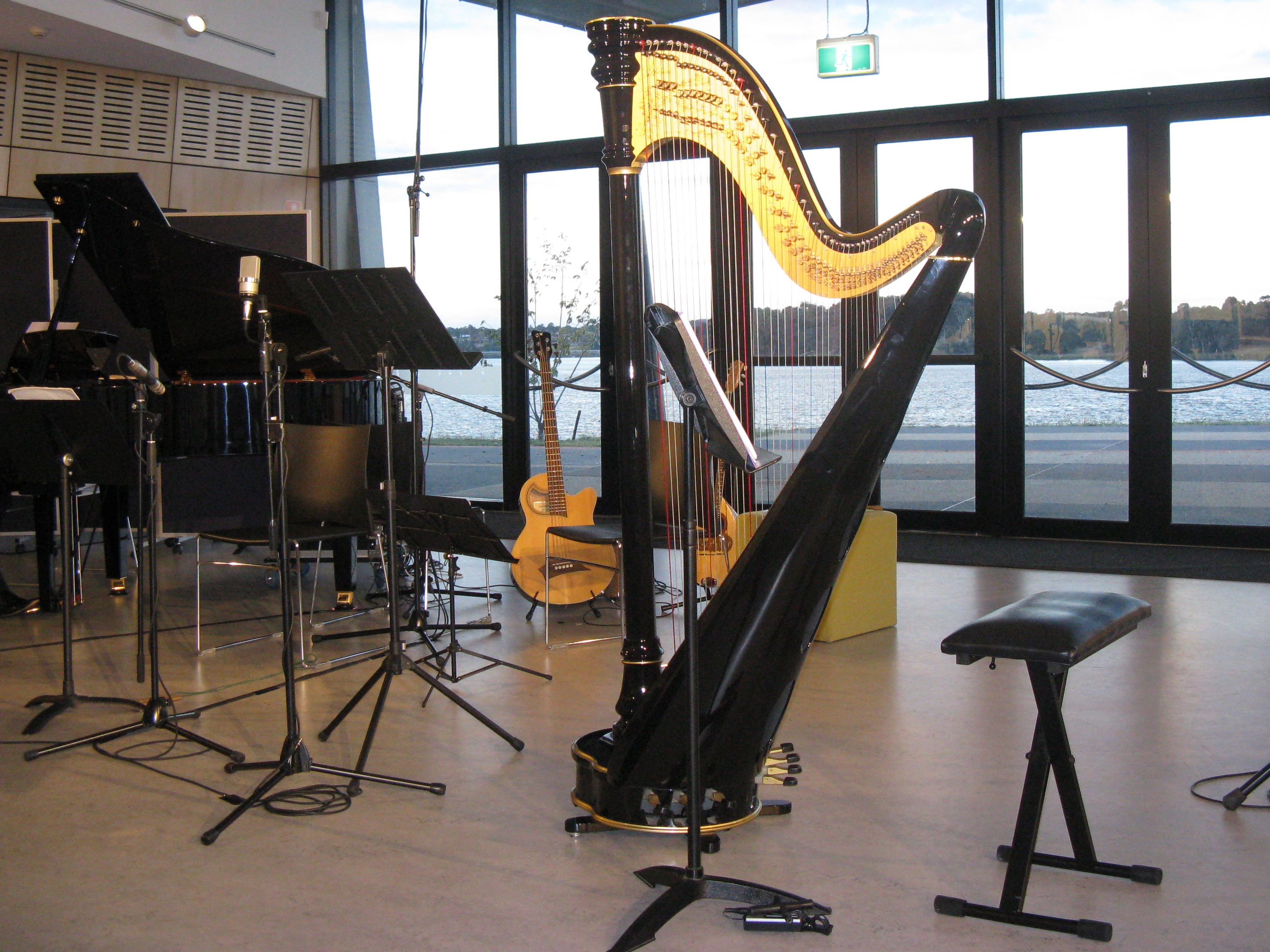
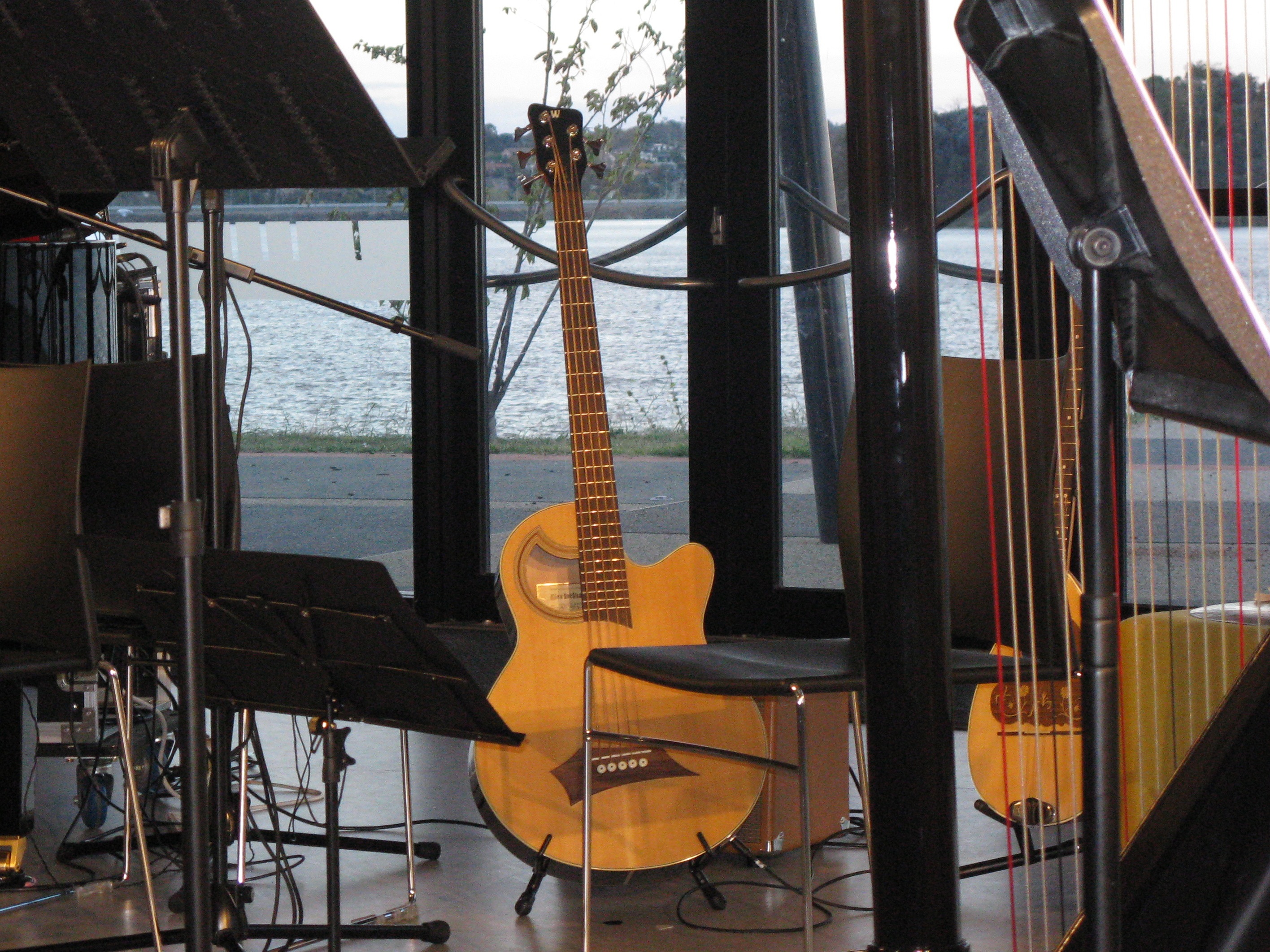
Before the concert, Belconnen Arts Centre
The most powerful piece of the first half was Robert Erickson‘s Pacific Sirens performed by the full ensemble (piano, flute, harp, violin, cello, guitar, mandolin, percussion, voice – with recorded sound effects). It was an evocative and eerie piece that confirmed my preference for terra firma! I also enjoyed the world premiere of Australian composer Marián Budoš’Clepsydra which, apparently, means water-clock. It’s a lovely piece with some jazzy elements to it.
While the first half focused primarily on the sea, the second half looked at water from various angles. One piece was the first movement of New Zealand composer Gareth Farr’s Taheke, which is Maori for waterfall. It was performed gorgeously by Kiri Sollis (flute) and Meriel Owen (harp). Flute and harp is a combination I usually enjoy. This half also featured the world premiere of Griffyn Ensemble director Michael Sollis’ Water into swine. Played by the Swïne (violin, cello, piano, flute), it also included vocalisations representing the dripping of water. As violinist George Kentros suggested, “there’s a hole in the bucket”. Playing their instruments while simultaneously vocalising (except for the flautist of course) looked pretty tricky but the players achieved it with a good deal of aplomb!
The Birtles family reappeared in the second half via a reading, by Susan Ellis, of some excerpts from Kanga’s mother (and Kiri Sollis’ grandmother) Dora Birtles’ journal Northwest by North about the trip she did in 1932 in a cutter from Sydney via New Guinea to Singapore. The reading was illustrated by Michael Sollis’ piece, Scenes from Ballad of a Highlands Man, which was performed surround-sound style with Michael and Kiri Sollis playing a traditional flute-like instrument from behind the audience.
I’ve mentioned only a few pieces played during the evening. We also saw Susan Ellis finger-clickin’ and barefootin’ around the “stage” to Alec Wilder‘s Sea Fugue Mama and heard, interspersed through the concert, the three movements of Swedish composer Klas Torstensson‘s Pocket size Violin Concerto, which challenged us with its mix of discordant and lyrical sounds and which was performed with confidence and enthusiasm by the group for which it was written.
Once again I thoroughly enjoyed the Griffyns. They always manage to put on a concert which appeals to a concert-goer like me, that is, one who is a reader-who-likes-music, who likes to think about what the music means, the stories it is telling, the emotions it is conveying. This concert, with its many watery atmospheres, gave me plenty to think about.
Australian public intellectual and ethicist, Clive Hamilton, wrote in his 2005 book Affluenza (excerpted in The invisible thread) that
Politicians love to identify with the Aussie battler, that stoic, resilient character who has little and complains less. Fifty years ago Australia was full of battlers, people hardened by the rigours of depression and war and, if not proud of their penury, certainly not ashamed of it. The Aussie battler is the central icon of Australian political folklore, and the image persists despite the fact that, as a result of sustained economic growth in the past five decades, the number of people who truly struggle has shrunk to a small proportion of the population.
My plan here, though, is not to discuss the political use (about which Hamilton makes a lot of sense) but the literary one, because reading this excerpt of course made me think about what part this “motif” or “myth” has played in Australian literature. I’ve written a few Monday musings to date on “themes” (such as the lost child, the beach, the gum tree, even sheep). The little Aussie battler is worthy, I think, of similar, albeit introductory, exploration. Is this icon (or stereotype) that is so popular with politicians, also reflected in Australian literature?
Who then is the “little Aussie battler”? My understanding of the term is that it refers to men (or more broadly families) who are working class, urban or rural, who struggle (battle) to make a living. Historically, they had few pretensions to upward mobility, except perhaps for their children. There’s a discussion of the word’s meaning on the Australian National University website, which includes the following definition of the “battler” as:
the person with few natural advantages, who works doggedly and with little reward, who struggles hard for a livelihood, and who displays enormous courage in so doing.
The notion of “the battler” probably originates in Australia’s convict heritage of the late 18th century and the battle to survive, but the early “battlers” in Australian literature were the itinerants and the struggling rural workers of the late 19th century, as glorified by writers like Banjo Paterson and Henry Lawson. They could be employed, irregularly employed, or unemployed. By the early to mid twentieth century, the “battlers” were often urban, though the country battler survived.
In fact, the iconic “battlers” of early 20th century literature were Steele Rudd‘s Dad and Dave, the struggling settler farmers who are often described as “the original Aussie battlers”. The first Dad and Dave book, On our Selection, was written in 1899, but the characters and their struggles became popularly known through plays, film and radio in the first decades of the 20th century. My favourite battlers, though, are those of Ruth Park. Her Harp in the south trilogy and her Miles Franklin Award winning Swords and crowns and rings are quintessential battler stories. New Zealand born Park got down pat the mid-twentieth century battler, the often flawed characters with big hearts and a desire to provide for their families and care for their mates. George Johnston’s My brother Jack is another example of a great battler of Aussie literature, as is Kylie Tennant‘s unfortunately lesser known novel The battlers. These mid-20th century battlers had usually experienced the Great Depression and/or the world wars. Life was difficult.
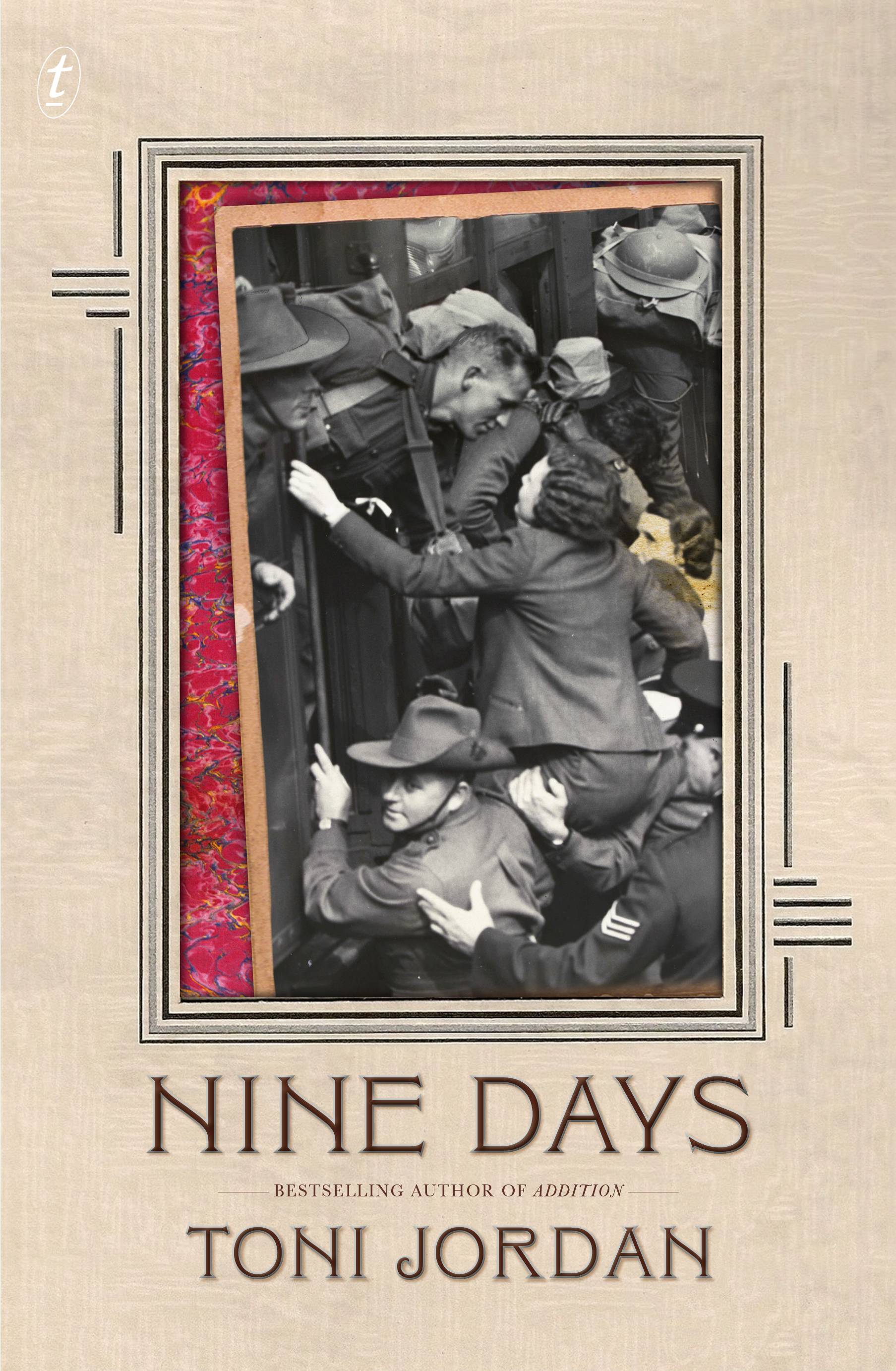
Book cover (Courtesy: Text Publising)
Current writers like Joan London (Gilgamesh) and Toni Jordan (Nine days) have also written about these historic battlers, as has, most famously, Tim Winton in Cloudstreet. What does it say, I wonder, that the book which most often wins surveys seeking our favourite or best Australian novel is this one about Aussie battlers?
But what about late 20th or early 21st century battlers? Do they still exist (outside the politicians’ minds?). Are Tim Winton’s more contemporary-focused books, like The turning, also about “Aussie battlers”? If they are, they are written with a more realistic, less affectionate eye, I think, than the earlier books I’ve mentioned. Is the old definition of “battler” – essentially, a working class white Australian male – still reflective of contemporary Australian society, with its multicultural and increasingly middle-class make-up? Certainly, when I think about recent Australian literature that is set in current times, the “battler” theme, or even character really, does not come to the fore – and yet, if I Google, “aussie battler”, the idea is alive and well. It seems, perhaps, that literature has turned its eye to more complex notions of the Australian character while politicians and the media stick to a romanticised version of “the battler”. I’d love to know what other readers of Aussie literature think.


 Whispering Gums