I’ve been remiss. I could have solved some of your Christmas shopping challenges by telling you about two books which would be perfect gifts for readers: Shane Maloney and Chris Grosz’s Australian encounters, and Susannah Fullerton’s Brief encounters. Both have “encounters” in the title, but they use the word in slightly different ways, as you’ll see when you read on …
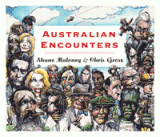
Book cover (Image: Courtesy Black Inc)
Maloney and Grosz’s book is the more light-hearted of the two, and just right for the Christmas season. Every encounter involves at least one Australian, but not all are literary. Some are a little tongue-in-cheek and a couple, even, are not between people. Take for example, Esperance and Skylab. (Australians will know what this is about!). Each encounter is given a page, with text by Australian novelist Shane Maloney, and a cartoon illustration by book illustrator Chris Grosz. I’ll choose just three* to share with you:
- Australian novelist George Johnston and Canadian singer-songwriter Leonard Cohen (1960). Cohen (25 at the time) met Johnston (48) and his writer wife, Charmian Clift, in Greece. Johnston and Clift let Cohen stay in their spare room. Cohen says “They drank more than other people, they wrote more … they helped a great deal. They were an inspiration”.
- Banjo Paterson and Rudyard Kipling (both of whom have been featured in this blog) (1900). Paterson (36) sat next to Kipling at a dinner in South Africa, where Paterson was visiting to report on the Boer War. They apparently discussed politics and war, and must have hit it off because they met up again a year later in Kipling’s home in Sussex.
- Robyn Davidson and Bruce Chatwin (1980). This was an organised encounter, and occurred in London. Chatwin had heard of Davidson (30) and her camel journey across the Australian desert. You can imagine what these two remote-area travel writers talked about, can’t you? Nomads was one topic, but politics was not. Chatwin apparently found politics boring and preferred to talk about (and mimic) people. Despite this, Davidson gave him contacts in Alice Springs which he would later use for his Australian travel book, Songlines.
This is an entertaining book, great for dipping into and discovering fun facts. I would have loved it if sources were provided for the information in the encounter descriptions, but this is not that kind of book. And, knowing now that these encounters took place, I can always research them myself.
Susannah Fullerton’s book, albeit called Brief encounters, is a longer tome and describes visits to Australia by 11 literati between 1836 and 1939. The book has an index and an extensive bibliography, satisfying my historian-self. The first visitor she covers is Charles Darwin, and the last HG Wells. In between are writers such as DH Lawrence (who wrote and set his novel Kangaroo only a couple of hours from where I live), Joseph Conrad, Agatha Christie (the only woman), Mark Twain and yes, even Rudyard Kipling.
Given Kipling appears in both books, I’ll use him as an example. Fullerton describes how Kipling came to visit Australia. It had its roots, she says, in an unhappy childhood and a consequent difficulty in forming relationships with women. He set off from England in 1891:
The ostensible reason he gave for the trip was that he was going to visit Robert Louis Stevenson in Samoa. What he desperately needed was to “get clean away and re-sort myself”.
His first experience of Australia was Tasmania – but only briefly – before he landed in Melbourne on 12 November. On 13 November, The Age newspaper reported him as saying:
This country is American, but remember it is secondhand American, there is an American tone on top of things, but it is not real. Dare say, bye and bye, you will get a tone of your own.
I find this quite fascinating because right now many of us feel there is an “American tone” to things in Australia, whereas back in the early to mid twentieth century the tone was distinctly British. Anyhow, Kipling said quite a bit in this early interview, both complimentary and not. His comments apparently “ruffled feathers” and he worked to smooth them over during the rest of his stay. While in Australia, he also briefly visited Sydney and Adelaide.
Now, here’s the interesting bit that ties us back to Maloney and Grosz’s book. He left Australia, Fullerton writes, rather “unenthusiastic about Australians” but this changed eight years later when he went to South Africa for the Boer War. There he met Australian troops and felt he had discovered “a new nation – Australia”. He is quoted as saying that he had never come across a “cleaner, simpler, saner, more adequate gang of men” and saw Australia as forging its own identity. Oh dear – why it is through war that our identity seems to be formed (at least in the eyes of others)?
Fullerton not only uses memoir, biographies and newspaper reports to track Kipling’s relationship with Australia, but she also quotes from his poetry and stories. One of the most significant of these is the ode he was asked to – and did – write for the Melbourne Shrine of Remembrance. The last verse includes the lines:
Then they returned to their desired land,
The kindly cities and plains where they were bred…
Clearly his view of Australia had softened. Fullerton concludes her Kipling chapter with:
Kipling spent only two weeks in Australia and saw very little of the country in that time. The visit may or may not have achieved his purpose of “re-sorting” himself. But it did leave a rich legacy – an ode, the beautiful poem “Lichtenberg” and a delightful explanation of how Australia’s most memorable animal, the kangaroo, came to look the way it does.
Fullerton’s book is well worth reading if you are interested in the authors she covers and/or in Australia as a literary destination! Lisa at ANZLitLovers agrees.
Shane Maloney and Chris Grosz
Australian encounters
Collingwood: Black Inc, 2010
111pp.
ISBN: 9781863955058
(Review copy supplied by Black Inc)
Susannah Fullerton
Brief Encounters: Literary Travellers in Australia 1836-1939
Sydney: Picador, 2009
396pp.
ISBN: 9781405039505
(Personal copy, signed by the author)
* I have left out the juicy bits – you’ll have to read the book yourself if you want to know those!
 Whispering Gums
I was all prepared to write a glib comment about you not getting a book for Christmas this year (I wonder what you could be getting? 😛 ) but then I read the Kipling quote about traveling to “get clean away and re-sort myself”, and I stopped short. Yes, yes, yes. I understand that so much. And I may well decide to do that again myself in the future… it worked pretty well last time, albeit my trip being just four months 🙂
Glad you weren’t glib! You and Ruddy (to his mother) are probably not the only ones who travel (have travelled) to re-sort themselves.
Sounds like two fun and interesting books. I loved the stuff on Kipling!
Yes, they are. Kipling is an interesting character I think, and probably worth re-investigating (in our spare time, eh!)
I listened to an interview with Shane Maloney about this book not too long ago on The Book Show (podcast here. It certainly sounded like an interesting read.
Oh thanks, Marg. I heard that too and should have linked to it so thanks for doing so. It was a fun interview wasn’t it? Maloney comes across well. Isn’t The Book Show wonderful?
Once upon a time I used to listen to music at work. Now I pretty much just listen to podcasts, and yes, The Book Show is one of my favourites.
Marg, I have to join in here and second the recommendation for Shane Maloney. I’ve heard him speak too and he’s a very entertaining fellow, but I liked his books well before that – one of the rare crime writers I enjoy.
Oh good, I must check one his crime books out. Like you I tend not to read them.
You’ve just solved my last present dilemma – thank you. I’m going to try to buy the Fullerton book today and speed read it before handing it on tomorrow. Have a very happy Christmas and new year, Whispering.
Oh good – wish I’d posted a few days earlier to have given you more time to read it (it opens quite nicely so is easy to read surreptitiously!). I got mine earlier this year at Paperchain. Hope you can get it. And I wish you a wonderful Christmas and New Year season too, zmkc.
Thank you, Whispering – and it was Paperchain that supplied it for me too. Sadly, I’ve had no chance to look at it at all, as my husband has become enthralled in it. It has to be handed on tomorrow. I suppose we may have to return to Paperchain for a copy of our own.
It sounds like you just might! I do hope your husband hasn’t dog-eared it.
I was at Paperchain today. I love their sale tables – the best ever. I found a hardback copy of Alice Munro short stories reduced from $40 to $13. I’m getting better though at not being tempted because I have bought so much there in the past that I haven’t actually found time to read.