Monday musings on Australian literature: Elizabeth von Arnim

Cover of "All the Dogs of My Life"

All the Dogs of My Life (Courtesy: Vintage Books, via Amazon)

This week’s Monday musings is a bit cheeky since Elizabeth von Arnim (or Mary Annette Beauchamp, her birth-name) was born in Sydney in 1866 but her parents left Australia in 1871 for Switzerland and then England. Von Arnim spent the rest of her life abroad. So, why am I writing about her? She didn’t grow up in Australia and doesn’t write about it either. Well, it’s because I love her writing and thought I could use the Australian birth justification to write about her now rather than later. After all, it’s my blog and I’ll do what I want to!

Before I talk about her writing, it’s worth mentioning that she has a famous relation: her first cousin was Katherine Mansfield (born Katherine Mansfield Beauchamp in 1888). But this isn’t the only name-dropping that can be done. The writer E.M. Forster tutored her children at one stage, she had a three-year relationship with H.G. Wells, and she married (but soon regretted it) Bertrand Russell‘s older brother. In other words, she had an interesting life.

I have read a few of her 20 or so books:

And, I have Vera (1921), which some see as her best, on my TBR pile.

So, why do I like her? Well, not only is her main theme, at least from the books I’ve read to date, women’s lack of power in a male-dominated world but, like Jane Austen, she approaches this with wit and irony and with a clear eye for human failings in general. In other words, she empathised with women’s lot but wasn’t blind to their faults and foibles (as individuals, as women and as representatives of humanity). Just read Mr Skeffington, and you will see what I mean.

To give you a sense of her writing, here are the opening paras of her “memoir” All the dogs of my life:

I would like, to begin with, to say that though parents, husbands, children, lovers and friends are all very well, they are not dogs. In my day and turn having been each of the above – except that instead of husbands I was wives – I know what I am talking about, and am well acquainted with the ups and downs, the daily ups and downs, the sometimes almost hourly ones in the thinskinned, which seem inevitably to accompany human loves.

Dogs are free from these fluctuations. Once they love, they love steadily, unchangingly, till their last breath.

That is how I like to be loved.

Therefore I will write of dogs.

How can you not be captivated by such a wry writer? The book continues in this teasing tone. She insists it is not her autobiography (“as this isn’t an autobiography, I needn’t go into that” is a refrain), but a story of her dogs, and regularly tells us so. But of course, through the story of her dogs, we get a pretty good impression of her life. She may not give us all the details, but we certainly learn about many of her “ups and downs”. This book, though, was not my introduction to von Arnim: that goes to the delightful Elizabeth and her German garden.

In a recent post, Max of Pechorin’s journal wrote that “the line between novel and memoir can be a tricky one”. I immediately thought of Elizabeth and her German garden, which I first read back in the mid 1980s. This is, I believe, a novel (in diary form) but it is also rather close to her life. She did, like the Elizabeth of the book, marry a German (count) and she did call him, as she does in the book, “The Man of wrath”. Furthermore, she did have several children. In fact her second book, The solitary summer, is dedicated “To the man of wrath, with some apologies and much love”.  Anyhow, here is the Elizabeth in the novel:

The people about are persuaded that I am, to put it as kindly as possible, exceedingly eccentric, for the news has travelled that I spend the day out of doors with a book, and that no mortal eye has ever yet seen me sew or cook. But why cook when you can get someone to cook for you?

OK, so she is well-to-do … but still, I love her priorities! Here she is in her (aforementioned) memoir, speaking of herself and one of her dogs:

Fortunately we liked the same things. She only wanted to be outdoors in the sun, and so did I …

And so, while some of the facts may differ (though I don’t know which ones), the basic “truth” of her life – her likes, dislikes and, more to the point, her attitudes and personality, come through both books.

Elizabeth von Arnim was a woman who tackled life head on. Her first husband died, she had affairs and a failed marriage; she lived in England, Europe and the USA; and she met some of the significant thinkers and writers of her time.  But, through it all, she never lost sight of “women’s lot” and the psychological ramifications of their powerlessness. Here she is in Elizabeth and her German garden on migrant workers:

From us they get a mark and a half to two marks a day, and as many potatoes as they can eat. The women get less, not because they work less but because they are women and must not be encouraged.

There is also, in the same book, an extended – and infuriating – discussion between Elizabeth, the Man of Wrath, and two others on German women having the same (lack of) rights as children and idiots. But politics was not her main game, I think. Rather, she was interested in women’s lives, in their wish and need to make self-determined, meaningful lives for themselves. So, I might just finish with another little excerpt from All the dogs of my life:

What on earth did I, of all people, want with a lot of husbands? I asked myself in wonder. Besides, by readily sticking to poached eggs for dinner I was getting abreast of my expenses, and the bills of Saturdays held no more terrors for me.

Ha! What indeed (at least in those inequitable days)!
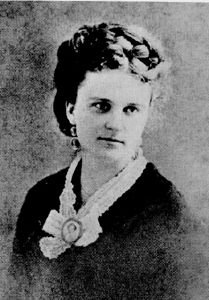
Kate Chopin, Désireé’s baby

Kate Chopin

Chopin (Public domain, via Wikipedia)

I read Kate Chopin‘s short story “Désireé’s baby” (1893) back in March when Kirsty mentioned it in her comment on my last Chopin post, but I didn’t blog it then. However, when it appeared a couple of weeks ago as a Library of America selection, I felt its time had come. But, what to say? It is, in a word, gut-wrenching.

The first short story to create a lasting impression on me was Guy de Maupassant‘s “The necklace” (1884). It was that short story, really, that launched my enjoyment of short stories. I found them particularly appropriate for my student days when I couldn’t justify reading a novel but wanted some escape from set texts. I was consequently interested to read in the Library of America’s introductory notes to “Désireé’s baby” that Chopin has been compared to such writers as Maupassant and Flaubert. I can see the connection.

“Désireé’s baby” starts off gently – and, more to the point, innocuously:

As the day was pleasant, Madame Valmondé drove over to L’Abri to see Désireé and the baby.

It made her laugh to think of Désireé with a baby. Why, it seemed but yesterday that Désireé was little more than a baby herself…

We then discover that Désireé had been an abandoned baby and brought up by the childless Madame Valmondé and her husband, hence I suppose her name. As this (very) short story unfolds, subtle hints of something not quite idyllic are introduced. A young man of an old wealthy family, Armand Aubigny, falls in love with and insists on marrying the nameless, but now 18-year-old Désireé. He fell in love “the way all the Augibgnys fell in love, as if struck by a pistol shot”. What an odd image to use for love eh?

Then we hear that Aubigny is a strict master of his estate. The home is “sad-looking” with its roof “black like a cowl” and “solemn oaks” growing near it. And, more telling, under his rule “his negroes had forgotten to be gay, as they had been during the old master’s easy-going and indulgent lifetime”. Set against this is Désireé in her “soft white muslins and laces”, so we are not surprised when we read that

Marriage, and the birth of his son, had softened Armand Aubigny’s imperious and exacting nature greatly. This was what made the gentle Désireé so happy, for she loved him desperately. When he frowned she trembled, but loved him. When he smiled, she asked no greater blessing of God. But Armand’s dark, handsome face had not often been disfigured by frowns since the day he fell in love with her.

Now, there is a clue to the dénouement in this excerpt, but if you don’t know the plot I’m not giving it away. All I’ll say is that Chopin’s writing is superb in the way she uses imagery and irony to subtly set the scene and leave the clues so that the conclusion, though shocking, meets Amanda Lohrey’s criteria for endings.

In less than 6 pages, Chopin explores a complex set of themes, including the psychological and social ramifications of young love, old wealth, race and gender, with a clarity that is breath-taking. I’m not surprised that it is a much-anthologised and studied story.

On endings – in novels, that is

Road Ends sign

The End! (Courtesy: OCAL via clker.com)

Australian writer, Amanda Lohrey, was interviewed on this morning’s Bookshow about her new book, a collection of short stories titled Reading Madame Bovary, which Lisa at ANZLitLovers has well reviewed. I’m not going to talk about the interview here in any detail, but I did think she had something interesting to say about endings, particularly given the last two books I’ve read whose endings were a little surprising.

Before getting to Lohrey, though, let’s just recap EM Forster‘s famous (well, I like it anyhow) statement about endings in his Aspects of the novel:

Nearly all novels are feeble at the end. This is because the plot requires to be wound up. Why is this necessary? Why is there not a convention which allows a novelist to stop as soon as he feels muddled or bored? … Incidents and people that occurred at first for their own sake now have to contribute to the dénouement … most novels do fail here – there is this disastrous standstill while logic takes over the command from flesh and blood. If it was not for death and marriage I do not know how the average novelist would conclude.

Oh dear…that is certainly how novels in the past usually concluded isn’t it? Modern – Modernist and, particularly, Postmodernist (but don’t test me too closely on literary theory because I haven’t made a close study of it) – novels are more likely to have an open ending. They don’t necessarily subscribe to the notion that there must be a dénouement that ties everything up (except perhaps for genre fiction?) which creates a challenge for readers. You get to the end of an open-ended novel and are forced to ask “What was that about?”. With a traditionally ended novel, all you have to say is, well, boy met girl, boy lost girl, boy got girl again. Of course, it was usually about something else but a simple, straightforward plot can discourage further thought about the “about” question.

Amanda Lohrey expressed it this way. She said “I think that surprise is absolutely essential to satisfying fiction” but this surprise must not be too absurd, extreme or contrived. Rather it should be something that gives you a “hit of adrenaline”, that you didn’t see coming but makes you think “yes, of course, that must be how it will end”. She goes on to say that “plot isn’t everything” but there must be a journey…

So, where does all this leave us? Take my two recent reads. There was some consternation among my reading friends about the ending of Lionel Shriver’s So much for that. It was pretty much a surprise – but the question is whether it meets the second part of Lohrey’s criteria. For some it was a cop-out and diluted the novel’s intent but that, of course, depends on what you think the intent is. My other example is John Banville‘s The Infinities. It also had a surprising ending that could also be seen as a cop-out but, when I stop to think about it, particularly its somewhat playful tone, the ending did in fact make sense. (It’s telling, I think, that  part of the surprise of these two potentially “copout” endings is that they are reasonably positive!)

All this said, I must say that I often forget the ending of novels I’ve read (unless they’re of the traditional marriage or death variety). What I tend not to forget though is the tone and my emotional reaction – and that is good enough for me. What about you? What do you think about endings and do you have any favourite or problematic ones?

Monday musings on Australian literature: The gum tree in the Australian imagination

In the next week (I hope), I’ll be reviewing Anna Krien’s Into the forest, her investigation into the longstanding conflict over logging native forests in our southernmost state, Tasmania. In the meantime, though, as I’ve been reading the book, I’ve been thinking again of the role eucalypts play in Australian life and culture – and, voilà, this week’s Monday musings was born.

Salmon Gum (Eucalyptus Tintinnans)

Salmon Gum (probably Eucalyptus Tintinnans) at Nitmiluk National Park

But, where to start? Why not with Waltzing Australia, an American blogger who has travelled extensively in Australia, written a book as a result, and is now writing a blog about her experiences? She complained – nicely of course – in our little comment to-and-fro about her visit to my city that “My whole first day there, I didn’t see any gum trees, and that made it almost seem that I’d somehow left Australia”. If that doesn’t tell you something about gums and Australia nothing will!

My first memorable literary confrontation with gum trees came in the childhood classic, Seven little Australians (1894), which is, perhaps, to Australian girls what Little women is to American. It is about a family of children and includes a tragic death, but here the death is caused not by illness but, yes, by a falling gum:

There was a tree falling, one of the great, gaunt naked things that had been ringbarked long ago. All day it had swayed to and fro, rotten through and through; now there came up across the plain a puff of wind, and down it went before it. …They lifted it off the little bodies, the long silvered trunk with the gum dead and dried in streaks upon it… (from Seven little Australians, by Ethel Turner).

Never fails to move me. As for which of the seven is so tragically killed, my lips are sealed, but let’s just say that, in contrast to Alcott’s book, it is not the meek, mild one.

As backdrop or centre front, gums are rarely absent from our literature, but the next most memorable example for me has to be Murray Bail‘s mysterious and beautiful novel, Eucalyptus, which can be read as a modern fairy story: once upon a time there was a father who promised the hand of his daughter to the man who could name each eucalyptus species that the father had carefully and lovingly planted on his property. The book starts as follows:

We could begin with desertorum, common name hooked mallee … and anyway, the very word, desert-or-um, harks back to a stale version of the national landscape and from there in a more or less straight line onto the national character, all those linings of the soul and the larynx, which have their origin in the bush, so it is said, the poetic virtues (can you believe it?) of being belted about by droughts, bushfires, smelly sheep and so on; and let’s not forget the isolation …

It is these circumstances which have been responsible for all those extremely dry (dun-coloured – can we say that?) hardluck stories which have been told around fires and on the page. All that was once upon a time, interesting for a while, but largely irrelevant here.

If you haven’t gathered a sense of Bail’s tone and intent from this, you might when I tell you that the last species mentioned in the book is Eucalyptus Confluens! It is fairy story, a love story, and a meditation on stories, framed by gums in all their diversity: “A forest is language; accumulated years”.

In Peter Temple‘s Truth, which I reviewed here a month or so ago, a running motif is the eucalypt and oak forest planted by Villani and his father. The trees provide an important point of contact for father and son throughout their lives, and the forest’s survival in the fire at the end signifies the survival too of Villani’s relationship with his father.

Often of course, gums are simply the backdrop – the ever-present part of the landscape that makes that landscape recognisably Australian. They are an important part of the landscape in Chambers’ The vintage and the gleaning … just by being there.

The thing is, though, that gums are so ubiquitous that they can become clichéd. The 1930s was an important and active time in Australian literature – and a time when there was enthusiasm for defining and creating literature that was, in a word, Australian. Australian poet, Rex Ingamells wrote, in 1938, an article titled “Conditional culture” in which he explored “the state of the art” of Australian literature. Not surprisingly, gums pop up several times in the article, often to show failures in the Australian imagination, such as when gums are invoked in nondescript ways. However, he also sees them as a barometer for the maturation of our culture:

Before long, the strange, unorthodox beauty of the Australian gum tree, and many other manifestations of beauty peculiar to this country, will find a sure place in the standards of general culture, which will be one stage nearer universality and so much the richer.

All this makes me wonder whether there is anything similar – any motif that has as much universal recognition – in other national literatures? Anyone?

(Oh, and just in case you are interested, there is a pretty extensive listing of eucalyptus species at Wikipedia.)

Books into films

‘Do you mind what they did to your book?’
‘Well, they can’t do anything to my book. They can’t alter a single comma … ‘

I came across the above in an article about P. D. James‘ in the September issue of goodreading magazine. The discussion relates to her non-crime novel The children of men which was adapted into film. What a great response I thought, because …

Pride and Prejudice (1940 film)

1940 film adaptation (Image via Wikipedia - Presumed public domain?)

I tend to take a pretty relaxed view towards adaptations. I see books and films as completely different media. Rather than expect the film to replicate the book, I like to see how the filmmaker has interpreted it. These are the questions I ask myself:

  • First: Did I enjoy the film as a film? Did I like the story? Did I like the way it was acted, directed, photographed, scripted? What did it “say” to me? Did it move and/or entertain me?
  • And then, if I’ve read the book, I think about the filmmakers’ interpretation. What was their take on it? Did it accord with mine? If it didn’t accord with mine, was it an interesting take? Was it a valid take?

And so, for example, I am one of the few Jane Austen fans who likes Patricia Rozema‘s Mansfield Park. Her Fanny is certainly not the Fanny of the book, but she is an interesting creation nonetheless and, as I see it, an attempt by Rozema to “update” her and to invest her more clearly with the strength of mind that she clearly has but that many readers lose because her “issues” (such as not taking part in the play) seem “wimpy” to modern eyes.  (This is not the only point of difference in the film, but discussing these is not the point of my post).

A poster on the Ellen and Jim blog has attempted a “classification” of film adaptations, using Jane Austen as an example. Here it is:

  • Close (or faithful) adaptations (such as the Pride and Prejudice film, 1995, starring Colin Firth and Jennifer Ehle), meaning “literal transposition of plot hinge-points, keeping most major characters, important crises, dialogue, themes”;
  • Intermediate (or analogous) adaptations (such as Patricia Rozema’s Mansfield Park, 1999), in which “the film-makers drop hinge-points or characters, change enunciations, and alter the book’s themes, even radically”; and
  • Free (or loose) adaptations (such as Clueless, 1995), meaning “a transposition into modern or other era terms which keeps only enough idiosyncratic elements of the major story and characters to be recognizably partly derived from the book”.

You will know my approach to adaptations when I say I enjoyed all three examples I selected above – which is not the same as saying that I think all adaptations work. I was less enamoured, for example, of the 2007 ITV adaptation of Mansfield Park. It had the unfortunate effect of making me laugh – at the wrong time for the wrong reasons – and its plot changes did not seem to me to enhance the themes.

Further on in the Ellen and Jim blog post is this from John le Carré on the adaptation of his The Constant Gardener:

the job of the movie … is to take the minimum intention of the novel and illustrate it with the maximum of freedom in movie language in movie grammar.

That sounds very reasonable to me, but now I wonder about you, as I know a few readers here are keen moviegoers. What makes a successful adaptation to you? How important is fidelity – however you define that – to you? And, if you like, what are some of your favourite adaptations?