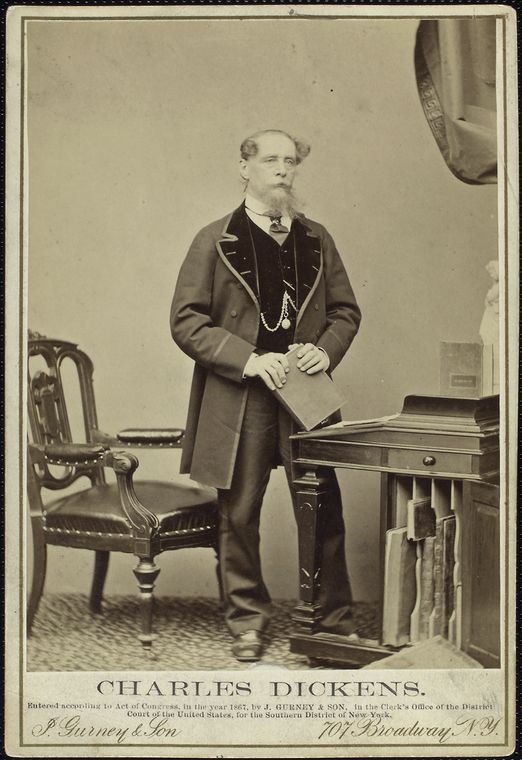
Monday musings on Australian literature: Charles Dickens and Australia

Charles Dicken, c1860

Dickens, c. 1860 (Presumed Public Domain, via Wikipedia)

Here’s something completely different for my Monday musings! Not an Australian author, not even a foreign born author who came to Australia (though, being the great traveller he was, he did consider a lecture tour), but Charles Dickens does have a couple of interesting “connections” with Australia. These connections are supported by the existence of some letters written by him at the National Library of Australia.

On convicts and migration in general

Transportation of convicts to Australia – actual, implied or threatened – features in several of his novels. These include John Edmunds in Pickwick Papers (1836-37), the Artful Dodger in Oliver Twist (1837-1839), Mr Squeers in NicholasNickleby (1838-39), Alice Marwood in Dombey and Son (1846-48), and Magwitch (probably the most famous of all) in Great expectations (1861), not to mention Jenny Wren who threatens her father with transportation in Our mutual friend (1864-65). Dickens apparently learnt quite a lot about convict life, and particularly the penal settlement on Norfolk Island, from his friend Alexander Maconochie (to whom I refer in my review of Price Warung’s Tales of the early days).

Clearly, it was this knowledge which inspired the letter he wrote to the 2nd Marquess of Normanby (George Augustus Constantine Phipps), who was Secretary of State for the Home Office . He suggests

a strong and vivid description of the terrors of Norfolk Island and such-like-places, told in a homely narrative with a great appearance of truth and reality, and circulated in some very cheap and easy form (if with the direct authority of the Government, so much the better) would have a very powerful effect on the minds of those badly disposed … I would have it on the pillow of every prisoner in England. (3 July 1840, Original in the National Library of Australia, Ms 6809)

He offers to write this narrative, gratis. As far as I know, although Dickens and the Marquess were friends, nothing ever came of this offer.

While Dickens deplored the treatment of convicts in the penal settlements, he also saw Australia as a land of opportunity. The transported Magwitch, as we know, made his fortune in Australia. Mr Micawber, debt-ridden at the end of David Copperfield, emigrates to Australia and becomes a sheepfarmer and magistrate. But, perhaps the strongest evidence of Dickens’ belief in Australia as a place where people could get ahead, is the emigation of his sons.

On his sons

Two of Dickens’ sons – Alfred D’Orsay Tennyson Dickens and Edward Bulwer Lytton Dickens* (nicknamed Plorn) – emigrated to Australia, both with their father’s encouragement.

Alfred (1845-1912) migrated to Australia in 1865. He worked on several stations/properties in Victoria and New South Wales and as a stock and station agent, before partnering with his brother in their own stock and station agency, EBL Dickens and Partners. He died in the United States in 1912, having left Australia on a lecture tour in 1910. Dickens’  youngest son, Edward (1852-1902), went to Australia in 1869. He also worked on stations before opening the stock and station agency with his brother. He later worked as a civil servant and represented Wilcannia in the New South Wales Legislative Assembly in 1889-94, but he died, debt-ridden, in 1902 at Moree. Australia did not quite turn out to be the land of opportunity for these two that Dickens had hoped, but fortunately he was not around to see it!

A couple of Dickens’ letters to his sons are held at the National Library of Australia. One was written in 1868, not long before Plorn left England, and includes some fatherly advice:

Never take a mean advantage of anyone in any transaction, and never be hard on people who are in your power …

The more we are in earnest as to feeling religion, the less we are disposed to hold forth on it. (26? September 1868, Original in National Library of Australia, Ms 2563)

One does rather wish that Dickens had taken his own advice regarding not being “hard on people who are in your power” in his treatment of his poor wife Catherine.

Eighteen days before he died in 1870, he wrote this to Alfred:

I am doubtful whether Plorn is taking to Australia. Can you find out his real mind? I note that he always writes as if his present life were the be-all and end-all of his emigration and as if I had no idea of you two becoming proprietors and aspiring to the first positions in the colony without casting off the old connexion (1870, Original in National Library of Australia, Ms 6420).

These are just two of the many letters that he wrote to (and about) his sons in Australia. More can be found in published editions of his letters. I have chosen these particular ones purely because we have them here in Canberra. It’s rather a treat to be able to see Dickens’ hand so far away from his home.

Do you enjoy close literary encounters of the handwritten kind?

Peter Temple, Truth

I think that every novelist has a single ideal reader (Stephen King, On writing)

Peter Temple, Truth

Truth bookcover (Courtesy: Text Publishing)

As I was reading Peter Temple‘s Truth I wondered whether I was Temple’s “ideal reader”. Somehow I think not. I am not a crime novel reader, but I did read and greatly like Temple’s previous book, The broken shore, so why did I feel less enthusiastic about Truth?

Part of the reason might be expectations. This novel won the Miles Franklin award this year. I don’t, theoretically, have a problem with a so-called genre novel winning literary awards but I did expect that if such a book won it would be out of the ordinary, and by that I mean that it would break the mould of its genre in some way. Well, I don’t think Truth does that. Of course, the Miles Franklin doesn’t explicitly say the work has to be innovative; it just says the work must be “of the highest literary merit” and present “Australian life in any of its phases”.

Another reason, related to the above, is that I found it to be a little too stereotypical. While I don’t read crime fiction as a matter of course, I do watch a lot of crime television, particularly those based on the writings of Ian Rankin, Val McDermid, and the like. I didn’t find Temple’s detective here, Steve Villani (who at one point talks of “the full stupidity of his life”), particularly different from many of the other contemporary angst-ridden middle-aged detectives I’ve seen. I didn’t find the plot, which deals with corruption (in the police force, politics and business) to be particularly different either.

So, did I like anything about it? Well, yes. But not for what Val McDermid would expect. She has said that:

As literary fiction became more hermetic, more concerned with literary theory and less concerned with narrative, crime writers assumed the mantle of turning the spotlight on the world we live in and doing it in a form where narrative was still of paramount importance.

Oh dear. I have to say this narrative bored and, at times, confused me. I was not interested in the plot – in remembering who all the characters were and guessing whether this one or that one might have “done it”. I just didn’t care. But, I was interested in Villani and his relationships with people – his father and brothers, his family, his old (now deceased) boss Singo, and his colleagues, particularly the indigenous policeman, Dove, who appeared in The broken shore. It was all a bit typical really – the workaholic cop with the troubled background and failing marriage – but Temple did manage to engage me in this character. He did this largely by telling the story through Villani’s eyes – through a third person limited point of view (or “first person in the third person” as he told Ramona Koval on the Bookshow). We are right there with Villani through one pretty hellish week in his life: horrific murders, bushfire threatening his father’s property, and a runaway daughter, alongside the odd bit of pressure to drop one of the cases because it was “just” a prostitute who’s not worth rocking the boat over.

Peter Temple is well-known for his writing. Ramona Koval describes this book as having “beautifully written ugly scenes”. I suppose they are. There is a lot of staccato dialogue, though Temple does little to explain the language used by the cops. If you don’t know the lingo, you are expected to pick it up as you go. (American readers, however, will apparently get a glossary!). There are a few motifs which run through the book. Smells are important – they convey the corruption and the social disintegration in the city and they play a practical role in solving a crime; and trees are also significant, conveying Villani’s connection with nature and his father, with, that is, something far more healthy than his homicide-driven life:

Below them a forest, wide and deep and dark, big trees more than thirty years old. Planted by hand, every last one, thousands of trees – alpine ash, mountain swamp gum, red stringybark, peppermints, mountain gum, spotted gum, snow gum, southern mahogany, sugar gum, silvertop ash. And the oaks, about four thousand, grown from acorns collected in two autumns from  every russet Avenue of Honour Bob Villani [father] drove down, from every botanical garden he passed.

Lists like this are a feature of the writing and they are effective in building up pictures in the fast moving, rather clipped world of this novel. Rhythm is in fact a significant aspect of the style. As you would expect, the story is mostly grim, but there is the odd bit of humour. I did love this one:

“Say police as caringly as possible. Like a blessing.”
“Jeez, that’s a big ask.”

The title seems to come from a horse which is mentioned only once in the novel:

…the first horse Bob raced, the best horse he ever had had, the lovely little grey horse called Truth who won at her second start, won three from twelve, always game, never gave up. She sickened and died in hours, buckled and lay, her sweet eyes forgave them their stupid inability to save her.

There’s a message in there somewhere – mostly ironic. I kinda like that.

So, my overall reaction? I don’t usually read reviews before I post, but I do when I’m preparing for my bookgroup. One of the reviews I read was Edmund Gordon’s in The Guardian. I like his conclusion that it’s an accomplished book but doesn’t escape the bounds of its genre. I was, I realise, hoping it would – and that means I’m not Peter Temple’s “ideal reader”. You, however, may be.

Peter Temple
Truth
Melbourne: Text Publishing, 2009
387pp.
ISBN: 9781921520716

JM Coetzee wins the 2010 Queensland Premier’s Literary Award

The Queensland Premier’s Literary Awards were announced last night, on the eve of the Brisbane Writers’ Festival.

The main award was won by JM Coetzee with Summertime, the third book in his fictionalised memoirs. The first two were Boyhood and Youth. I have this in my TBR but it has yet to arrive at the top! However, since it also won this year’s NSW Premier’s Literary Award, I clearly need to start levitating it.

As with the NSW Premier’s Literary Awards and the Age Book of the Year awards, these awards comprise a whole swag of prizes. I won’t list them all here but, given recent posts on this blog, I would like to mention the David Unaipon Award for an Unpublished Indigenous Writer. This year’s was won by Jeanine Leane with a book called Purple Threads which is apparently a funny and sad tale of a household of indigenous women. I look forward to seeing it in print.

And, on a personal front, my Kindle landed today. I have downloaded Ford Madox Ford‘s The good soldier (because that’s the next classic I want to read) and Jane Austen’s Mansfield Park (because a Jane Austen has to be among the first). More anon …