John Banville, The infinities

Hermes, sculpted bronze figure by Lee Lawrie. ...

Hermes, sculpted bronze figure by Lee Lawrie (Presumed Public Domain, via Wikipedia

This is what Benny loves, what all the gods love, to eavesdrop on the secret lives of others.

Hmm … this is also, I think, what readers love! Readers after all are, surely, the ultimate voyeurs. And yet the god Hermes, who narrates John Banville‘s The infinities, also admits to the gods interfering in people’s lives, which is, in a way, what authors do. Is this double whammy – voyeur and meddler – one of the reasons why Banville chose a Greek god as his narrator?

The infinities is one of those books that takes place in a day, and it has a fairly small cast of characters. Adam Sr has had a stroke and is ostensibly on his deathbed. He is being cared for by his much younger second wife Ursula and his somewhat “loony” daughter, Petra. Also living on Adam’s Irish estate are the middle-aged employees Ivy Blount and Duffy.  The novel starts in the morning with the arrival of son, also Adam, and his wife, the aptly named Helen. During the day two more people arrive, separately, Roddy Wagstaff and Benny Grace. The only other characters are two Greek Gods, the narrator Hermes and his “father” Zeus.

You might presume from this that the novel is one of those traditional deathbed stories about a family which gathers to await the death of a loved one and lets loose their pent-up conflicts, but it’s not so. This is a more interior novel in which the interaction between the characters is less important than their individual responses to their rather messy lives. They are overseen by Hermes who watches with amusement and not a little envy while also trying to keep his father, the “randy” Zeus, in check.

Unlike The sea, that more sombre novel of Banville’s, this one has a light if not downright funny touch. The gods roam at will around the estate, occasionally taking the form of other characters in order to meddle a bit in their lives, or, in the case of Zeus in particular, experience a little human pleasure with the luscious Helen (“‘Oh’, she says laughing, ‘it was divine, surely'”). Some of the names are symbolic – Helen, of course, recalls Helen of Troy; Adam reminds us of the “first” man; Adam’s last name is Godley. But this isn’t overdone. Not all names are so laden with meaning – and those that are have a more playful than serious import. Added to this is the delightful humanising informality of Hermes talking of Zeus as “Dad”.

So, what is it all about? Adam Sr is (was) a mathematician who explored Quantum theory and developed his own theory of multiple infinities. By contrast, the gods of course are infinite (or, more accurately, immortal), but they envy humans their mortality. Hermes says of his father’s flirtations with women:

Each time he dips his beak into the essence of a girl he takes, so he believes, another enchanting sip of death, pure and precious. For of course he wants to die, as do all of us immortals, that is well known.

Towards the end Adam realises what the gods already know, that “somehow, extension brought not increase but dissipation”. He says:

I still do not understand it. The hitherto unimagined realm that I revealed beyond the infinities was a new world for which no bristling caravels would set sail. We hung back from it, exhausted in advance by the mere fact of its suddenly being there. It was, in a word, too much for us. This is what we discovered, to our chagrin and shame: that we had enough, more than enough, already, in the bewildering diversities of our old and overabundant world. Let the gods live at peace in that far, new place.

Ha! Except the gods already know what Adam and Benny learnt, which is why they keep hanging around the humans. They know that it is death that somehow gives life its meaning. This makes the ending, which I will not give away here, doubly ironic.

It feels impossible to do justice to this superficially simple but rather astonishing book and I have already laboured over my post far too long, so I’ll just make a couple more comments. One is the shifting POV from our narrator Hermes to interior monologues from others, particularly Adam Sr. It seems, at times, that Adam is Hermes, something both disconcerting yet also oddly logical. And there is the tight, evocative language. Take, for example, his use of colour. There’s a lot of blue-black-grey which expresses well the hovering death and its associated mystery, but there are also hints of the more earthy of-the-world green-brown colours and, in the cushion clutched by Ursula, a touch of passionate red. Banville’s intent can almost be read by simply tracking the colours.

In the end, the book is a hymn to the mortal world, in all the messiness that’s been laid before us:

This is the mortal world. It is a world where nothing is lost, where all is accounted for while yet the mystery of things is preserved; a world where they may live, however briefly, however tenuously, in the failing evening of the self, solitary and at the same time together somehow here in this place, dying as they may be and yet fixed for ever in a luminous, unending instant.

Couldn’t have said it better myself!

John Banville
The infinities
London: Picador, 2009
300pp.
ISBN: 978033045025
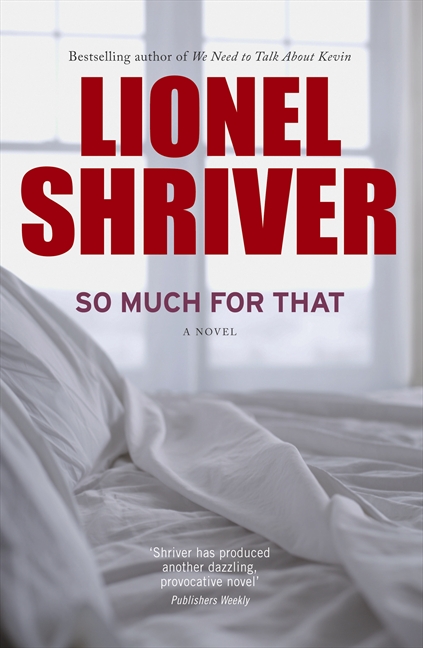
Lionel Shriver, So much for that

Lionel Shriver, So much for that

Book cover (Courtesy: HarperCollins Australia)

Having had my own rather traumatic experience of the American healthcare system back in the 1980s I was rather keen to read Lionel Shriver‘s latest offering, So much for that. And, I wasn’t disappointed – or, let me rephrase that, I found it an interesting and engaging page-turner though not a top-ten-of-the-year one.

First a quick plot summary. The book starts with 48-year-old nice-guy Shep Knacker planning to escape the American rat-race to his dreamed of, and as it turns out ironically named, AfterLife in Pemba off Zanzibar. Unfortunately, his plans turn sour with his wife’s announcement that she has a rare aggressive cancer called peritoneal mesothelioma and will need him to continue working, for his health insurance. Paralleling Shep and Glynis’ experience of health service and insurance – and told in roughly alternating chapters – is that of their good friends Jackson and Carol whose 16-year-old daughter, Flicka, was born with the degenerative disease, familial dysautonomia.

So, at the start we have a terminal cancer diagnosis and a child with a disease that is not likely to see her making old bones. Through the course of the novel, two more health issues are thrown in to round out the mix – aged care for Shep’s father after he falls and breaks his femur, and elective shall-we-say “vanity” surgery undertaken with disastrous results by Jackson. This all felt a little contrived to me – as did the occasional preachy dialogue that seemed to be there to make sure we got it. (Shriver is not a taker-outer I think!)

But, somehow, Shriver made it all work – right through to the rather surprising and, thus, risky ending. I liked the fact that she balanced the health care polemics with some wider issues such as the psychology and language of illness and the soul-destroying nature of the American (in particular) rat-race. And I liked the way she offset the plot and structural contrivances with a warm but unsentimental regard for her characters. Glynis and Flicka are not “pin-up” patients but “real” people who are angry with their lot and exhibit selfishness and petulance more often than meek forbearance. Glynis, like the character in Helen Garner‘s The spare room, is in denial about her fate pretty much to the end, and Flicka sees little value in living the sort of life she does. Both consequently feel little need to make it easier for those around them.

Most of Shep’s chapters commence with a statement of his net worth, which at the beginning of the novel is around $730K but which decreases with alarming rapidity as the months wear on and his poor insurance cover doesn’t begin to meet the costs of Glynis’ treatment. If you knew nothing before about co-payments, deductibles, co-insurers, out-of-network providers and lifetime payment caps, you’ll know all about them by the time you finish the book. (Apparently the most common cause of personal bankruptcy in the USA is medical debt.) But this is just the background – the polemics if you will – because the more interesting story is that of Shep and Glynis’ complicated but loving relationship, and of how friends and family react to the diagnosis. We feel Shep’s pain as he realises “he couldn’t fix things”. We understand Glynis’ eventual epiphany that “her husband had misguidedly hoarded his pennies, when the only currency they spent that had ever counted was time”. We cringe when we recognise ourselves in the friends who don’t visit often enough, who offer lip-service assistance rather than actual help. And we start to understand the real implications of cancer-speak that encourages an unrealistic belief in positive thinking, that suggests you can win the battle if you fight hard enough:

I know you mean well [says Shep to the oncologist], but after all this military talk she now equates – dying – with dishonor. With failure. With personal failure.

Near the end Shep asks the doctor what the $2 million spent on Glynis’ treatment (to date) had bought:

“Oh, I bet we’ve probably extended her life a good three months.”
“No, I’m sorry, Dr Goldman,” Shep said on the way out. “They were not a good three months”.

… leaving the real question, which Shep had previously asked his father, hanging:

“is there also a limit to how much you should pay to keep any one person alive?”

Lionel Shriver does not specifically answer this question in the novel but – despite the ending – you know exactly what she thinks.

There is more I could say about the novel. The story of Jackson and Carol, for example, offers the book more than a simple confirming parallel. There are some genuinely funny moments, particularly those between Shep and his free-loading sister Beryl, and those when Jackson pronounces yet another long-winded title for the book on “mugs and moochers” that he never will write. And there are some interesting discussions about art and artists, and about parenting in modern USA. But I’ve said enough I think to give a sense of what this book is about.

Shep says at the end that he’d “rather live a good story than read one”. I’ll leave you to ponder the implications of a novelist writing that line … and simply say that while this is not a perfect novel, I don’t begrudge having given up a bit of my good life to read it!

Lionel Shriver
So much for that
Sydney: Fourth Estate, 2010
433pp.
ISBN: 9780732287030

Monday musings on Australian literature: In praise of the “taker-outers”

Today’s Monday musings post is not solely about Australian literature but it was inspired by an Australian writer, Kate Jennings, about whom I’ve written a few times in the last month or so. In 2002 she wrote an essay titled “Bone and sinew”, for our now defunct Bulletin magazine, in which she praises short novels (or, novellas*). Tony of Tony’s Bookworld likes novellas, and so do I.

Anyhow, Jennings starts her essay with a statement that F. Scott Fitzgerald apparently made to Thomas Wolfe. He said:

You’re a putter-in, and I’m a taker-outer.

It seems that Wolfe believed a novelist couldn’t be taken seriously until, to use Jennings words, “he or she had produced something that could hold up a three-legged sofa”. Jennings likes Scott Fitzgerald’s description and goes on to say:

Putters-in and takers-out – as good a way as any to classify novelists. Putters-in: writers who pile on atmosphere, adjectives ad arguments, who share with readers all their thoughts, and research, who follow storylines like a dog on the loose. Takers-out: writers who fiddle with each comma and finesse every word, who know exactly what Samuel Johnson meant when he said that when you think you’ve written a particularly fine passage, strike it out.

Jennings admits to her bias – after all, she says, she’s written a couple of short novels herself – but says she does also enjoy  the likes of George Eliot, Christina Stead, Patrick White and Rohinton Mistry. Her point is that their novels are not “superior because of their length” and that short novels should not be perceived as “slight” simply because they are “slim”. There are many short novels with proven staying power (such as The great Gatsby, Joseph Conrad’s The heart of darkness and George Orwell‘s Animal farm) and yet, she says, publishers, recognising that readers and reviewers are prejudiced against shortness, “often ask writers to pad out short novels with stories. The term ‘novella’ is now pejorative: a marketing kiss of death”.

Well, it isn’t for me. Jennings quotes David Mamet on elegance in writing. He asked “how much can one remove and still have the composition be intelligible”. I like this way of describing it. Taker-outers, I believe, trust their readers, viewers and listeners (because this also works for theatre, film and music) to get it. They don’t believe they have to explain every detail. Kate Jennings certainly doesn’t in Snake. She presents a series of little vignettes and expects her readers to “get” the whole picture – and we do, only too vividly!

Kate Grenville with her cello

The versatile Kate Grenville (Courtesy: Peter Ellis via Wikipedia using CC-BY-SA 3.0)

Fortunately for me, many of my favourite Australian writers (hmm … is this a “chicken or the egg” situation?) have written short novels (as well as, for some, longer novels). I have listed some before and so here will add some others, mostly lesser known, that have impressed me:

  • Thea Astley’s Coda
  • Kate Grenville’s Dreamhouse
  • David Malouf’s Ransom
  • Eva Sallis’ The city of sealions
  • Tim Winton’s In the winter dark

Jennings writes “That short novels can be tough, specific and encompassing can come as a surprise to readers. Sinew and bone …”. Really, though, it’s a matter of what you read for. If your preference is to escape into fat and flesh, then short novels may not be for you, but if you like chewier fare, then a good short novel will rarely disappoint.

* I think novellas are generally defined as those under 150 pages, but I tend to include in my personal definition books that are up to 200 pages (or so).

Kate Jennings, Snake

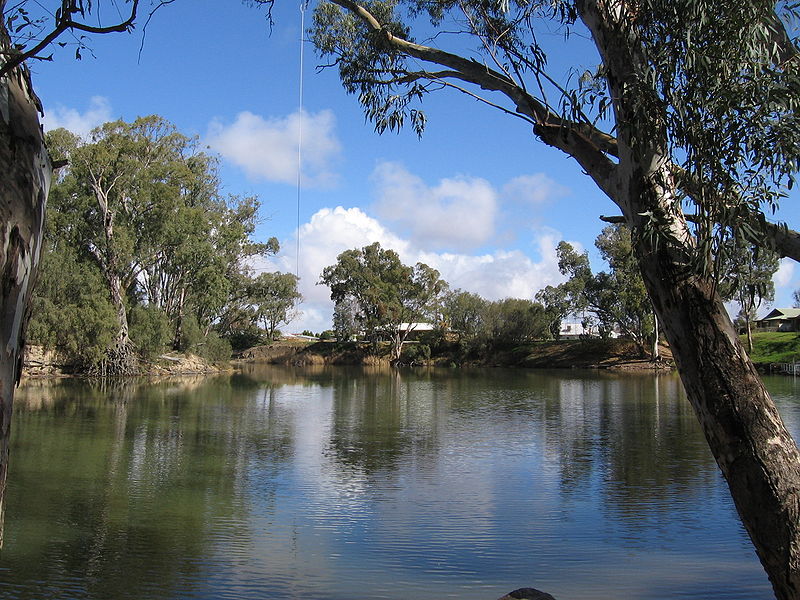
Murrumbidgee River

Murrumbidgee River in the Riverina (Courtesy: Mattinbgn, via Wikipedia, using CC-BY-SA 3.0)

In her “fragmented autobiography”, Trouble, Kate Jennings used excerpts from her first novel, Snake, to convey her childhood experience of growing up on a farm in the Riverina region of New South Wales. She had, she wrote, an “unhappy mother, diffident father”. Snake is the story of such a mother and father. While the novel is not totally “true” to her life in the factual sense, I have read enough novels and memoirs (such as Jill Ker Conway‘s The road from Coorain) about rural Australian life to know that it is “true” to the sort of experience it describes.

The blurbs on the back of my edition include the following descriptions: “a string of prose poems” (Times Literary Supplement) and a “domestic dystopia” (Sydney Morning Herald). The novel – novella in fact – is intriguingly structured. It has 4 parts. Parts 1 and 4 are short bookends, told in second person: the first part is addressed to the father and the last to the mother. The middle two parts are told in the more traditional third person voice and chronicle the life of the family: Rex the ironically named father, Irene the mother, and Girlie and Boy, the children who are caught in the middle. The chapters are short, some being only a paragraph or two long, and present vignettes of the family’s life rather than a simple this-then-that chronology. Dystopian is, unfortunately, an accurate description of their life. As Daphne, Irene’s sister, guesses on the wedding day,

Rex was a nice enough chap but about as interesting as a month of rainy Sundays. Irene will be bored with him before they arrive at the Blue Mountains guesthouse for their honeymoon.

While we never hear from Daphne again, she was not wrong. Rex is a “good man”, “decent”, a farmer of simple needs, while Irene, as her father realises, “dances to a tune no one else hears”. Not a likely recipe for success.

I thoroughly enjoyed this novel. Despite its unusual mix of voice and rather episodic form, it has a strong narrative that drives us on to its inevitable (but no spoiler here) conclusion. The snake motif runs through the book. Snakes are a fact of rural Australian life and so are a natural, real presence in the book, but their symbolic allusion to temptation, deceit and danger lurks behind every reference. Early in the novel, we are told of Irene’s youthful romantic tendencies – her love of

… smoky-voiced singers and innuendo-laced lyrics. Tommy Dorsey and Benny Goodman, Frank Sinatra and Peggy Lee, they were the snake charmers and Irene the snake.

Later, Girlie looks at snakes in a book on Australian fauna: they are “fanged, flickering, unblinking”.

Kate Jennings is a poet – as well as novelist and essayist – and it shows. The language is accessible but full of imagery. This is particularly apparent in the chapter titles, most of which are obvious in meaning, though some are more cryptic: “Home is the first and final poem”, “Send my roots rain” and “My mother has grown to an enormous height”. They are fun to think about as you read. There are some beautifully apposite descriptions. Here for example is Rex experiencing misgivings about his new wife:

The sight of her caused his nature – practical, honourable – to assert itself … What was done was done. Without being conscious of it, he coughed importantly – I am a man, I have a wife – and squirmed inside the jacket of his uniform until it sat better on his shoulders.

And here is Girlie reading:

Girlie read books like a caterpillar eating its way through the leaves on a tree.

Their town is, ironically, called Progress. However, very little “progress” occurs in the book. Rex struggles to keep the farm going in the face of mice and locust plagues, hail and dust storms. Irene tries to make a life that suits her romantic, imaginative spirit – she creates a garden, seeks friendships with interesting people, looks for work – but in the end nothing works:

Rex and Irene had given up arguing. He no longer bothered to tell her that he wasn’t asking much – harvest his crops, care for his animals, share it all with a good woman, tra-la – and Irene didn’t reply that far from not asking much, he was asking everything.

Such is the life of a mismatched couple. We’ve read of such couples before, and we will again, but for a clear-eyed, finely balanced, while also touching, portrayal, this one by Kate Jennings is hard to beat.

Kate Jennings
Snake
Sydney: Picador, 2003 (first pub. 1996)
153pp.
ISBN: 9780330364003

Another award for Nam Le

I read Nam Le‘s collection of short stories The boat a few months before I started my blog. The collection has been well reviewed nationally and internationally, and has won quite a few awards. I have just read that he has now been awarded another: The Kathleen Mitchell Award which is a biennial literary prize for writers under 30 years old (as Nam Le was when the book was published). This award has been previously won by Sonya Hartnett who has gone on to write several highly acclaimed novels – and been shortlisted for the Miles Franklin – and Markus Zusak.

I loved The boat. It’s an unusually diverse collection. The language is highly differentiated from story to story to suit the particular characters and setting of each; the narrative voice varies from 1st to 3rd person, and from male to female points of view; and there’s an asonishing variety in his protagonists and settings. The subjects range from an 8 year old orphan girl in Hiroshima to a middle-aged painter in New York, from a 14 year old hitman in Colombia to a 35-year old American woman visiting Iran. Despite this diversity, though, there is a strong underlying theme, that of survival. This is probably not surprising in a writer who came to Australia from Vietnam as a boat refugee (albeit when not much more than a baby).

As it’s been a while since I read the book I’m not going to review it now but, given my particular interest in the intersection between fact and fiction, I’ll just mention the autobiographical aspect of the first story, “Love and honour and pity and pride and compassion and sacrifice”. That story is so close to Nam Le’s own life that it is tempting to read it as his life. A character says to the fictional Nam that “instead [of writing immigrant stories], you choose to write about lesbian vampires , and Colombian assassins, and Hiroshima orphans – and New York painters with haemorrhoids”. One reviewer, Hari Kunzru in The Scotsman, wrote that “Sure enough, The Boat, contains all these stories, minus the lesbian vampires, who presumably got lost in the edit”. My question is: Does he know this for a fact? Did the real Nam Le write such a story or is it only the fictional one who did? Is this a case of life getting mixed up with art? In an interview on the ABC’s Bookshow Nam Le admits to a story about lesbians but says “the vampires I needed to leave some interpretive distance, I reckon”. I like to think of it as Nam Le’s little joke – but I may be wrong!

Oh, and did I mention that Nam Le attended the Iowa Writers’ Workshop? Doesn’t seem to have done him any harm!

Monday musings on Australian literature: Kookaburras at the coast

Kookaburra

Kookaburra (Courtesy: Noodle Snacks via Wikipedia, using CC-BY-SA 3.0)

With daughter and dog left to guard the fort, Mr Gums and I are holidaying on the northern NSW coast with Ma and Pa Gums, and so this week’s musings will be short and more relaxed. In fact, I am just going to write about one thing: Kookaburras.

I was pondering what this week’s Musings should be, until I awoke on our first morning here to the wonderful sound of kookaburras. My topic was born, because they reminded me that there is another famous Australian song, perhaps almost as well-known as “Waltzing Matilda“:

Kookaburra sits in the old gum tree
Merry, merry king of the bush, is he.
Laugh, kookaburra, laugh, kookaburra,
Gay your life must be.

And they do laugh, even if New Zealand-born Australian poet Douglas Stewart didn’t think so. He described their sound as “a triumph of trumpets” (from “Kookaburras“). Their nickname, however, is the Laughing Kookaburra* or Laughing Jackass, though you don’t hear the latter name used so much these days. I’m not sure whether that’s because we’ve become more boring or more reverent! Kookaburras, carnivorous birds of the kingfisher family, are pretty ubiquitous in eastern Australia. We see them regularly on street lamp posts in our city, but we don’t hear them often from our house and so it is always a treat to hear them when we are out and about in the country – even if it’s at 4.30am on the first day of our holiday!

Anyhow, back to the song. It was written by a teacher, Marion Sinclair (1895-1988), for a Girl Guides Association of Victoria competition in 1934 … and the rest, as they say, is history! That said, I’ll conduct a little straw poll: are there any non-Australian readers here who have not heard or sung this song?

Kookaburras, of course, often feature in Australian writing. John O’Brien, whose “Said Hanrahan” I mentioned in last week’s musings, also wrote a poem called “The kookaburras”. While it’s a fairly sentimental poem, I can’t resist these lines:

Comes a buoyant peal of laughter from the tall, white, slender timber,
Rugged mirth that floods the bushland with the joy of brotherhood.

And that seems as good a place as any to end this week’s brief holiday musings.

*This is the more common kookaburra. There is another, the slightly smaller Blue-winged Kookaburra, but its call is also described as a “laugh”.

Kate Jennings on Gutless Fiction

Did I say in my review of Kate JenningsTrouble that she’s not backward in coming forward? If not, I do now and will cite as an example her essay “Gutless fiction” which was first published in The Australian Financial Review in 2005. The article was inspired by her becoming aware of  “prejudices against so-called business fiction”.

Business fiction? Have you ever heard of – or thought about – business fiction? Must say that it’s not something I’ve thought enough about to have a prejudice against. Apparently neither had she until she wrote Moral hazard, her novel drawing from her experiences on Wall Street. So, she did some research and among the writers she read were Anthony Trollope,  Theodore Dreiser, Zola, H.G.Wells, William Dean Howells, Sinclair Lewis, Upton Sinclair, Louis Auchincloss and Christina Stead. Hmmm…maybe I do have a subconscious prejudice against business fiction because, with a couple of notable exceptions, these are not writers I’ve read or read much of. I have not read, for example, Christina Stead’s House of all nations which, she says, is one of the best novels ever written about banking.

As I was reading her article, the novel that popped immediately into my head was Tom Wolfe’s Bonfire of the vanities. Sure enough she mentions this one a little way into the essay. She says that her research suggested that “as the century [20th I presume] progressed, fiction where business or businesspeople were either subjects or drove the plot was all but abandoned by serious novelists” but she does recognise that there have been satires “that fall under the business novel rubric”. Other modern satires she mentiond, besides Wolfe’s, include Money by Martin Amis, England England by Julian Barnes, and Nice work by David Lodge. Oh-oh … I’ve read these three authors but not these particular books! Am I one of the prejudiced ones (without knowing it?)

Satires are all very well, she says, but her concern is that “sober [my stress] fictional treatments of business are scarcer than conservatives who are pro-regulation”! “How,” she asks, “did we go from Trollope, Dreiser, Lewis and Zola to Sebold, Eggers, Foer and Cunningham, from full-blooded questioning fiction to a tottery, homogenised, gutless, ingrown ‘produce’? Not to put too fine a point on it.” Tell us what you feel Kate!

She believes, quite rightly I’m sure, that there are fashions in fiction and that this particular issue can be partly explained through the long-running argument between HG Wells and Henry James over what was “the proper stuff” of fiction. Wells, she says, was about the “larger world” whereas James argued for “feeling and characterisation”. One, I suppose, you could describe as more exterior, and the other interior. James won she says, and so our fiction turned to “dysfunctional families, psychological malaise, affairs of the heart, eccentricities, freaks”. As a result, the exterior – or the “scene” as she calls it – which still interests us has become the province of non-fiction, of memoir in particular. But, she says, as good as some of these works are, these books

are no substitute for unflinching works of fiction that engage our public and private selves, our intellect and emotions. More able to inhabit the skins of its characters, fiction can capture the ambiguity and caprice inherent in human behaviour and then give it context and causality in ways that nonfiction rarely can.

She gives some reasons why she thinks fiction has lost its punch – writing schools, an over reliance on irony, and marketing – but I won’t go into those here. I’ll just leave you to think about whether you agree with her. Is contemporary fiction gutless? Is it all “too self-aware, too self-conscious, too knowing. Too clever“? While I can see her point, I don’t totally agree, and wonder if she has looked too narrowly. Sebold and Cunningham, for example, would not be among the first authors off my tongue as my pick of contemporary “literary” fiction. What about you?

Monday musings on Australian literature: For the love of ballads

Gum tree trunks, Rutherglen

Crisscrossing gum tree trunks at Rutherglen

I was first introduced to Australian ballads by my father who loved to read the works of AB (Banjo) Paterson to us. I loved it – my father’s reading and the poems themselves. This love was reinforced in my first year of high school, through my poetry textbook, The call of the gums: An anthology of Australian verse. I treasured this book – and still have it today. It’s organised by subjects/themes, with the first two sections being “Bush songs and ballads” and “Not very serious”.

First though, the introduction. The anthology was selected by one Ian V Hansen, and he starts his brief introduction by saying that:

The world knows Australia; she produces brilliant cricketers and formidable soldiers, athletes and tennis players. But this is not all. She also exports (mostly to Britain) painters, opera principals, concert musicians, scientists … and keeps her poets at home. Which is a pity. This book is an attempt to give some Australian poets the wider school public they deserve.

I don’t know much about Ian V. Hansen, the anthologist, but his introduction gives me a little pause. I wonder how much has changed in the last five decades regarding how the rest of the world sees Australia and its (we don’t use “her” anymore, do we) achievements? Methinks not quite as much as we’d like!

Anyhow, back to the book. It seems that I started my marginalia practice quite young. In the front of the book I have written the following, clearly based on what the teacher taught us:

Ballads

  1. Passed on from one man’s lips to another
  2. They varied because people could not remember all the words
  3. Easy rhythm that can be sung (Folk songs)
  4. A lot are anonymous
  5. A complete story about a happening or story
  6. A lot have a chorus
  7. Narrative (spoken by story-teller)

Well, a few of the ballads in the book are anonymous, they do tell stories, and I’m sure it was my love of ballads that led to my enthusiasm for folk music. While my interest in folk music now ranges widely, a good singer-songwriter telling a moving or funny story will always win me over.

Australia’s best known ballad has to be Banjo Paterson’s “Waltzing Matilda” which tells of the swagman who drowns himself in the billabong rather than be captured for stealing a sheep. It says something rather endearing I think about the Australian character that many would be happy to have this as our national anthem! It is, of course, in this anthology along with many others, including Paterson’s “Clancy of the Overflow”, Adam Lindsay Gordon’s poignant “The sick stockrider”, and Henry Lawson‘s “Andy’s gone with the cattle now”. I’m sure I don’t need to tell you their subject matter: droving was almost the universal theme of the nineteenth century Australian ballad.

Some of the ballads are tragic, and some wistful, but my favourites in this collection tend to be the funny ones, because humour in the face of adversity is often seen as an Australian trait. They celebrate ingenuity, such as Thomas E Spencer’s “How Macdougall topped the score”, or the determination of the bush to prove itself over the city, as in Banjo Paterson’s “The Geebung Polo Club”, or simply explore personality. One such is “Holy Dan” (anonymous), the story of a devout drover who, as he loses his cattle one by one to drought, continues to pray trustingly to God, until only one remains:

‘That’s nineteen thou hast taken, Lord
And now You’ll plainly see
You’d better take the bloody lot,
One’s no damn good to me.’
The other riders laughed so much
They shook the sky around;
The lightning flashed, the thunder roared,
And Holy Dan was drowned.

Another is John O’Brien’s “Said Hanrahan” who is the opposite of optimistic Dan. Hanrahan always expects the worst – and again the theme is the weather. It starts:

‘We’ll all be rooned,’ said Hanrahan
In accents most forlorn
Outside the church ere Mass began
One frosty Sunday morn.

And continues…

‘We’ll all be rooned,’ said Hanrahan,
‘If rain don’t come this week.’

Well, the rain does come but Hanrahan is still not satisfied. Rain, you see, means growth and knee-deep grass, and that means the risk of bushfires. As Hanrahan says, “We’ll all be rooned”!

“Said Hanrahan” also appears in a recent anthology, 100 Australian poems you need to know. The anthologist of this collection, Jamie Grant, writes

…it is significant that a large proportion of the poems I have chosen are distinctly funny … The most striking achievement of our culture, and the distinctive element of our national character, lies in the Australian sense of humour. That sense of humour is often described as “dry”, like the Australian landscape, but it also includes an element of cheerful exaggeration, and a liking for the reversal of expectations. It amuses Australians that our most iconic military adventure was a failure, but it also amuses us that we have produced triumphs where none was anticipated, whether through a stroke of ingenuity such as a winged keel or by winning a race by being the last left standing…

(If you don’t know what Grant is referring to in these examples, just ask the next Australian you meet. S/he is sure to know.) Meanwhile, I’ll be posting more on Australian poetry, but I wanted to start with the ones that first captured my attention… Do you have poems that you remember from childhood?

The call of the gums
(The world of English poetry)
Selected by Ian V Hansen
London: Edward Arnold (Publishers), 1962
180pp.

Jeremy Chambers, The vintage and the gleaning

Jeremy Chambers, The vintage and the gleaning Bookcover

Bookcover (Courtesy: Text Publishing)

There’s something I haven’t had an opportunity to share with you, until now that is – and that is that I love to visit wine regions. Not just because I like wine but also because I like the areas in which wine is made. The landscape is often beautiful, the wineries themselves vary so much in architecture and cellar-style, and, because of the culture that usually attends wine, there is often good dining and, if you’re lucky, some great music too. I was consequently very happy to read The vintage and the gleaning by the new Australian writer, Jeremy Chambers. It is set in in a winemaking town on the Murray River in northeast Victoria, an area I have visited and enjoyed many times – and so I was ready to sit back and enjoy.

And, enjoy it I did. However, there is very little – in fact, I’d go so far as to say none – of the glamour of the wine industry in this book. That this is so is clearly intended by Chambers. As one of the vineyard labourers says near the end, after a night of some violence:

I thought we was meant to be the civilised ones, he says. Winemaking town.

The irony, then, is keenly felt!

So, what is the book about? It doesn’t have a strong plot. Its first person narrator is Smithy, a man who would be in his 60s. He’s now a vineyard labourer, after having been a shearer for 47 years. He’s also now sober, necessitated by poor health from  years of heavy drinking. The story takes place over two weeks – starting on Monday and ending two Mondays later –  and the novel is structured by the days of this fortnight. Most “chapters” (unnumbered and unnamed) commence with the name of the day, and many are followed by “Spit doesn’t show”: “Tuesday, Spit doesn’t show and Lucy catches a snake”. Spit, we discover, is Smithy’s rather recalcitrant adult son, but the story is not about him. Rather, his chronic absence is symptomatic of the pretty dysfunctional masculinity that is the “stuff” of this novel.

Civilised Northeast Victoria - Sunday Creek Bridge, Pfeiffer's Winery

Smithy is a quietly engaging character. Through his inner reflections and discussions with others, particularly the publican’s wife, we learn that drink has been his ruin:

Can’t hardly remember me own life. Because I drank it all away, you understand.

And that

Nowadays I’m doing all the thinking I should have done when I was young … When I could have done things right. But all I got now is memories and regrets. And there’s not a thing in the world I can do about it. That’s it. That’s me life. Gone. Can’t change a thing. Can’t put it right.

Paralleling this is the story of Charlotte, the young woman whom he had found one night on the railway track after she’d been severely beaten by her husband, Brett. In the second half of the novel, just as Brett is being released from jail for this beating, Charlotte (in her mid 30s) stays with Smithy and tells her story. She also sees her life as having “gone”:

I just can’t make a new start … I just can’t. I don’t have it in me anymore. I feel like everything’s over, like it’s already ended …

Chambers gives a lot of time to Charlotte’s story – we learn that she was a “horrible private school bitch” who married Brett, already prone to violence, against her parents’ wishes. She’s inclined to blame others for her troubles – her father who indulged her and Brett for obvious reasons – though she does have the occasional flash of recognition of her own part in her life’s trajectory. And yet, unlike Smithy, who says his life is over but is quietly trying to change, she seems incapable of acting upon the little self-knowledge she has achieved, saying that her life is “not something I can change”. To tell more, however, would give away the plot, such as it is … so we shall leave Smithy and Charlotte here.

While the novel has some awkwardness – Charlotte’s story for example is a little drawn out – my only real reservation relates to the scattered references to Aboriginal Australians, and particularly to the institutionalisation of Aboriginal children. I understand where Chambers’ heart is coming from, but can’t quite connect it all with the rest of the story. It’s perhaps a case of the first-time novelist trying to include too much.

There’s a lot to like about the book. It is carefully structured but not slavishly so. The language evokes the rhythms and atmosphere of the place and its people: birds, insects, the sun, and the ever-present gum trees backdrop the story well and are made to serve the book’s resigned, if not downright foreboding, tone. The dialogue captures what I would describe as “laconic Australian”: terse but with the occasional touch of dry humour. The title is lovely: vintage refers of course to winemaking, but also evokes age in general (and thus Smithy); gleaning is an agricultural term and therefore appropriate, but also implies the gathering of knowledge (such as Smithy does through the course of his life).

This is a very new book, but it has also been reviewed by Lisa at ANZlitLovers. She believes Chambers is a writer to watch, and I can only agree.

Jeremy Chambers
The vintage and the gleaning
Melbourne: Text Publishing, 2010
264pp.
ISBN: 9781921656507

(Review copy supplied by Text Publishing)

HL Mencken, The nature of liberty

I’ve said it before, and I’ll probably say it again: I am enjoying being introduced to classic American writers of whom I’ve heard but not read through the Library of America. This week it is HL Mencken, and you can read his satirical piece, “The nature of liberty” (1920), online at LOA. Mencken (1880-1956), according to the brief introductory notes that always accompany these LOA stories, was a highly popular figure in post World War 1 America*. The Library writes that this popularity gave him the freedom to write on subjects that no-one else would: he “supported woman suffrage, promoted African American authors, and championed the contribution of immigrants to American society. He inveighed against censorship, corruption, police brutality, the Ku Klux Klan, and (above all) Prohibition“. Well, I thought, this sounds like an interesting man.

And so, I read “The nature of liberty”. It is essentially a satirical essay on the limits of liberty, on the way the Bill of Rights has been “kneaded and mellowed” through the legislature and judiciary, on the tension between a person’s liberty and the law (aka the state). The example he uses is the use of violence by police. He imagines the story of an innocent citizen who resists arrest and is beaten, then arrested and investigated by the police. He shows how, once that citizen is proven innocent, the citizen’s rights of redress are severely limited because all those involved (police, detective, watchman) acted within the law. There is only one right that the citizen has, he says

…and the courts have jealously guarded it. You have a clear right, guaranteed under the Constitution, to go into a court of equity and apply for a mandamus requiring the Polizei to cease forthwith to expose your portrait in the Rogues’ Gallery among the murderers. This is your inalienable right…

The satire is obvious throughout the essay – but you can see it here, particularly in the use of emotive terms such as “Polizei” and “Rogues’ Gallery”, and legalese such as mandamus. At the beginning of the essay, he ridicules the Civil Libertarians, with whom he patently sympathises, as follows:

…the same fanatics who shake the air with sobs every time the Postmaster-General of the United States bars a periodical from the mails because its ideas do not please him, and every time Russian is deported for reading Karl Marx, and every time a Prohibition enforcement officer murders a bootlegger who resists his levies …

Mencken very effectively shows, in this essay, how “rights” can be so regulated that the ordinary citizen ends up, in effect, with few. Those of us living in the era of “the war against terror” are only too aware of how quickly rights can be eroded in the name of the “common good”, in which the rights of individuals can be overridden in the blink of an eye.

Mencken was a passionate libertarian. He was critical of democracy, seeing it as inherently paradoxical, and of course, as a libertarian, he disliked socialism. And yet, we are social beings who live in groups, and we therefore need to balance individual liberties against the needs of the group. Earlyish in the essay, he comments that the Bill of Rights “specified the rights of a citizen, but it said nothing whatever about his duties”.  This issue of “duties” is mentioned and then dropped. I wonder, for all the satire, what his attitude was to “duties” and the degree to which these “duties” might impinge upon individual freedoms? But that, I think, is a discussion for another day … perhaps via another LOA essay.

*He was apparently also the inspiration for Anita Loos’ Gentlemen prefer blondes!