Monday musings on Australian literature: Making a start

Whispering Gums is now 15 months old and I’m still playing with what I am doing here – but one thing I haven’t played with is my desire to help promote Australian literature. And so I’ve decided to formalise this a bit through a weekly post titled “Monday musings on Australian literature”. This is somewhat of an experiment for me. I haven’t fully worked out how I’ll proceed – or where I’ll ramble – but I do hope to entice the occasional guest blogger to share some aspect of their experience of Australian literature. Watch this space.

Dry creek bed, Kata Tjuta

From the dry (creek bed, Kata Tjuta in Central Australia)

How to start things going though? How about this?

5 random, and possibly little-known, facts about Australian literature

  1. Australia has only one Nobel Laureate in Literature: Patrick White in 1973
  2. Melbourne was the world’s second UNESCO City of Literature
  3. The first Australian-born woman to publish a novel in Australia was probably the pioneering botanist and  journalist, Louisa Atkinson, with her Gertrude: the emigrant (1857)
  4. David Unaipon (1872-1967) is generally regarded to be the first indigenous Australian writer and is commemorated on the Australian $50 note and by the the David Unaipon Award for Unpublished Indigenous Writers
  5. The most taught Australian text in 2010 (in Australia), according to the Teaching Australian Literature website, is Kate Grenville’s The secret river.
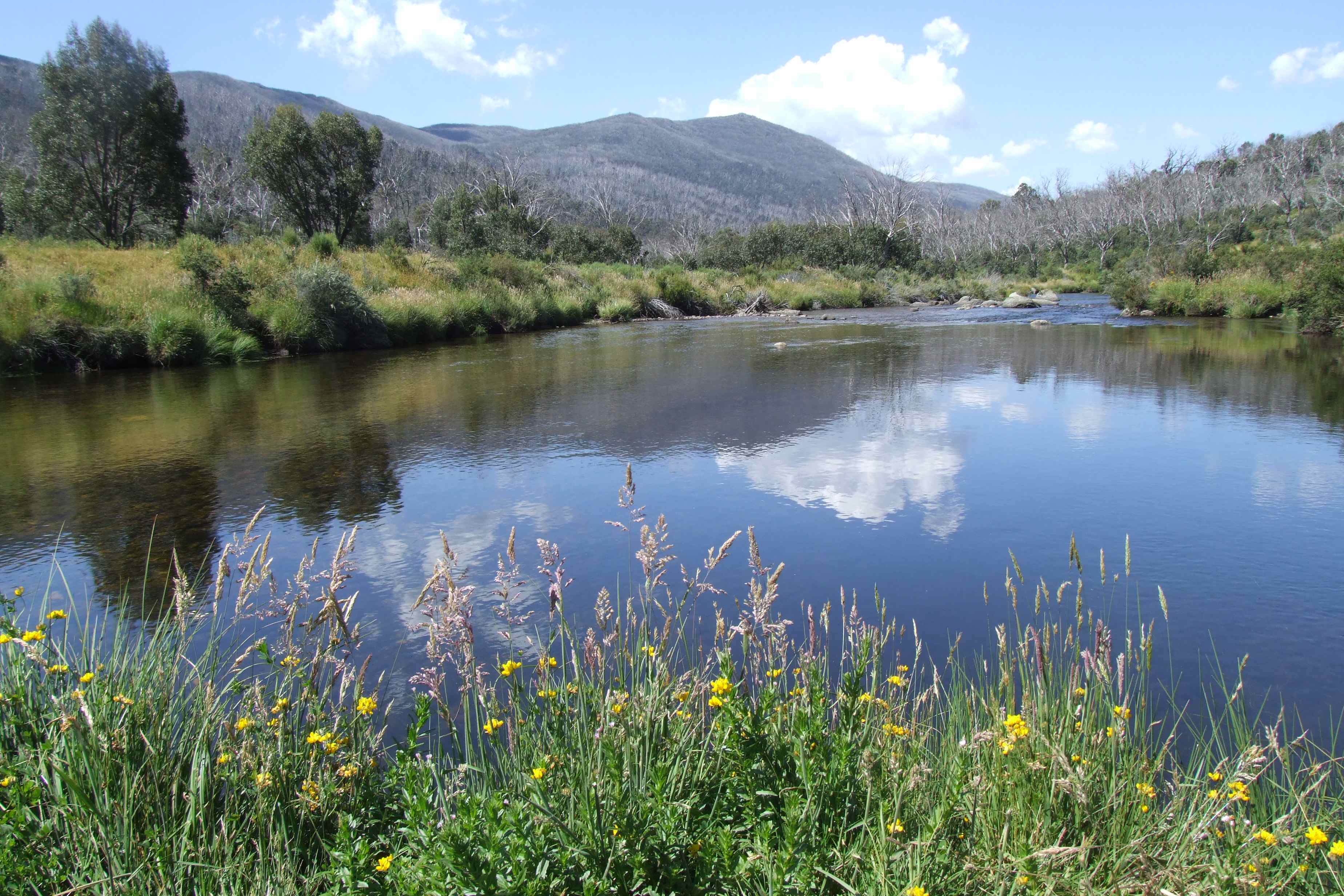
Thredbo River, Kosciuszko National Park

To the wet (Thredbo River, Kosciuszko National Park)

Well, there’s the start – brief though it is. I hope in future weeks to explore in more depth all sorts of writers, works and issues relating to literature in Australia. It will be rather serendipitous. Meanwhile, I’d love to hear from you about your favourite Aussie writers…

What is a classic: Guest post at DesertBookChick

Those who read this blog may have come across DesertBookChick (DBC) before. She’s the one who doesn’t like Jane Austen! In fact, she admits that, despite being a PhD, she’s a bit anxious about classics in general. However, not one to shy away from a challenge, she has declared August Classics Month on her blog. She is running a range of activities for this, including guest posts. Today the guest blogger is me. Do go check out her blog. And, if you’ve come here from there, you are most welcome to check me out!

Anyhow, writing that post – and reading some of the comments already made on DBC’s blog this month – has made me think more on this whole classics business. And here is what I think…

They must speak to some universal truth

That is, what they say about human nature has to ring as true today as when they were written. There is a fascinating little paradox here though, because classics can come and go. Clearly there is something more going on – something, perhaps, commercial or political or academic, which brings me to …

They must stand the test of time (and place)

Little Black Dress

Little Black Dress, says Clker.com (Courtesy: Chika87 at Clker.com)

To know they ring as true today as when they were written, some time must have elapsed. Think classic fashion. A classic LBD (aka little black dress) is one which looks as smart (note, not trendy, not funky, but smart) today as it did 30 years ago. It may show its age around the edges – perhaps an older style fabric, or a slightly different length – but it still works beautifully.

The way I test this for literature is not by defining an arbitrary amount of time but by a more pragmatic rule-of-thumb. And that is multiple reprintings – not in the first flush of publication, but some years down the track. The more years down the track and the more reprintings, the more classic perhaps? Or, at least, the closer it gets to the pantheon of classics, like, say, Shakespeare and Jane Austen!

But it is not always quite this simple

Some books die and then are revived. Sometimes this is to do with “fashion” in academia as writers fall in and out of favour (but I’m not going to explore this one now). Sometimes though there is something more, shall we say, political going on. And here I’m referring to minorities, such as, oh, women! In the 1970s, with the revival of feminism, there appeared a number of publishers who fossicked out works by women that had been lost (the works that is, not the women!). Virago Press and The Women’s Press are two biggies, but there were (and still are) many others. They (re)introduced us (or me at least!) to writers like Elizabeth von Arnim. These presses revealed that, while the meaning of “classic” as expressing something universal may be a commonly agreed thing, what we get to read is a highly constructed thing.

I’d love to know what you think. What do you mean by classic (excluding the Greeks for the time being!)? Do you purposefully choose or not choose to read classics, or is the notion of making such a distinction irrelevant to you? What are your favourite classics?

And, if you are interested in what some others are saying on this, do pop over to DesertBookChick. While there, you could always help me in my project of changing her mind about Jane Austen!

Helen Garner, Cosmo cosmolino

When I returned to seriously reading Australian writers back in the 1980s, there were four women writers who caught my attention, and I have loved them ever since. They were Elizabeth Jolley (1923-2007), Thea Astley (1925-2004), Olga Masters (1919-1986) and Helen Garner (b. 1942). Garner, the youngest by a couple of decades, is the only one still here, still writing novels, short stories, non-fiction and journal articles. I say I love her, but I can’t say I always agree with her. In fact, sometimes she makes me mad – but I admire her honesty and love her writing.

Cosmo cosmolino is not her most recent work. It was published in 1992 and has been on my TBR pile since my brother gave it to me in 1995. How embarrassing! But it finally managed to scramble to the top and I’m glad it did. It’s an intriguing book: it looks like two short stories (“Recording angel” and “Vigil”) and a novella (“Cosmo cosmolino”), but nowhere on the cover or the title page does it say “a collection of short stories”. This means, I think, that we are meant to see it as a novel.

So, how does it work as a novel? Each story would, I’m sure, stand perfectly well alone, but the two short stories also work as back stories to the novella. The tricky thing though is that the connections between these three are only obvious if you are an attentive reader – or, if you re-read it. For me it was a bit of both. I got some of the connections first time around, and others when I flicked through it to prepare this review. This is not a big problem but there is more depth if you have “got” the back stories when you read the final story.

And so, what are the three stories?

  • “Recording angel”. A recently separated woman (who is clearly Janet in the final story) visits an old friend and his wife in Sydney. This friend is seriously ill with brain cancer. He has not only been an important support and rescuer for her but the one who has “recorded” her life. And, he is never backward about telling her his view of what that is. She doesn’t always like or agree with this view, but she nonetheless fears the possibility that in sickness he will “forget everything” and that she will thereby lose an important connection with herself. There is a brief mention in this story of Ursula, who is the mother of the girl in the second story.
  • “Vigil”. A young woman, who is clearly “out of it” and waiting for her father to rescue her, has a boyfriend Ray(mond), who appears to be there more for the “good times” than for a mutually supportive relationship. When things go wrong, he’s not there for the count. This, we discover in the final story, is something he’s been trying to rectify ever since.
  • “Cosmo Cosmolino”. Three rather lonely people – the aforementioned Janet and Ray plus the rather fey artist, Maxine – find themselves sharing Janet’s house. It’s an uneasy grouping.  Ray is waiting for his big brother Alby (who once lived in Janet’s house) to arrive and take him away; Maxine would like a baby but is running out of time; and Janet is recovering from a broken marriage and doesn’t really know what she wants.

These are not strongly plot-driven stories. However, quite a bit happens on the emotional front, and this is Garner’s real subject.

Which brings us to the themes

Taken together, these stories are about the muddles people get into, particularly regarding their relationships with each other. Poor decisions, missed opportunities and the never-ending seeking for meaningful connection are the stuff of her fiction. But there is a departure in this book: the introduction of a spiritual (and at times magical) element, often involving some sense of “visitation”.

Angel Wings

Angel wings(Courtesy: OCAL via clker.com)

In the first story, the distraught woman is visited at the end by “a small, serious, stone-eyed angel of mercy”. In the second story Ray is dragged into a rather ghoulish underworld-like scene, after which he is told “You’ll be right … Things’ll be different now”. And in the final story there are all sorts of hints of spiritual happenings, including the “dark column” that shadows Janet, and Maxine’s “magical realist” flight “into the blinding upper sky” where “nameless souls and sacraments outrageously disport themselves”.

It all feels very un-Garner-like. She is usually firmly grounded in the real world of messy relationships where people struggle to connect and find meaning. But I should have been prepared: the novel’s epigraph from Rilke reads “Every angel is terrible”. “Terrible”, of course, has two meanings, and I suspect Garner is playing on both here – on the fear angels engender and the awe. As this paradox implies, there is no suggestion here of easy answers but more of possibilities. Here is Janet at the end:

Our minds are not hopeful, thought Janet; but our nerves are made of optimistic stuff.

I was intrigued by the use of “nerves” rather than “souls” or “spirits” given what had gone before, but I rather like her use of that word. It’s effectively ambiguous.

Finally, the style

The thing that marks Garner out for me is her expressive language. Her books are rarely long. This isn’t because she doesn’t have much to say but because she doesn’t waste words. Read this:

… The heart of the house was broken. It ought to have been blown up and scraped off the surface of the earth.

But houses as well as their owners must soldier on …

and this:

… and the architraves had lost their grip on the walls, and slouched this way and that …

and, finally, this:

The room contracted around Ray again, fitting itself tightly to the shape of him, squeezing …

I love the atmosphere and emotion conveyed by language like this.  Garner uses a lot of imagery and symbolism – but never simply. Birds, for example, can augur wonder and hope, or, particularly when “the failure bird” appears, something completely different. There are also biblical allusions, such as when Ray denies three times that he knew his girlfriend. No wonder he’s dragged into the underworld for a bit of shock therapy! From beginning to tend, the language never sways from conveying a sense of things being awry because the characters’ lives are so.

Cosmo Cosmolino is one of those books that is both accessible and challenging – and that is just the sort of book I like to read.

Helen Garner
Cosmo cosmolino
Ringwood, Vic: McPhee Gribble, 1992
221pp.
ISBN: 0869142844

Howard Zinn, Finishing school for pickets

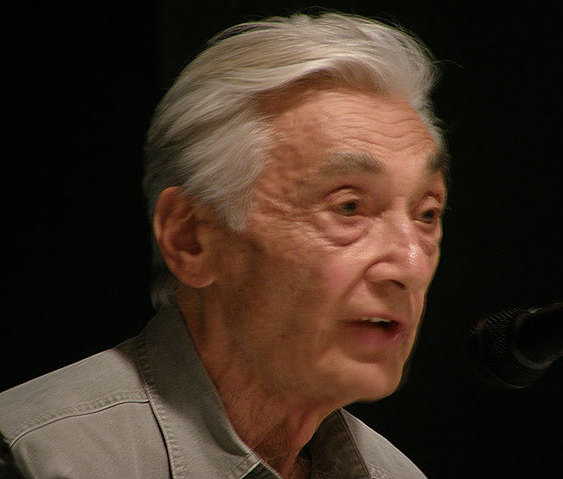
Howard Zinn

Howard Zinn, 2009 (Courtesy: B-Fest at Athens Indymedia, using CC-BY-SA 2.0, via Wikipedia)

I have been remiss lately with my Library of America reading. Busy-ness has taken its toll, but it just so happened that this week I was (briefly) between books and the LOA offering looked right up my alley, so I decided to read it over breakfast. “Finishing school for pickets” was published in 1960, making it the most recently written of the LOA items I’ve read to date. It was written by Howard Zinn (1922-2010), an American writer, historian, activist and all-round intellectual. You can read the essay yourself, online, at the Library of America site.

However, before I discuss this essay, a little background. In 1955, Rosa Parks refused to give up her seat to a white person on a Montgomery, Alabama, bus. She wasn’t the first to take such action but it was this particular occasion which sparked the Montgomery Bus Boycott whose aim was to end segregation on the city’s public transport. The battle was finally won in a Supreme Court ruling in late 1956. But, more importantly, it played a pivotal role in the fledgling Civil Rights Movement in the USA. Now, jump a few years and over the border to Atlanta, Georgia, and we are in the time and place of Zinn’s essay.

In 1960, Howard Zinn was chair of the history department at Spelman College, America’s oldest “black college for women” (Wikipedia). This college was well-known as, more or less, “a finishing school” for young black women. They were encouraged to “be nice, be well-mannered and ladylike”, to “not speak loudly” and not “get into trouble”. As Zinn says, “if intellect and talent and social consciousness happened to develop also, they were, to an alarming extent, by-products”. Here is the opening para of the essay:

One quiet afternoon some weeks ago, with the dogwood on Spelman College campus newly bloomed and the grass close-cropped and fragrant, an attractive, tawny-skinned girl crossed the lawn to her dormitory to put a notice on the bulletin board. It read: Young Ladies Who Can Picket Please Sign Below”. (Let’s not worry here about the “attractive, tawny-skinned” descriptor as Zinn’s heart was clearly in the right place).

Zinn goes on to chronicle various subversive actions being undertaken by the “still ‘nice'” but politically aware students. He says: “They are well-mannered, but this is somewhat tempered by a recent declaration that they will use every method short of violence to end segregation”. And so what do they do in the cause of desegregation? They sit in the front (aka white) area of buses; they occupy the white section of the Georgia Legislature’s gallery “in a pioneering show of non-violent resistance”; they show up “at the main Atlanta library in sufficient numbers to worry [my emphasis] the city administration into a decision to admit Negroes there” (what the? the librarian in me asks), and so on. Zinn writes that:

Spelman girls, more sheltered than women at the other colleges, were among the first to leave the island and to begin causing little flurries of alarm in the segregated outside world.

These activities, he says, may have bewildered the conservative matriarchy of Spelman, but they infuriated the “officialdom of the State of Georgia”. However, this did not stop the students of Spelman (and the other colleges of the Atlanta University Center) who continued their campaign even though, as Zinn describes it, many of them came from “the deep South … the Faulknerian small towns of traditional Negro submissiveness”.

It’s a highly readable essay, with light-handed use of various rhetorical devices to progress his argument, but it does not conclude on any great triumphs. After all, in 1960, there was (and, some would say, there still is) a long way to go in the cause of true racial equity. Zinn’s goal was, I assume, to raise some awareness amongst the white readers of The Nation. I can only hope he did so. As for him, he was fired from Spelman in 1963 “for insubordination” (his words), that is, for siding with his students in their fight for desegregation.

Zinn died earlier this year. Not long before he died he said that he would like to be remembered “for introducing a different way of thinking about the world, about war, about human rights, about equality,” and “for getting more people to realize that the power which rests so far in the hands of people with wealth and guns, that the power ultimately rests in people themselves and that they can use it. At certain points in history, they have used it. Black people in the South used it. People in the women’s movement used it. People in the anti-war movement used it. People in other countries who have overthrown tyrannies have used it.” (Wikipedia).

This essay is clearly just one tiny example of how he went about achieving this lifelong passion. I am indebted to the Library of America for making it available to us.

South Solitary (Movie)

Tacking Point Lighthouse

Not on an island, not to the south, but an Aussie lighthouse - Tacking Point

What is it about lighthouses? They conjure up such a romantic notion of life in the wild, of communing with and/or battling the elements. They excite us with their extremes of remoteness and loneliness which can push people to their limits. And they paradoxically symbolise both life (light) and danger (warning). All of these are present to some degree in Shirley Barrett’s latest film, South Solitary, which is set on a remote lighthouse in the southern seas off Australia, in the late 1920s. Barrett says she chose this time period because it was before radio communications, and thus enabled her to explore how humans behave under extreme isolation.

The basic plot is that George Wadsworth (Barry Otto) and his niece, Meredith Appleton (Miranda Otto) arrive at an island lighthouse where George is to be head keeper. Already on the island are assistant lighthouse keeper Harry (Rohan Nichol) and his family, and the war damaged Mr. Fleet (Marton Csokas). These characters are all recognisable and the story is pretty predictable. Meredith is single, having lost her almost-fiancé in the first world war. Her uncle is the tough and somewhat unbending keeper of the old school. Harry is the “never-let-a-chance-go-by” womaniser, and Fleet the broody, awkward silent type. It’s generally realistic – Barrett doesn’t push the drama much  beyond the limits of our belief (though there are a couple of debatable points) – but it is also rather archetypal, and so nothing in the story really surprises.

For these reasons, I found it to be an enjoyable – though not great – movie. The things I particularly enjoyed were:

  • the cast, particularly Miranda Otto who perfectly juggles her fragile, rather too naive but also a little coquettish character; Rohan Nicol who plays the “cad” to perfection; Annie Martin who plays a knowing and unsentimental 10-year old; and Marton Csokas who, despite his almost clichéd stiff gruffness, has a voice to die for;
  • the setting – the way the island and the sea are filmed to convey, at different times, beauty, freedom and terror;
  • the social history of lighthouse living – such as the use of carrier pigeons and semaphore flags for “comms” (as we’d call it today).

Overall, this film is just a little too predictable to match the power of Beautiful Kate or Samson and Delilah or Animal Kingdom, but, it is an eminently watchable movie, primarily because of the cast and the setting. I’m not at all sorry I saw it – I could watch Miranda Otto, in particular, forever – but I’m not sure how long I’ll remember it.