What gives you joy?

I’ve just watched Andrew Denton interviewing Clive James on his Elders program. He asked James what gives him “joy”, and James replied “the Arts”. James said it didn’t have to be anything particular, it could be Marvin Gaye singing “I heard it through the grapevine” or the Adagio from Beethoven’s Ninth Sympathy or a painting by Toulouse Lautrec (whom he apparently adores). What a great answer! Being the eclectic dilettante (to lay it on thick) that I am, I can relate to that … I just hope all those responsible for funding education were watching. The Arts should be absolutely fundamental to any school program. (Now you know one of my soapboxes).

While James didn’t specifically mention books in response to that particular question, the interview did take place in his library. He is said to own 1000s of books. In response to Denton’s question about how we should judge him if we agree with the idea that we “can judge a man (hmm…) by his relationship to his books”, James said:

Intimately involved I should’ve thought. And this is just sort of the outer limit of the books that I own. And that immediately raises the question, not how many of them have you read – cause I really have read most of them, I’ve been alive a long time now – but how many of them will I read again? And if I won’t, why are they here? …[Answering this question he continued] I just like the look of them. I think the civilisation that exists in the book gets into you through osmosis, I like to have them around.

I hope he’s right … about the osmosis I mean! I sure know he’s right about liking to have them around.

Anyhow, anyone like to share what gives them joy?

Bright star, or a thing of beauty?

What can ail thee knight at arms,
Alone and palely loitering?
The sedge has wither’d from the lake,
And no birds sing.

I have always loved these opening lines  of John Keats‘ “La Belle Dame Sans Merci”. The first two lines with their mystical, but also traditionally Romantic, melancholy, just roll off the tongue. You want to read them out loud. The third line though, with its harder sounds, starts to suggest something different, and this difference is delivered in the wonderful shock of the shorter last line with its more staccato like rhythm. This, by the way, is my rather idiosyncratic introduction to the recent biopic, Bright Star, about John Keats and Fanny Brawne. I’m not being totally idiosyncratic though as several lines of the poem are recited in the movie…

Bright Star, which is also the title of a Keats’ poem, was written and directed by the wonderful Jane Campion (whom we Aussies like to call our own though she was born in New Zealand). According to the credits she based much of her script on a biography of Keats by Andrew Motion. The film is set in the last years of Keats’ life (surely this is not a spoiler?) between 1818 and 1821, so the fashions are exactly those I love – Regency. Through this and a host of other details, the film feels historically accurate – in tone and look at least. I only know the basics of Keats’ life so can’t really comment (without doing a lot of research!) on its veracity to the details of his and Fanny’s story. But, as I’ve said before, I’m not sure that matters if the essence of their story is achieved, and I believe it is.

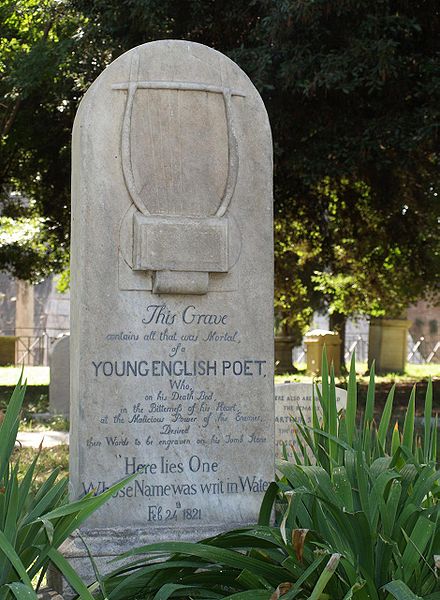
John Keats' grave, Rome

John Keats grave, Rome (Courtesy: Piero Montesacro, via Wikipedia, under CC-BY-SA-3.0)

The film has an elegaic feel – in its muted colours, slow pace, and the rather  (unusually so for a period piece) spare music. This spare use of (spare!) music is carried through to the credits during which, instead of music, we hear Ben Whishaw recite Keats’ poetry. Despite its slow march towards its inevitable conclusion, however, the film also has some light moments, many of them in the lovely family scenes which include Fanny’s brother and sister.

One of the endearing things about the film is Fanny’s comment early on that poetry “is a strain” to understand. Poetry is not an easy art form – how many people have you heard say “I don’t get poetry”? – and there is something reassuring in having that validated.  After all, Fanny is, in a way, everygirl – compassionate but also a little wilful, somewhat coy but at the same time rather knowing. She is, as conceived by Campion and played rivettingly by Australian actor Abbie Cornish, entirely believable as a universal teen girl, but one living in the early 19th century.

In a scene between the lovers (albeit an unconsummated love), Whishaw, as Keats, recites the film’s eponymous poem:

Bright star, would I were steadfast as thou art–
Not in lone splendour hung aloft the night

Still, still to hear her tender-taken breath,
And so live ever–or else swoon to death.

Here is Keats expressing the paradoxical nature of life and love, the way permanence and impermanence can exist side by side. This is rather poignant given the facts of his life: he died at just 25 years of age but his poetry has become firmly entrenched among our classics.

If you are interested in Keats’ story, or if you like films that slowly but beautifully evoke a past era, then this is likely to be a film for you. If, on the other hand, you like something with a bit of zing and an element of surprise, then you might best look elsewhere… For me though, this film is “a thing of beauty”.

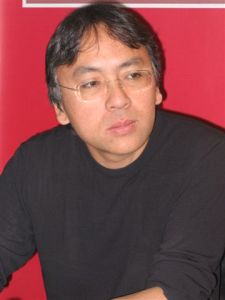
Kazuo Ishiguro, Nocturnes: Five stories of music and nightfall

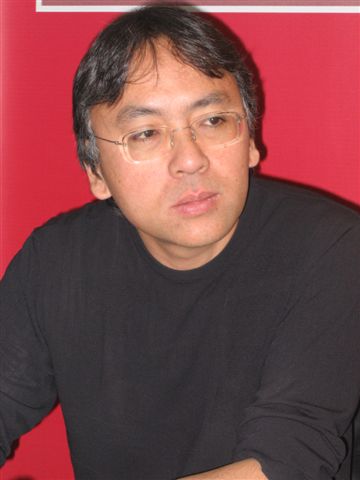
Kazuo Ishiguro

Kazuo Ishiguro, 2005 (Courtesy: Mariusz Kubik CC-BY-SA 3.0)

I like Kazuo Ishiguro – and have read 5 of his 6 novels – so I was looking forward to reading Nocturnes, his first published collection of short stories. Nocturnes, as the subtitle describes, comprises five short stories, each focussing in some way on music, and on a day’s end.

The five stories – a couple of them with overlapping characters – are unmistakably Ishiguro. All have first person narrators, and in all cases the narrator is either unreliable or in some other way not completely across what is going on. This is the Ishiguro stamp … as is the overall tone of things not being quite right, of potential not being quite achieved, of people still looking for an elusive something but not necessarily knowing quite what that is.

When reviewing a short story collection I don’t necessarily feel the need to list each story but with there being so few in this case, I think I will, so here they are:

  • “Crooner”: an aging crooner, with the narrator as his accompanist, serenades his young wife from a gondola at a time when their marriage is breaking down
  • “Come rain or come shine”: a nearly 50-year old ESL teacher visits old university friends, only to find that their relationship is under stress
  • “Malvern Hills”: a not-yet-successful young rock guitarist visits his sister and brother-in-law in the country, and meets some Swiss tourists who are also musicians and whose marriage is a little rocky. (Hmm… see a theme developing here?)
  • “Nocturne”: another not-very-successful musician (this time a saxophonist) finds himself in the same hotel as the (now ex-)wife from the first story, while they are both recuperating from plastic surgery
  • “Cellists”: a cellist with potential is mentored by another cellist who is not quite what she seems

While there is a similarity in the tone of these stories, there are also differences. “Come rain or come shine” and “Nocturne”, for example, are a little reminiscent of When we were orphans in the sense that Ishiguro slowly (even in a short story!) but surely leads his characters (and we readers alongside) into increasingly bizarre, if not almost surreal, behaviours. Moreso than the other stories, these two have a comic, albeit tinged with pathos, edge.

The technique Ishiguro uses to present his notions of failing or missed potential is one common to most of his writing: he explores and exposes the gap between appearance and reality. This gap is given literal expression in “Nocturne” where two would-be stars are both bandaged for most of the story as a result of their plastic surgery, but it is there in all the stories: from the first story’s Tony and Libby Gardner who are separating for the most “superficial” of reasons to the last story’s self-described virtuoso cellist. It is found in Ray Charles’ version of the title song in “Come rain or come shine” “where the words themselves were happy, but the interpretation was pure heartbreak”. This gap is also conveyed through the prevaricative words commonly used by Ishiguro’s narrators, such as “I guess”, “perhaps”, “maybe” and “probably”:

I guess it showed in our music (“Crooner”)

Perhaps it was simply the effect of receiving a clear set of instructions (“Come rain or come shine”)

Maybe they were just tired. For all I know, they might have … All the same, it seemed to me (“Malvern Hills”)

… that probably means … and Maybe it was plain spinelessness. Or maybe I’d taken on board … (“Nocturne”)

Maybe there was a tiny bit if jealousy there … and … well, maybe there’s something in that (“Cellists”)

Ishiguro’s hallmarks of misconceptions and misconstructions, assumptions and self-deceptions are all evident here…sometimes in the narrator, sometimes in the other characters, sometimes in both.

The stories stand alone but, somewhat like Tim Winton‘s The turning, there’s a feeling that these stories go together, not just because of the recurring characters in two of them, and the apparent similarity of setting in the first and last stories, but also because of the recurring musical motif and the consistency in theme. If I were a musical expert rather than dilettante I might have tried to relate the five stories to some sort of musical structure but, fortunately for you, I am just the dilettante! That said there are some neat little links between the first and last stories which round them off nicely, just like a well-conceived piece of music.

There are no twists in the tail or crashing codas in these stories. This may disappoint some readers but, for me, they are deliciously conceived quiet, subtle stories that cleverly draw you into their characters’ lives while at the same time leaving you with the impression that you should keep your distance lest you too suffer from their malaise and disappointments.

Kazuo Ishiguro
Nocturnes: Five stories of music and nightfall
London: Faber and Faber, 2009
221pp.
ISBN: 9780571244997
Six months old today!

Precious things: My kids and some of my toppling TBR piles!

I started writing this blog six months ago today – and what a fun experience it’s been, not only because I’ve enjoyed forming my thoughts into some sort of coherent (I hope ) whole, but also because it has introduced me to a vibrant, welcoming and encouraging book blogging community. I put off starting a blog for a long time exactly because I feared being caught up in another community – not because I hate community but because I feared spreading myself too thinly. Well, I probably am spread a bit too thinly across all my interests and enthusiasms but I don’t regret starting blogging for one minute. And for that I thank you lovely bloggers who have taken the time to read and comment on my blog and, where I’ve needed it, to offer help and guidance. Thankyou!

Like most bloggers – I think – I am interested in who comes to my blog and what they come for. My most popular post by far (and “by far”, I mean so “by far” that there’s not another post within cooee) is my post on the film Coco Avant Chanel. The post is about the “biopic” but the searches that lead to it all seem to be for Coco Chanel herself. I’m truly gobsmacked. And moreso because this post has not one comment on it. Curious, as well as gobsmacking.

My second most popular post, if you can call it a post, is, not surprisingly “Who am I?”. My third, though, intrigues me again. It is not one of my Australian posts (my Winton post comes in fourth) but my post on the Indonesian book This earth of mankind by Pramoeyda Ananta Toer. All I can think is that he continues to be studied internationally and hence the slow but constant hits on it. I’m not going to bore you by listing all my top ten posts and analysing them, but they are an eclectic lot and include posts on:

  • the indigenous poet Kath Walker (aka Oodgeroo Noonuccal),
  • the Aktimate speakers I bought for my iPod,
  • the Sydney Blue Gum, and
  • the one on Jane Austen that mentions The Times newspaper of 1785. I have no idea why people are searching for  “The Times 1785” but they are, and they get my post. I wonder if they are happy when they get there? I’ll never know cos they never tell me…

And that, I suppose, is the rub. We know more or less what those who comment think but what about all the others? Who are they? Did they find our posts useful? Ah, sweet mystery of life ….