C.J. Dennis, The moods of Ginger Mick

Sometimes a bloke gits glimpses uv the truth
(“In Spadger’s Lane”)

I wasn’t sure, really, that I wanted to read CJ Dennis’ verse novel, The moods of Ginger Mick, which I received as a review copy from the Sydney University Press as part of their Australian Classics Library – but have surprised myself. I rather enjoyed reading it and am glad that I had this little push to do so!
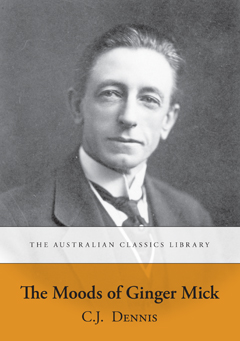
The moods of Ginger Mick
The moods of Ginger Mick cover (Courtesy: Sydney University Press)

The moods of Ginger Mick was published in 1916 just weeks before the big Conscription Referendum, according to Philip Butters who wrote the new introduction to this edition. It does not however buy into that debate. The book comprises 15 poems “written” by Dennis’ other character, The Sentimental Bloke, at whose wedding Mick was best man. The poems introduce us to Mick and his larrikin life before the Great War and then go on to chronicle his life as a soldier.

Dennis writes his poems in broad Australian slang (but there is a glossary at the end). Most are 6-line stanzas with an ababcc rhyme (the same as Wordsworth’s “Daffodils”!) but every now and then there is a different rhyme scheme which mixes it up a little. The sweet poem “The singing soldiers”, for example, has a sing-song aab(with an internal rhyme)acc, while the poignant “Sari Bair” about the eponymous battle has 4-line stanzas with a simple aabb rhyme.

I enjoyed reading the poems, not only for their evocative language but also for their subject matter. While their setting and language make them very much of a particular time and place, their concerns have some universality. They are about egalitarianism vs class difference, and about what it means to be a man (a “bloke” as it were). Mick starts off as a bit of a larrikin – one who cares not for the “toffs” and for whom the “toffs” care not! As he says in an early poem:

But I’m not keen to fight so toffs kin dine
On pickled olives …
(“War”)

What sends him to war in the end is “The call uv stoush” but, when he gets there, he starts to discover that in uniform all men are equal, that

… snobbery is down an’ out fer keeps,
It’s grit an’ reel good fellership that gits yeh friends in ‘eaps.
(“The push”)

This poem, “The push”, provides a wonderfully colourful roll call of the sorts of men who enlisted. Other poems cover the support of women at home, hopes for work when they return home now they’ve proved themselves (after all the “‘earty cheerin’ … per’aps  we might be arstin’ fer a job”) and the sense that Australia has grown up as a nation (“But we ‘av seen it’s up to us to lay our toys aside”). There is ironic humour (as in “Rabbits”) and pathos (as in “To the boys who took the count” and “The game” in which Ginger Mick finally realises that he’s found his metier). There’s also some racism that was, unfortunately, typical of the time. And of course there is patriotism, with some rather lovely descriptions of the Australian landscape. I just have to mention here some references to gums:

An’ they’re singin’, still they’re singin’, to the sound uv guns an’ drums.
As they sung one golden Springtime underneath the wavin’ gums.
(“The singing soldiers”)

An’ we’re ‘opin’ as we ‘ear ’em, that, when the next Springtime comes,
You’ll be wiv us ‘ere to listen to that bird tork in the gums
(“A letter to the front”)

As a group, the poems offer an interesting insight into Australia’s experience of the First World War, particularly given their mix of realism and romanticism that belies perhaps the recent glorification that’s developed around our ANZAC heritage. If you are interested in Australia’s cultural and literary heritage, it is well worth giving this short little book a look.

C.J. Dennis
The moods of Ginger Mick
Sydney: Sydney University Press, 2009 (orig. pub. 1916)
87pp.
ISBN: 9781920898984

(Review copy supplied by the Sydney University Press)
Top 12 fiction of 2009

I think, pedant that I am, I can now post my Top 12 fiction books of the year, since the book I’m currently reading (interesting though it is) won’t be on it, and I won’t be finishing another one before January 1 comes around. I am listing 12 because Tom at A Common Reader said I could! Picking 12 is about as subjective as I’m going to get and so I am going to list them in the order I read them rather than in any further order of quality:

Sleeping Reader

Why I didn't read enough classics (Courtesy: OCAL via clker.com)

There are some interesting (to me, anyhow) observations to make about this list:

  • two are short story collections;
  • six (ie half) are by Australian authors;
  • only 3 are by women authors;
  • three are works in translation by European (that includes Turkish!) authors;
  • two thirds were published this century; and
  • there are no classics (not because none made it to the Top 12 but because for some rather odd reason I didn’t read any this year – well, except for Maria Edgeworth’s delightful little novella, Castle Rackrent, which nearly made this list)

Like most statistics, these only tell part of the truth. They show my increasing interest in short stories (collections and individual), my continued commitment to Australian literature, and my desire to extend beyond anglo-literature. They don’t show, however, my longstanding commitment to reading works by women and my love of “the classics” (however you define that term). Maybe my 2010 resolution – cos I do like, for fun, to make one – will be to redress this imbalance!

Sherlock Holmes (the movie)

This will neither a book nor a film review be – since I’ve never read a Sherlock Holmes book, and I don’t really feel inspired to review Guy Ritchie’s new film, Sherlock Holmes. That’s not to say I (in fact we) didn’t enjoy the film, we did well enough. It’s just that it didn’t fully captivate us. It’s very stylish, and the cast, particularly Robert Downey Junior, not only did a convincing job but they were great to look at too!

Pipe

Smoke Pipe (Courtesy: OCAL via clker.com)

Chacun à son goût, as they say. I’ve now seen Bright Star twice. And, I could probably see it again. Some others though find it a little slow. I, on the other hand, felt there was just a little too much “adventure” and skulking round in Sherlock Holmes. It’s pretty predictable…good triumphs over evil, the little twists provide no real shock…but it is fun, and it is nicely made. I would recommend it on that basis – and if you are a Ritchie or Holmes fan, I expect you’ll like it a lot.

I am one of those people who like to sit through the credits. Not only do I like to see the list of music used (and this is always near the end) and the locations, but you never know what you might discover. Sometimes just a name you know, sometimes you are given some extra information, and sometimes the credits are an art-form or entertainment in themselves. Sherlock Holmes falls into this last category. The credits were gorgeous to look at … and I had to laugh when the Costume Designers’ names came up. The image shown alongside their names (Jenny Beavan and Melissa Meister) was the one scene in which Downey (as Holmes) wore nothing but a cushion! For a stylishly recreated period movie, that has to have been intended…and is one of those little jokes that rewards we who sit through the credits.

Best unread books of the decade

One of my favourite internet bookgroup friends – the one who gave me the Jane Austen diary – has just posted, on a listserv we belong to, a link to The Guardian’s list of books that got away over the last decade. Now, that’s a new take on lists isn’t it?

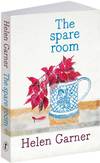
Spare Room

The spare room cover (Courtesy: Text Publishing)

They asked people like publishers, literary agents and translators to nominate books that didn’t make, but they think should have, “best of best” lists. I’ve only read one of the books nominated, Helen Garner’s The spare room. It was nominated by Jamie Byng, the Managing Director of Canongate which published it! Fair enough. I’m sure they published many other books that didn’t make the “best of the best” lists either so his selection has some credibility. I think he hits the nail on the head when he says  it is “deceptively slight”. It does seem pretty simple but Garner is a great writer, and an unflinchingly honest one too. Put these together and the result is a compelling book, even though Lisa at ANZLitlovers doesn’t quite agree. Actually, both of us disagree with much of the way Garner views her world but I admire her nonetheless. Read this:

The one thing I was sure of, as I lay pole-axed on my bed that afternoon … was that if I did not get Nicola out of my house tomorrow I would slide into a lime-pit of rage that would scorch the flesh off me, leaving nothing but a strew of pale bones on a landscape of sand.

Sometimes Garner fills me with a similar rage, but when she presents me with writing and imagery as powerful and as fresh as this I can’t help but love her at the same time…and agree that Jamie Byng has a bit of a point.

(NB. The funny thing, though, is that The spare room won a few awards in Australia so I’m wondering how valid a selection it really is in this particular list.)

Helen Garner
The spare room
Melbourne: Text Publishing, 2008
195pp
ISBN: 9781921351396

Andrew Croome, Document Z

Truth, according to the dictionary, can mean several things including:

  • the state of being the case, fact or actuality; and
  • a transcendent or spiritual reality.

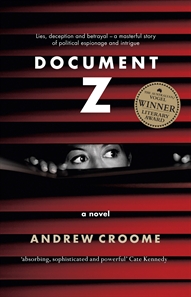
Document Z bookcover

Document Z cover image (Courtesy: Allen & Unwin)

Truth in all its variety and slipperiness is, I think, the fundamental theme of Andrew Croome’s Document Z which won the 2008 The Australian/Vogel Literary Award. This book, which chronicles the famous-in-Australia Petrov Affair about the defection of Vladimir (familiarly, Volodya) and Evdokia Petrov in 1954, began as a PhD Creative Writing thesis. Who needs a PhD in Creative Writing, though, when you have a publication offer instead?

At the end of the novel is a reference to an oral history that was conducted with Evdokia by the National Library:

This historian’s questions give her the space to betray Volodya, to admit his faults, to commit herself finally, to the truth. She doesn’t. The record is no all-important thing, and what exactly would be the point?

What indeed? After all, duplicity is what the book is about. Vladimir and Evdokia are MVD agents at the Soviet Embassy. This is their secret role, in addition to their formal embassy roles, and it puts them in conflict with the ambassador since, in effect, they work for two masters, the ambassador and the MVD headquarters in Moscow. Not an easy position to be in, particularly in a regime that thrived on suspicion.

Croome nicely structures the book, commencing with the dramatic attempt on 19 April 1954 by the Soviet authorities to return Evdokia to Russia. The book’s narrative form is multiple third person subjective, and this opening scene is viewed through Evdokia’s eyes: “Evdokia knew this crowd was for her. They were hunting her…”. She was wrong though. The crowd was with her and were “hunting” those who seemed to be taking her away. This opening chapter ends with the words, “Everything he had betrayed”. The scene is set to tell their story, and the book flips back to 1951 and their arrival in Canberra. From this point on the story is told through several eyes, particularly Evdokia’s, Vladimir/Volodya’s (who, Moscow thought, “could be well and truly trusted [my stress]”) and Dr Bialoguski’s (the man who worked for ASIO and who, through cultivating Petrov’s friendship, engineered the defection).

I enjoyed the book – partly because it was set in familiar territory, which is a bit of a rarity for we Canberrans, and partly because I was interested in the Petrov Affair. Croome seems, to the best of my knowledge, to have captured the era well. I loved the description of the Soviet Embassy wives going shopping…and he nicely evokes the polarisation of views between East and West/Communism and Capitalism that characterised the Cold War period. However, the book was a little unsatisfying too. I think it’s because Croome focusses a little too much on plot machinations for me – and yet the plot is not dramatic enough to support this. He does try to get “into” the characters but, for all his sound characterisation of the Petrovs, they are, at the end, pretty much as shadowy in terms of their “true” natures/desires/motivations as they were at the beginning. In the end, there’s not much drama in either the political or the personal story. It feels, almost, as though they were victims of circumstance – and perhaps they largely were.

And what were these circumstances? Well, they were largely the duplicitous – and fear-ridden – situation they lived and worked in. I had to laugh, early in the book, at the description of the embassy’s secret (MVD) section: “Somewhere, the roof leaked“. The book has many little ironies and paradoxes mostly playing on notions of secrets, lies, deception and betrayals, playing, that is, on a world in which truth is treated with rather careless abandon. By the end of the book we are, I think, no nearer the truth. We perhaps know some of the “facts” (albeit this is fiction!), but we do not “really” know the “spiritual reality” of these two people whose marriage seemed weak and who apparently lived a pretty sad life in exile.

I’d certainly recommend the book … it’s well written, and is a genuinely interesting portrayal of the case. But if you are looking for insights into the affair, I’m not sure you’ll find them here.

Andrew Croome
Document Z
Crow’s Nest: Allen & Unwin, 2008
350pp.
ISBN: 9781741757439

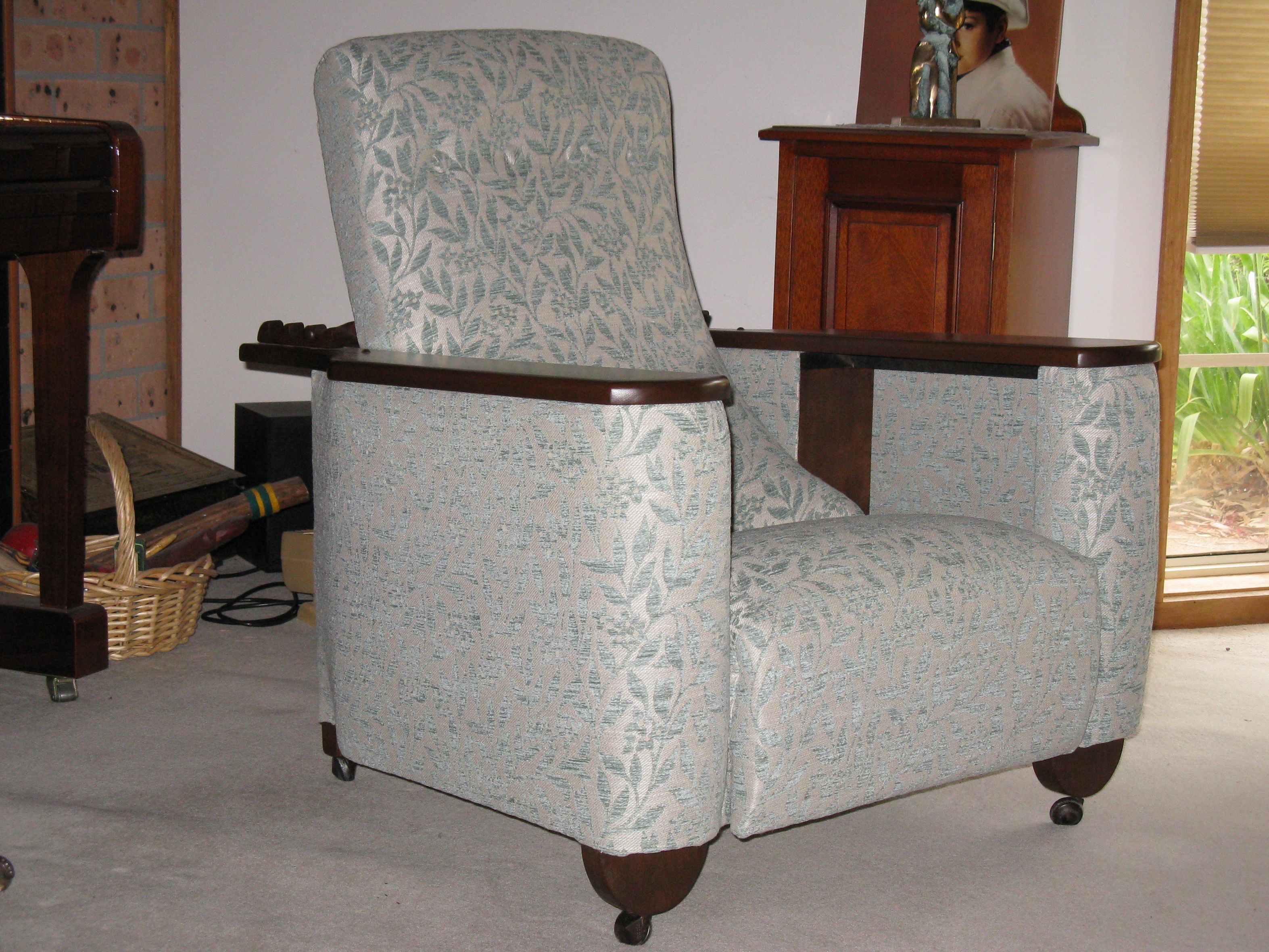
Smoking chair?

Arm chair

Arm chair, c. 1930

…and now for something completely different. Recently I was offered, and gratefully accepted, two chairs which had belonged to my grandparents and which date back to around 1930. They no longer suited my aunt’s needs, and my father, keen to see them stay in the family if they were wanted, offered them to me (with refurbishment thrown in). Not an offer to refuse – particularly when I too had a sentimental attachment to the chairs. After all, I remember them from my grandparents’ home and I do love to have around me things that have some meaning. Readers of this blog know that I love gums and so will not be surprised that the fabric I chose for the new upholstery is called Gumleaf. I am thrilled with it – it’s soft but distinctive – and adds another layer of meaning to the chairs for me!

My father remembers sitting in these chairs and smoking a fat cigar with his dad (some many years after 1930 I hasten to add) – and I think chairs like this were sometimes called smoking chairs. I’m not quite sure what “like this” means other than perhaps that such chairs are very comfortable to sit and relax in. These ones can even be reclined.

You may wonder, though, why I am writing all this? Well, it’s because while some might see them as smoking chairs, I reckon others could very well see them as reading chairs. Not only is this one comfortable, but it has nice wide armrests for that cup of coffee (or whatever takes our fancy) that we like to imbibe while reading. But, more importantly, though you can’t see this easily in the photo, under the armrests are deep open pockets in which it is possible to stow a few books from the TBR pile. They were only delivered last week and, with Christmas around the corner, I have little time to read but, come the new year, I think I will have a new favourite place to read…

My second book for Christmas

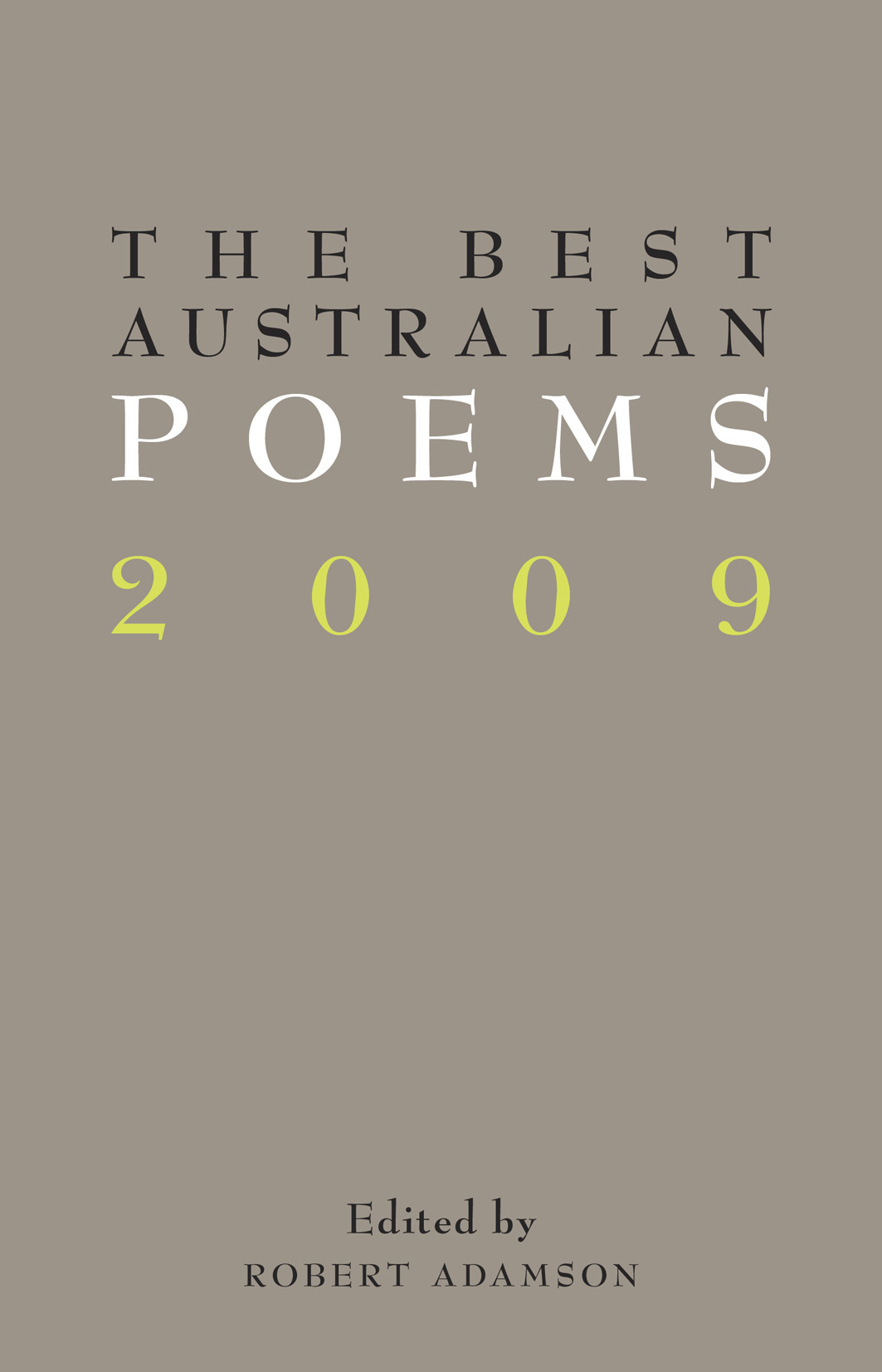
Is this starting to sound like a carol you know? Anyhow, I did say in a comment on my first Christmas book post that I had received another book for Christmas, The best Australian poems 2009 (edited by Robert Adamson). DKS’s comment about the value of this annual series to the cause of poetry made me think that I ought give it its own post.

I wouldn’t call myself a poetry expert, but I have mentioned poetry several times in this blog’s short life because I do enjoy reading it and wish, really, that I spent more time with it. Australian surgeon Mohamad Khadra, in his rivetting memoir, Making the cut, talks about the value of poetry, about how each day on his hospital teaching rounds he would begin by having his students recite a poem that might offer some entrée to understanding their patients’ states of mind. His view is that, as doctors deal daily with humanity, they, and by extension we, can learn from poets who have spent lifetimes making a study of humanity. Each chapter of his memoir commences with a poem.

The Best Australian Poems 2009

Cover image (Courtesy: Black Inc)

But I digress. Robert Adamson mentions three poets in the first paragraph of his introduction – Irish WB Yeats, English Gerard Manley Hopkins (one of my favourites) and Australian Meg Mooney – referring to use in their poems of birds and song. He says that there are many birds and lyrics in the anthology. I’m not quite sure why he singles out these two particular ideas in what is a general anthology – but maybe I’ll know by the time I’ve read all the poems?

To make the selection for this volume he “read all the poetry in the print publications as well as many of the electronic journals and even blogs that feature poems”. Isn’t it great seeing the blog world becoming an integral part of the publishing industry! He says about his selection that he “wanted to create a rhythm for the reader: shorter lyrics and some satirical poems, then hopefully a few love poems, poems of weather, landscape poems and, of course, bird poems.” Ah, the birds again…and then comes the explanation:

People ask me, why are so many bird poems being written and published? I have a theory : we miss having poets among us who can imagine that a soul can ‘clap its hands and sing, and louder sing’ [Yeats], that we need to acknowledge visitations by intense psychological presences, and that birds are the closest things we have, more or less, to angels.

Wow! I’m not quite sure how to respond to that.

The anthology commences with a lovely poem by Martin Harrison titled “Word” written for Dorothy Porter, after her death:

in which briefly suddenly one voice’s glimmer is lost

The anthology also includes a poem by Porter and, indeed, contains for the first time apparently more poems by women than men. The poems are listed alphabetically by poet – saves need of an index not to mention the problem of how to sequence the poems (and all those questions about how one poem’s proximity to another will affect its impact or meaning). He has also included a lot of new poets, more perhaps than in the past, as well as the tried and true. And that is how I like it (just as I like a “classical” music concert to mix it up a bit).

I think that’s about enough on a book I haven’t fully read, so I’ll just finish with some lines from Meg Mooney to whom Adamson referred in his opening paragraph:

The large, brown shapes of the wedgebills
their cheeky crests
disappear as I get closer

like they’re telling me
you can’t just look
and expect to see
in this country

(from “Birdwatching during the Intervention“)

The best Australian poems 2009
Melbourne: Black Inc, 2009
239pp.
ISBN: 9781863954525

My first book for Christmas

I know that Christmas is still over a week away but last night I received my first book of the season…and that, I think, is a litblog-worthy event!

Actually, I tell a bit of a lie, because last week I was sent, by a very kind internet bookgroup friend who knows my likes, the British Library Jane Austen appointment diary for 2010. It is gorgeous, containing Regency era images, silhouette images, and quotes from Jane Austen (from her books and letters). Being an appointment diary it notes standard public holiday dates, but being a Jane Austen appointment diary it also records dates important to Austen’s life – such as the poignant (possibly!):

January 15: I am to flirt my last with Tom Lefroy (from letter to Cassandra)

It is a lovely diary and I shall treasure it way past its expiry date (that is, past December 31, 2010).

Haruki Murakami (Photo by Wakarimasita, Wikipedia, under Creative Commons Attribution ShareAlike 3.0)

And now to the book I received last night. It is Birthday stories, an anthology of thirteen short stories “selected and introduced by Haruki Murakami“. (The givers knew that I like Murakami.) The book was originally published in Japanese, Murakami having both selected and translated the stories from English, but was later published in English with “a specially written introduction”. The stories all deal with birthdays and are by such luminaries as Raymond CarverDavid Foster WallacePaul Theroux, and William Trevor – as well as by Murakami himself. Each story has a brief – and delightfully personal – introduction by Murakami.

In his introduction to the anthology, Murakami writes that his inspiration for compiling the anthology:

was my consecutive reading of two outstanding stories that happened to be based on the theme of birthday: “Timothy’s birthday” by William Trevor and “The Moor” by Russell Banks. … Both stories left me feeling haunted.

I imagine that there will be various interpretations of “birthday” from the day of one’s birth to those days in which we celebrate our own or the births of others. I rather like themed collections of short stories, and so am looking forward to reading this book – perhaps by dipping into it over time rather than reading it all at once, so you’ll probably hear about it as I go.

Meanwhile, I’m thinking that if these are the sorts of gifts arriving before Christmas, some wonderful delights must be in store for me when the day itself arrives! After all, you can never receive too many books for Christmas – can you?

Haruki Murakami (ed)
Birthday stories
London: Vintage Books, 2004
206pp.
ISBN: 0099481553

A free range Christmas

Can you think of anything more free-ranging than a concert which includes the Inch Worm song and Blake’s Tyger, Rudolph the Red-nose reindeer and a 13th century Benedictine Nun’s lullaby, and much more besides? I certainly wouldn’t have before we attended a concert on Friday titled A Free Range Christmas by the wonderful Song Company.

The Song Company is an Australian vocal ensemble which was formed in 1984. It comprises 6 singers – and they perform music, often if not mostly a capella, in a wide range of styles. Their website states that they sing music from the 10th century to the present day – well, you can tell that from my little intro to this post can’t you! The website also states that they have an ongoing relationship with Australian poet Les Murray. That explains why our show was introduced by their Artistic Director, Roland Peelman, reciting Les Murray’s “Animal Nativity” poem.

Cartoon singers

Singing-Bunch (by Mohammed Ibrahim, from http://www.clker.com)

Anyhow, we have seen the Song Company before – back in 2003 when they did their Venetian Carnival, a theatrical musical  (or is it musical theatrical?) journey through the music of some of the great composers of Venice such as Monteverdi, for Musica Viva. It was an exciting concert and I’ve wanted to see more of them ever since. Their performances usually include a theatrical element and this was so on Friday night, though it was not quite as flamboyant as the Venetian Carnival.

A free range Christmas comprised a wide range (ha!) of songs about animals – many but by no means all – with a Christmas theme. Several were composed by contemporary Australian composer, Martin Wesley-Smith, including his humorous “Lost snail” and “I’m a slug”. They really did mean “free ranging”! The show was loosely held together by a little running joke to do with a Rudolph the Red-nosed Reindeer Christmas ornament…and we did eventually get, more or less, a rendition of the song. Highlights for me included a beautiful version of “Wimoweh”/”Mbube” (how many ways can you do this song?), a sung arrangement of Blake’s “The Tyger”, a gorgeous version of my sentimental favourite “Carol of the birds”, and a very entertaining presentation of “The twelve days of Christmas”. Put this together with three men and three women who can sing with great versatility, as well as recite and act a little, and you have a great night out.

Not everyone in our party loved it though. Some thought it a little slow to start – and perhaps starting with a set of serious but beautiful early and lesser known songs was not the way to engage the children in the audience. Some did not like the humour, which veered (though only lightly) I suppose towards the nonsense/silly/music hall variety, but the rest of us thought it just about right for the Christmas season – all the moreso when we repaired downtown for an after-show snack and had to battle our way through multitudes of pub-crawling Santas. Each to his (her) own as they say!

Singers:

Clive Birch, Bass
Richard Black, Tenor
Mark Donnelly, Baritone
Ruth McCall, Soprano
Nicole Thompson, Soprano (guest artist)
Lanneke Wallace-Wells, Mezzo-soprano (guest artist)

Little treasures (that’s novellas to you)

I realised a few years ago that quite a few (though by no means all) of my favourite works of fiction are novellas. I think it’s because I admire succinctness, the ability to convey an idea, feeling, impression in very few words. (By contrast, I love Big Fat Books – which I may post on another day – because you can get down deep and spend time with them like you do with a good friend).

I’m not going to get into arguments about definitions. My definition is simply that a novella is a short book, and that means (ignoring issues of printing styles resulting in different word numbers to a page) one that is under or not much over 200 pages. I’m prepared to be flexible on this! The Wikipedia article I’ve linked to above lists some famous novellas in its opening section. I’ve read several of them – including the Steinbeck, the Conrad and the Orwell – and rather like them, but for some reason they haven’t made it to the list I’ve been compiling over the last few years. And so, here is my list of really special novellas (to date):

The list-maker’s law says that whenever you make a list, the minute you finalise it you will think of more to add to it. I know that – but decided to go ahead anyhow because even though there are others I might wish I’d added, I know that these are ones I’m very glad I remembered. Almost half are by Australian writers, and the majority are relatively recent. I’m not sure whether the latter means that more novellas are written now or that I am reading more of them now? Is it that I appreciate terseness more the older I get? You know, time is running out so why waste words getting to the nub of things? These books, one way or another, get to the nub of things in ways that have managed to capture my imagination and not let it go long after I’ve finished them…and that, after all, is why many of us love to read.