On the literary road, in Gippsland

The Gippsland area of Victoria is a particularly rich one in terms of Australia’s literary history. It is also an area I’ve never visited before and so this week we decided to return home from Melbourne via the less common path, that is via Gippsland. Unfortunately our trip through the region was a quick one, with just one overnight stop at the pretty little fishing and tourist town of Lakes Entrance. It has whetted my appetite for a more leisurely exploration of the area in the future. Gippsland is a diverse region with plains, lakes, rivers, mountains and coastal landscapes – the sort-of “something for everyone” place that tourist guides like to promote.

Some of the authors commonly associated with Gippsland are Eve Langley, Mary Grant Bruce, Katharine Susannah Prichard and Hal Porter … Some were born there (such as Porter) and some visited there (such as Katharine Susannah Prichard), but all wrote about the region. The English writer, Anthony Trollope, also visited the area in 1872.

Eve Langley, whose novel The pea-pickers was the subject of one of my early posts, was particularly well known for extolling the virtues of Gippsland. In The pea-pickers, her two main characters travel through Gippsland – to places like Bairnsdale and Lakes Entrance – working as agricultural labourers. Steve, the main character, yearns to return to her family’s glory years as “princes” of Gippsland.

One of my favourite – though rather politically incorrect these days – childhood authors was Mary Grant Bruce. She set several of her lesser novels in the region and drew on her experiences there for her children’s series, The Billabong novels. My literary guide suggests that “the sense of escape and immersion in untouched nature”  are evident in Bruce and Langley. While clearly there is more settlement now than there was in the early to mid twentieth century when these writers were writing, there are still many wild and natural spaces to enjoy in the Gippsland.

One discovery – and a rather embarrassing one for a person who prides herself on her knowledge of Australian geography – was that it is in Gippsland that the Snowy River, of Banjo Paterson fame, has its mouth. How did I not know that? Anyhow, I was pleased to see it at its quieter end!
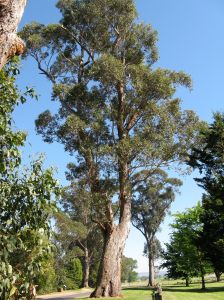
Gum tree, Orbost

Towering gum tree, Orbost

None of the region’s literary heritage was evident to the casual traveller – how I wish we celebrated our writers more. I will finish though with some lines from a poet of the region, Jennings Carmichael, as quoted in the guide under the entry for the town of Orbost:

Each soaring eucalyptus, lifted high,
The wandering wind receives;
I watch the great boughs drawn against the sky,
Laden with trembling leaves.
A soft harmonious music, full and rare,
Murmurs the boughs along–
The voice of Nature’s God is solemn there,
In the deep undersong.
On the literary road

Back in the mid 1990s I bought The Oxford literary guide to Australia. Having not looked at it for a few years, I decided to take it on our current little road trip. Two days ago, for example, we drove through Gundagai and Tarcutta, both of which appear in the guide.

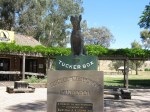
The Dog on the Tuckerbox, GundagaiGundagai, NSW

Most Australians will have heard of Gundagai – there is the famous Dog on the Tuckerbox (which features in many songs and poems) and the well-known song, “Along the road to Gundagai”, by Jack O’Hagan. Its lines include:

where the blue gums are growing and the Murrumbidgee flowing.

The funny thing is that Jack O’Hagan apparently never visited Gundagai! This didn’t stop him writing other songs about the town too including “When a boy from Alabama meets a girl from Gundagai”.

There are several other songs and poems featuring the town – including by Banjo Paterson and Henry Lawson –  but the Guide says it is a mystery as to why this particular town “was such a popular inspiration for songs”. If they don’t know, I don’t know either … but it is a pretty town with a famous old bridge.

Tarcutta, NSW

Not all that far down the road from Gundagai is Tarcutta. According to the Guide it is a popular truckies stop. It also features in the poem “Under way” by Bruce Dawe:

…there would be days
banging open and shut like the wire door of the cafe in Tarcutta
where the flies sang at the windows…

Ah, the flies! Apparently in 1961 Les Murray wrote his poem “The burning truck” in the same cafe. Unfortunately, having already had coffee at Bullocky Bill’s near the Dog on the Tuckerbox, we did not test our muse in Tarcutta.

And yesterday we drove through other towns, including…

Emerald, Vic

Down in the Dandenongs east of Melbourne is the pretty little town of Emerald – quite different from the somewhat drier and dustier Tarcutta and Gundagai. It was a gold town – hmm, wonder then why it was called Emerald! Apparently Katharine Susannah Prichard spent her honeymoon here with Hugh Throssel in a cottage owned by her mother. She wrote her novel Black Opal (1921) while staying in the town in another cottage.

Vance and Nettie Palmer lived there in the early 1920s. Nettie wrote:

You could easily imagine yourself taking root there, developing a local patriotism, bringing up your children to know its history and become attached to its soul.

Having passed through, I can think of worse places to live. Vance Palmer’s novel, Daybreak (1932) is set here and in the Dandenongs in general.

Peter Pierce (ed)
The Oxford Literary Guide to Australia
Oxford: Oxford University Press, 1983 (rev ed)
501pp.
ISBN: 0195536223

Jennifer Forest, Jane Austen’s sewing box

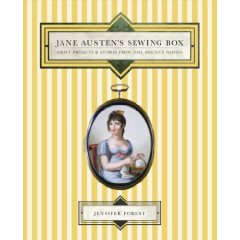
…and so the current Jane Austen juggernaut rolls on. The latest that has come to my attention is Canberra writer Jennifer Forest’s book Jane Austen’s sewing box. Must admit that I was a little sceptical when I first heard of it, but I saw it, bought it, and was pretty impressed. It’s a nicely produced book and represents a genuine attempt to look at the “crafts” of Jane Austen’s time – as well as being a “how to” book.

Jane Austen Sewing Box, by Jennifer Forest, Book cover

Cover from http://www.jennifer-forest.com/sewing-box.php, using Fair Dealing (I think)

The first thing to note, said the author when she attended my Jane Austen group’s monthly meeting last weekend, is that these are not all simply “crafts”. Many are, in fact, women’s work. Women made clothes, including men’s shirts and cravats, bags and purses, bonnets and so on. There was, in fact, a clear divide between “decorative” work and “useful” work and most women, including Jane Austen herself, did both. In fact, Penny Gay, writing in Cambridge University Press’s Jane Austen in context wrote:

Most houses had several sitting-rooms, in one of which the ladies of the household would gather after breakfast to ‘work’. By this is meant needlework, an accomplishment which was both useful and artistic, and which was considered a necessity for women of all social classes. Jane Austen herself was a fine needlewoman… If visitors called, it was often considered more genteel to continue with one’s ‘fancywork’ rather than ‘plain’ shirt-making or mending.

Forest also talked a little about how Jane Austen uses knowledge and skill in this work as part of her characterisation. In Mansfield Park, for instance, the work of the Bertram sisters is deemed not good enough for display in the public rooms (“a faded footstool of Julia’s work, too ill-done for display in the drawing room”) of the house – a clear indication that these girls are not to be admired. On the contrary, Henry Tilney in Northanger Abbey shows himself to be a solid young man and a loving brother by his knowledge of muslin. He could even be seen, many of us think, as the fore-runner of the SNAG (aka Sensitive New Age Guy)!

Forest introduced her talk with the quote that set her thinking about crafts in Jane Austen. It comes from the famous Netherfield scene in Pride and Prejudice in which Elizabeth Bennet, Mr Darcy, and Caroline and Charles Bingley discuss women’s accomplishments. The aways generous Charles Bingley believes all women are accomplished:

Yes, all of them I think. They all paint tables, cover screens and net purses.

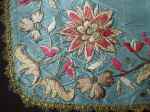
CrewelWiki

Crewel embroidery (from Wikipedia using Creative Commons CC-BY-SA)

Forest went on to describe these three “accomplishments” and more, such as crewel work, tambour work, and knotting. She also brought along a “show and tell” of the objects she had made in the course of writing the book. There is nothing like seeing and touching a hand-made bonnet or a netted purse to understand just how these women spent so much of their time. I am so glad I was born in the time of labour-saving devices!

This might not be a book for everyone. It is not academic but is nicely researched; and it is gorgeously produced with lovely period illustrations. I do have a quibble though – one that is, to me, quite serious – and that is its index. Why have a Table of Contents listing for “Muff and Tippett” and then have an Index listing for the same. If you want to find out what a Tippett is, you will not find it under T. Try M instead. How silly is that? Overall, the index is idiosyncratic and needs to at least double its existing size to be truly useful. That said, even if, like me, you are unlikely to make the 18  items described, take a look. Its readable discussion of “the accomplishments” of the period nicely illuminates the context of the novels – and this can only enhance our enjoyment of them.

Jennifer Forest
Jane Austen’s sewing box: Craft projects and stories from Jane Austen’s novels
Miller’s Point: Murdoch Books, 2009
224pp.
ISBN: 9781741963748

Prime Minister’s Literary Awards, 2009

Nam Le’s The boat has won the fiction category in the Prime Minister’s Literary Awards. Much deserved too I say! Interestingly, the non-fiction prize was shared by two books: Evelyn Juers’ House of exile, and Marilyn Lake and Henry Reynolds’ Drawing the global colour line. Lisa, at ANZLitLovers, recently wrote about Juers’ book – you can read what she says here.

The Boat – Recap

Back in February I reported on my bookgroup’s discussion of The boat on our group blog, but that was before I started writing here. I won’t repeat here what I said there – as you can read it yourselves. I will note though that one of its stories was included in Mandy Sayer’s recent anthology, The Australian long story. That has to say something! If you haven’t read it yet, think about it now. Nam Le is a new voice on the scene and I certainly hope he isn’t a flash in the pan.