Advice to would-be women journalists, 1930s style

While I was researching something completely different today, I came across a wonderful – you’ll see why soon – article titled “Not much fun in being a woman journalist – or is there?” in the second issue of The ABC Weekly published on 9 December 1939 by the Australian Broadcasting Commission. The article was written by Zelda Reed, an American who was working her way around the world as a journalist. The editor says that Miss Reed has directed the article “to ambitious Australian girls who think, perhaps, that JOURNALISM IS SUCH FUN” (their stress).

Miss Reed starts by describing how “the talkies [that is, movies] have discovered that there is glamour in the newspaper business” and goes on to give a rundown of the typical plot involving “cheeky young females” who “peck perkily at their portables and indulge in gay repartee with that winsome character, the Editor”. HOWEVER, Miss Reed warns, young women dreaming of such a career should first “well study the seamy side of the journalist’s lot”.

She says would-be reporters should be aware of:

a curious paradox in the minds of practically all editors. These men are liberals by temperament and feminists by conviction. They will do everything to help women break down the prejudice against their sex – everything, that is, except hire them as general news reporters.

Dorothy Dix (released to Public Domain, at Wikipedia)

Dorothy Dix (released to Public Domain, at Wikipedia)

She says that the real paying jobs are not the adventurous ones – and cites Dorothy Dix as one who makes very good money without ever having to move from her desk. This leads her into the traditional areas in which women do well – because “nobody else wants them. The women’s page editors, the society editors…” and so on. You know the drill.

Then she dashes any hopes of romance! She says that

Gallantry is not a strong point among the men who work on newspapers. Except when salaries are involved, these are the men who believe in equality of the sexes and act on it!

Hmmm…what does that mean? They believe in equality but don’t want to marry it? Well, she goes on to say that newspaper men have “none of the elementary requirements for a good husband”. In other words, “men reporters … go in for irresponsibility as an art” and “lack material ambition, and are proud of it”!

So, the positives? Well, there’s never being bored in a newspaper office because “entertaining companions, with a rich store of anecdotes, will always drop their work to share a coffee with you”. And a female reporter “will have her scrapbooks filled with forgotten scoops [and] a reputation as a ‘top journalist for a woman’. But that is a Bohemian reward which perhaps one woman in a million finds satisfactory”. Well…

Her conclusion is that

the rest [the other 999,999 women in a million, that is] would do well to run like rabbits whenever the urge to work on a newspaper creeps over them – they’ll pay a price that is exorbitant for the doubtful privilege of being the uninvited guest at a social function, or meeting a few front-page characters face to face.

Miss Reed, it seems, doesn’t think much of the career that is taking her around the world! I’m sure there’s truth in what she says – and I’m sure things have changed since then. All I can say is that I’ll stick to blogging. May not be as adventurous but I can have the fun of writing what I like while steering clear of all those non-materialistic irresponsible male writers!

Kath Walker aka Oodgeroo Noonuccal

I fell in love with Kath Walker, as she was known then, in my teens and bought her book of poems, My people. I loved her passion for her people and the intensity but accessibility of her poems. Every now and then I look at them again. Today, however, my mum gave me a dear little illustrated book produced by the National Library of Australia called Little book of dogs. It contains a small selection of Australian poems on, well, dogs. One of them was also in My people, and is called “Freedom”. It’s a powerful little poem about man’s (and the implication is white man’s) desire to tame “all things wild and tameless”.

Brumbies on the run in Central Australia

Brumbies on the run in Central Australia

For copyright reasons I don’t believe I can quote the whole poem – it only has four verses – but here is the first verse:

Brumby on the wild plain
All men out to break you,
My warm fellow-feeling
Hopes they never take you!

Simple stuff really but, if you have a message you must get across to as many people as possible, simple is sometimes best.

Breakfast with David, Malouf that is

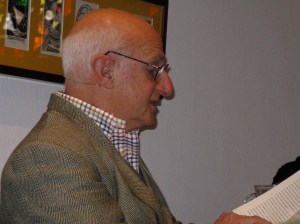
Malouf reading from Ransom, National Library of Australia, 16 August 2009

Malouf reading from Ransom, National Library of Australia, 16 August 2009

“Exploring in the dark” is how David Malouf frames the process of writing. In other words, writing, he says, brings out what is within the writer but is not fully understood until the writing starts. Furthering this notion, he quoted Herman Hesse as saying that a writer needs to be “a sleepwalker with the absolute assurance that he will put his foot down in the right place”. These were the first thoughts David Malouf shared with us, this morning, at the National Library of Australia’s last Books with Breakfast event of the year. He was in conversation with academic Brigid Rooney.

This is the second time my friend and I have attended a David Malouf literary event, the first being in 1990 when The great world came out. Admittedly that was a bigger event but we both felt that he was more relaxed today. I guess that’s not surprising given nearly 20 years of literary events have passed since then.

The focus of the conversation was, not surprisingly, Malouf’s most recent book, Ransom, which essentially recounts the last 24 hours of Achilles’ and Priam’s lives at Troy. Malouf explained his fascination with Troy, from his first introduction to the story in 1943 when he was 9 years old, through a poem he wrote around 1969/1970 called “Episode from an Early War”, to this latest novel of his, Ransom. Explaining his obsession, he talked about Troy being a city under siege waiting for war, and how Brisbane had felt the same in 1943; and about the 1960s being a period of maximum anxiety about nuclear war, and how Troy reminds us of the destruction of a civilisation. He sees Troy as an important part of our cultural inheritance and as emblematic of many of the things that confront us today – particularly in relation to war and its victims.

The discussion returned several times during the conversation to writing and storytelling, things of major concern to Malouf and about which he is wonderfully eloquent. He recounted Henry James’ description of “experience” as being “threads suspended in the chamber of consciousness”. Henry James also said that “a writer is someone on whom nothing is lost”. Similarly, Malouf said that he sees our consciousness as “whole”, by which he means “all our experience is always with us”. Writing, he said, is about making connections in our experience and is “an extraordinary illustration of how our consciousness works”.

At one point in the morning, he discussed his book An imaginary life, which explores the exile of the Roman poet Ovid. He said it initially puzzled people as to why an Australian would write such a book, and that it was not really comprehended until European commentators started noticing that it dealt with the issue of “living at the centre versus living at the edge”. Just as the exiled Ovid was “living at the edge”, so do we in the New World. This recognition, he said, helped readers see it as a book that was indeed about and relevant to Australia.

Towards the end, the conversation returned to Ransom…but as I have only read 20 pages (after all, while I wasn’t concerned about spoilers, I didn’t want to go to the event completely unprepared) I will save discussing those comments until I review the book (probably next year the rate I’m going!) The event concluded with Malouf giving a brief reading from the book. Rather tellingly – and perhaps cheekily – he chose a section that ended with the words:

This old fellow, like most storytellers, is a stealer of other men’s tales, of other men’s lives.

Would that I could be such a stealer!

You know you are hooked

…on blogging when you start writing your blog in your head while you are out and about enjoying something. This is what happened to me last night (and it’s not the first time) when I was at a Kate Ceberano concert (sorry Kate – but I did pull myself up quickly and start concentrating again). The concert was her Kate Ceberano – 25 Live Tour which celebrates her 25 years in show business. The support act was Carl Riseley, a rather gorgeous and confident “big band swing-style” singer and trumpeter from Queensland.

Anyhow, a little aside. One of the delights of being retired in Australia is that you get to listen to ABC Radio National programs on all sorts of topics. And so, just last week, I heard an interview on Bush Telegraph with Jim Haynes, the author of a book titled The ultimate guide to country music in Australia. There is a relevance I promise to this digression from an article on jazz-soul-pop-musical theatre singer Kate, and it is this: Haynes suggested that missing on the current country music scene in Australia are good interpreters of song. He said the tendency today is to want to be a singer-songwriter but that interpreting the songs of others is also an important part of the scene.

Kate and her band (including brother Phil at right) (Mobile phone image, August 2009)

Kate and her band (including brother Phil at right) (Mobile phone image, August 2009)

This brings us to Kate. Of course, interpretation is a more intrinsic part of the jazz scene but Kate’s concert included a delightful mix of interpreted and original songs, with the interpreted songs being every bit as engaging as the originals. Carl Riseley warmed us up nicely with an entertaining mix of mostly swing style music, interspersed with the odd bit of trumpet and finishing somewhat surprisingly (unless you follow Riseley I gather) with his version of Boz Scaggs‘ “Lido Shuffle”. And then Kate came on and sang for around 2 hours. She comes across as warm, confident and irrepressible. Her voice is powerful but also has a rich mellowness, and she sang a wide repertoire  including a song she wrote for her mother and her somewhat raunchy also self-penned hit single “Pash”, songs from her Jesus Christ Superstar days, her gorgeous version of “The First Time Ever I Saw Your Face” and much more besides.

Oh, and curvaceous Kate looked wonderful in the sparkly long black dress she started in, the white diva gown she changed into, and the tight little black number that she wore to end the concert. 25 years on and Kate is still going strong. It’s hard to think that she won’t still be in another 25 years.  It was a truly joyous night.

What do I mean by spare?

If you asked my kids what my favourite mantras are, they would probably include “less is more” as one of them. This is not to say that I don’t enjoy flamboyance and “over-the-topness”, because I most certainly do, but it is true that I am more often drawn to what I would call “the spare”.

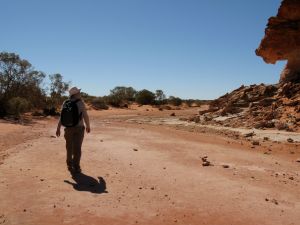
Claypan in Wurre (Rainbow Valley), south of Alice Springs

Claypan in Wurre (Rainbow Valley), south of Alice Springs

As we drove recently through Central Australian desert country, I started thinking about why it is that I love deserts, why I am drawn to them – and it suddenly occurred to me that my love of deserts can probably be equated with my love of spare writing. There are similarities: deserts and spare writing look deceptively simple and even, at times, empty on the surface but, hidden beneath this surface is a complexity that you can only find by looking and, particularly, by knowing what to look for. Conversely, in say a rainforest or a big fat nineteenth century novel, you are confronted with an embarrassment of riches. This is not to say that they, too, don’t have their complexities, but the “wow factor” is in your face!

And so what exactly is spare writing? I realised that I have often called something spare but this has been an intuitive thing – I’ve never actually sat down and defined what I mean by it. I’m going to now – for my benefit even if not for anyone else’s!

What typifies spare writing?

Of course, nothing that I write below is exclusive or absolute – there are, as they say, exceptions to every rule, but there are too, I think, some generalities we can identify:

  • preponderance of short sentences
  • minimal use of adjectives and adverbs
  • apparent focus on the concrete rather than the abstract
  • simple dialogue
  • repetition
  • strong (often more staccato like) rhythm
  • short paragraphs and more white space on the page

By excluding anything that could be seen to be superfluous to the intent, the author can cut to the chase…and the chase is often the most elemental, the most intense of experience or emotion. In this sense spare prose is reminiscent of poetry – and in fact can often feel and sound poetic. Spare writing, though, can also be its own worst enemy: it can be so pared down, so concise, that it becomes elliptical; so non-florid, so unsentimental, that it can seem cold. But then, this is no different from any other style is it? There are those who use a style effectively and those who don’t. Used well, a spare style can grip me quickly and, often, viscerally.

Some proponents of the style

While Ernest Hemingway is the writer most often cited, I think, as a spare writer, I have read little of his work – something I would like to rectify. Albert Camus, particularly in works like The outsider, is spare: the protagonist Meursault explains little leaving it to the reader to untangle who he is and what he feels and believes (or not as the case may be!). JM Coetzee’s Disgrace is another rather spare work, exemplified by its detached tone, by the refusal of the main character to explain himself, and by its matter-of-fact description of fear and horror.

A recent very obvious example is Cormac McCarthy’s The road. This book is elemental in more ways than one: everything is pared down to the minimal – the landscape, the characters, the language. It is in fact about the struggle for life – literally and spiritually. The spare style – with its rhythmic repetitions – makes sure that we see that! And guess what? Its landscape, while not originally a desert has been made so by cataclysm. This is one of the sparest books I’ve read – and also one of the most mesmerising.

An observation

Have you noticed something about the above? All the examples are male. Is a spare style more suited to the male psyche? While I can’t think of any specific examples of women writing quite like the male writers I’ve described, I’d suggest that writers like – yes, I admit it, my favourites, Jane Austen and Elizabeth Jolley – are closer to the spare end of the writing spectrum. Austen, for example, is quite out of step with her female contemporaries, most of whom were writing Gothic or so-called sentimental novels. She is more rational, witty and ironic than descriptive and emotional…which is why, really, Charlotte Bronte, child of the Romantic age, didn’t much like her!

And here, in the interests of following my own “less is more” mantra, I shall close! I would though love to hear others’ thoughts on the matter.

Some Australian literary classics

Lisa at ANZ LitLovers referred yesterday to ABC Radio National’s The Book Show program on Patrick White’s The solid mandala. This is in fact part of weeklong series they are doing on Australian classics. They have chosen an intriguing – but not unappealing – list of works to discuss:

Dare I admit it? I’ve only read two of these: the White and the Astley.

Although I haven’t read as much of White as I want (plan) to, I’ve liked everything I’ve read. I like his style; I like the things he talks about. The solid mandala’s style includes multiple points of view, sentence fragments, and a somewhat complicated time structure: I’m a bit of a sucker for these techniques as they tend to keep my brain in gear while I’m reading. And while it sounds terrible really, there’s an aridity to his characters that fascinates me. This aridity is well evident in The solid mandala. It’s there in the repetition of yellow-brown colours: the main characters’ surname is Brown, their neighbours are the Duns, and the colour yellow features regularly (“waves of yellowing grass”, “yellow fluctuating light”, “yellow feet”). It’s there in the description of characters as dry and brittle (Waldo is “dry and correct”, “felt as brittle as a sponge” and “had shrivelled up”). And, somewhat ironically, it’s even there in the colour blue (“the moons of sky-blue ice fell crashing” and “his heart contracted inside the blue, reverberating ice”). It’s a desperately sad book about failed ambitions and missed connections – and yet it’s also about kindness and about the “truth above truth” (that is there if you look for it).

As to Astley, I have been promising for a while to write my next Favourite writers post on her – and I will do it soon!  Since reading Chloe Hooper’s The tall man earlier this year, I have been wanting to re-read The multiple effects of rainshadow as it’s been a lo-o-o-ng time since my first reading. Both, as you probably know, deal with violence and racial tensions on Palm Island – Astley through fiction, Hooper through non-fiction. Hooper is interviewed briefly in The Book Show’s program. She says of Astley that:

I think that she was very much interested in the violence of the frontier and she wrote about it and was very brave, because she was one of the first writers of her generation to deal with this question.

And that was Astley. Fearless, forthright and prepared to be confronting. I will get to her soon…

As simple Arthur says to would-be intellectual Waldo in The solid mandala, “it doesn’t matter what you write about, provided you tell the truth about it”. White’s and Astley’s truths are often uncomfortable – but that didn’t stop them and we, I think, are the richer for it.

Victorian Premier’s Literary Awards Shortlist

And so, as reported by Perry Middlemiss on his Matilda blog, it’s pretty much the usual 2009 suspects that have been shortlisted for the Vance Palmer Prize for Fiction. They are:

  • The pages by Murray Bail (Text)
  • Dog boy by Eva Hornung (Text)
  • The boat by Nam Le (Penguin)
  • The slap by Christos Tsiolkas (Allen & Unwin)
  • Breath by Tim Winton (Penguin)

I have read the last three of these (links are to my reviews here or elsewhere), and will be reading The pages in the next month or so. Nam Le’s The boat won this year’s New South Wales Premier’s Literary Awards Book of the Year and UTS Glenda Adams Award. Will it win in Victoria? I rather hope it does – if only because it represents a fresh new and talented voice that would be great to encourage.

Peter Godwin, When a crocodile eats the sun

[WARNING: SOME SPOILERS]

Saltwater crocodile

Saltwater crocodile

We know it happens – is happening – but it is shocking to come face to face with it, that is, with the experience of living in a situation which was once ordered and safe but which, almost overnight, becomes chaotic and downright dangerous. This is the story Peter Godwin chronicles in his most recent memoir of life in Zimbabwe, When a crocodile eats the sun. The title comes from an old Zulu and Venda belief that a solar eclipse occurs when a crocodile eats the sun. They see it as the worst of omens, “as a warning that he [the celestial crocodile] is much displeased with the behaviour of man below”. Two eclipses occur in the space of two years during the writing of the book. If you were not superstitious before, you might be after reading this! There is, however, an added layer to the crocodile motif: an old woman now living in a nursing home spends her time reading and rereading an old English magazine containing an article in which Churchill warns the English that “appeasement is feeding the crocodile, hoping it will eat you last”. There’s a reason I think that Godwin tells us this story twice in the book.

I might as well come clean now. I am not very good at keeping up with all the world’s trouble-spots and so was rather horrified last year by the events surrounding the elections in Zimbabwe. I had thought Mugabe was doing a good job – and I think he did in the very beginning – but clearly I had taken my eyes off the ball long ago because as most of you will know I’m sure things had been going downhill there for well over a decade. It is the political change in Zimbabwe since about 1996 that forms the backdrop to this book.

Morgan Tsvangirai, 2009 (Photo: Harry Wad)

Morgan Tsvangirai, 2009 (Photo: Harry Wad, using CC-BY-SA licence)

Godwin recounts how with increasing violence Mugabe (who is 80 by the end of the book), through various groups and organisations such as his ZANU-PF, seizes land, uprooting both white and black farmers and workers – any one who appears to oppose him – in his quest to retain power.

Excluding the prologue, the book starts in July 1996 and ends in February 2004, with each chapter titled by the date of a visit Godwin, now residing in the USA, makes back to his home country. During these trips, many of them justified by a journalistic assignment, Godwin visits, with some bravery it seems to me, besieged white farmers and the families of people who have been murdered. However, while the conflict between Morgan Tsvangirai’s MDC and the ZANU-PF is central to the book, Godwin also explores his family, particularly in relation to his discovery, in middle age, that his father was a Polish Jew who had been sent to England to avoid the coming Holocaust. Without labouring the point, Godwin draws some parallels between the experience of Jews and of white farmers in Zimbabwe. He also, on a more personal level, parallels himself with his father: “Like Poland was to him, Africa is for me: a place in which I can never truly belong, a dangerous place that will, if I allow it to, reach into my life and hurt my family”. In a lovely bit of – hmm, je ne sais quoi – his father, who started life as Polish Jew but who lived most of it as an English Christian, is buried as an African Hindu.

Godwin has a lovely style – some nice turns of phrase without being over-florid. Here’s one such: “It is winter in Africa, when the warm breath of day dies quickly on the lips of dusk”. The book is rich in anecdotes and observations. Topics as wide ranging as the legend of the hippopotamus’s creation, the story of Livingstone, and the life-cycle of the aid worker are all neatly fitted into the narrative. He  tries a little to explain and perhaps even justify the role of whites in Africa – methinks he is on somewhat shaky ground here but I suppose, like all colonial societies, what’s done is done and we need to find ways for peaceful co-existence. Too late now I suppose to worry about the rights and wrongs of the past…but he could perhaps have been a bit more cognisant of the entrenched inequities beneath the current strife.

At the heart of the book though is the people – the strong-willed parents who despite themselves start to become the children, the rebel-broadcaster sister who flees to England, the white farmers and black supporters of the MDC who face each day with amazing (to me, anyhow) bravery, the black workers and labourers who struggle along often quite loyally while nothing really improves for them, and so on. This is its richness.

Near the end of the book, Godwin makes one albeit backhanded concession to Mugabe:

Mugabe has managed to achieve something hitherto so elusive; he has created a real racial unity – not the bogus one portrayed in the beer commercials of the new South Africa, but something more substantial, a hard-won sense of comradeship, a common bond forged in the furnace of resistance to an oppressive rule.

Perhaps the crocodile hasn’t quite yet had its day!

Jim Crace, Being dead

The old “so many books, so little time” mantra means that I very rarely read a book more than once (other than my Jane Austens of course), but I have read Jim Crace’s Being dead twice. I love this book. I know some find the subject matter unappealing but I find it not only fascinating but rather beautiful.

Beach near Bermagui, New South Wales

Beach near Bermagui, New South Wales

For those who haven’t heard of this novella (really), its plot centres on a murder. Joseph and Celice, a middle aged couple (and, significantly, zoologists), are bashed to death on a secluded part of a beach at the book’s beginning and, from this point, the story moves in multiple directions to explore a number of before and after scenarios relating to this event. In fact, one of the things I like about the book is its four-part structure, and its forwards-backwards movement in time as the different strands of the story are played out. Crace moves backward from the moment of their death to the beginning of that day, and alongside this he recounts forward the story of their relationship from the point of their meeting. The third strand concerns their daughter as she reacts to the news of their disappearance, and the final strand, which is the one that turns off some readers, chronicles the decomposition of their bodies as they lie undiscovered in the dunes. It’s not for nothing he makes them zoologists!

Near the end of the book is a clue to why Crace has chosen this structure. He writes that “Earth is not a visionary and can’t be blamed for what’s ahead. It is retrospective … It is the past that shapes the world, the future can’t be found in it”. It seems to me to be a pretty fatalistic – what will be, will be – view of the world, and one I rather like. I don’t think he’s quite saying we can’t change our world but he is saying that what we do, what is now, shapes it and our lives, that there’s no future mystery out there waiting to make something of us. Right near the end is this:

Nothing could be changed or amended, except by the sentiment of those who were not dead. That’s the only Judgement Day there is. The benefits of hindsight. The dead themselves are robbed of hindsight.

So what about the characters who are the focus of all this? Crace has in fact chosen pretty ordinary, fairly unlovable (except to themselves) not-particularly-admirable characters. By doing this he makes the point that we all have our lives, that the only really important thing is love, and that there is dignity in that. As he writes: “Love songs transcend, transport, because there is such a thing as love”.

And it is all told in language that is rhythmic and oddly beautiful despite the horror of the subject matter:

The corpses were surrendered to the weather and the earth, but they were still a man and wife, quietly resting; flesh on flesh; dead, but not departed yet.

Crace is a great stylist, I think, which is why he can tell such a story in four parts but in less than 200 pages. Take the title for example: the use of the present participle “being” is very telling. Present participles imply action, continuation, ongoingness, but death is usually seen as the end. In this book there are several continuations: the world, the natural world in particular, continues, and Joseph and Celice’s love continues. Oh, and they stay dead. Great title.

So, to labour the point, his message is that we and only we make our lives:

There is no remedy for death – or birth – except to hug the spaces in between. Live loud. Live wide. Live tall.

Carpe diem I suppose – but an oh so eloquent evocation of it!

Here come some gums

Actually, the terms “gum tree” and “eucalypt” are more complex than many of us, I think, realise. The trees I have habitually called Gums or Eucalypts actually come from three genera: Eucalyptus, Corymbia and Angophera. I was quite shocked when I discovered a few years ago that in the 1990s there had been a reclassification of Eucalypts, with about 113 species being moved to the Corymbia genus. Apparently the Angophera had already existed. I just wasn’t aware that they too were what I called gums. They all belong to the Myrtle family. Perhaps it would be easier to just call them that? Whispering Myrtles anyone?

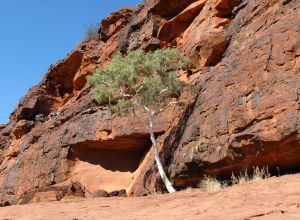
Anyhow, while Central Australia is not the place where gums are the most prolific, you do find some wonderful specimens there. One of the most famous is the Ghost Gum (which is actually a Corymbia aparrerinja). It can grow in the most amazing places, seeming often to prefer exposed rock faces.

Ghost Gum against the red rocks of Palm Valley

Ghost Gum against the red rocks of Palm Valley

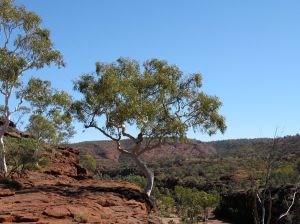
And here’s one, in a really precarious spot…

Ghost Gum on a cliff edge in Palm Valley

Ghost Gum on a cliff edge in Palm Valley

One of the other common gums in the area is the River Red Gum (which is really a eucalyptus – the Eucalyptus Camaldulensis). It is found in many parts of Australia, including Central Australia, and mostly grows in or by water courses. A useful marker in the Centre!

River Red Gum trunk at Jessie Gap

River Red Gum trunk at Jessie Gap

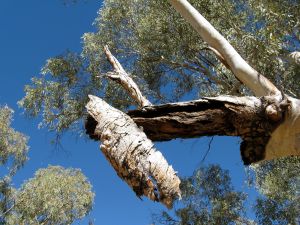
These are the gums that are sometimes called “widow makers” for their habit of suddenly dropping large boughs – apparently a protective mechanism against drought. We walked under this one – though this is only half the bough that is about to fall off. Still it looked dramatic.

Looking up at a River Red Gum in Serpentine Gorge

Looking up at a River Red Gum in Serpentine Gorge

I took many more photos but will save more for another post! But, aren’t they beautiful?