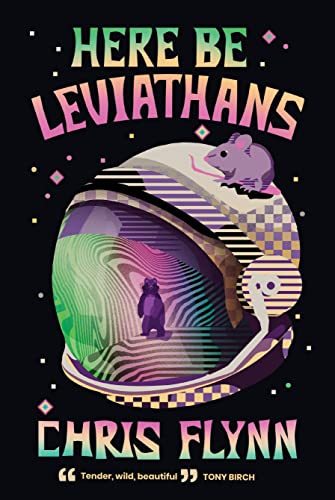
All being well, my next post – or, a very near future one – will be on Chris Flynn’s astonishing short story collection, Here be Leviathans. As I was reading it, I came quite serendipitously across Nina Culley’s article titled “Weird is in“, in Kill Your Darlings*. The article references Chris Flynn’s collection and some other works I’ve read recently that are a bit, well, off-centre.
Culley opens the article with:
Australian fiction has long been dominated by the realist novel. A new wave of writers continue the avant-garde tradition—but are experimental and offbeat stories always destined to be relegated to a literary niche?
Now, I do tend to prefer realist (or realistic) novels. I am not much into the various forms/subgenres of speculative fiction (though I don’t mind dystopias, which just seem to me to be future realism!) However, this is not to say that I don’t occasionally venture into the more imaginative, surreal or even fantastical. I like Murakami, for example; I loved Jane Rawson’s A wrong turn at the Office of Unmade Lists (my review); and in more recent times I enjoyed Chris Flynn’s Mammoth (my review). I am certainly enjoying his Here be Leviathans. Would Culley’s article, I wondered, explain why?
She follows her intro with the point that “experimental and strange fiction is often viewed as a niche of the literary world, reserved for audacious writers who dare push the boundaries of storytelling and their open-minded readerships”. Such writing is also, she says, “frequently subjected to mixed reception – some ardent, some bamboozled”. I can understand the latter, because, almost by definition, weird writing tends to subvert, if not actively eschew, the conventions against which many of us think about what we read. When that happens, we can struggle to work out how to assess it. or example, if our benchmark is realistic characters, what do we do with characters who are determinedly not so?
Culley, who actively sought out unusual fiction, was surprised to find that there was more out there than she’d thought. It’s hard to categorise but she found it under genre labels like “bizarro fiction” and “new-weird fiction”. She suggests that these genres seem “to have a lot in common with post-modernism and early avant-garde movements, with self-reflexive tendencies towards satire, irony and pastiche”. They “playfully comment on their own artifice” and challenge readers with “bold questions”. I often enjoy writing like this. I have no problem with writers reminding me that it is art I’m consuming, not a representation of reality, because, well, it is art I’m reading and I want to think about the art.
Anyhow, she argues that Australian literature has moved on from a focus on ‘bush and beach’ to something she calls ‘urban existentialism’. Much of this is “wonderful” albeit often “bleak”, but it is also Euro-centric. She characterises it as being concerned with “weaving together a character’s multi-faceted relationship with their country—how it’s threatening and how it’s beautiful, notions with complex colonial implications”. The problem is that this writing might be significant to a point, but it is also homogenising. It “undermines the demand and presence of a diverse literary scene”.
And now, before you jump in with but, but, but, she agrees that Australia has “fostered bold voices and innovation” from the likes of Patrick White through Helen Garner, Gerald Murnane, Murray Bail, and that fascinating import from South Africa, JM Coetzee, to newer writers like Alexis Wright, Robbie Arnott, Ellen van Neerven and Evelyn Araluen. I’ve reviewed all of these writers here at lest once (and admit that while I have enjoyed their writing, most have challenged my reviewer faculties! Which is no bad thing!)
Culley then discusses the publishing of weird writing – who is publishing it and why enough isn’t publised – but I want to explore a little about why read “weird” fiction.
Take weird narrators, for example. Some readers don’t like them, they don’t like, say, skeletons (in Carmel Bird’s Family skeleton) or foetuses (in Ian McEwan’s Nutshell) but in the hands of authors who know what they are doing, weird narrators can jolt us with fresh perspectives on an idea or issue. Chris Flynn’s Mammoth, as I wrote in my review, tells the story of humanity’s destructive, often brutal march through time, through the eyes of those we supplanted, the fossils of extinct creatures. Seeing the world through such eyes is mind-bending and eye-opening.
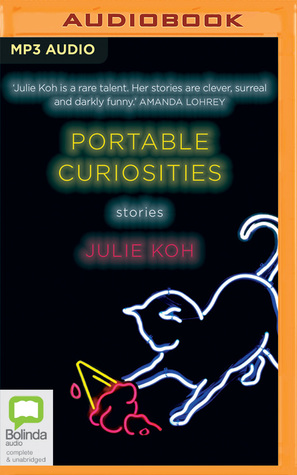
Julie Koh takes a different approach. Most of her stories in Portable curiosities (my review) start realistically but often turn surreal or absurd. Her targets, though, are grounded – in issues like consumerism, capitalism, commercialism, and the stereotyping of Asian people in Australia. Again, the weirdness can jolt us into seeing (or feeling) things that realism may not expose because it’s all so familiar.
With First Nations writing, the situation can be different again. What we western readers might think is weird is perfectly natural to First Nations people, because, for example, there is no line between the humans and country. It is all interconnected. There is no hierarchy, but mutual responsibility. Reading the writing of others may not change our own worldview, but I like to think it can help us understand different worldviews and see that they are just as valid as our own.
Returning to Culley now, towards the end of her article, she says that Flynn’s Here be Leviathans was described as “boundary pushing”. His response was that this kind of labelling indicates “that the Australian literary scene has been beholden to a streak of misery realism for so long that it’s forgotten to…have fun.” I am not averse to “misery realism” – it has its place – but it’s not my only diet. I also like fun. I like cheeky writers who know how to make points with a light – or even bizarre – touch. Watch out for my review of Here be Leviathans to see what I mean.
Meanwhile, do you read “weird” fiction? Why or why not?
* KYD is an online subscription journal, but some free access is provided.
 Whispering Gums