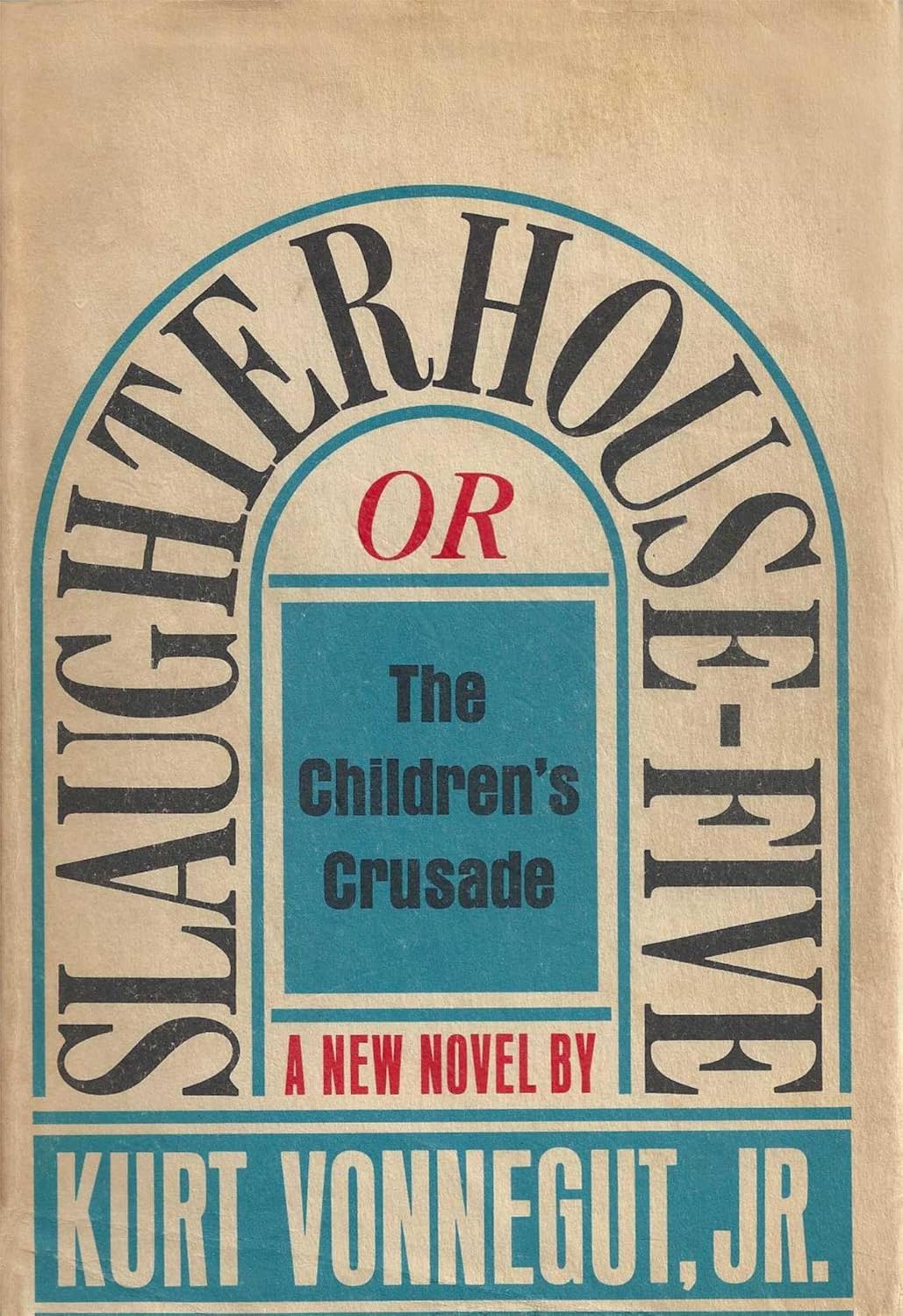
Kurt Vonnegut, Slaughterhouse-Five (#BookReview)

While my reading group’s main reading fare has, from the start, been contemporary fiction, we also mix it up a bit. We do non-fiction, for example, and most years we try to do a classic. Over the years we’ve done Jane Austen, Elizabeth von Arnim, Anton Chekhov, EM Forster, and Randolph Stow, to name a few. This year we turned to Kurt Vonnegut, and, because we couldn’t decide which book to do, we narrowed it to two – Cat’s cradle and Slaughterhouse-Five – and let members decide. You can tell from the post title which one I chose. This was because I have read Cat’s cradle, albeit decades ago. Most of the group, however, read Cat’s cradle, because they’d read Slaughterhouse-Five before.

So, Slaughterhouse-Five it is then – and I’m confronted by the old challenge of what to say about a classic, and a cult classic at that. This book has been analysed ad infinitum, and been found, as the decades have trundled by, to retain its relevance to new generations. However, before I say more, let me give a very brief synopsis, just in case there’s someone out there who doesn’t know the story.

“jumbled and jangled”

Ha, did I say brief synopsis? Easier said than done, but I’ll give it a try. Slaughterhouse-Five tells the story of Billy Pilgrim, from his early years, through his time as an American soldier during World War II including being in Dresden when it was bombed, to the post-war years. During his life, Billy is also abducted by flying saucer and taken to the planet of Tralfamadore, where he is displayed in a zoo. The critical issue underpinning all this is that Billy was damaged by his wartime experiences, something we now recognise as PTSD. Vonnegut conveys – and represents – Billy’s discombobulation, his trauma, through a complex non-linear, non-chronological narrative, in which Billy, who “has come unstuck in time”, travels not only back and forth through time, but also back and forth between Earth and Tralfamadore. 

Slaughterhouse-Five is, as a result, a challenging, sometimes mystifying read, but it is also an exhilarating one, because Vonnegut tells his story through satire and absurdity, both of which I love. In the first chapter, the narrator, who is Vonnegut, tells us about writing the book we are now reading. As he hands his finished book to the publisher, he says

It is so short and jumbled and jangled, Sam, because there is nothing intelligent to say about a massacre.

Alongside the occasional appearance of this first-person narrator, we have the unsuccessful science fiction writer Kilgore Trout, who can also be read as a version – caricature – of Vonnegut. His “unpopularity was deserved”, the narrator tells us. “His prose was frightful. Only his ideas were good”. But, Billy loves him. We first meet Trout when Billy is introduced to him by Rosewater, another patient in the hospital to which Billy had committed himself when he feels he is “going crazy”:

Rosewater was twice as smart as Billy, but he and Billy were dealing with similar crises in similar ways. They had both found life meaningless, partly because of what they had seen in war. Rosewater, for instance, had shot a fourteen-year-old fireman, mistaking him for a German soldier. So it goes. And Billy had seen the greatest massacre in European history, which was the fire-bombing of Dresden. So it goes.

If you’ve read the novel, you will know that “so it goes” is its over-riding refrain. Used over 100 times, at moments of murder, death, and other disasters, it functions as a motif, one that both underlines and undermines the horror, by drawing attention to it, then passing it off. The constant opposition, in the novel, of the serious with the offhand keeps the reader unsettled, which is part of the point.

The occasional self-conscious appearance of the author/Vonnegut and the references to Kilgore Trout, along with its story-within-a-story framework, its wild playing with time and place, its fragmentary approach to storytelling, and its unapologetic undermining of “reality”, make this book a postmodern work, if that interests you. By this I mean what sort of work it is doesn’t matter, really. It’s what the work says or makes you feel that really counts. However, it’s these features and techniques which enable Vonnegut to convey what he wants to say in such a powerful way. The how of it is inseparable from the meaning of it.

Slaughterhouse-Five is said to be about many things, including war and pacifism, fate and free will, our experience of time. I could discuss each of these in turn, but the academics already have. I’ll simply say that my primary takeaway is that it’s about the absurdity and incomprehensibility of life and, by example, about how our everyman Billy Pilgrim copes (or doesn’t) with such life.

Slaughterhouse-Five was published at the height of the Vietnam War and the anti-war movement. It was, it seems, the right novel at the right time. Although Vonnegut had had some success before, this was the novel that apparently established him. I can see why. With wars just keeping on coming – and being just as horrific and absurd as the ones that came before them, I can also see why this novel continues to speak to new generations of readers. I mean, how can you not laugh at Billy on display in Tralfamadore:

Then he did exercises he had learned in the Army—straddle jumps, deep knee bends, sit-ups and push-ups. Most Tralfamadorians had no way of knowing Billy’s body and face were not beautiful. They supposed that he was a splendid specimen. This had a pleasant effect on Billy, who began to enjoy his body for the first time.

And, you know what? I’m going to leave you right here, because if this doesn’t convey why this book is such a complex, funny, humane read, I don’t know what will.

Kurt Vonnegut
Slaughterhouse-Five, or, The children’s crusade
Horizon Ridge Publishing, 2024 (Orig. pub. 1969)
199pp.
ASIN: ‎ B0D9SKLL68

Gail Jones, Salonika burning (#BookReview)

Australian author Gail Jones’ ninth novel, Salonika burning, is a curious but beautiful novel, curious because she fictionalises four real people for whom she has no evidence that they met or knew each other, and beautiful because of her writing and the themes she explores. The novel is set during World War 1, but its focus is firmly on the interior rather than the grand stage of battle.

It opens dramatically with the burning of the city of Salonika (Thessaloniki). This is another curious thing, because this destructive event was caused not by an act of war but an accidental kitchen fire. Also, the novel is not set in Salonika but some 90 miles off, in and around “the field of tents that comprised the Scottish Women’s Hospital”, on the shores of Lake Ostrovo in Macedonia. It is 1917, and the novel’s narrative centre is this hospital and those working in and around it. Here, not Salonika, is where our four main characters are based — Stella, an assistant cook/hospital orderly; Olive, an ambulance driver; surgeon Grace; and Stanley, an orderly with the Royal Army Medical Corps. They are based on the Australians, writer Miles Franklin and adventurer Olive King, and the British painters, Grace Pailthorpe and Stanley Spencer. In her Author’s Note, Jones makes clear that she has fictionalised these characters, and that while all are known to have worked in the vicinity, there is no evidence that they met or even knew each other. It is “a novel which takes many liberties and is not intended to be read as a history”. This is fine with me. After all, a novel, by definition, is not history. The novel follows these characters over a few months after the burning of Salonika.

“everything was coming apart”

So, why Salonika? I see a few reasons. For a start, its burning sets the novel’s tone. On the first page we are presented with opposing ideas. The sight of the burning city is described as “strangely beautiful” but, on the other hand, “alarm, instant fear, the sufferings of others … were no match for excitement at a safe distance”. As the fire died, “excitement left and in its place was a murky lugging of spirit”. Throughout the novel, Salonika represents these contradictions, this tension between what is ugly, what is beautiful; between what is random, what is not; and in how to respond to, or feel about, what is being experienced.

The Salonika fire also encompasses the idea of witness and representation. In the opening scene, Jones describes a painting made of the fire by William T. Wood. It is a “morning-after scene, brightly calm, with a floaty view from the heavens” done in his “signature pastels, remote as a child’s dream and thinly decorative”. Those who saw this painting later, she writes, “saw the pretty lies of art”, whereas “former residents and soldiers said, No, it wasn’t like that”. This tension too is played out in the characters as they think about how they might represent their experience.

The burning of Salonika, then, embodies several ideas that are followed through in the novel. But, Salonika is also relevant to the plot. The novel’s narrative arc lies mainly in the characters and their emotional reactions to what is happening as the months wear on. Not only is there the war with its injured and dying soldiers, but malaria is rife, and the privations they experience, professionally and personally, are exacerbated by the burning of Salonika and the attendant shortage of essential provisions – food, petrol, medical supplies. However, a plot also unfolds, and it is something that happens on the way to Salonika, well into the story, which sets the novel’s final drama in motion.

Salonika burning traverses themes that are the stuff of the best war literature – themes that expose the “idiocy of this war, of all wars” and its impact on those caught up in it – but it offers its own take. The telling feels disjointed, particularly at the start, with its constant switching between the perspectives of the four characters who interact very little with each other until well into the novel – and even then it’s often uneasy, as befits their temperaments. And yet, the novel is compelling to read, primarily because of these characters. They are beautifully individuated, so flawed, so human, so real.

Olive, who is the first character we meet, and the one who closes the novel, is confident, tough and practical. Grace, too, is tough, doing her “duty” with a “dull vacancy”. Stella, at 38, the oldest of the four, is “cranky and wanting more”, more excitement to write about, but she believes in “chin-up and perseverance”, while the youngest, 26-year-old Stanley, is “ill-fitted … to this life of rough cynical men”.

These are “intolerable” times, and we are privy to their struggle to maintain their sanity. Olive resorts to her German grammar to escape the emotional load, while Stanley has his mules and favourite painters, his “Holy Rhymers”. Stella, “writing jolly accounts in her diary”, thinks about what stories she will tell, while Grace has her favourite brother to think about and write to. The disjointed structure mirrors, I think, their sense of isolation. Contact and the potential for friendship is there, but Matron discourages emotional engagement. There’s “no room for emotion”, she says, just “duty”. Olive, who seems to represent the novel’s moral centre, thinks otherwise:

It seemed another kind of duty, not to forget. Olive wanted to speak of what she had seen and known, though she suffered too much remembrance.

This could neatly segue to that issue of representation, and the post-war work done by Stella, Grace and Stanley, but instead, I want to conclude with another idea. On a supply trip to Salonika, Olive, “driving in her safe foreign aura”, had been indulging in a dose of self-pity, but is suddenly confronted by the loss Salonika’s burning represented for its residents, “and only now understood that it was the woe of others that claimed importance”. Likewise, Stanley, Grace and Stella are confronted with the woes of others through the novel’s closing drama, and must decide where their humanity lies.

I started this post noting some curious things about Jones’ approach to her story, but these didn’t spoil the read. Rather, they added to my interest as I read it. Ultimately, Salonika burning is a true and tenderly written novel that captures the essence of war’s inhumanity, and then goes about extracting the humanity out of it. A worthy winner of the 2023 ARA Historical Novel Prize.

Lisa and Brona also read and enjoyed this book.

Further reading

Gail Jones
Salonika Burning
Melbourne: Text Publishing, 2022
249pp.
ISBN: 9781922458834

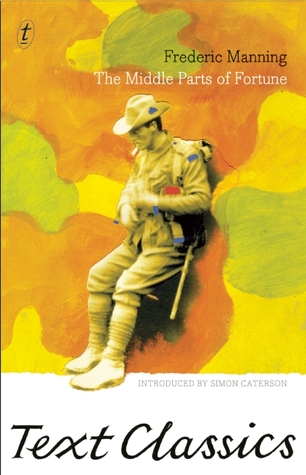
Frederic Manning, The middle parts of fortune, Ch. 1 (#Review, #1929 Club)

I had identified two novels for my 1929 read, M. Barnard Eldershaw’s A house is built and another. With Lisa also considering A house is built, I decided to go for the other. I started it, and am loving it, but I won’t finish it in time, so I thought I’d check my Australian anthologies for a 1929 offering, and found one. In the Macquarie PEN anthology of Australian literature is the first chapter of a book I’d been unaware of until I wrote my 1929 Monday Musings post this week. The book is The middle parts of fortune: Somme and Ancre, 1916, by Frederic Manning.

It particularly caught my attention because the title sounds more like a nonfiction book. So, I checked it. Yes, it is fiction, I clarified, and has an interesting history. I’ll start, though, with the author…

Frederic Manning (1882-1935) was born in Sydney. An apparently sickly child, he was educated at home, and when a teenager he formed a close friendship with Rev. Arthur Galton, who was secretary to the Governor of New South Wales. When Galton returned to England in 1898, Manning went with him, but returned to Australia in 1900. However, he returned to England in 1903 – when he was 21 – and there he remained. He produced all his writing from there, but the Australian Dictionary of Biography (linked on his name) claims him as Australian.

That’s all very well – for us to say now – but at the time of his death, according to Nicole Moore who wrote his entry in the Anthology, he was “largely unknown in Australia”. And yet, she continues, “his novel, The middle parts of fortune: Somme and Ancre, 1916 (1929) is cited around the world as one of the most significant and memorable novels of the First World War”. Indeed, she writes, it is “often grouped” with Ernest Hemingway’s Farewell to arms and Erich Remarque’s All quiet on the western front.

Manning served in the war from October 1915, first as Private (no. 19022) and later as a second lieutenant, though apparently the officer’s life did not suit him. He drank, and resigned his commission in February 1918. Wikipedia explains explains that, with increasing demand through the 1920s for writing about the war, and his having published some poems and a biography, he was encouraged to write a novel about his wartime experiences – and so The middle parts of fortune was born.

The story does not end here, however. The first edition was published privately and anonymously, under subscription, says Moore. Soon after, in 1930, an expurgated edition was published under the title Her privates we, with the author now identified as Private 19022. This version, Moore says, “removed the soldiers’ expletives that strongly punctuate the text”. Acceptable, apparently, for the private edition, but not for the public one! Wikipedia says that Manning was first credited as the author, posthumously in 1943, but the original text wasn’t widely published until 1977.

Wikipedia identifies the book’s admirers as including Ernest Hemingway, Arnold Bennett, Ezra Pound, and T. E. Lawrence. Lawrence is quoted as saying of The Middle Parts of Fortune that “your book be famous for as long as the war is cared for – and perhaps longer, for there is more than soldiering in it. You have been exactly fair to everyone, of all ranks: and all your people are alive”, while Ernest Hemingway called it “the finest and noblest novel to come out of World War I”. How could I have not known it?

Now, the book … Wikipedia says that each chapter begins with a quote from Shakespeare – answering a question I had, because Chapter 1 so starts. The source of the quote, however, is not cited, but a quick internet search revealed it to come from Act III, Scene 2 of Henry IV Part 2:

By my troth, I care not; a man can die but once;
we owe God a death. … and let it go which way it will,
he that dies this year is quit for the next.

It basically says that we can only die once, and that we’ll all die one day – so, we may as well accept our fate? A soldier’s creed?

Before I say briefly discuss the first chapter, I’ll add that Nicole Moore says that the protagonist’s nationality is not “made explicit” which is “in keeping with the novel’s deflation of military hierarchies and nationalism”. She goes on to say that it explores “the effect of war on reason and selfhood” and is thus “an existentialist study of the extremes of human experience”.

I’ve read several novels, over the years, about World War 1, including – to share another Australian one – David Malouf’s Fly away Peter. It too powerfully evokes the terrible impact of that war.

So, Manning’s Chapter 1 introduces us to a soldier stumbling back to the trenches after some action during which many men had been lost. Soon, he – named Bourne, we learn – is joined by a couple of Scottish soldiers – not from his battalion – and then an officer from his. The rest of the excerpt chronicles his moving through a “battered trench” to join his compatriots in their dugout, before setting off again to meet their captain and retire to their tents in the ironically, but truthfully, named “Happy Valley”.

The tone is one of desperate resignation. Faces are blank (despite “living eyes moving restlessly” in them); no energy is wasted in unnecessary talk; and whiskey is a necessary support after “the shock and violence of the attack, the perilous instant”. The description of their progress from the dugout to the camp above ground beautifully exemplifies the writing:

they saw nothing except the sides of the trench, whitish with chalk in places, and the steel helmet and lifting swaying shoulders of the man in front, or the frantic uplifted arms of the shattered trees, and the sky with clouds broken in places, through which opened the inaccessible peace of the stars.

The “frantic uplifted arms of the shattered trees” and the “inaccessible peace of the stars” conveys it all – and this is only Chapter1.

If you would like to know more about this novel, you can check Lisa’s blog, as she knew of this book and reviewed it back in 2015!

Read for the 1929 reading week run by Karen (Kaggsy’s Bookish Rambling) and Simon (Stuck in a Book).

Frederic Manning
The middle parts of fortune: Somme and Ancre, 1916 (1929)
in Macquarie PEN anthology of Australian literature (ed. Nicholas Jose)
Crows Nest: Allen & Unwin, 2009
pp. 365-369
ISBN: 9781741754407

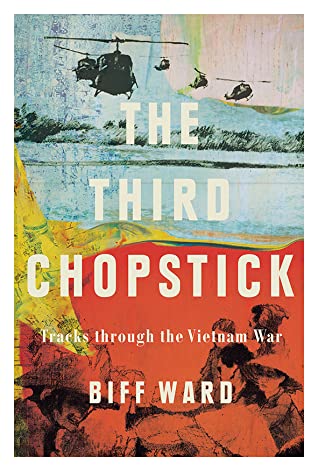
Biff Ward, The third chopstick: Tracks through the Vietnam War (#BookReview)

Biff Ward’s The third chopstick was my reading group’s October selection. It’s the second book by Ward that we’ve done, the first being her memoir, In my mother’s hands (my review), about growing up with her academic father, the historian Russel Ward, and her mentally ill mother, at a time when mental illness was shameful and to be hidden. It was a moving book that engendered an engaged and wide-ranging discussion. Biff Ward, in fact, attended that meeting.

The third chopstick is another personal book, but one that’s not so easy to classify. I would describe it as hybrid memoir-creative nonfiction. Memoir, because it’s about her experience as an anti-Vietnam war protester who later chose to meet Vietnam veterans and listen to their stories. And creative nonfiction, because, although nonfiction, it uses some of the devices of fiction to engage its readers. These include hinging her story around one particular vet, Ray, whom she describes as her “muse”, her “archetypal veteran”, her conduit, perhaps, to “the missing piece”. His story, combined with his powerful presence, gives the book its compelling, narrative drive.

The implication of what I’m saying here is that while The third chopstick is historical it is not an academic history. Although Ward did the historian thing, and conducted recorded interviews with vets, she does not attempt to present an “authoritative” analysis of protesters or of vets, but a thoughtful, personal quest. It has no footnotes, although there is a selected reading list at the end, and there’s no index. This is not to say, however, that it doesn’t add to our understanding of history, because it certainly does.

The book has a logical, and more or less chronological, structure, though there is criss-crossing of timelines where appropriate. It has three main parts – Protest, Veterans, Vietnam – which are bookended by a Prologue and Epilogue. In Protest, Ward describes her life as a protester, and introduces us to her ongoing interest in Vietnam long after the war ended. In Veterans, she introduces us to the veterans she met and interviewed, shares their stories and experiences, and reflects on these. Finally, in Vietnam, she discusses post-war Vietnam, including how Vietnamese people have processed, and live with, what happened. She has visited the country many times – as a sole tourist, on war-themed tours, and as a tour leader herself. On some of those visits, she either accompanied or met vets. Through these postwar connections, she starts to bring together her central questions concerning how we Australians got caught up in this, and what it did to us – as a nation, as individuals – though, of course, there are no simple answers.

“a scrambled snarl”

A bit over halfway through the book, while interviewing Nick, an SAS veteran of the war, Ward confronts the issue of “killing”. Nick’s story causes her to think about that and, thence, her stance as a pacifist. She realises she’d never really grappled with it. She had, she writes, a ‘”natural” antipathy to killing, a generalised kind of pacifism which yearns for peace’ but she also believed that, if needed, she would strive as hard as she could to defend “me and mine”. Her pacifism was “a scrambled snarl of thoughts and feelings”. She doesn’t explore this further, as it’s not the subject of the book, but …

… I liked this expression because what her book does is explore just what “a scrambled snarl” war is, whichever way you look at it. I particularly liked her various reflections on war. She makes the point early on that it is well known that war takes years to recover from. Vet Graham tells her that medieval knights “used to go into a monastery after being on a crusade”. He himself had, after leaving the army, been ill; he’d been in hospital and at a health farm, before spending “thirteen years, mostly alone, making music, keeping quiet”. By the time Ward met him, he was working with the Federation for Vietnam veterans.

Throughout the book, then, Ward reflects on war in general, but I’ll just share a couple that captured my attention, both resulting from her reading of Ray’s journal, where he expresses the trauma he experienced. It leads Ward to suggest “that the truth of all war is only these depthless oceans of grief”. A few pages later, she discusses “moral injury”, which “refers to an injury to the soul, to morality, to what can happen when a soldier has to do something against his own sense of what is right and wrong.” The injury done to Ray is immense.

Ward may not have intended this, but her book also functions, at least a little, as a cautionary tale, because she shows how easy it is to believe you are doing the right thing when you protest for a humane cause, and be oblivious to the potential for unintended consequences. The anti-Vietnam War protesters’ beef was with the government and its policies, but the result, as we all know now, was that the soldiers who went to Vietnam were vilified – not so much by the core protesters but by others who took their ideas on without understanding the politics. Ward shares some of the facts and myths about how it played out.

Ward also discusses those other two big fall-outs from this particular war – Agent Orange and its ongoing impact on the health of both soldiers and Vietnamese people, and PTSD, which she describes as the Vietnam vets’ gift to the world.

What makes this book a particularly good read, besides all this subject matter, is the language, which mixes journalistic-style reportage with more evocative writing. There’s too much to share, but here’s one describing her experience of transcribing Ray’s journal:

As I transferred his words from the page to pixels on my screen, they sometimes spiralled off and pranced about the room like leering pixies.

(This sometimes necessitated her needing to take a break!)

Here’s an appropriate point to explain the title, because it came from Ray, as she explains in Chapter 2. While in a restaurant, he places two chopsticks in parallel lines, about two centimetres apart, across a bowl, and names the space between the two as “normal life … where people get born and grow up …” etc. Then, he takes another chopstick (“the third chopstick”), places it parallel to the others, the same distance apart, and says

The veteran lives here, alongside but separate, see? He can see this life, he pointed back to the first space. He can see what other people are doing, but he can’t join in. He doesn’t know the rules anymore. It might look like like garbage to him. It’s got no connection to what’s happening inside him, see?

The secret, Ray continues, is for the veteran to be able to handle both “his own stuff” and join in. There’s a little more to it but that’s the gist.

    Lest you be thinking so, The third chopstick is not just relevant to those who lived through the Vietnam War era. As I read this book, I couldn’t help thinking about a war that is happening right now. Near the end, Ward writes:

    So even today, for the People of the Bag*, the mountains and the rivers, the land and the water and their interconnectedness are concepts integral to the way Vietnamese conceive of themselves. And, I chucke to myself, those men in Washington and Canberra thought they could somehow beat them, that the People of the Bag would eventually give up? Really?

    Given its origins in a leftie anti-Vietnam war protester who went on to engage openly and genuinely with soldiers involved in that very war, The third chopstick is quite an astonishing book. For anyone interested in the complex experience of war, it makes excellent reading. All eleven who attended my reading group agreed.

    * The Vietnamese, from their Creation Myth

    Biff Ward
    The third chopstick: Tracks through the Vietnam War
    Penrith: IndieMosh, 2022
    313pp.
    ISBN: 9781922812025

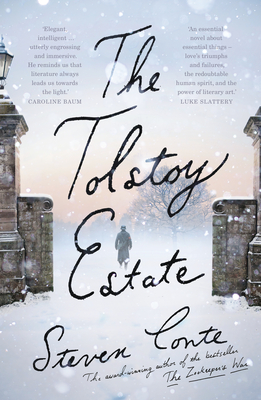
    Steven Conte, The Tolstoy Estate (#BookReview)

    Steven Conte burst on the scene in 2008 when he won the inaugural Prime Minister’s Literary Award with his 2007-published debut novel, The zookeeper’s war. I always intended to read it but somehow it never happened. Jump to 2020, and Conte’s second novel, The Tolstoy Estate, was published. That’s a big gap, but what he’s produced is a well-researched, carefully-crafted, thoroughly absorbing novel.

    What intrigues me more than this gap, however, is that both his novels are set during World War 2, and both deal with Germany in the war. The zookeeper’s war is about how the Berlin Zoo’s owner and his Australian wife managed to keep it going through the war. I wonder what it is about war and Germany that attracts Conte? Or, is it just coincidence?

    So many paths to follow

    The Tolstoy Estate’s plot is not complicated. Most of the story takes place over the six week period – November-December 1941 – during which a German army medical unit established and ran a hospital in Yasnaya Polyana, Tolstoy’s estate, near Tula, south of Moscow. Arriving at the estate, the Germans, including doctor Paul Bauer, meet the site’s curator, Katerina Trubetzkaya, who is, not surprisingly, hostile. A relationship develops between Paul and Katerina, against a backdrop of deteriorating conditions both on the war-front and in the unit, as its commanding officer Metz’s behaviour becomes increasingly erratic.

    Sounds straightforward enough? Yes, but as one of my reading group members said, the novel has so many paths to follow, so many ideas to think about, that it’s impossible to follow them all. I agree, so, here, I will focus on just a couple of them.

    I’ll start, however, with a few comments about the style and structure. The novel is primarily told in third person through the perspective of Paul, so our understanding of what happens, our assessment of the characters and their relationships, come through his thoughts and feelings. Fortunately, he is quickly established as a humane, considered person, so we can trust him, as much as we can trust anyone.

    SORT OF SPOILER (though not the ending)

    Half-way through the novel we jump to 1967, and a letter from Katerina to Paul. This introduces a second chronology which covers nearly a decade from then. Most of it, until the last chapter, is conveyed though a few letters between the two, interspersed with the main wartime narrative.

    Why does Conte do this? This is the question I always ask when an author plays with their narrative structure like this. My usual thought is that the author wants to de-emphasise the plot to encourage us to think about something else, but then the question is, what? I suspect that this is partly the case here, and I’ll talk about the “what” soon. Regardless of the “what”, however, the impact of revealing that Katerina and Paul have survived the war, is to slow us down. It encourages us to focus on the development of their relationship against the backdrop of this cruel war, rather than rushing to turn the pages to see what happens next.

    As for the paths, the “whats”, there are many. The Tolstoy Estate is about war of course. The history part of this novel is true, in that Tolstoy’s estate was indeed occupied by the Germans for a military hospital, so there is that. And, there’s the exploration, through our two protagonists, of two unappealing regimes, Nazism and Stalinism. I could write more about the nuances of that, but I won’t. Then, there’s its evocation of how humans behave during war, of how some will and some won’t behave with humanity across the enemy divide. We see this in many war novels, so I won’t dwell on that, either, except to say that I liked Conte’s appreciation of the continuum of humanity’s behaviour from the worst to the best. One of the questions on Steven Conte’s website concerns whether we can forgive what we come to understand. I’ll leave that one with you too!

    Love is an excellent motivator (Katerina)

    Now, though, I want to turn to two paths that particularly interested me – love and literature. Let’s do love first. The Tolstoy Estate is a love story. Both our protagonists have lost their spouses, meaning both are currently free but have experienced love before. However, they are also, of course, technically, enemies, belonging to opposing regimes, both of which can be brutal to those who cross the line. This tests their love.

    Love is not one-dimensional, as Conte knows, so he sets their love against other sorts of love, including master-race proponent Metz’s dutiful but ultimately sexless marriage because of the “physiological costs imposed by sexual congress”; the Soviet Government’s conservative, sexist attitude to romantic relationships, evidenced in its reaction to Katerina’s novel; a German officer’s homosexuality that brings about his demise; the bawdy conversations and behaviour of many soldiers. There’s also Bauer’s brief but pointed reference to the soldiers he treats:

    Loves or is loved“, he thought constantly as he amputated, concerned less about the truth of the incantation than its usefulness to keeping him alert.

    War and love, by definition, make strange bed-fellows. War heightens emotions of all sorts, and forces those who love to think seriously about it, as Paul and Katerina do. Paul’s bawdy but romantic colleague Molineux says that Paul and Katerina’s bond “transcends race, it transcends law”, and yet both Paul and Katerina are aware that the practicalities of love can spoil even a strong bond – which provides the perfect link to the literature path …

    Writers document, great men do (Metz)

    Contemplating the value and practice of literature underpins the novel, with Tolstoy’s War and peace, of course, providing the pivot. It links to the love path, because Paul and Katerina frequently consider Tolstoy’s evocation of love in the novel. In a letter to Katerina, Paul writes that War and peace reminded him

    that love doesn’t always conquer but that, arguably, it’s better that way – that thwarted love is stronger, more enduring than the domesticated kind.

    But, beyond love in Tolstoy, Conte’s characters also think about the value of literature. Again, here is Paul in a letter to Katerina, telling her that War and peace had restored his faith in

    doing good in the world; because if, as Tolstoy argued, we are all specks in a vast world-historical drama, including those who think they’re in charge, it follows that everyone’s actions are potentially significant, that the humblest person can influence events as much as any general, emperor of tsar.

    This counteracts Metz’s argument to Katerina early in the novel that

    with his rifle our humblest “Landser” shapes the world in a way your Tolstoy never did.

    The old “pen is mightier than the sword” discussion I suppose, but oh so engagingly told!

    There are also discussions about the craft of writing – some of which reflect wryly on Conte’s interest, such as Katerina’s research focus being narratology.

    But I will end with Katerina’s concern about the fading of the novel in the later 20th century:

    Everything fades, I suppose, certainly everything made by human hands, and yet I can’t help feeling bereft to witness this diminution of the novel, which for all its inadequacies has trained us to see the world from others’ points of view. To borrow a Stalinist idiom, the novel is a machine, a noisy, violent thing whose product, oddly enough, is often human understanding, perhaps even a kind of love.

    Love … and the novel. A good place to end my post on this compelling and intelligent novel.

    Lisa (ANZLitLovers) also loved this novel.

    Steven Conte
    The Tolstoy Estate
    Sydney: Fourth Estate, 2020
    410pp.
    ISBN: 9781460758823

    George Orwell, My country right or left (#Review)

    Having recently posted on the fourth essay, “The prevention of literature“, in my book of George Orwell essays, I’ve decided to plough on and try to finish it. The next essay is the short, cleverly titled, “My country right or left”. It was first published in Autumn 1940 in Folios of new writing.

    It’s a curious little essay. I’m going to introduce it by sharing the Orwell quote used by the Orwell Foundation under its banner: “What I have most wanted to do… is to make political writing into an art”. You can certainly tell from “The prevention of literature” that he sees literature as being necessarily political. That essay was written in 1946, just after World War 2 had ended. “My country right or left” was first published just one year into this war – and is politically-driven.

    The essay starts with:

    Contrary to popular belief, the past was not more eventful than the present. If it seems so it is because when you look backward things that happened years apart are telescoped together, and because very few of your memories come to you genuinely virgin. It is largely because of the books, films and reminiscences that have come between that the war of 1914-18 is now supposed to have had some tremendous, epic quality that the present one lacks.

    I wasn’t sure at all, from this opening, where it was going. Soon, however, it’s clear that war is the driver for the essay which turns out to be about Orwell trying to rationalise, or work through, his socialist beliefs, his previously avowed pacifism, and his patriotism (and thus support for the war).

    He writes about being a middle-class school boy during World War 1 and being oblivious to what was happening, particularly to “the true significance” of the big events. He writes:

    The Russian Revolution, for instance, made no impression, except on the few whose parents happened to have money invested in Russia. 

    I’m sure that’s not unusual! He talks about how pacifism

    had set in long before the war ended. To be as slack as you dared on O.T.C. parades, and to take no interest in the war was considered a mark of enlightenment.

    Interestingly, however, this pacifism, he says, gradually gave way to a certain nostalgia in those who had not experienced the war! He suggests that this was why his generation was so interested in the Spanish Civil War. He then moves onto World War 2, to the growing awareness in the mid-1930s that it was coming and – this is his main point – his realisation that he “was patriotic at heart” and “would support the war”.

    Orwell’s sees this as a no-brainer. He says:

    If I had to defend my reasons for supporting the war, I believe I could do so. There is no real alternative between resisting Hitler and surrendering to him, and from a Socialist point of view I should say that it is better to resist; in any case I can see no argument for surrender that does not make nonsense of the Republican resistance in Spain, the Chinese resistance to Japan, etc. etc. 

    But, he admits that this support stemmed primarily from “the long drilling in patriotism which the middle classes go through”. The drilling had, he said, “done its work … once England was in a serious jam it would be impossible for me to sabotage”. This patriotism, however, in not incompatible, he argues, with his socialist view that “only revolution can save England”. That “has been obvious for years”. “To be loyal both to Chamberlain’s England and to the England of tomorrow might seem an impossibility”, he writes, but it is, in fact, a fact, because such dual loyalties were happening everyday. Revolution could not happen with Hitler in control, so, Hitler must be resisted.

    His final point is to criticise the left-wing intellectuals who do not understand this, though his method is curious. He turns to the idea of “patriotism”, arguing that “patriotism” should not be equated with “conservatism”, because, unlike “conservatism”, “patriotism” can encompass change. Indeed, he proposes that “socialism” can grow out of the emotions that underpin “patriotism”, whether “the boiled rabbits of the Left” like it or not.

    So, curiously argued perhaps, but I can imagine the socialist-leaning, middle-class raised, intellectually open Orwell wanting to nut out how to marry his socialist beliefs with the very real threats his imperfect Britain was facing – and coming up with something confronting, but true.

    Wikipedia writes that “according to his notes to his literary executor in 1949”, this was one of three essays that he did not want reprinted after his death. I can sort of see why, and I don’t know why the executor didn’t respect this. However, I do like the insight this essay provides into how Orwell thought, and that it shows him to be an independent thinker, rather than a parroter of received truths.

    Previous reviews of essays from this book: “Books v. Cigarettes“, “Bookshop memories“, “Confessions of a book reviewer“, and “The prevention of literature“.

    George Orwell
    “My country right or left” (orig. 1940)
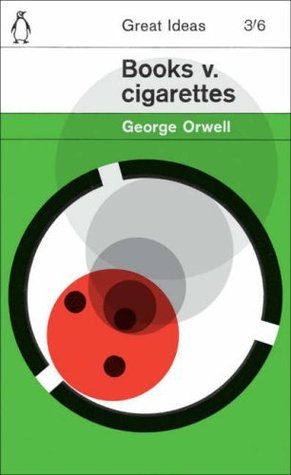
    in Books v. cigarettes (Great Ideas)
    London: Penguin Books, 2008
    pp. 21-41
    ISBN: 9780141036618

    Available online at the Orwell Foundation.

    Monday musings on Australian literature: Writing about the war between the wars (2)

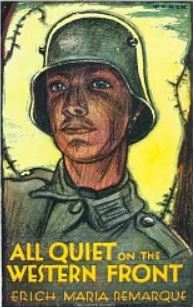
    Last week’s post focused on attitudes to writing about the war during the interwar period, particularly in relation to the realism of books like Erich Maria Remarque’s All quiet on the western front. This post continues the discussion, but will share some specific war writing from the article that inspired this series.

    But first, a reminder of the main concern expressed about the war novels coming out in the late 1920s to early 1930s. L.S. Avery, former Secretary of State for the Dominions, explains it in his statement that the

    fashion of “stench warfare” writing would pass, and the war would take its place as the marvellous effort and an amazing romance in which no part was more amazing that that played by the Australians.

    He was proposing the toast of “The Commonwealth of Australia” at a dinner at the Royal Society of St. George, London, in May 1930. I can’t resist digressing to a description of the dinner, which:

    was reminiscent of old times. The roast beef of Old England was borne around the room, preceded by the crimson cross of St George, and heralded by the roll of drums and the playing of fifes. Only Empire food, including Australian apples, was served.

    No wonder they looked to war being presented as a “marvellous effort” and “an amazing romance”, eh?

    Recommended war writing

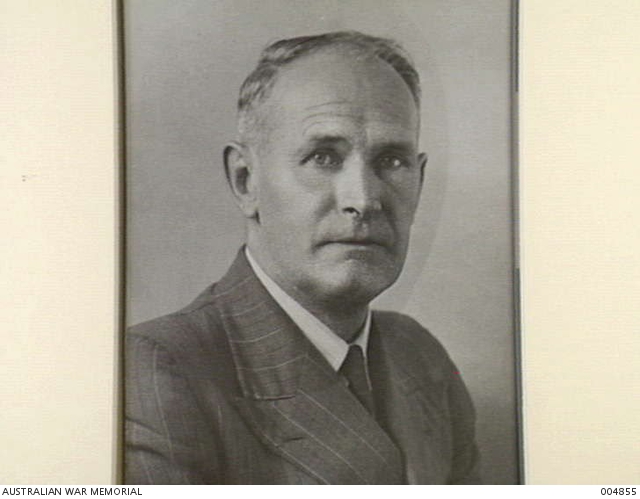
    Cyril Longmore, c. 1941. Public Domain; Courtesy Australian War Memorial

    Now to Non-com’s article on the “AIF in Literature” in Perth’s The Western Mail (30 April 1936).

    Who is this Non-com, I wondered? Some googling took me to the State Library of Western Australia photographic database where I discovered that he was Cyril Longmore (1897-1964), of The Western Mail, which, the photo notes said, preferred to use pseudonyms. Of course, I wanted to find out a bit about Cyril Longmore. More googling found the portrait I’ve used here on the Australian War Memorial (AWM) photographic database. Its notes said he’d been “appointed Military Commentator of the Department of Information” in 1941. At this point, I returned to Trove and found an article in Launceston’s Examiner (21 January 1941) about this appointment. He was to replace one Major Jackson who was returning to military service. The Examiner says that Longmore was recommended by C. E. W. Bean (the respected war historian), and that he had served in “the last war with the 44th Battalion and attained the rank of captain”. Post-war, it says, he “has been actively connected with Australian journalism and has written extensively on military subjects, of which he is a close student”. 

    So, not only did I find out who Non-com was, but I also ascertained his credentials for writing the article he did. (Oh, and the AWM also told me that he was The Western Mail‘s editor!)

    His article is based on a talk he did for an “Australian Authors” session on the “National station” (by which I presume he means the ABC). Despite his credentials, he commenced by saying that

    I speak on the A.I.F. in literature with diffidence, being no authority on the subject, although I have read most of the Australian war books, and my work has led me to make some study of them during the last few years. In this talk I am not touching Dr. Bean’s great historical work on the A.I.F., nor am I mentioning several Australian war novels. I have taken those books produced during the last five years which purport to be the experiences of those who wrote them—men (and a woman) who served in Australian units.

    In other words, his focus is not novels but memoirs and the like, but I think they are relevant to our discussion. I’m glad he includes women (albeit “a woman”, parenthetically!) It’s now 1936, but he too references All quiet on the western front, negatively, saying it “seemed to stimulate the imaginations of authors all over the world, for each seemed to try to outwrite the others in his trail of ghastliness”.

    Anyhow, here’s his list, in his order:

    • Red dust (1931), by JL Gray, writing as Donald Black: Subtitled “A classic account of Australian Light Horsemen in Palestine during the First World War”, this was apparently written during the war as a diary, and, says Longmore, “is a remarkable description and analysis of the life and deeds of the Australian trooper”.
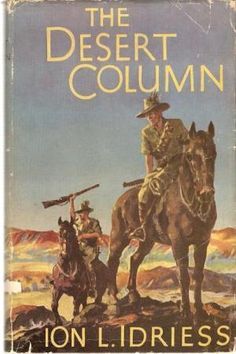
    • The desert column (1932), by Ion L. Idriess: Also a story in diary form of the Lighthorsemen, but at Gallipoli, Sinai and Palestine. Longmore says that “some of his pen-pictures are epics of war realism”. (As realistic as Remarque’s, I wonder?)
    • Hell’s bells and mademoiselles (1932), by Joe Maxwell, VC, who served with the 18th Battalion. Longmore says it is “an enjoyable volume, but there is some fiction woven into its truth, especially about the mademoiselles. The best feature in it is its faithful reproduction of types” that diggers would recognise.
    • Jacka’s mob (1933), by E. J. Rule: Longmore describes it as “a true and vivid picture of experiences with the 14th Battalion, A.I.F., by a man who was intimately associated with everyone and everything of which he wrote. It is no glowing picture of faultless knighthood.” He continues that “Knighthood and chivalry were in every unit in the A.I.F., in all the fighting armies, but even knighthood experienced the chill pangs of “wind-up” at times, and it is in the correct proportions in which the author has presented these and many other of the minor personal details that somehow escape the novelist [my emph!] that makes Jacka’s mob so valuable.”
    • The gallant company (1933), by H.R. Williams: Subtitled “An Australian soldier’s story of 1915-18”, it is praised by Longmore as the “best of all the Australian war books … It is not highbrow literature and there is no forced striving for effect. But it is a faithful, vivid narrative of an Australian unit and of its individuals, with just sufficient historical background to give them their proper atmosphere. A readable book that does justice to the great achievements of the digger and puts “war, wine and women” in proper perspective”.
    • Iron in the fire (1934), by Edgar Morrow: About the author’s experience of the 28th Battalion, Longmore praises it for being “the truest and most comprehensive war book of the lot” in terms of capturing the “inner feelings — sinking in the pit of the stomach before zero; sorrow at the death of a comrade; joy on receipt of a letter, or a parcel, or leave, which we all tried to hide under a mask of unconcern.” It’s “critical”, he says, and “all may not agree with the criticisms of authority, but it is a fine book”.
    • The grey battalion (1933), by Sister May Tilton: The one book by a woman, “the only one of its kind”, this “gives its readers an idea of the great courage and endurance that were needed by these women in their unenviable task of nursing the sick and maimed victims of war back to health and strength”. Interestingly, he notes that “what they suffered themselves no one will ever know”!
    • The fighting cameliers (1934), by Frank Reid. By a member of the A.I.F’s Camel Corps, but Longmore sees it as “the one disappointing Australian war book” because “colour and realism are lacking”.
    • Crosses of sacrifice (1932), by J. C. Waters. Differs from the others because the author is a journalist who was too young to go to war but had “toured the battlefields and war cemeteries of the world”. Longmore says he “brings a reverent and understanding mind to … his subject”. He writes more on this book than on any of the others!

    Do you read war histories, diaries or memoirs?

    Monday musings on Australian literature: Writing about the war between the wars

    By accident, really, I came across an article from the 1930s in Trove about war novels. However, with Anzac Day coming up here in Australia next weekend, it seemed apposite to follow up. So, I did – and was somewhat surprised by what I found.

    Not surprisingly, World War 1 was still fresh in people’s minds in the 1930s, and there were many opinions on how war should be written about. Erich Maria Remarque’s now classic All quiet on the Western Front was particularly controversial at the time and discussions about it provide some insight into those opinions. First published in 1928, it appeared in English in 1929 (translated, in fact, by an Australian, Arthur Wesley Wheen, himself a World War 1 soldier.)

    “the most graphic picture I have had of the war” (Woman reader)

    All quiet on the Western Front was a big hit, particularly with women readers. An article in the Port Adelaide News (14 March 1930) reports that “the popularity of the war novel is still maintained in England, where every girl typist seems to have read All quiet“. Apparently one Council Library system had bought a record number of 126 copies of the book, but they had 553 people on their waiting list. Unfortunately, the article said, “borrowers, strong in that possession which is nine ‘points of the law are lending All quiet to relatives and friends before returning it”. (Love it!)

    Here in Australia All quiet was also popular with women, as The Herald (14 February 1930) reported in its article, “VC attacks war novels”. Captain W.D. Joynt V.C., speaking at a Legacy Club luncheon, denounced “recent war books” including All quiet. At the luncheon, Captain Peters, of booksellers, Robertson and Mullen’s, said that women “had been the largest buyers and readers of the book”. It had “achieved such success that it was affecting the sale of wholesome [my emph] English novels”. He continued that the boom of interest in war novels “had brought out some good war books, but not many, and unless the protest was made the women and young people would get a wrong impression of the soldiers”. A motion had been put “to deplore” such books, but it failed, not because attendees disagreed but because they feared the motion would increase interest in the book!

    So, what was the problem? Wikipedia summarises the controversies in its article, but I’ll share some of what I found in Australian newspapers. The main concern seemed to be that its presentation of war denigrated the heroism of the soldiers. It had too much “muck”. One speaker at the luncheon said that “the book showed contempt for the men who served at the war, and brought grief to dependents of men who fell at the war” while another said that the phrase “give ’em muck” was applicable to the book. He said he had “read one or two chapters and refused to go further. It is full of Continental grossness. The coarse language is superfluous. This type of book should be banned.”

    Interesting that women were reading this “muck”.

    The writer in Freeman’s Journal (10 April 1930) comments on the new fashion for war novels, saying that for some time people had had their fill of war news but

    Now it has come into its own again, and, perhaps under the influence of the peace movement, it concentrates on the most repulsive aspect of war, sometimes deliberately trucking to the appetite of so many readers for word-pictures of the evil aspects’ of human life. Many of these novels are as wide of the truth and as repulsive as Zola’s La Debacle, which professed to give a realist picture of the war of 1870, but was a horrible libel on the people of France, representing her young soldiers as mostly imbecile fools or blackguards. 

    He goes on to describe another novel – not Remarque’s – that has, as its central figure, an utterly incapable Anglican chaplain. He says:

    It was by self-sacrifice and earnest efforts to be helpful that they [Anglican and Non-conformist chaplains] won the respect of the men. It is an insult to their memory to write of them as this novelist does, as if they were either hopeless failures or self-seeking idlers.

    Similarly, the Singleton Argus (28 April 1930) reports on one Rev. C. J. Macaulay, who was the principal speaker at the West Maitland Anzac Day service. Macauley made “a scathing attack … on salacious war novels”. He doesn’t name any, but said they “paint vile pictures, not so much of war, as of the men themselves”.

    Interesting that women were apparently reading these “vile pictures”.

    Were women seeing something different? Were women, like Lady Kitty’s woman reader, appreciative of “the grim reality” that its opponents wanted to hide? Lady Kitty writes that “it is remarkable what a vogue war novels are having now, especially among women. The type of immediate postwar sentimental romance has given way to simple narratives which reveal the common soldier’s point of view.”

    Writing about war

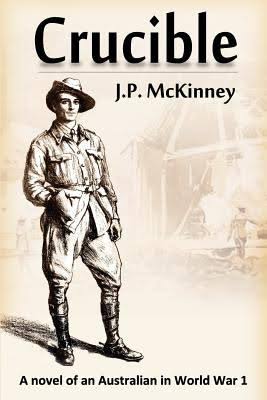
    JP McKinney, Crucible

    Meanwhile, in 1934, Australia’s RSL instituted a war novel competition. It was “open to all men and women who served abroad during the war as members of the Australian army, navy or nursing services”. The novel had to “depict the life of an Australian soldier during the war, and his reactions to the various conditions and environment through which he passed. The sequence of the story and descriptive matter must be historically and geographically correct”. It was won by JP McKinney (who, alert readers among you may know, was Judith Wright’s husband, though much later.) His novel was published as The crucible, in 1935.

    During my research, I came across a letter to the editor written by McKinney concerning his novel, and writing about war. He was responding to reviewers who seemed to criticise his novel for being “largely recollections cast in the form of fiction” or “more or less autobiographical”. (Helen Garner knows the feeling!) McKinney wanted to correct these misconceptions. He writes:

    A writer of fiction is permitted, by the canons of his art, to draw for his material upon both his own and other peoples’ experience and upon his imagination, the only demand made of him being, if his work is to be judged as literature, that he keep within the bounds of probability. His accepted function is to illuminate life— or at least that aspect of it which he treats —from all angles. The greater the fidelity to life and actuality the greater his achievement. 

    But, he says, people seem to see war fiction differently:

    In the case of the war novelist, however, it appears to have become unconsciously assumed that he shall write only of what he knows from his own actual, personal experience; and he is either denied, or assumed not to have availed himself of, the privilege of his fellow craftsmen of ranging into the realm of what may be called created fact. 

    So, he writes, “I granted myself the fiction writer’s full privilege, the only restriction I placed upon myself being that I make no sacrifice of truth to dramatic effect”. The characters are all created he said; they’re “types” not “persons”.

    J.P. McKinney did go to war, but, some readers here may be interested to hear the words of T.C. Squire, editor of London Mercury (reported in Tasmania’s Advocate, 10 January 1930). He was critical of the current crop of war novels, like Remarque’s, suggesting that they came out of “hysteria” rather than from thinking, compassionate, “religious” men. He concluded his comments with

    And it may be that the novel of this war (there is precedent for it) may come from some Tolstoi or Hardy of the future, who never saw a bullet fired and never looked in the face of the unnecessary dead.

    And here, I’ll conclude with Henry Savage from The Port Adelaide Gazette (10 January 1930). He was, I think, a local businessman and religious official. He wrote about war novels:

    There is a great difference between the horrors of war and reading of its horrors; between reality, that is to say, and the interpretation of reality in terms of art. Will the story of Eden ever stop simple Adam from being lured to his hurt by curious Eve? Will Hamlet make a man of action out of a dreamer and give him faith and resoluteness? Can it be done?

    Ignoring Adam-and-Eve, I pass his question on to you!

    Writing War: A panel discussion about war and historical writing

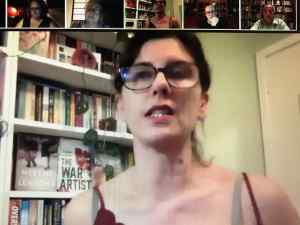
    In its original guise, I would not have been able to attend Writing war: A panel discussion featuring Nigel Featherstone, Melanie Myers and Simon Cleary because it was going to be held in Brisbane’s Avid Readers bookstore. However, in one of those lucky COVID-19 silver linings, the discussion was transformed into an online ZOOM discussion and, hey presto, I could attend for the princely sum of $5. Having read Featherstone’s Bodies of men (my review) and Myers’ Meet me at Lennon’s (my review), and being interested in Cleary’s The war artist, it was an opportunity too good to miss.

    Convenor, and author herself, Cass Moriarty, started by introducing the authors and asking them to talk about their novels, particularly in terms of their inspiration or intention:

    • Nigel Featherstone talked about wanting to explore different expressions of masculinity, particularly as expressed under extreme military pressure. He wanted to look beyond the ANZAC mantra that all men are brave, all do remarkable things, and so on. Can being a deserter, he wondered, be an act of bravery?
    • Simon Cleary described his Afghanistan War novel as a homecoming story, as being about soldiers finding a place in their home countries, as looking at the cost to the community of sending people to war.
    • Melanie Myers introduced a new genre (or sub-genre) to me, the “ensemble home-front novel”, which, she said, was coined by writer and educator, William Hatherell. It encompasses books like Come in spinner. Her novel is primarily about women’s experience of WW2.

    On the challenge of writing about past wars with nuance

    Featherstone immediately turned to the ANZAC idea, asking how do we talk about ANZAC without being kicked out of the country, and how is it that we have created a day that we can’t critique. He referred to Peter Stanley’s history Bad characters, which is about soldiers who were labelled as “bad”. Stanley’s book counterbalances the traditional ANZAC mantra, and taught him that bravery and cowardice can have many meanings.

    Cleary liked the word coined by Featherstone for ANZAC, its “uncriticability”! He spoke of something he returned to a few times during the evening, the idea that sending people to war is political act. It means, he said, that writing about war is also a political act. Too many war novels focus on glory, resulting in the more human facets, including genuine human trauma, often being missing.

    On that tricky question of the authority to write about war, when you haven’t personally experienced it

    Myers talked about the challenge of being true to the times and values you are writing about, while being sensitive to those of your own era. Writing about African-Americans in Brisbane during World War 2, for example, she had to deal with the “N-word”.

    Featherstone confronted the question more head on, asking “who gets to tell what story?” He did question his ability to write about war but, essentially, he believes “writers can do whatever they want”, with the proviso that they be prepared to talk about it. However, he also, a little anxiously but generously, shared his experience of inherited trauma (epigenetics), through his grandfather’s experience of World War 1.

    Cleary noted that authority can come from various sources – personal experience, the novelist’s imagination and creative experience, and, returning to that idea of war being “a deeply political act”, he argued that “every citizen has a right to an opinion” about war.

    Regular readers here will know that I agree, philosophically, with Featherstone, including that authors need to be prepared to discuss their choices. I also liked Cleary’s argument.

    On the de rigueur question of research 

    Myers explained some of her research process, saying that she starts with secondary sources, before looking at primary ones, and that in the case of this novel, she also walked the city imagining how it was, how it looked.

    Cleary said that it was important to know the details – even those not actually needed in the work – to help avoid clangers. He also said – and I loved this – that writing novels is an excuse for learning stuff!

    There was discussion about the impact of war on the social and economic opportunities for women, on values and prejudices, on the bonds forged during war, and on the burdens of war. Featherstone spoke of the physical and emotional scars of war. He pointed to a book titled We were there which reports on a survey of 3,700 World War 2 soldiers. A significant lesson from this book was that there can be multiple perspectives. He exemplified this by sharing a returned soldier’s view of his life versus the wife’s rather different view!

    On should you write about war and love

    Featherstone reiterated his position that there are no “shoulds” and that, anyhow, he wanted to write about love as a force of liberation. Love, he said, is what gets us through. Cleary noted that being in the proximity of death can make people feel vulnerable and therefore open to new things, and that these are the stuff of writing about war. However, he also said that war and gore can be depressing, and that art and love can provide useful “leavening”.

    On whether war fiction is a genre

    Myers answered that she specifically wrote in the “ensemble home-front genre” while Cleary didn’t see his book as being in the war novel tradition, but as simply being a story about humans dealing with an issue.

    And on whether there are any parallels re society’s response to war and to the current pandemic, Cleary suggested that in war, as in the pandemic, humanity is fragmented, that borders are closed and self-interest reins, but, in both situations, he said, you can also “flip it around” to see a spirit of solidarity.

    On the importance of documenting war

    Featherstone responded that the work of artists is to ask difficult, dangerous, blasphemous questions, that we need artists to ask questions politicians won’t, that artists can “dream their way into answers”. Getting into trickier territory – though it wasn’t further explored – he also said that artists can explore different versions of history, the “what ifs”. (Kate Grenville would agree!)

    Myers suggested that the volume of books still being written about World War 2 implies we still can’t make sense of it, that it is still unintelligible, while Cleary believed that it’s easy to forget the past, and that the role of fiction is to explore “the costs and consequences of the past”.

    Ending the session

    At this point the evening’s co-ordinator, Krissy Kneen, brought the event to a conclusion with some general questions:

    • Their advice to young writers: “if it feels dangerous, it’s worth doing”, “trust your instincts” and “be brave”.
    • War-related books they’d recommend: Dymphna Cusack and Florence James’ Come in spinner (Myers); Pat Barker’s Regeneration trilogy (Cleary) and The honest history book (Featherstone).

    Melanie Myers

    Melanie Myers (with the three novels faced out behind her)

    Given the opportunity to plug their new work, only Myers was brave enough to name her project. I was thrilled to hear it as she’s research pioneering Australian filmmakers, the McDonagh Sisters. I look forward to that. Featherstone simply said he was not going near war for a long time, while Cleary said that he had a project but it was early days!

    The hour whizzed by. Moriarty’s questions were focused and intelligent, the panelists’ responses were respectful and thoughtful, and the technology held up! It wasn’t the same as being in the room, but then, I wouldn’t have been, would I, so I’m grateful to have had the opportunity to hear these three writers speak.

    Writing War: A panel discussion
    20 April 2020, 6:30 PM – 7:30 PM
    ZOOM Online, organised by Avid Reader (bookshop)

    Melanie Myers, Meet me at Lennon’s (#BookReview)

    Book coverI was keen to read Melanie Myers’ debut novel, Meet me at Lennon’s, because it is set during the Brisbane of my mother’s early teens, that is, wartime Brisbane when her school, Somerville House, was commandeered in 1942 by the Australian Military Forces and served as a US Army Headquarters for the rest of the war. I grew up knowing this story, so was keen to see what Myers made of it, particularly since not many literary fiction novels, as far as I know, have tackled Brisbane during those times. Ariella van Luyn spends some time there in Treading air (my review) and David Malouf’s semi-autobiographical novel Johnno, which I read a long time ago, covers those years. However, being five years younger than my mum, Malouf was only 11 when the war ended, so his perspective is necessarily different.

    Myers’ focus is the lives of women during those strange, heady days when women experienced new freedoms through filling the jobs left by men. Added to this was the excitement and glamour of the American GIs in town resulting in increased socialising at bars, like the titular Lennon’s Hotel, and dance venues, like the Trocadero.

    It’s something isn’t it? It’s hard not to get caught up in the fever of having a common purpose. Uniforms everywhere and everyone feeling what they’re doing is important and useful. And the Americans, let’s not forget them. For all their braggadocio, they’ve certainly brought a touch of glamour to our little colonial outpost. (April 1943. p. 233/4)

    But it was a dark time too. It was a time of austerity and rationing. There was tension between the Australian men and the Americans whose cashed-up glamour, with their gifts of “nylons” and fur coats, attracted the women. There was racism towards black American soldiers. And there was sexual violence against women. This is the complex world that Myers explores in her historical novel, Meet me at Lennon’s.

    However, this novel is not straight historical fiction because Myers has taken the increasingly-common dual narrative approach, alternating between the 1940s and the present, when protagonist Olivia Wells is struggling, not only with her PhD on the life of a now-forgotten feminist author Gloria Graham, but also with her abusive (as it turns out) boyfriend, Sam, and the reappearance of her estranged father. Just like her 1940s counterparts, Olivia meets an American man. The stage is set in chapter 1 …

    You might be getting a glimmer now of why Myers chose the dual narrative approach? It serves to compare the lives of women in the 1940s with those of women now, asking us to consider what, if anything, has changed? Myers undertook extensive research into wartime Brisbane, looking particularly at police and newspaper reports of crimes against women, as well as the infamous Battle of Brisbane. She uses this research to create stories of several young women in the 1940s, stories she winds around a plot based on an unsolved crime – the River Girl murder. Through these women we learn, for example, that crimes by Americans were mostly passed to their Military Police and quietly handled, with justice rarely being obtained for the victim. Such was the River Girl’s fate. Can Olivia and her friends solve it now? There is, then, also a mystery at the heart of this novel.

    Myers does a lovely job of recreating the times. Her characters not only engaged me, but they felt authentic. There’s sturdy sensible Alice, who, having worked pre-war as a house-maid for rich people, sees the opportunity, now that she’s in a well-paid job, to buy a fur coat, just like her former employer had owned. To her horror, however, she soon realises that fur coats were “the gift of choice for women whom American servicemen ‘favoured'”. There’s Gwendolyn, engaged to the uninspiring Robert, but now having fun, as the much more exciting Dolly, with the “energetic” Corporal Charles Feely. There are several more, including those in the present time. One of the book’s challenges is keeping track of the characters and clocking the clues that might connect them.

    Myers plays about a bit with her dual chronologies. Chapter 4, for example, is divided into three sections, September 1942, July 1942, then August 1942. The aim, I assume, is to reduce the focus on plot tensions, by preparing us for characters’ actions and feelings. In September 1942, Alice burns the above-mentioned fur coat she buys in July 1942. She also remembers a violent act by her brother when they are children, which prepares us for meeting him in August. And Chapter 12 is set in 1993, when we meet again, as an older woman, Alice’s friend Val from 1942. It works fine – and indeed meeting the lively Val again in 1993 provides some light relief, while also moving the more serious issues on.

    The writing is generally sure and expressive. Myers writes some evocative descriptions, such as “a confident early sun fixed on warming the rest of the day ahead” and “the vaulted plaster ceiling of Reckitt’s blue was badly deteriorated and hadn’t felt the caress of a paintbrush in decades”. However, for me at least, she does overdo the similes. While, individually, most are fresh, they often felt irrelevant and distracting, such as “like a starlet’s eyelids, the brownout covers …”, “unfolding like a crumpled flamingo, Clio …”, and “the details landed like clumps of pelted sand.” Too much, I’m afraid.

    Meet me at Lennon’s, which won the Queensland Literary Awards’ Glendower Award for an Emerging Writer in 2018, is a good and meaningful read about a significant and little covered period in Australia’s and Brisbane’s history. Early in the novel, Olivia’s American acquaintance Tobias refers to the racist segregation of black American soldiers during the war years, and sees a wider relevance:

    “A place has got to come to terms with its ugly history, is what I think. Otherwise it metastasises like a cancer cell. And from what I understand, ugly history goes back a lot further here than just the war.” (p. 10)

    In the end though, it’s the lives of women which are the central concern of this novel. The final chapter commences with a letter written by Rhia (Gloria Graham) in 1975. She admits that she had hoped to “undo” what had been done to Olive, the River Girl. However, she comes to realise that “there are some evils that no art form can make better, fix or even soothe”. Perhaps she’s right, but novels like this can keep the important issues front and centre – and there’s value in that.

    Theresa Smith also appreciated this novel.

    AWW Challenge 2019 BadgeMelanie Myers
    Meet me at Lennon’s
    St Lucia: UQP, 2019
    265pp.
    ISBN: 9780702262616

    (Review copy courtesy UQP)