Ognjen Spahić, All of that (Review)

Regulars here know that I enjoy short stories, and that I review them regularly. Most of these reviews, though, are of Australian writers. I was therefore pleased when blogger roughghosts, in his review of a novel by Ognjen Spahić, provided a link to a Spahić short story titled “All of that”. As I haven’t reviewed many Balkan writers here, and definitely no Montenegrin writers, I grabbed the opportunity to read this story.

According to the biography provided by the online journal BODY, Spahić “is the best-known member of the young generation of Montenegrin writers to have emerged since the collapse of former Yugoslavia”. He’s published two collections of short stories and his novel Hansen’s Children (the one reviewed by roughghosts) won the 2005 Meša Selimović Prize for the best new novel from Croatia, Serbia, Montenegro and Bosnia-Herzegovina. Elsewhere I read that he’s been a resident writer at the University of Iowa’s International Writing Program and won, in 2011, Romania’s Ovid Festival Prize for a prominent young talent. Have you heard of him? I hadn’t. Another win for litbloggers, methinks.

“All of that”, which I suspect comes from his first short story collection, All that, published in 2001, is a first person story by a father concerned about his son Danilo’s ability to cope with the death of a schoolfriend and with attending her funeral. Most of the story takes place on a father-son fishing trip in which the father plans to take his son’s mind off the death, but the son has other plans:

‘Dad, have you ever been to the cemetery?’ he asked as we were driving.

And so starts a conversation … I loved the writing (albeit I read a translation). The dialogue, which constitutes much of the story, is simple, direct, and true, but it is in the father’s reflections that the truth of the matter comes out. It’s the father who has problems with death. He’d lost his father (car-crash) when he was 6 years old and his mother (illness) when he was thirteen. “It’s difficult to talk about death”, he says

And even more difficult to explain to a child the ceremony and rituals which go with it in this rotten country.

“This rotten country” is alludes to something wider than the story at hand, and suggests to me there may be another level on which the story might be read. Interestingly too, as the father and son are rowing, the son says he doesn’t like fog though it doesn’t bother him. This surprises the father, but he suggests:

‘OK Danilo, Strange Prince of Darkness. Let’s row a little bit faster to that deserted island.’

Strange Prince of Darkness? Why does he call his son that? It seems affectionate. Other religious references, on the other hand, are more direct, such as “Deformed quotes from the Bible”.

Anyhow, the fog returns a few times in the story. At one time the father says it “creeps like a python after the slow process of digesting its prey”. It lifts towards the end, suggesting some resolution for the father/narrator’s anxieties.

What I enjoyed was the way Spahić slowly teases out the father’s feelings – through the dialogue, his reflections, the style (particularly the use of repetition), and the language and imagery – because in the end the story is more about the father’s feelings. Just after the “strange Prince of Darkness” comment, the father talks of making “a pretence at adventure, a small harmless attempt to escape from reality”. And yet, the son gives no sense of needing to escape from reality. It’s the father.

I’m not going to write more about this story. It would certainly bear multiple readings, but is powerful enough on the first reading to give a sense of yet another writer I’d like to get to know more. I might read Hansen’s children yet.

Ongjen Spahić
“All of that” in BODY, June 30, 2013
(Trans. by SD Curtis)
Available online at BODY

Fyodor Dostoevsky, Crime and punishment (Review, hmm)

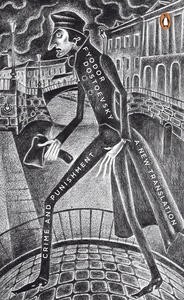
DostoevskyCrimePenguinPart way through my reading of Fyodor Dostoevsky’s Crime and punishment I wrote in my book – because, yes, I am a marginalia writer – “Who does Dostoevsky agree with?” It’s a somewhat naive question, I know, because the author doesn’t have to agree with anyone – and very often doesn’t. You just have to look at Humbert Humbert for example, or Patrick Süskind’s Jean-Baptiste Grenouille. But, in those novels, you can assume the authorial viewpoint. Crime and punishment, however, seems to me to be very different. What is Dostoevsky’s viewpoint? Does he have one?

SOME SPOILERS FOLLOW … THIS IS A CLASSIC, SO FAIR GAME I’D ARGUE.

This brings me to why I read classics. There are two main reasons: one being simply that I’m interested in our literary heritage, and the other is because they still have something to say. I guess this partly answers the question I posed a couple of posts ago doesn’t it? I read for insight into “the human condition”, to understand what makes us tick, and therefore, I suppose, to know myself and others better. Anyhow, back to Crime and punishment and my marginalia comment. The central question in the novel is, really, why did Raskolnikov do it? And his reasons are so ambiguous, so paradoxical, that he slots pretty comfortably into our post-modern world of uncertainty, self-consciousness and fluidity. Of course, he’s not modern (or post-modern). He’s a 19th century creation (and this is a mid-19th century novel with a happy ending). But he’s a creation who is hard to pin down, because he’s the creation of a writer from a society in flux, and of a writer who was perhaps himself in flux. Indeed, Raskolnikov’s name, so the translator of my edition tells me, derives from “raskol” meaning “a split or schism”.

So, Raskolnikov commits his crime. He murders not only the “old hag”, a pawnbroker with whom he’d had several problematic dealings, but her sweet, simple-minded sister Lizaveta, who surprised him in the act. Raskolnikov evinces little or no obvious guilt for his actions, though his physical illness and mental disarray post-murder are surely a psychosomatic response to what he’d done. His behaviour is quite schizoid, at one moment warm and generous, and then suddenly cold and calculating. No wonder those close to him can’t make him out. He’s a slippery beast.

And he’s a slippery beast because it seems – if I understand the various end-notes included in my edition – he’s a vehicle for Dostoevsky’s views on Russian society and intellectual life at the time. So, here I’m answering my opening question: Raskolnikov represents Dostoevsky in that he speaks to Dostoevsky’s concerns about some critical issues, but these concerns are multifarious so cannot be pinned down to one main idea. In some ways Crime and punishment could be seen as Dickensian, in its description of the grime and poverty of St Petersburg, but I don’t see Dostoevsky as a Russian Dickens. His main focus is not social justice, though the idea of “justice” features frequently in the novel, but more intellectual, political and psychological. Raskolnikov’s “motives” range from utilitarian ones (the world will be better off without the “hag”, “a useless, foul, noxious louse”) through philanthropic ones (her money could be used to help others) to megalomaniac and egotistic ones (“I wanted to become a Napoleon”, am I one of the “extraordinary” people “who dares to stoop and grab”, one who “moves the world and leads it towards a goal”?). These motives address many of the debates that were occurring in contemporary Russia, debates about socialism, Westernisation, moral responsibility versus environmental impact on human behaviour, and social Darwinism. Overlaying all this is Dostoevsky’s Christian belief. Sonya, the young girl who takes up prostitution to provide for her step-mother and siblings, is the person to whom Raskolnikov first confesses. While shocked, she listens and refuses to believe, or at least accept, his baser motives. Her solution is a Christian one, to “accept suffering and atone”.

In the end, at his trial, Raskolnikov gives practical reasons for the crime to do with his poverty and desire to use the victim’s money to help his career (except he didn’t touch the money), and admits he turned himself in because of “heartfelt remorse”. He receives a relatively light sentence (only eight years in Siberia) for various reasons, including his sickness before the crime, his generous character, and the fact he did not use the money.

Raskolnikov is one of literature’s great anti-heroes, alongside the likes of Shakespeare’s Macbeth and Camus’ Meursault, to whom he has been compared. I can see why – though he doesn’t have the clear motivation of Macbeth, nor the absence of motivation of Meursault. Like Meursault in particular, Raskolnikov is complex and engenders endless debates that are as affected by the reader’s beliefs, experiences and attitudes, and dare I say by the reader’s times, as they are by the text itself.

The novel’s ending suggests “renewal” and “rebirth”, but what exactly Dostoevsky meant by it all is not completely resolved, at least in my mind. There has been enough ambiguity and paradox throughout – for example, Raskolnikov argues that if he has to question whether he has “a right to power” then he doesn’t because one who does wouldn’t ask – and the trial is covered with such brevity to undermine complete confidence in the resolution. I like this sort of openness. It seems appropriate, therefore, to conclude with Raskolnikov’s loyal friend Razumikhin who says to Razkolnikov’s mother and sister:

Keep fibbing, and you’ll end up with the truth! I’m only human because I lie. No truth’s ever been discovered without fourteen fibs along the way … Name anything you like: science, development, thought, inventions, ideals, desires, liberalism, rationalism, experience, anything at all, anything, anything – and we are all, without exception, still stuck in the first years of preparatory school! We just love making do with other people’s thoughts.

Is Raskolnikov an original, a creative truth-teller, or just another confused human being prattling off ideas he’s heard from others? That is the question.

Fyodor Dostoevsky
Crime and punishment
(Trans. by Oliver Ready)
London: Penguin Books, 2014 (Orig. ed. 1866)
702pp
ISBN: 9780141192802

More on Simone de Beauvoir’s Memoirs of a dutiful daughter

My recent review of Simone de Beauvoir’s Memoirs of a beautiful daughter was a little dry, focusing on some specific ideas or issues that interested me, rather than on her writing. It’s a pretty dense book, containing detailed description of her life and thoughts, but her fearless and often evocative writing carries it. I’d like to share a few examples to round out my review – but of course, in doing so, I can’t help but also discuss the book a little more too!

Nature

Beauvoir and her family would spend their summers with relations in the country – with her father’s sister at La Grillière and her father’s father at Meyrignac. In these places she developed a deep love of nature. Early in Memoirs, from when she is still a very young schoolgirl, she writes that

… I was learning things that are never taught by books or official syllabuses. I learnt to recognise the buttercup and the clover, the phlox, the fluorescent blue of the morning glory, the butterfly, the ladybird, the glow-worm, the dew, the spiders’ webs, and the strands of gossamer; I learnt that the red of holly is redder than the cherry laurel or the mountain ash, that autumn blooms the peach and bronzes the leaves, that the sun rises and sets in the sky though you cannot see it moving. The wealth of colours and scents excited me. Everywhere in the green water of the ponds, in the waving grasses of the fields, under the thorny hedgerows and in the heart of the woods were hidden treasures that I longed to discover.

This love of being in the natural world continues with her – at least until she is 21 when these memoirs end. Indeed, at one point, when she is 19 or 20 years old, she admits to a mystical experience:

… the fact of existing here and now sometimes took on a glorious splendour. During those few days, the silence of nature often plunged me into joy and horror. I went even further. In those woods and meadows undisturbed by man, I thought I touched that superhuman reality I aspired to. I knelt down to pick a flower, and suddenly I felt riveted to the earth, with all the weight of the heavens on my shoulders; I couldn’t move: it was both an agony and an ecstasy which brought eternity within my grasp.

One of the threads running thought the novel is her desire to find “the meaning of life”. With this “mystical” experience, she was tempted, she writes, to “believe that I had attained the Unknown”. However, being the intellectual she was, she continues, “I didn’t want to take myself in” so asked some respected confidantes. Their responses bring her to the conclusion that “one can’t base one’s life on such giddy notions and I did not try to bring them on again”.

“I am alone”

Sartre and Beauvoir

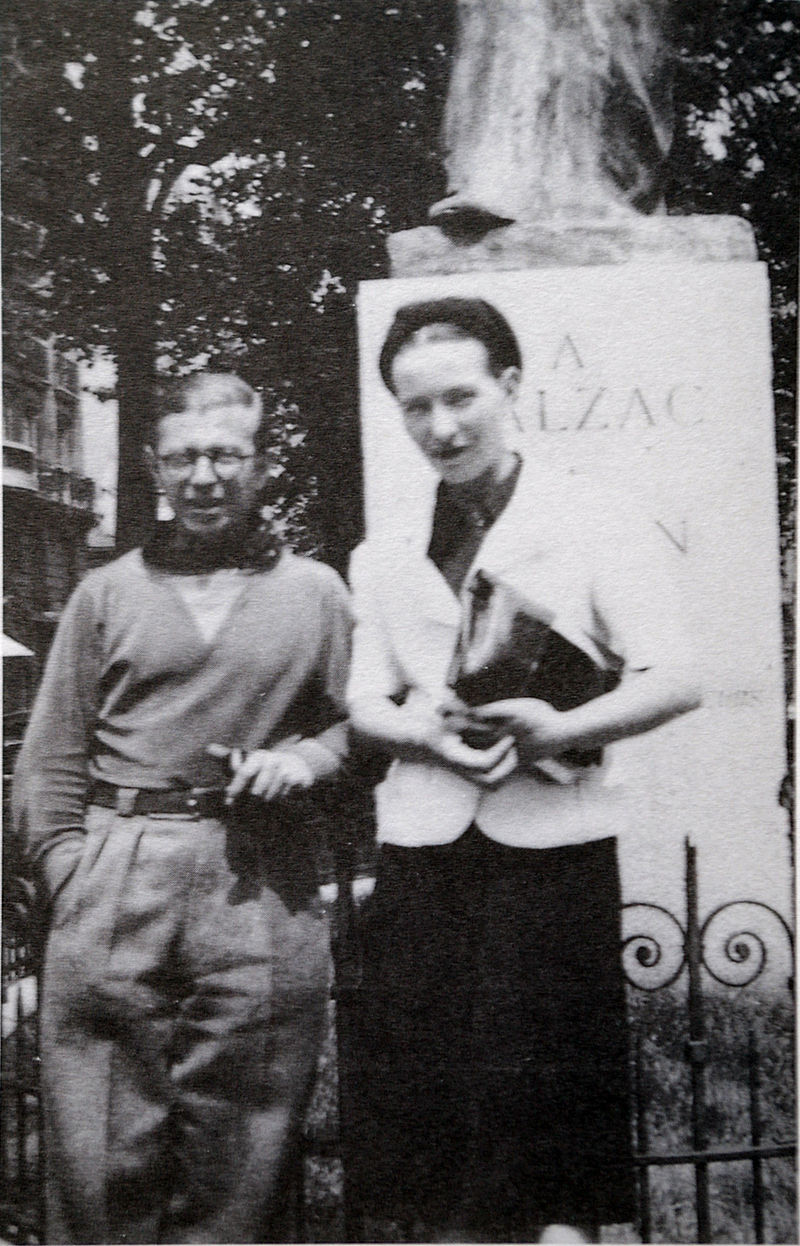
Sartre and Beauvoir, Balzac Memorial (Presumed Public Domain, via Wikipedia)

In my review, I likened her autobiography to a bildungsroman, and nowhere is this more applicable than in her descriptions of what we would now call teenage angst. Sometimes I think I have forgotten my youth, but Beauvoir’s descriptions of her own inner conflicts brought the memories back – reminding me, as if I needed it, of one of the reasons I love to read. What teenager can’t relate to the feeling of being “alone”? Beauvoir certainly could. Being the daughter of a devout Catholic mother and an atheistic but socially conservative father, in a society in which women were (or, at least she felt) “cabined, cribbed and confined”* left her frequently feeling alone, in “exile”.

In today’s discussion of the book on ABC Radio National’s Books and Arts Daily, literary critic Geordie Williamson quoted a heart-rending section from the book (p. 188-9) in which she discusses this issue, when she realises the error of her belief that

it would be possible to rise above bourgeois mediocrity without stepping out of my own class. Its devotion to universal values was, I thought, sincere; I thought I was authorised to liquidate traditions, customs, prejudices, and all kinds of political and theological particularism in the light of reason, beauty, goodness and progress.

She thought she would be praised if she wrote a book that “trampled conformity in the dust”, but she discovers that she’s wrong, that “people did not accept me at all; instead of weaving laurel crowns for me, people were banishing me from society”.  She “would always be ostracised”. Painful, painful.

This sense of aloneness – of “exile” – continues. Part of it is, of course, typical for adolescents. She writes, when she’s 20, that “I would fall into an arid despondency of heart, and then be bounced up into happiness again”. But it’s clear too that she was different from most of her peers. Joining Sartre and his little group brought her, finally, to “her” people, and she knew at last that she didn’t have “to face [the] future all on my own”.

A novelist’s eye

In my review I suggested that Beauvoir’s autobiography has some of the sensibility of a novel – particularly in language and characterisation. At my reading group’s discussion, one member shared her favourite quote. It’s a perfect example of the fiction writer’s ability to capture a moment. Here it is (with thanks to Kate):

On the evenings when my parents held parties, the drawing-room mirrors multiplied to infinity the scintillations of a crystal chandelier. Mama would take her seat at the grand piano to accompany a lady dressed in a cloud of tulle who played the violin and a cousin who performed on a cello. I would crack between my teeth the candied shell of an artificial fruit, and a burst of light would illuminate my palate with a taste of blackcurrant or pineapple: all the colours, all the lights were mine, the gauzy scarves, the diamonds, the laces; I held the whole party in my mouth.

* Roughly quoted from Macbeth.

Simone de Beauvoir, Memoirs of a dutiful daughter (Review)

Courtesy: HarperCollins Australia

Courtesy: HarperCollins Australia

I have only read one other work by Simone de Beauvoir – and I’m ashamed to say that it wasn’t The second sex (which still sits in my long-in-the-tooth TBR pile). It was, instead, one of her autobiographical novels, She came to stay. I enjoyed it as I recollect, but that was a long time ago. Then this year, my reading group decided to choose one of the books being discussed in ABC Radio National’s European classics series – and we opted for the first of Beauvoir’s autobiographies, Memoirs of a dutiful daughter.

Now, the things is, it’s a pretty dense book that can be looked at from multiple angles, too many to explore in one review. Consequently, my plan is to focus here on a few that interest me, and to later post a Delicious Descriptions containing examples of her gorgeous descriptive writing.

First though, as always, a brief summary of its content. Published in 1958, the book chronicles her youth from her birth in 1908 to when she turned 21 in 1929. It deals at some depth with her childhood, school and university days; her relationship with family and friends; her youthful thoughts about and experience, such as it was, of love; and, most importantly, the foundations of the ideas that drove her adult life. It shows the inner conflict she experienced as an independent thinker growing up in a conservative Catholic bourgeois family. I’d describe it as the autobiographical equivalent of a bildungsroman, which sounds silly since autobiography is intrinsically about the development of self. But this particular autobiography ends at the moment when she formally leaves childhood behind, and, like a bildungsroman, is primarily the story of her “formation”.

Autobiography

WARNING: THERE BE SPOILERS IN THIS SECTION – DOES THAT MATTER IN AN AUTOBIOGRAPHY?

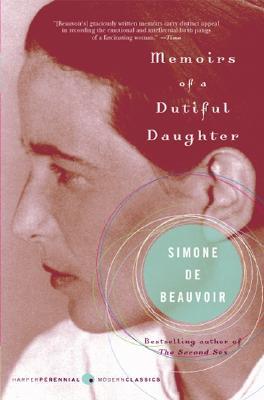
BeauvoirMemoirsHarperPerennialThis leads nicely into the first aspect of the book I’d like to discuss, its form. It is a traditional autobiography in that it starts with her birth and moves in a linear way, with the occasional foreshadowing, to her chosen endpoint which is when she turned 21, finished her schooling and left home. Like an autobiography it contains many characters. (There is a comprehensive index if keeping track becomes difficult, though I didn’t find it that hard).

The book also, though, has some novelistic elements. While at times the style is dry and almost diary-like, at other times it is highly evocative, particularly when she describes her experience of nature. More relevant though to my argument is her use of characters, because while we meet many, there are three that she focuses on – herself, her first cousin and first love, Jacques, and her closest friend Elizabeth “Zaza” Mabille. These two significant people provide coherence to the narrative line and a semblance of a plot. Will she or won’t she marry Jacques? And how will Zaza develop?

Beauvoir doesn’t marry Jacques, but while the book ends when she’s 21 and he’s about 23, she briefly describes what happens to him in the rest of his life, which ends, sadly, when he’s 46. Zaza, on the other hand, could be seen as her alter ego. As we read the book, focussing on Simone as “the dutiful daughter”, we become aware that Zaza is also one. The difference between them is that while Simone is dutiful in an obey-the-parents sense, she is an independent thinker and learns to distance herself intellectually from her parents. Zaza, on the other hand, exemplifies the tragedy that can happen to “dutiful daughters” who don’t achieve this. She, in other words, rounds out the theme implied in Beauvoir’s title.

This sense of Jacques being her potential future and Zaza being her alter ego gives this autobiography some of the sensibility of a novel.

Gender

I couldn’t of course write on this book without discussing gender. But first, it’s important to remember when she was born – 1908 – and the community into which she was born – conservative, Catholic, bourgeois. It was intriguing to see how her ideas developed in this early part of her life.

Early in her childhood she saw that mothers had a life of “servitude”, and were “overburdened with a thousand tiresome tasks”. Her response was to decide not to have children but be a teacher. In her teens, she states that “I believed in the absolute equality of human beings” but doesn’t engage with  the idea of universal suffrage. A few pages later, she is a little fuzzy on this idea of equality when she considers her future husband:

I should be in love the day a man came along whose intelligence, culture, and authority could bring me into subjection.

Why, she says, did she think this? She continues

I never thought of myself as a man’s female companion; we would be two comrades [but, she goes on] My education, my culture, and the present state of society all conspired to convince me that women belong to an inferior caste.

She goes on to explain that the man she loved would be “the model of all I wished to become; he would therefore be superior to me”.

Overall then, her thinking was a little confused. Theoretically she believed in equality and demanded independence for herself, resulting in much conflict with her parents in her later teens, and yet she saw her ideal partner as being “superior”. Part of her belief in equality was an absolute rejection of the double standard. She ascribed to the Christian morality of her times but felt “that men should be subject to the same laws as women […] I saw no reason why my future partner in life should permit himself liberties which I wouldn’t allow myself”.

By the end of the book, that is, by the time she turned 21, her thinking hadn’t developed much beyond this. She believed in equality, she didn’t want to be constrained as she saw married women with children were, but she had not developed the ideas that she presented in The second sex, which she wrote around the age of 40Tellingly, Beauvoir-Sartre biographer Hazel Rowley writes in my edition that it was Sartre who told Beauvoir that if she were to write her memoirs she would need to look into “what it had meant to be a woman”. Beauvoir was apparently dismissive, believing that being a woman had never really affected her but, she decided to do some research. What she discovered was “a revelation” and resulted in her putting her memoirs aside to write The second sex.

Literature and truth

The other issue that spoke strongly to me as I read the book was the importance of literature, of books and reading, to her – and, related to this, her search for truth. Reading was, she writes, “the great passion of my life”. If you are well-versed in French literature, as I am not, you could track her intellectual development through her reading. She discusses the books she read as a young school girl, her reaction as a young teenager to Jo in Little women and Maggie in Mill on the floss (both English books, I know!). She talks of engaging in her late teens with contemporary literature of “the disquiet” through writers like Gide (whom I have reviewed here), and of then moving on from them.

She learns much through reading, not only intellectually and morally, but practically. Books, for example, provided her with much of her sex education, so that when her mother finally decided it was time to tell her the facts she could say “I know all about that” – though what she knew about sex and what she understood about the world were two different things!

She learns that literature and reality are not the same thing, saying at one point that

Literature takes its revenge on reality by making it the slave of fiction.

At times she argues that literature is the truth, while at other times she feels its connections with truth are dubious, but this is all part of a portrait of the writer as a young girl. “Real” truths are not found easily, and she, we see, worked hard for hers.

Finally – and how long we readers had to wait for it – it’s her meeting with Sartre, “the dream-companion I had longed for”, that grounds her, as she reaches the end of her formal childhood. He is, she says, her intellectual superior, and she is, she knows, still naive, but

I no longer asked myself: what shall I do? There was everything to be done, everything I had formerly longed to do: to combat error, to find the truth, to tell it and expound it to the world, perhaps to help to change the world.

And so she did.

Simone de Beauvoir
Memoirs of a dutiful daughter
(Trans. by James Kirkup)
New York: Harper Perennial, 2005
(First pub. 1958; Translated 1959)
364pp.
ISBN: 9780060825195
Diego Marani, The last of the Vostyachs (Review)

Italian writer Diego Marani‘s The last of the Vostyachs was originally published in 2002, but the English translation was not published until 10 years later in 2012. How lucky we are that it was, because this book is unlikely to have been written by an English-language writer. Its focus on the relationship between language, culture and place and on darker issues like ethnic nationalism comes from a different – and particularly European – sensibility. We speakers of the world’s dominant language can, I think, be a bit oblivious to the linguistic issues faced by speakers of other languages, particularly in Europe where multiple languages live cheek by jowl. The challenge of communication is an important issue for Marani who works in Brussels for the European Union. His roles have included interpreter, translator, and policy adviser on multilingualism. Marani knows as well as anyone that language is both a cultural and political issue – and this is what he explores in this, his second novel.

However, The last of the Vostyachs is no dry tome explicating the role and value of language. Instead it is a surprising and often funny novel that weaves myth and saga, melodrama and irony through the warp of a crime thriller. It incorporates a number of literary traditions and archetypes: the wild (innocent) man set loose in the city, the spurned wife, the spirit guide, the corrupt obsessive, and the remote cottage in the woods where dastardly things happen. On the night the crimes (murders, in fact) take place, nature runs amok. Zoo animals roam the city and the temperature drops to its coldest in fifty years.

The plot centres on Ivan, who is the last of the Vostyachs, an ancient Siberian shamanic tribe. He is the only one who can speak the language, though at the novel’s opening he had not spoken it (or anything else) for twenty years, not since, as a young boy in the gulag, he’d seen his father killed. When the gulag is suddenly freed, he returns to the Byrranga Mountains but all he finds are wolves. He believes them to be his people who, to flee the soldiers, had hidden deep in caves and turned into wolves. He cannot bring them back to human form but they shadow and protect him.

Every single language is necessary to keep the universe alive

Into this mix appears the plain, ethical, Russian linguist Olga who is excited to find a speaker of a language thought to have been extinct and who sees in this language an exciting connection between Europeans and the native Americans. Her old colleague, the womanising, unethical, Finnish linguist Jarmo Aurtova is not so pleased with this threat to his theory of Finnish as the “Latin of the Baltic”, as, in effect, the master language of Europe. Jarmo sounds scarily like Hitler in his desire to prove the supremacy of a pure Finnish language:

In ancient times we were the civilised ones and they were the barbarians. We were the masters, they were the slaves. Not for nothing is the word aryan so similar to the Finnic orja, which means slave.

and

But now ‘someone’ was trying to throw Finland into the dustbin of history, together with the other conquered peoples who have no future. Aurtova was not having that …

Jarmo cares not if a language or two disappears and dies in the service of his theory. He believes that the fewer the languages the more “we’re moving towards the truth, towards the pure language”, while for Olga “with each one that dies, a little truth dies with it”. Marani, the creator of the flexible inclusive language Europanto, is on Olga’s side, on the side of plurality. She says

The true meaning of things is hidden from us; it lies beyond the bounds of any one language, and everyone tries to arrive at it with their own imperfect words. But no language can do this on its own. Every single language is necessary to keep the universe alive.

Cherish ignorance

The last of the Vostyachs is a ripping yarn that takes us from the tundra to Helsinki, through city streets, down country roads, across ice and onto the sea, as the various characters pursue their passions. But it’s the irony that conveys its main messages – and much of this irony revolves around our arch-villain and misogynst, Jarmo. His guilt as a murderer is revealed through a clue that is gorgeously ironic. In his final speech to the linguistic congress he, an academic for heaven’s sake, exhorts people to “cherish ignorance”, to not learn other people’s languages but “force” them to learn yours. And, most ironic of all, not only is the Vostyach language not destroyed, but by the end of the book, without giving too much away, “it could truly be said to be alive and flourishing” – albeit in a rather odd place.

Partway through the novel, Olga says to Jarmo of Finns that “to communicate with the rest of the world you have to learn another one, you have to venture out among words which are not your own, which you have borrowed from others”. In The last of the Vostyachs, Marani has ventured out and written something wild and rather risky. In doing so, he has produced a novel that’s not only fun to read but also gives the mind much to think about.

Lisa at ANZLitLovers read and enjoyed this book earlier this year.

Diego Marani
The last of the Vostyachs
(Trans. by Judith Landry)
Melbourne: Text Publishing, 2012
176pp.
ISBN: 978192196885 (Kindle ed.)

Valeria Luiselli, Faces in the crowd (Review)

Mexican writer Valeria Luiselli’s Faces in the crowd was, as regular readers here might remember, one of my two Bah Humbook virtual gifts from Stu of Winston’s Dad. I ordered it on Christmas Day for my Kindle – after all, it was a Christmas present – and have now read it. Wow, what a read, but how to write about it?

Perhaps I’ll start by quoting something near the end of the novel:

There are people who are capable of recounting their lives as a sequence of events that lead to a destiny. If you give them a pen they write you a horribly boring novel in which each line is there for an ultimate reason: everything links up, there are no loose ends.

This is not such a novel. Things don’t link up, there are loose ends, and it’s both chronological and not. It is in fact a metafictional work. It has the old story-within-a story-within-a-story structure, the self-consciousness about fiction versus reality, all of which could be a bit old hat, except it isn’t. The first person narrator is a somewhat frustrated novelist in Mexico City. She has two children – the boy and the baby – and a husband. To make her novel, an autobiographical one, interesting, she has her husband leave her. (Wish fulfilment? we wonder.) Reading over her shoulder, he says:

Why have you banished me from the novel? What? You wrote that I’d gone to Philadelphia. Why? So something happens.

This fictional husband sometimes takes up the story, telling of his life in Philadelphia and of missing his children. Our narrator reminds us that “it’s only a novel, none of it exists” and says she is writing “A horizontal novel, told vertically”, and then “A vertical novel told horizontally”, and still later “Or a horizontal novel, told vertically. A horizontal vertigo”. Word play, you see! I can imagine the fun the translator had with this – and from what I can tell, she seems to have made a good fist of it because there’s a lot of humour here, humour that is linguistic, verbal, and that requires you to keep your wits about you.

Meanwhile, interspersed with telling the story of her current life in Mexico City and the “fictional” life of her husband in Philadelphia, she tells of her past when she worked in New York City “as a reader and translator in a small publishing house dedicated to rescuing ‘foreign gems'”. There are a few “digs” at Americans in the book and one follows this statement, when she continues, “Noone bought them, though, because in such an insular culture translation is viewed with suspicion!” I can see why Stu, with his love of translated literature, related to this work! This story, the one about her time in NYC, is full of unusual but colourful characters flitting into and out of each other’s lives, houses and beds, all told through little, sometimes interconnecting, vignettes which mostly serve to illustrate the contrariness of existence.

There’s Moby, for example, who “forged and sold rare books that he himself produced on a homemade printing press”. “My husband reads some of this”, our narrator writes, “and asks who Moby is. Nobody I say. Moby is a character.” Is he? Your guess is as good as mine. Suffice it to say that Luiselli plays these games with us from beginning to end, all the while challenging us to consider what is fiction, what is real. Is any of it real, she seems to be asking? She writes, “Writing this is coarse. But reality is even more so.” There are ghosts, blindness, and shadows; people and objects suddenly slip from being substantial to being insubstantial. And gradually our narrator, herself, seems to merge with the obscure Mexican poet, Gilberto Owen, about whom she is writing, while running into (or does she?) other poetic luminaries like Federico Garcia Lorca, William Carlos Williams and Ezra Pound.

There’s a fantastical element to the story, but it’s not the same as Gabriel Garcia Marquez‘s magical realism. It’s more slippery, if that makes any sense at all. While Gabriel Garcia Marquez expects us to comprehend “the magical” as part of it all, Luiselli seems to be saying the opposite, suggesting that perhaps “nothing is”.

This all might sound rather depressing, but it’s not. It is in fact a fun read. And while the novel is, I think, about the challenge of living an artistic life in which the things of the real world threaten to overwhelm the imagination, the final word is positive – albeit ironically so. You’ll have to read it yourself though to find out what that is.

Valeria Luiselli
Faces in the crowd
Translated by Christina MacSweeney
London: Granta Books, 2012
ISBN: 9781847085580 (Kindle ed.)

Yan Lianke, Dream of Ding village (Review for Shadow Man Asian Literary Prize, 2011)

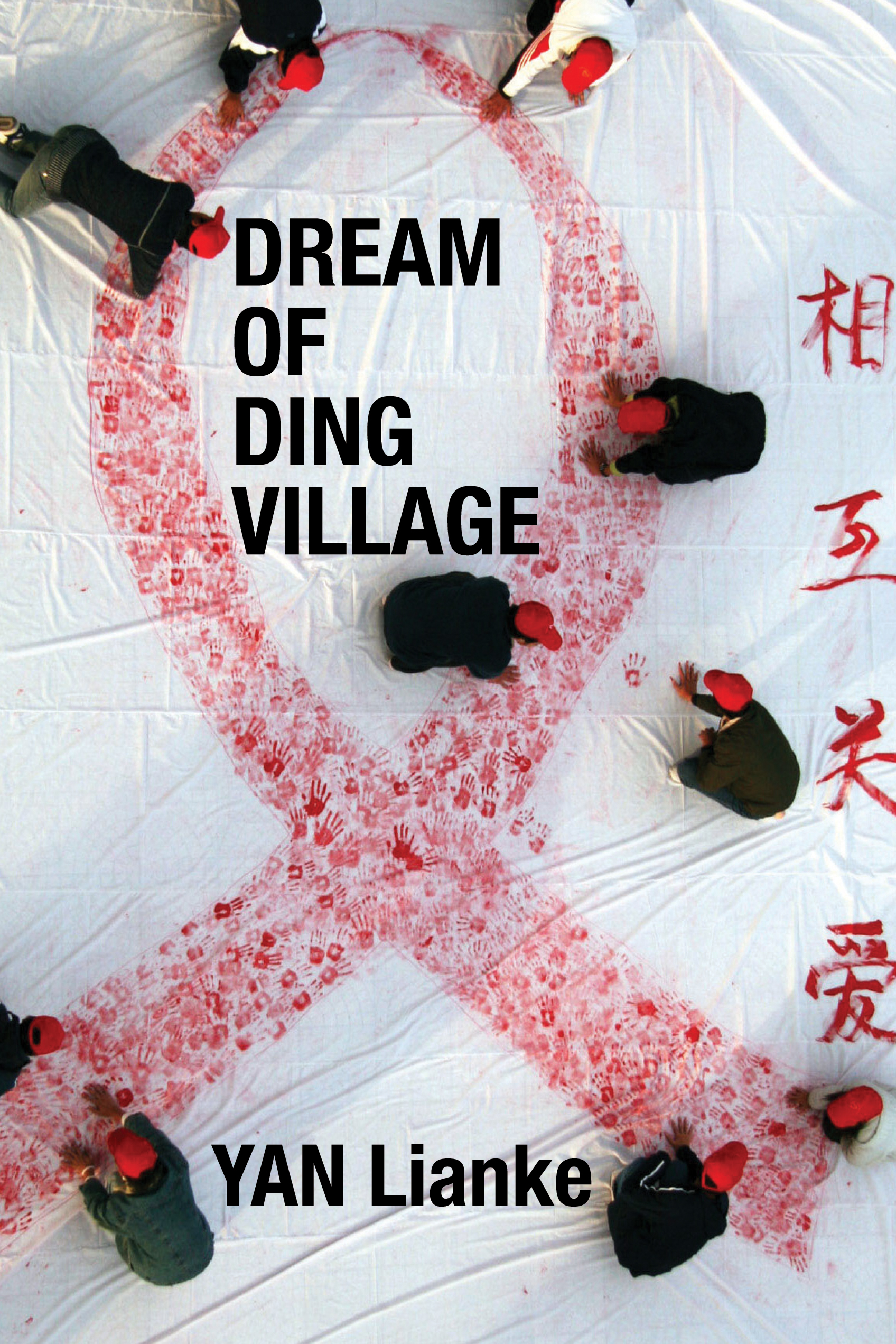
Yan Lianke's Dream of Ding Village

Bookcover courtesy Grove / Atlantic Inc.

As I started reading Yan Lianke‘s Dream of Ding Village, I was reminded of a favourite novel of mine, Albert CamusThe plague. However, as I read on, the similarity started to fade – or, perhaps it’s just that the particularity of Lianke’s conception took over. Both books explore a community living with a highly contagious, deadly disease, and both can be “read” through the lens of a wider political interpretation, but the two stories are told differently. For a start, Camus does not make his political “reading” literal while Lianke closely intertwines the political with the personal in his novel. No wonder this novel was published in Hong Kong and banned in China!

The story was inspired by the fallout that occurred from Henan Province‘s plasma economy, 1991-1995, in which Chinese were encouraged to sell their blood plasma. According to the Wikipedia article, it is estimated that over 40% of the blood donors (sellers) contracted AIDS, due to the low health and safety standards applied to the campaign. It’s a tragic story and Lianke uses it to tell a cautionary tale about a rush to progress that seems to cast humanity to the winds.

So, how does he tell it? The story is narrated by the dead son of “blood kingpin” Ding Hui. Qiang was poisoned in an act of revenge for his father’s role in bringing “the fever” (HIV/AIDS) to Ding Village. In the clear, non-judgemental voice of a child, Qiang proceeds to chronicle events in the village as the disease takes hold, using occasional flashbacks to fill in the gaps. His is not a schmaltzy or sentimental voice. It’s simply the voice of an omnipotent narrator who happens to have also been part of the story, before the novel starts, and whose “existence” initiates its dramatic denouement. It’s an interesting device that nicely balances involvement with distance. We get close, but not too close, to the people and events.

Shadow Man Asian Literary Prize 2011 Badge

Image by Matt Todd of A Novel Approach

The novel is told in 8 Volumes, and progresses chronologically from the appearance of the fever to when its impact on Ding Village is complete. Qiang tells his story primarily through the actions and behaviour of his grandfather, a man who hangs onto his ethics throughout the crisis while trying, mostly against his better judgement, to remain loyal to his two self-centred sons. A difficult task for the hard-working man entrusted with caring for the school and being its teacher when qualified teachers couldn’t be found. While Grandpa does his best to support the villagers in their darkest time, his oldest son Ding Hui engages in scam after scam (such as selling the government’s “free” coffins and organising “marriages” between dead people) to feather his own nest and further climb the greasy pole of bureaucracy.

Along the way, the stories of other villages are told, such as that of the adulterous couple Ding Liang and Lingling who, having uninfected spouses, decide to find affection in each other’s arms. It’s hard to feel they deserved the disapprobation they received (from most, though not all, in the village), but, speaking novelistically, they usefully represent the breakdown in normal codes of behaviour. Early in the novel, there is a respite from the horror when Grandpa invites all infected villagers to live at the school – and for a while a real community develops among the sick and dying. It doesn’t last of course and, as in The plague, bad things start to happen as the villagers respond to their disastrous situation. Graves are robbed, buildings ransacked, and, in a terrible scenario, the village is denuded of all its trees by villagers needing to make coffins. Black humour is never too far from the tone, and this tree-felling scene provides a perfect example.

It’s all powerful stuff and is conveyed through strong writing that uses physical description to underscore the devastation occurring in the village. I particularly liked the paradoxical use of the sun, gold and yellow throughout the novel to convey on one hand, warmth, prosperity and harmony, and on the other drought, desiccation and oppression, with the latter becoming precedent as “the fever” and associated corruption take hold:

Translucent, pale yellow and green leaves shimmered in the sunlight like golden offerings.

BUT LATER

… leaving Grandpa standing in the middle of the road, beneath the blazing sunshine, like a small clay figure of a man that someone had left to dry in the sun. Like an old wooden hitching post bleached by the rotting wood that no one wanted any more.

Other colours also pervade the book such as blood-red suns and green leaves and grass, continuing the disconnect between life and death that characterises Ding Village in the throes of “the fever”.

There’s something about the form though that puzzled me and that’s the use of italics. Sometimes they are used for Grandpa’s dreams – dreams that are often prescient, occasionally surreal – and sometimes they are used for flashbacks. But sometimes I couldn’t quite work out the reason, other than that they were possibly for ideas or events slightly out of kilter with the narrative point at which they occur. I’m not sure that the differentiation, except perhaps to delineate Grandpa’s dreams, serves the novel well.

This is a minor quibble though in a book that explores how greed leads to skewed values (“I spent my whole life doing philanthropy” says the serial scammer Ding Hui) and provides an opening for political corruption. Fast economic progress, Lianke seems to be saying, cannot be simply or easily pasted over cultural traditions that have taken centuries to build … but his vision is not, I think, completely hopeless. “A cool breeze”, he writes near the end, “carried the mingled scents of rotting plants and newly sprouted grass across the plain”. Let’s hope that “newly sprouted grass” gets the upper hand.

For reviews by other members of the Shadow Man Asian Prize jury, please click on my Man Asian page.

Yan Lianke
Dream of Ding Village
(trans. by Cindy Carter)
New York: Grove Press, 2009 (2005, orig. Chinese ed.)
341pp.
ISBN: 9780802145727

Kyung-Sook Shin, Please look after mom (Review for the Shadow Man Asian Literary Prize 2011)

Shadow Man Asian Literary Prize 2011 Badge
Image by Matt Todd of A Novel Approach

Am I right in thinking that mothers are more often the subject of novels and memoirs than fathers? Or, is it just that I’m a woman and am subconsciously (or even consciously, if I’m honest) drawn to the topic? Of course, with the Shadow Man Asian Literary Prize reviewing project I didn’t really have a choice. Kyung-Sook Shin’s Please look after mom (or, mother in the British edition) has now been shortlisted for the prize. So, here I am again, reading about a mother!

And I liked it – for a number of reasons. But, before I explain that, a quick overview of the plot. The book commences with the line “It’s been one week since Mom went missing”. We learn pretty quickly that the mother and father had been in Seoul to visit some of their children and had become separated when trying to board the subway together, with the mother being left behind. The rest of the book chronicles the family’s search for the mother and, as they search, their reflections on her life and their relationship with her.

So, what did I find fascinating? Firstly, of course, is the fact that it is set in South Korea. I haven’t been there, and I don’t think I’ve read any Korean literature before, so I was predisposed to be interested before I started it. I wasn’t disappointed. The novel is contemporary but spans a few decades, decades in which many of the current parental generation were still living fairly traditional rural lives while their children were being educated and moving to the city to chase “bigger” dreams. Through flashback reflections of the various characters we learn about this time of transition, and the challenges both generations faced in coping with the change. We learn of the mother’s determination that her children be educated, the lengths she went to to obtain the money to pay for this education, and her disappointment when one daughter trained to be a pharmacist but then married and had three children in pretty quick succession. It’s a story that’s been repeated around the world over the last century or two, and the usual universals are there – the economic challenges and all those big and little conflicts that attend social change – but each situation has its particularity. In this book it’s in how this specific family functions – the mother’s determination springing from her own lack of education, the self-centred father’s unreliability resulting in increased poverty for the family, the sibling relationships characterised by a mix of mutual responsibility, love and exasperation.

The next thing of interest is the form. Readers here know I like books which play around with form and voice, and this is one of those books. The story is told in five parts, using four points of view and three different voices. Got that? To make it easy, I’ll list how it goes:

  • “Nobody knows”, told by the elder daughter (but second eldest child), Chi-hon, in second person
  • “I’m sorry, Hyong-chol”, told by the eldest child, son Hyong-chol, in third person
  • “I’m home”, told by the father/husband, in second person
  • “Another woman”, told by the mother, Park So-nyo, in first person
  • “Epilogue: Rosewood rosary”, told by Chi-hon (again), in second person.

As is common in multiple point-of-view novels, the main narrative, the story of the search, progresses more or less chronologically through these parts, with each part also incorporating some back-and-forth flashbacks in which we learn about that person’s relationship with “mom”. This multiple point-of-view technique provides a lovely immediacy to the different perspectives. The choice of different voices – first, second and third – though, is an intriguing one. Here is how I see it. First person for “mom” makes sense since she is the subject. Second person feels like a half-way house between the intimate first person and the more distant third person. Using it for Chi-hon and her father, to speak about themselves, subtly conveys a tension between their responsibility for “mom” (which would be expected of their roles as elder daughter and husband) and their regret and guilt for their failings. Third person, on the other hand, seems appropriate for Hyong-chol who, as the oldest in the family, carries the major weight of familial responsibility into the future. It’s the most distant voice and gives, I think, a layer of gravitas to his role.

And last is the theme – or, should I say, themes? The lesser, if I can call them that, themes include the country-vs-city one, particularly in relation to values; literacy and education; and our mutual responsibility for others (something, the family discovers, “mom” took seriously for friends and strangers as well as her family throughout her life). The overriding theme, though, is that of guilt and regret, of having taken “mom” for granted. They all assumed she liked cooking and being in the kitchen, day in day out. The children forgot to call her regularly and didn’t always come home for special occasions. Her husband remembers all the times he failed to help her, while she would put herself out repeatedly for him. It’s a pretty common story but the way Kyung-sook Shin tells it – the form, the reflective tone, the characterisation, the setting – makes this universal story about respect, a very personal one. I admit to being a little choked up at the end!

I have one little query though, and that relates to the invocation of Catholicism in the end. “Mom” does, early in the novel, ask about a rosewood rosary, thus providing a link to the Epilogue, but where did this interest in the rosary come from, given the frequent references to the more traditional ancestral rites during the book? Mom doesn’t explain it – “I just want prayer rosary beads from that country”, “the smallest country in the world”, she says. I assume it has something to do with the recent growth of Catholicism in South Korea. It didn’t spoil the book for me, but it provided a somewhat odd note. All I can say is read the book for yourself, and see what you think.

Please click on my Man Asian Literary Prize page link for reviews by other members of the team.

Kyung-Sook Shin
Please look after mom
(trans. by Chi-Young Kim)
New York: Alfred A. Knopf, 2011
237pp.
ISBN: 9780307593917

Banana Yoshimoto, The lake (Shadow Man Asian Literary Prize 2011)

Shadow Man Asian Literary Prize 2011 Badge
Image created by Matt Todd of A Novel Approach

When I saw that Banana Yoshimoto‘s novel The lake was shortlisted for the 2011 Man Asian Literary Prize I knew that it would be a high priority for me to read, because I like Japanese literature and I have read and enjoyed Yoshimoto (her novel Kitchen) before.

The first thing that struck me, however, as I started reading the book was a case of reading synchronicity. Roy’s The folded earth, the first book I reviewed for our Shadow Man Asian Literary Prize 2011 project, is about a young woman grieving the death of her husband. In The lake, the protagonist, Chihiro, also a young woman, has just lost her mother. And, in further synchronicity, both women meet men who impact their lives. This is not unusual, of course, but the thing is that in both books there is a sense of mystery surrounding these men. However, this is where the similarity ends: the mystery in The lake has nothing to do with the death of Chihiro’s mother. Rather, it relates to something the man has experienced, something that has clearly damaged him.

So, what is the plot? It is basically a romance. The first line of the novel is:

The first time Nakajima stayed over, I dreamed of my dead mom*.

Chihiro, our first person narrator, then flashes back to tell us about her background, her somewhat unusual life with her bar-owner mother and businessman father who never married due to his family’s objections. Chihiro is around 30, but this is, really, a coming-of-age novel because she doesn’t yet feel grown-up:

I’m still a child. I still need my parents, and yet, I suddenly feel I’m walking alone.

Into this solo life comes a young medical student, a “puzzling young man”, Nakajima, who lives in the apartment opposite hers. They first communicate non-verbally across the dividing space. Gradually Chihiro feels she is falling in love with Nakajima, but she is not sure, partly because he’s odd, uneasy, something he admits to but can’t (yet) explain. However, it is through learning to accept Nakajima, to not push him but simply to care for him, that Chihiro starts to grow up. At first she wants to have fun – “I didn’t want to deal with weighty matters” – but she comes to realise that she needs him, and senses that he is “the one”. All this develops before we know what happened to Nakajima. Plotting the story through Chihiro’s description of their developing relationship puts the focus less on what happened in the past – though we certainly want to know – and more on how two young “kind of weird” people might move together to a good future.

Now, here’s the rub. Do I let on what happened to Nakajima? The blurb inside the jacket hints at what it is, so perhaps it’s ok to. However, I think I won’t. All I’ll say is that the lake – to which Nakajima takes Chirihiro half way through the novel – and the brother and sister (Mino and Chii) living there are important to the resolution. Chii is bedridden and mute but she can foretell the future and she does this through Mino. This adds a supernatural element to the story, which works well enough for me though I’m not sure what it specifically adds to the novel (except perhaps a sense of “otherness” to the atmosphere?)

The more important question to ask is why has this novel been longlisted for the Man Asian Literary Prize? Is it more than a nicely written coming-of-age love story? Well, the mystery and its impact on Nakajima, Mino and Chii is a significant one, but that, from the way the story is told and how the plot is resolved, doesn’t seem to be the main point. It is clearly about grief, trauma and recovery, but I think this might be overlaid with the struggle in Japanese society, particularly for the current young generation, to not follow the norm blindly. Nakajima and Chihiro did not have “normal” upbringings. This means that, whether they like it or not, they symbolise nonconformity – and must, consequently, make active decisions about where to next. Freedom is not, I understand, a high value in Japanese society … but it is an issue that comes up regularly in the book. Chihiro’s parents aren’t, through family expectations, free to marry. The mystery surrounding Nakajima relates to a loss of freedom. In her work as a muralist, Chihiro’s only demand is the freedom to paint what she wants and, when that is threatened by a sponsor wanting her to incorporate an enormous logo into her mural, she intelligently but resolutely conducts a campaign to encourage him to change his mind.

Late in the novel, when talking about his experience, Nakajima says:

When you’re in a state of homogeneity, you’ve lost yourself.

Beyond loss and childhood trauma, then, it is the ongoing things like homogeneity, lack of freedom, the push to be normal that challenge Yoshimoto’s characters. But this is a quiet, lyrical book rather than a feisty one. It recognises that life involves “dull repetition of the same old thing” peppered by those “little leaps of your heart to put a splash of colour in the world”. Have I fully understood this novel? I’m not sure that I have … but I did enjoy reading it and thinking about the issues Yoshimoto seems to be exploring.

Matt of A Novel Approach and Lisa of ANZLitLovers, on our Man Asian team, have also reviewed it and are worth reading for their different takes.

Banana Yoshimoto
The lake
(trans. by Michael Emmerich)
Brooklyn: Melville House, 2011 (orig. Japanese ed. 2005)
188pp
ISBN: 9781933633770

* An American translation. We would say “mum”!

André Gide, The immoralist (or, L’immoraliste)

André Gide: pencil drawing

Gide, c. 1901, Pencil drawing by Henry Bataille (Presumed Public Domain, via Wikipedia

Reading synchronicities strike again – though on the surface it wouldn’t seem to be so. That is, could there really be synchronicities between Geoff Dyer‘s Jeff in Venice, death in Varanasi and Andre Gide‘s The immoralist? I think there are. Besides some comments on art – its value and meaning – in The immoralist, there is the grappling with what seems to me to be the paradoxes inherent in explorations of how to live our lives. In Dyer, as I wrote in my recent post, the paradoxes are front and centre. You can’t miss them. In Gide, they are there too, but tend to be more subtle.

The immoralist was published in 1902 and was at the time, I believe, seen as a rather shocking tale of dereliction. Over a century later, we are not so easily shocked by the behaviour he describes, but the book still has things to say. Gide writes in his preface:

If certain distinguished persons have refused to see this drama as anything other than the folding of a particular, unusual case, and its hero as anything other than an individual with an illness, they have failed to see that there are important ideas of interest to many to be found in it.

In other words, he claims some level of universality for his tale.

The first thing to note about the novel is that it has three parts – at least, from the second edition on when Gide included his preface. There’s:

  • the preface in which Gide, as I’ve explained above, argues that Michel’s “problem” exists regardless of whether or not he resolves it;
  • the letter in which one of Michel’s friends seeks a job for Michel to, in effect, save him from himself; and
  • Michel’s story, as told to his three friends.

And so what is Michel’s story? Well, it’s about an unworldly young scholar who marries a young woman, Marceline, whom he barely knows, at the request of his dying father. After their marriage, which they do not consummate for some time, he becomes ill with tuberculosis and nearly dies. As he starts to recover in beautiful Biskra to which they have travelled, he starts to see life in a new way – inspired partly by a young Arab boy, Bachir, introduced to him by his wife:

I thought of Bachir’s beautiful, glistening blood … And, suddenly I felt a wish, a desire, more pressing and imperious than anything I have ever felt before, to live. I want to live!

So, gradually, begins his life as an “immoralist”. This does not exactly mean that he lived an “immoral” life, though that he did to some degree, but that he rejected being bound by morality, by society’s rules and restrictions. Gide was influenced by the philosophies of Nietzsche, which in the novel are promulgated, somewhat extremely, by an older friend, Ménalque. For Michel, they mean, for example, learning to “feel” – and to eventually putting sensation (body) totally ahead of thinking (the mind):

The only way I could pay attention to anything was through my five senses …

From this time on, he tries out his new ideas and starts leading a self-centred life, ignoring his friends and his wife more and more to follow a life of freedom to do what he will. He wants to live a life that is individual, not imitative of others. He loses interest in the lessons of the past (which had once been his passion) because, as Ménalque says, the past (particularly through memory) “encroaches” on and thereby spoils the present:

Now I could only derive pleasure from history by imagining it in the present. I was much less inspired by great political events than by the new emotions stirred by the poets or certain men of action…

What he discovers, though, is that freedom does not, in fact, free him (or, make him happy). Paradox, n’est-ce pas?

I’m not going to detail the full story of his “decline”, his forays into low-living, his “repudiation of all culture, decency and morality”, the tragedies he experiences in his personal life, but he eventually arrives at the point where he calls his friends to hear his story, and help him. He says to them at the end of his story:

The thing that scares me, I have to admit, is that I am still quite young. I sometimes feel as if my real life has yet to begin. Take me away from here and give me a reason to live. I no longer have one. Maybe I have liberated myself. But so what? I find this empty liberty painful to bear.

This is a complex little book, and I’m not sure I’ve fully grasped its import. Does it, for example, reject Nietzschean ideas or simply the misapplication of them? Does the Michel at the end still believe in himself as the “perfectible being” he did earlier in the novel? Are we meant to see his as a cautionary tale, and if so, what particular lessons should we draw from it? Anyone?

Andre Gide
The immoralist
(trans. by David Watson)
London: Penguin Books, 2000
124pp
ISBN: 9780141182995