Anton Chekhov, The lady with the little dog (#Review)

Penguin collection, translated by Wilks, book cover

“The lady and with the little dog” was an out-of-left-field recommendation for my reading group for two reasons. One is that it is a single short story – not even a whole collection which we have done before. And the other is that the member who recommended it did so on the basis of its being referred to a few times in Sebastian Smee’s recent Quarterly Essay (72), Net loss: The inner life in the digital age, which I’ll review next, hopefully.

So, what to read? We were as a group challenged, albeit was a good challenge. First, “the lady and the little dog” has appeared in many Chekhov collections over the years, accompanied by different selections of stories (though of course some individual ones do recur more than others.) Second, the story has been translated by many translators, including Constance Garnett, Ivy Low Litvinov, collaborators Richard Pevear and Larissa Volokhonsky, and Ronald Wilks. So, do we read all or some of the other stories in the collections we variously acquired (or try, even, to suggest we all read the same collection? That wasn’t going to happen! Particularly given availability challenges.) Or, do we just read the story plus the work that inspired its recommendation? (But what about the fact that there was a mix-up not resolved until late in the month about what exactly was that work!) In the end, our being a disciplined but not controlling group, we all chose our own paths, which made for an interesting meeting.

Penguin collection, translated by Garnett, book cover

Now, I have to admit that at the end of my first reading of the story – this story that is the lead story in so many collections and so must be well-regarded – I was a little underwhelmed, though why is hard to explain. After all, much as I love Guy de Maupassant’s short stories with their dramatic twists, I also love quiet stories about character, which is more Chekhov’s style. I think the issue was that I read it too fast, too distractedly, because when I reread it, Chekhov’s skill started to shine through. Chekhov, by the way, is seen as marking the transition between the mid- to late-nineteenth century realism of de Maupassant and the modernism of early twentieth century Joyce.

The story concerns an adulterous affair between 40-year-old Gurov and the much younger Anna, who meet while holidaying in Yalta without their respective, unsatisfactory spouses. Gurov’s arranged marriage was to a woman whom he considered “not very bright, narrow-minded and unrefined” and who “makes love insincerely”, while Anna sees her husband as “no more than a lackey” or “flunky” (depending on your translation!) She wants “to live life to the full”. Gurov initially sees his seduction of and relationship with Anna as “just another adventure”, not expecting to care when she returns home to St Petersburg. But, after he returns to Moscow, he realises that he’s been touched by her. Life has become meaningless:

Those pointless business affairs and perpetual conversations – always on the same theme – were commandeering the best part of his time, his best strength, so that in the end there remained only a limited, humdrum life, just trivial nonsense.
Penguin collection, translated by Pevear and Voslonsky, book cover

Consequently, he seeks out Anna, and finds that she too was unhappy, and so their affair resumes.

As the affair progresses, Gurov makes a distinction between his inner and outer lives (which is what Smee references in his essay). Gurov thinks:

He was leading a double life: one was undisguised, plain for all to see and known to everyone who needed to know, full of conventional truths and conventional deception, identical to the lives of his friends and acquaintances; and another which went on in secret. And by some strange, possibly fortuitous chain of circumstances, everything that was important, interesting and necessary for him, where he behaved sincerely and did not deceive himself and which was the very essence of his life – that was conducted in complete secrecy; whereas all that was false about him, the front behind which he hid in order to conceal the truth– for instance, his work at the bank, those quarrels at the club, his notions of an ‘inferior breed’, his attending anniversary celebrations with his wife – that was plain for all to see. …

What I noticed more on my second read through was Gurov’s personal growth. In the beginning, he is bored, misogynistic, and selfish. He found men boring, and preferred female company, and yet “he always spoke disparagingly of women and whenever they were discussed in his company he would call them an ‘inferior breed’”. Moreover,

Repeated – and in fact bitter – experience had long taught him that every affair, which at first adds spice and variety to life and seems such a charming, light-hearted adventure, inevitably develops into an enormous, extraordinarily complex problem with respectable people – especially Muscovites, who are so hesitant, so inhibited – until finally the whole situation becomes a real nightmare.

Penguin collection, translated by Slater, book cover

Then Anna appears, and this self-centred man is suddenly possessed by “those stories of easy conquests … and the alluring thought of a swift, fleeting affair, of a romance with a strange woman whose name he didn’t even know.”

By the end, though, not only has he realised that he had “genuinely, truly fallen in love – for the first time in his life”, but that he had come to a new understanding of himself:

Anna Sergeyevna and he loved one another as close intimates, as man and wife, as very dear friends. They thought that fate itself had intended them for each another, and it was a mystery why he should have a wife and she a husband. And in fact, they were like two birds of passage, male and female, caught and forced to live in separate cages. They forgave one another all they had been ashamed of in the past, forgave everything in the present, and they felt that this love of theirs had transformed them both.

There is, however, no easy conclusion – no clever twist, no clear ending, happy or tragic.

And so, of course, as I should have realised on the first read, “The lady with the dog” (or “with the little dog” or “the lap dog” or “the pet dog”, depending on your translation) is a tight, moving, ironic story about a man who, like many of Jane Austen’s best characters in fact, discovers the errors of his attitudes, and is transformed by the knowledge.

Anton Chekhov
“The lady with the little dog”
in The lady with the little dog and other stories
(trans. Ronald Wilks)
London: Penguin Books, 2002)
(“The lady with the little dog”, first pub. 1899)
ISBN (eBook): 9780141906850

Avalailable online at Adelaide University’s etext site.

Sayaka Murata, Convenience store woman (#BookReview)

Book coverConvenience store woman, which won Japan’s prestigious Akutagawa Prize, is Sayaka Murata’s 10th novel, but her first translated into English. Hopefully, it won’t be the last. A rather unusual book, it elicited a stimulating discussion at my reading group last week.

The convenience store woman of the title is 36-year-old Keiko Furukawa. She isn’t “normal”, and her family worries she will never fit in to society. However, when 18 years old, she obtains work at a newly opened Smile Mart convenience store, and quickly feels comfortable, undertaking routine daily tasks, and following the store’s rules. Eighteen years later, she’s still there. This is not seen as a valid situation for a woman of Keiko’s now mature age. Why isn’t she married? And why doesn’t she have a better job? Then she meets another convenience store worker, the also, but differently, nonconformist Shiraha, and she thinks she can solve both their problems by having him move in with her.

It’s a short book, at just 176-pages in the print edition, and is told first person. Now, for those of you who remember my recent discussion of first person voices, Convenience store woman is a perfect example of an effective use of first person. The main theme is the push for conformity, the push to follow the expected narrative of a life, but our narrator, Keiko, is not, for whatever reason, able (or willing) to conform. This theme is particularly relevant to Japan, which has a reputation for conformity and group behaviour, but it’s also universally relevant, because many societies, my own included, are not good at coping with people who stray from the “norm”.

So, Keiko is different. She’s been different all her life. She knows it, and she’s mystified. She’s particularly mystified by the way people often behave which seems counter to logic, and also by the way people cheer up when they think she’s behaving “normally”. An example of the former happens in her childhood, which she tells us via flashback. There’s a schoolyard fight. The kids call for the fight to stop, so she goes to the toolshed, gets a spade and bashes one of the kids with it. Everyone is horrified,

“But everyone was saying to stop Yamazaki-kun and Aoki-kun fighting! I just thought that would be the quickest way to do it,” I explained patiently. Why on earth were they so angry? I just didn’t get it.

An example of the latter occurs after she invites Shiraha to live at her place. Everyone assumes they are in a relationship. “They were all so ecstatic”, she wondered, she says, “whether they’d lost their minds”. Listening to her friends “go on”, she says,

was like hearing them talk about a couple of total strangers. They seemed to have the story wrapped up between them. It was about characters who had the same names as we did, but who had absolutely nothing to do with me or Shiraha.

There it is – the expected story or narrative of life!

Of her convenience store colleagues, she says:

I was shocked by their reaction. As a convenience store worker, I couldn’t believe they were putting gossip about store workers before a promotion in which chicken skewers that usually sold at 130 yen were to be put on sale at the special price of 110 yen. What on earth had happened to the pair of them?

As you can see there’s a good deal of humour in this book. You can also see why this story could only be told first person. Any other voice would risk undermining Keiko’s authenticity, her reality.

So, for Keiko, it’s “convenient” having Shiraha at her place. Everyone is happy for her, and she likes that “they’ve stopped poking their nose into my business”.

However, while Keiko, for all her strangeness, is a likeable character, Shiraha is not. He has no desire to work, and takes advantage of her wish to appear “normal”, even though it satisfies his need for the same. He excuses his laziness by criticising society and its unfair gender expectations on men:

“Naturally, your job in a convenience store isn’t enough to support me. With you working there and me jobless, I’m the one they’ll criticize. Society hasn’t dragged itself out of the Stone Age yet, and they’ll always blame the man. But if you could just get a proper job, Furukura, they won’t victimize me anymore and it’ll be good for you, too, so we’d be killing two birds with one stone.”

Worse, he’s arrogant and cruel:

“I did it! I got away! Everything’s okay for the time being. There’s no way you’ll be getting pregnant, no chance of me ever penetrating a woman like you, after all.”

Actually, he only “got away” because Keiko had the idea of his moving in. Fortunately, she has no interest in sex, so his comment falls on flat ears – but we notice it.

The novel, then, hinges on the idea of normality, with the word “normal” recurring throughout the novel. Early on, Keiko realises that “the normal world has no room for exceptions and always quietly eliminates foreign objects”. This is why, it dawns on her, her family wishes to “cure” her. She is therefore grateful for the convenience store, where she can operate as “a normal cog in society” – until her age makes it no longer “normal”. The charming Shiraha has his own take:

“People who are considered normal enjoy putting those who aren’t on trial, you know. But if you kick me out now, they’ll judge you even more harshly, so you have no choice but to keep me around.” Shiraha gave a thin laugh. “I always did want revenge, on women who are allowed to become parasites just because they’re women. I always thought to myself that I’d be a parasite one day. That’d show them. And I’m going to be a parasite on you, Furukura, whatever it takes.”

Shiraha shows us that Murata’s understanding of deviations from the norm is nuanced, not simplistic.

Anyhow, later in the novel, after her sister asks “How can we make you normal?”, Keiko comes to recognise that her sister is happier seeing her as “normal”, albeit with “a lot of problems”,

than she is having an abnormal sister for whom everything is fine. For her, normality—however messy—is far more comprehensible.

In the end, Keiko does resolve her conundrum regarding how to live in a way that is true to herself. It is inspired, in fact, by the convenience store, which I think we can read as a microcosm of society. She suggests that “a convenience store is not merely a place where customers come to buy practical necessities, it has to be somewhere they can enjoy and take pleasure in discovering things they like”. She can play a role in that.

Convenience store woman is a wonderful read. Perfect in tone and voice, and fearless in its exploration of the confining nature of “normality”, it forces us to look beyond, and imagine other lives and ways of being.

Sayaka Murata
Convenience store woman
Translated by Ginny Tapley Takemori
London: Portobello Books, 2016 (trans. ed. 2018)
eISBN: 9781846276859

José Jorge Letria, If I were a book (#BookReview)

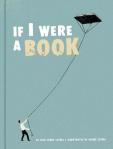
Book coverIf I were a book is one of those “gift” books you give to readers – and it was in that spirit that it was given to me for my birthday a couple of years ago. It’s a delight of a book, and is somewhat quirkier than these sorts of book-lovers’ gift books often are, which is why I’ve decided, finally, to share it with you. Or, have you seen or read it already?

My edition is a little hardback of 60 plus pages produced in San Francisco in 2014. The original, however, was published in Portugal in 2011, the author being Portuguese. The illustrator, André Letria, happens to be his son. Now I hadn’t heard of José Jorge Letria before, but he was born in the Lisbon District of Cascais, in 1951, and is apparently, says Google’s translation from a Portuguese biography, “a journalist, poet, playwright, fiction writer and author of a vast work for children and young people.” This biography also tells us that he has won many many national and international literary awards, including the Unesco International Prize (France), the Barcelona Classical Poetry Prize, the Plural Prize (Mexico), the Prize of the Paulista Association of Art Critics (São Paulo), and the Gulbenkian Prize. He has won prizes for “the environment in children’s literature” and the Manuel de Arriaga Prize for his contribution to the defense and dissemination of animal rights. He has been on many Portuguese, European and international literary boards, and his books have been translated into “over a dozen” languages. Yet, I hadn’t heard of him, until, that is, I was given this delightful ….

… love-letter to the book and reading. I fell in love with its passion and idealism. The book comprises two-page spreads, each one containing an image and the phrase “If I were a book” followed by a response. So, the first image shows a person looking at a book on a park bench, with the phrase “If I were a book, I’d ask someone in the street to take me home.” (What a nice sign that would make for a street library!) The next shows this same person opening a larger-than-life book, inside which there are stairs descending into unknown depths, with the phrase “If I were a book, I’d share my deepest thoughts with my readers”. And so it continues…

What makes this book so delightful is the personalising of the book (as in “if I were a book”), the ideas expressed in these personalised phrases, and the illustrations. I’m not sure what is allowed by copyright, but I’ve chosen three images to share with you, so you can see what I mean:


This slideshow requires JavaScript.

I’ve chosen these three because the one suggests the way I like to read – slowly, savouring the words and ideas – and because the other two contain aspirations that I’d love books to achieve. You can see how in some images the book is supersized, while in others its size is more “normal”. The images are simple but beautifully whimsical, the colour palette is minimalistic, and the text’s font feels a little worn and loved.

And here, I think I’ll leave it, because what more, really, can I say?

José Jorge Letria
If I were a book
Illustrated by André Letria
Translated by Isabel Terry
San Francisco: Chronicle Books, 2014 (orig. pub. 2011)
[64pp.]
ISBN: 9781452121444

Raphaël Jerusalmy, Evacuation (#BookReview)

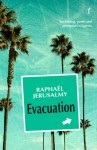
Raphael Jerusalmy, EvacuationRaphaël Jerusalmy, for those who, like me, hadn’t heard of him, is a French-born and educated writer living in Tel Aviv. He had a career in the Israeli military intelligence services, worked in humanitarian and educational fields, and is now an antiquarian book dealer in Tel Aviv, where his novella, Evacuation, is set. In some ways, the book is a love letter to Tel Aviv – but it is more than that, too …

Evacuation is a short, quick, but powerful read. The narrative is structured around a road trip, in which twenty-something Naor is driving his mother from her kibbutz home to Tel Aviv. As they drive he tells her what happened in Tel Aviv, after he, his girlfriend Yaël, and his grandfather Saba, had jumped off the bus that was taking them out of the city, as part of a mandatory evacuation process.

The thing about this book is that although we realise the war is part of the ongoing Middle-eastern conflict, no specifics are given. No dates, no enemy, just, later on in the story, that peace negotiations were taking place in Geneva. By the time the novel starts, that peace had been achieved (for the moment anyhow) and Naor is dealing with the aftermath. The lack of specificity universalises the story, focusing us on the characters’ experience more than on the whys and wherefores, rights and wrongs, of the war.

So, their experience. Firstly, I should explain that it was Saba and Yaël who had decided not to evacuate, with Naor feeling obliged to stay with them. They are all artists – Naor a filmmaker, Yaël a visual artist, and Saba a writer – so there is also an underlying thread about art and resistance. They go to friend Yoni’s house in the already evacuated part of the city, and from there they learn how to survive – how to find food, water, clothes – and how to occupy their time. They roam further and further, taking risks to enjoy a dip in the sea; they enjoy strolling down Tel Aviv’s beautiful Rothschild Boulevard; and, they decide to make a film, titled Evacuation, to Naor’s script and with Saba and Yaël acting.

It’s while filming a critical scene in a synagogue that a long-range missile attack occurs, forcing them to take cover. After this attack, Yaël decrees that they are not going to let air-raid sirens disturb their peace again – “From now on, we were going to behave as if there was no war” – setting us up for the tragedy that we have been sensing through Naor’s narration.

Now, I said that the novel focuses more on the characters and their experience, than the war. However, there are occasional references to Zionism and the ongoing political situation, including this on Saba’s opinion:

Deep down Saba wasn’t unhappy about what was happening to Tel Aviv … He said it did no one any harm to get a kick up the arse from time to time. And that we Israelis badly needed it. Because we had got stuck in a stalemate. Not only with the Palestinians, which was of course unfortunate. But also and especially with ourselves, which was much worse.

So the evacuation was timely. It gave us an undreamt-of chance to wipe the slate clean. To start again. In his mind, Zionism as an idea was not a failure. But it was stagnant. It had come unstuck in its application. Because of this and that. Those were his exact words. This and that. He spoke about restarting our attempts at Jewish socialism. About the importance of education. ‘Everything stems from that.’ And about being kinder in general. To poor people, and to Arabs.

There’s also Yaël’s stronger statement that Tel Aviv was the only place she “felt safe. From those at war with us. From those who have morality and justice on their side.” [my stress]

All this is narrated by Naor to his mother as they continue their trip – and as he does, certain things become clear. One is that there’s been some falling out between his mother and Saba, her father, and that this trip is partly a peace-making one (subtly paralleling the political war-and-peace background to the story.)

Now, I daren’t say any more for fear of giving the whole lot away. While it’s written nicely (albeit I read it in translation), its main appeal, besides the story, is its engaging narrative structure and gentle tone. I loved the way Naor’s story is interrupted regularly by comments from his mother (not to mention road signposts). These interactions, while hinting at some of the tensions needing to be resolved, also imbue the book with a lovely normal intimacy, unexpected perhaps in a book with such subject matter.

Evacuation is an open-ended book, one the reader can consider from various perspectives, including the choices we make, love and family, art and resistance, war and peace. I found it a surprisingly enchanting read, which I hope doesn’t make me sound insensitive to its seriousness, because I felt that too.

Raphaël Jerusalmy
Evacuation
(Trans. by Penny Hueston)
Melbourne: Text Publishing, 2018 (Eng. ed.)
150pp.
ISBN: 9781925603378

(Review copy courtesy Text Publishing)

WG Sebald, Austerlitz (#BookReview)

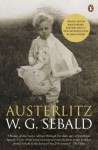
WG Sebald, Austerlitz

For the first time in my reading group’s 30-year history, we read a book recommended by a fictional character. It happened like this: after reading and discussing Rabih Alameddine’s An unnecessary woman (my review) in January, we thought it would be interesting if we all nominated which book mentioned by the “unnecessary woman”, Aaliya Saleh, that we’d most like to read. The book that got the most votes was Austerlitz. I was thrilled, because I bought my copy back in 2010 to read with one of my online reading groups, but never did, and because I had already read and been bowled over by his The emigrants.

But now where to start? A bit left field I think – which is probably not inappropriate given Sebald’s approach to literature. The “left field” happens to be one of my (few) never-forgotten book quotes. It’s from Toni Morrison’s Beloved, and is Sethe talking about “the day’s serious work of beating back the past.” Sethe is, as most of you probably know, an American ex-slave who is living with the trauma of her past life. Austerlitz, in Sebald’s book, is a man who, as a four-year-old, had been sent from Prague to England on a Kindertransporte in 1939, never to see his parents again. Indeed, he suppresses all memory of his past life – realising later

how little practice I had in using my memory, and conversely how hard I must always have tried to recollect as little as possible, avoiding everything which related to my unknown past.

This realisation comes some 50 years later, in the early 1990s, when, one day, having become “increasingly morbid and intractable” after the death of his only true friend, he is in the Ladies Waiting Room of the Liverpool Street Station – and a memory comes back of his arrival in England. At this point, his “self-censorship”, his “constant suppression of … memories” brings about a nervous breakdown. Upon his recovery, he begins researching his past life, resulting in trips to Prague to look for his mother, and to Paris to do the same for his father. Much of this is couched in discussions of architecture – because Austerlitz is an architectural historian – forcing us to consider the role architecture plays in human history and psychology. It’s compelling, but more than that, mesmerising …

However, this book has been written about with great insight and sensitivity by reviewers at, for example, the New York Times and The Guardian, so I’m going to do something a little different, and respond to that fictional woman, Aaliya, who recommended the book to my group!

“His style, drawn-out and elongated sentences that wrap around the page and their reader …”

And I will start with the seemingly mundane, the style, because it is this that confronts us most strongly with we start the book. If you’ve never read Sebald before it could be a shock. There are almost no paragraphs – well you could say there are 5 including the beginning of the book – which means there are no real chapters. The story just continues on and on, often through very long sentences containing multiple clauses and lists. We do have a narrator, the person to whom Austerlitz is telling his story and who relates it on to us.

Strangely though, I found the writing page-turning. There is something mesmerising about the almost flat, rather melancholic, tone suffusing the narration, that you want to keep reading. At least I did – and so did most of my reading group once they’d “got into it”. The style, in other words, wraps around you.

There are motifs and images which recur through the novel, making the whole cohere, creating the tone and developing the themes. There are shadows, there’s darkness more than light, and colours are muted, mostly grey. There are star-shapes, railway stations and other monumental buildings. There are references to ghosts. Places are more often empty or deserted, than heavily populated. And there’s the mysterious operation of time and memory. All these support the narrative’s mesmerising quality.

The book also includes black-and-white photographs, encouraging us to see it as non-fiction but no, this is fiction. Austerlitz is a made-up character – but, says The New Yorker, Sebald sometimes called his work “documentary fiction”. In other words, this is a very different sort of read.

“All I am is lonely. Before I go to bed, I must put away Sebald …

… both The Emigrants and Austerlitz. I can’t read him now, not in this state. He’s much too honest. I will read something else.” 

Our “unnecessary woman”, Aaliya, who lives in Beirut, has experienced war herself, been affected by its ravages. I won’t say more here, because I think what I have said about the story and it’s tone already makes clear why she feels this. Sebald is not a writer to be read at times of distress or melancholy, but his insights into what we call “the human condition” are … well, let me put it this way: this is not a book you explain, really, but one you feel. What you feel is something that affects the way you think about human history, about where we’ve been and where, unfortunately, it looks like we’re going.

“I am proud that I finished the Austerlitz project. I consider it one of the best Holocaust novels.”

Aaliya goes on to say that “I find that when a subject has been heavily tilled, particularly something as horrifying as the Holocaust, anything new should force me to look with fresh eyes, to experience previously unexperienced feelings, to explore the hitherto unexplored.” And this is why Austerlitz is powerful. Austerlitz was a young boy in a little Welsh town while the war was on so he did not experience the Holocaust directly. But, his experience of being displaced comes back to haunt him later. So this is not about a person who directly experienced the Holocaust, nor is it, though, about the second generation. It is about someone who lived at the time, but had not experienced it first-hand because his parents, who did, had removed him. He is in a sort of limbo generation – and “limbo” is probably a good description for how he feels through much of the novel.

He writes, describing his experience of another mental/physical collapse:

It was obviously of little use that I had discovered the source of my distress and, looking back over all the past years, could now see myself with the utmost clarity as that child suddenly cast out of his familiar surroundings: reason was powerless against the sense of rejection and annihilation which I had always suppressed and was now breaking through the walls of its confinement.

This statement struck me powerfully, because not only does it reflect another experience of the Holocaust – another way of looking at its impact – but it articulates the experience of our stolen generations, and, beyond that, of any children removed, for good or bad reasons, from their homes. “Reason was powerless against the sense of rejection and annihilation”. What more is there to say?

There is so much to talk about this book, so much I haven’t touched upon, but I’m going to finish with a brief reference to his discussion of time, the past and memory which underpins the novel. Here is Austerlitz late in the novel:

It seems to me then as if all the moments of our life occupy the same space, as if future events already existed and were only waiting for us to find our way to them at last, just as when we have accepted an invitation we duly arrive in a certain house at a given time. And might it not also be, continued Austerlitz, that we also have appointments to keep in the past, in what has gone before and is for the most part extinguished, and must go there in search of places and people who have some connection with us on the far side of time, so to speak?

I love this organic way of looking at time, this suggestion of how we might experience, approach or understand the events, particularly traumas, that happen to us.

Our unnecessary woman, Aaliyah, calls Austerlitz a great Holocaust novel, but I’d go one step further and simply say it is a great novel. Full stop.

WG Sebald
Austerlitz
(Trans. by Anthea Bell)
London: Penguin, 2002
415pp.
ISBN: 9780140297997

Yuri Herrera, Signs preceding the end of the world (#BookReview)

Yuri Herrera, Signs preceding the end of the worldWhile I was travelling in the USA last month, I wanted to read at least one book relating to the regions we were visiting. I started by looking for a novel set in/about the northwest, but then Yuri Herrera’s Signs preceding the end of the world, set in the southwest, popped out at me, and I knew I had my book.

When you live in the southwest, as we did in the 1990s, you can’t help but be aware of the issue of migration, “illegal” or otherwise, across the border from Mexico. I’d seen the film El Norte (about two Guatemalan youths fleeing to the US via Mexico) and read T. Coraghessan Boyle’s The tortilla curtain, but I hadn’t read a Mexican author on the subject – until now.

Signs preceding the end of the world tells the story of Makina, who is sent to “the other side” by her mother to carry a message to her brother who’d gone and not returned. To obtain the help she needs to make the crossing, she also agrees to take a message from Mexican gangster, Mr Aitch. This synopsis would suggest to most readers an adventure story – a thriller perhaps – or at least some sort of plot-driven drama, but that’s not what this is at all. Yes, it follows a traditional linear journey narrative, but the tone is more mythical, which means that it works on two levels, the literal Mexican-American border story and something more universal about crossings and transitions.

Herrera achieves this by keeping details to a minimum. Places aren’t named, but just described. Chapter titles like “The place where the hills meet” and “The place where people’s hearts are eaten” exemplify this beautifully. Most people aren’t named, either, and, where they are, the names are minimal (such as Chucho who helps her cross the border) or enigmatic (such as the alphabetical three, Mr Double-U, Mr Aitch and Mr Q!) It is in this shadowy context that Makina makes her journey.

He also achieves it by starting the novel with a surprising scene that isn’t critical to the literal plot, but which provides a thematic or symbolic link to the ending. We meet Makina walking in the street, when, suddenly, a sinkhole opens up and a man is swallowed up. Makina manages to pull herself back and survive, but we learn in the opening paragraph the tenuousness of life and, perhaps, that Makina is either lucky or has good survival instincts. Meanwhile, the sinkhole itself, while a literal geographic phenomenon, also conjures up the underworld, the murky sub-legal world that Makina must traverse to make it to, and survive in, “the other side”.

Herrera evokes the dangers of the journey vividly, but having already set up Makina as a resourceful young woman, he convinces us of her ability to survive the crossing – and she does, despite being accosted by a young thug, nearly drowning in the river, being shot at near a mountain pass. She locates her brother too, even though the information she has regarding his whereabouts is minimal.

What really makes this book, though, besides the strength and heart of Makina, is Herrera’s language (albeit in translation). It’s written in the sort of spare language I like. Here’s Makina’s experience of the city:

The city was an edgy arrangement of cement particles and yellow paint. Signs prohibiting things thronged the streets, leading citizens to see themselves as ever protected, safe, friendly, innocent, proud, and intermittently bewildered, blithe, and buoyant; salt of the only earth worth knowing. They flourished in supermarkets, cornucopias where you could have more than everyone or something different or a new brand or a loaf of bread a little bigger than everyone else’s. Makina just dented cans and sniffed bottles and thought it best to verse …

Yes, “verse”. Dillman in her translator’s note discusses the challenges of translating the book, which she says is about “bridging cultures and languages”. One way Herrera conveys this theme is to use neologisms, signifying the idea of a new language for the potentially new people forged out of migration. One of his neologisms is “jachar” which he uses to mean “to leave”. Dillman needed to create/choose an English word that would play the same role, and came up with “to verse”, because it refers to poetry and is also part of “several verbs involving motion and communication (traverse, reverse, converse) as well as the ‘end’ of uni-verse”.

As I implied earlier, this is a road novel, a journey to another place as well as to the self. Here’s Makina looking for her brother:

It had taken everything she had just to pronounce the eight tundras. To cleave her way through the cold on her own, sustained by nothing but an ember inside; to go from one street to another without seeing a difference; to encounter barricades that held people back for the benefit of cars. Or to encounter people who spoke none of the tongues she knew: whole barrios of clans from other frontiers, who questioned her with words that seemed traced in the air. The weariness she felt at the monuments of another history. The disdain. The suspicious looks. And again, the cold, getting colder, burrowing into her with insolence.

And when she arrived and saw what she’d come to find it was sheer emptiness.

Here and elsewhere, Mexican-born Herrera, who now lives in the USA, is clear about the materialistic, insular reality of “the other side”.

As I read this book, I was reminded of other journeys and crossings, specifically crossing the Styx (it’s no accident I’m sure that the first chapter is titled, simply, “The earth”), Dante’s journey to hell, and even Alice’s fall down the rabbit-hole. Herrera, though, while invoking these journeys in Signs preceding the end of the world, has created his own, one that addresses the politics of borders and boundaries (and dare I say “walls) between countries, while exposing the personal, psychological and spiritual implications of traversing these borders. Its ending is unsettling – but perfect for all that.

Yuri Herrera
Signs preceding the end of the world
(Trans. by Lisa Dillman)
London: And Other Stories, 2015 (Orig. lang. ed. 2009)
114pp.
ISBN: 9781908276421

Friedrich Gerstäcker, Australia: A German traveller in the Age of Gold (Review)

Friedrich Gerstacker, AustraliaFriedrich Gerstäcker’s Australia: A German traveller in the Age of Gold was first published in its original German, as Australien, in 1854. Gerstäcker did prepare, at that time, an English language version of his travels, but the section on Australia, at least, was much shorter than his German edition, and is all English readers have been able to access – until now. Amazing really.

You may remember that I mentioned this book back in November, because it inspired a Monday Musings on 19th century travellers. It is a beautifully conceived book. It has a brief note on the text at the beginning, and an afterword at the end. There is also a decent index, and extensive end notes sharing editor Monteath’s in-depth research. These notes added significantly to my enjoyment and understanding of Gerstäcker’s writing.

So, who was this Friedrich Gerstäcker? A German, he travelled around the world from 1849 to 1852, partly funded by a German publisher. Australien was the fourth of five volumes. His writings were loved in Germany and he was, apparently, a household name there for many years – starting when his mother, unbeknownst to him, gave the diaries he was sending home during his 1837-1843 American travels to a publisher!

Now, as I said in my Monday Musings, historical travel writing can provide valuable “primary” insight into different times and places. But the best travel writers are those who, in addition to that, use language well and give us themselves. Gerstäcker is such a writer.  He provides revealing insights into mid-nineteenth century Australia. But, in addition, his writing is engaging: it has touches of humour mixed with deeper reflection, it includes some gorgeous descriptions, and we get a sense of who he is.

“the truly astonishing number of public houses” (p.21)

Gerstäcker arrived in Sydney in March 1851, and left it at the very end of September in the same year. He provides a fascinating picture of Sydney life at the time, commenting on the plethora of drinking establishments (or “public houses”), but also expressing some astonishment that his prejudices regarding visiting a “criminal colony” were ill-founded. It was not, as expected, full of “an indefinite number of murderers, thieves, burglars and other dreadful, horrible, characters”. He then travels, by the Royal Mail, canoe and foot, from Sydney, via Albury and the Murray River, to Adelaide. The chapters describing this trip (Chs. 2-5) are probably the most interesting in the book.

In South Australia, his focus is on visiting some of the German communities there, particularly in Tanunda, in the Barossa wine region. He sees his role partly as providing “real” information about places for would-be German emigrants, and reflects thoughtfully on what emigration means. He notes that Germans had made themselves a living, one that many “would never have been able to establish in Germany in that time and with those means” but he also sees the cost. He writes:

Now the question still remains of course, how much the heart is still attached not only to old habits but also to old friends and loved ones and perhaps even the old homeland itself, and whether it really was so impossible to secure a living back there that one really had to tear oneself away from everything one held dear and transplant oneself in cold foreign soil. Sometimes – and how often! – a slightly better living is too dearly bought through emigration …

He also writes about the practice of religion by the Australian Germans, particularly the tensions between different groups, and he describes in some detail how government-supported education works in South Australia, pointing out some of its illogicalities. This would have been of interest to prospective immigrants, and is now to current readers and researchers. The material most relevant to contemporary Australians, though, was his navigation of the Murray. How navigable was it was the question on administrators’ lips and Gerstäcker was able to provide first-hand knowledge.

He returns to Sydney by boat, in August, and notices a dramatic change there, providing an on-the-ground insight into the impact of the beginning of the gold rush. In his “short absence” Sydney had changed from “a busy city, but otherwise calm, to all appearances perfectly reasonable” to a city in which everyone was “dizzily, yet tirelessly dancing around the glistening false God of the newly found gold”. His departure being delayed for boat repair reasons, he decides to visit some of the goldfields and the picture he draws is one of frenzy, excitement, and loss. He overlays this with common-sense advice, based on his Californian goldfields observations, that it is generally more profitable to work one claim systematically than to be forever upping stakes to chase another chance to strike it rich.

Interestingly, he castigates the media – the newspapers, in other words – on several occasions. He writes, for example, of people’s failure to make their fortunes, and comments:

All of this is not reported in the Australian newspapers: they only highlight the positive elements of the picture and their purpose and goal is easily recognisable. They want people to come to Australia, workers …

Ah, the media … but that’s another whole story.

“indestructible, unavoidable, unbearable gum trees everywhere” (p. 43)

Gum trees

A boring forest of gum trees (Southern NSW)

You have probably realised by now that while Gerstäcker’s writing is generally informative, it is also limited by the perspective of his times, and by his own cultural biases. For example, imagine my horror at his ongoing disparagement of our gum trees! They are “sorry specimens”, “dull, green” or “dun-coloured”.

Soon after his arrival in Sydney he writes that “strangely enough, all the beauty of the scenery is restricted to the sea and to the nearby coast of Port Jackson”. He shows his cultural hand, most obviously, when he heads into the, admittedly beautiful, Blue Mountains region near the end of his trip, and writes of Mount Victoria that

this was the first place in Australia where I have seen real scenery of a quite impressive nature. Mount Victoria is itself a fairly significant mountain, rugged and picturesque, sloping down into a depression that surrounds it on three sides, forming a wide, deep, densely wooded valley. The vegetation is, however [oh dear, here it comes], the same as in all other parts of Australia that I have seen so far. Gum trees, nothing but gum trees, which makes the remaining countryside so terribly monotonous …

He does admit, a couple of sentences on, however, that seen in the distance “decorated … with the sunlight and … draped … in colourful, misty veils” they have a “mysterious aura”. But then he continues that “in reality they are also just plain, dun-coloured gum trees, all with the same leaves”. I could retort that any single-tree-species forest can be monotonous, but it’s not worth it. He won’t hear me!

There’s a lot more to share and enjoy, but I can’t finish this lengthening post without mentioning his descriptions of Australia’s “Indians” as he calls indigenous Australians. Strangely, Monteath only discusses, in his Afterword, the sources Gerstäcker uses for the extensive information he provides about indigenous life and culture in chapters 8 and 9. He doesn’t comment on Gerstäcker’s attitudes to the “Indians” in his travels, attitudes which are mostly derogatory and fearful, often based more on hearsay than on experience. For example, Gerstäcker repeats the stories he’d heard of the “Indians” killing people for their “kidney fat”, a widely-held belief at the time that Monteath explains in his very useful end-notes.

On his first sighting of “Indians”, near Albury, Gerstäcker writes of finding himself

in amongst the eternal dreary gum trees and amongst the black, dirty, treacherous, murderous people of these forests.

Funny how, despite this, he manages to survive his long trip from Albury to Adelaide, with minimal incident even though he did much of it alone and was carrying items of great interest to the “blacks” he met! Most of the time he repeats stories of “their” treachery, and he regularly describes them as dirty and ugly, but he also says that he does not agree with “acts of cruelty against Indian tribes”. It is “right and proper to apply restraint”, he says, but

we can hardly expect that they should immediately conform to rules and practices which, after all, have been imposed on them by the whites.

And right at the end of his trip, while visiting islands in northern Australia, he comments that he is

firmly convinced that the primary cause of all hostility, indeed of all acts of cruelty toward the savage tribes, is the white man himself.

This is an engrossing book that I took some time to read. It’s certainly not a page turner, but it is full of information, observations and reflections that would appeal to diverse interests. For this reason, it’s probably difficult to market. How lucky we are to have publishers like Wakefield Press willing to take a risk on books like this.

Friedrich Gerstäcker
Australia: A German traveller in the Age of Gold
(Ed. Peter Monteath; Trans. Peter Monteath and his team)
Mile End: Wakefield Press, 2016
303pp.
ISBN: 9781743054192

(Review copy courtesy Wakefield Press)

Pierre Lemaitre, The great swindle (Review)

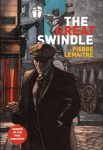
Pierre Lemaitre, The great swindleAs I was reading Pierre Lemaitre’s literary page-turner, The great swindle, I started to wonder about the endings of books, what I look for, what I most appreciate. What I don’t look for is neat, happy conclusions. There are exceptions to this of course. Jane Austen, for example, but she was writing at a different time when the novel was in an earlier stage of development. In contemporary novels, I look for something a little challenging, something that suggests that life isn’t neatly wrapped up. Fiction isn’t life, I know, but its role, for me anyhow, is to reflect on, and thus make me think about, life. So, Lemaitre’s The great swindle? How does it end? I’m not going to tell you – it’s not the done thing in reviews – but I will say that it’s satisfying, even though it does have one of those many-years-later wrap-ups that I’m not convinced is needed.

There, that’s an unusual opening for me, isn’t it, to start with the end? Where do I go now? Back to the beginning I think. The novel is divided into sections: 1918, November 1919, March 1920, and Epilogue. It starts in the trenches on 2 November 1918, just days before the First World War ends. One of our two main characters Albert Maillard is there, wanting a quiet, safe time until the war ends, but his commanding officer, Lieutenant Henri d’Aulnay-Pradelle, has other ideas, setting off a series of events that reverberates through all their years.

This is, in fact, quite a plot-driven novel, despite having many strings to its bow. And you all probably know how much I hate describing plots, so I’m going to keep it simple. After a devastating opening which leaves soldier Édouard Péricourt with a severely damaged face and Albert, for good reasons, taking responsibility for his care, the novel focuses on life in Paris in the immediate aftermath of war. While our two soldiers struggle to survive, Pradelle has been demobbed a Captain, as he’d orchestrated, married a wealthy young woman, Madeleine, who happens to be Édouard’s sister, and is engaged in the business of providing coffins and burying soldiers in cemeteries around France – focusing more on the money he can make than on whether, say, the right soldier ends up in the right coffin. You getting the picture of this Pradelle by now?

There are several other characters – this is a big story that owes much to the 19th century novel – but I’ll just mention a couple more: Monsieur Péricourt, Madeleine and Édouard’s father, a tough businessman who had never had time for his artisitic, effeminate son, and Merlin, the dogged, bottom-rung, about-to-retire civil servant who is given the job of reporting on the cemetery project.

Finally, just two more things you should know before I leave the plot. One is that Édouard did not want to return home after the war, so in the military hospital Albert manages to swap his identity – in a swindle, you might say – with a dead soldier, resulting in Édouard Péricourt becoming Eugene Lariviere. His father and sister, therefore, do not know he is alive. The other is the war memorial swindle concocted by Édouard (Eugene), which he finally manages to convince the “even when well-intentioned, lying was not in his nature” Albert to support.

The novel, then, has a complex plot with a rather large cast of characters, but Lemaitre, who is apparently known for his crime novels, handles it all very well so you never feel lost. One of the ways he does this is through vivid characterisation. Every character, from the main “cast” (it’s to be filmed I hear) to the supporting characters, is so strikingly portrayed that you feel you are there in postwar France – there in the streets where poor, injured returned soldiers struggle to make a living, there in the houses of the well-to-do where money is king, there in the cemeteries where Pradelle’s exploited Arab, Chinese and Senegalese workers do what they can to survive.

Another is through the clever set pieces which illuminate the characters, such as Edouard/Eugene’s increasingly bizarre masks – from horse-head to budgerigar – which he creates and wears to cover his horrendously disfigured face. Or the more gruesome scenes in which the taciturn, not very agreeable, but diligent public servant Merlin tramps around cemeteries investigating coffins. Using these set pieces, many of which border on farce, alongside controlled doses of satire and irony, Lemaitre creates a tragicomic tone – but to what end?

“will this war never be over?”

Early postwar, concerning Pradelle’s cemetery plans, the (mostly omniscient) narrator says:

To an entrepreneur, war represents significant business opportunities, even after it is over.

War, then, is the over-riding theme – but war is a big canvas. Lemaitre’s focus is war’s aftermath. What does it mean for those who went and those who stayed, and for the new world they must forge, preferably together. At one point Albert, worn down by his cares and responsibilities, and facing yet another hurdle, wonders, “will this war never be over”. But, as ordinary citizens get back to life, the needs of the returned are forgotten:

ex-soldiers were all the same, forever banging about their war, forever giving little homilies, people had had just about enough of heroes. The true heroes were dead!

A ripe environment, in other words, for cemetery and war memorial scandals, for profiteering – particularly when you add that it was a time of great social change in France, one where the nouveau riche (represented by M. Péricourt) were getting the upper hand over the often money-short aristocracy (represented by Pradelle).

Opposing this almost obsessive focus on money is a sense of resignation. It can be seen in Madeleine who marries the execrable Pradelle. “We each settle down as best we can”, comments our narrator. For many, there is a sense of “emptiness”, this word appearing several times in the novel. They were tough times – the time of “the lost generation” or what the French called “the génération au feu” – for which society was not equipped to cope. So, in the end, what Lemaitre has painted is a picture of a society under stress, a picture which is conveyed most directly through our “everyman”, our struggling returned solider Albert who just wants to make a life for himself but who is also loyal to those who need him:

War had been a lonely business, but it was nothing compared to the period since demobilisation that was beginning to seem a veritable descent into hell …

The novel, as you will have gathered, is replete with swindles, but the greatest of all, Lemaitre is saying, was the abominable treatment, upon their return, of the ordinary soldier.

This is one of those novels which uses a light touch to tell a heavy story. No wonder it won France’s main literary prize, the Prix Goncourt.

Lisa at ANZLitLovers also enjoyed this book.

Pierre Lemaitre
The great swindle
(trans. by Frank Wynne)
London: MacLehose Press, 2015
ISBN (eBook): 9781848665804

Monday musings on Australian literature: Australian literature in China

GrenvilleSecretRiverChineseNow I admit, right up, that this post is very much a toe-in-the-water sort of post. I know very little about the topic, but what I’ve come across I’ve found interesting and decided to share it. The thing is, we Aussies – those of us born here of Anglo parentage anyhow – tend to be monolingual. We also live in a fairly insular place, being an island ‘n all. Consequently, few of us I think know much about how well or far our literature travels. Occasionally, an Aussie book will do very well – say, Anna Funder’s non-fiction book Stasiland (my review) or Kate Grenville’s novel The secret river – and we’ll hear that it’s been translated into multiple languages. But mostly we tend to be fairly oblivious of these off-shore happenings.

I was therefore intrigued when, a few weeks ago, I found an article in Trove titled “Chinese interest in our literature” from a 1994 edition of The Canberra Times. It was written by Robert Hefner who was, as I recollect, the paper’s literary editor of the day. Hefner commences with:

I first met Chinese author, teacher and translator Li Yao six years ago [ie around 1988] when he was visiting Canberra with author Rodney Hall. Li had just met Patrick White, whose novel The Tree of Man he had translated into Chinese.

Wow, I thought, Hall and White are serious writers – that is, they don’t produce page-turners or simple plot-driven stories. How fascinating – how wonderful too – that our northern neighbours are interested in our literature at that level. Hefner was writing the article because Li was back in Australia for the Melbourne Writers Festival. He’d discovered that since that last meeting, Li had translated 15 more books, 8 of them Australian. These included Brian Castro’s Birds of passage, Patrick White’s Flaws in the glass, Nicholas Jose’s Avenue of eternal peace [a big seller in China], a short story collection, and Geoffrey Bolton’s A history of Australia. Hefner quotes Li, then associate professor in the Department of English at the International Business Management Institute in Beijing:

Translations of Australian books in China are welcomed by students and general readers, especially Patrick White. I translated A fringe of leaves and it sold 10,000 copies in Beijing. That’s a best-seller, even compared with Chinese authors.

Wow, again. Patrick White a best-seller in China? Who’d have thought?

Li told Hefner things were changing in China, that “people, especially young people” were “looking for something new”, wanting to “know another world, especially a world so far away as Australia”. They were also interested, he said, in how “China is seen through foreign eyes”. Consequently, his most recent translation was Alex Miller’s Miles Franklin Award-winning novel The Ancestor Game, which is about early Chinese immigration to Australia. Li* hadn’t decided whom he’d translate next, but was “considering Tim Winton, David Malouf or Rodney Hall”.

Alexis Wright Carpentaria in ChineseThat was 1994. Was it a flash in the pan I wondered? I did some very scientific research, that is, I “googled”. And I found all sorts of things, such as the China Australia Literary Forum. It met in 2011, and involved “ten prominent Chinese writers” visiting Sydney for “in-depth discussions with Australian authors, and those involved in the translation and reception of their works”. The Australian writers they met included Judith Beveridge, Kim Cheng Boey, Lisa Gorton, Ivor Indyk, Gail Jones, Nicholas Jose, Julia Leigh, Shane Maloney, John Mateer, Michael Wilding, Ouyang Yu and Alexis Wright. The forum resulted, the report goes on to say, in the translation of Alexis Wright’s Carpentaria (my review), which was launched in 2012 at the Australian Embassy in China. Nobel Prize winner Mo Yan wrote the introduction to the translation, and guess who did the translation? Yep, Li Yao.

A second China Australia Literary Forum took place in 2013, this time in Beijing. Eight Australian authors attended, including JM Coetzee. The eight Chinese involved included Mo Yan.

Apparently though, Australian literature had been read in China long before these last few decades. Back in the 1920s four Australian poets, including Mary Gilmore and Roderick Quinn were read. Ouyang Yu (whose Diary of a naked official I’ve reviewed here) is reported as having read a poem by Adam Lindsay Gordon in 1927. (All this came from a 2011 article in JSTOR which is not available freely on the web.) This article disproves the previously held view that translated Australian literature hadn’t been available in China before 1949. Indeed Ouyang Yu has written a paper about the reception of OzLit in China from 1906 to 2008. It’s an interesting survey article which looks at the history of Australian literature in China, including the interest in and value of different forms such as poetry, popular writing, literary fiction, and so on. He concludes by saying that Australian writers are now receiving Chinese awards. In 2009, for example, “Alex Miller became the first Australian writer to receive a Chinese literary award for his novel The landscape of farewell”.

I won’t go on, because I think I’ve made my point about Chinese interest in Australian literature. Quite coincidentally, I discovered a (now expired) call for entries from the Australian Association for Literary Translation for its AALITRA Translation Prize. This prize “aims to acknowledge the wealth of literary translation skills present in the Australian community” and awards prizes for translation of a selected prose text and of a selected poem. Each year a different language is chosen, and in 2016 the language is Chinese!

This is all wonderful for Australian literature, but what about the reverse? How much effort do Australians put into reading translated literature from other countries. If my record is anything to go by, not as much as I’d like – or should!

* I found a 2010 article in The Australian about Li Yao’s introduction to English-language literature. It was in the late 1960s, during the Cultural Revolution, and he read, “under the covers” at night, books like Jane Austen’s Pride and prejudice! This little comment reminds us too that availability of Australian (or any non-Chinese) literature in China hasn’t had the simple trajectory my post might imply!

Vincenzo Cerami, A very normal man (Review)

Vincenzo Cerami, A very normal manAnd now for something very different from my recent fare here, a modern Italian classic. Originally published in 1976, A very normal man was, the back cover blurb says, Vincenzo Cerami’s first novel – and it brought him instant acclaim. I can see why. At least, this is the sort of writing that gets me in, but more on that anon.

Now, you may have heard of Cerami (1940-2013). I know I should have, because he was the co-screenwriter on that wonderful 1998 film La Vita è Bella (Life is Beautiful). He was also a poet, commentator and a writer on writing. In other, words a very interesting man! (Couldn’t resist that.)

But now, the book. It is, as you might have realised, a translation, which is always a challenge from my point of view, because I know I’m reading a mediated work. And, as I started this book, I felt it must have represented a very particular challenge because this is a satirical, darkly humorous and deeply ironic work. That must be hard to translate across languages and cultures – and it apparently was, starting with the title. Wakefield Press says on its website that “the complex word play of the Italian title is untranslatable in English; it means literally a very little, very middle-class man”. Does this remind you of Camus’ L’Etranger, and its publication in English as both The stranger and The outsider?

So, who is this very little, very middle-class – or very normal – man? He is Giovanni Vivaldi, living in Rome during the Years of Lead. He’s married, happily enough it seems, with a  20-year-old account-trained son, Mario, of whom he is very proud. He’s been a public servant in the Ministry, the Office for Retirement Pensions, for 40 years, and at the start of the novel he is about to retire. First, however, he wants to get Mario a job in the Ministry. It’s the least he deserves, he believes. Italian novelist Italo Calvino, who apparently negotiated the novel’s publication, also wrote the preface to the original Italian edition. My Wakefield edition’s preface quotes from it:

You would expect a story about office workers to be drab, short on events — the inevitable caricature. Not this one. Extraordinary events abound: a ludicrous initiation ceremony into Freemasonry; an incursion into the savage world of the daily crime columns; revenge that is the stuff of nightmares […] What we see is reminiscent of the precision effects of a magnifying glass angled over the unredeemed ugliness at the heart of civilised society — and over the tenacious lust for living which clings on in a world emptied of meaning.

Hmmm, what more can I say? These excerpts convey a little of the story and the main theme, without giving away too much of the plot. I wouldn’t want to give away any more, but I can talk a little about the character, the style and tone.

“the common sense of an ordinary decent man”

About a quarter of the way through the novel, during his application to become a Freemason, Giovanni is described as having “the common sense of an ordinary decent man”. Sounds lovely doesn’t it? Except that we have already seen quite a bit of not-so-decent behaviour from him, including the very reason he is applying to become a Freemason, which is to obtain favour to help his son beat the civil service exam for the Ministry job. On the first page of the novel, he tells his son that “the sign of a really smart young man is a total focus on career and nothing else. Let the rest of the world go and hang themselves”. On page 2, Giovanni, out fishing with his son, kills a fish in a cruel, violent way. At the beginning of chapter 2, his normal drive to work is described: he’d “deal out vicious abuse to anyone he thought was trying to get in his way, rant and rave against everything and everyone”.  Pretty quickly then, we are clued in to the fact that he is not a very humane man – and yet, he is also presented as a “normal”, responsible family man. He’s (arguably) a good father, a decent husband and a diligent employee.

What happens in the novel is, in fact, shocking, and the way Giovanni responds is even more so, but it is all told in matter-of-fact prose, and this is what I like. I love writing that is integral to the meaning of a work, that is, that isn’t just there to carry the story and ideas. In this case, the calm tone of writing that conveys a grotesque story reinforces the themes of hypocrisy and corruption, of mismatch between the surface and the subterranean (if that makes sense).

The tone might be matter of fact, unemotional, but the imagery leaves us in no doubt as to Cerami’s view of life in 1970s Rome:

The city had all the signs of a Sunday: greasy roller blinds down on the shops; apartments with their entrances yawning open mockingly; parked cars lining the footpaths like the embalmed corpses of family pets; the slow, tentative caterpiller-weaving of empty trams. Against an unbroken infinity of apartment blocks that crossed the city from end to end, branching off in every direction, rows of bristles on a hairbrush for a scabby head.

Cerami mixes up descriptions of mundane detail (“he got his raincoat, grabbed his car keys … found himself a clean handkerchief from his sock drawer”) with descriptions that stop you in your tracks:

In person: young maybe Mario’s age, except that this one reminded you of rusted-out tools and coffee dregs.

At times there is a sense of the mock-heroic: Giovanni “sprang into the saddle of his charger”, that is, his Fiat 850. And there is plenty of humour (dark and otherwise), such as when Giovanni, in a police station, tries various Freemason secret signals, to no avail. Giovanni thinks he’s “mastered the art of living” but his view of living is not an appealing one.

For all this, there are moments when he seems human – he is a loving father and responsible husband – and can tug, albeit briefly, at our sympathy. Overall though, the novel is a devastating indictment of middle-class life that is superficial, self-centred and morally corrupt in a society which seems to be not much better. A fascinating read.

Vincenzo Cerami
A very normal man
Translated by Isobel Grave
Mile End: Wakefield Press, 2015
117pp.
ISBN: 9781743053713

(Review copy courtesy Wakefield Press)