Meanjin’s Tournament of Books 2011, Finale

… and now we have a winner! Those of you who have been following the tournament will know that the two books facing off in the Finale were Helen Garner‘s The children’s Bach and Joan London‘s Gilgamesh. I would not have guessed this at the beginning (and neither, they say, did the organisers). Not because these aren’t great books – I’ve read them both – but because they are not the ones on the top of people’s tongues (like, say, My brilliant career) or the ones with critical weight behind them (like, say, The man who loved children or The fortunes of Richard Mahony). That said, I’m surprised but not sorry, because it’s no bad thing to expose other works to wider attention. The question is, will they get it?

Anyhow, onto the finale. It was judged a little differently: there was a panel of 5, with each giving a brief reason for his/her vote. You can read their reasons on the Meanjin site, because here I’m simply going to announce that the winner.  And it is, drum roll please, with 3 votes to 2,  Zombie Round returnee, Helen Garner’s The children’s Bach.  I’m happy – after all it’s one of the few from the original list that I’ve reviewed on this this blog. It was a reread too, which tells you something: Garner is a great writer.

The real question, though, is what happens next? Has the Tournament achieved anything for Australian literature, and Australian women’s writing in particular? Is it worth doing again next year? Well, I’m not sure. Leaving off the question concerning the merits of judging books, and looking at it from a consciousness-raising point of view, which were, I believe, its main goals, did Meanjin‘s Tournament achieve what it set out to. I fear it didn’t … and that I suspect is due less to the tournament itself than to lack of promotion of it. I didn’t see or hear much buzz about it around the traps – in neither the formal print and electronic media nor in less formal places like blogs.

Appropriately, the following quote from The children’s Bach has some application here:

Like many women of her age whose opinions, when they were freshly thought and expressed, had never received the attention they deserved, Mrs Fox had slid away into a habit of monologue, a stream of mild words which concealed the bulk of thought and knowledge as babbling water hides submerged boulders.

I fear that, like Mrs Fox’s wisdom, the submerged boulders of good Australian literature have stayed submerged … what must (can) we do to expose them?

Meanjin’s Tournament of Books 2011, Zombie Rounds

Just one round of Meanjin‘s tournament of books to go … after this one, that is.

The Zombie round comprises the winners of Semifinals 1 and 2 being pitted against the books returned to the fray by reader vote in the Zombie poll (on which I reported at the end of the Semifinals post).

Zombie Round 1: Joan London’s Gilgamesh defeated Alexis Wright’s Carpentaria

Well, hmmm … I don’t have a particular problem with the winner here as they are both very fine books. I love Gilgamesh and would not be sorry to see it win, though I did have a slight preference for Carpentaria because of the “bigness” (to use my best litcrit terminology) of its idea/s and language. It is a larger than life novel that takes you on a very wild ride. And it explores some of the conflicts and challenges faced by contemporary Indigenous Australians, something we need to see more of in our contemporary literature. But, this judging was odd. Firstly, the judge was First Dog on the Moon, the pseudonym of Andrew Marlton, the cartoonist for the independent electronic magazine Crikey. This is fair enough, but he got his facts wrong. He described the two books he was judging as “zombie” books. However, only one is. And then, the judging took the form of a cartoon. It was just a little too light-hearted, a little too minimal … but perhaps, really, he took just the right tack. We’ll get a winner in the end but we all know, don’t we, that all the books are winners!

Zombie Round 2: Helen Garner’s The children’s Bach defeated Miles Franklin’s My brilliant career

Ah well, the grand old dame of Australian literature, the bequeather of our (arguably) most important literary prize, has been toppled off her perch by the zombie! Just shows it’s never over till it’s over, eh? Lorelei Vashti, the judge, uses some rather odd criteria to make her decision – she likes the old-fashioned (or, is that, oldfashioned) way Garner’s book used “ear-rings” for “earrings”; she believes (and gives examples) that men called Harry always get the girl but Franklin’s Sybylla rejects her Harry for a career! In the end, being (semi-) serious, she gives it to Garner because, and I’ll quote:

So, in conclusion: near the end of The Children’s Bach, Philip instructs a girl who is trying to write pop song lyrics: ‘Make gaps. Don’t chew on it. Don’t explain everything. Leave holes,’ and that there is a Garner masterclass; it’s precisely what her book does. You never find her doing something so obvious as, for example, rhyming Harry with marry; this book is all about the gaps and holes.

I do think Garner is a very fine writer, so I won’t argue – though I probably wouldn’t have argued with the alternative either. It’s that sort of tournament after all.

Next …

The Final. Who will win? Gilgamesh or The children’s Bach? Which would you vote for?

Monday Musings on Australian Literature: Pondering Meanjin’s Tournament

My recent post on the semifinals of Meanjin‘s Tournament of Books engendered some comments on the value or validity of the tournament itself – so I thought, having dedicated myself to reporting on the tournament, I should comment on what I think about it as an event.

I’ll start by saying that I don’t take literary competitions overly seriously. Literature (like any creative pursuit) just cannot be fit into a neat set of criteria against which to judge it. We could (should we so desire) judge the longest book, or the book with the most characters, or, well you get the drift, but judging the “best” book that, for example, depicts “Australian life in any of its phases” (the Miles Franklin) or that represents “literary excellence” (Prime Minister’s Literary Awards) is patently not a cut and dried thing. But, awards have value, the two main ones being that they:

  • raise awareness and bring not just the winners but also short and longlisted books to wider attention, and that is never a bad thing;
  • often involve MONEY for the winner, and that, too, is never a bad thing!

And so to Meanjin. Here is the Wheeler Centre’s announcement launching the tournament:

The inaugural Meanjin Tournament is a literary stoush like no other. The venerable literary journal pits classics against each other to determine one true candidate for the Great Australian Novel.

The Meanjin Tournament of Books is not your typical literary prize. It’s a sports tournament for people who don’t like sports, a literary smackdown that pits book against book in a bloody battle for ultimate victory. Join us as we launch the Tournament for 2011, announce the shortlisted 15 books, and ask you the audience to vote for a 16th contender. This year the shortlist is limited to novels by Australian women, of any era. The Meanjin Tournament of Books is certain to be the year’s bloodiest, most ruthless literary event.

“Literary smackdown”, “bloody battle”. That rather sets the tone, don’t you think?

Shared Reading Sign

Shared Reading (Courtesy: Amy via Clker.Com)

This is not to say that the tournament doesn’t have intellectual or cultural value – as well as a promotional one. Lisa Dempster, Emerging Writers’ Festival director, said in a guest post on Kill Your Darlings that she was going to readalong with the tournament, and wrote on the value of shared reading. This made me think of “water cooler” television programs. You know, those programs that people like to watch in real-time so they can talk about it at work the next day, something that media fragmentation is undermining big time. But, for Dempster, it’s a bit more than this. She says:

I don’t just enjoy talking about books I have read; I also love the idea of having a shared reading experience, discovering new books, and being one of a community of people reading the same books at the same time …

She’s keen on ideas like One city, One book which encourages everyone in a city to read and discuss one book. I like the idea too … as long as it’s a book I’d like to (or, should I saw, be happy to) read!

But, back to the Tournament itself. Here is what they at Meanjin say it is about:

The Tournament is a literary prize… kind of. Finding a winner is less important in the Meanjin Tournament of Books than the arguing and debating of the competition. It’s about reading books you’ve always meant to read but never quite got around to, and about re-reading dog-eared favourites…

And that, I think, encapsulates perfectly the way I see this and other literary competitions. What do you think?

Meanjin’s Tournament of Books 2011, Semi-finals

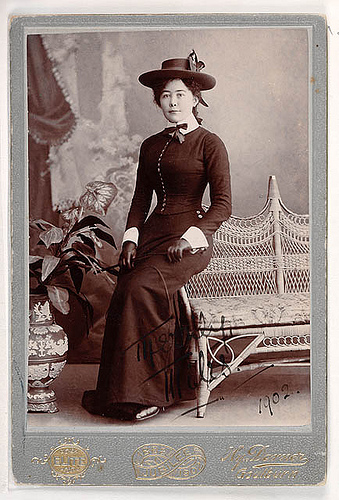
Miles Franklin, 1902

Miles Franklin, 1902, by H.Y. Dorner (Presumed Public Domain)

So now we are getting to the business end of Meanjin‘s tournament of books … and it’s getting exciting. Since I’ve been posting a little more frequently lately, I’ll keep this one short and, hopefully, sweet … after all, there’s still more to come.

Semifinal 1: Joan London’s Gilgamesh defeated Kate Grenville’s The secret river

It is at this point in the tournament that you start to feel really sorry for the losing book (and author). These are both contemporary authors, and both deserving of accolades, but if we are talking specific book and not body of work (as indeed we are) then I agree with the judge. The secret river is a brave book, and a well-written one. Kate Grenville is an excellent writer. But, London’s Gilgamesh has something special – a tone, a conception, a je ne sais quoi – that gives it the edge in this pairing. This seems to be what the judge, Robyn Annear, thinks too:

If Joan London sketches with a few bent lines and the suggestion of shade, Kate Grenville colours-in right to the edge of the page. Coming to The Secret River after Gilgamesh’s shrugged conclusion is startling, like plunging from sepia into vivid 3-D technicolour.

Semifinal 2: Miles Franklin’s My brilliant career defeated Henry Handel Richardson’s The fortunes of Richard Mahony

Well, if Semifinal 1 was a battle between two living writers, the second semifinal was between two dead ones! I’m a little surprised by the result, mainly because Career is generally regarded as the less “polished” of the two, but it was judged by none other than Hilary McPhee so who am I to argue? McPhee recognises Richardson’s achievement and, like the judges before her, finds the judging hard, but in the end she goes for the visceral. And I see no reason to argue against a reader judging on the basis of passion and feeling!

As always, the critical and the visceral response to powerful writing are in play — the tournament is located in my head. Right now, I’m with Sybylla, full of life, bouncing along in her boots made for sparring, outrageous, curmudgeonly, railing against fate. Fortunes is a masterpiece which has had its day and will have it again and again. My Brilliant Career might just be having it now. Go Miles.

Next up … the Zombie Round

I discovered, too late (why wasn’t I told?!), there’d been a poll on the Meanjin Facebook page for the two books to be returned in the Zombie round. They are Helen Garner‘s The children’s Bach and Alexis Wright‘s Carpentaria – but which book will be pitted against which semifinal winner we still don’t know. Keep watching this space …
Meanwhile, I could comment on which books did and didn’t make it to the final four … but I won’t, as I did say I’d keep this short! However, I’d love to hear what you think on the matter …

Meanjin’s Tournament of Books 2011, Round 2

For those interested in the continuing story of Meanjin‘s Tournament of Books, which I introduced in late October, Round 2 has now been played. Here are the results … with a little additional commentary by me.

Match 1, Joan London’s Gilgamesh defeated Helen Garner’s The children’s Bach

Oh, such a hard one. I feel for judge Michaela McGuire, a self-0uted Helen Garner fan who gave the match to Joan London. That takes bravery. I’m sure she had her heart in her mouth when she put those fingers to her keyboard. Anyhow, in the end, she gave it to London for the lovely single sentences (she’s right there) and, as I understand her, the expansiveness of the conception. She admires Garner’s “characteristic elegance and wryness” but “was left wanting”. She decides not to give it to Garner based on her love for the body of Garner’s work but to London based on this work. Fair enough. It would have been a hard call for me, too, and I would like to see London’s beautiful, mesmerising book receive wider exposure.

Match 2, Kate Grenville’s The secret river defeated Christina Stead’s The man who loved children

This may be the shock of the round, methinks. Admittedly the judge, Michael Williams, like McGuire above, bemoaned his lot. He calls them both masterpieces. He argues that both writers have a significant body of quality work. He says literary comparisons are b******t. And so, in a sense, he cops out. He tells us that in 1967 The man who lived childrenwas declared ineligible for the Britannica Australia Award because Stead had “ceased to be Australian”, though he also admits that it took only 70 years for it to assume a strong place in the Australian canon. But, he concludes, “Canonisation is for the dead. Tournaments are for the living. I’m giving this to Grenville“, and then declares his conflict of interest as having been involved in promoting The secret river at Text Publishing on its publication. Not having read Man yet and being a big defender of The secret river as excellent and valid historical fiction, I must, in fairness, stand on the sidelines, but I find this outcome an interesting one.

Match 3, Miles Franklin’s My brilliant career defeated Melina Marchetta’s Looking for Alibrandi

Sorry, Melina, I did love your book but I feel this is the right and proper decision. Judge Sarah L’estrange discusses the similarities in subject matter between these two books – “strong willed and independent” teenage girls fighting to find their own life against a background of familial and societal expectations. However, she gives the match to Franklin because Looking for Alibrandi is “just too straight-forward in the telling, there isn’t the dazzling dance of words across the page that My Brilliant Career has in spades”. I think she’s right. Alibrandi is locked pretty firmly into the Young Adult genre while Career has a more universal appeal, largely because of its writing and conception.

Match 4, Henry Handel Richardson’s The fortunes of Richard Mahoney defeated Cate Kennedy’s The world beneath

Another judge complaining about comparing literature! Makes me wonder why they signed up for the job! Anson Cameron makes me laugh though. Of Richardson‘s big book he says “Fat books, like fat people, die young unless they have huge hearts” and concludes that “only very good books age this well. Only very good books have the architecture to withstand great changes in the world. Of Kennedy‘s book he writes that it is “a Garnerish, (Garneresque? Garnery? Garnerly?) type novel in that it is imbued with a the kind of everyday insufferable domestic pressure Helen Garner excels in and it’s rendered in a spare, accurate prose reminiscent of her”. Not that he says it, but perhaps that’s a good enough reason for it to lose, perhaps it is too “Garner” rather than something original. I’m afraid I wouldn’t know as this one’s still in my TBR pile. Richardson would, I think, have the body of opinion behind her so Cameron has probably chosen well … and anyhow, if Garner was going to win, I’d rather it be Garner (if you know what I mean).

Now onto the Semi-finals …

In three of the four matches in this round, a classic was pitted against a contemporary, and the classic won two of them. I’m surprised the third one didn’t win too. Does this mean I’m a reactionary, old fuddy-duddy of a reader? Or does it simply mean that the classics have proven themselves as stayers over time? I prefer to think the latter … which suggests that if a contemporary novel wins the tournament, it will surely move one step higher on its climb to classic status.

I will be reporting again …

PS: I planned to list the semi-final matches here, but the numbering of the matches above does not accord with the numbering on the initial tournament plan, so I’m not sure which book will be pitted against which. Has some match-fixing been going on? Surely not!

Monday musings on Australian literature: Meanjin’s Tournament of Books

Henry Handel Richardson in 1945, a year before...

Henry Handel Richardson, 1945 (Presumed Public Domain. Courtesy: Wikipedia)

Many Monday musings ago I wrote about the reduced visibility of women writers in Australia. I wasn’t the only one concerned and things have been afoot to up the ante for women writers. For example, a new award targeting women writers, the Stella Prize, was announced earlier this year. And now Meanjin, a longstanding literary magazine, is emulating the Morning News’ Tournament of Books (to which a favourite blogger, Hungry like the Woolf, introduced me a couple of years ago) by conducting a tournament comprising books by Australian women writers.

Meanjin describes the tournament as follows:

The way it works is this: 16 books are chosen … and then divided into pairs. A judge is given a pair, reads them both, writes up their decision process and announces which of the pair they deem the better book. That book then progresses into the next match to go up against a winner from a previous round. It’s a sporting tournament for people who don’t like sport.

This year, in light of the discussion around women’s writing and literary prizes, we’ve selected a short list of novels exclusively by Australian women. The list has been chosen by us, and is incomplete, capricious and arbitrary. That’s ok. There’s no way you could do Australian women authors justice in 16 books…

Fair enough … and being this upfront about their selection makes it hard for us to complain, doesn’t it? And really, I wouldn’t want to, because I can’t imagine we’d ever get universal agreement on 16 books, anyhow.

The tournament schedule can be viewed at the Meanjin site so I won’t detail it here, but I will list* the 16 books, partly because it’s a useful list, despite its arbitrariness, for those interested in Aussie women’s lit:

Regular readers of my blog will recognise some of my favourite and oft-mentioned authors here. Interestingly, a couple of young adult/children’s novels (those by Carmody and Marchetta) have been included – one of their “capricious” decisions, perhaps! Not that I have anything against such novels – I thoroughly enjoyed Marchetta’s Looking for Alibrandi – but I wonder whether they have the weight to beat a Stead or an Astley, a Wright or a Jolley, for example. Well, keep reading …

Round 1 results

  • Match 1, Gilgamesh beat The lost dog. Both are interesting books but Gilgamesh is a beautiful one. I would have chosen it too.
  • Match 2, The children’s Bach beat Mr Scobie’s riddle. This is harder. I love The children’s Bach but have not read Mr Scobie’s riddle. I’m not sure it’s the Jolley I’d have chosen … but, oops, I said I wasn’t going to go there, so let me just say that this match is a tricky one – the judge thought so too – and I’m glad I wasn’t asked to call it!
  • Match 3, My brilliant career beat Tirra lirra by the river. Another hard one, but My brilliant career would have to be the sentimental favourite in this pairing. And, anyhow, how could I not agree with a book the judge called “chick-lit amongst the gums” and “Austen in an Akubra with a broad Australian twang and some permanent sun damage”?
  • Match 4, Looking for Alibrandi beat Harp in the south. Interesting decision. A main criterion for the judge seemed to be the ability to stand the test of time … but, but, I argue, Looking for Alibrandi is only 20 years old while Harp in the south has already stood the test of time. And, I’m not sure that Alibrandi reaches adult audiences in the same way that Harp does. Still, perhaps I should read Alibrandi again to be sure.
  • Match 5, The secret river beat A kindness cup. Both good books, and a very hard choice … one the judge clearly found hard too. It seems as though it was Astley’s more dystopian view that was the deciding factor. That seems a bit of a cop out to me!
  • Match 6, The man who loved children beat Obernewtyn. Now this must surely have been a no-brainer and the judge agrees, explaining why they were (mis)matched in the first place. I’ll say no more.
  • Match 7, The fortunes of Richard Mahony beat Of a boy. Another pretty obvious choice, really. While I do think a short novel or novella can beat a hefty tome, this is probably not the hefty tome to be up against!
  • Match 8, The world beneath beat Carpentaria. Now this does surprise me. The latter won the Miles Franklin award while The world beneath was not shortlisted. I don’t think we should give excessive credence to awards but it seems the judge gave the match to The world beneath because he found Carpentaria “difficult”. Is this fair or right, I cry into cyberspace? No, but at least the judge admits to being “covered in the stench of subjectivity”, so all one can do is vote Carpentaria back in the zombie round.

Plot, humour  and readability seemed high on the various judges’ agendas. They would not be my top criteria but, as this tournament is mainly about promotion of women writers and having some fun, I’ll say no more, except that I’ll report again on the tournament after the second round has been played …

* The two linked titles are to reviews on this blog. I’ve read many of the books listed, but mostly long before I started this blog.