Back in 2012, I reported on Text Publishing’s new initiative to publish Australian classics, with new introductions, and market them at a very affordable $12.95. I was thrilled and hoped the venture would take off. Well, it did, and now four years later they have published the 100th title in the series. What a wonderful achievement – for them and for readers of Australian literature. I have loved seeing favourite authors in print again and, particularly, being introduced to new ones (to me) including the luminous Elizabeth Harrower and the intriguing Madeleine St John.
Text’s 100th Classic

Text Publishing – quite rightly – is planning to celebrate this milestone but, before I talk about that, I should tell you the title of the 100th book shouldn’t I? It’s a book and author I hadn’t heard of, The dyehouse by Mena Calthorpe. Originally published in 1961, it was, according to Wikipedia, shortlisted for the Miles Franklin Award. Hmm … I wonder where the Wikipedia author got that from, because on the Wikipedia Miles Franklin page it says that they’ve not been able to find records of shortlists released prior to 1987. Fiona McFarlane, who wrote the introduction to Text’s release, says it was “commended for the Miles Franklin Award”. I wonder where that came from too. I’d love to know more about the early history of the awards. However, that’s not my concern today.
The dyehouse belongs to the tradition of social realist novels – to which Ruth Park’s Harp in the south belongs, not to mention many of the books written by our women writers of the 1920s to 1940s. It is set in a textile factory, and the Australian Women’s Weekly, reporting its publication, quoted Calthorpe as saying:
All my life I’ve just written for myself, for experiment. I started this novel when I was working in the dyehouse, simply to practise writing dialogue.
McFarlane tells us that Calthorpe was a member of the Communist Party in the 1950s, and after leaving that joined the Australian Labor Party. She was also secretary for a while of the “leftist Australasian Book Society”. It’s not surprising, then, that she wrote in the social realist style.
McFarlane says that the book received mostly favourable reviews, from the “right-wing Bulletin to the left-wing Tribune“. However, my research did uncover a less than favourable one from The Canberra Times’ reviewer “RR”. RR was rather circumspect about it, praising it with one hand and panning it with the other. S/he writes:
Despite its immaturity of style, it is an impressive piece of work—about a factory, factory workers, unsubtle seduction, and love.
Its characters range from a not-very-convincing All Black, Renshaw, to a veritable troupe of Snowy Whites. The few in-betweens, notably Oliver Henery, are the really interesting characters. They almost come to life. The story is about simple people experiencing simple emotions.
“Almost come to life”. Oh dear. Describing it as, among other things, the story of “a lovesick girl and her search for the Real Thing”, s/he says
This is trite material. That Mrs. Calthorpe makes it interesting is a tribute to her skill.
Yet the book is badly overwritten and pretentious. It needs ruthless pruning of its “literary” passages […
…] She has considerable skill as a writer, her great strength appears to be story construction. When she stops fascinating herself with her own clever prose, throws away her thesaurus, and gets down to telling a story simply, economically, and honestly she may well be a force to be reckoned with on the Australian literary scene.
Well, that final point is good isn’t it? Interestingly, when the book was republished by Hale and Iremonger in 1983, suggesting faith in it, The Canberra Times’ reviewer, author Marian Eldridge, was more positive. She ends her piece with:
Calthorpe’s views about the exploitation of people are clear but at no time does she preach at the reader. Nor does she offer pat solutions. She is too good an artist for that: through spare, clear prose and jaunty dialogue she creates a series of intermeshing situations that she lets speak for themselves. She does not probe deeply into the psychology of her diverse characters but neither has she created stereotypes.
The Dyehouse’ is a fine example of the social realist genre. Through Calthorpe’s vivid, compassionate picture of people at work we learn a great deal about the actual processes in a dyehouse, or at least one of 25 years ago. I find very satisfying a piece of fiction that both tells a good story and explains how things work.
So, Eldridge likes her prose … anyhow, that’s enough for now. I’ll say more when I read it myself!
Text’s celebration plans
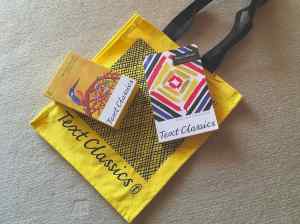
Text is clearly proud of its achievement – as it should be – and is planning a multi-pronged celebration, which will hopefully also promote these books to more Australian readers. Celebratory activities include:
- events at writers festivals;
- giveaways and reader competitions;
- a revamped website including a literary map of Australia and New Zealand;
- initiatives for bookshop promotions;
- a boxed set of 100 Text Classics Postcards (thanks Text for my complimentary set); and
- a free “I could never get bored with reading” (Amy Witting) tote bag for customers buying Text Classics at participating bookshops.
If you are interested in any of these I suggest you go to their website and “become a text member”. While there you will see a special deal of 5 classics for $50. You’ll also see Text’s Top Ten classics. Guess which book is number one? Elizabeth Harrower’s The watch tower (my review). What a service Text has done for Australian literature by bringing this author to our attention. I wonder what great finds Text will bring to us in the next 100?
Lisa (ANZLitLovers) has also written a post on this milestone.
 Whispering Gums