Sofie Laguna in conversation with Karen Viggers

I don’t know how it has happened, but tonight’s conversation between Sofie Laguna and Karen Viggers is the first ANU/Meet-the-Author event I’ve attended this year. I did book one featuring Omar Musa a month ago, but I came down with laryngitis, as did, I believe, his interlocutor. (The show went on, with Karen Viggers, in fact). My problem is a busy schedule combined with regular trips to Melbourne and a couple of holidays. They get in the way of normal life!
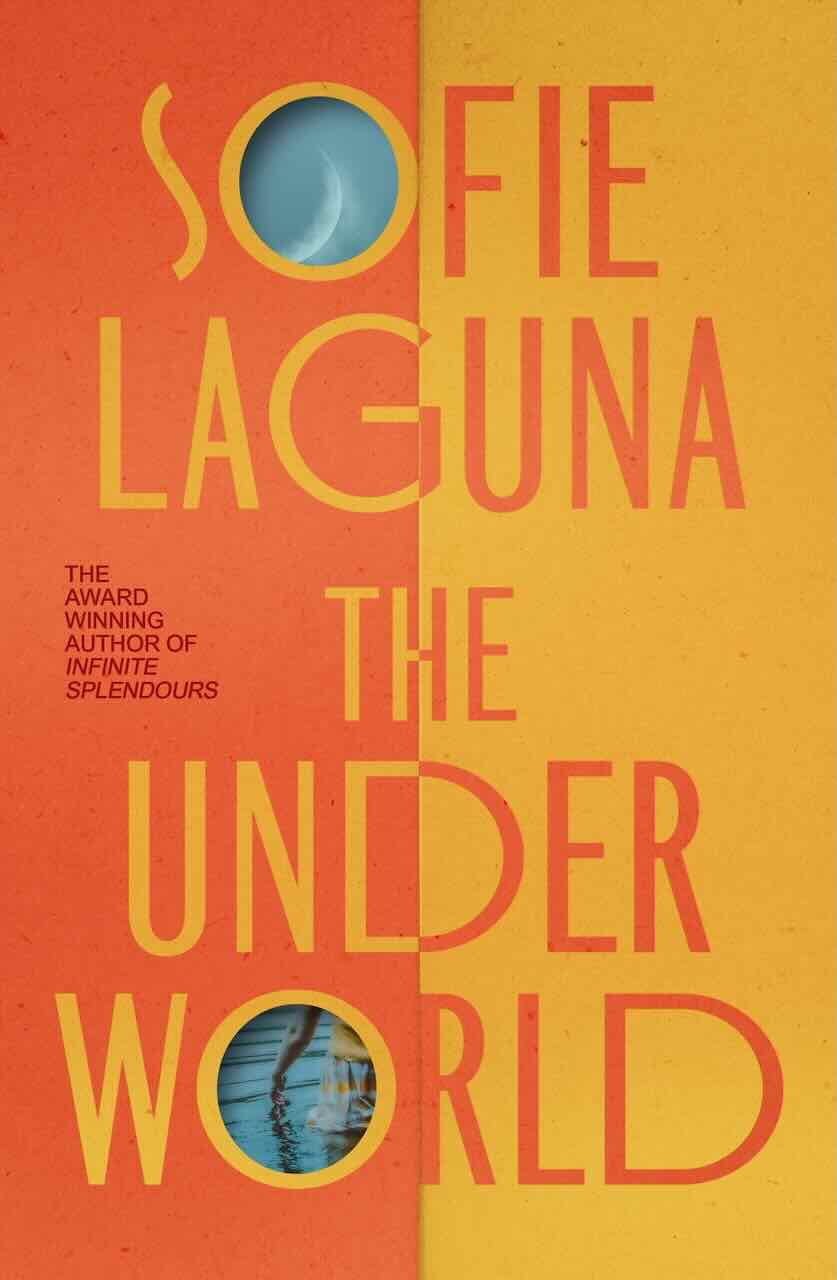
Anyhow, the event – which was for Sofie Laguna’s latest novel, The Underworld – started as usual with Colin Steele acknowledging the traditional owners, introducing the participants and thanking supporters, before handing the floor to Karen Viggers. He thanked Karen in particular for turning up because last Sunday, while in Ubud for the Writers Festival, she was run down by a motorcycle and was somewhat bruised and battered!

The conversation
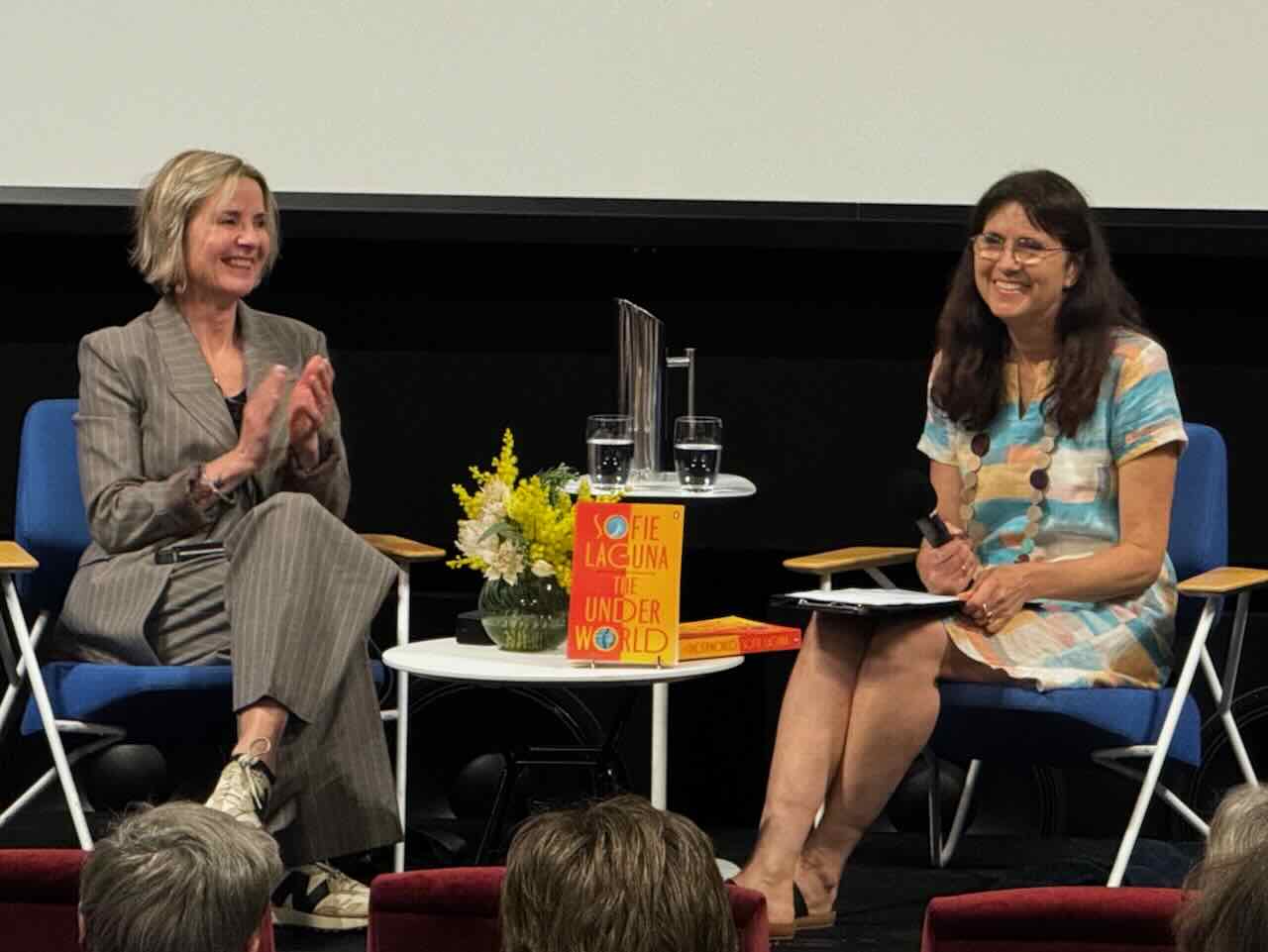
Now, I have seen Karen converse with Sofie Laguna before (back in 2017) and it was one of the most delightful conversations I’ve attended, so, I was looking forward to this one. It didn’t disappoint. Sofie Laguna is a joy and a hoot, in the open way she engages in discussions about her work. It’s a way that manages to feel fresh, as though the conversation is a journey for her, not the same-old same-old. Whether that’s Sofie or Karen or the chemistry they have, I don’t know, but it works.

On coming-of-age and young people

Karen started by introducing the novel as a coming-of-age story, which encompasses violence, love and transformation. She loved that Sofie takes the reader on a journey with Martha. The novel starts in 1973, with her protagonist Martha in Year 9 – at which point there was a little discussion between Sofie and Karen about how old that made her, and whether that was the same as Third Form. Whatever! The point is she’s around 13 or 14, is at an elite private boarding school in the Southern Highlands, and has parents who are ”trapped in a loveless marriage”. Here, there was another little discussion about whether they were in fact “trapped” and whether it really was “loveless”. As you can see, this really was a conversation.

Karen asked Sofie about the dedication, which she suspected implied a spark? It is an In Memoriam to her Latin teacher, who was both dedicated and elitist, but created a dynamic learning space. This led to a discussion about the role of teachers in guiding young people, and the fact that teachers are woven in different ways through most of Sofie’s novels. She doesn’t do this consciously, but realises teachers have had a pivotal role in her books. They have an incredible influence, they can draw out of students who they are. For Sofie, whose home was unconventional, school was a safe place, that gave her boundaries.

On the writing

We then moved on to voice, and the fact that Martha’s voice came to Sofie at a basketball gym where her son was playing. She began writing there and then in the voice of a women in her 50s, a woman who was funny, heartbroken, intellectual. She “knew something had happened”. She felt an urgency, and it was exciting because things were coming out that she didn’t know she knew. This sort of writing is easy to do because it wants to happen, but the book wasn’t easy.

She knew she had to go back and learn what Martha’s life was like at 14. It would be untidy. Puberty is messy, and she’d never properly written about it before. It’s a time of transition, challenging for everyone, as our bodies, ideas, sexuality change.

Karen then returned to why this book had been difficult. Was it because she was closer to Martha? Yes, but it was difficult in many ways – more difficult to get a sense of the whole, more difficult to get a straight line, more nuanced. And then as Sofie does, she asked Karen whether that made sense!

Karen noted that Martha attends a privileged private boarding school, which is a shift from the hardscrabble lives she usually writes about. This resulted in Sofie sharing another difficulty she’d had. Was she was “allowed”, in current times, to describe wealth, privilege? Was it permissible to describe pain experienced by a privileged white person? But, that’s who Martha was! So, she kept on, but she had to work hard to give herself permission to do this.

She wishes she’d kept a diary, that she’d captured this “dance” she’d had between the conscious and the subconscious as she worked through the issues.

On the Underworld

Next was the Underworld, Martha’s place of escape. Sofie explained that the Underworld, which comes from Greek and Roman mythology, is not the same as the Christian idea of hell. Everyone goes to the Underworld. We all know about Charon the Ferryman who takes souls across the river, but what is the Underworld? How did it work? Was it a watery place? There are many interpretations, but nobody knows, which gave Sofie – and Martha – the freedom to imagine it for themselves.

For Martha, suggested Karen, it is layered – mythic, sexual, academic, and more. Sofie agreed. It’s a metaphor for the darker parts of our psyche. Martha is obsessive, which makes it difficult to grow up, difficult to come to terms with her self, so the Underworld is a safe place.

On family and pets

Karen and Sofie then discussed Martha’s family. The opening paragraph describes the distance between mother and daughter. The mother, Judith, is aloof, remote, beautiful, tall, comes from old money, and is largely unavailable, though Martha remembers a time of closeness – underwater in a pool – when she was young.

Martha is more like her father, Andrew, but he is absent physically and emotionally. Her parents shared a love story. He was from the wrong side of the tracks, so why did Judith choose him? Was she rebelling against controlling mother, Babs, a snob who is the third party in the marriage?

They all love Martha, but they all fail her. Yet, Babs could be seen to save Martha. She’s an example of a character who starts as a role or function, but who becomes fully human with good traits and flaws.

Pets also play a role in the novel. They are like teachers. Martha’s grandmother has little dogs, but then Martha meets three big Irish wolfhounds, who ground her, who see her need. This scene at the farm was a joy to write. Sofie tries to write her novels from beginning to end, but if a scene needs to be written she will do it, and slot it in later. She returned to the idea of difficulty, and how surprising it was to find it so easy to write that scene but not the scenes before and after it.

Sofie said that Martha doubted herself, and this was what the writing was like. Some scenes would drag. She has depended all her writing life on her intuition, but with this book she needed an outside eye in a way she never has before. When she got that, she was able to write “with gusto”. That person gave her “permission”, reminding her that certain scenes can happen off the page, which is something she normally knows herself. This book she did the hard way, but she couldn’t give up on Martha!

On the 1970s setting

Sofie said there is some crossover between her life and Martha’s. This was a time when it was taboo to be gay, and feminism was growing but Martha could still cut off. Sofie found the research “thrilling”, and loved it when she found the extant female poet Sulpicia, whose authorship was contested by male academics. This was a great way for Martha to enact her own form of feminist activism.

During the Q&A, there was a brief discussion between Sofie and Karen re trauma, after Karen commented that there is trauma in each of Sofie’s books. Trauma, which comes from the Greek word for “wound” said Sofie, shapes people. All lives have “trauma”. You can’t avoid heartbreak, loss, acute pain. Karen observed, however, that trauma’s impact can depend on how and when it happens.

Before we went to the Q&A, Sofie apologised for being tired and getting tongue-tied, but we didn’t notice.

Q & A

On whether Martha represents Sofie (whom this questioner knew at school as a warm, passionate and curious girl) or a combination of girls: Both, she is a combination but also a “more true me”, said Sofie. She is awkward, prickly, can’t do eye-contact, until she meets horses and dogs. She’s a presence outside of Sofie, but is also “a soul twin’; she is both Sofie and separate.

On whether she had to kill any darlings: No, because whatever she killed were not darlings, as they were not working. Her aim is to find the structure, the shape, so she is always happy to lose things that are spoiling the shape, that are distracting from the story. Sofie laughed that she was using various metaphors – music, forest, sculpture – to answer this question, but essentially, once she has the path it’s a joy filling in the picture.

Vote of thanks

Features editor, Sally Pryor – who wore orange especially to coordinate with the book’s cover – gave the vote of thanks. Martha felt so much like a real person, she said, but is really just words on a page. How does that happen? Sofie replied that those marks on a page go from her soul to ours!

Another great meet-the-author event! We are very lucky, as Sally said.

ANU/The Canberra Times Meet the Author
MC: Colin Steele
Kambri Cinema, Australian National University
6 November 2025
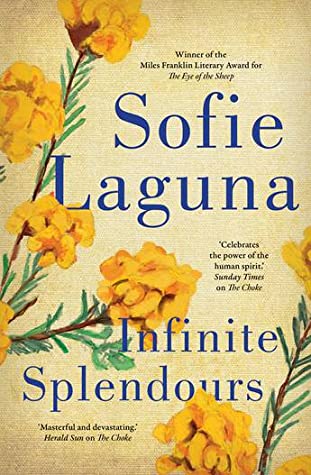

Sofie Laguna, Infinite splendours (#BookReview)

Those of you who know the subject matter of Sofie Laguna’s latest novel, Infinite splendours, will not be surprised to hear that it drew a mixed reaction from my reading group, particularly coming on the heels of recent reads like Nardi Simpson’s Song of the crocodile (my review) and Douglas Stuart’s Shuggie Bain (my review). However, if we all agreed on one thing, it was that Laguna’s writing is splendid.

Some of you though, particularly non-Australians, will not know what it’s about, so let’s get that out of the way first. The back cover blurb starts this way:

Lawrence Loman is a bright, caring, curious boy with a gift for painting. He lives at home with his mother and younger brother, and the future is laid out before him, full of promise. But when he is ten, an experience of betrayal takes it all away, and Lawrence is left to deal with the devastating aftermath.

It’s not a spoiler to say that this betrayal involves sexual abuse.

Infinite splendours, like Laguna’s previous book, The choke (my review), is set in the rural past. In this case, we are in the Grampians, west of Melbourne, and the novel starts in 1953 when Lawrence is 10. As with The choke, my question is, why set the story in the past? And my answer – though I don’t know Laguna’s – is the same: it’s set at a time when awareness of abuse and the resultant trauma were essentially non-existent. This enables Laguna to explore her theme unencumbered.

The novel is told chronologically in three parts. The first ends with the abuse, and the second takes Lawrence through to another crisis in his late twenties, with the third picking him up, a couple of decades later, in 1994. By this time, Lawrence is living alone in the isolated family home. The novel is told first person, so we spend the whole time in Lawrence’s head, seeing only his perspective. It’s intense and introspective, but not unleavened. There are moments of calm and beauty.

One part engaged, another observing. Two selves. (p. 411)

Still, it’s a tough story, as we watch this lovely, sensitive boy, whom we’ve come to love, decline. He stutters. He gives up his interests, including the art in which he’d shown such talent, and he keeps to himself. His body is a source of mental and physical anguish. From the moment of the abuse, he’s a divided person:

I felt myself dividing; there were two selves to choose from. One inside, one outside. (p. 152/153)

There are moments when he may have been helped. Soon after the abuse, his younger brother Paul asks “what did he do to you Lawrence” – but Lawrence won’t confide. At the beginning of part 2, the family’s kind neighbour, Mrs Barry, tells his mother that he reminds her of the “men back from the war”, but of course PTSD was not properly recognised nor treated back then.

After his mother dies when he is 26 years old, his brother leaves home, and a crisis occurs at his workplace. At this point, Lawrence’s self-isolation is complete. He does, however, have points of solace. His beloved mountain Wallis, a fictional mountain in the Grampians which features in the story from the beginning, provides moments of peace, hope and transcendence; a bunker on the property, in which he hides in a game of hide-and-seek at the novel’s opening, is a place he goes to for safety; and his art, to which he returns after leaving his job, provides occupation and self-expression:

This was the world for me; there was Wallis above and the bunker below, and here was I, between them with my tray of colours. (p. 267)

Lawrence also has an art book, Letters from the masters, that his uncle had given him during his “grooming”. This book becomes his “bible” – for art and life – and he returns to it again and again. He studies the paintings, and he ponders the artists’ words. Indeed, the novel’s title comes from Master Millet who wrote “I see far more in the countryside than charm, I see infinite splendours”. And so does Lawrence, particularly in his beloved Wallis. It is while standing on Wallis, before the events unfold, that he has his first intimations of “something else, greater, that was infinite–the earth’s invisible self. Wallis whispered, See this“.

It is in this context that Lawrence’s art becomes his life’s work. He describes one of his landscapes as “like a living thing … a soul contained within an object”, and sees his paintings as his family. He is as settled as he can be. But, change is inevitable, and the time comes when Mrs Barry’s long-empty house across the yard is occupied again. It discombobulates Lawrence:

I painted into the sun, layers of yellow into yellow. Immersion in light. Sun across my knees, sun in the sky, sun on my canvas. Could I not keep going, contained forever within this one emerging world of light? Must I inhabit another?

It seemed I must … Everything changes.

The new occupants are a single-parent family like his own had been, this one, though, with a mother, teen daughter, and, yes, a 10-year-old boy. The tension builds as we readers watch and desperately hope that Lawrence will not repeat history, that he will get his two selves back in sync in the best way.

I said at the beginning that my reading group praised Laguna’s writing. Her descriptions of the landscape are exquisite and her delineation of character, even minor ones, is so very good. Her warmth and empathy are palpable. I also love her ability to change pace and rhythm to evoke different emotions. However, several of us did feel it became repetitive. Further, although I was fully engaged in Lawrence’s story, and was never going to give up on him or the book, there were times that I felt overwhelmed with the multitude of motifs. As well as those I’ve mentioned, like Wallis and the bunker, there’s Robinson Crusoe, Madame Butterfly, a strawman/scarecrow, birds and the bird clock, rocking and a rocking chair, colours, and more. While none of these were gratuitous, they did sometimes become distracting, as I tried to identify whether they were adding anything critical to what I already knew and felt.

As I read this novel, with a frequent sense of foreboding, I was buoyed by my memory of Laguna’s statement that hope is important. Without giving anything away, let’s just say that, here, the hope felt a bit thin, albeit there is a real transcendence in the ending. For that I was truly grateful.

As for my reading group? Well, there’s been a request for books with a lighter touch next year, which is fine by me, as long as they have meat too!

Challenge logo

Sofie Laguna
Infinite splendours
Sydney: Allen & Unwin, 2020
435pp.
ISBN: 9781760876272

Winner of the 2021 Colin Roderick Award

Sofie Laguna, The choke (#BookReview)

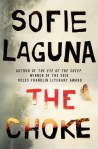
Sofie Laguna, The chokeThere are many reasons why I wanted to read Sofie Laguna’s latest book The choke. Firstly, I was inspired by a very engaging author conversation I attended late last year. Secondly, she won the Miles Franklin with her previous book The eye of the sheep (which I still haven’t read). Thirdly, its setting, the Murray River, is one of my favourite parts of Australia. For these and other reasons, I finally slotted it in this month, despite my growing backlog of review copies, and I’m glad I did. It’s an engrossing, moving read.

The novel is divided into two parts, the first set in 1971 when its first person protagonist Justine is 10 years old, and the second set three years later when she is thirteen years old and starting high school. It’s an effective structure. The first part sets up Justine and her physically and emotionally impoverished situation. She lives with her war-traumatised grandfather Pop on a struggling farm on the banks of the Murray. Her mother is long gone, and her father returns erratically. She has regular contact with her two older half-brothers who live nearby with her father’s first wife. Pop loves Justine, but he does not have the wisdom or emotional resources to guide – or even provide for – her as she needs. She is undernourished and poorly groomed. We are therefore unsurprised when Part 2 unfolds the way it does.

Now, I am a little cautious about first person narratives. It’s not that I don’t like them. In fact they can be highly engaging, but it did seem, for a while at least, that first person was becoming the voice du jour. However, Laguna’s choice here is inspired. She’s known for her ability to write young people and it’s well demonstrated here. Telling the story in Justine’s voice enables her to show Justine’s situation, without resorting to telling, which can so easily turn to moralising. Justine is the perfect naive narrator. She can only describe and explain the world as she knows it, so we readers must read between the lines to work out what is really going on. We work out, for example, that she is dyslexic by the way she describes her inability to read. We learn about the quality (often poor) of the relationships that surround her through her observations.

When I looked at [half-brother] Steve it was as if there was a ditch all around him too wide to jump. If you shone a torch into it, you’d never see the bottom. Steve couldn’t get across by himself; it was only Dad who could help him.

She might not understand the world – and it is this, along with her loneliness, which drives the crisis when it comes – but she’s attuned to the feelings between people.

One of the reasons this book so engaged me, in fact, is that it’s all about character. In the conversation we attended, Laguna said a couple of things about this. She said that it’s the characters and the tensions between and within them that drive the narrative and that character IS the plot.

“I got it wrong from the start”

So, who are these characters who drive the narrative? Justine is the main one, of course. She tells us that she was a breech birth – “I thought that was the right way to come out.” She understands by this that she “wrong from the start”, and she blames herself for her mother’s departure three years later. Her sense of being wrong – and feeling somehow responsible – is a recurring refrain in the novel. The other characters – her Pop, her sometimes-present father Ray, her mostly absent but significant aunt Rita, her friend Michael, her half-brothers, and the similarly dysfunctional neighbouring Worlleys – are all seen through her eyes. It is the tensions, stated and unstated, between them and their impact on her, that drive the narrative and the decisions she makes.

As well as a coming-of-age story, The choke is also a classic outsider story. Part one sets up Justine’s outsiderness, and chronicles, among other things, the friendship that develops between her and another outsider at school, Michael, who is taunted, bullied, because of his physical disability. Justine doesn’t have the words, but his disability appears to be cerebral palsy. The end of this friendship with Michael’s departure for the city ends Part One. This friendship plays multiple roles in the narrative. It helps develop Justine’s character. Her decision to stand up for Michael, having earlier wanted nothing to do with him, not only brings her a friend and marks her outsiderness from the cohort, but also shows her own sense of social justice. However, this friendship also exposes her low self-expectations and further reveals her neglect, because Michael’s family is a “normal” middle-class family. There’s a mum and dad, two kids, a proper house, regular meals and proper care. Justine is intitially embarrassed by the gap between their lives and hers, but when Michael eventually visits her home, she discovers he loves visiting it. He loves, for example, the chooks, Cockyboy and the Isa Browns.

By the time Part Two starts, her father Ray is in jail and Justine is starting high school. With Michael gone, she’s isolated at school and, while loved at home, continues to be neglected. The crisis is revenge-driven for something her father had done, but Justine, as the vulnerable female, is, of course, the target. It’s a gut-wrenching story of damage, neglect, abuse and, yes, also just simple misguidedness. Her Pop means well but is ill-equipped for the caring role thrust upon him. In the end, the story is also one of a failure of people and systems – including education – to identify Justine’s real situation.

And then there’s “the choke” of the title. I don’t always discuss a book’s title, particularly given that the author doesn’t always have last say on this, but for this book it’s highly relevant:

Down at The Choke the river pushed its way between the banks. The water knew the way it wanted to go. Past our hideouts, past our ring of stones, past the red gums leaning close enough to touch – it flowed forward all the way to the sea.

The “choke”, then, is a bottleneck in the river, a place, Justine says elsewhere, “where it would push through and keep going”. It is a physical place (based on the actual Barmah Choke) and a metaphorical one. Physically, it is a place of tranquility, of respite, for Justine. However, it also symbolises the things that threaten to “choke” her life, while at the same time hinting at hope, at the possibility of pushing through.

The choke is a book written by someone who knows exactly what she is doing. As I flipped through it to write this post, I noticed again and again the crumbs laid for us, the signs, in other words, that prepare the groundwork for what comes later. There is nothing wasted here. It is a grim story, but it is enlivened by its resilient young protagonist who finds the resources within herself to “push through” when life threatens to overwhelm. It may not have been shortlisted for the Stella Prize but I’m glad I decided to read it.

AWW Badge 2018Sofie Laguna
The choke
Sydney: Allen & Unwin, 2017
369pp.
ISBN: 9781760297244

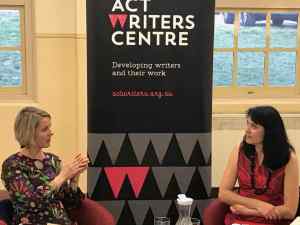
Sofie Laguna in conversation with Karen Viggers

Sofie Laguna and Karen VIggers

Sofie Laguna and Karen Viggers

What a treat it was to witness a conversation between two lively, intelligent Australian women writers in the company of other writers. I mean, as you can see from the post title, Miles-Franklin award-winning author Sofie Laguna and local writer Karen Viggers whose book The lighthousekeeper’s wife has just hit 500,000 copies sold in France!

I must say that I felt a bit like an interloper, given the event was organised by the ACT Writers Centre in their “Developing Writers and their Work” program, but I did enjoy eavesdropping on what writers talk about and want to know!

“I wasn’t ready to win”

The evening started with Sofie (I’m going to use first names) reading from the second chapter of her new book, The choke. Then we got down to business, starting with how Sofie handled her Miles Franklin win for The eye of the sheep (a book which still sits on the pile next to my bed, I’m afraid.) She had a new baby at the time and wasn’t expecting to win. She felt out of her depth. She had no speech prepared, and was suddenly surrounded by media and the press. It was both too much and something you want, she said. However, she felt the prize would be positive for many years to come, and said it made her feel her work was now validated by the literary establishment.

Karen Viggers, The lighthouse keepers wifeKaren then asked her about her experience as a woman in the industry, but Sofie turned this back on Karen – as she did several times during the conversation! Karen, though, was up for the challenge. She commented that she did feel her gender has impacted her career, including such things as the covers of her books.

Sofie agreed that she works in an unfair world, and that women get less attention. She talked about dealing with practical demands of winning the prize and managing a baby. It helps, she said, to trust your instincts. However, “you still have to empty the dishwasher every day”. That got a rueful laugh from many!

“Character IS the plot”

Sofie Laguna, The chokeMany times during the interview, Sofie returned to character. It’s clearly what she writes for, and about.

Karen asked her how she “found” Justine’s voice, the 10-year-old girl living on the Murray with her war-damaged grandfather in The choke. Sofie referred to her training as an actor, and how actors discover that some characters are easier to inhabit than others; she finds young voices easy. Young protagonists, she said, can have a fresh view on the world. Moreover, the more vulnerable voice of child characters frees her to comment on the adult world in a more powerful way.

Sofie then talked about Justine’s Pop. He’s narcissistic. He cares about Justine, albeit not necessarily as he should or could. She admitted that yes, he was another damaged character, but that seeing him that way was too simplistic. Many of us, she said, are damaged in some way. It was clear that she felt there’d been too much focus in interviews on “damage”!

Nonetheless, Karen commented, Sofie did write demanding books, to which Sofie responded that she’d grown up with war-caused loss and damage in her family, something she hadn’t talked about before.

The conversation then returned to Justine, who is dyslexic and generally powerless. Karen asked whether there were ways in which Justine was powerful. Sofie said that while Justine’s in a difficult world, she has the power – can choose – to respond in positive ways. She’s able to form connections. Unlike Pop, she’s not self-absorbed, and can enter other people’s worlds, can empathise. Sofie believes there’s much positivity in the book.

Sofie said that it’s the characters and the tensions between and within them that drive the narrative.

Later, when asked whether her books are character- or plot-driven, whether the plot fits the character or vice versa, she said that character IS the plot.

Place

While character is Sofie’s focus, Karen noted that place is significant in the novel. Sofie described how the Murray River and the Barmah Choke inspired her setting. She said the Murray is brown and gritty which works metaphorically in her story. The choke is where the river becomes narrower. Trees in the choke may look like they’re dying, but they don’t die, they keep growing, which makes a lesson for Justine.

Hope

Sofie believes that hope is important. She quoted a writer’s adage, which is that you want readers thinking:

“I fear she won’t, but I hope she will”

Writing to this tension keeps readers reading. (I love this, and will try to remember it.)

Around here, the issue of writing about disadvantage came up. Sofie said that people living disadvantaged lives often find themselves in self-destructive patterns. And yet, like the women in her book who don’t have much power, they can find ways to survive. However, she said, her subject is the richness of world, not specifically poverty and disadvantage. Her stories would not work if she decided to write about disadvantage. She sees her job as being to endow world with life not to be a spokesperson for marginalisation. Anyhow, privilege doesn’t save people from suicide, crime, etc, she argued.

The writing process

Given that the session’s focus was “developing writers”, Karen concluded by turning to the writing process. A lesser interviewer would have been flummoxed at this point when Sofie responded that she had “no answers for questions about how she does it”. But, of course, she did have answers, and she shared them. She:

  • plunges in with a plan
  • writes millions of drafts
  • doesn’t always write from beginning to end, and sometimes stops when she has more to say which can make it easier to start next sitting
  • has found that, with experience, writing has got faster over the years
  • knows her character’s “soul”, but the rest she gets to know as she writes. She noted that initially she found it hard to differentiate Justine from The eye of the sheep’s Jimmy, but Justine’s character developed as she kept writing
  • prefers one-person to multi-person narratives
  • doesn’t choose to write for a specific audience (i.e. young people or adults) but writes for character, and the audience falls into place
  • likes to have some time and space between books (partly because of the promotion she needs to undertake for the most recent book)

It felt at times that Sofie was discovering more about her book as she discussed it with Karen. Her excitement and Karen’s flexibility in going with it made the conversation fun and engaging. It was one of the liveliest I’ve been to, and we all laughed when Sofie said that she wasn’t like this at the breakfast table! I’m glad I decided to go.