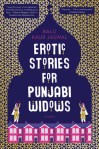
Balli Kaur Jaswal, Erotic stories for Punjabi widows (#BookReview)

Book cover

Broadly speaking, Singaporean author Balli Kaur Jaswal’s third novel, Erotic stories for Punjabi widows, reminds me of Anita Heiss’ choclit books like Paris dreaming (my review). By this I mean it presents as an escapist romcom genre novel but within it is some serious intent. In this case it relates to the oppression of women, particularly widows, and, more specifically, the problem of honour killings, in Britain’s Punjabi Sikh community.

The story concerns the “still searching for her calling” Nikki, who, twenty-two-and-a-half years old with half a law degree behind her, obtains a job teaching writing to immigrant Punjabi widows in Southall, the heart of London’s Punjabi community. Except, what she finds is that these widows do not want to learn to write:

I’ve survived all this time without reading and writing; what do I need it for now?’

What they want is to tell stories – erotic ones – to each other. What they want, really, is companionship and a safe place to be themselves, away from the oppressive eyes of a traditional community dominated by the self-appointed “morality police”, the Brothers.

And here is where some darkness comes in, because within this community, several young women have died. Officially, these deaths are recorded as accidental or suicide, but it gradually becomes apparent that all may not be as it seems and that murder and honour-killing may be involved. Widow Sheena chillingly says later in the book that “in this community I’m suspicious of accidents.” The novel, therefore, is a romcom-cum-crime mystery.

Paralleling this story of the widows and their writing class is that of Nikki and her nearly 25-year-old sister, Mindi. Born in England to Punjabi immigrant parents, they represent the other side of the cultural coin – to a degree, anyhow, because Mindi, a nurse and (still) unmarried, is considering “embracing our culture” and going the traditional arranged marriage route. This shocks the freer wheeling, English-to-a-core-she-thinks, Nikki, who tells Mindi:

This is what young women do in Britain! We move out. We become independent. This is our culture.

Even so, our modern Nikki does sometimes feel “split in two parts. British, Indian.” Fortunately, Nikki meets a man the more usual way – by serendipity – and love starts to bloom. But, this is a rom-com so, as you’d expect, the course of true love doesn’t run smooth and soon enough Nikki finds herself wondering why this man is behaving a little strangely.

As with Anita Heiss’s choclit books, what lifts Erotic stories for Punjabi women out of the straight chick lit genre, is its interrogation of social issues. Besides the above-mentioned mystery concerning a young woman’s death, two other issues are reflected in the lives of these characters, one being the challenges faced by young first generation women, and how they navigate the two cultures they find themselves straddling. By having Nikki and Mindi handle this quite differently, Jaswal reveals the complexity of what this generation faces. Then we add in Nikki’s new love, Jason. I don’t want to spoil anything, but let’s just say that his experience of being a first generation Sikh man from the USA, and the expectations placed on him, adds commentary to Nikki and Mindi’s thoughts about life, love and marriage.

The other main issue is the oppression of Punjabi Sikh women, particularly but not only widows, within their own culture and in the culture of their adopted home. Our widows are invisible in their own community. Without their husbands they are seen as and feel “irrelevant”. However, these Punjabi women overall haven’t made any inroads into the English community either, feeling the English “haven’t made their country or their customs friendly” to them. “Britain”, Nikki realises, “equalled a better life and they would have clung to this knowledge even as this life confounded and remained foreign.”

There is, then, a lot going on here, but Jaswal, whose first novel, Inheritance, earned her a Sydney Morning Herald Best Young Australian Novelist Award, knows how to construct and move along a plot. She also knows how to entertain. The erotic stories are a bit of a hoot. With our widows finding creative synonyms for certain body parts, you may never look at a cucumber the same way again. It’s laugh-out-loud funny at times, which my reading group enjoyed, and there are some lovely touches of irony. For example, the earnest Kulwinder, interviewing Nikki for the writing class, starts to sense that Nikki’s idea and her own may not be aligned:

It dawned on Kulwinder that she had advertised for something she did not understand.

The joke, though, is on Nikki too, because for all her “passion to help the women”, little did she expect just how that “passion” might play out!

My favourite books are those which touch the heart and challenge the mind. Erotic stories for Punjabi widows, for all its serious intent, primarily meets the former. It ticks all the boxes: it’s fun to read, has likeable characters, and its message is valid and relevant. For me, though, it’s a little too obvious and predictable, and the resolution is too neat to give the book the sort of gritty, punchy power I love. However, I enjoyed the read and recommend it to anyone wanting an enjoyable romp of a read with a little meat on its bones.

Lisa (ANZLitLovers) also enjoyed this book.

Balli Kaur Jaswal
Erotic stories for Punjabi widows
London: HarperCollins Publishers, 2017
ISBN: 9780008209902 (eBook)
299pp.

Sharlene Teo, Ponti (Guest post by Rosalind Moran) (#BookReview)

Last year as in the two previous years of the ACT Litbloggers/New Territory program, I offered the participants the opportunity to write a guest post for my blog. As a result Emma Gibson wrote a post on Randolph Stow’s Tourmaline, while Amy Walters suggested we do a 2018 Year in Review posts on each other’s blogs. This year, Rosalind Moran (check out her website) offered a book review on Singaporean author, Sharlene Teo, which of course I accepted as I’m happy to increase the diversity of authors covered on my blog.

Here is Rosalind’s post …

Book coverI haven’t read many books by Singaporean authors. Nevertheless, I am always keen to read more writing from beyond the traditional confines of the Anglosphere. So when I stumbled across Ponti in a bookstore after payday, I thought: why not?

Ponti was already vaguely on my radar. The debut novel had its London-based Singaporean author win the 2016 Deborah Rogers Writers’ Award before even being published (the award serves to support authors as they finish their first book). Since being released, it has been shortlisted for multiple prizes. Even Ian McEwan called the book “remarkable”. Naturally, my interest was piqued.

Ponti explores the lives of three interconnected women. There’s the cold and beautiful Amisa, who evokes the archetype of an enchantress; her pinched and unhappy daughter, Szu, who struggles to connect with others, least of all her mother; and Szu’s schoolmate, the privileged and acerbic Circe. As Amisa wallows in bitterness and begins to waste away, Szu and Circe develop a claustrophobic friendship – one that leaves Circe reckoning with her memories of it long after it has ended.

The novels switches between the perspectives of the three characters as well as between different points in time in their shared and separate histories. One quickly realises this book is focused not so much on detailing elaborate plotlines, but rather on deepening its characters. That said, it remains an engaging read throughout, simply owing to the compelling nature of the three women telling the story. What’s really behind each of their unique states of unhappiness, and how do their futures unfurl?

As the story unfolds, Amisa’s history emerges as the strongest plotline, perhaps because her experiences sow the environment in which Szu and Circe’s own troubles flourish. Indeed, she is the novel’s pivotal character, with her flaws, frustrations and traumas colouring all those with whom she comes into contact – and she is intriguing from the start. An unearthly beauty, she is introduced to the reader as a reclusive former actress, one of waning fame, whose defining moment was that of playing the lead in a trilogy of cult horror movies: Ponti 1, 2 and 3. Her role as the Pontianak, a predatory monster disguised as a beautiful woman, also comes to mirror her ongoing experience of moving through the world. Amisa is simultaneously desired and despised, even by her own family, and is ultimately a restless figure. She also effectively comes to haunt Szu and Circe.

I enjoyed many aspects of Ponti. Teo’s writing is strong and evocative, with characters frequently seeing their surrounds through a tinge of disgust and criticism; while these emotions do not in themselves make the writing strong, they do render it visceral and memorable. It was a pleasure to read a book where the characters’ homes, from the Malaysian village where Amisa grows up to the cosmopolitan Singapore, were drawn so distinctly. Through these strong descriptions, the book also manages to voice a subtle critique of how quickly and irreversibly the south-east Asian metropolis has changed over a few short decades, bringing both pressures and opportunities. In this sense, Pontiis a treat.

Characterisation is also a highlight of the novel – indeed, one could argue the novel is essentially one large exercise in characterisation. Teo’s focus on her characters’ interiorities makes them lifelike and compelling. Their interpersonal relationships, which often blur the boundaries between love, hate, and co-dependency, are also striking, with Szu and Circe’s friendship in particular standing out. Teo is masterful in her depiction of teen angst and complex female friendships, to the degree that her writing brings to mind a grungier Elena Ferrante. I also greatly enjoyed the book’s exploration of Indonesian and Malay mythology through the figure of the Pontianak, and the way this is used as a springboard into an exploration of broader ideas around perceptions of women and how they relate to men.

In the end, the novel’s only real shortcoming was – regrettably – the plot. For most of the book, this didn’t matter: the writing and characters are deeply engaging and I enjoyed simply following the story as it unfolded. Towards the end, however, it became clear the book was not going to resolve several of the questions that had helped build tension and momentum throughout its pages, or at least not do so adequately. In this sense, Ponti feels somewhat like a missed opportunity – because while ambiguity and character-driven plot can be done well, in this case, the story ended up feeling rushed in its final pages and retrospectively underdeveloped as a whole. It’s a shame, considering the book’s characters, setting, and writing are all so strong.

Nevertheless, Ponti remains an intriguing and thought-provoking read, and one that will rightly earn Sharlene Teo many avid fans; while her debut novel may not be perfect, it’s still well worth reading and suggests a great deal of promise. I’ll certainly be keeping an eye out for whatever she writes next.

Sharlene Teo
Ponti
London: Simon & Schuster, 2019
304pp.
ISBN-13: 978-1501173127

Thanks to Rosalind for an engaging and interesting review. Novel endings are a challenge, we know. Just ask EM Forster who wrote about it in Aspects of the novel. How many authors have changed the endings – even Jane Austen did for Persuasion – and how many readers question endings? Rosalind and I would love your thoughts on her review and/or on endings in general.