Shelley Burr, Vanish (#BookReview)

With Vanish, the third novel in her Lane Holland series, Burr mixes it up yet again, which appeals to me because my main reason for not liking genre fiction is that it can be formulaic. I know this is why many like it, and I understand that need for comforting reading. It’s just not my need.

So, a brief recap. In Wake (my review), we are introduced to a private investigator, Lane Holland, who arrives in a remote, outback, fictional town to investigate an old missing persons case. He’s keen and caring, but he also has his own agenda – and the resolution is shocking. The next book, Ripper aka Murder town (my review), is set in a different country town. It initially looked like something different, as Lane is in prison from Wake‘s fallout, but it soon becomes a dual investigation story that coalesces when it turns into both a murder and a missing persons case.

And now, book 3. It seems you really can’t keep a good PI down, even if he is in prison! Vanish is set a few years later. Lane is still in prison but, because of prison governor Carver’s vested interest, he soon manages to get himself on a pre-parole release program in order to continue the unsolved investigation from Ripper. If you’ve read Ripper you’ll know what that is, and if you haven’t, it becomes clear very soon. My point, though, is that once again Burr has produced a highly readable crime novel that manages to be a bit different from the preceding book, while retaining enough familiarity for those invested in her characters and worldview. It’s a fine balance that Burr has trodden nicely.

Like its predecessors, Vanish belongs to the rural noir sub-genre, and is consequently, noir-ish – or Australian Gothic – in tone. It features characters we have met in the previous novels, including Lane Holland, his sister Lynnie, and his first client Mina McCreery. Further, its plot centres again on a missing person. In Vanish, however, there’s more than one missing person. A serial missing persons case!

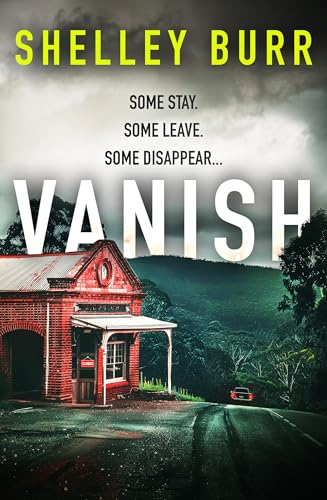
Some stay. Some leave. Some disappear.

“Some stay. Some leave. Some disappear” appears above the title in the book’s first Australian edition (as you can see in the cover pic above). What it references is the main setting of the novel – a farm near Hume Weir, southeast of Albury, an area Burr knows well. At the novel’s opening, Lane has tracked down several missing people as having visited this farm, then disappearing from view – hence the tag line. What is this farm, and why have some people disappeared? Lane wants to find out and Carver, with his daughter still missing, is happy to help him do so.

Consequently, with ankle bracelet, a prison guard minder, and an agreement for him to work at the farm, Lane arrives – but not without a mysterious-sounding death having just happened on the road in. This, of course, captures Lane’s attention – and we’re off.

Now Lane is, of course, your suspicious type. He takes nothing at face value, and he closely observes all that’s going on around him. There’s something about this farm that doesn’t feel right. Is it a community of like-minded people who want to escape their old lives and live more simply, growing their own food and reducing their energy impact on the world? Or is it a cult? How genuine is the owner Sam Karpathy, not to mention his recently deceased father? What do the people in the nearby township know, and why do they seem evasive when Lane tries to find out? And, why is a certain person from a previous novel there too?

Oh, and who is the trapped, sick, or injured person whose story is told in short italicised sections interspersed with the main narrative? (It added to the intrigue, and I didn’t guess it at all.)

As in her previous novel, Burr’s builds her crime story around wider issues. In Ripper for example it was “dark tourism”. Here, it is the idea of people wishing to live eco-minded, sustainable lives. So, as the investigation progresses, Burr also interrogates what this sort of life means in terms of whether or not you compromise and why, whether you stockpile for an end-of-world scenario, whether you eschew western medicine, and so on. These are questions Lane considers as he tries to understand the community he is living in. And it starts with the controlling Karpathy.

Lane, as he needs to be, is a trustworthy narrator for us. The novel is told third person, through his eyes, and he brings us along with him, sharing his thoughts and explaining his processes. His awareness of body language and his experience of human behaviour guide his actions. I loved those details. There’s risk and tension, some creeping around the farm at night, a locked room, magic mushrooms, and more. I didn’t find it edge-of-the-seat suspenseful, but I don’t like that anyhow, so the level of stress was just about right for me. The plot builds slowly, sending us off in various directions, and keeping us uncertain as we consider what Lane sees and questions. Is Karpathy, for example, coercive or simply wanting to keep control of a dream he is vested in. The denouement, when it comes, unfolds quickly, and at just the right time.

I enjoyed the read. I have been invested in Lane from the beginning, and he continued to interest me in this book. He’s conscientious, intelligent and decent, but, appealingly, is not always sure of himself, particularly when it comes to relationships. Also, Burr evokes place well. The farm, which is set in mountains just far enough from a little town to feel isolated, feels believable, as do the natural disasters – flood and bushfire – which threaten it.

My only question now is, will we see more of Lane? As a convicted felon he will not be able to renew his investigator licence. There is a hint at the end that there might be a way around it. Time will tell, but if you are a Lane Holland fan, I think you can have hope.

Shelley Burr
Vanish
Sydney: Hachette Australia, 2023
384pp.
ISBN: 9780733652158

(Review copy – an uncorrected book proof, hence no quotes – courtesy Hachette Australia)

Shelley Burr, Ripper (#BookReview)

When I started reading Ripper, Shelley Burr’s follow-up novel to her bestselling award-winning debut novel Wake (my review), I thought about crime novels, about how they are often written in series and how I am not a big series fan. Ripper looked to me like a stand-alone novel – and it is, somewhat! I say somewhat, because a few chapters in we come across one Lane Holland.

The plot thickens…

Lane Holland, I thought. I know that name. Sure enough, Lane Holland is the private investigator protagonist of the aforementioned Wake. However, he is not the prime investigator in this novel, because he is in prison as a result of his previous investigation. (You’ll need to read Wake to find out more!) The result is an intriguing crime novel in which we have our prime, self-appointed amateur investigator, Gemma, plus the police working away in the background, and Lane who is pulled into the investigation by his prison governor, Patton Carver. Yes, you’ve guessed right, the plot thickens – except I haven’t really told you about the plot yet.

Ripper is set in a fictional town called Rainier, which, as Burr confirms in her acknowledgements, is partly based on the town of Tarcutta. Seventeen years before the novel opens, three murders had occurred in this little country town, the last one outside the door of Gemma’s little teashop. She – and the town – have never fully recovered from these events. The town has stagnated under its black reputation, and Gemma herself suffers PTSD from what she had experienced. Now a tour company has arrived wanting to run a true crime or dark tourism walking tour of the Rainier Ripper’s murderous path, but Rainier’s residents have mixed feelings about the idea. On the eve of the trial tour aimed at garnering their support, the tour operator is killed in what looks like a copycat murder. It has to be copycat because the Rainier Ripper is in prison, the same prison as Lane Holland. As I said, the plot thickens, and part of the thickening springs from why prison governor Carver is interested.

Once again, I enjoyed Burr’s story, because once again it is more than a crime story, exploring issues like the impact on a small town of having a reputation for violence, the impact on people who have been close to a violent crime, the idea of dark tourism, and the murky world of police investigations and the ways in which confessions are elicited. I am not an expert but Burr’s research into the relevant issues, including prison life, felt thorough but lightly applied.

I also enjoyed Burr’s characterisation. Gemma and Lane are well-evoked. Other characters are necessarily more sketchy, but they are individualised enough to lift them above pure stereotype, to make them feel true. There is an engaging exploration, through Gemma’s daughter and her friends, of how teenagers cope with a complex adult world. There are some truly “tangled” family relationships in the town. There is some diversity, including a non-binary teen and a Wiradjuri woman, which Burr introduces without trying to appropriate other experiences. There are farmers, business people, pub owners, and doctors whose lives are entwined through marriage and murders. It’s a lot to convey, and there are plenty of names, but I rarely got lost!

Ripper has some similarities with Wake, in addition to also belonging to the rural noir sub-genre. It’s told through roughly alternating third person voices (Gemma and Lane); the protagonist is privately investigating; and it deals with a cold case, which involves a missing person. But it is significantly different, too, including the fact that Gemma is an amateur unlike Wake‘s Lane, and that it is set in a different place with different issues to confront. This means that it is not formulaic, which keeps us readers on our toes. We can’t assume anything about where Burr is going.

Now, I am not a big plot-follower, by which I mean I don’t put serious brainpower into trying to work out who dunnit. Rather, I read crime like I read most books, that is, with a focus on the characters and the issues being explored. But of course, I can’t help following the actual plot, particularly when the characters have engaged me and I want them to fare well. In Ripper, I worked out one of the plot twists, but it had several – like those Christie and Christie-like TV shows I watch – and they left me for dead. They did make sense, though, which is the important thing.

On the basis of her manuscript for Wake, Burr won a two-book deal with Hachette, and Ripper is the second book. I do hope she is offered more book deals because, while there is absolute closure on this book’s crimes, there is also a clear hint at the end about where a next book might go – and I’m intrigued. Burr is a clever writer, with her wits about her. Ripper’s readers will guess the main investigation Burr plans for her next novel, but what will the context be this time? What will be the issues? Time will hopefully tell.

Shelley Burr
Ripper
Sydney: Hachette Australia, 2023
346pp.
ISBN: 9780733647857

(Review copy courtesy Hachette Australia)

Shelley Burr, Wake (#BookReview)

Regular readers here will know a few things about me. One is that I don’t regularly read crime, and another is that for three years, before the pandemic struck, I was the litblogging mentor for an ACT Writers Centre program. One of the last two participants in that program was Shelley Burr, author of the just-published crime novel Wake.

In my post on that 2019 program, I introduced Shelley as follows:

Shelley Burr is working on a novel, and took part in the ACT Writers Centre’s well-regarded Hard Copy program last year … She is particularly interested in what she calls “drought noir”, which term sounds perfect for some of the crime coming out of Australia at present. Shelley has had her writing place well in the Stockholm Writers Festival First Pages program.

That novel she was writing was Wake. It won the CWA Debut Dagger in 2019. It was also shortlisted for the 2019 Kill Your Darlings Unpublished Manuscript Award, which gave her a Varuna fellowship, and the 2020 Bath Novel Awards, which is an international award for emerging writers. Judge for the Bath award, literary agent Jenny Savill, wrote of Wake:

With forensic attention to detail, the reader is effortlessly drawn into the small town, rural Australian setting and a community in mourning. Immersive and riveting.

Savill was right on all fronts. Burr’s attention to detail is forensic, and readers (even non-crime readers like me) are “effortlessly drawn in”. I was thoroughly engaged from the opening pages, and this is because, besides being a crime novel, it’s a novel about character, and what happens to people when terrible things happen to them. How do people respond, and why do different people respond differently? It confronts readers to think about our own responses. How would we respond if it happened to us? And, how would, or do, we respond when it happens to others?

Wake is about a cold-case that took place on a remote farm some twenty years before the novel opens. Nine-year-old Evelyn (Evie) McCreery disappeared from her bed one night, never to be seen again. This means the novel alludes to a longstanding Australian writing tradition, that concerning the lost child. However, this motif has layers of cultural complexity that are not central to this novel, so I’m just mentioning it and moving on.

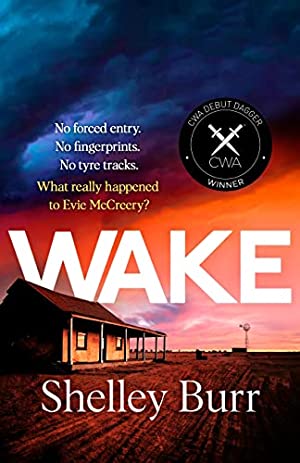
Now, the plot … as the book’s promotion says, “no forced entry, no fingerprints, no footprints, no tyre tracks”. Evie’s twin sister, Mina, has grown up in the wake (pun intended!) of that disappearance. She has never fully recovered and is quietly trying to solve the mystery on her own. The novel opens with the clearly fragile Mina doing her shopping under the kindly eye of a local shopkeeper. A stranger, who turns out to be private investigator Lane Holland, approaches her, but she is not interested. The novel progresses from this point with the twists and turns typical of the genre until its inevitable – though not completely expected – resolution.

Wake is carefully plotted, with, for example, hints concerning Lane Holland and why he has chased this particular case being gradually shared. Wake is also well-paced, starting slowly, and gradually building intrigue until near the end when the pace hots up. Suddenly, the chapters become shorter, causing the alternating perspectives, which characterise the narrative, to become more urgent.

As I mentioned above, the characters are a major strength of the novel. Mina and Lane are sensitively developed. Both are driven by past trauma, and can be tough and prickly, but both also exhibit moments of vulnerability and tenderness which help us care about them. There are a few other characters, the main ones being Mina’s more together friend Alanna whose sister had also disappeared around the same time as Mina’s, and Lane’s much younger sister Lynnie. Though minor, they too have flesh.

The narrative is chronological, with occasional flashbacks filling in some gaps. Other gaps are cleverly filled in by entries on a social media forum, MyMurder, which open some of the chapters. They add a thoughtful layer to the story, by conveying how such mysterious cases catch the public attention and how obsession with them can play out. They show how crime aficionados, conspiracy theorists, and others, can spear wildly away from the truth and potentially, if not actually, cause mental harm to those most touched by the crime.

So, yes, I was impressed. The writing and plotting is so sure, and Burr’s exploration of the crime is considered, sympathetic, and grounded in reality. There is drama – of course – but it properly serves the story and the complexity of the emotions, reactions and consequences that Burr is exploring. This made for engrossing reading for a non-crime reader like me, but Wake is also, if the awards tell us anything, great crime reading. It’s a page turner, with depth.

Now, I’d better at least mention the setting, given I’ve referenced Burr’s interest in “drought noir”. Wake is set in rural central New South Wales. Burr, herself, grew up in regional New South Wales, and her grandparents had a farm in regional Victoria, so her writing of place and country life felt authentic. The setting adds tension because Mina and her father Liam’s property is remote, remote enough that they have installed alarms on the gates to announce the arrival of visitors. You can’t be too careful when you live so far away from help.

However, the property also neatly reflect the challenges being faced by Australian farmers in climate-change-affected times. It was a working farm, but the disappearance of Evie consumed the family’s energy so much that viable farming fell by the wayside. In a nice political touch that speaks to our times, Burr has Mina and her father moving into working it as a conservation project.

Wake earned Shelley a two-book deal with Hachette, and is about to be published in the USA. Having now read it, I’m not surprised. I recommend it.

Shelley Burr
Wake
Hachette Australia: Gadigal Country/Sydney, 2022
360pp.
ISBN: 9780733647826

(Uncorrected proof courtesy Hachette Australia)