Monday musings on Australian literature: Australia’s favourite genres

A week or so ago I received an email from an organisation called Studying in Switzerland. Their main focus, as their name suggests, is helping students who want to study in Switzerland, but it seems that they also do some research of their own. A recent project was to identify the most popular book genres – in countries where data was available. 

Their methodology was to analyse Google search queries on genres from different countries, and the results are intriguing. I haven’t found much discussion of their analysis to know how others view the effectiveness of the methodology. Does it match up with borrowing or book-buying data? Or, is what we read different to what we research?

Study in Switzerland says that:

Books continue to be a significant part of our lives, with reading being a popular pastime for many people. Indeed, a typical person reads 12 to 13 novels each year, and how people choose what to read has long piqued the curiosity of researchers. As a result, book publishing has a huge market size worldwide, with revenue reaching $112.5 billion in 2022.

Anyhow, here is what came up for Australia – they identified that Australians search most for Adventure and Classics! Is this what you would have guessed? If I’d been asked, I would have thought Crime. Indeed, I probably would have said “Crime, hands down”. And, of course, as I questioned, what is searched may be different from what is actually read.
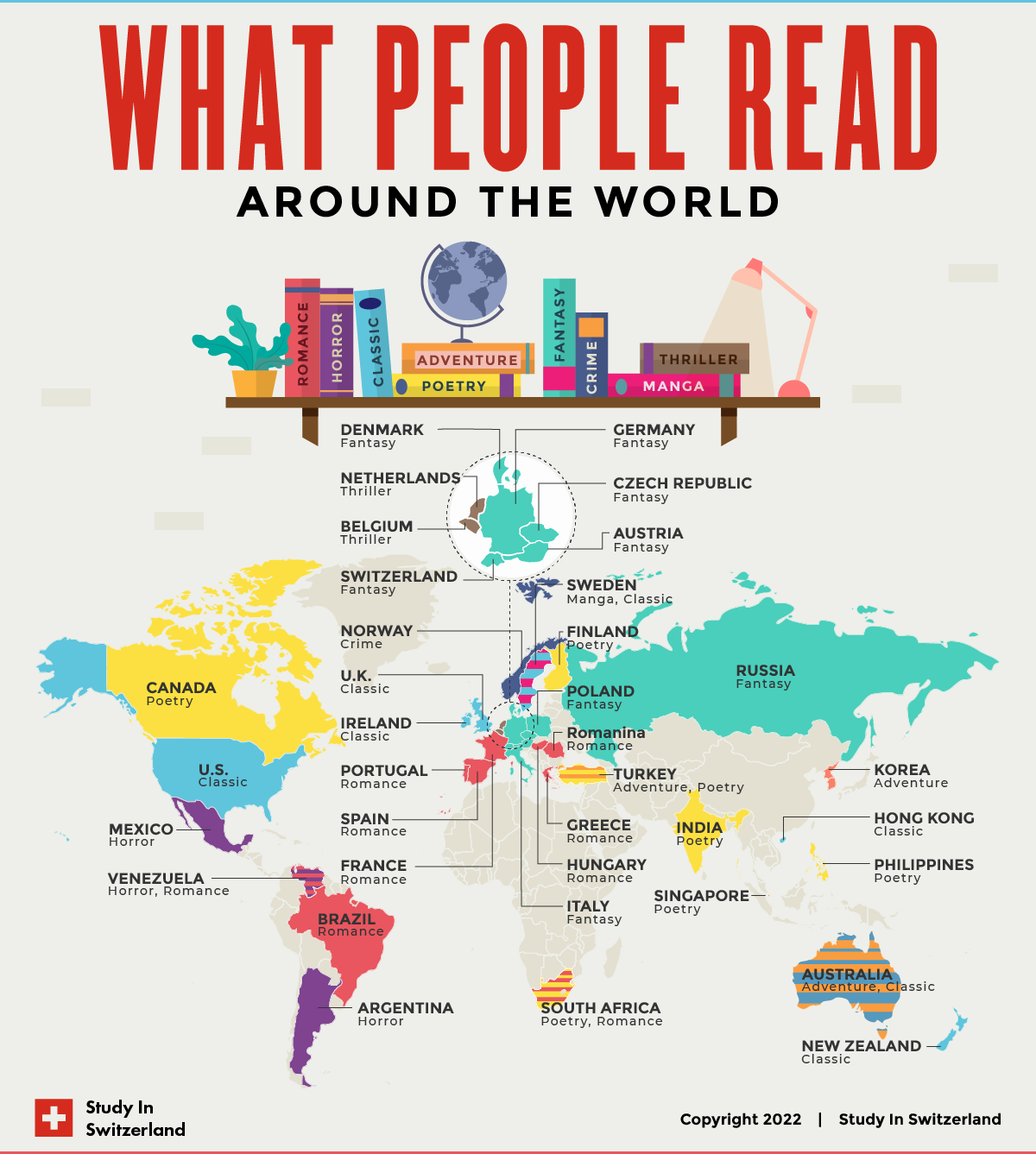
We are not the only country interested in Classics. This genre was also popular in Sweden, Hong Kong, USA, UK, Ireland and New Zealand.

Worldwide, they say, Romance, Classics and Poetry are the most searched for genres but, drilling down, there are some interesting preferences. Asians and Canadians, for example, had Poetry first, while overall Europeans (like the Russians, Poles and Finns) go for Fantasy, although some of them (like the French and Spanish) searched more or Romance! Not surprisingly, Belgians, the Dutch and the Norwegians seemed to prefer Crime and Thrillers.

Study in Switzerland makes some assumptions about the reasons for the various preferences they found. Those assumptions make some sense, but they are not based, I believe, on this research.

For their report, please check out this link.

Meanwhile …

There is other research to look at. Back in 2017, a survey conducted by the Australia Council and Macquarie University of Australians’ reading habits, found something closer to what I expected, which is that

The most popular fiction genre is crime/mystery/thriller, with 49% of Australians having read a book of that genre in the last 12 months … followed by historical fiction on 36%, contemporary/general fiction on 33%, science fiction/fantasy on 32%, and classics on 31%.

However, they also found that just over half (51%) of Australians were interested in “literary fiction”, which they described as fiction “eligible for prizes like the Man Booker and Miles Franklin”. They also found that it’s generally older readers who are most interested in this fiction. Interestingly, they found that these “older readers also tend to be more interested in work by Australian authors”.

I did report on this survey back in 2017, and posed some questions at the end. Some of these might have been answered by …

A report on bookselling published by ArtsHub in 2019 which confirmed Australians’ interest in “home-grown authors”. They found “a 30% jump in local authors featured in the top 25 fiction titles” over the previous two years. Further, bookseller and Book Club coordinator, Jennifer Stephens at Brisbane’s Avid Reader Bookshop, Brisbane, reported that “we are reading a lot of Australian women writers”. (Music to my ears, of course.)

Overall, this report, which drew on two years of Nielsen BookScan data, concluded:

Australian readers’ priorities and interests are evident: self-help and finance, a taste for home-grown writers, an eye for feminist writing, curiosity about sexuality and gender, a fascination with crime and mystery, and a deep need for First Nations perspectives.

I wonder if things have changed much since then, particularly given the pandemic? Either way, it’s interesting to ponder whether there is a significant difference between what we search for online and what we actually buy, or, whether, Study in Switzerland has identified a big swing in our interests over the pandemic?

Any thoughts?

Monday musings on Australian literature: Reading the reader (Survey)

Late last month, the Australia Council of the Arts released the results of a survey they conducted with Macquarie University. It is, the introduction to their final summary says, “the third stage of a major study of Australia’s changing book industry, by the Australian Research Council and Macquarie University.” The project, according to the Macquarie University website aimed to investigate:

  1. Authors and their responses to changing circumstances;
  2. Book publishers and the ways in which they contribute economic, social and cultural value; and
  3. Practices of contemporary book readers.

They say they are looking into extending the research into other parts of the “Australian book industry”. Today, I’m going to focus on the readers, which is the only part in which the Australia Council was apparently involved but, having discovered the whole project, I just might delve a little more into it in future posts.

The summary document’s subtitle is “A survey of Australian reading habits”. What ho! I wish they’d asked me!

So, who did they study?

There were three parts of the research:

  • A series of focus groups: with Year 8 students at Ryde Secondary College, and with different groups at Parramatta Library (both book clubs that meet at the library and the general public)
  • An online survey of Australians aged 14 years and over undertaken by Roy Morgan Research in October 2016. The final sample of 2,944 was, they say, “nationally representative in terms of age, gender, geographic location, income and ethnicity”.
  • A seminar with masters degree students at Macquarie University.
Their research found, overall, “a strong culture of books and reading in Australia”. It appears that “although developments in digital technology have radically changed many daily habits and pastimes, reading books is one of the nation’s favourite leisure activities, ahead of browsing the internet and watching television.” How fascinating. I’m a little surprised, but pleased. They did say their sample was nationally representative, but would an online survey of just under 3,000 people really catch a representative sample of all Australians? I admit to a little scepticism (is that fair?) but still, the findings are interesting.

Overall, they found that

Australians:
  • value and enjoy reading, and would like to do more of it. Apparently we spend more TIME “browsing the internet and watching television” but are more likely to rank reading books as our favourite leisure activity over these activities. The most common reason we read for pleasure is “to relax and release stress”. This probably explains what we most like to read – see a couple of points below!
  • mix up digital forms with more traditional ways of reading. The majority of us apparently still read print, but over half of us mix this with e-reading, and 12% use audiobooks.
  • read more books than book sales suggest, which is not surprising, I would have thought, given the use of libraries, lending between friends etc (and this is what they found). When we buy books, the major chains are our main source, followed by online bookstores, and then secondhand shops with independent local bookshops a close fourth.
  • like crime/ thrillers/mysteries best! I am fascinated, really, that these “relax” people, but I know this is so (and not just from the survey). The main reason I read is not “to relax and release stress”, and “thrillers and mysteries” are not my favourite reads, so I’m out of step here. You can probably guess the most popular non-fiction category? Yes, autobiography/biography/memoir. Interestingly, the survey found that “around half (51%) of all Australians (including those who are currently non-book readers) are interested in reading the types of books that may be eligible for literary prizes such as the Man Booker and the Miles Franklin and 45% enjoy literary classics. A similar number (48%) are interested in literary fiction by Australian writers past and present.” What they say, and what they do, though, seems a little different.
  • value Australian books and the Australian book industry. I’ll just quote the first paragraph here which is that “The majority of Australians (65%) like to read fiction by Australian authors and 59% like to read non-fiction by Australians. Readers aged 50 and over are the most likely to consciously choose Australian-authored books, while younger readers tend to like Australian books without thinking about the nationality of the author. There is a strong level of interest (42%) in books and writing about Indigenous Australia.”

The report goes on to provide breakdowns of the numbers, including these points regarding interest in reading Australian writers, Australian literary fiction and indigenous writers. There tended to be some gap, in these areas, in terms of people’s interest and what they are actually reading. The report also notes that the most frequent readers – and this is no surprise – are female, over 30 years old and tertiary-educated.

You can read all the detail at the report I’ve linked to above, and that report provides a link to the more academic data provided by Macquarie University. I didn’t go there, I’m afraid. Life is a bit too busy.

Playing with the data

I did, though, have a play with the fun interactive dashboard of the data, which enables users to interrogate the data a little via various parameters. For example:
  • 10% of all readers (all genders and ages) who use online sources to find out about books, use book blogs/bloggers. But if you change the parameters to Frequent Readers who are Female and aged 30-39, then 19% use book blogs/bloggers, while only 7% of Frequent Female Readers who are 60-69 do. Funnily (!), Occasional Male readers aged 14-19 seem not to have ever heard of book blogs/bloggers, whereas their Female counterparts have! Overall, book blogs/bloggers are fourth in terms of online sources of information after online booksellers, Facebook and GoodReads. Other sources include online literary journals, Instagram, Twitter and YouTube. It’s really interesting to see the difference here between different permutations of readers.
  • Regarding physical sources, only 5% of all readers (all genders and ages) obtain information from face-to-face bookclubs, but change that to Frequent Readers who are Female, and the percentage jumps to 10%. The most popular physical source is “word of mouth”, at 60% plus for most of the possible permutations.
  • 42% of All Australians (all genders and ages) agree that “books and writing about indigenous Australians are of interest to me“, but if you change the parameters to Frequent Readers who are Female and All ages, the percentage jumps to 56%. Further refine that to Female Frequent Readers who are 60-69 and it jumps a bit more to 60%. By contrast, the percentage for Male Frequent Readers in the same age group (60-69) is just 45%.

Help Books Clker.com

(Courtesy OCAL, via clker.com)

There’s a whole lot of fun to be had exploring the factors people consider when choosing books to read – such as topic/subject/setting/style, or liking the author, or reader reviews, or the cover. There are eighteen reasons, and they can be explored by the same permutations – Frequent, Occasional or All readers; Female/Male or All genders; and age breakdowns or All ages. Interestingly, in all the permutations I checked, Reader Reviews ranked higher than Professional Reviews. Hmm … how much of that is due to the dearth of professional reviews available these days. The top reason though, that people base their choice on what to read, is “topic, subject, setting or style”.

The interesting thing, now, is to see what, if anything, is done with this research. For example, if people are interested in reading Australian writers or indigenous writers, but don’t, why is that? Is it that there’s not enough specific promotion of these books in the places most people go to? Or?

Any comments?