This post was inspired by the Pulp Fiction exhibition* at the Canberra Museum and Art Gallery that ran from August to October this year. The exhibition used materials from two collectors, Graeme Flanagan (d. 2015) and James Doig, who also wrote the accompanying booklet. Doig says that Flanagan “amassed one of the most significant collections of Australian pulp fiction paperbacks”. He also collected original cover art, and in 1994 wrote Australian vintage paperback guide, which was apparently the first detailed book about Australian pulp fiction and is still an authority on the subject.
Most of you probably know what pulp fiction is, but if you don’t, it encompasses cheaply produced “mass market paperbacks and digests” in popular genres such as Westerns, crime, romance, adventure, science fiction and horror. Printed on “pulp” paper, they were not made to last and were poorly regarded by the literati of the time. But, of course, they were part of Australia’s reading culture and are now being recognised for the cultural objects they are. Because of their cheap production and disposability, however, they can be tricky to find – and, says, Doig, even Australia’s legal deposit libraries don’t hold complete collections.
Doig starts by referring to an article in the Tribune titled “I spent a week in a literary sewer” by journalist Rex Chiplin who wrote about the “muck” – “the pornography, sex, sadism, brutality and illiteracy” – being sold weekly on Australian newsstands. He wanted to find out where it all came from – but I wanted to find out who Rex Chiplin was. Well, I found out, via a blog called Ethical Martini, that he was a communist, which is not surprising because, as most Australians would know, the Tribune was the Communist Party of Australia’s newspaper.
Apparently Chiplin was called before Australia’s version of the USA’s McCarthy hearings, the Royal Commission on Espionage (1954-55), but the tidbit I want to share is Ethical Martini’s quoting another communist journalist, David McKnight, on Chiplin. McKnight wrote:
One unusual piece of exposure journalism was the pamphlet, “Facts Behind the Liquor Commission”, printed by the Communist Party of Australia at its underground printery which set out to expose capitalism in the shape of the ‘brewery barons’. Written by a journalist (probably Rex Chiplin) who had a racy turn of phrase (‘Bottled beer was as rare as a bankrupt Vice Squad sergeant’) the pamphlet incidentally exposed corruption in the labour movement…
It’s the “racy turn of phrase” that caught my attention, because it is certainly in evidence in the “sewer article” where he describes, for example, the directors of a magazine publishing company, American-Australasian, as “all North Shore pukka sahibs.” A little further on he describes a magazine called Action Detective Stories as “good wholesome literature for homicidal maniacs and similar unfortunates”. He criticises these “sewer” magazines’ forays into political commentary about the Korean War and Soviet behaviour in southeast Asia – but, I’m getting offtrack, so let me just share what he writes about Consolidated Press:
Consolidated Press, Frank Packer’s organisation … publishes a host of crime, sex and violence comics and the Phantom and Star paper-covered novels. Phantoms and Stars are direct reprints, lurid covers and all, of American gutter novelettes which are churned out by the score in “pulp factories.”
By reprinting they apparently circumvented import restrictions. Doig says that “Phantom Books … reprinted more than 300 of the best American crime novels between 1953 and 1961 and is a highly desirable series.”
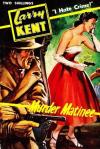 Another company named and shamed by Chiplin was Cleveland, which our mate Doig says is the only pulp publisher still active (in Australia) today – focusing these days on westerns. Cleveland was also known for the Larry Kent I hate crime series which “was named after a 1950s Sydney radio show [preserved at the National Film and Sound Archive] about a hard-boiled New York detective”. The radio series commenced in 1950, and its popularity inspired, says The Thrilling Detective website, Cleveland “to try their hand at some Larry Kent novels”. They were written by American expat Don Haring through “an arrangement” with the radio producer. The first series of these monthly novelettes commenced in April 1954.
The Thrilling Detective explains that:
over 400 Larry Kent novels and novelettes were pumped out under the Larry Kent byline in the next thirty years, and supposedly, as late as the 1990s, the series was still being produced in Scandinavia. The covers usually featured paintings of leggy, full-figured babes and sported such snappy (and often exclamation mark-endowed) titles as Kill Me a Little!, This Way, Sucker!, Cute Heat!, Dig Me a Dame! and Stand Up and Die! Add on the 150 or so radio shows, and our Larry turns out to be one of the hardest working eyes around…
If you, like me, ever give pulp fiction a thought, it is probably for these covers, “lurid” though Chiplin thought they were. As The Thrilling Detective says:
Although the books were decidedly hokey pulp affairs, and by no means great literature, the covers themselves have a gorgeously cheesy flavour, and are now quite collectible. In fact, most of the web sites featuring Kent deal as much with the covers than the contents of the books.

Illus. Frank Benier
Doig says that selling these books, which happened at stalls and newsagents on street corners and railway stations, was a competitive business. So “the cover was all important, the more colourful and garish the better.” He names some of the illustrators who did these covers – Stan Pitt and Walter Stackpoole (for Cleveland), and Col Cameron and cartoonist Frank Benier (for Horwitz). It is these covers as much as anything which now make these books highly sought after – and highly exhibitable!
Have you ever read any pulp fiction – or, even, are you a collector? I’d love to know.
* Images from the exhibition can be seen on Pinterest.
 Whispering Gums