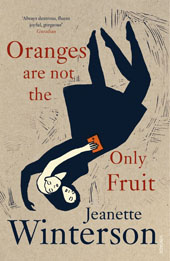
Book cover: Used by permission of the Random House Group Limited
As I was reading Jeanette Winterson’s novella Oranges are not the only fruit, the question, rightly or wrongly, that was uppermost in my mind was “What is it with the oranges?” Is there something about oranges that I don’t know? Something specific that they symbolise? I racked (wracked) my brain for something in my literary past that would give me a clue, but I came up with nothing. I guess she wanted to choose a motif to represent her mother’s limiting interactions with her and an orange seemed as good as anything? Certainly oranges are a recurring motif, and her mother regularly insists they are “the only fruit” until the end when a “pineapple” makes its appearance. I’m not sure, however, that this change heralds anything in their relationship other than compounding the paradoxes that seem to underpin this novel.
This is an intriguing book. It is a semi-autobiographical coming-of-age novel which tells the story of the first person protagonist, Jeanette, who was adopted by a religious zealot and is being brought up to be a missionary. However, around the age of 16 she discovers that her (homo)sexual leanings do not meet her mother’s (or her church’s) approval and, well, the plot is slim but perhaps I will leave it here nonetheless…
The novel exhibits some of the hallmarks of postmodernism, of which the most obvious is its metafictional elements, the way it contains stories within stories and plays around with the idea of stories in relation to “truth”. It all begins with Winterson naming the main character after herself and modeling that character’s life on much of her own, resulting in our being, from the start, teased by notions of what is “true” and “real”.
The book is divided into chapters titled appropriately, given Jeanette’s upbringing, by books of the Bible, such as Genesis, Joshua and Ruth. These titles are descriptive but also symbolic and even a little satirical; Jeanette, for example, has walls to confront just like Joshua. And the narrative, while roughly chronological, intermittently leaps from “reality” to “fantasy” as Jeanette tries to escape or make sense of her experience of life. Sometimes these stories – such as the Winnet story near the end – represent a parallel fantasy life for what is happening to her, but other times the reference point is more indirect, and draws on history and myth such as the King Arthur legend (and Sir Perceval’s search for the Holy Grail).
And this brings me to “story” and “history”. Readers of my blog will know that these notions, and the related one of “truth”, fascinate me when they are played out in fiction. I tend to enjoy reading books that deal self-consciously with them, that recognise the challenges and ambiguities inherent in them – and this is one of those books. Jeanette, the character, has some interesting things to say on these topics around the time the “truth” of her life, her sexuality, is becoming clear. She says in the short chapter titled Deuteronomy: The last book of the law:
Of course that is not the whole story , but that is the way with stories; we make them what we will. It’s a way of explaining the universe while leaving the universe unexplained … People like to separate storytelling which is not fact from history which is fact. They do this so they know what to believe and what not to believe. This is very curious …
And she goes on to discuss how history, the past, “can undergo change” because “the lens can be tinted, tilted, smashed”. She recognises that “perhaps the event had an unassailable truth” but we all see it through our own lens. Tellingly, near the end of the book, in the chapter titled Ruth, she runs into Melanie, her first lover (now married with a child):
…she [Melanie] laughed and said we probably saw what had happened differently anyhow … She laughed again and said that they way I saw it would make a good story, her version was just the history, the nothing-at-all facts.
Melanie, it seems, does not have the imagination to re-vision her “story”.
So, did I enjoy this book? Yes, pretty much. I like her attempt to make sense of what was a very particular childhood, and to try to draw from it some larger “truths” about how we might all manage the “stories” of our lives. It is not a straightforward read – and it is first novel with, perhaps, a little of the overdone in it. I’m not sure why, for example, she suddenly decides to include a little rant against Pol Pot. It usefully supports a point she is making about the uses of history, but it is odd in a story that is nowhere else political. Perhaps that’s just being post-modern!
In her introduction to my 1991 Vintage edition, Winterson claims to have written an experimental, anti-linear novel. Well, it is a bit of that I suppose, though not dramatically so. I would have called it reasonably linear – at least in the chronological sense – but perhaps the ideas in it do “spiral” (as she calls it) a bit in the way she toys, through the various narratives, with the idea of “story” and what it means to us. What it means, I think, is not always clear – we like stories but we cannot (perhaps need not) always draw conclusions from them. That is the paradox of our lives. As she says near the end
…not all dark places need light. I have to remember that.
Jeanette Winterson
Oranges are not the only fruit
London: Vintage, 1991 (orig. 1985)
171pp.
ISBN: 9780099935704



 Whispering Gums