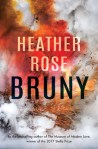
 If The yield (my review) was Tara June Winch’s passion project, I’d say Bruny is Heather Rose’s. It’s a very different book to her previous novel The museum of modern love (my review). Not only is it a strongly plot-driven novel, but it’s about something that is clearly dear to her heart, the future of Tasmania and, perhaps more generally, of liberal democracy.
Bruny could be described as a genre-bender. Part political thriller, part romance, verging even towards dystopian fiction, the novel tracks the fate of a bridge being built to join the main island of Tasmania with Bruny Island. In it, New York-based UN conflict resolution specialist, and twin sister of Tasmania’s premier, Astrid Coleman returns home at the behest of her twin brother to ensure that the bridge is completed on time after a bomb had nearly destroyed it. It’s not long, however, before she smells a rat. Just what that rat is, who’s behind it and why, is what keeps us turning the pages.
Now, as this is a plot-driven book – and one underpinned by political intrigue – I am fearful of giving too much away. However, fortunately, it’s not all plot, because the plot serves a purpose. The book reminds me in a way – though I’m not sure Rose will appreciate this – of Richard Flanagan’s The unknown terrorist (which I read long before blogging.) It too is a strongly plot-driven novel from a literary fiction author, and it too was inspired by a clearly passionate political concern. In Flanagan’s case it was how government and the media were handling the terrorism threat, engendering fear and consequently facilitating the scapegoating of people with little or no evidence.
Anyhow, back to Bruny. In the Bruny teaser on her website, Rose describes her book as a “political thriller”, “satire”, “love story”, and “family saga”, which, fundamentally, is questioning the “new world order”. Now, Rose has done something clever, I think, in setting her book just into the future. The American president isn’t named in the novel, but the description Rose provides leaves us in no doubt as to the timing of her novel, which would be around 2022. Astrid says:
‘Right now, America has an isolationist, neo-conservative president who doesn’t believe in American strength being used to stabilise the world. Quite the opposite. He considers it the chief weapon to exert dominance. And he’s in his second term. He’s turned his back on American’s allies because he doesn’t believe in that framework. Now we’re seeing the fallout of that approach and it’s crippling international relations, the global economy, the American economy.’
I say the dating is clever because, being just into the future, we can’t say “that didn’t happen”, but Rose can say “this is what might happen”. Readers, of course, have to decide for themselves whether they agree that what Rose proposes could happen, but I must say she was uncomfortably prescient about cruise ships!
It made the whole front page of the newspaper. BIO-SCANDAL! The whole fiasco of cruise ships and no policing, no ability to quarantine sick passengers and get medical help to them on board. The risk of an epidemic, if they were allowed into our hospitals.
So, what are Rose’s concerns? She is concerned that, with America withdrawing from the field, another power – in this case, China – can step in. She sets up a Macchiavellian plot based on this supposition, but this is as far as I’ll go about that. She is concerned more broadly about the increasing conservatism of governments, on their focus on money (“jobs and growth”) over people (“health and education”). She is worried that unimpeded progress – which is already a concern in Tasmania – will be detrimental to community, to society. She sees the destruction of the arts as weakening our culture and laying us open to outside influence. Government official Edward tells Astrid:
‘ … This government, at a state and a federal level, they’ve hammered the arts for years. They’ve eviscerated it … Every theatre company or film production company in this country – unless it’s making a Marvel movie – has been defunded. That’s our cultural expression, and if we don’t have that, it weakens everything. It’s a bit like leaching. We’re wilting with cultural anaemia…’
Ok, so now you might be thinking this is a preachy novel – as political novels can be – and it is to a degree. There are times when the explanations threaten to take over, but Rose manages not to bog it down too much. The story gradually builds up pace, with most of the messages carried through dialogue. Being told first person helps, too, because we don’t have an omniscient third person telling us like it is, but Astrid sharing her thoughts, concerns, and ponderings with us. Is there something, though, that she’s not telling us? How reliable is she? That little niggle also keeps us reading.
And then there are the characters. Astrid’s family is not exactly your typical one. Her endearing but stroke-affected father says little except to – rather perspicaciously – quote Shakespeare at his family; her prickly mother has terminal cancer; and her half-sister, Max, is the Labor leader of the opposition. Her brother, as I’ve already said, is the state premier, while his wife Stephanie has a warmth and intelligence that belies her supportive political wife demeanour. There is also a love interest for 54-year-old divorced Astrid down there on Bruny! The relationships between all these characters not only move the story and ideas on, but they also provide a little human respite from the machinations. Respite also comes from little touches of humour, much of it drawing from Rose’s deep understanding of Tasmania and Tasmanians. You have to laugh, for example, at the plethora of activist groups, like the Pythonesque Bruny Friends Group, Bruny in Action, and the Bruny Progress Society!
Concluding the above-mentioned Bruny teaser, Rose says “I hope you are entertained by this novel; I hope that you are intrigued by it; and I hope that it also makes you think?” She achieves all of this. The plot and the strongly delineated characters, as befits her satire, make it both intriguing and entertaining to read, while the politics certainly make you think. The Chinese government – together with neo-conservative governments – are the villains of the piece. This makes for uncomfortable reading, and not just because of the truth of the issue but because naming villains this way, as we know, can lead to wrong and dangerous assumptions. The Chinese government is not all Chinese people, just like a certain American president does not stand for all Americans. It behoves thinking readers to make that distinction.
And finally, there’s the ending. Without giving it away, I will say that there’s a certain question of the ends justifying the means, of those believing they are right taking matters into their own hands. It makes you think! Bruny, then, is more than an engaging political thriller. It is a book intended to challenge us to think about the world we are making for ourselves, and to consider what we can do about it.
Lisa (ANZLitLovers) enjoyed the novel; Bill (The Australian Legend) also enjoyed it, with some reservations.
 Heather Rose
Bruny
Crows Nest: Allen & Unwin, 2019
ISBN: 9781760875169
408pp.

 Whispering Gums