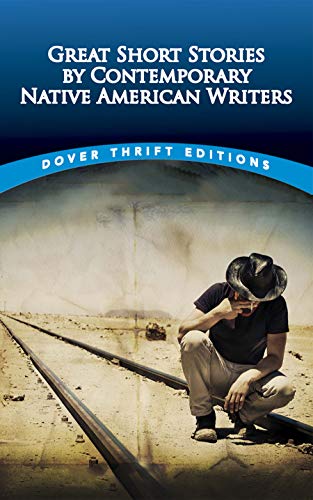
As some of you know, I have a close American friend, Carolyn, with whom I correspond weekly. We met in the early 1990s when I was living in California. During that time we started a reading group, so you won’t be surprised that our correspondence always includes reference to what we are – or are not – reading. What we recently realised is that we are not reading Native American literature. I was consequently thrilled to find Great short stories by contemporary Native American writers in my last Christmas parcel from her. I have now read the first three stories but today’s post is on the first one, “A red girl’s reasoning” by Pauline Johnson.
Pauline Johnson
The anthology’s editor, Bob Blaisdell, in his brief intro to the story, writes that Emily Pauline Johnson (1861-1913) was born on Six Nations Reserve near Brantford, Ontario. Her father, he says, was a Mohawk chief, and she was related to the American novelist, William Dean Howells, on her mother’s side. Wikipedia expands on this. It describes her as a Canadian poet, author, and performer. Regarding her parents, it says that “her father was a hereditary Mohawk chief of mixed ancestry and her mother was an English immigrant”.
Blaisdell says that Johnson started writing fiction after her father died to support the family, but Wikipedia again tells us more, focusing on her significance. It says that her poetry was published in Canada, the United States, and Great Britain, and that she was “among a generation of widely-read writers who began to define Canadian literature. She was a key figure … and has made an indelible mark on Indigenous women’s writing and performance as a whole”. Unfortunately, as so often happens, her literary reputation declined after her death, but, Wikipedia says, there has been renewed interest in her since the late 20th century.
If you are interested in her, do read the Wikipedia article because it’s reasonably thorough. Meanwhile, I will move on to …
“A red girl’s reasoning”
CanLit (where you can read the text online at the link below) says that “Red Girl’s Reasoning” was first published in Montreal’s Dominion Illustrated, in February 1893, and then, later that month, as “A Sweet Wild Flower” in Toronto’s Evening Star. Interestingly, CanLit’s online text, and the version in my anthology, both give it as “A red girl’s reasoning”. CanLit gives the author as E. Pauline Johnson. All details perhaps, but they do raise questions.
So, what’s our red girl’s reasoning? The story concerns the marriage between Christine, who is mixed-race (our ‘red girl”), and Charlie, a young white man. It starts with Christine’s white father counselling his “brand new son-in-law” to “Be pretty good to her, Charlie, my boy, or she’ll balk sure as shooting”. Charlie, as any new husband should, reassures him that of course he will, “there’s no danger of much else”. And all goes smoothly – for a while. She’s an asset to him … but, hold this thought because I want to digress to something else Pauline Johnson wrote, an essay titled “A strong race opinion: On the Indian girl in modern fiction”. It was published the year before this story, in 1892 (and is also available online).
In this essay, Johnson argues that people do not equate with their race, even though there are racial characteristics. “The American book heroine”, she writes, is allowed to be an individual. She does not have to have “American-coloured eyes” or an “American mode of dying”. She is allowed “an individuality ungoverned by nationalism”. This is not the case for “the Indian girl in modern fiction”. In an aside, she makes the point re “Indian”, that “there seems to be an impression amongst authors that such a thing as tribal distinction does not exist among the North American aborigines”. She continues:
The term “Indian” signifies about as much as the term “European,” but I cannot recall ever having read a story where the heroine was describes as “a European.” The Indian girl we meet in cold type, however, is rarely distressed by having to belong
to any tribe, or to reflect any band existing between the Mic Macs of Gaspé and the Kwaw-Kewlths of British Columbia…
She wrote this back in 1892 – how much has changed? Anyhow, her point is well-made. Johnson then details the stereotyping of “the Indian Girl” in fiction. She is always “Winona” or a name that ‘has a “Winona” sound to it’; she never has a surname; and her father is always a chief (like, in fact, Johnson’s father.) Further, this “Winona” is often suicidal, even though “suicide is an evil positively unknown among Indians”. She is always in love with “the young white hero”, and will betray her own people, but he “never marries her”. There’s more, but I think you’ve got the gist. (She does provide an exception, Charles Mair’s Tecumseh, in which the Indian Girl Iena “is the one book Indian Girl that has Indian life, Indian character, Indian beauty” – but, like her stereotyped sisters, she is not allowed to live.)
Needless to say, Johnson’s “red girl” does not have a Winona-sounding name and her white hero does marry her. Not only that, she stands up for herself when … but, I get ahead of myself. Before this, there is the wedding, which, Johnson writes, was not much, but fortunately groom Charlie didn’t mind:
in his heart he was deeply thankful to escape the flower-pelting, white gloves, rice-throwing, and ponderous stupidity of a breakfast, and indeed all the regulation gimcracks of the usual marriage celebrations …
This is significant to what follows, because the crisis, when it comes, is about Indian versus Canadian (western) marriage customs. Christine’s parents were married the “Indian” way, that is, there was a feast, but no other ritual. Charlie is aghast because he suddenly realises he has married someone “illegally born”! Her response – her “reasoning” – is that if he can’t accept that her parents are married by her mother’s customs, then she can’t accept that she and Charlie are married by his. And so the rift is wrought.
The story’s progression from here is fairly typical of nineteenth century short stories, but to say more would spoil the plot. I will say, though, that Christine does not die!
Blaisdell concludes his intro to the story that “while stagy” it “achieves some degree of pathos and delivers a strong comeuppance to Christian prejudices”. Yes, it is “stagy” (or, melodramatic, as I wrote in my margin) – but that’s fairly typical of its time. And it does deliver that comeuppance. But there is more to it. There is, for example, satire of white pretentious and superiority, a mockery of white storytelling even, in the way she uses the tropes of western rich man-poor girl stories:
She was “all the rage” that winter at the provincial capital. The men called her a “deuced fine little woman.” The ladies said she was “just the sweetest wildflower.” Whereas she was really but an ordinary, pale, dark girl who spoke slowly and with a strong accent, who danced fairly well, sang acceptably, and never stirred outside the door without her husband.
You can see the tongue firmly planted in Johnson’s cheek here.
Johnson’s story made a great opening to the anthology. It is somewhat dated in style and terminology, but its core concern, cultural clash, still holds true, and it is told with a light touch and a warmth towards its characters that engaged me.
Pauline Johnson
“A red girl’s reasoning” (1893)
in Bob Blaisdell (ed.), Great short stories by contemporary Native American writers
Garden City: Dover Publications, 2014
pp. 1-16
ISBN: 9780486490953
Available online at canlit
 Whispering Gums