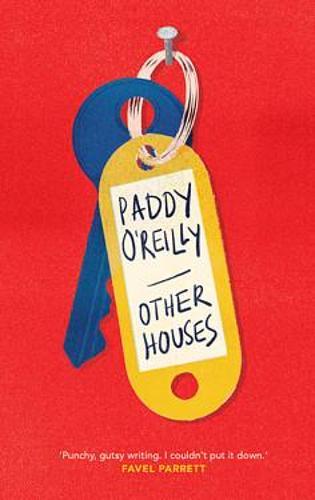
Paddy O’Reilly, Other houses (#BookReview)

It’s not totally coincidental that this week’s Monday Musings post was about a publisher of realist or social novels, that is, of novels which aim to explore social problems of their time. My reading group’s March book, Paddy O’Reilly’s Other houses, belongs to this tradition. I have been wanting to read it since it was published in 2022.

Searches of the Internet, including of Wikipedia, retrieve various definitions of the social novel (also called social problem or social protest or social justice novel), but they essentially agree that these are works of fiction which tackle some sort of inequality, prejudice, or injustice, through the experiences of their characters, and that their intention is to encourage social change. In Other houses, O’Reilly interrogates the idea of social mobility. Her protagonists, Lily and Janks, are “battlers“, working class people who struggle payday to payday, but they want more for their now 15-year-old daughter, Jewelee, who had started to run wild, heading down the path of delinquency.

“Good people live here” (Lily)

So, they move from their working class suburb to one they “could barely afford”, and enrol Jewelee in “a good school”. Jewelee might now behave as though she’s “too good” for her “bogan” parents, but they believe it was worth it. The problem is, Janks, now working in a food-factory, has mysteriously disappeared. The novel opens with Lily driving through her old neighbourhood at night, hoping to find Janks there. “Good people live here”, she says. “They try”.

From here the novel is told in the alternating first person voices of Lily and Janks, with Lily’s story occupying the greater part of the narrative. Having worked as a supermarket cashier in her old home, she is now a cleaner, which is where the title comes in. The novel is beautifully constructed around the cleaning jobs Lily does with her cleaning partner, the older, and wearing out, Shannon. While they clean houses, Lily reflects on her current and past lives, on the “entitled” Jewelee, on the lives and aspirations of the people they clean for, all the while worrying about Janks, and trying to find him. She prints “have you seen” leaflets and scours all the places he might possibly be. She does not believe he has deserted her willingly.

And, we know that he hasn’t. Having borrowed money from a bikie gang, he’d been “snatched” off the street, and coerced into paying off the loan by doing a job for them. The novel’s plot comes from this: will Janks get the job done, without being caught, and be allowed to return safely to the life they are building? Many of us in the group called this book a page-turner, but some disagreed. The plot is too straightforward, they said. It doesn’t have the breath-catching twists and turns of a thriller. Others of us, however, define page-turners differently. Ours don’t require an edge-of-the-seat plot. Rather, they are books that compel us on, because of the characters, or the writing, or the ideas, or the plot, or any combination of these. What do you think?

“Things, world, wrong” (Shannon)

Anyhow, there is a plot – whether you see it as a page-turning one or not – and there is also lightness, despite the seriousness of the protagonists’ plight. Much of the lightness comes from the house-cleaning scenes. Lily and Shannon name the houses they clean, such as the House of Hands (with its profusion of chrome dirtied by sticky hands), the House of Doom (whose owners see the world as “blighted”), Horror House (inhabited by a hoarder), and Lily’s favourite, the House of Light (which lets the sun shine in). They share their thoughts about the inhabitants and the lives they know (or think) they lead. If anyone knows how we live, it’s likely to be cleaners, eh? Lily’s and Shannon’s perspectives – their observations, opinions and reflections on how others live – are what gives this book its real heart.

Lily speaks with the dignity of a worker, when she says:

We know things no one else knows about our clients. I sometimes pick up objects in the places we clean – a vase, a notebook, a scarf … I give them attention, these things that I believe hold meaning for someone … It’s my moment of saying what I can’t say to their faces. I respect what you hold dear, even when you’re rude to me or barely acknowledge I exist. (p. 30)

Meanwhile, the older Shannon has her own mantra for how things are going, says Lily:

Something has gone wrong in the world … Shannon uses it about the eating habits for the population, the number of appliances in the kitchens we clean, leaf blowers, hair straighteners, so-called superfoods, weird weather events, toilets that wash your bottom, plastic wrapping on fruit that already has its own natural wrapping, quiz shows where she disagrees with the answers, tap water sold in plastic bottles and so much more. (p. 29)

Most definitions of the social novel say “through the experiences of their characters”, and this is true here. Telling her story through the experiences of Lily, Shannon and Janks enables O’Reilly to show what she wants to explore, without being didactic. Through these authentic characters we come to see just what the much-touted upward social mobility really is, means, and feels like. We see Lily and Janks recognising that the poverty faced daily in their old working class suburb results in lives that are lived on the edge with little opportunity to improve one’s chances, but we also see that it’s not easy to simply transplant yourselves into a different life and, essentially, culture:

Tonight my water-stained ceiling and the creeping draught taunt me that although we’ve adjusted to living here, it might be because we brought things with us when we crossed: rental damp and rot, clothes that fall apart, bank accounts that bounce between payday and zero. (p. 74)

For Lily, Broadie feels like “home” and it’s where she returns to find a solution to the problem of the missing Janks.

Other houses is a slim and accessible book, but it offers no simple answers. Rather than support the comfortable view that upward social mobility is the answer to the problems posed by socioeconomic inequity, it asks us to consider instead, how do we overcome the problems caused by inequity – indeed, how do we remove inequity – without expecting people to give up everything they hold dear about where they come from? It’s a quietly provocative novel that speaks to one of the most urgent issues of our time.

Paddy O’Reilly
Other houses
South Melbourne: Affirm Press, 2022
245pp.
ISBN: 9781922626950
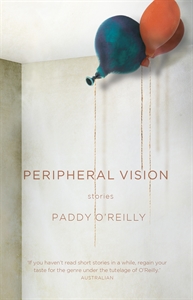
Paddy O’Reilly, Peripheral vision: Stories (Review)

Paddy O'Reilly, Peripheral vision Book cover

The title of Paddy O’Reilly’s latest collection of short stories, Peripheral vision, comes from the story “Restraints”, in which the narrator, standing in a robotics lab where things have gone awry, says:

… and I caught again a flicker in my peripheral vision.

It’s a good title for the book because the stories are about people or events that happen to the side of “ordinary” life, however we might frame that. (I don’t talk enough about titles in my reviews, but they are important.) O’Reilly’s characters vary greatly – in gender and age. Short story writers, I’ve noticed, pay little attention to the criticism novelists often face regarding the voice they write in, like, can a man write a woman, can an anglo-Australian write an indigenous or immigrant person, and so on. Short story writers frequently range far and wide in the voices they write in. As I was reading this collection, I found myself thinking about short story writers, and what writing short stories might mean to them. While some people see short stories as a training ground for the “real” thing, novels, the writers themselves, I suspect, see them as a form in which they can let their imaginations fly. They can try being anyone or anything, anywhere, and are less likely to be taken to task for it. Certainly, in Peripheral vision, O’Reilly’s characters range from a teenage schoolgirl to a homeless man, from a twenty-something brother to a ten-year-old step-daughter, from a Filipino man to a young Australian teacher in Japan.

There are 18 stories in this collection, of which 12 have been published before. I had in fact read two of them: “The salesman”, a powerful and confronting story that I reviewed here as an individual story, and “Serenity prayer”, which was published under the title “Reality TV” in Angela Meyer’s The great unknown (my review). Another story also underwent a title change, from “Friday nights” to “Territory”. Titles! Clearly important. Well, I presume these title changes are O’Reilly’s and that she thought the same story presented in a different collection would work better under a different title. “Reality TV”, for example, is a straightforward descriptive title, with a little hint of irony, for an anthology about inexplicable things. “Serenity prayer” is a more subtle title encouraging multiple readings, particularly if you consider the ways in which this prayer is, and has been, used. This story, about a publicly betrayed wife, gets you in, and then, at the end, makes you wonder.

Simplistically speaking, the stories can be divided into two types, plot-driven and character-driven. “Territory” is a fairly traditional plot-driven story about a group of six girls out on the town on a Friday night, but, there are clues that there’s something more going on. For one, there’s the way they dress:

That was the one thing you might question about us. Other girls who went out in a group looked more alike. Arty types with arty types; girls who knew how to pick up wearing the uniform of short hip-hugging skirt, skyscraper heels, mascara and lipstick … We were a mixed-up crowd …

Then there’s the reference to a seventh girl, Suze, and the suggestion that everything might be alright now she’s been accepted into medical studies. Gradually hint upon hint is dropped suggesting that these girls aren’t just out for a good time. A very effective story. “Serenity prayer”, mentioned above, is another with a strong plot line. “One good thing”, one of the longer but still nicely sustained stories, is about the friendship between two school girls, and a violent act that occurs during a holiday visit. Its resolution, as in most of the stories, is open, leaving us to consider the short and long-term ramifications of such acts. Each of these explores a core idea – but sharing that idea could spoil the plot, so I’ll leave it here.

I can though talk about the ideas underpinning the character-focused stories. “Caramels”, for example, is about a homeless man. The ideas underpinning it relate to pride and dignity. It has a story of course, describing his life, but in these character-focused stories, plot is not the driving force. “After the Goths” is about a young twenty-four-year-old man working through guilt about something that happened in his teens. It makes him behave meanly to his older brother but, in a nice touch, his brother doesn’t rise to the occasion. Not everything, O’Reilly knows, has to be high drama to be interesting.

Other stories are perhaps better described as slice-of-life. “Deja vu”, set in a small town in France known for its medicinal hot springs, is one. It’s about holiday relationships. There’s Anthony with unexplained concerns of his own, who meets an older couple and finds himself drawn into their company against his will, as can happen when you travel. And there’s the older couple, comprising a whining dissatisfied wife and a long-suffering husband. It’s, partly anyhow, about the accommodations you make. Martin “had never been able to speak rudely to anyone” and George, the husband, seems to do a good job of accommodating his wife. The language here is delicious. The whining wife’s “mouth held the shape of a drawstring purse”. A little later, “her lips grew tighter, as if someone had pulled the drawstring”.

There’s wry humour in some of the stories, like “Breaking up” and “The word”, and a couple of the stories, “Procession” and “Restraints”, tip, intriguingly, into the speculative genre. In all, though, O’Reilly presents humans facing challenging situations – some violent, some threatening or risky, and others confusing or unsettling. Whatever it is, she rarely fully resolves the tension, leaving it instead to the reader to think about the morality, the values, the accommodations at play. This can be disconcerting if you like closure. But I like it, not only because closure can be boring and, frankly, not realistic, but also because it means you can read the stories again and again, and come to a slightly different conclusion or, should I say, understanding, each time.

Peripheral vision is exciting to read. Each story is so different that I was driven on to the next one, wondering what I’d find there. What I invariably found was a new world with another challenge to my way of seeing. I wonder what her peripheral vision will pick up next.

awwchallenge2015

Paddy O’Reilly
Peripheral vision
St Lucia: UQP, 2015
200pp.
ISBN: 9780702253607

(Review copy supplied by UQP)

Paddy O’Reilly, The salesman (Review)

I’ve been wanting to read Paddy O’Reilly for the longest time but somehow haven’t managed to get to her so, as is my wont, I decided to read a short story of hers in the Griffith Review. She made her name, I think, with her short stories, but has also written novels/novellas and a screenplay, and is a regular contributor to Australia’s best literary magazines.

I know you wouldn’t expect this of me, but I’ve just told a lie – just a white one, your honour – because I have read a couple of articles by Paddy O’Reilly, and I did read her opening story in Scribe’s New Australian Stories 2, published in 2010. The story was titled “How to write a short story”. It’s a very short piece, just over a page, but it was my first, albeit very short, introduction to O’Reilly. The piece is presented as a recipe, with a list of steps, such as:

Test whether the story is done by inserting a reader. If the reader comes out clean, the story is done. If the reader comes out sticky, place the story back into the situation for another 500 words.

This story suggested to me that O’Reilly is not afraid to let women’s experience underpin her writing. But, this doesn’t mean that she wants her writing to be labelled “women’s fiction”. As she asks in her recent post for the Australian Women Writers Challenge 2012, what is women’s fiction? Writing for women? About women? By women? I’m inclined to agree with her that it’s not a useful distinction. What after all is “men’s fiction”? Categorising works as “women’s fiction” has the potential to (and in fact does already) marginalise, trivialise even, women writers and readers. So, like Paddy O’Reilly, I tend not to think in terms of “women’s fiction”. I do, however, and I’d argue this is quite different, like to focus on “women writers”.  Hence, here I am, reading (more) Paddy O’Reilly …

“The salesman” is set in a working class suburb of Melbourne where there’s 80% unemployment. It features a salesman (obviously), a young woman named Marly, and her boyfriend and his mate. The story opens with the young woman alone at home. It’s hot and life is clearly not much fun. Her boyfriend Shaun and his mate, Azza, spend their days working on cars, their heads “under the bonnet like stupid long-necked emus”. And, the fridge is “moaning”. Such language in the first paragraph makes it pretty clear that Marly is not a happy woman. In fact, we learn a little later on that she has lost part of a leg, creating an effective metaphor for a life that is missing something critical. Pran, the salesman, appears in the fourth paragraph. He’s a Hindu from Delhi but Marly, and later Shaun and Azza, persist in calling him a Paki.

Pran insists he’s not selling anything, but after Shaun and Azza return, we finally learn that what he is “selling” is a free offer! Shaun and Azza, as (stereotypically) men often do in these situations, lead Pran on while Marly is conflicted. Shaun is an “attentive” boyfriend. “She would not do better than this”, not better, she thinks, than a man “who had not once in eleven months raised a hand to her”. But, she’s attracted to Pran, to his “rich burnt-toffee” coloured skin and his “runny dark brown” eyes. It’s not just the physical though.  She senses through him, through her questions about his beliefs, that there could be more to life than hanging around waiting for the men to bring home beer and pizza. She does not want his visit to end in violence as, we are told, has happened before.

I’ll say no more about the plot. This is a story about the underside of modern Australia. It’s about poverty and deprivation and how these result in an arid, goal-less life in which there is little empathy for other. It’s about racism, about how, if you are the wrong colour, years of study can lead you to peddling “free offers” to people who can’t afford them. The ending is clever. While we are told the general outcome, we have to guess what really went down. What we do know, though, is that no-one ended up a winner. This is just the sort of story I like – it’s accessible, it has a clear vision with a tight focus, and it raises more questions than it answers. You can read it online at the link below.

Paddy O’Reilly
“The salesman”
Published in the Griffith Review, Edition 29, August 2010
Availability: Online at the Griffith Review