Red Dog (Movie and Book)

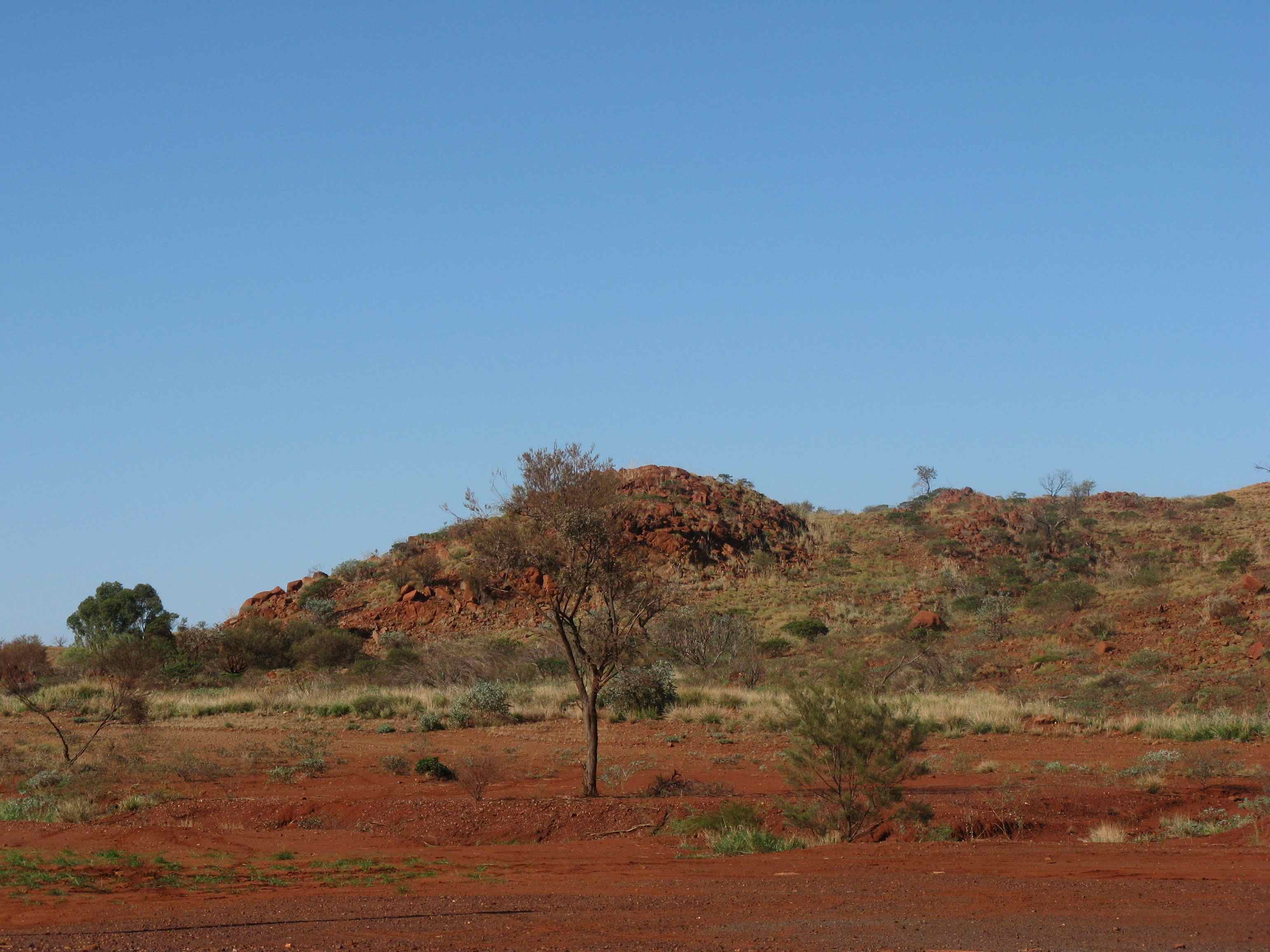
Pilbara landscape

Pilbara landscape

First, the disclaimer: I’m a dog person and am therefore a sucker for stories about dogs and their loyalty. I know, I know, it’s their nature, but that doesn’t stop me crying over doggie devotion stories. Red Dog is one of these! If dogs don’t move you, you may not want to see this film, but that would be a shame because while the dog – and it is based on a real dog – is the central idea, the film, and novel from which it draws, are about more than “just” a dog and his devotion to a master.

I first came across Red Dog – the (apparently famous) Pilbara Wanderer – several years ago through Louis de Bernières‘ novella (of sorts) which was first published in 2001. It’s a slim little tome and is based on stories de Bernières gathered about the dog, who lived from 1971 to 1979. De Bernières claims in his Author’s Note that the stories “are all based upon what really happened” to the dog but that he invented all of the characters, partly because he knew little about the people in Red Dog’s life and partly because he did not want to offend people by misrepresenting them. John though, he says, is “real”.

There is a simple plot in the book – it tells how Red Dog decides on John as his master and it then chronicles Red Dog’s various adventures in the mining communities of the Pilbara. The film follows de Bernières’ book pretty closely, though it takes a little artistic license, including adding a romance into the mix.

The story – and the film – is set in the Pilbara, the red earth country of Western Australia where mining is the main industry. It was – particularly back in the 1970s – a male dominated place and the workers at that time were mostly migrants:

It was lucky for him [Red Dog] that the town [Dampier] was so full of lonely men … They were either rootless or uprooted. They were from Poland, New Zealand, Italy, Ireland, Greece,  England, Yugoslavia and from other parts of Australia too. … Some were rough and some gentle, some were honest and some not. There were those who got rowdy and drunk, and picked fights, there were those who were quiet and sad,  and there were those who told jokes and could be happy anywhere at all. With no women to keep an eye on them, they easily turned into eccentrics.

And it is this* that the film, directed by Kriv Stenders, does so well … capturing men’s lives in a male dominated environment, against the backdrop of the starkly beautiful Pilbara. The cinematography is gorgeous, setting the region’s natural beauty against the ugliness (or beauty, depending on your point of view) of a mining environment. The music is what you’d expect, mostly 70s rock including, of course, Daddy Cool, but is appropriate rather than clichéd. And the dog is played by 6-year old Koko with aplomb!

The central story concerns John (Josh Lucas), Red Dog and Nancy (Rachael Taylor), but there are other smaller “stories” – the publican (Noah Taylor) and his wife, the Italian (Arthur Angel) who can’t stop talking about his beautiful home town, the brawny he-man (John Batchelor) who knits in secret, the miserly caravan park owners, to name just a few. Their stories are slightly exaggerated, and there is fairly frequent use of slightly low angle close-ups that give an almost, but not quite, cartoonish larger-than-life look to the scenes. These all work effectively to convey something rather authentic about character and place.

That said, occasionally the humour is too broad and the script a little clumsy – but these are minor. Overall, the film keeps moving at a pace that ensures it never gets bogged down in too much sentiment or romance or adventure or comedy. In other words, it’s not a perfect movie and yet it perfectly captures the resilient, egalitarian spirit of those people in that time. It’s a film I’d happily, if somewhat tearily, see again.

Louis de Bernières
Red dog
London: Vintage, 2002
119pp
ISBN: 9780099429043

*POSTSCRIPT: I quoted this passage from the book for a reason, and then got carried away on another point, but Kate’s comment below reminded me of what that reason was: it was of course to refer to Red Dog’s role in this male dominated environment. Not only does he symbolise the men’s independence and spirit of adventure that brought them to the Pilbara, but he also provides an outlet for their affection. Through this, he forges a community out of a bunch of individuals. As the publican says at the beginning of the film, it’s not so much what Red Dog did as who he was …

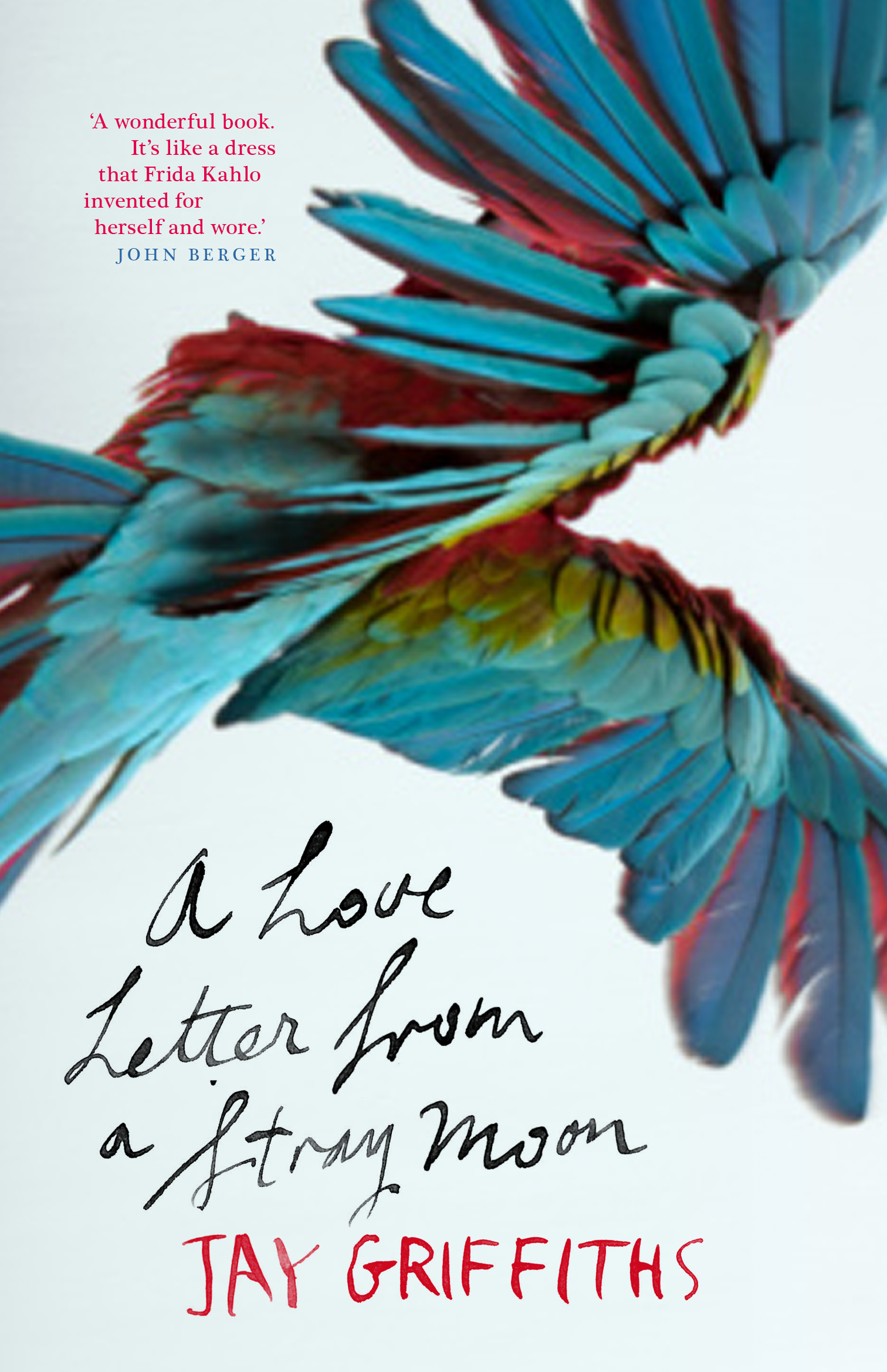
Jay Griffiths, A love letter from a stray moon

Jay Griffiths, A love letter from a stray moon cover

Book cover (Courtesy: Text Publishing)

I have always wanted wings. To fly where I belong, to become who I am, to speak my truths winged and moon-swayed.

I’m not sure I can do justice to this poetic, passionate novella by Jay Griffiths. Titled A love letter from a stray moon, it’s a first person outpouring in the voice of Mexican artist Frida Kahlo. I don’t use the term “outpouring” pejoratively, but rather to describe the full-on passion with which it is told. This is a book with confronts the senses with its power – the imagery is strong but beautiful, the story raw and honest (or so it seems to me.) It’s a book you want to describe as a “tour-de-force” but that would be too clichéd.

The opening lines of the novel quoted above introduce us to its two main metaphors – wings/flight and the moon. For Frida, flight equates with hope and with magic. The moon, though, is a far more complex image, and I’ll try to tease it out a bit as I go on. First though the story. This is biographical fiction (historical fiction?) in the form of a prose poem, told in the first person voice of Frida. The facts of Kahlo’s life are conveyed – such as the terrible accident when she was 18 which left her unable to bear children; her falling in love with, marriage to and divorce from Diego Rivera; her relationship with Trotsky; and even her death and cremation which requires some suspension of disbelief but that’s not hard to do given the novel’s style and tone. If you didn’t know much about Frida you could, I think, read this piece of fiction and feel you’ve got the basic facts, as well as a good understanding of the woman who “lived” those facts.

Woven through all this is the Mexican Revolution which started in 1910 (three years after she was born), discussions of the rise of Fascism, and her ideas on love, art and life (and particularly on how they interrelate). There are also, though this seems a bit anachronistic, some strong references to climate change. In fact, at the end of the novel, Griffiths dedicates her book to two groups of people, climate change activists and Zapatistas. Frida died in 1954. Was climate change an issue then? In the book Griffiths has Kahlo expressing concern about the Amazon and Tuvalu:

But the  Amazon will die of thirst, she will seize up with drought … One island nation, five atolls and four islands, pacific and named by doves, Tuvalu, is silently submerged as the quiet waters lap its shores, past the fishing boats, up its beaches, up, to the houses at the coastline, on, on, the gentle sea, the sea murmuring in quiet amazement at itself, on, until the centre where it can see itself coming, reflecting its rise, it meets itself in a full circle of embrace and Tuvalu will only be a story of mythic islands beneath the waves.

Let’s though get back to the moon. The motif is sustained throughout the novel. It’s appropriate of course for a woman, with its implications for women’s reproductive cycle, but Kahlo draws so much more from it than this single meaning. She layers meaning upon meaning for the moon, some of them superficially paradoxical but together they form a whole. Throughout the novel, for example, she opposes the ideas of gold, earth, sun and matter to silver, moon, and myth. The moon represents for her the mythical, the immaterial and creativity but it also connotes coldness and barrenness. I did say it was a complex symbol – but it’s fittingly s0 for a complex woman. In the first chapter, “Exiled from Casa Azul” she talks of wanting to fly to the moon, describing it as “pure idea” versus the sun which, more pragmatically, “lights the earth”. In the next (very short) chapter, “The moon’s instructions for loss”, she expands on her idea of the moon a little further:

And the moon? In the revolution of the earth’s turning – and I was a revolutionary – a shard of earth was flung off, coalescing, reforming further and later, far off as the moon. But shard is the wrong word, too hard and substantial; so immaterial was this moment, so unearthly the earth, so unanchored the moon, what word could be better? The moon was more like Idea, more like Metaphor, or Time, Flight, or Potential or Longing. A highly strung intensity of latency.

In the rest of the book, these ideas about the moon are explored, teased, stretched as far as they will go to convey the wild, free essence of her life. In her mind the moon is closely related to the idea of flight. She refers to Icarus (whose downfall of course was the sun), arguing that the important thing was not the fall but that he dared to fly.

In one of many references to flight she says:

… flight’s true reality was never in its being made material. What is real need not be material at all.

Given the challenges of her physical life (polio as a child and a leg amputation late in life in addition to her accident), it’s not surprising that Frida found significance in the life of the mind, the spirit and the soul.  “The mind needs myths, good ones”, she says.

And then there’s art. She was known for her self-portraits, in which she painted her passion and her pain. Her art was an extension of her “self”:

…so I make this as a votive painting, a prayer, a vow, a plea, painting to win him back to me…

Frida was a rebellious soul … whose passions were personal and political. Somehow Griffiths has managed to capture all this in a novel which could so easily have been over-the-top. It isn’t, because her Frida’s voice sounds authentic. Frida says, towards the end, ‘I would re-enchant myself with mankind, nothing less … I will promise to find the god of new beginnings.”

I have not done justice to this wonderful, complicated little book – but I hope I have conveyed something of its magic. After that, it’s up to you.

Jay Griffiths
A love letter from a stray moon
Melbourne: Text Publishing, 2011
117pp.

(Review copy supplied by Text Publishing)

Joyce Carol Oates, Beasts

Joyce Carol Oates @ The Belmont Library

Creative Commons licensed image by San Mateo County Library via Flickr

If we wanted to be writers we must examine the world with fresh, sceptical eyes.

Beasts is, I’m ashamed to say, my first Joyce Carol Oates. She’s one of those writers who has kept crossing my path but whom I’ve never quite got to read. I bought Beasts a couple of years ago when I saw it on the remainder table of my favourite independent bookshop – and still it took me some time to get to read it, but I’m glad I finally did. I didn’t really know what to expect – and I’m not quite sure what I got – but I nonetheless found it a compelling read that is staying with me.

Take the opening quote, for example. On the surface it makes perfect sense, and yet when we know who says it we see a whole different layer of meaning to it, a layer that doesn’t necessarily remove the fundamental truth but that certainly shows how such a truth can be twisted or, at least, complicated.

The plot concerns a young college student and her obsession with her poetry writing class teacher, Andre Harrow. The novel (novella, in fact) starts some 25 years after the main events of the novel, when our narrator is at the Louvre in Paris and sees a piece of sculpture that reminds her of the work of Harrow’s wife, Dorcas. The sculpture is an earthy totemic piece that is “primitively human” or, in fact, rather beast-like. In this short three page chapter we are introduced to the notion that something not quite right has happened. “It wasn’t burned after all”, the narrator says, and then soon after mentions the horrible deaths some quarter of a century earlier, of “two people I’d loved”. The final sentence of the chapter is:

This is not a confession. You will see, I have nothing to hide.

As soon as you see a statement like that you can be pretty sure you are in the hands of an unreliable narrator, and this is so here – though she’s cleverly disguised and could be taken to be reliable. It’s all a matter of perspective really! The novel is told first person, in flashback, so we do need to be aware that what she is saying may very well be coloured by her knowledge and experience, that what she says she was feeling at the time, may not be quite right. This adds to the complexity of the book. The structure, though, is pretty straightforward. There’s the first chapter in Paris in 2001, followed by a chapter, set in 1976, describing the night of the house fire (in which the two people died). The third chapter takes place four months before that. From this, the novel works chronologically forward again to the fire.

The novel has a smallish cast of characters – there’s the narrator (Gillian), Andre Harrow and Dorcas, and the girls of the poetry class. Gradually a complex picture is built up of surface friendships with secrecy and jealousy lying just beneath. The reason for this is that pretty well all the girls are obsessed with Andre and each it seems, in turn, have their way with him (or, should I say, vice versa). But here the plot thickens … though perhaps I’ll leave it there for you to discover for yourselves.

Let’s just say that this book is an unsettling exploration of the (sexual) games people play, games in which people can and do get badly hurt. It’s easy to see the young women as the victims – and I must say that to a large degree I think they are. Whenever there is a power imbalance (and this is why I disagree with Helen Garner‘s take in her non-fiction book, The first stone), I see the major wrong as being with those in power. However, that does not mean that the less powerful are not complicit in some way, because often they are, and this seems to be the case with Gillian. She says “I was not predator seeking prey, I was myself the prey. I was the innocent party”. But she has choices, and she makes them, knowing ….

I was in love now. I took strength from my love for Mr Harrow. Though knowing, for I was no fool, that it could never be reciprocated.

And yet, she of course, like the girls before her, lets herself be drawn into a situation that is both thrilling and destructive. Harrow is an aficionado of DH Lawrence – Lawrence was big on campuses in the 1970s as I recollect – and tells his students (with terrible irony) that:

Lawrence is the supreme poet of Eros. No recriminations, no reproaches, no guilt, no ‘morality’. For what’s ‘morality’ but a noose around the neck? A noose? What’s ‘morality’ but what other people want you to do, for their own selfish unstated purposes.

Hmm … this sounds a bit like the Nietzschean conundrum explored in The immoralist doesn’t it, but Oates plays it out in a very different way by exploring its implications across gender, age/experience and power differences to see what falls out.

The novel starts with an epigraph from a DH Lawrence poem:

I love you, rotten
Delicious rottenness

… wonderful are the hellish experiences

Wonderful for whom one may well ask? The ending – or is it the beginning – provides no definite answer but it sure teases out the complexity of “love” running rather amok amongst people who think little about the ramifications of their actions. Damage, as it usually does in such situations, ensues. What price morality, eh?

Joyce Carol Oates
Beasts
London: Orion, 2002
138pp.
ISBN: 0752855921

Leah Swann, Bearings

Bearings bookcover, by Leah Swan

Bookcover (Courtesy: Affirm Press)

When I read a collection of short stories, I look to see whether there is an overriding theme. It’s not essential that there be one, of course, but it can add to the satisfaction, if only because looking for a theme forces me to think a little more about what I’ve been reading. Well, I didn’t have to look too far with this most recent collection, as the title pretty well gives it away. Bearings, by Leah Swann, is a collection of seven short stories and a novella and, as the back cover blurb says, is about “challenging the course of our lives and keeping a foothold during unpredictable times”. That’s a pretty good description and, I must say, it’s appealing, for a change, to have a short story collection whose title is not that of one of the stories within.

Bearings is the fifth book in Affirm Press’s series, Long Story Shorts. (I reviewed the fourth one, Having cried wolf, a few months ago.) It’s a gorgeously produced series. The books are a little more squat than the usual paperback, and each has a cover designed by Dean Gorissen. They are books you want to hold (fondle even) and look at.

Anyhow, on with the show. This is a varied bunch of stories. Some are told in first person, some third, and the first story is told in the less common second person. The subject matter includes broken families, suicide, grief, foster children, and motherhood. That is, all those things that happen in people’s lives to challenge them. However, as the title suggests, the stories are not totally depressing. Sad at times, yes, but not hopeless. They are more about finding ways to survive the challenges.

The stories grew on me. It’s not that I didn’t like them from the start because I did, but I think the writing got surer and more interesting, less predictable, by the end. Whether, of course, they are presented in the order written I have no idea. Probably not, but that’s how it feels. Of the first few stories, I especially liked “All the mothers”, a first person story about a foster child. He starts off as a naive narrator, not quite understanding what is happening as he moves from “mother” to “mother”. Take, for example, Mr Gordon who sometimes gives him an Eskimo Pie “especially if I have a cuddle”. When Mrs Gordon catches him on Mr Gordon’s knee one day, she pulls him off but he’s mystified: “I keep saying I’m okay, but she doesn’t believe me. Or maybe she’s not listening”. Gradually, of course, he becomes less naive and, more angry. It’s a well realised, psychologically real, slice-of-life story.

The central novella, “Silver hands”, is a little predictable. You can see most of it coming before you get there, but it’s nonetheless a good read because the characters are engaging and the language is fresh. I enjoyed descriptions like this:

His laugh goes up and down the scale like a hammer on chimes.

And this one on a woman starting to see signs of aging:

My skin is drying like the pages of a manuscript lettered with childbirth, lovemaking, nicotine and alcohol, and under it all the bones are losing density. But the letters of my true being are not written here. I am not only my body. I’ve never believed that yet here I am mourning it, sucked into that great big lie, measuring myself by flesh more than ever.

This is (obviously) a first person story. The set up is a marriage in the process of breaking down, but it’s more about how experiences in our past can come back to bite us if we don’t properly address them at the time. There are some “mysteries” for the reader to uncover and Swann plots them nicely. An enjoyable read.

My very favourite stories though are the last two, “The Easter Hare” and “The Ringwood Madonna”. Many of Swann’s protagonists are artists – potters, musicians, painters, writers – and this is so in these two stories. “The Ringwood Madonna” is about an artist who is struggling with motherhood, about how she meets a homeless tagger and engages in her own little act of rebellion. She creates a Madonna poster which she pastes like graffiti on a railway cutting wall. It attracts a lot of attention but an art expert says that holy images should not be sprayed around town. However,

Her graffiti Mary was  – to her – a beautiful lamp in suburban ugliness. A gift. Subconsciously she’d hoped that by creating Mary she would create beauty inside herself, she could see that now. And she had felt warmth when she was creating. Yes. Even joy.

The story’s conclusion nicely resolves some of the conflicts in her life while also making a comment on art as being not only about expression but communication too.

“The Easter Hare” takes place over Easter (of course) and beautifully reflects on the Easter story of death and redemption through a loose parallel describing a suicide and the response of strangers to it. It’s a finely told tale, and its conclusion brought tears to my eyes.

Swann describes the mother in “The Easter Hare” as wanting to write an Easter story for her children that is not “bloody and harsh” like the Crucifixion story, as wanting, rather, to “create something gentler for them”. This seems also to be what Swann wanted to create for us. She chronicles the challenges, sufferings and miseries of life but, as her title suggests, her worldview is a positive one, one that believes we can all find our “bearings” if we just take the time to look for them. This collection would be a good place to start.

Leah Swann
Bearings
(Series: Long Story Shorts, 5)
Mulgrave: Affirm Press, 2011
198pp.
ISBN: 9780980790429

(Review copy supplied by Affirm Press)

André Gide, The immoralist (or, L’immoraliste)

André Gide: pencil drawing

Gide, c. 1901, Pencil drawing by Henry Bataille (Presumed Public Domain, via Wikipedia

Reading synchronicities strike again – though on the surface it wouldn’t seem to be so. That is, could there really be synchronicities between Geoff Dyer‘s Jeff in Venice, death in Varanasi and Andre Gide‘s The immoralist? I think there are. Besides some comments on art – its value and meaning – in The immoralist, there is the grappling with what seems to me to be the paradoxes inherent in explorations of how to live our lives. In Dyer, as I wrote in my recent post, the paradoxes are front and centre. You can’t miss them. In Gide, they are there too, but tend to be more subtle.

The immoralist was published in 1902 and was at the time, I believe, seen as a rather shocking tale of dereliction. Over a century later, we are not so easily shocked by the behaviour he describes, but the book still has things to say. Gide writes in his preface:

If certain distinguished persons have refused to see this drama as anything other than the folding of a particular, unusual case, and its hero as anything other than an individual with an illness, they have failed to see that there are important ideas of interest to many to be found in it.

In other words, he claims some level of universality for his tale.

The first thing to note about the novel is that it has three parts – at least, from the second edition on when Gide included his preface. There’s:

  • the preface in which Gide, as I’ve explained above, argues that Michel’s “problem” exists regardless of whether or not he resolves it;
  • the letter in which one of Michel’s friends seeks a job for Michel to, in effect, save him from himself; and
  • Michel’s story, as told to his three friends.

And so what is Michel’s story? Well, it’s about an unworldly young scholar who marries a young woman, Marceline, whom he barely knows, at the request of his dying father. After their marriage, which they do not consummate for some time, he becomes ill with tuberculosis and nearly dies. As he starts to recover in beautiful Biskra to which they have travelled, he starts to see life in a new way – inspired partly by a young Arab boy, Bachir, introduced to him by his wife:

I thought of Bachir’s beautiful, glistening blood … And, suddenly I felt a wish, a desire, more pressing and imperious than anything I have ever felt before, to live. I want to live!

So, gradually, begins his life as an “immoralist”. This does not exactly mean that he lived an “immoral” life, though that he did to some degree, but that he rejected being bound by morality, by society’s rules and restrictions. Gide was influenced by the philosophies of Nietzsche, which in the novel are promulgated, somewhat extremely, by an older friend, Ménalque. For Michel, they mean, for example, learning to “feel” – and to eventually putting sensation (body) totally ahead of thinking (the mind):

The only way I could pay attention to anything was through my five senses …

From this time on, he tries out his new ideas and starts leading a self-centred life, ignoring his friends and his wife more and more to follow a life of freedom to do what he will. He wants to live a life that is individual, not imitative of others. He loses interest in the lessons of the past (which had once been his passion) because, as Ménalque says, the past (particularly through memory) “encroaches” on and thereby spoils the present:

Now I could only derive pleasure from history by imagining it in the present. I was much less inspired by great political events than by the new emotions stirred by the poets or certain men of action…

What he discovers, though, is that freedom does not, in fact, free him (or, make him happy). Paradox, n’est-ce pas?

I’m not going to detail the full story of his “decline”, his forays into low-living, his “repudiation of all culture, decency and morality”, the tragedies he experiences in his personal life, but he eventually arrives at the point where he calls his friends to hear his story, and help him. He says to them at the end of his story:

The thing that scares me, I have to admit, is that I am still quite young. I sometimes feel as if my real life has yet to begin. Take me away from here and give me a reason to live. I no longer have one. Maybe I have liberated myself. But so what? I find this empty liberty painful to bear.

This is a complex little book, and I’m not sure I’ve fully grasped its import. Does it, for example, reject Nietzschean ideas or simply the misapplication of them? Does the Michel at the end still believe in himself as the “perfectible being” he did earlier in the novel? Are we meant to see his as a cautionary tale, and if so, what particular lessons should we draw from it? Anyone?

Andre Gide
The immoralist
(trans. by David Watson)
London: Penguin Books, 2000
124pp
ISBN: 9780141182995

Geoff Dyer, Jeff in Venice, death in Varanasi

Geoff Dyer, Jeff in Venice, death in Varanasi

Bookcover (Courtesy: Text Publishing)

What, a few moments earlier, had seemed such a persuasive notion – that ridiculousness might be the animating principle of life –  seemed, in the face of this more pedestrian idea of progress, abruptly … ridiculous. No sooner had I thought this, than I’d suddenly had enough of walking. (“Death in Varanasi”)

Hmm … what has the “idea of progress” got to do with “the animating principle of life”? Geoff Dyer‘s Jeff in Venice, death in Varanasi, which comprises two loosely connected novellas, is full of non-sequiturs, paradoxes and other confusions – so much so that I’m not quite sure what to make of it, but perhaps by the end of this review, I will!

I wanted to read it because I’d been hearing about it around the traps, and had seen it recommended several times on people’s reading lists. There is, it seems, a vague autobiographical element to this book: Dyer has been to the Venice Biennale and to Varanasi, and he has written journalistic pieces as have the two (or is it one?) narrators the book. But, he went to both with his wife, not as a single man, and he is Geoff not Jeff. Methinks there is some teasing/playing with us going on here!

The first tease relates to the form. Are the two novellas connected by character? Is the third person Jeff in “Geoff in Venice” the same as the first person narrator in “Death in Varanasi”? And there are teases in the subject matter, but let’s talk plot first, such as there is. “Jeff in Venice” describes Jeff’s few days at the Venice Biennale, and particularly his falling in love (or is it lust) with the lovely Laura. There is quite a bit of explicit sex in the story: in other words, the so-called “little death” is well covered. This first story is about art, life and love – and yet encompasses, paradoxically, the idea of “death”. In “Death in Varanasi”, the main character, a freelance journalist who could very well be Jeff, goes to Varanasi for a few days to write a commissioned piece, but decides to stay. One of the first things he does in Varanasi is go to see the cremations by the Ganges. Death is all around, and yet, paradoxically, this is where many westerners turn up to find “enlightenment”, that is, to find the meaning of life. The narrator, himself, gradually drops all vestiges of his former self until, near the end, he has shaven his head and wears a dhoti.

So what is the background premise to these stories? As far as I can tell it is something to do with being in one’s mid-forties and starting to wonder what it’s all about. Jeff Atman, “stuffed with pastry, tense with coffee”, decides to dye his hair because:

For a long time he’d thought of grey hair as a symptom, a synonym of inner dreariness, and had accepted it as inevitable – but that was about to change.

There are a lot of sly little jokes and word-games in the book. When Jeff’s newly dyed hair is about to be revealed, he calls it “the moment of untruth” which, in a sense it is, though it is also his new truth. It’s all a matter of perspective isn’t it? (After all, the hairdresser had quoted Plath – a hairdresser quoting Plath impresses Jeff –  at him by saying “We do [dye] it so it looks real”.) And so the new real Jeff goes to the Venice Biennale, a place characterised as much by “party-anxiety and invite-envy” as it is by exciting new art to discover. This first story is about hedonism, about booze, drugs and sex. It’s a common story in literature – a certain dissipation that follows disillusion, and leads to … well, it seems to me, back to disillusion. See, it’s a tricky  book!

I enjoyed the satirical descriptions of the Biennale, of the art world and, particularly, of the more sycophantic adherents. But, I couldn’t quite believe the relationship with Laura – it felt more like male fantasy than real. Perhaps that’s how it was supposed to come across.

In the second story of the book, the tone becomes a little more meditative, lower key. I expected to meet the beautiful Laura again. After all, she told Jeff in the first story that she planned to go to Varanasi to be a hedge fund manager (of all things!). But, we don’t meet her and, if there’s a reference to her (and I think there is), it’s very obscure and does suggest we are dealing with Jeff again. “Death in Varanasi” starts with:

The thing about destiny is that it can so nearly not happen and, even when it does, rarely looks like what it is.

What happens is that the narrator’s brief stay turns into something longer term. It’s not so much that he makes a definite decision to stay as that he doesn’t decide to leave: “there was nothing to go home for”.

As I said at the beginning, this is a book full of teases and paradoxes. The narrator in Varanasi “invents” the God Ganoona who “is all that which is not anything else. But it’s also that which is everything else”. In a similar vein he talks of being desire-free:

… for the idea of desirelessness to take root, to set off in that direction, to try to free yourself of desire, surely that must manifest itself as a desire, a yearning, an urge. How then does desire transcend itself?

This book demands some mental gymnastics – not hard ones, necessarily, but ones asking you to keep on going without pondering too long or thinking each one is the answer. In a discussion about the book on The First Tuesday Book Club, English author Philip Hensher says that in all his books Geoff Dyer “seems to reinvent the genre, to make the reader think twice about what it is he’s reading … the book is constantly retreating from you” so you have to make up your own mind. And that, in my best Dyeresque way, is where I’ll leave you … it’s worth a look, even if at the end you are not quite sure what you saw!

Geoff Dyer
Jeff in Venice, death in Varanasi
Melbourne: Text Publishing, 2009
296pp.
ISBN: 9781921656897

(Review copy courtesy Text Publishing)

Alan Bennett, The uncommon reader

Light with bite is how I would describe Alan Bennett‘s delightful novella The uncommon reader. But, before I explain that further, a quick plot summary for those few who haven’t come across it. It explores what happens when Queen Elizabeth II stumbles across a mobile library on the palace grounds and becomes obsessed with books and reading. Bennett cheekily suggests what the impact might be on her family, staff and the politicians around her when reading becomes not only something she wants to do all the time (instead of her work) but also results in her starting to think and question.

One of the delightful things about the novel is that it can be read on several levels from the straight (a sweet story about the current English Queen discovering the thrill of reading late in her life) through the contemplative (a meditation on readers, reading and the value of literature) to the satirical (an expose of life in the palace, and more broadly of politics and those involved in the political process).

Take for example, reading. The Queen (in the book) says that: “Books are not about passing the time. They’re about other lives. Other worlds.” Fair enough, we all agree with that I’d say. But then there’s this, again from our newly enlightened reading Queen: “Books generally just confirm you in what you have, perhaps unwittingly, decided to do already. You go to a book to have your convictions corroborated. A book as it were closes the book.” Hmmm…Bennett’s Queen is one clever (and scary) lady!

Jokes at the expense of palace officials, politics and politicians abound. Nothing really new here but they are proffered with a light touch. The Queen, now talking about writing her own book, says “To enquire into the evidence for something on which you have already decided is the unacknowledged premise of every public enquiry, surely?” on which the Prime Minister thinks to himself “If this was to be the tone of what the Queen was planning to write there was no telling what she was going to say. ‘I think you would do better just to tell your story, ma’am'”.

This is no sentimental tale, but neither is it completely cynical (though some could see it that way). Sly is perhaps the best word to describe its ability to engage us with the humanity of the characters while skewering them and their (our) world at the same time. However, I won’t go on, except to say that the ironies, word play and allusions evident in the title give a clue to what is inside – and yet it can be read and enjoyed whether or not you pick up all, some or none of them. I’m sure I missed my share. But that’s okay, as I would be more than happy to read it again.

Alan Bennett
The uncommon reader
London: Faber and Faber, 2007
124pp
ISBN: 9781846680496

Note: I originally posted this on my reading group’s site but, since one of my online groups will be discussing this in the next quarter, I decided to post it over here too as a record of my current reading and discussions.

The long and short of it, novelistically speaking

The novella has ambivalence built into its DNA. It’s neither one thing nor the other and tends to make you think even as it lures you down blind alleys and serves up irresolute endings.

(The Daily Beast)

Readers of this blog know that I am partial to short novels, particularly novellas. I always feel a little self-conscious saying this. I worry. Does it make me sound

  • Lazy, as in I can’t be bothered to read a long book? Or,
  • Impatient, as in I want to rack up my book reading stats and long books slow that down?

And to be honest, maybe there is a little bit of truth in these.

Big Fat Book

A long book requires a long commitment. Reading any literature requires attention and if you don’t have the concentrated time to give to a long book, you risk “losing the plot”, figuratively and literally speaking. In other words, if you read it in too many short spurts over too long a period of time, it can be hard keeping it all in your head. In the same time-frame you could very well have read two, three, four  or even six novellas (if, say, you were reading Vikram Seth‘s A suitable boy). You would have experienced a number of different perspectives on the world rather than just one – and you probably would have been challenged multiply by the often elliptical nature of the short novel. And this brings me to why I really like short novels …

I like, as the Daily Beast quote above says, being made to think while being lured down blind alleys and served up irresolute endings. Of course, the modern long novel can do that too … But with a short novel you tend to get tight prose. There are no wasted words. There are no long digressions – or multiple storylines …

What, no digressions? This is where the Big Fat Book comes in. When I wrote my post on novellas nearly a year ago, I said I’d write a post on long novels – and finally I am getting around to it, because, despite my general preference for short novels, I have read and enjoyed long ones*. First, here are some that I’ve read and enjoyed in the last decade:

Not a lot of them, eh, but memorable every one. And the reason is, I think, that you live with long novels. A short novel can engage your emotions, of course, but it is, I think, a more intellectual engagement in which our feelings are continually monitored by our brains: what are we feeling and why? A long novel is different. You become part of its life; the characters become “real” in a way that they rarely do in a short novel and you feel their loss when the book ends. This makes the reading experience very different. The brain is engaged, of course, but the emotions take the upper hand.

In fact, generalising wildly, I see the reading experience as going a bit like this:

  • In the short novel, with its tight prose and often minimal plot, your brain works hard to understand what is happening, where it is going, what it is all about, and then is suddenly confronted with an emotional kick at the end.
  • In the long novel, with its multiple story-lines and often frequent digressions, your emotions become engaged as you live the characters’ lives with them, love, cry, hate, worry with them, and then, when it’s all over, your brain comes in to work out what it was all about.
Detail from photographic portrait of Charles D...
Dickens, who wrote short and long novels (Image: Presumed Public Domain, via Wikipedia)

I say this relatively not absolutely, because of course we engage both emotion and intellect in all our (fiction) reading. However, it seems to encapsulate, for me at least, the mechanics behind my rather different responses to reading a short versus a long novel. Does this make any sense?

Anyhow, I’d better finish here and get back to my current, long and rather engaging, novel, Peter Carey‘s Parrot and Olivier in America. Review coming just as soon as I manage to finish it …

* A NOTE ON DEFINITIONS: Leaving aside those specific terms of “novellas” and “big fat books”, my rule of thumb definition is that short novels are under 300 pages, and long novels over 500 pages. The rest are, well, just novels.

Monday musings on Australian literature: In praise of the “taker-outers”

Today’s Monday musings post is not solely about Australian literature but it was inspired by an Australian writer, Kate Jennings, about whom I’ve written a few times in the last month or so. In 2002 she wrote an essay titled “Bone and sinew”, for our now defunct Bulletin magazine, in which she praises short novels (or, novellas*). Tony of Tony’s Bookworld likes novellas, and so do I.

Anyhow, Jennings starts her essay with a statement that F. Scott Fitzgerald apparently made to Thomas Wolfe. He said:

You’re a putter-in, and I’m a taker-outer.

It seems that Wolfe believed a novelist couldn’t be taken seriously until, to use Jennings words, “he or she had produced something that could hold up a three-legged sofa”. Jennings likes Scott Fitzgerald’s description and goes on to say:

Putters-in and takers-out – as good a way as any to classify novelists. Putters-in: writers who pile on atmosphere, adjectives ad arguments, who share with readers all their thoughts, and research, who follow storylines like a dog on the loose. Takers-out: writers who fiddle with each comma and finesse every word, who know exactly what Samuel Johnson meant when he said that when you think you’ve written a particularly fine passage, strike it out.

Jennings admits to her bias – after all, she says, she’s written a couple of short novels herself – but says she does also enjoy  the likes of George Eliot, Christina Stead, Patrick White and Rohinton Mistry. Her point is that their novels are not “superior because of their length” and that short novels should not be perceived as “slight” simply because they are “slim”. There are many short novels with proven staying power (such as The great Gatsby, Joseph Conrad’s The heart of darkness and George Orwell‘s Animal farm) and yet, she says, publishers, recognising that readers and reviewers are prejudiced against shortness, “often ask writers to pad out short novels with stories. The term ‘novella’ is now pejorative: a marketing kiss of death”.

Well, it isn’t for me. Jennings quotes David Mamet on elegance in writing. He asked “how much can one remove and still have the composition be intelligible”. I like this way of describing it. Taker-outers, I believe, trust their readers, viewers and listeners (because this also works for theatre, film and music) to get it. They don’t believe they have to explain every detail. Kate Jennings certainly doesn’t in Snake. She presents a series of little vignettes and expects her readers to “get” the whole picture – and we do, only too vividly!

Kate Grenville with her cello

The versatile Kate Grenville (Courtesy: Peter Ellis via Wikipedia using CC-BY-SA 3.0)

Fortunately for me, many of my favourite Australian writers (hmm … is this a “chicken or the egg” situation?) have written short novels (as well as, for some, longer novels). I have listed some before and so here will add some others, mostly lesser known, that have impressed me:

  • Thea Astley’s Coda
  • Kate Grenville’s Dreamhouse
  • David Malouf’s Ransom
  • Eva Sallis’ The city of sealions
  • Tim Winton’s In the winter dark

Jennings writes “That short novels can be tough, specific and encompassing can come as a surprise to readers. Sinew and bone …”. Really, though, it’s a matter of what you read for. If your preference is to escape into fat and flesh, then short novels may not be for you, but if you like chewier fare, then a good short novel will rarely disappoint.

* I think novellas are generally defined as those under 150 pages, but I tend to include in my personal definition books that are up to 200 pages (or so).

Kate Jennings, Snake

Murrumbidgee River

Murrumbidgee River in the Riverina (Courtesy: Mattinbgn, via Wikipedia, using CC-BY-SA 3.0)

In her “fragmented autobiography”, Trouble, Kate Jennings used excerpts from her first novel, Snake, to convey her childhood experience of growing up on a farm in the Riverina region of New South Wales. She had, she wrote, an “unhappy mother, diffident father”. Snake is the story of such a mother and father. While the novel is not totally “true” to her life in the factual sense, I have read enough novels and memoirs (such as Jill Ker Conway‘s The road from Coorain) about rural Australian life to know that it is “true” to the sort of experience it describes.

The blurbs on the back of my edition include the following descriptions: “a string of prose poems” (Times Literary Supplement) and a “domestic dystopia” (Sydney Morning Herald). The novel – novella in fact – is intriguingly structured. It has 4 parts. Parts 1 and 4 are short bookends, told in second person: the first part is addressed to the father and the last to the mother. The middle two parts are told in the more traditional third person voice and chronicle the life of the family: Rex the ironically named father, Irene the mother, and Girlie and Boy, the children who are caught in the middle. The chapters are short, some being only a paragraph or two long, and present vignettes of the family’s life rather than a simple this-then-that chronology. Dystopian is, unfortunately, an accurate description of their life. As Daphne, Irene’s sister, guesses on the wedding day,

Rex was a nice enough chap but about as interesting as a month of rainy Sundays. Irene will be bored with him before they arrive at the Blue Mountains guesthouse for their honeymoon.

While we never hear from Daphne again, she was not wrong. Rex is a “good man”, “decent”, a farmer of simple needs, while Irene, as her father realises, “dances to a tune no one else hears”. Not a likely recipe for success.

I thoroughly enjoyed this novel. Despite its unusual mix of voice and rather episodic form, it has a strong narrative that drives us on to its inevitable (but no spoiler here) conclusion. The snake motif runs through the book. Snakes are a fact of rural Australian life and so are a natural, real presence in the book, but their symbolic allusion to temptation, deceit and danger lurks behind every reference. Early in the novel, we are told of Irene’s youthful romantic tendencies – her love of

… smoky-voiced singers and innuendo-laced lyrics. Tommy Dorsey and Benny Goodman, Frank Sinatra and Peggy Lee, they were the snake charmers and Irene the snake.

Later, Girlie looks at snakes in a book on Australian fauna: they are “fanged, flickering, unblinking”.

Kate Jennings is a poet – as well as novelist and essayist – and it shows. The language is accessible but full of imagery. This is particularly apparent in the chapter titles, most of which are obvious in meaning, though some are more cryptic: “Home is the first and final poem”, “Send my roots rain” and “My mother has grown to an enormous height”. They are fun to think about as you read. There are some beautifully apposite descriptions. Here for example is Rex experiencing misgivings about his new wife:

The sight of her caused his nature – practical, honourable – to assert itself … What was done was done. Without being conscious of it, he coughed importantly – I am a man, I have a wife – and squirmed inside the jacket of his uniform until it sat better on his shoulders.

And here is Girlie reading:

Girlie read books like a caterpillar eating its way through the leaves on a tree.

Their town is, ironically, called Progress. However, very little “progress” occurs in the book. Rex struggles to keep the farm going in the face of mice and locust plagues, hail and dust storms. Irene tries to make a life that suits her romantic, imaginative spirit – she creates a garden, seeks friendships with interesting people, looks for work – but in the end nothing works:

Rex and Irene had given up arguing. He no longer bothered to tell her that he wasn’t asking much – harvest his crops, care for his animals, share it all with a good woman, tra-la – and Irene didn’t reply that far from not asking much, he was asking everything.

Such is the life of a mismatched couple. We’ve read of such couples before, and we will again, but for a clear-eyed, finely balanced, while also touching, portrayal, this one by Kate Jennings is hard to beat.

Kate Jennings
Snake
Sydney: Picador, 2003 (first pub. 1996)
153pp.
ISBN: 9780330364003