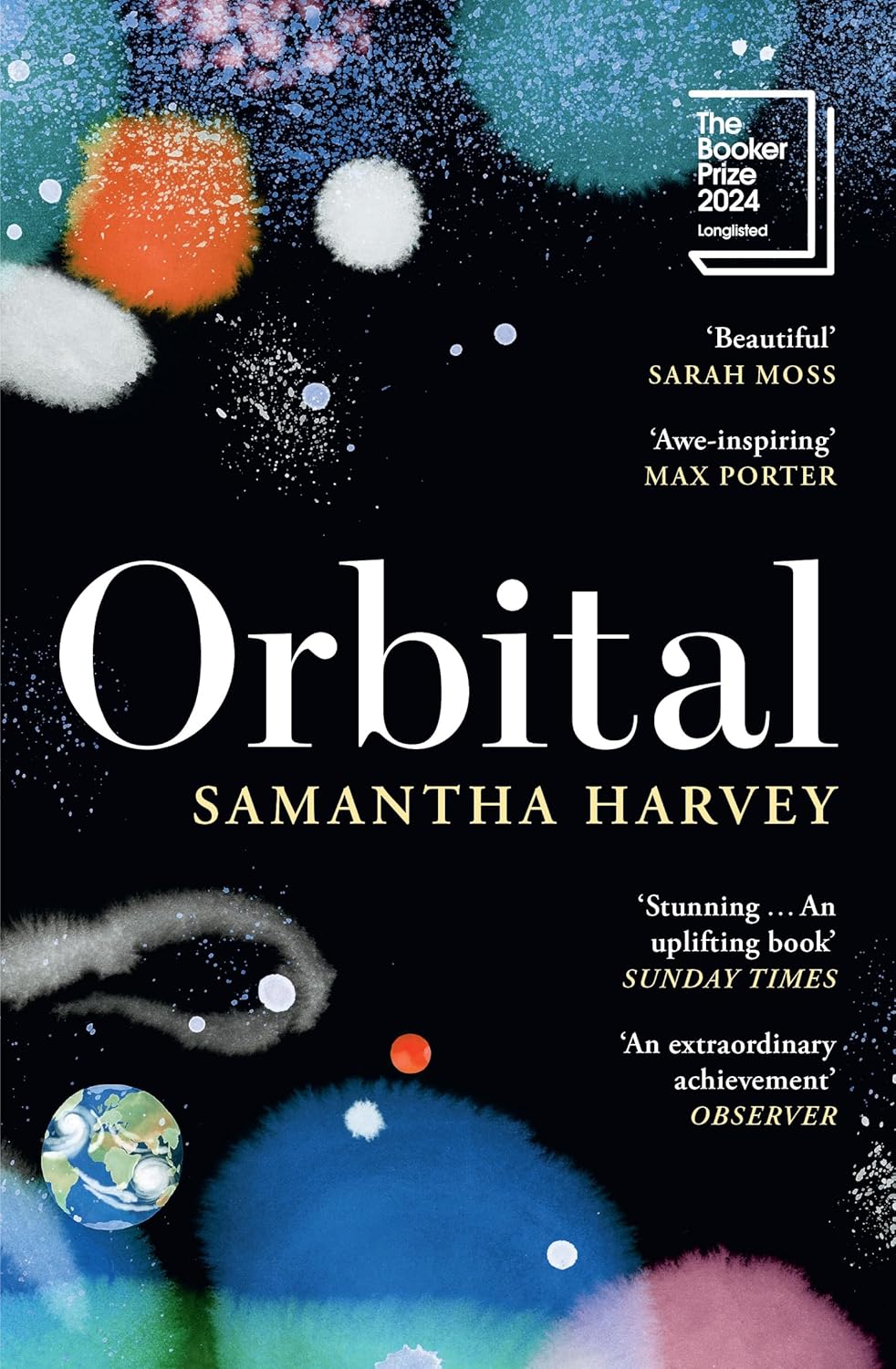
Samantha Harvey’s Booker Prize-winning novella, Orbital, is one of those novels you want to keep by your side after you’ve finished it, hoping that its calm beauty and quiet provocations will stay with you just that little bit longer. And here, in this opening sentence, I am channelling the “you” voice that she slips into occasionally but so effectively throughout her novel.
I am late to this book but I have wanted to read it for a long time, so was thrilled when my reading group scheduled it for February. I had avoided reading about it – sorry all you bloggers out there – but had heard enough to know it was different, that it didn’t have a strong narrative but involved a few astronauts orbiting the earth in a spacecraft. I wanted to come at this difference with a clear mind, ready to see what I thought, uninfluenced by the opinions of others. This is my usual modus operandi, but for “different” books, I find it especially beneficial.
Now, when my reading group meets, the first thing we do, before we start the to-and-fro of discussion, is briefly share our first impressions. Mine were that it is a beautiful book about earth and a deep book about humankind, and that I loved how Harvey balanced multiple paradoxes – science versus wonder, human inventiveness versus our rapaciousness, the beauty of the planet versus its exploitation. I also commented that it is another book that pushes what a novel is. It is not one thing or another, but combines many things – nature writing or eco-literature, philosophical treatise, literary realist novel, the one-day-novel, and more, all without a strong narrative arc or major character development, though there is a story and there are characters.
So, where to start? I’d like to start halfway in with Orbit 7, but I should explain that the novel is told chronologically over a 24-hour period during which the craft (based on the International Space Station) orbits the earth 16 times. Each chapter is named for an orbit, or part of an orbit, as in “Orbit 7” or “Orbit 3, descending”. We start with “Orbit minus 1” which sets the scene. It is early Tuesday morning in early October, and there are six astronauts on board, “nothing unusual about this anymore, routine astronauts in earth’s backyard”. Routine perhaps, but the chapter ends by telling us that they will return to earth “full of stories and rapture and longing” albeit “their bones a little less dense, their limbs a little thinner”. Immediately, this sets up the push-pull nature of this remarkable book.
Over the next 6 orbits we are introduced to the six astronauts/cosmonauts – Roman and Anton (Russians), Nell (English), Chie (Japanese), Shaun (American), Pietro (Italian) – and to some of the “events” that loosely frame the novel, a typhoon building over the Philippines, Chie’s mother’s death, and the launch of the first lunar expedition in decades. We are also introduced to life on board the spaceship, to something about the astronauts’ personalities and their roles on board, and to how microgravity affects the body. And, through Harvey’s glorious prose, we feel the magic and awe of being in space and see the gorgeousness of the earth:
this thing of such miraculous and bizarre loveliness … An unbounded place, a suspended jewel so shockingly bright (“Orbit 7).
This thing, with sights like the auroras,
the flexing, morphing green and red of the auroras which snake around the inside of the atmosphere fretful and magnificent like something trapped (Orbit 4, ascending).
But …
“humanity doesn’t know when to stop”
This is a novel that accommodates paradox. Alongside beauty and wonder, we are early introduced to other thoughts and perspectives. In the second chapter, “Orbit 1, ascending”, the idea of perspective is introduced through a postcard Shaun has depicting Velázquez’s “Las Meninas“, a painting which poses more questions than it answers about who is looking, who is being looked at, what is the subject, is there a subject, what is real and what is not. (This is one of a few images referenced in the novel that stimulate questions about perspective, that encourage us to see things from different angles.) By “Orbit 4, ascending”, this question has developed into a recognition that their view is “half-mast”, that we are not at the centre of it all. The thinking is existential:
we grow out of the royalty of childhood into supreme normality; we find out about our own unspecialness and in a flash of innocence we feel quite glad – if we’re not special then we might not be alone … And so, in loneliness and curiosity and hope humanity looks outwards.
By “Orbit 5, descending” through to “Orbit 7″, we are around halfway through the novel, and Harvey moves us on to thinking about the other side of the equation, which is not how humans feel but what we do. The push-pull tension between wonder and destruction, between the potential power of curiosity and the more negative “force of human want”, comes to the fore. Chie’s mother, who was born because her mother survived Nagasaki, tells her daughter “be afraid my child at what humans can do; you must never forget the price humanity pays for its moments of glory, because humanity doesn’t know when to stop …” (Orbit 5, ascending).
Then, two chapters later in “Orbit 7” comes this:
One day they look at the earth and they see the truth. If only politics were a pantomime … Instead they come to see that it’s not a pantomime, or it’s not just that. It’s a force so great that it has shaped every single thing on the surface of the earth that they had thought from here so human-proof.
… Every retreating or retreated or disintegrated glacier, every granite shoulder of every mountain laid newly bare by snow that has never before melted, every scorched and blazing forest or bush, every shrinking ice sheet, every burning oil spill . . .
The hand of politics is so visible from their vantage point that they don’t know how they could have missed it at first.
And there we have it, “the hand of politics”,”the amazing force of human want” that has “sculpted and shaped” every part of the planet. From this point on, the paradoxes – or tensions – that we had been subtly led to become more overt, but this is not a depressing novel. The book’s power and beauty lie in Harvey’s ability to inspire us with earth’s beauty while also posing, through her outsider-insider astronauts, our most pressing question: how do (or can) we harness the positive power of human wonder and curiosity without also embodying the negatives.
Ultimately, while not denying the underlying challenges, Orbital reads as a hymn to our “wild and lilting world”. We, like Harvey’s astronauts, see the news and have lived our lives – but, this does not make our hope naive (to paraphrase “Orbit 7”). Lovely.
Kimbofo and Brona have also reviewed this book.
Samantha Harvey
Orbital
Vintage, 2024 Original. pub. 2023)
136pp.
ISBN: 9781529922936






 Whispering Gums