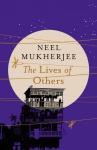
Neel Mukherjee’s The lives of others, and those epilogues

MukherjeeLivesOthersChattoWhen my reading group discussed The lives of others questions were raised about the meaning of the two epilogues, specifically in terms of what they contributed to the meaning of the book. Not having finished the book in time, I wasn’t able to join in, so I’m having a go now.

As I mentioned in my review, the two epilogues are dated much later than the main action of the book, the first occuring in 1986, and the second in 2012. Let’s start with 1986 …

Epilogue 1

It’s about Sona, the youngest grandson in the house and the son of the youngest, and most ill-treated, daughter-in-law Purba. At the end of the novel, before the epilogue, we learn that his mathematical skills have resulted in his being offered a scholarship to go to America. He’s 15. In 1986, he is 30, and a Professor of Pure Mathematics at Stanford University – and he has won a special Mathematics Prize. What has this to do with the novel?

Tricky. At one level, it shows that the lowest in the family hierarchy did manage to get away and “make good”. It’s lovely seeing poor Purba, even before they left, suddenly being recognised and appreciated by the family. But, it’s how they got away that is also significant, which is through skill, ability and education. Education is one of the novel’s themes. Early, daughter Chhaya sees a niece (another grand-daughter in the family) displaying signs of immodesty and defiance:

This is what happens when one has an uneducated mother, Chhaya thinks …

Then again, the rather unpleasant Chhaya is unmarried. Some say that

being a graduate, having a BA degree, had harmed Chhaya’s chances of finding a husband.

Even given that Chhaya is not the most sympathetic character, the message seems to be that for women education is a complicated issue – at that time, in that society. For men, though, it is a way out. For Sona (our Professor), education was critical to escaping a controlling family. For Sona’s grandfather, Prafullanath, however, education was unnecessary to his achievement, and he doesn’t see its value. His oldest son Adi though does, as does second son Priyo, who wishes he’d been born into a different family, one comprising “fierce reformers; progressive, educated people”. Go down another generation, to Sona’s that is, and we find Prafullanath’s oldest grandson and Adi’s son, Supratik. He is, in today’s parlance, radicalised at university to the point that he becomes a Naxalite.

I could go on, but for me it’s clear that a major point of Epilogue 1 has to do with education, and with the fact that with education you can escape.

But, what about maths? Why maths in particular? Is this significant? I think it is, and it deserves further study. For example, here is Supratik near the end, when he is under arrest and being confronted by his surely hypocritical decisions and actions:

The calculation at that time, he remembers, had been strictly mathematical – if one have-not had to be sacrificed so that fifty have-nots could be benefited, nothing trivial such as emotions could stand in the way.

I’ll leave you with that thought! Maths, like education, itself, or almost any idea in the book, has no intrinsic value. It is how it is used that is important. In other words, as I said in my review, Mukherjee doesn’t seem to want to give answers, but to show different ways of being. I think I know what he thinks, just by the fact that he has told this story, but he certainly doesn’t ram it down our throats.

Epilogue 2

This Epilogue is dark. It describes a terrorist act that will result in mass murder, and it is conducted by new revolutionaries, revolutionaries who see Supratik as a hero, a martyr to their cause. Their technique is his:

The trick is more than forty years old, she has been told during her training. Someone had come from Chhattisgarh to show them the ropes, and he had mentioned that according to local Maoist lore it was a Bengali invention, the work of a man known as Pratik-da in the late Sixties in some district bordering West Bengal and Bihar.  […] his gift to his future comrades survived and, for those who cared to or were old enough to remember, he lived on in his bequest …

Our young Maoist revolutionary knows what she is fighting for:

The tribal people knew what fate awaited them outside their land – daily wage-labourer in the city, maidservant in someone’s home, prostitute.

And she’s pragmatic about the implications of her role:

They would all die one day – and it will come a lot sooner in their lives than in others’ – but it was better to die fighting, like a cornered wildcat, than crushed underfoot like an unseen worm.

But what is Mukherjee saying? That it’s ok to continue to calculate, to sacrifice the lives of others for some better future?

I’m not sure, but going back a few chapter to when Supratik is under arrest, he thinks

The questions of feelings and principles and inhuman betrayal that he has had to wrestle with surge back, this time without the soul-destroying arithmetic to balance them out: did he . . . did he go down that route because of reasons of class, because a servant stealing is so much more credible, so much more natural, than a member of the family? Was it to make the theft believable to the police that he had framed Madan-da, or was it because it had cost less to betray a servant than one’s own kind? The questions are so unbearable …

And so now, I think, I understand the novel a little more. The questions are, indeed, unbearable … and the basic one is: when are the answers absolute and when do they require calculation, that soul-destroying arithmetic? The risk is, I suspect Mukherjee is saying, that when we apply that arithmetic we are more likely to sacrifice the lives of others than those of our own.

Neel Mukherjee, The lives of others (Review)

MukherjeeLivesOthersChattoBefore I talk about Neel Mukherjee’s Booker Prize short-listed The lives of others, I want to briefly mention the experience of reading it on the Kindle. I probably haven’t told you my little reading rule of thumb before, which is that I aim to buy Australian books in print, and overseas books electronically. It’s my measured foray into downsizing!

However, I don’t greatly enjoy reading on my Kindle. I like the Kindle itself. It handles pretty much like a book, the e-ink technology is easy on the eye, it’s light and portable, and with this particular author whose vocabulary is impressive, I did find the in-built dictionary to be very useful. But, I don’t find reading books in e-formats particularly pleasurable. It’s not easy to get the measure of a book, to flick through it and see what’s what. Consequently, I didn’t discover the family tree until I’d read the first couple of chapters. Now, if you’ve read this book, you will know that the three generations of the Ghosh family who live in a four-storey house are introduced in one chapter. Their names are unfamiliar to a westerner’s ears making it hard to remember who’s who, so that family tree was a godsend. But, I only found it when a a reading group friend mentioned its existence. The diagram’s small print was, though, very hard to read, and could not be enlarged like e-text can, so I hand-drew a family tree, photographed it, and shared it with my group. Then there were the many specifically Indian words that were not in the dictionary. They were in the glossary at the back, but it’s tedious flipping between glossary and text in an e-book environment, so I didn’t. How hard would it have been to hyper-link those words to the glossary?

“the very quicksands of family” (Suranjan)

Rant over, let’s talk about the book! The lives of others is set in West Bengal from 1966 to 1970, with two epilogues set much later, one in 1986 and the other in 2012. It centres on the aforementioned Ghoshes, a well-to-do family whose wealth comes from paper mills. By the time the novel opens, business is starting to fail, so there is tension in the air, exacerbating the rivalries, envies and secrecies which characterise the family’s relationships. That’s the personal, but this book is also political, because one of the characters, a grandson of the old couple, becomes a revolutionary with the Naxalites, a section of the Communist Party of India (Marxist) (or, CPI-M). In 1967, they commenced radical action to redistribute land to landless farmers and labourers. The book’s chronology mirrors the early years of this movement.

Indeed, the book is chronologically structured, with each chapter labelled by date. The first thirteen of its nineteen chapters comprise two sections – a third person story about the family in the Calcutta house, and a first person epistolary story (presented in a different font – unless your e-book was on an iPad, but that’s another story) by Supratik, the revolutionary grandson who is in the countryside “where the real politics lay”. This first person story finishes in chapter 14, when Supratik returns to Calcutta. The effect of this structure is to parallel manipulative behaviour and power plays in the family with the societal/political power imbalances against which Supratik fights. Just before he leaves the family, Supratik says to his mother, Sandhya:

Are you happy with the inequalities of our family? Of the power-on-top-ruling-people-below kind of hierarchy? Do you think it’s right? Has the thought ever crossed your mind that the family is the primary unit of exploitation?

This structure is just one example of how carefully the book is crafted. There are also allusions – and I’m sure there are many that I didn’t get – to literary classics. Chapter 4’s opening line that “not all family bonds are equal” must surely allude to the opening of Anna Karenina, which is also both about family and land/farm reform. And there’s a scene reminiscent of Sense and sensibility. In it the Ghosh patriarch, Prafullanath, is done out of the inheritance his father wanted him to have by a half-brother, who is spurred on by his wife. This reminded me of Fanny Dashwood talking husband John out of properly helping his stepmother and half-sisters, despite his dying father asking him to do. One of the themes of Sense and sensibility is economic power and inequality, and how families can wield power.

“this unvarying calculus about the worth of one’s own kind measured against the lives of others ” (Supratik)

Mukherjee, however, takes these themes to another level. The lives of others is a powerful and often brutal book. The prologue, which tells of a murder-suicide enacted by a poor sharecropper after consistently receiving no help from his landlord for his starving family, establishes the two main themes – economic inequity, and the inhumane treatment of “others”. These themes are played out in the way various members of the family treat each other, their workers and those with whom they come into contact, and are paralleled in the farm politics which engage Supratik’s passion. While the themes can be simply stated, the story-telling is sophisticated. Complex links and parallels, together with concrete and abstract motifs, evocative images and targeted allusions underpin the novel’s layers to expose human capacity for cruelty, self-preservation and self-deception. In a devastating conclusion, Mukherjee shows what happens when idealism loses sight of the humanity it is trying to protect, when calculation over-rides empathy. He offers no answers, makes no judgements, but simply shows.

The result is tough, and sometimes very uncomfortable, reading, but what drove me on was Mukherjee’s language. It is truly delicious. The imagery is accessible, often referencing the very ordinary, but it is so fresh that it takes its mark perfectly, again and again:

… if you fail an exam, it decreases the chances of getting out of the system that will slowly crush you to a flat piece of cardboard

AND

Two things with the power to scrunch Prafullanath’s plans into a shapeless paper bag had not occurred to his myopic mind.

AND

His voice has the serrations of a knife in it.

Cardboard, paperbags and knives. All so mundane but, in Mukherjee’s hands, so on the money. Here’s one more, describing one of the daughters-in-law:

Haranguing the servants at last gave Purnima a point of convergence for all her diffuse days and energies to focus on, and she took to it like a spindly, undernourished sapling to rich loam.

Mukherjee’s ability to capture people and place with such vividness and clarity is impressive. It’s not a perfect book, being weighed down at times by detail that, interesting though it is, doesn’t always seem essential.

However, Mukherjee’s compassionate but unsentimental understanding of human nature, combined with his clear-eyed analysis of how the personal interacts with the political, reveal uncomfortable truths about our dealings with other, and make him, unlike Supratik, a more trustworthy “defence counsel for humanity”.

Neel Mukherjee
The lives of others
London: Chatto & Windus, 2014
ISBN (e-pub): 9781448192182