Monday musings on Australian literature: Asian Australian writers

Brian Castro

Brian Castro (Public Domain, via Wikipedia)

Australia is an immigrant country, with the first immigrants, the original Aboriginal Australians, believed to have arrived 40-60,000 (there are arguments about this!) years ago via the Indonesian archipelago. They established what is now regarded as one of the longest surviving cultures on earth. Today, though, I’m going to write on some of our more recent immigrants – those from Asia. The first big wave of Asian immigrants came from China, during the Gold Rush in the mid 19th century. Since then people from all parts of Asia have, for various reasons, decided to call Australia home – and have enriched our culture immeasurably.

I’m not going to focus on the political issues regarding acceptance, promotion and encouragement of Asian Australian writers because, like any stories to do with immigration, it’s too complex for a quick post here. I hope that things are improving, but only the writers and communities themselves can really tell us that.

As has been my practice in these sorts of posts, I’m going to introduce 5 Asian Australian writers to get the discussion going. After that, I’d love you readers to share “immigrant” writers you know and love …

But first, a definition. My focus here will be on writers who emigrated from Asia, rather than those from subsequent generations. I will not therefore be discussing writers like Shaun Tan and Alice Pung.

Brian Castro (Hong Kong born in 1950, emigrated 1961)

Castro is one of the most prolific and most awarded writers among those I’m listing today. He came here as a child, and started writing short stories in 1970. He has, to date, published 9 novels, many of them winning major Australian literary awards. Lisa at ANZLitLovers suggests he is a contender for Australia’s next (should we ever have another one) Nobel Prize for Literature. In 1996, in the Australian Humanities Review, Castro said this about Australia and Asia:

The situation currently is that Australia needs Asia more than Asia needs it. While the West seems to have run out of ideas in the creative and cultural fields, relying on images of sex and violence, reviving old canons and dwindling to parody and satire in what can already be seen as one of the dead ends of postmodernism, the Asian region is alive with opportunities for a new hybridisation, a collective intermix and juxtaposition of styles and rituals which could change the focus and dynamics of Australian art, music and language.

Strong words – but they make you think! My sense is that Australia is now seeing (accepting?) some of this hybridisation that he speaks of – not only from Asia but also from our indigenous authors like Kim Scott and Alexis Wright. I wonder if Castro agrees?

Yasmine Gooneratne (Sri Lankan born, emigrated 1972)

Gooneratne is one of the first Asian Australian writers I read. I have chosen her for that reason and for some sentimental reasons: she holds a Personal Chair in English at my alma mater, Macquarie University, and she is the patron of the Jane Austen Society of Australia! Long ago I read her first, appropriately named, novel, Change of skies (1991). Like many first novels, it has an autobiographical element and explores the challenges of changing skies, of migrating to another place. It was shortlisted for the Commonwealth Writers Prize. She has, in the last decade, received a number of awards here and in the South Asia region for her contribution to literature.

Michelle de Kretser (Sri Lankan born, emigrated 1972)

Like Castro, de Kretser emigrated to Australia in her youth (when she was 14) and made quite a splash with her debut novel set during the French Revolution, The rose grower. Her second novel, The Hamilton case is set in Sri Lanka and represents she says her “considered” farewell to her country of birth. Her third novel, The lost dog, is set in her home-city (now) of Melbourne, but its main character migrated to Australia from Asia when he was 14 and struggles to find his identity. Her books are not self-consciously migrant but tend, nonetheless, to be informed by the experience of dislocation.

Nam Le (Vietnamese-born, emigrated 1979)

Nam Le is our youngest migrant in this list, arriving here when he was less than 1! His debut book, the short story collection, The boat (2008), won multiple awards and is remarkable for its diversity of content (setting and subject matter) and voice. I, like many others, am waiting to see what he produces next.

Ouyang Yu (Chinese born, emigrated 1991)

To my shame I hadn’t heard of Ouyang Yu until relatively recently, but I do have an excuse. He has only written three novels in English and two of them very recently: The eastern slope chronicle (2002), The English class (2010), and Loose: A Wild History (2011). He is, however, a prolific writer, of, apparently, 55 (yes, 55!) books of poetry, fiction, non-fiction, and translated works in English and Chinese. He’s translated Christina Stead, no less, and even Germaine Greer’s The female eunuch. If this is not contributing to cross-cultural understanding I don’t know what is.

I’ll close with some words from an interview with Michelle de Kretser in which she articulates rather nicely I think the experience of being a migrant (using the character Tom from The lost dog):

But I think that like a lot of people who come to Australia, Tom is trying to escape something. You know, people come here often because they’re trying to get away from war, or poverty or persecution — or merely from perhaps difficult family situations. And I think Tom coming here as a child simply delights in the kind of freedom and anonymity that Australia offers him, which is a classic experience of people moving countries, or indeed if you go back to the 18th century people moving from the city to the country; the city at once offers this kind of blissful possibility of inventing yourself anew, a kind of wonderful freedom from inherited ways of thinking and being identified and categorised. On the other hand that is also simultaneously — can be — a very lonely and disconcerting experience, again.
Delicious descriptions from Down Under: Arnold Zable on survival and stories

Arnold Zable is not, I believe, very well-known even in Australia, but I think he is a beautiful writer. He has a lovely way with words but, more importantly I think, his writing is warm and generous. I’ve read two of his novels – Cafe Scheherazade and Sea of many returns – and enjoyed them both. Zable was born in 1947 in New Zealand to Polish-Jewish refugees, a fact which clearly has driven his interest in human rights in general, and the migrant experience in particular. He has a new book out – Violin lessons – and so I thought now would be a good time to introduce him.

Cafe Scheherazade (2001), which is based on the stories told by Jewish refugees in the real Cafe Scheherazade in Melbourne, is, as much as anything, about survival – and, as is obvious from the title, about the importance of stories to this survival.

… but they persist with their opinions as if to argue is to know they are alive. They continue to tell their tales, as if to talk is to know they have survived.

and …

I feel the limits of my craft, the limits of what words can convey.

and …

panic … that … I would perish; and my tales would perish with me.

and, reflecting the practice of many survivors of the Holocaust (and other trauma) …

This is when the stories began to be suppressed … an urgent need to forget and to rebuild their aborted lives.

It’s a beautiful book … and well-worth reading if you ever get the chance.

PS If you Google Cafe Scheherazade Melbourne you’ll find some images (including those from a play that was adapted from the book) but I couldn’t find any that were free for me to use here.

Lloyd Jones, Hand me down world

I used to find myself saying, I can’t imagine. But, I’ve since found out, you can – it’s just a case of wanting to.

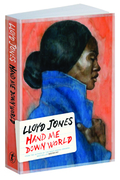
Hand me down world, bookcover

Book cover (Courtesy: Text Publishing)

What this character is talking about is empathy – and empathy, the having or not having it, is for me a major theme of New Zealand writer Lloyd Jones’ latest novel, Hand me down world. The novel is chock-full of characters who vary in their ability to empathise or not with other humans, to behave altruistically or selfishly towards others, to treat others with the dignity that all humans deserve or as nobodies to be ignored (or worse). These are not, in the real world, absolute alternatives but continuums along which we all position ourselves when relating to others. I think this positioning is one of the fundamental challenges of being human, and Lloyd Jones explores it in a novel which got me in from the get-go. In other words, I loved it.

This is a novel with a simple plot but a complex narrative. The plot concerns a young, poor African woman, a hotel worker, who leaves Africa using human-traffickers to find her son in Berlin. Why she does this is a shocking story revealed in the first chapter. The book follows her journey until its inevitable but not totally predictable conclusion.

What is particularly interesting about the book is how Jones has chosen to tell the story. It is divided into five parts:

1. What they said
2. Berlin
3. Defoe
4. Ines
5. Abebi

The first two parts comprise 13 chapters, each named for the narrator telling that part of the story. All but one of the narrators are first person and they chronicle their experience with the woman (whom we come to know as Ines) as she journeys to and finally arrives in Berlin. The third person narrator is “The inspector”. Why he is third person initially mystified me, but it all becomes clear when he reappears in Ines’ part. As I was reading these early chapters, I was reminded of Gabriel Garcia Marquez‘s Chronicle of a death foretold because they sounded like witness statements (and that, in fact, is what we later discover they are). This is not, though, a whodunnit, any more than Marquez’s book is, although a death does occur. Intrigued? You should be.

Anyhow, it is in these early chapters that the “empathy” theme starts to play out as it is in them that we hear how Ines gets from Africa, via Italy, to Berlin. She is “helped” by a number of people including a truck driver, snail collector, an alpine hunter, a chess player and a film researcher. Some of these people help her expecting nothing, some help her only if she gives something in return (and I’m sure you can guess what that might be), some help her but would like something in return, some are unsure whether to help her or not, and so on. It certainly makes you wonder what you would do, how far out of your way you would go.

Suffice it to say, she makes it to Berlin, manages to find a job, and starts searching for her son. But, I won’t talk more on that, so you can discover for yourself how her story plays out. What I will talk about instead are some of the other features of the book that make it such an interesting read.

Several metaphors run through the novel, but they never feel overworked. One that I particularly liked concerns phantoms/ghosts. Lloyd uses them to describe the marginalised or dispossessed. The pastor (who better to talk about ghosts?) speaks of ghosts in a number of contexts, including:

The ghost remains a spectre, no more than a possibility. Something to be afraid of. A manifestation of fear, such as the opposition parties in each and every undemocratic regime in Africa.

The other ghosts – the real ghosts if I may call them that – are simply those whom we choose not to see.

Ines, of course, is one of these – and later, when she considers stealing her son, she talks of teaching him “to turn himself into a ghost”. Another motif that runs through the book is that of versions and lies. Most of the early narrators are not exactly reliable, several people do not go by their own name and there are references to things being transformed (such as snails which can change gender and lungfish which can live in and out of water). When Defoe describes the lungfish (below) we see its reference to the way people change, to how we can transform (for good) or dissemble (for ill, such as the father of Ines’ baby):

Now he arrived at the question that interested him. At which point does it become the one thing and cease to be the other? In becoming that new thing how much does it retain of the other?

One of the little side stories in this multilayered novel concerns the old blind man Ralf in whose household Ines finds work. We learn from Ralf’s ex-wife, Hannah, that after her gentle, kind father-in-law had died they found a photograph that revealed his secret past as a photographer of atrocities during the Nazi regime. Ralf’s inability to come to terms with his father’s contradictory, secret past brings about the breakdown of his marriage. Meanwhile, Ines lies, steals and pretends in order to achieve her goal of developing a relationship with her son:

I had to see him. And that need turned me into someone with no heart or conscience. I didn’t care how the money was earnt.

It is difficult in fact to know who the real Ines is … but she is a wounded soul. Who are we to judge? Throughout the novel, in fact, Jones confronts us with imperfect people and challenges us to consider both them and their circumstances. How far can, should, our empathy extend? Uncomfortable questions but ones we must face.

During Ines’ story she says “I was shown more kindness than abuse” which reminded me of Rieux’s statement at the end of The plague that “there are more things to admire in men to despise”. I like to think they’re right but, with Camus and Jones, I also know that we need books like this to remind us that we still have a way to go …

Lisa at ANZLitlovers also enjoyed this book.

Lloyd Jones
Hand me down world
Melbourne, Text Publishing, 2010
352pp
ISBN: 9781921656682

Monday musings on Australian literature: The Australian bildungsroman

Miles Franklin

Miles Franklin, c. 1940s (Presumed Public Domain, via Wikipedia)

I know the sad truth. About everything.
(Craig Silvey, Jasper Jones)

In past posts, I’ve talked of enjoying coming-of-age novels (aka bildungsroman) and so today I thought I’d share 5 (cos 5 seems like a manageable number for a list like this – and gives you an opportunity to contribute your own!) Australian novels in the genre.

In the introduction to a course on “The European bildungsroman” at Columbia University in the USA, there is a brief discussion on the definition of the term. The unnamed writer (so let’s call him/her Columbia) of the introduction says:

My particular approach to defining the genre … returns to Dilthey‘s original definition. According to Dilthey, the prototypical Bildungsroman is Goethe’s Wilhelm Meister’s Apprenticeship in which the hero engages in a double task of self-integration and integration into society.

Columbia then expounds a little on this definition arguing that, while Dilthey see this as an affirmative, conservative genre which aims to find the “hero” a productive place in a valid society, s/he sees it as involving a tension – that between “the priorities of self-integration and social integration”, between personal desire and social obligation. For Columbia this tension is a major criterion for the Bildungsroman genre. This makes sense to me … perhaps this tension isn’t an issue for every young person who is coming of age, but a coming-of-age story without that tension, without some conflict to resolve, is probably not going to be interesting to read!

(By the way, I’m not sure that this necessarily negates Dilthey’s definition. The difference between Dilthey and Columbia seems to me to be that Dilthey focuses on the end result, while Columbia focuses on the process which may or may not culminate in Dilthey’s goal.)

And so, five Australian coming-of-age novels (choosing from those I’ve read):

  • Miles Franklin‘s My brilliant career (1901) is probably Australia’s best known book of the genre. It’s a semi-autobiographical novel about Sybylla, a young girl on an outback property who must choose between her passion for a man and her passion to be a writer. It was made into a film by Australian director Gillian Armstrong.
  • Henry Handel Richardson‘s The getting of wisdom (1910) is another novel about a blue-stocking girl. Laura’s innocence and idealism are sorely tested by the city sophistication of her well-to-do peers. In this story, the awakening is more intellectual and philosophical than sexual. According to the Henry Handel Richardson Society, this novel was admired by HG Wells. It was also made into a film.
  • Melina Marchetta‘s Looking for Alibrandi (1992) is a young adult novel (and, later, a film) which adds an immigrant background to the heroine’s challenge. Not only is she a young intelligent girl who confronts her awakening sexuality but she must do so within the strictures of a conservative Italian family.
  • Tim Winton‘s Breath (2008) explores the youthful drive to prove oneself, to take risks, and the complications that arise from choosing an imperfect male role model and from becoming embroiled in a rather unhealthy sexual relationship with an older woman. Eva is no Mrs Robinson. The question left for the reader at the end goes to the heart of Columbia’s disagreement with Dilthey.
  • Craig Silvey‘s Jasper Jones (2009) is set in rural 1960s Western Australia and, with a nod to To kill a mockingbird, combines a somewhat Gothic mystery with a more traditional coming-of-age story. Racism (against immigrants and indigenous people), sexuality and learning who you can trust are some of the adult issues that Charlie confronts in his growth to maturity.

I’m intrigued by how many of these books have a rural or small town setting. (Even Laura, in The getting of wisdom, is a country child, though the book is set in a city boarding school. Looking for Alibrandi is the only truly urban novel here.) Is this because we equate country with innocence? Because rural life tends to be more conservative and therefore presents a greater challenge to a burgeoning self? Is it simply that the books I’ve chosen are not representative? Or? What do you think?

Another award for Nam Le

I read Nam Le‘s collection of short stories The boat a few months before I started my blog. The collection has been well reviewed nationally and internationally, and has won quite a few awards. I have just read that he has now been awarded another: The Kathleen Mitchell Award which is a biennial literary prize for writers under 30 years old (as Nam Le was when the book was published). This award has been previously won by Sonya Hartnett who has gone on to write several highly acclaimed novels – and been shortlisted for the Miles Franklin – and Markus Zusak.

I loved The boat. It’s an unusually diverse collection. The language is highly differentiated from story to story to suit the particular characters and setting of each; the narrative voice varies from 1st to 3rd person, and from male to female points of view; and there’s an asonishing variety in his protagonists and settings. The subjects range from an 8 year old orphan girl in Hiroshima to a middle-aged painter in New York, from a 14 year old hitman in Colombia to a 35-year old American woman visiting Iran. Despite this diversity, though, there is a strong underlying theme, that of survival. This is probably not surprising in a writer who came to Australia from Vietnam as a boat refugee (albeit when not much more than a baby).

As it’s been a while since I read the book I’m not going to review it now but, given my particular interest in the intersection between fact and fiction, I’ll just mention the autobiographical aspect of the first story, “Love and honour and pity and pride and compassion and sacrifice”. That story is so close to Nam Le’s own life that it is tempting to read it as his life. A character says to the fictional Nam that “instead [of writing immigrant stories], you choose to write about lesbian vampires , and Colombian assassins, and Hiroshima orphans – and New York painters with haemorrhoids”. One reviewer, Hari Kunzru in The Scotsman, wrote that “Sure enough, The Boat, contains all these stories, minus the lesbian vampires, who presumably got lost in the edit”. My question is: Does he know this for a fact? Did the real Nam Le write such a story or is it only the fictional one who did? Is this a case of life getting mixed up with art? In an interview on the ABC’s Bookshow Nam Le admits to a story about lesbians but says “the vampires I needed to leave some interpretive distance, I reckon”. I like to think of it as Nam Le’s little joke – but I may be wrong!

Oh, and did I mention that Nam Le attended the Iowa Writers’ Workshop? Doesn’t seem to have done him any harm!

Dinaw Mengestu, An honest exit

There are, I suppose, two exits in Dinaw Mengestu’s short story “An honest exit”, which you can read at The New Yorker. One is the exit the father in the story made, when a young man, from his home in Ethiopia and the other is his final exit from life. (No spoiler here: we are told he dies in the first line of the story.) Mengestu is an Ethiopian-born American writer. According to Wikipedia, this short story is an excerpt from his coming novel, How to read the air, and clearly belongs to that growing body of work, Immigrant Literature.

As it turns out it was rather an apposite read for me, given all the “Stop the boats” calls we Aussies have just heard during our recent election. I wish more people would read stories like this. They might then realise that boat people (let’s forget the people smugglers for a moment) are not opportunists gaily leaving their homes to sail to a “better” place. They are leaving their home, their culture, their life – and they do not usually do it lightly or with ease.

Anyhow, this particular story starts with the father’s death and the son, a college teacher in Early American literature, deciding to tell his father’s story to his students.  However, as is only too common, he doesn’t know the full story:

I needed a history more complete than the strangled bits that he had owned and passed on to me – a short, brutal tale of having been trapped as a stowaway on a ship. So I continued with my father’s story, knowing I would have to make up the missing details as I went.

And so, over the course of a few lessons, he tells a story to his students, about how his father managed to get to Sudan, and from there, through the help of a man called Abrahim (“like the prophet”), onto a ship bound for Europe. As we hear the story – which is believable even if not necessarily factual – we also learn a little about the son. He says, for example, that he calls his place of work “the Academy”, a name he has stolen from a Kafka story about a monkey who’s been trained to give a speech to an academy:

I used to wonder if that was how my students and the other teachers, even with all their  liberal, cultured learning, saw me – as a monkey trying to teach their language back to them.

We see how disconnected he feels from both his father and his life. However, as he tells his story he seems to start to (re)connect a little:

They [his students] had always been just bodies to me … For a few seconds though I saw them clearly …They were still in the making, each and every one of them. Somehow I had missed that … As I walked home that night I was aware of a growing vortex of e-mails and text messages being passed among my students. Millions of bits of data were being transmitted … and I was their sole subject of concern. I don’t know why I found so much comfort in that thought, but it nearly lifted me off the ground, and suddenly, everywhere, I felt embraced.

A little further on, we learn that his father’s story is being spread around the “Academy”, albeit distorted as these things go. He hears various versions involving the Congo, Rwanda and Darfur! He is at one point called into the dean’s office:

“… How much of what they’re [students] saying is true?”

“Almost none of it,” I told him …

“Well, regardless of that,” he said, “it’s good to see them talking about important things. So much of what I hear from them is shallow, silly rumours. They can sort out what’s true for themselves later.”

The narrator is a little disconcerted by this, by the idea that “whether what they heard from me had any relationship to reality hardly mattered; real or not, it was all imaginary to them”. And yet, he himself is making a lot of it up as he goes! He continues his story with the students, ending at the point his father leaves Sudan as a stowaway. He says:

My students, for all their considerable wealth and privilege, were still at an age where they believed that the world was a fascinating, remarkable place, worthy of curious inquiry and close scrutiny, and I’d like to think I reminded them of that. Soon enough they would grow out of that and concern themselves with the things that were most immediately relevant to their own lives.

What he doesn’t do is tell the real truth of his father’s escape. Rather, when he gets to this point in his father’s story, he says “I knew that it was the last thing I was going to say to my class”. We don’t actually know what he does next because the rest of the story concerns his father, but it seems that there is a third exit in the story, his from teaching. It probably is “an honest exit”. All in all, this is an intriguingly layered story about migration, dreams and trust, stories and truth, teachers and students, and privilege.

To end, I might just return to Kafka’s “Report to the Academy” in which the ape says, “There is an excellent German expression: to beat one’s way through the bushes. That I have done. I have beaten my way through the bushes. I had no other way, always assuming that freedom was not a choice”. It rather suggests to me that there’s more than one reason our narrator alludes to Kafka’s monkey…

Edith Maude Eaton, Mrs Spring Fragrance

This week’s Library of America short story offering is “Mrs Spring Fragrance” by Chinese American author Edith Maude Eaton (1865-1914) who wrote under the pen name of Sui Sin Far. She had an American father and a Chinese mother and, according to the notes which accompany the story, was apparently the first person of Chinese descent to write in the US about Chinese-American life.

“Mrs Spring Fragrance” was published in a collection in 1912. Its concerns are not new to us, reading it nearly a century later and familiar with literature about the challenges of living cross-culturally, but at the time it was apparently rather exotic. The subject of the story is marriage, and the conflict between traditional Chinese arranged marriage and westernised marriage in which young people choose their marriage partner. The main characters are a happily married Chinese couple who live in America, the Spring Fragrances. Their marriage was arranged but as we are told early in the story, both are quite “Americanised”. Mrs Spring Fragrance, we learn, is sympathetic to the plight of their young neighbour who has been promised in marriage but who wants to marry her chosen love.

The plot turns on that old conceit of eavesdropping – of things heard out of context which threaten to derail the “real” situation. (Interestingly, there is a book published by Cambridge University Press titled Eavesdropping in the novel from Austen to Proust, which explores the concept of eavesdropping in nineteenth century English and French novels.) Anyhow, back to the Spring Fragrances. In this story, the eavesdropping is complicated by cultural confusion and the result is … Well, I’m not going to give it away as you can read it yourself using the link above.

I will say, though, that what is eavesdropped is Tennyson’s statement:

‘Tis better to have loved and lost,
Than never to have loved at all.

Surely, says Mr Spring Fragrance, expressing a Chinese perspective despite his “Americanisation”:

Is it not better to have what you do not love than to love what you do not have?

It is a straightforward story, but told nicely and with a light touch. She shows how difficult it is to truly “change” cultures: through such comments as those above and Mrs Spring Fragrance’s unconscious error when she refers to the “loved and lost” poem as the “beautiful American poem written by a noble American named Tennyson”! You have to laugh – but not cruelly, as these are appealing characters, earnest in their desire to do the right thing.

This is not a must-read story, unless you are interested in the history of Chinese-American literature, but it is an enjoyable one nonetheless.

Arnold Zable, Sea of many returns

He leaps through centuries, tears apart myths, and reassembles them in his own way.

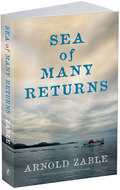
Sea of Many Returns cover

Cover image courtesy Text Publishing

These words that are said of one of the characters in Arnold Zable’s Sea of many returns could just as easily be said of Zable himself – not only of this book, but of his earlier ones such as Cafe Sheherazade. Zable loves telling stories, stories that weave between each other in an attempt to understand the impact of dislocation and exile on the human psyche – well, on his characters’ psyches but it is not hard to universalise this.

Sea of many returns is, essentially, a dual point-of-view novel:

  • the first person narrator, Xanthe, who was born in Melbourne to an Ithacan father and who tells her story; and
  • the third person story of Mentor, her paternal (also Ithacan) grandfather whose journals she is translating.

The story roams, backwards and forwards, from 1895 to present time as Xanthe and Mentor tell of the lives of their family members in Greece and Australia…about all their leavings and returnings, for work or adventure, or more terribly for war or, simply, to find a better life:

The stories I have heard, and am yet to hear, are echoes of one refrain: Is there somewhere on earth where I can find peace and prosper? Once the question is posed, the agony begins, the eternal dilemma: to stay or leave? To retreat behind fortifications, or cast our fate to the winds? (Xanthe, p. 203)

Underpinning this dilemma is the yearning for Ithaca – which translates, really, to the yearning for place, for home. Towards the end of the novel Mentor discusses the notion of “nostalgia” or “the pain of longing for the return”. Put this together with “the Ithacan phobia, the fear that I may never return” and the result is a melancholic – but not depressing – tone, since it is mostly accompanied by, if not always strength of mind, a resilience of spirit.

Not surprisingly, it’s the men who travel, at least in the earlier times of the book. As Xanthe’s aunt says, resignedly, “Let your men roam distant lands. Let them do what they must. What choice do we have? Bend your back to the mountain. Sow and reap”. And so, while Xanthe talks to some of the women in her Greek family, it is the men whose stories she seeks as she tries to understand her father, the angry Manoli, and her grandfather, Mentor. However, the book’s final section, titled “Epilogue: The resident tiller of the soil”, focuses on 90-something year old Irini who, quite paradoxically Xanthe realises, has not left Ithaca since her arrival there 90 years before and yet “is both voyager and teller, Odysseus and Homer”. This is perhaps a little elliptical but it has a certain resonance nonetheless! And Andreas does mutter in the previous section, “To know one place is to know all places”.

While the novel takes on a mythic overtone, it is “history” which provides its backbone and puts flesh on its characters: there are, for example, the way-too-many wars (to which many men go and from which some return), the 1916 anti-Greek riots in Kalgoorlie, the 1953 earthquakes in Ithaca, and the building in Melbourne of Cafe Australia and the Capitol by the Chicago architects, Walter Burley and Marion Mahoney Griffin. This last one seems a bit odd in terms of the overall thrust of the book but is interesting to one who lives in the city they planned!

I have only touched on a little of what this novel contains – there are the references to the Homeric quest and the story of Odysseus, there is the drunk but wise Niko, there is the beauty of the language in its rhythms and descriptions, and there is music – but if I go on, I might, like its storytellers, never stop. As Andreas says to Xanthe near the end

I have told you one version of the story and tomorrow I may tell it with a different slant. Each word I utter is true and false at the same time …

Paradoxical? Yes! But that is the essence of this lyrical and mesmerising but also rather mystifying – or, is that mythifying – book!

Arnold Zable
Sea of many returns
Melbourne: Text Publishing, 2008
307pp.
ISBN: 9781921351532