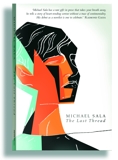
Michael Sala’s The last thread is 2013’s Pacific Region Winner of the Commonwealth Book Prize

Michael Sala The last thread bookcover

The last thread (Courtesy: Affirm Press)

I don’t know about you but I find blogging a challenge when I’m travelling, as I have been for much of May. I love my iPad for staying in touch, but I don’t find it easy to write blog posts on it – either via the WordPress app or the browser. And, our old PC laptop that we share for travelling just isn’t the same as my MacBook Pro. Consequently, I decided to delay posting on Michael Sala’s win, announced yesterday, until I got back today.

It’s an exciting win – of course, what win isn’t! – and means that Sala is now in the running for the overall Commonwealth Book Prize which will be announced on 31 May. I am particularly thrilled because it was published by a small, not yet well-known publisher, Affirm Press, which has published some lovely books over the last couple of years.

I reviewed Sala’s novel last year. It’s autobiographical, and has clearly been a challenge for him and his family*. I closed my review with:

In the very last pages of the book, Michael’s mother says that “words and stories can be dangerous” (echoing Francesca Rendle-Short’s “to think, to write, is dangerous”). They can indeed, but sometimes that danger can have positive outcomes. I hope that, for Sala, the dangers of putting his story, his truths, on the page will be restorative. There’s no guarantee though that such bravery will have its just rewards … in life or in fiction.

It’s exciting for Sala that his bravery has brought him recognition. He has also been shortlisted for the UTS Glenda Adams New Writing Award in the New South Wales Premier’s Literary Prize. I wish him well in both awards – and congratulate him and Affirm Press on their achievements to date.

* As comments from his family on my original post show.

Michael Sala and truthful fictions

Michael Sala The last thread bookcover

The last thread (Courtesy: Affirm Press)

Michael Sala doesn’t actually use the term “truthful fictions”. That was a character in Jessica Anderson’s Tirra Lirra by the river. But he could have.

Yesterday I heard Sala interviewed on ABC Radio National‘s Life Matters about his debut novel The last thread, which I reviewed last week. Presenter Natasha Mitchell commenced by mentioning the transitions, secrets and traumas that characterise Michaelis/Michael’s life in the novel. She asked why he had chosen the fictional, rather than memoir, route. He responded that he had started writing his story in first person but got swamped by emotions, and then he read J.M. Coetzee’s autobiographical novel*. He realised, he said, that he could write about the child he used to be “as if he were someone else”. (I love hearing how writers – as I also reported in my Jessica Anderson post – learn from other writers.)

This is fair enough I think. There are those who like a “memoir”, as it were, to be a “memoir”, but in our post-postmodern world in which we know that truth is a slippery beast at best, what difference does it really make? How important is it to be able to say Michael Sala did this, felt that, experienced such-and-such versus, for example, how does a child navigate abuse and how does such a child translate those experiences into functional adulthood? How important are questions of fact against exploration of these emotional “truths”?

In other words do we need to know the “facts” to understand the truths? I’m thinking now of Kate Jennings. I’ve reviewed two of her books here, her autobiographical novel, Snake, and her autobiography of sorts, Trouble: Evolution of a radical. Snake is a novella that chronicles Girlie’s life in a complicated family. We know it mirrors much of Jennings’s “real” childhood but we can’t be sure what are the facts and what are scenes created to convey her emotional truths. Trouble, described as an “unconventional autobiography”, is a collection of Jennings’ writings – journalistic articles, poems and excerpts from novels – that have been put together in such a way as to convey something about her life. We may not be able to glean from these slippery books a lot of citable “facts” but both tell us a lot about who Jennings is, about where she came from and what she believes.

All this of course begs the more fundamental question of how factual memoir is anyhow? But that is something I’ll leave – for the time being anyhow. Meanwhile, there’s a scene in Sala’s autobiographical fiction in which his mother discusses his problematical father with her sister:

“He’s a wonderful man,” Elfje says. “We’ve become great friends. Oh, he makes me laugh!”
“That’s one side of him,” Mum says.
“Yes, yes, we all have versions of events, stories to tell.”
“Stories?” Mum says. “Is that what you think they are?”
(from The lost thread, by Michael Sala)

Therein lies the rub. Whatever we read, memoir or fiction, we surely must always be aware that it is “one side” we are getting. Could it be, says she provocatively, that something labelled fiction is a more honest recognition of this fact?

* Coetzee has written more than one work of autobiographical fiction but Sala wasn’t clear which he’d read. I’m assuming he at least read the first one titled Boyhood: Scenes from a provincial life.