Helen Garner and Sarah Krasnostein in conversation with Beejay Silcox

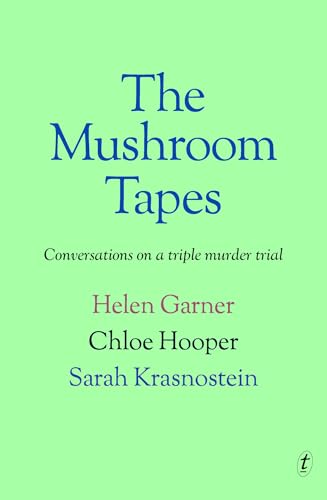
Last night’s ANU/Meet-the-Author event was a sold-out affair, in a 500-seat theatre. And why not? Helen Garner, Chloe Hooper, and Sarah Krasnostein are among Australia’s top writers of narrative nonfiction, and they have just produced a book about the Leongatha mushroom murders. Indeed, it’s only because they have written about it that I am interested in reading about this case. Of course I knew about it, but I didn’t follow it intensely because these tragic criminal cases that capture the public’s attention so often become unedifying spectacles in which emotion overtakes reason in much of the public discourse. And I don’t want to go there.

As always, Colin Steele did the introductions, including explaining that Chloe Hooper had had to pull out due to her young son being sick. He referenced Jen Webb’s recent article on The mushroom tapes in The Conversation, and quoted her statement that “If I were asked to pick three people to write about this dramatic, yet banal, crime story, I’d choose them”. Yes! He then handed the floor over to Beejay Silcox.

The conversation

I was disappointed not to see Chloe Hooper because I have seen Helen and Sarah in action before, and because Kate (booksaremyfavouriteandbest) loved the event she attended with the three of them. So, Chloe’s absence created a significant hole, but Helen and Sarah filled it wonderfully – and graciously. They were open, thoughtful, and, as Kate found, still discovering new things to talk about.

Beejay started by quoting Janet Malcolm, who, she clearly knows, is a favourite of Garner’s. Malcom has argued that what journalists do is “morally indefensible” because of the way they draw in and then report on their subjects. But, continued Beejay, good journalists will overcome this risk by not rushing in, by, I think she said, applying “a tilt” to the way they look at things. And these writers are “masters of the tilt”.

On working together

The conversation covered the sorts of things you would expect for a book like this, including our complicity as readers/spectators, why this case, the need to resist easy answers, their process, their thoughts on the trial, and where the trust in each other had come in.

Sarah noted that there is no division between Helen’s work and her person, which of course is what so many of us love about her, but which has also brought her criticism. They all respected each other – not surprisingly – so had no doubts about each other’s personal processes. Helen said they were like people who had been in and survived a car crash. They were friends for life now.

Beejay referred to the fact that each had shared what their opening line would have been had they written the book alone (though they wouldn’t have, they said). Their lines (pp. 4-5) capture something about their individual approaches. Helen’s, which plays on lines by Sir Walter Scott, sounds baroque, Shakespearean. It speaks of empathy and the question of where is the line that an ordinary person crosses to commit such a crime. Chloe’s is more sociological (as in, what in society created this), while Sarah’s is more legal. As Sarah said, each had her own tone and vibe, her own interest in what they were observing.

Sarah commented on how the case had “asserted itself into public discourse with velocity”.

There was more talk about how and why they decided to write this book. They admitted to bristling at the assumption from others that it was “their story”. They found the sensationalism repellent. (In a humorous interaction, Helen dobbed Sarah and Chloe in as readers of the Daily Mail, which she eschews, but didn’t mind their passing on its news!)

It was an exhausting process, given the trial lasted 10 weeks. Helen talked of how you cope with something like this, on defending yourself against awfulness and pain of the trial, how the mind turns off. They noticed early that the journalists had formed a gang, presumably their way of coping. Beejay suggested that humour is another way, and that Helen provided some of the book’s comic relief.

On the court – and their approach to understanding it

The court is a workplace, said Sarah, so alongside extraordinary grief and distress are all the administrative aspects, such as when to have lunch, managing a juror needing a toilet break. They shared examples of humour and drama in the witness box. Sarah described their work as an “ethnography of a micro-world”, one in which they tried to capture the humanity of court.

Observing that their book is more about watching, than about the judgement, Beejay asked what was important to see, that we normally wouldn’t. Helen’s answer came quickly. It was distress and suffering. You see the survivors. Helen said they dreaded people thinking they were taking suffering lightly. Sarah agreed, adding that one of the heaviest things is that this is not a story of exceptionalism but more of “there but for the grace of god …”

They talked about emotions versus the banality, the quotidian details, such as, for Helen, Erin’s toe in the hiking sandals she would wear. She commented on being nearly undone by the domestic nature of it all, such as survivor Ian talking about having “a nice bowl of porridge” in the morning with his wife of many years, and now she’s gone.

Beejay described the book as both spectacle and literature, and quoted Helen’s comment in it that “everything could become a metaphor here“. The discussion went roundabout here, but essentially they agreed that in a case like this, metaphor must be handled carefully. In fact, Helen suggested that the urge to get metaphorical doesn’t belong in nonfiction. Sarah shared something from documentary filmmaker Ken Burns. He said that to find a detail that stands for the whole is a gold nugget, but then realised that that detail (from his Vietnam War film) represented the piece of a man’s soul that had come at great cost – so “gold nugget” was not appropriate. So, said Sarah, you must handle metaphor carefully, as you are dealing with human meaning. Helen had never heard Sarah say this. They agreed that nonfiction deals with facts you must honour, that it is chained to reality in a certain way.

On Erin

This led to a conversation about Erin, how the public had turned her into “a character”, and how information that had come up in the pre-hearings (such as probable earlier attempts on her husband’s life) was deemed inadmissible in court because there was no evidence. This decision would enrage a family, Sarah said, but is necessary to protect the presumption of innocence. (There was humour in the conversation here because Daily Mail readers knew this information, but Helen didn’t – and had felt an idiot!)

But, who was Erin? Mostly, women kill to protect, so Sarah had gone into the hearings with this understanding, but as information came out she had to reassess her thinking.

Helen found Erin a strange person, but thought the court artists’ depiction of her as evil, witch-like, was appalling. Later, they described the way the media/the public feasted on her was a form of horror.

Sarah said that when Erin started speaking on the witness stand, she was articulate, funny, recognisable, but gradually, as she was questioned, this picture melted. It was hard to separate Erin’s self from the persona. The unpalatable parts of her personality were on display. The bad-tempered teacher-like tone she used in response to the prosecutor was a misstep. It’s a middle-class story, said Helen.

Re explaining Erin’s crossing that line into murder, Helen was surprised to find that the prosecution doesn’t have to find a motive. She doesn’t have an answer. Like most humans, Erin embodied various people, mother, crabby teacher … Sarah added that Erin is not legally insane but is a deeply disordered person, so how do you apply “order” to her? We want answers, but we can often be mysterious to ourselves. Erin is recognisable as a mother, but like many of us can also harbour a primal rage.

Q & A

On how such an intelligent, well-educated woman could think she could get away with it: Helen has a theory about murderers. They have a great desire to do it, and a fantasy about how they are going to do it, but this all stops at the lethal blow because they haven’t thought about what happens next. So, for example, Erin hadn’t concealed evidence of her ownership of the dehydrator. This was astonishing,

On ethical issues they considered during the process: There were many, including the children, the community, whether they should look at sites (like the home). Are you adding to harm or does not looking do harm too? They questioned whether they were looking out of human curiosity, were they just perving? Sarah said that Helen has a view about “utility”. Courts are public, so we should understand them, we should ask questions about what they are doing. Hannah Arrendt described such crimes or behaviour as “a rent in the social fabric”. The law is being acted in our name, so we have duty to know what the law is doing. Part of the “utility” is to add complexity to our understanding, to show that the law, and these cases, are not simple.

On the role of gender in how the case played out publicly: Gender absolutely played a role. Had the crime been committed by a man it would not have held the public’s attention for so long. This was a middle class mum, set around something domestic, the serving of a meal. Her behaviour was a violent inversion of a major archetype of what women are. The gleeful mocking tone employed by some commentators was an insult to victims. (And reminiscent of how Lindy Chamberlain was “feasted upon”.)

Finally…

Beejay described the book as “a love letter to doubt”, to which Helen responded that she is a fan of ambivalence. Yes! She is not the god of all knowing consciousness; she wants readers to be there, questioning along with her. Doubt comes in different forms. At times, Helen and Sarah would be sentimental and mushy, while Chloe would remonstrate, “Guys, she’s planning to poison them”. They agreed that their essential subject matter was the preservation of doubt

Beejay concluded by asking them what they wished we all knew or felt. Sarah named the mockery, caricature, parody that was applied to the case. Why do people do this? These are people’s lives, and it affected a family and an entire community. Helen agreed, adding that “you want to preserve the tenderness in the story”. The old people who died kept disappearing from the story, but they were plain country people with faces of kindness, people who had helped Erin in need (which she recognised).

So, another excellent conversation with some meaningful takeaways encompassing how we respond to crimes like this, how we value writers who bring them to us in a considered thoughtful way, and how doubt and acknowledging complexity should be our mantras.

ANU/The Canberra Times Meet the Author
MC: Colin Steele
Lowitja O’Donoghue Cultural Centre, Australian National University
19 November 2025
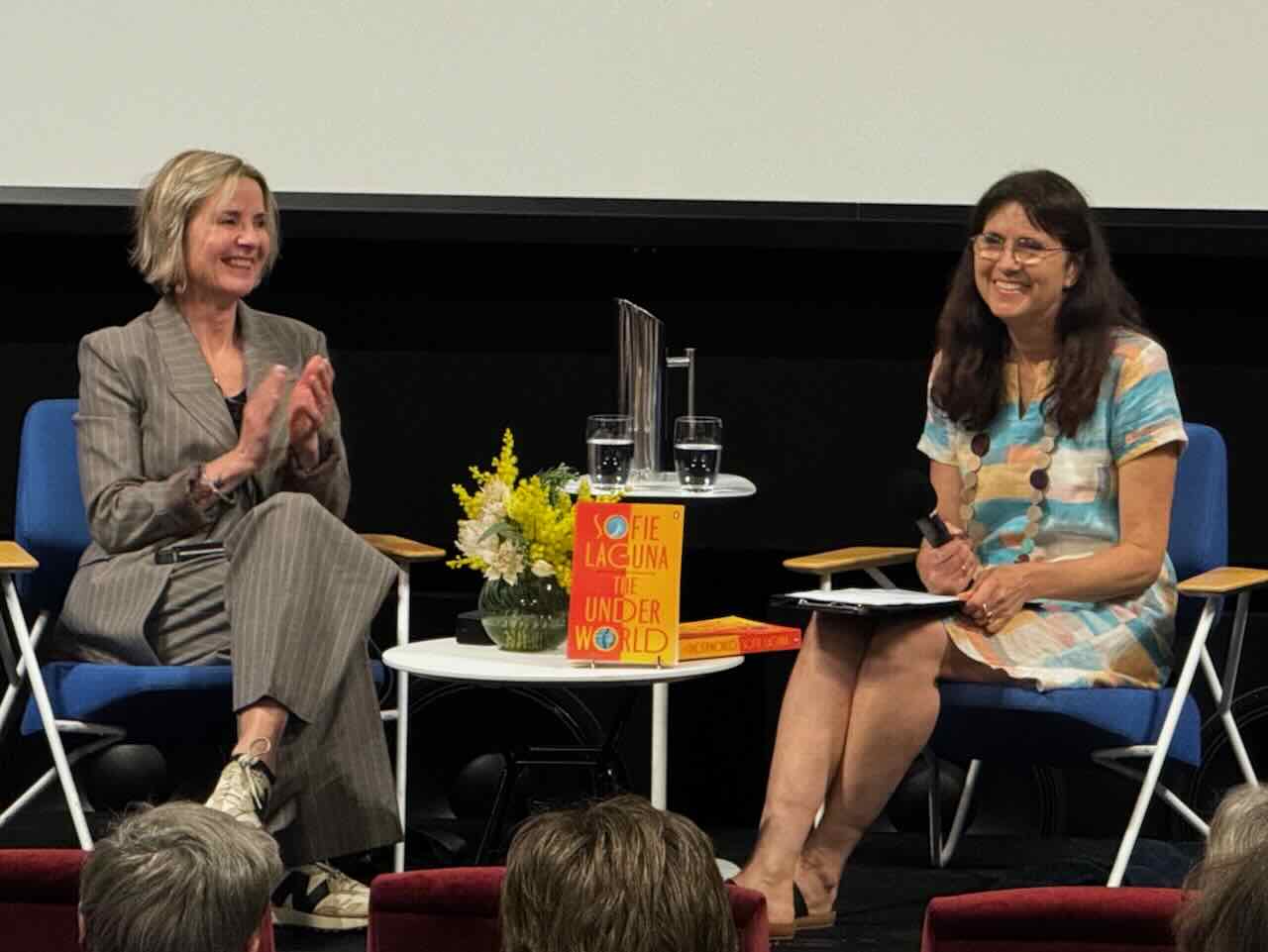
Sofie Laguna in conversation with Karen Viggers

I don’t know how it has happened, but tonight’s conversation between Sofie Laguna and Karen Viggers is the first ANU/Meet-the-Author event I’ve attended this year. I did book one featuring Omar Musa a month ago, but I came down with laryngitis, as did, I believe, his interlocutor. (The show went on, with Karen Viggers, in fact). My problem is a busy schedule combined with regular trips to Melbourne and a couple of holidays. They get in the way of normal life!

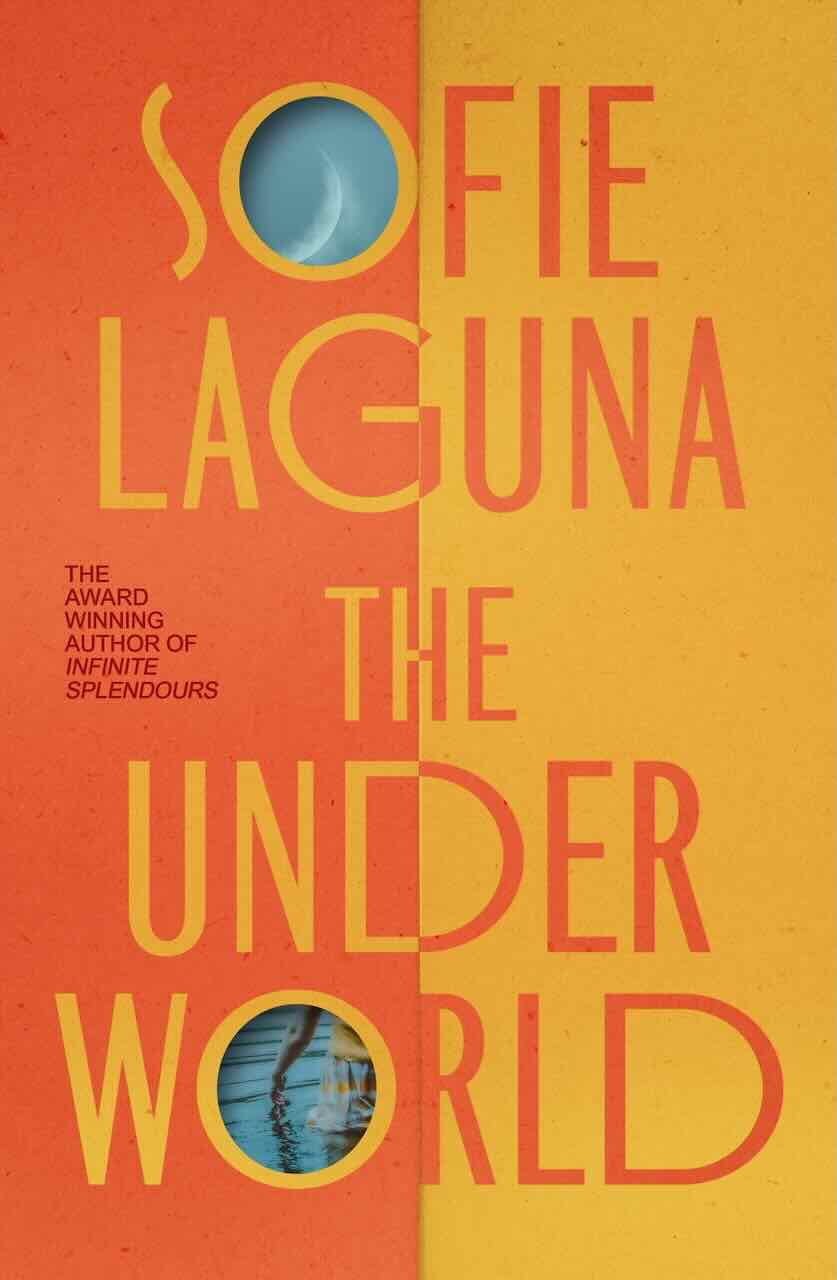
Anyhow, the event – which was for Sofie Laguna’s latest novel, The Underworld – started as usual with Colin Steele acknowledging the traditional owners, introducing the participants and thanking supporters, before handing the floor to Karen Viggers. He thanked Karen in particular for turning up because last Sunday, while in Ubud for the Writers Festival, she was run down by a motorcycle and was somewhat bruised and battered!

The conversation

Now, I have seen Karen converse with Sofie Laguna before (back in 2017) and it was one of the most delightful conversations I’ve attended, so, I was looking forward to this one. It didn’t disappoint. Sofie Laguna is a joy and a hoot, in the open way she engages in discussions about her work. It’s a way that manages to feel fresh, as though the conversation is a journey for her, not the same-old same-old. Whether that’s Sofie or Karen or the chemistry they have, I don’t know, but it works.

On coming-of-age and young people

Karen started by introducing the novel as a coming-of-age story, which encompasses violence, love and transformation. She loved that Sofie takes the reader on a journey with Martha. The novel starts in 1973, with her protagonist Martha in Year 9 – at which point there was a little discussion between Sofie and Karen about how old that made her, and whether that was the same as Third Form. Whatever! The point is she’s around 13 or 14, is at an elite private boarding school in the Southern Highlands, and has parents who are ”trapped in a loveless marriage”. Here, there was another little discussion about whether they were in fact “trapped” and whether it really was “loveless”. As you can see, this really was a conversation.

Karen asked Sofie about the dedication, which she suspected implied a spark? It is an In Memoriam to her Latin teacher, who was both dedicated and elitist, but created a dynamic learning space. This led to a discussion about the role of teachers in guiding young people, and the fact that teachers are woven in different ways through most of Sofie’s novels. She doesn’t do this consciously, but realises teachers have had a pivotal role in her books. They have an incredible influence, they can draw out of students who they are. For Sofie, whose home was unconventional, school was a safe place, that gave her boundaries.

On the writing

We then moved on to voice, and the fact that Martha’s voice came to Sofie at a basketball gym where her son was playing. She began writing there and then in the voice of a women in her 50s, a woman who was funny, heartbroken, intellectual. She “knew something had happened”. She felt an urgency, and it was exciting because things were coming out that she didn’t know she knew. This sort of writing is easy to do because it wants to happen, but the book wasn’t easy.

She knew she had to go back and learn what Martha’s life was like at 14. It would be untidy. Puberty is messy, and she’d never properly written about it before. It’s a time of transition, challenging for everyone, as our bodies, ideas, sexuality change.

Karen then returned to why this book had been difficult. Was it because she was closer to Martha? Yes, but it was difficult in many ways – more difficult to get a sense of the whole, more difficult to get a straight line, more nuanced. And then as Sofie does, she asked Karen whether that made sense!

Karen noted that Martha attends a privileged private boarding school, which is a shift from the hardscrabble lives she usually writes about. This resulted in Sofie sharing another difficulty she’d had. Was she was “allowed”, in current times, to describe wealth, privilege? Was it permissible to describe pain experienced by a privileged white person? But, that’s who Martha was! So, she kept on, but she had to work hard to give herself permission to do this.

She wishes she’d kept a diary, that she’d captured this “dance” she’d had between the conscious and the subconscious as she worked through the issues.

On the Underworld

Next was the Underworld, Martha’s place of escape. Sofie explained that the Underworld, which comes from Greek and Roman mythology, is not the same as the Christian idea of hell. Everyone goes to the Underworld. We all know about Charon the Ferryman who takes souls across the river, but what is the Underworld? How did it work? Was it a watery place? There are many interpretations, but nobody knows, which gave Sofie – and Martha – the freedom to imagine it for themselves.

For Martha, suggested Karen, it is layered – mythic, sexual, academic, and more. Sofie agreed. It’s a metaphor for the darker parts of our psyche. Martha is obsessive, which makes it difficult to grow up, difficult to come to terms with her self, so the Underworld is a safe place.

On family and pets

Karen and Sofie then discussed Martha’s family. The opening paragraph describes the distance between mother and daughter. The mother, Judith, is aloof, remote, beautiful, tall, comes from old money, and is largely unavailable, though Martha remembers a time of closeness – underwater in a pool – when she was young.

Martha is more like her father, Andrew, but he is absent physically and emotionally. Her parents shared a love story. He was from the wrong side of the tracks, so why did Judith choose him? Was she rebelling against controlling mother, Babs, a snob who is the third party in the marriage?

They all love Martha, but they all fail her. Yet, Babs could be seen to save Martha. She’s an example of a character who starts as a role or function, but who becomes fully human with good traits and flaws.

Pets also play a role in the novel. They are like teachers. Martha’s grandmother has little dogs, but then Martha meets three big Irish wolfhounds, who ground her, who see her need. This scene at the farm was a joy to write. Sofie tries to write her novels from beginning to end, but if a scene needs to be written she will do it, and slot it in later. She returned to the idea of difficulty, and how surprising it was to find it so easy to write that scene but not the scenes before and after it.

Sofie said that Martha doubted herself, and this was what the writing was like. Some scenes would drag. She has depended all her writing life on her intuition, but with this book she needed an outside eye in a way she never has before. When she got that, she was able to write “with gusto”. That person gave her “permission”, reminding her that certain scenes can happen off the page, which is something she normally knows herself. This book she did the hard way, but she couldn’t give up on Martha!

On the 1970s setting

Sofie said there is some crossover between her life and Martha’s. This was a time when it was taboo to be gay, and feminism was growing but Martha could still cut off. Sofie found the research “thrilling”, and loved it when she found the extant female poet Sulpicia, whose authorship was contested by male academics. This was a great way for Martha to enact her own form of feminist activism.

During the Q&A, there was a brief discussion between Sofie and Karen re trauma, after Karen commented that there is trauma in each of Sofie’s books. Trauma, which comes from the Greek word for “wound” said Sofie, shapes people. All lives have “trauma”. You can’t avoid heartbreak, loss, acute pain. Karen observed, however, that trauma’s impact can depend on how and when it happens.

Before we went to the Q&A, Sofie apologised for being tired and getting tongue-tied, but we didn’t notice.

Q & A

On whether Martha represents Sofie (whom this questioner knew at school as a warm, passionate and curious girl) or a combination of girls: Both, she is a combination but also a “more true me”, said Sofie. She is awkward, prickly, can’t do eye-contact, until she meets horses and dogs. She’s a presence outside of Sofie, but is also “a soul twin’; she is both Sofie and separate.

On whether she had to kill any darlings: No, because whatever she killed were not darlings, as they were not working. Her aim is to find the structure, the shape, so she is always happy to lose things that are spoiling the shape, that are distracting from the story. Sofie laughed that she was using various metaphors – music, forest, sculpture – to answer this question, but essentially, once she has the path it’s a joy filling in the picture.

Vote of thanks

Features editor, Sally Pryor – who wore orange especially to coordinate with the book’s cover – gave the vote of thanks. Martha felt so much like a real person, she said, but is really just words on a page. How does that happen? Sofie replied that those marks on a page go from her soul to ours!

Another great meet-the-author event! We are very lucky, as Sally said.

ANU/The Canberra Times Meet the Author
MC: Colin Steele
Kambri Cinema, Australian National University
6 November 2025

Brigitta Olubas and Susan Wyndham in conversation with Julieanne Lamond

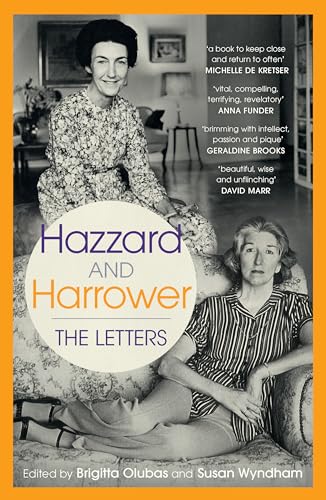
This week’s Meet-the-Author conversation with Brigitta Olubas and Susan Wyndham about their book Hazzard and Harrower: The letters was high priority for me – not only because Hazzard and Harrower are wonderful writers, but because Olubas and Wyndham are themselves significant players in Australia’s literary community.

For those who don’t know them, Shirley Hazzard (1931-2016) and Elizabeth Harrower (1928-2020) were both Australian-born writers, but Hazzard spent most of her life overseas, primarily in New York and Capri. She wrote four novels, of which I’ve read her last two (before blogging), The transit of Venus and The great fire (which won the Miles Franklin Award in 2004). Elizabeth Harrower’s trajectory was more complicated. Aside from living in London from 1951 to 1959, she lived most of her life in Sydney. She published four novels between 1957 and 1966 (of which I’ve read two), withdrew her fifth from publication in 1971, and then pretty much disappeared from view until Text Publishing reprinted her works in the 2010s. Text also convinced her to let them publish that withdrawn novel (In certain circles), and they published a collection of her short stories. I’ve read both of these. (My Elizabeth Harrower posts.)

Brigitta Olubas, an academic and Hazzard’s official biographer, instigated the project to edit the letters, and asked journalist and literary editor Susan Wyndham to collaborate with her. Wyndham had, during her career, interviewed both Hazzard and Harrower. For the project, Olubas focused on Hazzard’s letters and Wyndham Harrower’s. It was a big task that included negotiating how to reduce 400,000 words of letters to the final 120,000. During the conversation, Olubas joked that, at one stage, Harrower had five letters in a row, providing some insight into the challenge it had been to choose letters that would make a coherent whole. Julieanne Lamond, who conducted the conversation, is a literary critic and academic in Australian literature at the Australian National University.

The letters begin in 1966 and continue for four decades, though the two writers didn’t meet physically until 1972, and after that only a few more times.

The conversation

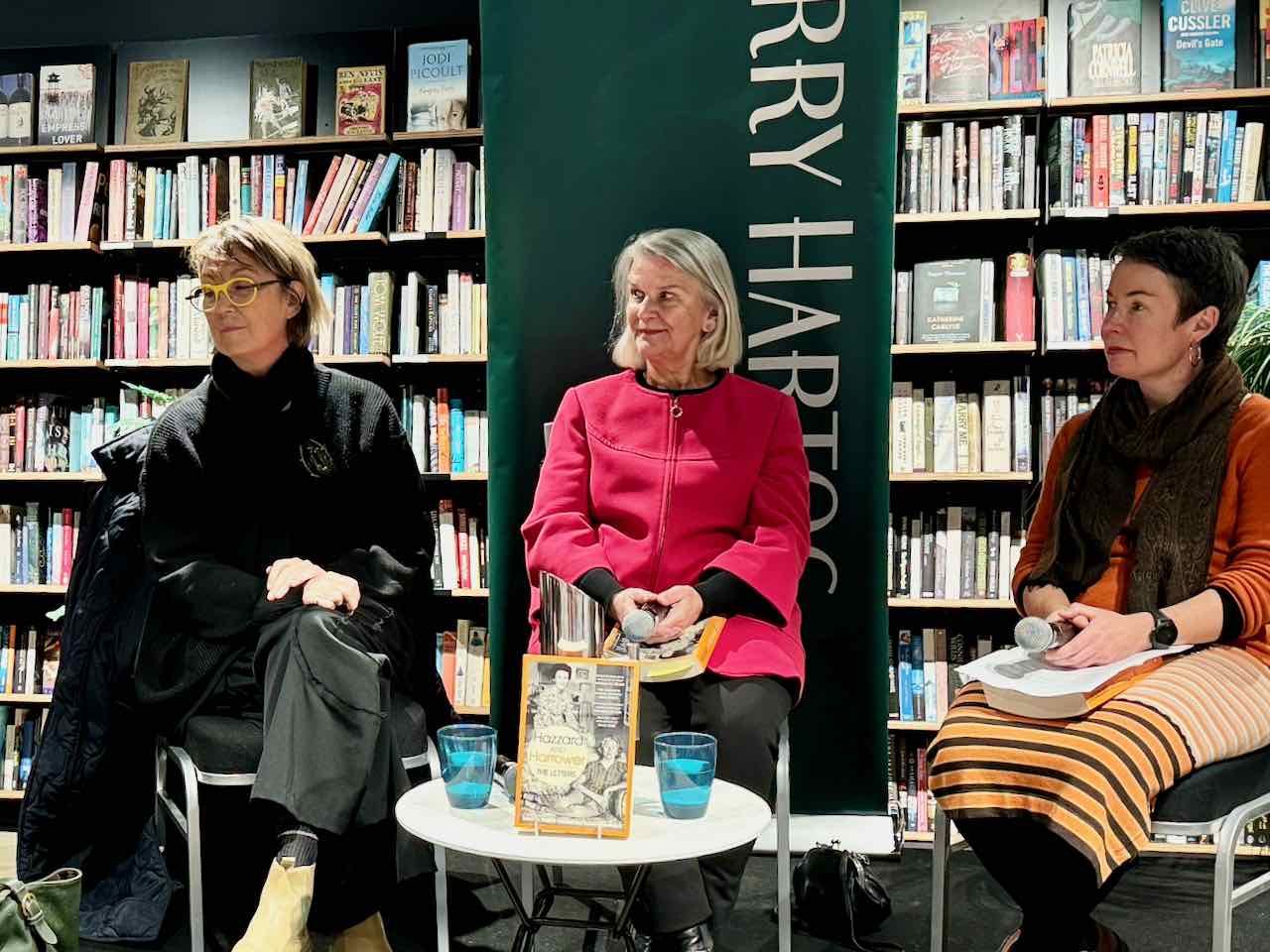
From left: Brigitta Olubas, Susan Wyndham, Julieanne Lamond

MC Colin Steele did the usual acknowledgement of country and introductions, before passing the session over to Julieanne, who started by asking Susan and Brigitta to describe the relationship between the two writers. I am going to use first names from hereon. Last names sound just too formal for warm-hearted events like these.

On their relationship: Susan explained that the two writers were introduced to each other by Shirley’s Sydney-based mother Kit, and that their friendship was formed on the page. Although Elizabeth’s friendship with Kit was kind and caring, family problems and Kit’s mental fragility meant that Elizabeth was thrust into an intimacy she wasn’t necessarily expecting. However, although Kit and her needs occupied part of their correspondence, the two women also wrote about their own lives, what they read, the political landscape, and challenges they confronted in writing (including writer’s block). Their correspondence, suggested Brigitta, may have been more important to Shirley, who said that Elizabeth reflected “something eternal in my consciousness”. She also mentioned the brief falling out they had after Elizabeth visited Shirley and her husband in Italy.

For her part, Elizabeth would tell her friends that she didn’t have much time for Shirley Hazzard, and yet her final letters to Shirley express a keen desire (or concern) to hear from her. Susan suggested that Elizabeth’s attitude could be related to the fact that as Shirley became famous, she became grand in her manner, which Elizabeth didn’t like.

Later, Julieanne asked why would someone, like Elizabeth, take on responsibility for someone else’s mother. Susan explained that Elizabeth liked Kit; they had fun together. Also, her own mother had died (aged only 61) soon after Elizabeth had become friendly with Kit. Elizabeth felt some guilt about her own mother, so was perhaps making up for that. Caring for Kit also enabled her to procrastinate her writing! Julieanne suggested the situation created a complicated sibling-like relationship between Shirley and Elizabeth. Brigitta agreed, adding that Shirley had a sister living in Sydney with whom she had a poor relationship, and would call on Elizabeth to do things that one would normally ask of a sister.

On their careers: Elizabeth had a more difficult career. She wrote a lot in London but it became more difficult after she returned to Australia (due to her own mother’s health). Elizabeth moved in Sydney’s literary circles, including Patrick White, Kylie Tennant and Christina Stead. She had good reviews, but didn’t make a lot of money from her novels. The watchtower – described as a “great act of compression and atmosphere” – was particularly well reviewed.

Shirley also had a late career with big gaps, but is now being rediscovered by younger writers. Both, Brigitta said, were writing “outside their time”, making them difficult to market. They wrote what they wanted to write, what they were good at.

Patrick White, who admired Elizabeth’s writing and kept urging her to write, apparently said that “she’s living a novel rather than writing one”! She was a diligent writer early on but needed a day job to pay her way. She was working at Macmillan publishing while writing her fourth novel, The watchtower (1966). She obtained a grant for her next novel, but that was the one she withdrew. Did she write better when she was pressured for time, as she had been with The watchtower?

By contrast, Shirley was lucky, as she was published by The New Yorker, which provided an income you could live on. She also had a much older, well-off husband, Francis Steegmuller. They worked as jobbing writers, honing their craft. Life wasn’t easy though. She was receiving “monstrous letters” from mother, and her husband started developing dementia.

Meanwhile, Elizabeth had her own challenges. Her mother died in 1970 but, besides Shirley’s mother Kit, she took on helping others, like Kylie Tenant. She got “sucked” into Kylie’s complicated life. She was sympathetic to others. She had a “laser vision into other people’s psyches” which was good for her writing, but it impacted her life.

Both writers, too, were sociable, and claimed they had no time to work. All this affected their careers.

On their correspondence: Both writers put a lot of effort into crafting their letters, which shows in the way their letters reveal their insight into character, dark humour, sense of place, and moral compass.

Brigitta answered in the affirmative Julieanne’s question about whether the two were thinking about posterity as they wrote their letters. Infuriatingly, Shirley didn’t keep her manuscripts – she seemed invested in herself as a “perfect first-time writer” – but she kept her letters and diaries. Elizabeth, on the other hand, threw out many letters, including those she wrote to her mother, but she did keep an “organised set of letters”. Susan believes she wanted posterity to find her. This may be why she was discreet in her letters, often not naming people she wrote about. Susan did some sleuthing to unearth some of this information.

Brigitta added that they had no false modesty. They were aware of their value as writers.

On their political views. Both Shirley and Elizabeth had strong political commitments. Shirley worked for the UN for 10 years. She was bound up in the moral seriousness of the project, and likened her own views to those of Milton – his liberal attitudes, and his commitment to becoming involved in political ideas. Later, Shirley became obsessed with Watergate. In 1977, her article “Letter from Australia” (paywalled) was published in The New Yorker. I think it’s here that Shirley writes about Nixon and Republicans, saying something like “each one in his awfulness makes the next one possible”. Hmmm…

As for Elizabeth, she grew up in Newcastle, through wartime. She saw poverty, and she witnessed the Aldermaston anti-nuclear protests in England. She was galvanised by Whitlam and his reform project. She was staying with Christina Stead at University House in Canberra when the Dismissal occurred, and was at Parliament House when Whitlam appeared on the steps. Susan read from Elizabeth’s letter to Shirley on 17 November 1975, but I’ll excerpt her excerpt. Elizabeth describes Stead answering the phone and being told that Malcolm Fraser was now Prime Minister, then writes:

… Horror. Horror and stupefaction. People very nearly fell down in the street with amazement and dismay. Manning Clark (our most splendid historian) said he was literally sick … Everyone was outraged. Our votes meant nothing. Moderate reform is not allowed to take place here. The new leaders came out on the balcony and laughed like Nazis …

We weren’t surprised when Susan said that later, Paul Keating became her new hero.

Despite this, Elizabeth wrote that she wished she hadn’t become so involved in politics.

Q & A

There was a brief Q&A. By this time I was struggling to keep up with my notes, but here are some of the points discussed:

  • Brigitta and Susan talked about their own, relatively new, literary friendship which has been forged through this project.
  • Regarding gaps in the letters – and things not discussed – they don’t know why. Were they discussed when they met, or over the phone, or?
  • Regarding the brief falling out between Shirley and Elizabeth, this happened in 1984 during a visit Elizabeth made to Capri. She hadn’t wanted to go but had relented after much urging from Shirley. Elizabeth didn’t behave well. Brigitta and Susan speculated on why. Perhaps she didn’t want to let Shirley feel grand (as she was inclined to do), or perhaps, being worried about spending money, Elizabeth didn’t want to feel obliged. An audience member wondered whether the awkwardness came from theirs being primarily an epistolary friendship. Perhaps, was the answer. Speech seemed to be a second language for Shirley. She could be more truthful in writing. She was also, they commented wryly, better at monologues than conversation. Writing gave them both time to consider their thoughts. (I relate to that!)
  • There was also discussion of the history being lost because people aren’t writing letters like this any more. Julieanne commented on the value of letters like these in which time and care have been taken to express thoughts. There is a sort of romance, too, it was suggested, in the time and distance correspondence like this involves.

Brigitta shared some words from a short letter Elizabeth wrote to Shirley on 13 June 2005 concerning a visit Shirley was making to Australia:

You say you hope to be recognizable, and I look much more worn than I feel, but we’ll know each other.

“But we’ll know each other”. Lovely – and what fascinating women.

Vote of thanks

Beejay Silcox, literary critic and Artistic Director of the Canberra Writers Festival, gave the vote of thanks. As eloquent as ever, she was enthusiastic in her acknowledgement of what Brigitta and Susan have achieved and of the conversation we had just experienced. I think I got the gist of her remarks. Describing herself as “a pathological shredder of the past”, she admired these “life-ravenous”, ferocious, flawed and gorgeous women whom we discover through their letters. She described the book as protecting the comradeship of writing, and as a “great and mighty gift” to readers. Our culture tends to praise newness, she said, and bright, shiny things are lovely, but they are not the whole story. Yes! (This is why my reading group aims to include at least one classic/significantly older book in our reading schedule each year. Not only do “good” older works make great reading but they add perspective and depth to all our reading.)

Another very enjoyable, and well-organised, meet-the-author event.

ANU/The Canberra Times Meet the Author
MC: Colin Steele
Harry Hartog Bookshop, Australian National University
16 July 2024

Shankari Chandran in conversation with Karen Viggers

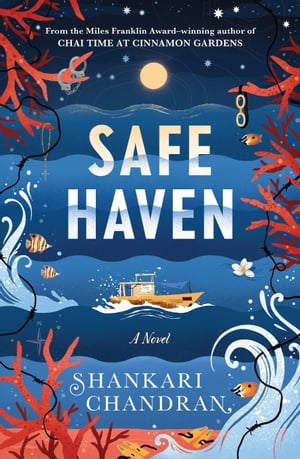
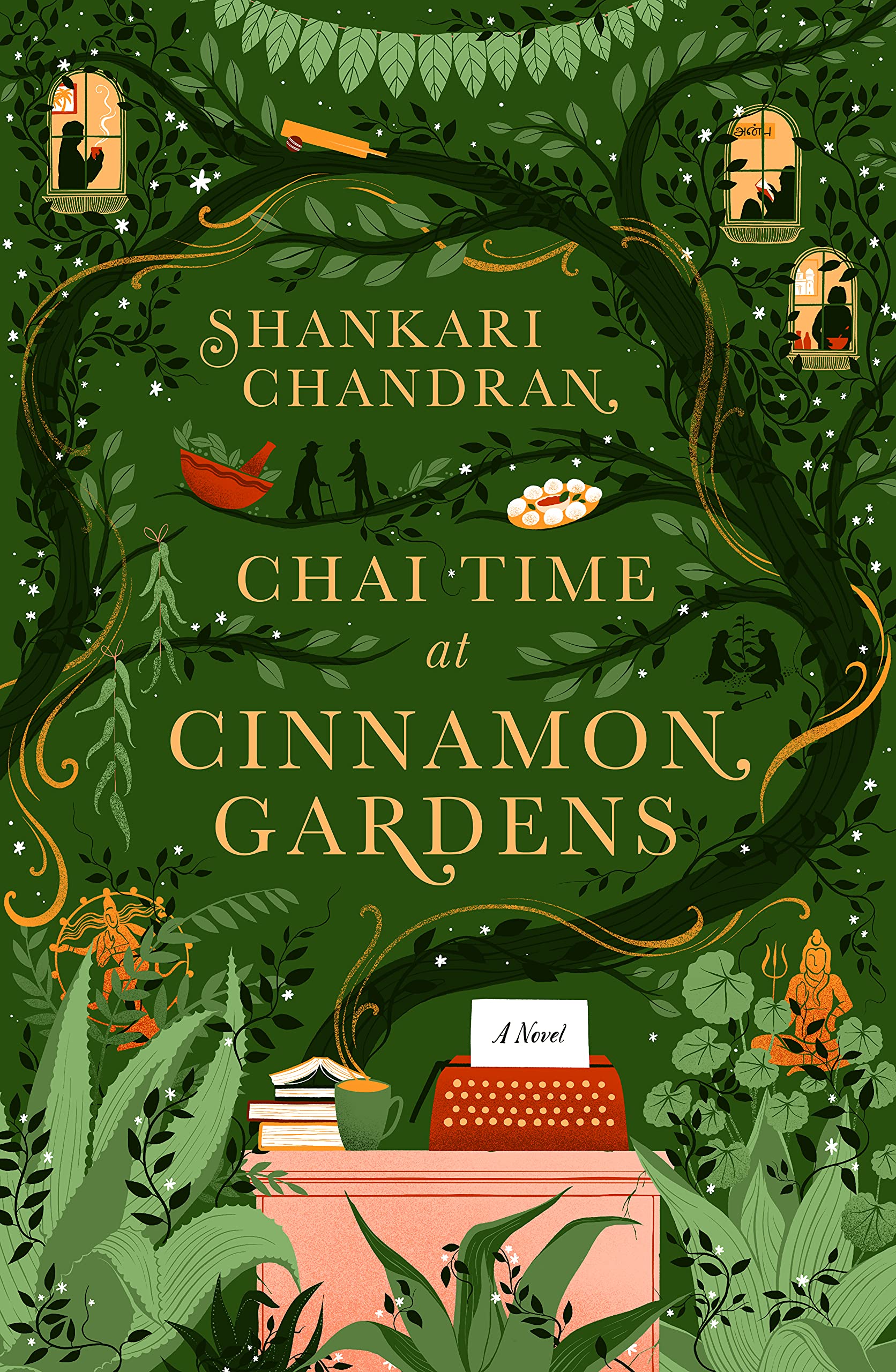
Shankari Chandran’s conversation with Karen Viggers is the second Meet the Author event I’ve managed to attend this year, and it reminded me how much I wish I could get to more of these sessions. This one featured Shankari Chandran, author of the Miles Franklin winning novel, Chai time at Cinnamon Gardens (my review), in conversation with Karen Viggers, who was on the other side of the table at the last session I attended. Karen has appeared several times on my blog, most recently for her novel Sidelines. And Shankari was appearing at this session for her latest novel, Safe haven.

This was a wonderful session, which featured intelligent questions and thoughtful answers from two writers who care deeply about justice and how we find and express our humanity. Their backgrounds might be different, but their hearts not so.

The conversation

MC Colin Steele opened proceedings by acknowledging country and introducing the speakers. He then introduced the conversation, describing Safe haven as appearing to be about displacement and seeking refuge, but in the end, he said, it’s about finding home.

Karen started by congratulating Shankari on winning the Miles Franklin award last year. She wanted to know how Shankari felt the moment she heard she’d won, and its impact on her life and career. Shankari told a funny story about not answering the phone at first – because it came from an unknown number – and then not believing it when she finally answered and got the news! However, of course she was thrilled, and it has been extraordinary for her career. It has affected sales, and it created a spotlight on all her works, not just the winning book, and on her ongoing themes of injustice and dispossession. She also hopes that her win has helped and encouraged other writers of colour.

Shankari also made the point that it was great to win such a prize for a diasporic migrant story, one that is not only set partly elsewhere, but that interrogates who gets to define identity to the inclusion of some and the exclusion of others.

Sticking with the getting-to-know-you theme a little longer, Karen wanted to know how Shankari manages her busy life with four children, a law career, and writing. “Very badly” was the response, accompanied by some self-deprecating humour, followed by a recognition that she has a great team in all aspects of her life.

Karen then moved onto Safe haven, using descriptors like “moving”, “confronting”, “shines a shaming light” on detention, and creating “humans we come to care about”, and noting that the book contributes to an ongoing discussion about racism and exclusion in this country. Shankari talked about the approach she’d chosen, which was to write a romance and murder-mystery set in an off-shore detention centre. Her two main characters are the nun, Sister Fina, who seeks asylum, and special investigator Lucky, sent to investigate the death of a detention guard. Was it suicide, or was it not? Shankari described her book as being about the lengths people will go to to find safety and home.

Wanting to explore the romance-and-mystery approach a bit more, Karen commented that it was a surprising decision. And here a major theme of the discussion came to the fore, Shankari’s belief in storytelling. She wanted to elevate the lived experience of marginalised people, and likes to use fiction/storytelling to take readers into a place of discomfort but one where they can feel safe to reflect and think about the ideas. She wanted a storytelling mode that is compelling, entertaining, interesting. John Le Carre used the literary thriller model to explore macro themes of injustice, so she “wanted to give it a go”.

This led to continued discussion about using fiction to draw people and explore themes, and to the specific question of what Shankari wanted readers to take away from the book. She wants people to not forget the detention centres and what is happening to people in them. Politicians – and the media – too easily appeal to our baser instincts and encourage moral panic. But, she says, there are Australians who see the situation differently – like the people of Biloela for example, people who understand why others get on a boat, risking everything, to seek safety in another country. She wanted to elevate that aspect of what it means to be Australian. (Shankari used the word “elevate” several time during the conversation, and I like it. It’s powerful, and conveys something active and positive, active.)

Shankari talked about her two main characters, and what inspired them. Sister Fina stemmed from her admiration of people whose faith calls them to the sort of bravery seen in religious people during the terrible last days of the Sri Lankan Civil War. Special Investigator Lucky, on the other hand, was fun to write, because she could have Lucky do the sorts of investigation she’d like to do. Of the friendship that develops between these two, Shankari wanted characters who help each other, not one being saviour and the other the saved.

The conversation then moved onto the book’s tougher sections, and how Shankari researched and handled writing them – the scenes at the detention centre, for example. Here, we got a clear sense of Shankari’s ethical and compassionate approach to her work. She set herself some parameters. For example, she would not try to go to a Detention Centre, because she dislikes the voyeurism involved. For this same reason, she did not want to speak to the Biloela family whose story had provided inspiration for the book. At the time of writing they were still in a difficult place. It was not her place to draw fiction from their specific experience. So, she used research undertaken by civil organisations and activists; she read memoirs; and she used her experience of working in justice. If she had a superpower, she said, it would be that through her life people have given her their stories. These recorded truths, she’s been privileged to hear.

But, obtaining these stories, including those she needed for the brutal Civil War flashbacks, requires sensitivity. Interviewing people about their trauma can re-trigger that trauma. When people do want to tell her their story, she is careful about process because they don’t aways know how telling the story will affect them. She is careful, also, to ask whether they want their “lived experience to be conveyed in fiction”. Most respond that there are few safe places in our culture for the truth except in fiction! That feels like an awful indictment on our nation, but a powerful argument for the role of fiction/storytelling in our lives.

Indeed, a strong message I took away from the conversation was absolute belief in fiction being a way to tell important truths, but awareness that those whose truths are being told may not like them fictionalised.

The novel is not all grim, however. Karen turned to the scenes in Hastings (which were inspired by Biloela). What did Shankari want people to glean from them? That strangers can become family, she said, and that we should celebrate that capacity in us. Rural communities are often remote. They only have each other, and can develop an incredible ethos. Hastings offers a moral counterpoint to the other parts of the novel, but also offers readers a place of fun and joy.

Karen raised Australia’s policy regarding asylum seekers, and our use of privatised services to manage detention centres, particularly given these companies can employ people who “have done terrible things”. And why do we not have compassion for asylum seekers? The government’s arms-length management of asylum seekers, said Shankari, erodes accountability and transparency. Her novel asks the questions. It doesn’t provide answers.

As for our lack of compassion, Shankari said she struggled to understand the high level of xenophobia she found in Australia regarding migrants. She was horrified when she returned to Australia with her children – telling them it was “home” – only to find strong racial profiling of “friend” and “foe”. It’s disturbingly easy for politicians and media to trigger xenophobia – and not just in Australia. But she believes we are capable of integrity and intellectualism. This experience, and talking with Aboriginal activists, led her to think about the creation of nation, about the mythology of a nation’s founding and how we construct identity from this, one that involves the inclusion of some and the exclusion of others. She saw a link here with Sri Lanka’s founding mythologies. Does our concept of being Australian really need us to create “other” to maintain it?

Shankari believes that we have a choice in how we want to be – to face the future with fear, or with compassion!

Finally, Karen asked Shankari about how, with such a serious subject, she manages to achieve her light touch. It’s not conscious, but she’s a funny person, said Shankari – and life is tragic and funny. There’s irony too, including in the title. As to whether humour helps keep her sane, Shankari said that a lot of her work deals with trauma. She relies on humour to enable her to keep writing and her readers to keep reading. Writing trauma is traumatic, but she’s writing about the experience of people who have suffered but have survived, who are resilient. Their lives need to be elevated and remembered.

Q & A

On how children of disaporic migrants can broach their background with colleagues and friends. Books and stories, said Shankari, offer a good way in. Also, curiosity and questioning, and trying to meet people where they are. She shared advice she once received from a First Nations Australian, which was to “listen in order to listen, not to react and respond”. (What great advice.)

On how she, not Sri-Lankan born, knew all the details she used in her book, and how she decided on the Cook issue in Chai time in Cinnamon Gardens. For the first, Shankari laughingly credited the talkativeness of her extended family, but regarding the second, she reiterated her point about the creation mythologies in Australia and Sri Lanka and the role they play in forming national identity.

Vote of thanks

Sally Prior, literary editor of The Canberra Times offered a brief but heartfelt vote of thanks. She commented on the lack of curiosity in Australians regarding asylum seekers – who they are and why they want to come – and said she was inspired by Shankari’s persistence. She thanked all involved for an excellent conversation, to which all the audience could say was, hear, hear.

ANU/The Canberra Times Meet the Author
MC: Colin Steele
Australian National University
13 May 2024

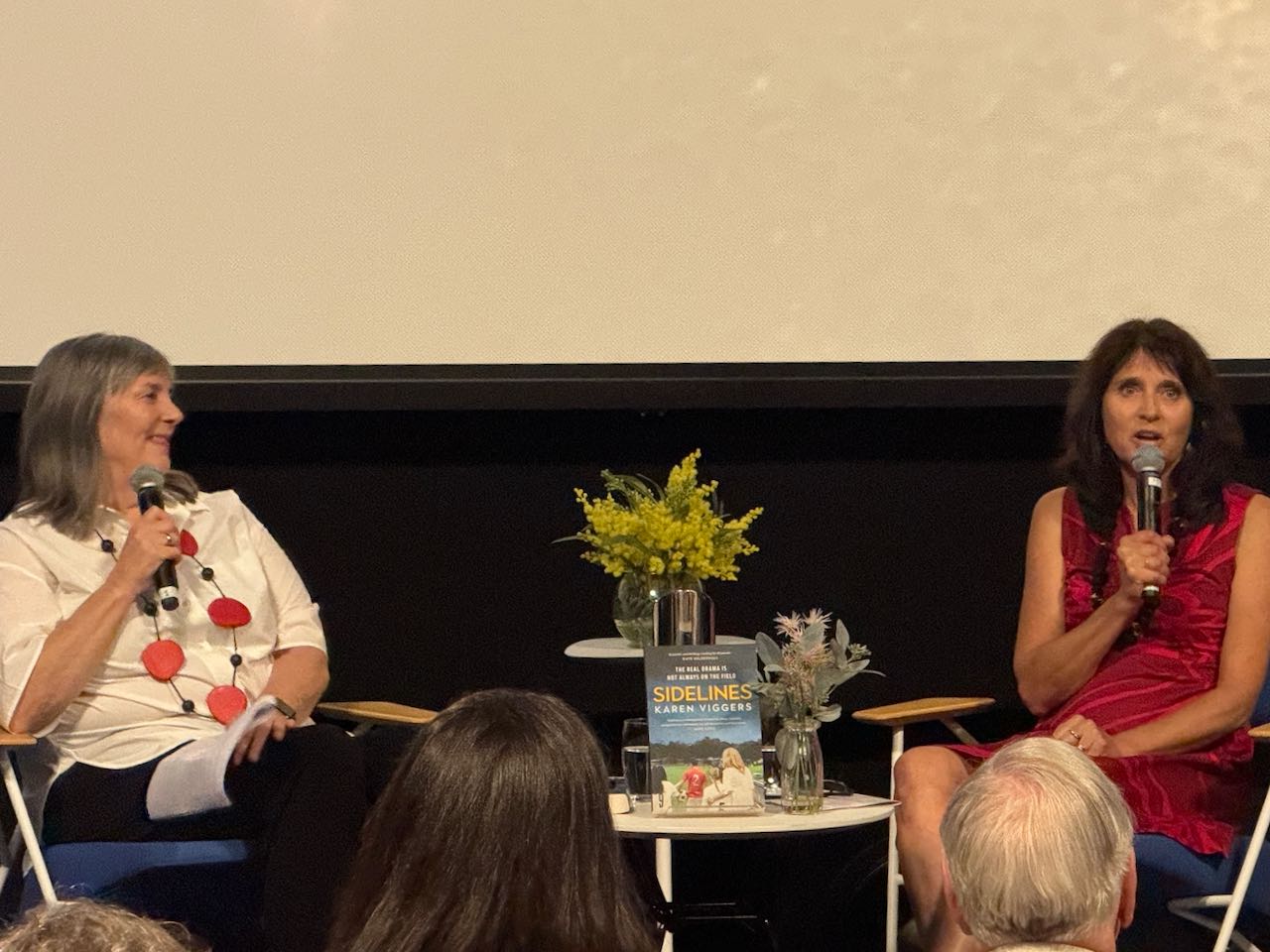
Karen Viggers in conversation with Alex Sloan

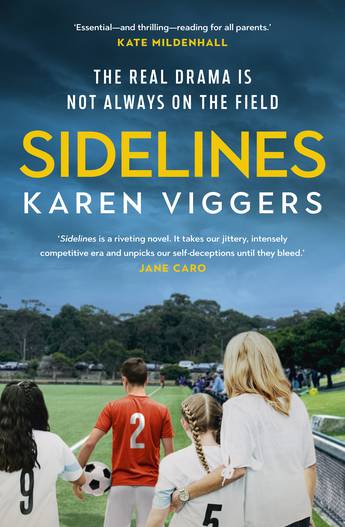
When Colin Steele emailed out the schedule, to date, for this year’s Meet the Author series, I immediately marked in my calendar those events I could attend. There weren’t many, as life is busy with yoga, tai chi, reading group and concert subscriptions, but the first I could attend was local author Karen Viggers (who has appeared several times on my blog) in conversation with Alex Sloan about her latest novel, Sidelines.

The conversation

MC Colin Steele, who was so deservedly made a Member of the Order of Australia in this year’s Australia Day Honours, opened proceedings by acknowledging country and introducing the speakers. He then paid tribute to Marion Halligan who had died this week, and who had planned to attend this event. There was an audible sigh in the audience because she really was much loved here. But, moving on, as we must … Colin introduced the conversation, describing Sidelines as “social commentary on modern society”, before passing us over to another local luminary, Alex Sloan.

Alex opened with a point I had planned to make in my post on the book, which is that it’s quite a departure from Viggers’ previous environment/landscape-based novels. Sidelines is set in the suburbs, whereas her previous four novels are set in “wild, rugged places”. But then, on reflection, she added, suburban Sidelines is “rugged” too. It “has teeth”.

However, before asking Karen about her novel, she too paid tribute to Marion Halligan. How could she not, given this week, this place, and this interviewee? Karen responded by saying what a “terrible loss” Marion’s death is. She had been a “huge supporter” and friend, and had lived life right to the end. Isn’t that how we’d all like to go?

Karen then shared a statement made by Marion, in an interview with Gillian Dooley, about what novels are about:

It seems to me that novels are very much about this question of how shall we live, not answering it but asking it, and what novelists do is look at people who live different sorts of lives, and often people who live rather badly are a good way of asking the question.

This is so Marion! Karen suggested that Sidelines looks at people living badly … but not at bad people. There’s a difference – one that people don’t always make, I think.

She also said – and this is the other thing I was planning to raise in my (coming-soon) post on the book – that she realised she is an “issues-based writer“. She can only write what is inside her. This book grew partly out of her thinking of her own behaviour but was also inspired by an Under-12 Canberra football game in 2014, which had ended in parents brawling on the field. Were these, she wondered, really bad parents or parents who had got carried away?

There is a line between support and pressure, and she wanted to use fiction to consider the issue – not just in sport, but in society overall. Where is the line drawn?

Alex asked about the fact that she has said that her first draft was written in anger. Karen explained that she had seen her son, a volunteer referee, cop a lot of abuse which has resulted in his giving up refereeing. This and other injustices she’d seen had made her angry.

Alex then moved to the characters, asking Karen to talk about them and their role in the novel – the well-to-do Jonica and Ben who start the book, and the succeeding characters who include the working-class Greek-Australian family, Carmen and Ilya, and the young talented player Griffin. Alex, as became clear through the rest of the interview, disliked Ben and loved Griffin.

Karen teased out her characters a little. Ben is one of those fathers who have to win at everything. For him winning at sport is all, and it gives social currency. However, Karen wants people to think about what success really is. Sport brings very different people together, people who may not otherwise ever meet each other. Choosing this subject-matter gave her an opportunity to explore class.

Turning to Griffin, Karen talked about how sport can also be a way out of poverty. She wanted to include all the different elements of sport – class, cultural, economic, and so on. She said if a child shows an ounce of talent, parents are sold the idea that their child can play for Australia, but only a tiny percentage do. Later in the conversation, Karen said that the lovely Griffin had been inspired by a particular young player she knew. He provides one of the novel’s epigraphs.

Karen said she had started this novel thinking she was writing about sport, but soon realised that, in fact, she was writing about modern society and parenting.

Alex mentioned the dog Honey and its importance to teen Audrey, noting that there’s always a dog in Karen’s books. Doglover Karen commented that animals are a great support to families, and that we can’t underestimate their role in our mental health. (Yes! Like her character Audrey, I found much-needed solace from my beagle when I was a teen.)

The conversation then segued to how well Karen had got into the heads of teens. We often forget the pressures of being a teen, Karen said, and how something like sport, which is meant to be fun, becomes pressure.

From here, we moved on to writing characters. Karen said she likes it when her characters start to take over and tell her who they are. Her first angry draft was too black and white. It needed more nuance. Alex, still disliking Ben, asked about the writing of badly behaving characters. Karen didn’t see the characters as all unlikable, and anyhow, she said, characters don’t have to be likeable. The structure of Sidelines is like The slap (my post). It is told chronologically but through six different characters, with each character picking up the story from the one before.

Alex mentioned the references to the arts in the novel. Had Karen specifically intended to pit the arts against sport? Audrey, said Karen, is a teenager who is interested in many things. She did want to play for Australia, but she also wanted to try other things like theatre. However, her father had told her to choose what you are best at. The arts vs sports question hadn’t been a conscious theme, but she had pared the novel back to leave gaps for people’s own thoughts. She didn’t want to be didactic.

The conversation turned to specific examples of young talented sportspeople and the role of parents in their lives – like Jelena Dokic (whom the world had watched being abused by her father), David Beckham whose parents had different ideas about their role in his success, and Ellyse Perry whose parents had never applied pressure but had always supported her. There is, said Karen, a wide range of parental behaviours and she wanted to leave space for readers to think about all this, particularly in terms of expectations and ambitions.

Regarding writing about the actual playing of sport, Karen said that watching someone who is really good is a form of beauty, like experiencing poetry or music. Alex suggested that beauty is usually revealed in her novels through nature, but in Sidelines we see it through Griffin.

Given how well Karen had captured teens, Alex wondered whether this novel would be suitable for schools. Karen felt that it could work for, say, Year 10, but is more interested in seeing it discussed in book and sports clubs. She’d like people to think about about how to be better parents, how to be better sports parents, and, more broadly, about our society and its attitude to competitiveness. She shared the story of a child being asked about the best thing about playing sport, and answering that it was the time with her friends before and after their games. If we want children to keep playing sport through childhood and into adulthood – something that is good for people’s health – we need to tap into how to make it enjoyable.

Q & A

On her professional versus writing life, and how the former helps the latter: Karen said her work as a vet keeps her in touch with the real world, and enables her to meet people from all walks of life.

On what talented athletes need besides their natural talent: Karen felt it was all those obvious things, like grit, the inner desire to play, support from others, persistence, willingness to take risks, knowing what to do afterwards (which Audrey points out to Griffin in the novel). In particular, she said, it’s the ability to be a team player, and being able to make the team look great as well as oneself.

On (referencing the Adam Goodes booing affair) being a good watcher: Karen talked about the importance of adults role-modelling good behaviour. When parents and coaches abuse referees, so will children. She hopes her novel will stimulate discussion about these sorts of issues.

On her popularity in France and how she thinks this book will go: The novel is currently being translated. The French love her “big landscapes”, but they also like philosophical questions so she hopes this novel will appeal to them for that.

On whether parents and children have different wants, different attitudes to winning and losing: After some sharing of quotes about winning and losing, Karen said that “how” you win or lose is more important than “whether” you win or lose.

Vote of thanks

Emma Pocock, wife of Federal independent senator David Pocock, gave the vote of thanks. (Pleasingly, it was Emma, not the organisers, who referred to her husband. She was introduced in her own right, as the founder of FrontRunners and an emerging writer). She shared a poem she had written at the end of her husband’s sporting career. It concludes with a reference to all those winning trophies/cups. They are, she wrote, all hollow, and must now be filled with something tangible, something that was really him.

Sidelines isn’t, she said, about neatly sorting characters into good and bad – as she’d initially tried to do – but about our behaviour individually and collectively. It asked her, she concluded, to think.

This was a lively but warm-hearted evening at which the local literary community came out in numbers to hear and talk about Karen’s timely book, to think about its intent, and to share in some camaraderie in a sad week.

ANU/The Canberra Times Meet the Author
MC: Colin Steele
Australian National University
22 February 2024

Melissa Lucashenko in conversation with Alex Sloan

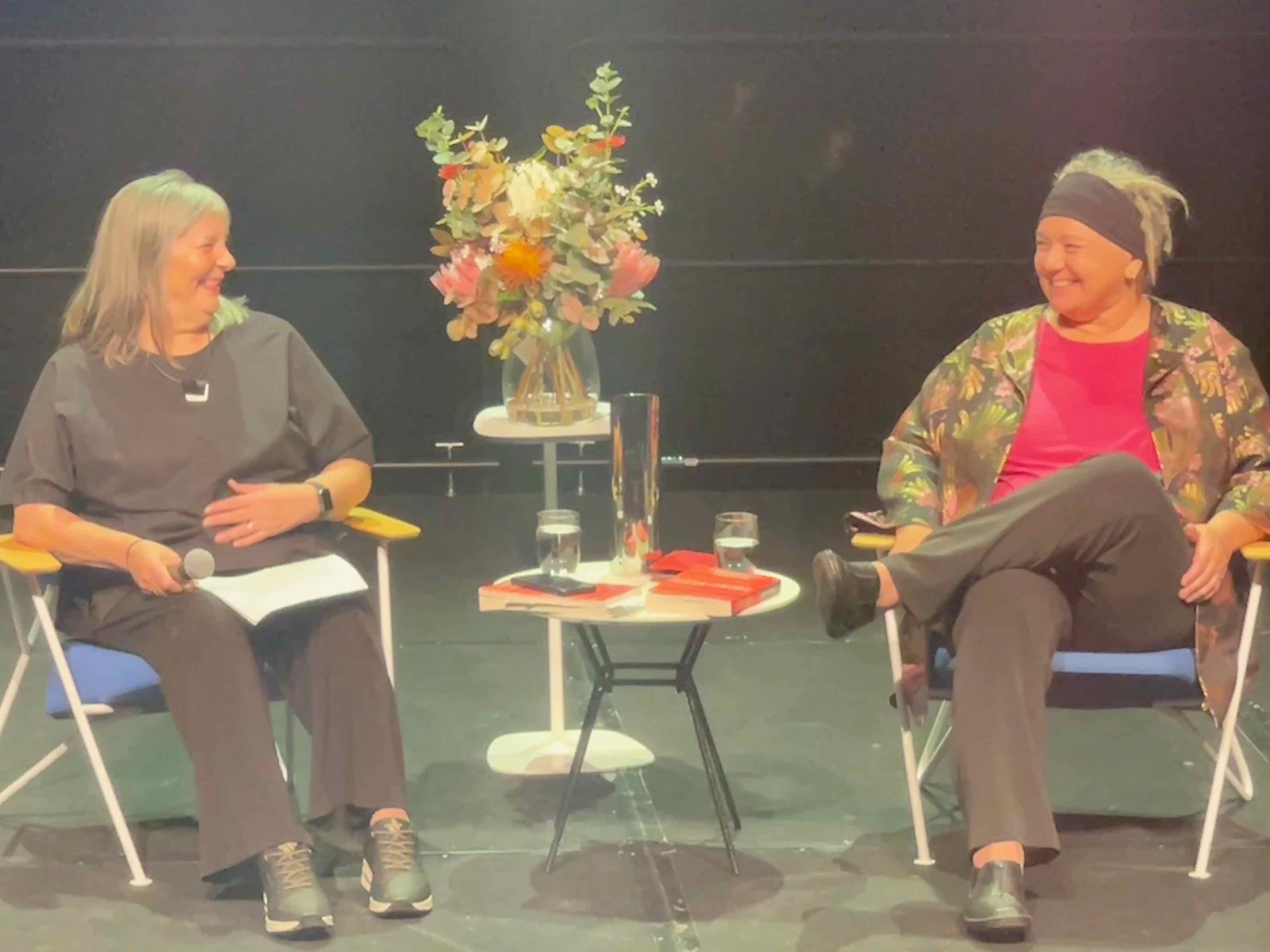
I can’t believe it’s been a year since I attended an ANU/The Canberra Times Meet the Author event, but this year has been packed. Finally, though, we were free on at the right time – and the event happened to be one of high interest for me, Melissa Lucashenko being interviewed about her latest book, Edenglassie. The interviewer was popular ex-radio journalist and well-known Canberra booklover, Alex Sloan.

I have posted on Lucashenko several times before, including on her Miles Franklin award winning novel, Too much lip. I don’t always hang around for book signings these days – do authors really like doing them? – but we thought we’d see how long the line was. It wasn’t too long, so I decided to hang around. When it got to my turn I told her that I loved that she could write with humour about serious things. It’s a skill. Quick as a flash, she signed my book “For Sue / Keep laughing/ Melissa Lucashenko”. It was worth lining up for.

The conversation

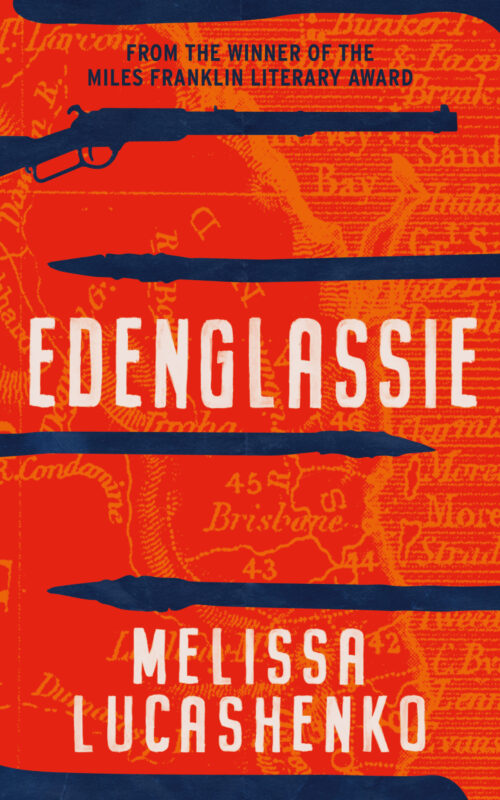
The event started as always with MC Colin Steele, acknowledging country and introducing the speakers. He explained that the title of Lucashenko’s latest book Edenglassie, comes from the name, combining Edinburgh and Glasgow, that was nearly given to Brisbane in early colonial times. He summarised the book as being about the “impact of loss of country” but also being a “novel of strength and love”.

Before getting into the conversation, Alex Sloan referred to the elders at Uluru and their request of us, the Voice, that we are now voting on in this weekend’s referendum – and asked us all “to do the right thing”. Problem is she was probably preaching to the converted.

I’m going to use first names, mostly, in the rest of the report where the alternative would feel too formal.

Alex started the conversation by referring to a review in The Guardian which described the novel in terms of its “flair, humour, generosity” and as being a novel about ongoing resistance. She then asked Melissa to share the origins of her novel.

Melissa commenced with “hello friends” and said she’d like to “extend good feelings to anyone touched by events in the Middle East”. There’s nothing much else she can say, she said, but “war crimes are never ok”.

She then introduced her novel, describing it as a historical novel, with a contemporary thread to add some humour. She said it had grown out of the memoir she’d read of the Queensland “pioneer” Tom Petrie. She told an amusing story about being in London at the same time as Alexis Wright, then working on Carpentaria (my post), and as Peter Carey, who had won the Booker Prize with True history of the Kelly Gang. We are talking around 2001, I guess. Apparently, after they’d had a brief moment with Carey, Wright, who liked Carey’s book, also said that the problem was that Australians “write too many historical novels”.

Melissa took this to heart, and so her first three novels were contemporary novels. But, on catching up with Alexis Wright several years later, she reminded Wright of her comment. Wright looked at her, and clarified that she meant “white people write too many historical novels, not us”. Lucashenko went back to her historical novel interest!

Alex then moved the discussion on to place, noting the epigraph from Jean Rhys’ Wide Sargasso Sea. It comes from when the now locked-up Antoinette is told she is in England, and responds “I don’t believe it…and I will never believe it”. Lucashenko explained its application to her novel, to the fact that Australia is “aways Aboriginal land”. All her books are about place she said.

Alex asked about the novel’s first line, which describes Granny Eddie “falling, falling, falling”. Lucashenko said that besides Granny’s literal fall, it also alludes to an old woman “falling, falling, falling” in a Thea Astley* novel, and to the biblical fall.

Next, Alex turned to the novel’s love theme. Lucashenko said it has two love stories, one in each time period. Blackfellas are human too, she said, and deserve “love, joy and peace” like anyone else. I hate that she feels she has to say this. What sort of world do we live in? Anyhow, Alex described the historical lover Mulanyin as “hot, move over Mr Darcy”, she said. She asked Melissa to do a reading, which she did, from Chapter 8, when the historical section lovers meet. “Love at first sight,” said Alex.

The conversation moved from Mulanyin and his love interest Nita to the modern storyline and the character of Winona, who, Lucashenko said, is around 27 or 28, and “likes to tell it straight”. Alex asked her why she interlinked this modern story with the historical one, and the answer was clear and to the point. She wanted to counteract the trope of the dying race. It has been slowly changing since Mabo, but is still evident. Because of it, she never kills off her Aboriginal characters. She also wanted to balance feisty characters still here in 2024, who are talking back, with her historical figures.

From here, Alex asked Melissa about Edenglassie being a work of fiction. Lucashenko responded that although it was a work of fiction, she’d done a lot of research. She’d agonised on getting facts right, because she had Keith Windschuttle on one shoulder and Andrew Bolt on the other (an image that tickled Alex.) She knew her novel would be attacked because she was telling the story from a non-conservative position. Her historian friend reassured her, though, that “it’s all fiction” – a position I don’t disagree with. Melissa also shared Barry Lopez’s point that everything in life is “story and compassion”.

At this point we returned to the title. Lucashenko elaborated on Colin Steele’s intro, saying it had come from the Scottish Chief Justice Forbes who had established a property in NSW called Edenglassie, and had liked it so much that he tried to later give this name to Brisbane. It’s a great find for a writer. Lucashenko loved it with its “Eden” and “lassie” (for a feminist like her) references. 

In terms of the novel’s perspective, she said that at the time the historical part of the novel is set, the Aboriginal people, who were in the majority at that point, felt the whites would go away. This brought us back to discussing Mulanyin, whom Lucashenko described as brave, and a fisherman. She did another wonderful reading from early in the book, when he is taught some lessons by his elders, but taught in the way First Nations culture does it, which, as Lucashenko describes it, is “you go work it out”. In this case, the lesson involved honouring old ones and not being destructive out of greed. 

Lucashenko also explained that her idea for the novel had its origins in the fact that next year will be the bicentenary of white Queensland. She wanted to provide an Aboriginal perspective on the story but it developed into something more complex, that included love, and also encompassed the idea of “what could have been”. 

She talked quite a bit about Tom Petrie who had established a pastoral station with the permission of the local Aboriginal headman – in a location that was strategically chosen by that headman. The central question of the novel concerns “what was going through these people’s minds”. Things could have been different then, she said, and could still be now. There’s the paradoxical idea of British pluck and courage versus the facts involving murder, mayhem, theft. The conversation teased out several complex ideas about colonisation – attitudes to law, and to beliefs, for example. Lucashenko talked about pastoral workers being branded, and how that can be seen in two ways – it marks a person as a slave, but it can also work as protection (as in “don’t shoot me, I belong to Petrie”.)

Her story explores how colonisation could have been done differently. In Petrie’s case, for example, it was still colonisation, but the way he did it saved Aboriginal lives and partly at least protected their culture. I’m intrigued. Without having read it yet, I can see why she felt the need to prepare herself for attacks. (She’s been attacked before for her “non-conservative”, confronting exploration of difficult subjects.)

Alex talked about the section in the book where Mulanyin asks for permission to marry Nita. She felt it explained things about Aboriginal practices and beliefs that she had not known (which is how Debra Dank’s We come with this place impacted me, so I look forward to continuing that journey here.) Lucashenko then talked about the novel’s modern thread, about Winona confronting the wanna-be (my term) Aboriginal, and her upfront message to him. About this, Lucashenko said that “being harsh is not blackfella law” but there is also a “right way”.

Q & A

On what she learnt about herself through writing each novel: That she has stamina for writing, though not for much else. So, the lesson is, “Do what you are good at”! 

On not providing a glossary for words in language: Meaning can be understood with a little work; knowledge is best earned not given. (Love this.) 

On the novel taking four years: She has been writing this novel her own life, but serious research for it started in 2019, just before the fires, floods and pestilence!

On how Brisbane is affected by its history: All Australia is affected by colonisation, but in Brisbane’s case it was a brutal penal settlement, giving meaning to that phrase, “Another day in the colony”, which still has meaning today. Melissa talked about the question “Are you a monkey or an ape” experienced by an Aboriginal woman prisoner in Logan in 2014.

Vote of thanks

Lucy Neave (whose novel Believe in me I’ve reviewed), gave a sincere vote of thanks, which included thanking Melissa for the special readings from her book (there were three.) She described Edenglassie as a generous book, that’s “compelling, accessible, and meticulously researched”. It encompasses diverse values, she said, and shows what enormous value we can get “if we listen”. 

I would add thanks to Lucashenko for her gracious handling of occasional clumsiness from her questioners, because we whitefellas can be hamfisted at times.

* First Chris Flynn (Here be Leviathans) and now Lucashenko admit to the influence of Thea Astley. Love it

ANU/The Canberra Times Meet the Author
MC: Colin Steele
Australian National University
12 October 2023

In conversation with Craig Silvey

I understand that literary conversation events in Canberra go best when the subject is political. I guess it’s the nature of the beast – that is, of living in the national capital. But for me, it’s the fiction writers that I want to see, and we do get some interspersed amongst the run of historians and journalists that we get. Even so, it’s been three years since I attended an ANU/Canberra Times Meet the Author event, due partly to the pandemic which halted the program for a while and partly because I have a pretty full dance card. However, Mondays are often free, so Mr Gums and decided to check out Craig Silvey. I’ve only read his best-selling Jasper Jones (my review) but that’s because you can’t read everything. I would like have read Honeybee. Tonight’s focus, though, was his latest novel, Runt.

The conversation was conducted by local author Irma Gold, who is no stranger to this blog. She’s always good in the interviewer’s chair, being both warm in manner and astute about writing – and so it proved again tonight.

The conversation

After MC Colin Steele did the usual introductions, Irma took over and introduced Silvey and the book we were there to hear about. Runt is, she said, a middle-grade children’t book. It features a solitary girl, Annie, with a penchant for fixing things, and the dog, Runt that she befriends. Irma found Runt a heart-warming book, which was lovely to read to her 11-year-old son. She believes it is destined to become a children’s classic. It would, both she and Colin Steele said, make an excellent Christmas gift. What a shame our grandson is only 4.

Irma Gold and Craig Silvey, 2022, ANU

After some light-hearted banter with Craig about a Fremantle biscuit artist – who knew? – Irma got down to business. Noting that Runt represents a new audience for Craig – that middle-grade age – she asked what his favourite book/s had been as a child. Craig replied that he’d been a voracious reader as a child. (Show me an author who wasn’t!) He loved a range of books, including those traditional classics like Lord of the Rings and the Narnia books, but then he made some points that were specific to him. For example, he liked books that made him feel things, and named a short story by Paul Jennings titled “Busker”. It was the first story, he said, that made him cry. Another favourite was Goodnight Mr Tom, which elicited sounds of agreement from the audience, and which, he later realised, might have partly inspired Honeybee.

He also liked books that made him laugh, and he mentioned Roald Dahl, Paul Jennings again, and the James Herriot vet series.

After this, there was some discussion of Runt, which is set in the perfectly named country town of Upson Downs. There are Annie and Runt of course, and some villains, including the farmer, Earl, who is also a collector. One of the things he collects is water! Earl is buying up farms to get the water, and wants Annie’s family’s farm. The plot revolves around Annie’s plans to save the farm. There was more chat about the story and the characters, which include the wonderfully named 13-year-old Fergus Fink, and then we moved onto setting and themes.

Irma noted that Craig had grown up on an orchard in a small country town, and asked whether this had inspired Runt. Craig responded that the novel was an “affectionate love letter to country life“. He loves country people – their use of understatement, and their dry humour – and the country makes for great fiction settings because it is “exposed to the whims of elemental forces”.

This led to a discussion about the relevance of climate change to the book. Craig observed that water policy and climate change are putting people under pressure, and that villain Earl’s avarice is boundless. There are subtle messages in the book, including the fact that people are more important than hoarding/collecting things!

Irma commented that Runt is very different to Honeybee, but it does encompass diversity. Craig responded that he writes about Australians in Australia, and that we are a diverse country. Irma then said that the book had a contemporary setting but a very classic feel. Craig replied that he wanted classical elements underpinning his text but that, for example, a 13-year-old boy’s aspiration now would be to be a YouTube star. Of course!

From here Irma turned to screenplays, because each of Craig’s books have or are being adapted to film, with Craig also writing the screenplays. There was discussion about the screenplay writing process, and how Craig, “wrote them sort of together”. Film development for Runt is already underway, with production possibly starting next year.

Craig had some interesting things to say about writing screenplays versus novels. There are rigidities to screenwriting that you don’t have in novel writing, he said. The screenplay format can be too restrictive to let your creativity fly, so he enjoys novel writing, but, conversely, writing screenplays reins him in as a novelist, which has benefits.

Irma’s next question concerned publishing and the fact that Craig has been published for 20 years now. How has publishing changed? Interesting question, responded Craig. For him, the biggest change is in the post-publishing aspect. Back in 2004 when his first novel, Rhubarb, was published, we were not as “connected” so you had no idea what was happening with your book. Now, with social media, you get immediate recognition and can see what is happening. Reviewing is democratised and it is “a really beautiful thing”, he said. (As a blogger, I appreciated this.)

Publishing, itself, though is still painful. You take this tender part of yourself and you expose it to the world. So, while his success means that he no longer has to do the “shitty jobs” he had to do when he was 19 and writing Rhubarb, in terms of writing, he still faces the blank page with the same uncertainty. This is essential, though, to being a writer: you need to “straddle the pain and struggle” but you need also to balance it with hope and pride. Such a mentally healthy attitude.

On whether he was always going to be a writer, Craig talked about meeting his first writer, Glyn Parry, at school, when he was 14. He realised, suddenly that writers were human beings and it could be a vocation. He wrote to Parry, and got some great advice: “Don’t become a writer, be a writer”. Craig didn’t go to university. Instead, he did menial jobs and read and read – and “forensically examined novels.”

After a delightful little interlude discussing his career as an electric ukelele player in a band called the Nancy Sykes (inspired by Dickens, of course). During the band’s short life, they apparently played Shaun Tan’s bride down the aisle! A little later in the interview there was another fun interlude, this time about his being a finalist in Cleo’s Bachelor of the Year contest and being described as “the thinking woman’s buttered crumpet”. It was an entertaining story, but I’m not going to spoil it just in case you get to a launch and hear it yourself. Instead, back to the writerly life.

Irma asked Craig whether he enjoyed book tours, and the response was immediate. He loves it and is deeply grateful to anyone who comes out to hear him. Novelists lead bifurcated lives. They tease stories out of themselves, then release them to the audience at which point they become each reader’s to appreciate and define. He said most authors, like himself, feel profoundly empty when they finish a book, but engaging with readers fills him back up again.

Q&A

These sessions are always well-run, resulting, always, in time for a Q&A. There were some excellent questions. Canberra didn’t let Irma down!

On getting the voice of a teenager, and whether he sees hope in younger people: Craig said that he has gravitated to teenage protagonists (though Annie is I think pre-teen), because everything is amplified at that age. The bubble your parents keep you in is pierced and you start to recognise the truth of things. It’s a time of profound change, when you start to define who you are, where you’re going. He likes to pair his protagonist with something opposite that can provide the catalyst for change. As for hope, he said that Runt‘s protagonist Annie’s hope is infectious. She inspires change, kindness, generosity, hope.

On diversity and the challenge of writing characters outside his own experience: (This would have been my question if I hadn’t been taking notes and had to get up and go to a microphone!) Craig responded that the further his character is from his own experience, the more responsible he feels. His practice is to connect with the appropriate community, as he did with the trans community for Honeybee. I loved Craig’s response to this question. He had three rules of thumb for writing ethically: do no harm; your purpose must have merit; and execute properly. Ethical writing is something we must discuss, he said. Responding to a follow-up question on Honeybee, he said that while the trans character doesn’t announce herself at the beginning, it was clear to all audiences that she was trans. His writing was informed by the trans community. The risks trans people take in disclosing themselves means that his character would not have announced their trans nature immediately. His character Sam is slow to trust, which is true.

On film adaptations and how he feels about giving over control: Craig said that he has screenwriter all his novels which partly answers the question! However, filmmaking, he continued, is a vastly collaborative process which is the opposite of writing a novel. He said that seeing Jasper Jones brought the screen was one of the most extraordinary moments of his life. It’s a communal artistic pursuit, and the result can be something larger than you are capable of conceiving on your own.

Irma closed by reiterating that Runt was a “really beautiful book” and that Craig had been compared to Roald Dahl. That is an accolade worth having. Having not read the book, I can’t say whether I agree or not, but I can say that Craig came across as a genuinely positive yet thoughtful and serious-minded person, and that Irma did a great job of bringing it all out. Thoroughly enjoyable – and there should have been more people there!

ANU/The Canberra Times Meet the Author
MC: Colin Steele
Australian National University
10 October 2022
Podcast available at SoundCloud

Stan Grant in conversation with Mark Kenny

Who could resist a conversation involving Australian journalist, author and academic, Stan Grant? Not many, it seems, which is why this ANU/The Canberra Times conversation event was held in a bigger venue than usual, Llewellyn Hall, and just as well, because the audience was indeed bigger than usual. Such is the drawcard of Stan Grant – whose Talking to my country I reviewed in 2017.

Book coverThis conversation, with Australian journalist and academic Mark Kenny, coincided with the publication of Grant’s new book Australia Day and his essay On identity.

After MC Colin Steele did the usual introductions, Kenny took over, introducing himself and Grant, whom he called an “all-round truth-seeker”. Grant is an articulate, confident, erudite speaker who peppers his arguments with the ideas of many writers and philosophers. There’s no way – my not being a short-hand trained journalist – that I could record all that he said, so I’m going to focus on a few salient points, and let you read the books or research Grant for more!

On Identity

Grant’s analysis of the current “identity” situation made complete sense to Mr Gums and me. He said, essentially, that identity (of whatever sort) is problematic when it becomes exclusive, when it reduces us to those things that define a particular identity and intrudes on our common humanity. At its worst it can trap us into a toxicity which pits us against each other. This sort of identity can make the world “flammable”.

On Justice

This is a tricky one, and I could very well be layering my own values and preferences onto it, but I think Grant aligns himself with people like Desmond Tutu for whom forgiveness, leading to a “higher” peace, was the real goal rather than justice, per se. (It’s all about definitions though isn’t it?) It’s one thing, Grant suggested, to feel righteous indignation, but quite another to desire vengeance. Grant talked about inhaling oxygen into the blood, not the poison of resentment.

On Liberal democracy

The strongest message of the conversation, as I heard it anyhow, concerned Grant’s belief in the fundamental value of liberal democracy as the best system we have for organising ourselves, albeit he recognises that it’s currently under threat (and not just in Australia). In supporting liberal democracy, which came out of the Enlightenment, Grant does not minimise the hurts and losses of indigenous Australians under this system. However, he argues there are solutions within its tenets. I hope I don’t sound simplistic when I say that I found this both reassuring (because I sometimes wonder about our democracy) and encouraging (because it was good to hear some articulate so clearly why he believes liberal democracy has got what we need).

His aim in this latest book of his, Australia Day, was, he said, not to look at indigenous issues in isolation but within a broader context. The conversation spent quite a bit of time teasing out what this actually meant.

Grant made a few clear points:

  • we have a problem when a liberal democratic state refuses to recognise its own history. In Australia we are still living with the legacy of our history, and are facing the challenge of marrying this with Australia’s founding principle, the liberating idea of freedom.
  • the Uluru Statement from the Heart was, fundamentally, indigenous Australians stating that they want to be part of this nation; it conveyed an active choice to be part of a nation that had done them wrong; it represents, and this is my interpretation of what he said, a faith and trust in the nation and its liberal democratic processes. For Grant, the Statement represents the foundational idea of a liberal democracy. Grant then spent some time articulating the flawed arguments used to reject the Voice to Parliament. He argued that the rejection was more than a failure of imagination, courage, and politics. It represented a lack of understanding of the system we are founded upon.
  • the problem in Australia is that there are some extreme minorities who refuse to engage in our liberal democracy.
  • nations are not static – just ask the Balkans, he said! – they come and go. What defines them are not borders but story, a shared story. What is Australia’s story? Part of it is that we are a liberal democracy, but this democracy is being threatened, here and elsewhere, by the increase in the politics of identity which tears at the fabric of nation.

Detail of Michelangelo's Creation of Adam

Detail, Michelangelo, The creation of Adam (Public domain)

A key question he said is whether a liberal democracy can deliver on its promises. Among the many philosophers he referenced was Hegel whose idea of “becoming” Grant likes. He talked about Michelangelo’s painting of The creation of Adam on the Sistine Chapel, and the fact that the fingers don’t meet. We all live in this space, he said. It’s a powerful image. He believes that “unfettered liberalism can erode community”, and that liberalism is currently failing to deal with fruits of its own success. It works well in an homogenous state, but most states are not homogenous. Resolving this is modern liberalism’s challenge.

On Australia Day (January 26)

I have heard Grant on this before, but I enjoyed hearing it teased out more in this forum. On January 26, 1788, the idea of the Australian nation was planted, and this idea encompassed the ideas of the Enlightenment (albeit, he admitted when question by Kenny, the colony didn’t look much like it in those early days). This day, he says, holds all that we are and all that we are not. It also means something for all of us, indigenous and non-indigenous. For him, the day is about considering, recognising, exploring who we are.

He argues that changing this date would hand January 26 over to white nationalists, but he applauds that the change-the-date campaign has ensured that no-one can now come to the day without knowing the issue, without knowing the angst it encompasses. Indigenous people have changed how we see this day, and we all share deeply that first injustice.

He then asserted that our right to protest that day is a rare thing – and it’s because we are a liberal democracy. Grant argued that antagonism is the life blood of the nation, that being free “to antagonise” is the fundamental principle of liberal democracy. The challenge is to hold these antagonisms in balance.

Considering how the current impasse could be resolved, he talked about ways that the day could be imbued with new significance: wouldn’t it be good if a treaty were signed on this date, or that Australia became a republic?

Returning to the idea of identity, he believes the problem is that we think first about identity rather than policy, but, he argued, powerful communities will always look after identity. What we need is good policy to fix our socio-economic burdens. And that, on this Australian election day, seems a good place to end!

ANU/The Canberra Times Meet the Author
MC: Colin Steele
Australian National University
13 May 2019

Michelle Arrow in conversation with Frank Bongiorno

A few days ago, Mr Gums and I attended another ANU/The Canberra Times Meet the Author event, this one featuring Australian historian Michelle Arrow in conversation with Australian historian Frank Bongiorno. It was an especially interesting pairing because Arrow’s book, which she is currently touring, is titled The seventies: The personal, the political and the making of modern Australia, while Frank Bongiorno wrote, just 4 years ago, The eighties: The decade that transformed Australia. So, it was a case of the Seventies facing off against the Eighties! Fortunately no blood was shed…

The conversation was introduced, as usual, by MC Colin Steele, who does a marvellous job of organising and mc-ing these events. In his intro, he told us that one of the main threads in Arrow’s book is the now well-known idea that the personal is political. This theme also ran through the conversation.

The Seventies was a big decade for me. It’s the decade in which I graduated, established my professional career, and married. It’s also the decade in which I read Germaine Greer’s The female eunuch, and when the great reformer, Gough Whitlam, came to power – and showed what a government with vision and heart could do. I must say that it is rather disconcerting to think that an era in which we were fully adult is now the subject of serious history! Such is life!

Now, the conversation …

The conversation

Michelle Arrow, The SeventiesBongiorno commenced by asking Arrow how she defined her decade. Before I share her answer, I should explain that Arrow later told us that, while Bongiorno had taken a comprehensive look at the Eighties, she had narrowed her decade’s focus to gender and sexuality. This affected how she defined the decade. So, her answer was that she took the formation of the Homosexual Law Reform Society in the ACT in 1969 as her start, and the Women Against Rape in War protests (which also originated in Canberra) of the early 1980s as her end. She noted that soon after these protests, the ANZAC narrative began to dominate our national mythology.

Bongiorno asked Arrow to describe the discourse characterising the Seventies. Arrow talked about its being a time of rapid social and economic change and, consequently, of some disarray. Feminism and Gay Rights were big issues.

The conversation then turned to the theme mentioned by Colin Steele that the personal is the political. The main example of this, Arrow explained, is feminism. Women began to realise that their personal experiences and concerns (economic and social, for example) were structurally and politically based. Formal and informal consciousness-raising groups began exploring the underlying issues. This theme also played out in the gay and lesbian rights movement: being gay was also seen as having a political component. She mentioned here the work of the early-1970s-formed group, CAMP (Campaign Against Moral Persecution).

After this rather long introduction, we got to the core of Arrow’s book, the Royal Commission on Human Relationships. This Commission grew out of the Whitlam government’s failed attempt to reform abortion law. It was reading the fascinating personal submissions to this Commission that inspired Arrow’s book. While the Dismissal and Fraser’s election resulted in funding cuts to the Commission, bringing the Report forward and affecting the end result, the submissions themselves remain valuable.

Bongiorno noted that this Commission initiated a new role and purpose for these sorts of enquiries. Arrow agreed, explaining that it legitimated people’s stories and played a therapeutic role, both of which we still see today. (The recent Royal Commission into Institutional Responses to Child Sexual Abuse is a good example)

Another issue discussed was that of violence – and its appearance in the submissions. Violence also reflects “the personal is the political” theme. Corporal punishment for children, violence against women and girls, and gay bashing were all issues that played out politically. Bongiorno referred to Pierre Trudeau’s famous statement that “there’s no place for the state in the bedrooms of the nation”. Arrow explored the paradoxical nature of this argument: homosexual people sought freedom and privacy for the expression of their sexuality, while women were seeking protection for theirs!

There was of course a discussion about the Pill and its role. I was interested, given contemporary politics, in Arrow’s comment that the liberation of the 1960s, afforded by developments like the Pill, transformed in the 1970s to concerns with identity.

Bongiorno, though, pushed on to ask about the relationship between women’s liberation and the sexual revolution. Arrow talked about researching 1970s popular culture. She read magazines like Cleo and Forum, and suggested that Cleo had a more feminist aspect underpinning its exploration of sexuality and bodily knowledge, than did Forum. She commented that “letters to the editor” were particularly informative. She shared her shock on reading a response to a letter about father-daughter incest that said it was caused by wives not satisfying their husbands. How far we have (hopefully) come!

She also looked at movies – such as Alvin Purple and Petersen – for their evocation of sex, class and gender.

The conversation concluded by discussing Whitlam, the Seventies, and whether it matters. Arrow argued that there was a particular convergence in Australia of the height of the women’s liberation movement and the election of the Whitlam government. This resulted in things like Elizabeth Reid becoming the first women’s adviser to a leader anywhere in the world, to a big government commitment to International Women’s year, to attempts to reform abortion law (still an issue today), and the Royal Commission on Human Relationships. Fraser, coming into power at the end of 1975, had to face this new infrastructure. She traces in her book what happened to women’s issues as time passed – for example, to Women’s Refuge funding made by Whitlam in 1975.

Q & A

The Q&A, though brief, demonstrated the audience’s knowledge of the Seventies! Topics included:

  •  No-fault divorce laws (the Family Law Act of 1975): Arrow agreed this was crucial social change, and it is covered in the book
  • Multiculturalism: This is mentioned in the book, but given her focus, it’s mostly in relation to migrant and indigenous women in the women’s movement, and how the movement accommodated difference.
  • Indigenous issues (Tent Embassy, Land rights, etc): Again, because of her focus, her coverage mostly relates to women. She noted that because of Indigenous people’s specific concerns, Indigenous women did not particularly feel part of the women’s movement.
  • Education: Arrow agreed that Whitlam’s opening up access to tertiary education was transformative, and that it was particularly so for middle-class women (rather than for its main intention, working class people.) This led to the rise of women’s studies in universities, and to women (as teachers) then taking their learning out to schools – proving, again, that “the personal is political”.
  • Backlash against feminism: Arrow noted PM Malcolm Fraser’s (1975-1983) “more fractious” relationship with the women’s movement, and the rise of anti-feminist groups. However, the women’s movement, she said, “opened up spaces for protest”.

Another questioner cheekily asked which decade – the 70s or 80s – was most influential, to which the replies were mutually respectful!

The final question I’ll share concerned whether “the personal is political” theme played out in other parts of the world. Arrow responded “yes, mostly in women’s movements”, but that in Australia the convergence of Whitlam with women’s movement gave it a particular flavour. She noted the significance of the Royal Commission on Human Relationships being not just about work but private life as well, and that this influenced the flavour of action in Australia.

Vote of thanks

Frank Bongiorno, The eightiesSociologist/social commentator Hugh Mackay gave an inspired vote of thanks. With a cheeky glint, he compared the subtitle of Arrow’s 70s book – “the making of modern Australia” – with that of Bongiorno’s 80s book – “the decade that transformed Australia”.

He discussed the major “revolutions” Arrow explores – women’s and gay rights. He noted that histories like Arrow’s show how rocky these were, and how far we have come. It is because of these revolutions, he suggested, that we now better understand Gender and Equality. He then talked a bit about gender and its place today – and why young women seem to feel that it, as a concept, is less relevant to the inclusive, gender-blind, world we want. However, he said, those wanting to eschew the “feminist” tag might want to read Arrow’s book to see just how rocky and difficult it’s been to get where we are today.

It was a lively and engaged encounter, and one which I’ve got even more out of by writing up!

ANU/The Canberra Times Meet the Author
MC: Colin Steele
Australian National University
7 March 2019

Jane Caro in conversation with Alex Sloan

It was to the ANU’s brand new Kambri Cultural Centre that we went for this week’s ANU/The Canberra Times Meet the Author event with Jane Caro, who is doing a book tour with her new book Accidental feminists. Kambri is not as cosy as the old venue but is bigger, more flexible, and offers a cash bar! What’s not to like? Oh, and to add to the enjoyment, there is, on the lecture theatre’s side wall, an impressive 20-metre-long Sidney Nolan mural, The Eureka Stockade, which was donated to the University by the Reserve Bank of Australia, for whom it was originally created in 1966.

Anyhow, as always MC Colin Steele started the evening off with some housekeeping and then introduced Jane Caro (who needed no introduction) and her interlocutor Alex Sloan (who needed no introduction – in Canberra, anyhow). And then we were  off …

With no beating about the bush, Sloan got stuck right in by sharing the Walkley Award judges’ comment that Caro was “an invaluable warrior for women’s rights”, and then referring to Caro’s comment on the morning’s TV show Sunrise regarding the renewed asylum-seeker/people smuggler debate. Caro said that “Australia needs to find its moral compass again” and that the scare campaigns being waged against “people who are in tragic circumstances” means we “have reached a new low in this country.” Sloan asked Caro to comment on this, particularly regarding the reactions to it.

Say what you think

It was the perfect question for Caro to explain her modus operandi. She’s not “going to play the stupid game” and hide from unpleasantness, she said. This is about morality, and she believes that “If you say what you think, and mean it genuinely, nothing bad happens.” I like this faith!

The problem, she says, is that we worry too much about what we say, and how we look. She learnt – with, she wasn’t afraid to admit, the help of therapy – that she can’t control how people respond to her, so she now just says what she wants. She’s not here, she said, to be liked or approved of. Confidence, she believes, comes from recognising this, and from realising that there is no magic formula, that risk is a reality.

Jane Caro, Accidental feministsThe conversation then moved to the main reason we were there, her book Accidental feminists. It was inspired by her discovery that women aged over 50 comprise the fastest growing group of homeless people. She was shocked because this was her age-group, a group she’d believed revolutionary because they were the first cohort to earn their own money for most of their lives. Why were they ending up in this situation?

At this point the conversation turned historical, to how things were in the 1950s to 70s:

  • many girls were discouraged from continuing their education because they’d only be working for a while and then getting married.
  • many women were suspicious of/didn’t support Women’s Libbers (Feminists today), feeling that their lives were being criticised rather than that they were being “offered new horizons.”
  • women were brought up with a sense of inferiority, of feeling lesser, something which continues today. (For example, women are still less likely to speak up in public gatherings.)

Caro quoted Hugh Mackay’s definition of feminism from his book What makes us tick?:

Feminism is the fight by one half of the human race to be taken seriously by the other half.

Sloan asked Caro, how, then, had these “accidental feminists” come about. Caro identified a few causes, which were obvious to those of us who lived through this time:

  • the Pill which “unshackled women from their reproductive system” providing them with choices never available before
  • the Whitlam government’s provision of free tertiary education, which saw more young (and in fact middle-aged middle-class) women go to university.

What about the men?

Next Sloan moved onto the role of men, quoting ACT feminist Virginia Haussegger’s suggestion that men should be seen as crucial part of the solution, not the problem. Caro agreed, suggesting that feminism, in fact, offers men, too, the opportunity to live broader, freer lives. She also said that men are starting to defend women. Hmmm, my immediate reaction was why should women need to be defended by men, but Caro second-guessed that when she went on to explain that male champions are important because they put people on notice that it’s all about being human.

A brief reference was made to the #metoo movement whose main benefit Caro suggested is that it is shattering the silence, because silence puts the vulnerable at risk.

From here the conversation covered a variety of topics. One concerned “dutiful daughters” and the fact that women tend to take on the major caring roles – for children, for parents – which interrupts their working lives. She reported Betty Friedan’s criticism of the anti-feminist group, “Women Who Want to be Woman”. Friedan pointed out that such women “are one bread-winner away from the poverty line”. Caro discussed this in some detail in the Australian context – particularly regarding women’s inability to get jobs when they are older, the gap between when they are no longer employed and are able to access the pension. She somewhat jokingly suggested that the most important financial advice for women is to “work on your marriage!” Hmmm, perhaps that’s what the “women who want to be women” think they are doing, but my, they are taking a risk.

I have just given the bare bones here. The actual conversation included several anecdotes, not to mention facts and figures, to support Caro’s arguments, but you’ll just have to take these as read I’m afraid. That sort of detail is hard to capture while trying to enjoy yourself as well!

Q & A

There was a Q&A but the session was recorded so if you are interested, do Google the event in a couple of days. Meanwhile I’ll just share a couple of the points that were made:

  • Caro hates the term “work-life” balance because she doesn’t see them as separate things. Work is part of life. Now this could lead to a whole new conversation and what “work” is and how we “value” it, and it was clear than Caro has a raft of arguments to support her view.
  • Reference was made to Julia Baird’s recent article about politicians, merit and quotas. Worth reading if you haven’t seen it.
  • Caro argue that there’s nothing wrong with preaching to the converted. If you don’t keep them on-side someone else may convert them! Further, “the converted” have a sphere of influence which they can impact if they are kept informed and on-side.
  • Caro critiqued women taking their husband’s names. Women, she said, argue they’re assertive at work but then take on a “placatory” attitude at home. Yes! I truly cannot understand why contemporary young women are regressing in this regard. It’s a small thing in one sense, but in another it feels indicative.

Finally, when asked what advice she’d give young girls, Caro said:

Look to your Super. You are not here to make someone else’s life brilliant. You do not have to perform a role. Your job is to become as fully yourself as you can.

An interesting, inspiring and, yes, entertaining conversation, that was nicely managed by Sloan who, with the professionalism she’s known for, went with the flow while also ensuring the main issues were covered.

ANU/The Canberra Times Meet the Author
MC: Colin Steele
Australian National University
18 February 2019