Carson McCullers, Home for Christmas (#Review)

Carson McCullers, 1959

Carson McCullers, 1959 (photo by Carl Van Vechten, Public domain, via Wikimedia Commons)

As you will guess from the title of this Library of America (LOA) Story of the Week, I meant to post on it closer to Christmas Day than I have in fact achieved. I chose it for two reasons – firstly the obvious seasonal one, and secondly because my first Carson McCullers post was an unusual piece and perhaps not completely reflective of the writer she was. Her story “Home before Christmas”, while nothing like her best-known novels, does get us a bit closer to them.

First, though, some background. LOA’s notes tell us that the story, written in 1949, was the first of a few essays McCullers wrote for magazines like Mademoiselle and Redbook. McCullers’ biographer, Virginia Spencer Carr, says, according to LOA, that “even as a preschooler Carson would be asked what she wanted and the answer was, ‘I want book—lots of books, Mama’.” I suspect many of you reading this will say the same about yourselves. I know I would!

LOA shares a couple of other stories about the adult Carson and gift-giving – including one that resulted in such a kerfuffle that someone was written out of a will, and another involving Truman Capote. However, they take us further away from the point of THIS story.

“Home for Christmas” was apparently commissioned by Mademoiselle for its 1949 Christmas issue, and was published alongside pieces by food writer MFK Fisher and novelist Jessamyn West (whom I plan to cover here one day via the Library of America). LOA chose to share McCullers’ piece this last Christmas because 2017 was the centenary of McCullers birth.

Now I said in my opening paragraph that this story, although nothing like her best-known novels, does connect us a little with them. Firstly, an autobiographical piece, it describes life in a southern family, but more significantly, like The member of the wedding, it is seen through a child’s eye. It is not like her novels in the sense that it is not Gothic, and nor does it deal in any major way with the loneliness or “outsiderness” that I remember from her oeuvre – though there is a touch of melancholy in it, all the same.

In some ways, it’s a traditional story about childhood yearning for Christmas. It begins in August with our young first person narrator, that is, Carson, pondering Christmas, and it concludes, just after Christmas, with her yearning for the next Christmas. In between, we hear about the buying of Christmas presents, the cooking of Christmas food, and how Christmas day itself was spent. But, there is also a little unifying theme running through this – the “mystery of Time”.

In the second paragraph, it is August and our narrator is up a tree thinking:

I did not want to talk with my brother. I was experiencing the first wonder about the mystery of Time. Here I was, on this August afternoon, in the tree-house, in the burnt, jaded yard, sick and tired of all our summer ways. (I had read Little Women for the second time, Hans Brinker and the Silver SkatesLittle Men, and Twenty Thousand Leagues under the Sea. I had read movie magazines and even tried to read love stories in the Woman’s Home Companion—I was so sick of everything.) How could it be that I was I and now was now when in four months it would be Christmas, wintertime, cold weather, twilight and the glory of the Christmas tree? I puzzled about the now and later and rubbed the inside of my elbow until there was a little roll of dirt between my forefinger and thumb. Would the now I of the tree-house and the August afternoon be the same I of winter, firelight and the Christmas tree? I wondered.

You can see biographer Carr’s point about books can’t you? Anyhow, again, I suspect many of us have pondered Time in this way. McCullers doesn’t labour the point but it pops up a few more times in the article,  including the notion of time behaving differently for different people. “How”, she writes, “could it be that when she [her sister] opened her eyes it would be Christmas while I lay awake in the dark for hours and hours? The time was the same for both of us, and yet not at all the same.” There’s also a delightful little – almost throwaway – line about how her father would manipulate the clocks to enable them to get up early on Christmas morning but not too early for the parents.

“Home before Christmas” is not a particularly deep story/article, but then as an article for a Christmas edition of a magazine, it probably wasn’t meant to be. It is, however, an enjoyable read and, while presumably part of that bread-and-butter work that writers do to survive, it also provides some insight into a significant writer of, and from, America’s south.

Carson McCullers
“Home for Christmas”
First published: Mademoiselle, December 1949
Available: Online at the Library of America
William T Hornaday, The bird tragedy of Laysan Island (Review)

William Temple Hornaday (1854-1937), whose article “The bird tragedy of Laysan Island” was a recent Library of America (LOA) Story of the Week offering, is a tricky man to write about. Originally a taxidermist, he became one of the pioneers of the wildlife conservation movement in America after he realised, around the 1880s, the dire situation regarding the country’s bison population. In this LOA article,  published in 1913, he chronicles the bird massacre on Laysan Island and the role played by President Theodore Roosevelt in helping to end the plumage trade. But he wasn’t without controversy, of which I’ll write more a little further on.

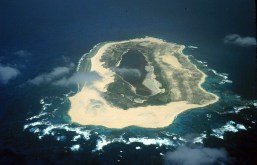
Laysan Island

Laysan Island. By Robert J. Shallenberger, U.S. Fish and Wildlife Service (http://www.doi.gov/photos/06152006_photos.html) [Public domain], via Wikimedia Commons)

“The bird tragedy” is a powerful piece which starts by describing the island as “sandy, poorly planted by nature, and barren of all things likely to enlist the attention of predatory man” but as the home of many varieties of birds, including the “Laysan albatross, black-footed albatross, sooty tern, gray-backed tern, noddy tern, Hawaiian tern, white tern, Bonin petrel, two shearwaters, the red-tailed tropic bird, two boobies and the man-of-war bird.” It was a “secure haven” for them, and, since 1891, had been viewed as “one of the wonders of the bird world”.

But, along came “man, the ever-greedy” looking for ways to make money, first via guano and egg collecting, then feathers for the plumage trade. The culprit was Max Schlemmer, who also introduced rabbits and guinea-pigs which multiplied and started to destroy the vegetation. Hornaday describes the horrendous massacre in 1909 of 300,000 birds for their wings. According to LOA, Hornaday is somewhat wrong in ascribing the massacre to Schlemmer. The say a biography of Schlemmer argues that he was ‘”cash-strapped” and sold the rights to the island to a Japanese entrepreneur. Whatever the situation, the destruction of the birdlife was massive in number and horrific in cruelty. Fortunately, it was stopped before complete destruction by a Zoology Professor who called the Government who in turn sent in the Navy – as you do!

Hornaday’s language makes clear his disapprobation of what happened and of the people who carried it out. His description of the massacre is horrifying, some of it quoted from a report by a 1911 scientific expedition to the island. This report notes that their “first impression” was that the island had been stripped of its birdlife:

Only the shearwaters moaning in their burrows, the little wingless rail skulking from one grass tussock to another, and the saucy finch remained. It is an excellent example of what Prof. Nutting calls the survival of the inconspicuous.

Hornaday says that if the Government had not intervened

it is reasonably certain that every bird on Laysan would have been killed to satisfy the wolfish rapacity of one money-grubbing white man.

Fortunately – albeit a little after the horse had bolted – Roosevelt, in 1909, created “the Hawaiian Islands Reservation for Birds” which includes Laysan and which, Hornaday writes, will ensure that

for the future the birds of Laysan and neighboring islets are secure from further attacks by the bloody-handed agents of the vain women who still insist upon wearing the wings and feathers of wild birds.

However, as Bill McKibben, the environmentalist whose memoir Oil and honey I’ve reviewed, writes in the headnote to the article, Hornaday had his own controversy. He became, in the late 1890s, the head of the New York Zoological Park (the Bronx Zoo), but, as McKibben writes,

a rough sense of the reasons why the social justice and environmental movements have often parted ways may be garnered from the fact that he saw nothing wrong with exhibiting a live African pygmy, named Ota Benga, in the zoo’s monkey house, later remarking that it was the “most amusing passage” in the institution’s history. His 1913 book Our Vanishing Wild Life … has a strongly nativist edge: immigrants and negroes are singled out as villains for their hunting of indigenous fauna.

According to Wikipedia, he was criticised, including by African-American clergymen James Gordon, who said that “Our race … is depressed enough, without exhibiting one of us with the apes … We think we are worthy of being considered human beings, with souls.” With the controversy, Benga was released to roam the zoo, even though Hornaday did not see anything wrong with what he’d done. Benga was later released to Gordon’s custody, but eventually committed suicide at the age of 33 when the start of World War 1 prevented his return to Africa.

Another wonderful LOA offering in a genre I always enjoy reading – nature or environmental writing.

William T Hornaday
“The bird tragedy of Laysan Island”
First published: Our vanishing wild life, 1913
Available: Online at the Library of America

Ellen N. La Motte, Alone (Review)

I decided to read Ellen N La Motte’s story “Alone” from recent Library of America (LOA) Story of the Week offerings because it was a war story, but as I read LOA’s notes I became more and more intrigued. I hadn’t heard of La Motte (1873-1961) before, but she was an American nurse. Two years before the US formally joined the First World War in 1917, she offered to work at the American Hospital of Paris.

She wasn’t pleased by what she saw. Rather than a serious “warzone” she found a bunch of “alleged do-gooders crowding out the recuperating soldiers”. In an essay written at the time, “An American Nurse in Paris,” she described the workers, as follows:

nearly all are dressed in the becoming white gowns of the French Red Cross and a few are pearled and jeweled, rouged and scented till they are quite adorable. . . . This system floods the institution with a mass of unskilled labor, some of which is useful, much superfluous, and some a positive menace to the patients themselves.

Not surprisingly, La Motte decided to move on, and worked for a year in a military hospital in Rousbrugge outside Dunkirk. She was little prepared, LOA writes, for the horror she witnessed. She herself described it as “beyond and outside and apart from the accumulated experience of a lifetime.”

Ellen N LaMotte, The backwash of warWhile working at the hospital, she wrote of her experiences, and upon her return in 1916 published a dozen or so sketches in The backwash of war: The human wreckage of the battlefield as witnessed by an American hospital nurse. However, it was withdrawn in 1918 by her publisher, due to government pressure. It was too “unpalatable”, and wasn’t published again until 1934!

“Alone” is one of the sketches in the book. It tells the story of injured soldier, Rochard, who has gas gangrene. It’s a straightforward story – story-wise, anyhow. Rochard is brought into the hospital within six hours of being injured, but his wounds are inoperable and all know he will die. All they can do is offer pain relief and nursing care to keep him as comfortable as possible. What impressed me about the piece was La Motte’s insight, her humanity, and her ability to write, all of which turn this sad story into something more powerful.

La Motte describes the doctors in the hospital as comprising, primarily, young recent graduates from medical schools, and old doctors who had graduated long ago. She writes that

all those young men who did not know much, and all those old men who had never known much, and had forgotten most of that, were up here at this field hospital, learning. … there were not enough good doctors to go round, so in order to care for the wounded at all, it was necessary to furbish up the immature and the senile.

Oh dear. She describes the initial treatment given to Rochard in rather gruesome detail – which I won’t share here – and then describes his dying. He is given morphia, which “gives a little relief, at times, from the pain of life, but it is only death that brings absolute relief”. She never mentions euthanasia but, from her description of Rochard’s horrendous pain, you sense she’d support it. His death is a long and painful one. She writes, after one trying night:

So when the day nurse came on in the morning, there was Rochard strong after a night of agony, strong after many picqures of strychnia, which kept his heart beating and his lungs breathing, strong after many picqures of morphia which did not relieve his pain. Thus the science of healing stood baffled before the science of destroying.

As Rochard nears death, the screams of pain reduce and he becomes quiet. She writes that:

he had been decorated with the Médaille Militaire, conferred upon him, in extremis, by the General of the region. Upon one side of the medal, which was pinned to the wall at the head of the bed, were the words: Valeur et Discipline. Discipline had triumphed. He was very good and quiet now, very obedient and disciplined, and no longer disturbed the ward with his moanings.

Bitter, eh. The piece moves to its inevitable end – Rochard’s death – but the language La Motte uses to describe it and the way she controls the narrative to deliver a punch at the end, is impressive. This woman could have been a writer – well I suppose she was! – but her passion lay elsewhere, nursing and public health.

After the war La Motte, who wrote many books and articles on her nursing experiences, travelled in Asia and saw the devastation caused by opium addiction. According to the Johns Hopkins Medical Institutions, where her papers are stored, she became an authority on opium trafficking, and reported to the League of Nations. She was awarded the Lin Tse Hsu Memorial Medal by the Chinese government in 1930 and received the Order of Merit from the Japanese Red Cross.

But, she did more, too, so I’m going to conclude with the final paragraph from the American National Biography Online:

Ellen La Motte’s professional life was devoted to causes she analyzed through the lens of public health advocacy. Her efforts on behalf of the antituberculosis campaign, woman suffrage, and the anti-opium crusade emerged from a firm belief that promoting ways to improve the health of the larger community could create a more equal and just society for all.

Someone well worth knowing about … I’m glad I decided to read this LOA story.

Note: The backwash of war is available in entirety at Project Gutenberg.

Ellen L. La Motte
“Alone”
First published: The backwash of war: The human wreckage of the Battlefield as witnessed by an American hospital nurse (1916)
Available: Online at the Library of America

Noah Webster, On the absurdity of a Bill of Rights (Review)

Noah Webster

By James Herring (1794 – 1867) [Public domain], via Wikimedia Commons

If you’ve read my last post you may have guessed from the title why I’ve chosen Noah Webster’s “On the absurdity of a Bill of Rights” as my next Library of America (LOA) Story of the Week to discuss. For those of you who haven’t read that post, or who, like me, have a memory like a sieve, I discussed the play adaptation of Frank Moorehouse’s Cold light, and protagonist Edith Campbell Berry’s desire for government (or, those governing) to act according to the Universal Declaration of Human Rights.

Now, before I briefly share Webster’s arguments, a little background to this clearly very tricksy man! I’ll start by admitting that my main knowledge of Noah Webster was as the creator of America’s best known dictionary, Webster’s of course. It wasn’t initially, or even in his lifetime, called that, though. He published his first dictionary in 1806 under the title, A compendious dictionary of the English language, but his first big, comprehensive dictionary, An American Dictionary of the English Language, wasn’t published until 1828.

All this, though, came after the writing I’m talking about here, but it is related because it was through his writing and publishing work that he became interested in federation, and thus the Bill of Rights issue. You see, as LOA’s notes tell us, in 1783, when he was a twenty-five-year-old schoolteacher, Webster “began publishing his Grammatical Institute of the English Language, the first part of which became The American Spelling Book”. A spelling book leading to the Bill of Rights? How, you might wonder? Well, here’s LOA again:

Less familiar to many readers is the pivotal role Webster played in the founding of the American republic and the adoption of its new constitution—and his advocacy was very much related to the success of his publications. The difficulty of securing copyrights from thirteen separate state governments for each subsequent edition of his spelling book convinced him of the need for an effective national government, and he became an advocate for the Federalist cause.

He started campaigning for the federalist cause in 1785, and here comes the particularly “tricksy” bit because when the new constitution was proposed in 1787, he wrote articles supporting its ratification under various pseudonyms! One of these was Giles Hickory under which he wrote the article I’m discussing here. As LOA writes,

One of the main objections to the new constitution was that it did not include a bill of rights, an argument Webster dismisses in his first Hickory letter by responding that such documents are only needed as protection against tyrants and would become unnecessary in a government elected by the people.

This is one of the main arguments he puts in “On the absurdity of a Bill of Rights”. He argues that a Bill of Rights [like the “Magna Charta”] against “the encroachment of Kings and Barons, or against any power independent of the people, is perfectly intelligible” but that a Bill of Rights in a democracy would essentially be the people guarding against the people. In other words, in an elected legislature “the rulers have the same interest in the laws, as the subjects have” so, he argues, “the rights of the people will be perfectly secure without any declaration in their favour”. Hmm, that sounds perfectly good in theory, but in practice, well, it doesn’t always seem to quite work out that way does it?

Anyhow, as it turned out, those in favour of a Bill of Rights won the argument, as Massachusetts, for example, only agreed to ratify the Constitution with the addition of “ten amendments”. These became known as the “Bill of Rights“, and were adopted in 1791.

Webster’s second argument, which he calls his “principal point”,  is also, given how the Bill of Rights has played out in the US, very interesting:

I undertake to prove that a standing Bill of Rights is absurd, because no constitutions, in a free government, can be unalterable. The present generation have indeed a right to declare what they deem a privilege; but they have no right to say what the next generation shall deem a privilege.

He argues, in other words, that times change, and what one generation might see as a right may not be appropriate to another generation, and that it is therefore inappropriate to set such rights in stone. He uses, as an example, “trial by jury”:

The right of Jury-trial, which we deem invaluable, may in future cease to be a privilege; or other modes of trial more satisfactory to the people, may be devised. Such an event is neither impossible nor improbable. Have we then a right to say that our posterity shall not be judges of their own circumstances? The very attempt to make perpetual constitutions, is the assumption of a right to control the opinions of future generations; and to legislate for those over whom we have as little authority as we have over a nation in Asia.

Would the US be different now, if, for example, they did not have the “perpetual”, enshrined right to “bear arms”?

Webster suggests that:

There are perhaps many laws and regulations, which from their consonance to the eternal rules of justice, will always be good and conformable to the sense of a nation. But most institutions in society, by reason of an unceasing change of circumstances, either become altogether improper or require amendment …

He makes some excellent points, but I’d like to believe there are some rights which stem from “the eternal rules of justice”. However, I can also see how temporal and cultural it all is. Australia, rare for a western democracy, does not have a federal bill of rights – the issue arises occasionally – but my state (well, territory) did pass one in 2004, and was followed by Victoria in 2006.

What do you think?

Noah Webster (as Giles Hickory)
“On the absurdity of a Bill of Rights”
First published: American Magazine, December 1787
Available: Online at the Library of America
Carson McCullers, The great eaters of Georgia (Review)

Carson McCullers, 1959

Carson McCullers, 1959 (photographed by Carl Van Vechten, Public domain, via Wikimedia Commons

Regular readers of my Library of America (LOA) Story of the Week posts will probably guess why I’ve chosen to write about this story: it’s by an appealing American writer and it’s about food. However, it’s quite different from the other food stories. Firstly, while it’s called “the great eaters” it’s more of a little memoir essay albeit structured around food, and secondly, it was published posthumously in 2005. McCullers was born in 1917 (on Feb 19 in fact, so this month in the centenary of her birth) and died in 1967. “The great eaters of Georgia” was written, LOA’s notes say, in 1954 but was not published, because …

It’s a complex situation, which the Wikipedia article section on her personal life fills in, but the significant thing for us is that she had returned (fled) to the US from Paris in 1953, because her husband had tried to encourage her to commit suicide with him. Soon after her return, he succeeded in taking his life. Now, this is relevant because LOA tells us that McCullers had been offered money by Holiday magazine for a piece on Georgia, but, according to McCullers’ biographer Josyane Savigneau, the magazine rejected the article because they were “looking for a lighter, more descriptive, less personal piece.”

I guess that’s fair enough for a holiday-oriented magazine, but for readers more interested in McCullers than in Georgia – sorry, Georgia – it’s great that the piece didn’t disappear. Like many people, I’ve read and/or seen The heart is a lonely hunter and The member of the wedding – but in my case so long ago that my main memory is not of the plots but of melancholy and loneliness, the sorts of emotions that appealed to my teenage self!

But now, “The great eaters of Georgia”. It’s an intriguing piece that doesn’t perhaps quite cohere – certainly as a piece for a holiday magazine. For example, she mentions visiting various people. First is the controversial writer Lillian Smith, who openly confronted such issues as race and gender equality. McCullers writes:

Lill, like other Southerners, feels passionately about the problems of the Negro. Most Georgians do not agree with her, and often when her name is mentioned there is that strange area of silence.

This may not have been what Holiday was looking for, particularly when she adds that during her visit they “discussed Georgia politics”. Then she visits psychiatrist Dr Hervey Cleckley. She doesn’t share her discussions with him about her husband’s suicide – this I learnt from LOA – but they did talk

of the improvement in the understanding of racial problems and the migration from the rural cotton areas to the cities and towns.

Again perhaps not Holiday content? She says they also talked about Dr Crawford Long, a Georgian who was the first to use ether in an operation. You may wonder why this came up, but it resulted from their discussion of “ether parties”:

These odd-sounding affairs must have been like marijuana parties to the modern teenager but there was no social stigma attached, and my grandmother told me that, as a young lady, she often held ether parties for her young friends after they had ridden home from church and gathered for Sunday dinner.

Fascinating eh? Dr Long apparently noticed the numbing effect of ether (!) and thought it might work in surgery! I found this interesting because I have reviewed Sawako Ariyoshi’s The doctor’s wife, which fictionalises the story of Hanaoka Seishū who is believed to have been the first to use general anaesthesia in surgery – in 1804. Long carried out his first surgery in 1842.

Anyhow, I guess McCullers included this story of Long as an example of Georgian ingenuity? Again it may not have been what Holiday was looking for.

She was probably on firmer ground in her description of eating practices and food, because yes, she does talk about those too as the title suggests! I enjoyed little tidbits such as that in her mother’s day:

a child wore an asafetida bag around his neck to ward off colds and contagious diseases. Asafetida is the foulest-smelling substance. I suppose it makes good medical sense because one was not apt to go very near a person wearing an asafetida bag.

Hmmm, that’s not a food story though asafetida is used in cooking – and, anyhow, it’s adds a touch of humour.

She also talks about what great eaters (hence the title) Georgians are – at every meal:

Georgians eat big meals three times a day. I have never gotten over this orange-juice-and-coffee breakfast they have up North. A respectable Georgia breakfast means fish roe and grits or at least eggs or maybe country sausage.

She remembers chewing sugarcane as a child, and the historic cultivation of chinaberry trees “to counteract miasma”. She mentions the razing of the home she was born in, and sneaks in a comment about the reduction in (though not removal of) poverty in her home-town, before returning to the subject of breakfasts. She talks of the Yankee vulgarity of referring to children as “kids”. And she tells us that fried chicken is probably Georgia’s best-known dish, closely followed by “field peas”. She surprised me by mentioning a dish I have in my recipe folders from my early recipe-gathering days, Country Captain. It’s a sort of curried chicken dish, and I didn’t realise it came from the American south.

She also tells us that “any discussion of Georgian food is incomplete without the mention of watermelon” and provides a loving description of the “special operation and procedure” it demands. Fruitcake, tupelo honey, and the smells of Savannah are also shared with us, before she comes to a little anecdote about a “town character”, a bachelor who prefers to eat alone. This is very “un-Georgian”, and she concludes her piece by saying that

Although we have our share of eccentrics, I know very few Georgians who do not love fellowship, good hunting, food, and laughter—who do not enjoy life.

All in all, it’s a fascinating article – for what it tells us about Georgian life and food but more, for the little insights we glean of her interests and her emotional state. A good read for anyone interested in McCullers.

Pam (Travellin’ Penguin) has also written a response to this story.

Note: My other LOA food stories are by John Duncan (“A Virginia barbecue“), Ana Menéndez (“Celebrations of Thanksgiving: Cuban offerings“), George G. Foster (“The eating-houses“) and George Augustus Sala (“The tyranny of pie“).

Carson McCullers
“The great eaters of Georgia”
First published: Oxford American, Spring 2005
Available: Online at the Library of America
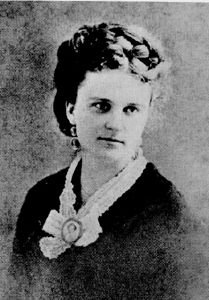
Kate Chopin, Fedora (Review)

Kate Chopin

Kate Chopin (Public domain, via Wikipedia)

Time methinks for another Library of America (LOA) Story of the Week, particularly since one of their recent offerings was one of my favourite American authors, Kate Chopin. “Fedora” is the sixth story by Chopin I’ve discussed here, and is probably the shortest, more of a “sketch”. In fact its original title was apparently ““The Falling in Love of Fedora. A Sketch”

If you’ve read any of my previous posts, or her novel The awakening which I read a couple of times before blogging, you’ll know that Chopin was not afraid to tackle confronting subjects, like suicide, adultery, and miscegenation. LOA’s notes briefly discuss the controversy surrounding The awakening. Words such as  “morbid,” “sex fiction,” “poison,” were applied to it, and the clearly more conservative, younger, Willa Cather, whom I’ve also reviewed here, said that “I shall not attempt to say why Miss Chopin has devoted so exquisite and sensitive, well-governed a style to so trite and sordid a theme.”

Well, of course, many of us do know why she explored the themes she did in puritanical late-nineteenth century America, and we admire her for doing so. LOA explains that while her stories were usually sought after, some were a little too hot to handle. “Fedora” was one such, being “turned down by the national magazines that often competed for her work”, only appearing “in an upstart literary journal in her hometown of St. Louis”.

So, what is it that was so shocking about “Fedora”? Well, there’s the rub, because it’s one of those short stories that leaves you wondering. Fedora is 30 years old – and is described pretty much as the quintessential spinster:

The young people—her brothers’ and sisters’ guests, who were constantly coming and going that summer—occupied her to a great extent, but failed to interest her. She concerned herself with their comforts—in the absence of her mother—looked after their health and well-being; contrived for their amusements, in which she never joined. And, as Fedora was tall and slim, and carried her head loftily, and wore eye-glasses and a severe expression, some of them—the silliest—felt as if she were a hundred years old. Young Malthers thought she was about forty.

The story concerns her going to the station – driving the horse and cart – to pick up young Malthers’ sister who is returning from college. Young Malthers is, we are told, 23 – and Fedora has become fascinated by him, suddenly realising he is a man – “in voice, in attitude, in bearing, in every sense — a man”. Now, early in the story, we’d been told that:

Fedora had too early in life formed an ideal and treasured it. By this ideal she had measured such male beings as had hitherto challenged her attention, and needless to say she had found them wanting.

But, suddenly she is aware of him, she watches him:

She sought him out; she selected him when occasion permitted. She wanted him by her, though his nearness troubled her. There was uneasiness, restlessness, expectation when he was not there within sight or sound. There was redoubled uneasiness when he was by—there was inward revolt, astonishment, rapture, self-contumely; a swift, fierce encounter betwixt thought and feeling.

Fedora could hardly explain to her own satisfaction why she wanted to go herself to the station for young Malthers’ sister. She felt a desire to see the girl, to be near her; as unaccountable, when she tried to analyze it, as the impulse which drove her, and to which she often yielded, to touch his hat, hanging with others upon the hall pegs, when she passed it by.

It seems, then, that she is in love with him, as the original title encourages us to think – or that she, at least, feels a desire or passion for him. So, when she picks up Miss Malthers, why does she do what she does? That is the question – and it’s one I’m not going to answer, because that would be a spoiler and because the story is so short that you can read it, and ponder it, yourself. And anyhow, I’m still thinking about it myself, given the way Chopin teases us. Suffice it to say that, however you read it, Chopin was challenging her readers to think about desire – its origins, its expression, and its impact on the person who desires.

This is a beautiful and intriguing little “sketch”, though to call it that doesn’t fully do it justice.

Note: My other Kate Chopin reviews are A pair of silk stockings, After the winterA respectable womanDésirée’s baby and Morning walk. My, they are building up aren’t they?

Kate Chopin
“Fedora”
First published: Criterion, February 20, 1897
(Under the pseudonym, La Tour)
Available: Online at the Library of America
Eudora Welty, A curtain of green (Review)

This week I received the Library of America’s annual email in which they list their “Top 10 Story of the Week selections of 2016″. I’ve only read eleven of their selections this year, but two – Kate Chopin’s “A pair of silk stockings” (my review) and Willa Cather’s “Enchanted bluff” (my review) – are in their Top Ten. More interesting to me though is that it contains another writer I like, Eudora Welty. I read her book One writer’s beginnings and what is probably her most famous short story, “Why I live at the P.O.”, before I started blogging, so I decided to read this Top Ten story, “A curtain of green”.

weltycurtainofgreenWelty was a short story writer and novelist who wrote mostly about the South. She won the Pulitzer Prize in 1973 with her novel The optimist’s daughter and, according to Wikipedia, was the first living writer to be published by the Library of America (LOA)! “A curtain of green” was one of her early stories. It provided the title for (and was included in of course) her first published collection of short stories (1941), which also includes “Why I live at the P.O.”

However, before I get to the story, I want to share a little from One writer’s beginnings. This book originated in a series of lectures, the inaugural ones apparently, she gave in 1983 at Harvard University, the William E Massey Sr. Lectures in the History of American Civilisation. The cover of my 1984 edition claims that it was on the New York Times Bestseller List for 46 weeks! Pretty impressive for a series of essays I think. She was born in 1909 in Jackson Mississippi, the eldest of three. From the opening pages of the book she tells us how her growing up contributed to her writing.

For example, in the first paragraph she mentions growing up “to the striking of clocks”. She’s not sure whether it’s because of her father’s Ohio family “having been Swiss back in the 1700s” but her family were all “time-minded” all of their lives:

This was good at least for a fiction writer, being able to learn so penetratingly and first of all, about chronology. It was one of a good many things I learned, almost without knowing it; it would be there when I needed it.

Surely there’s a little bit of the tongue-in-cheek in her reference to the Swiss origins? Anyhow, two pages in, and she’s talking about her parents’ respective reactions to the weather, her father’s caution regarding storms for example and her mother’s rejection of that “as a character failing”:

So I developed a strong meteorological sensibility. In years ahead, when I wrote stories, atmosphere took its influential role from the start. Commotion in the weather and inner feelings aroused by such a hovering disturbance emerged in dramatic form.

And so the book continues in this delightful manner, sharing her childhood with affection, perception and a wonderful sly wit … but now to “A curtain of green” in which meteorological conditions do, in fact, feature!

“A curtain of green” is about grief, but it starts

Every day one summer in Larkin’s Hill, it rained a little. The rain was a regular thing, and would come about two o’clock in the afternoon.

One day, almost as late as five o’clock, the sun was still shining …

It tells the story of Mrs Larkin whose husband had died the previous summer in a terrible accident – a tree, “a fragrant chinaberry”, had come crashing down on his car as he was arriving home. She had seen it happening, had believed her love would keep him safe. And so now, while the other women of the town sit inside “fanning and sighing, waiting for the rain”, Mrs Larkin is out in her garden, where she is now all the time, because “since the accident in which her husband had been killed, she had never once been seen anywhere else”. It’s a fertile garden, needs “cutting, separating, thinning and tying back” to keep the plants from “overreaching their boundaries and multiplying out of all reason”. But, Mrs Larkin is deranged with grief. She does none of this, just works incessantly, obsessively, planting

thickly and hastily, without stopping to think, without any regard for the ideas that her neighbours might elect in their club as to what constituted an appropriate vista, or an effect of restfulness, or even harmony of colour. Just to what end Mrs Larkin worked so strenuously in her garden, her neighbours could not see …

She doesn’t offer flowers when they’re sick or die, for example. I love how the language in this story just piles on, driving us forward this way and that, just like Mrs Larkin’s grief does to her. The garden, to the neighbours who had initially tried to support her, “had the appearance of a sort of jungle, in which the slight, heedless form of the owner daily lost itself”. It’s oppressive to us, but Mrs Larkin has isolated herself behind her “curtain of green”. The only person she tolerates in this garden, and then only occasionally, is Jamey, “the coloured boy who worked in the neighbourhood”.

At this point in the story, which is told third person, the perspective shifts from omniscient to subjective, to Mrs Larkin’s point-of-view, that is. We are now in the garden with her as her memory returns her to the day of the accident. Suddenly all is still, “everything had stopped again, stillness had mesmerised the plants …” Jamey infuriates her, with his “look of docility”, of being “lost in some impossible dream of his own”. She watches him – her hunger for his innocence suddenly overtaken by a fury at his youthfulness, at his being able to be lost in this, to her, “impossible dream”. She’s overwhelmed by the unaccountability of accident, of life and death, by the meaningless of it all, and wants to smash his innocent absorption – but then comes the rain. There are two more pages in the story after this, but I’ll finish here.

This story was written in 1938 – quickly written and easily published, according to LOA. LOA also tells us that in 1931, Welty and her mother had been present when her father died of leukaemia, and they quote Welty’s biographer Suzanne Marrs as saying that her mother “discovered solace in gardening”. She spent hours in her garden, most days, often with Eudora by her side. Welty, says Marrs, wrote in an unpublished essay that “its [the garden’s] peace and fragrance are soothing to frayed nerves when we are weary from contact or perhaps conflict with the everyday world.” This memory clearly informed her story of the grieving Mrs Larkin.

“A curtain of green” is a great read, for its exploration of how grief can derail you, making you, temporarily at least, a little mad; for its evocative writing which captures that sense of derailment, taking you right into that garden with Mrs Larkin; and for its resolution which offers hope without being simplistic about it. After such a year as this has been, it seems just the right story to end on. Happy New Year everyone!

Eudora Welty
“A curtain of green”
First published in: Southern Review (Autumn 1938).
Available: Online at the Library of America
George Augustus Sala, The tyranny of pie (Review)

When I decide to write about a Library of America (LOA) Story of the Week it is usually because it’s by a favourite author (like Willa Cather, Kate Chopin, or Edith Wharton), or by an author I want to read but haven’t yet (like John Updike or Washington Irving) or on a topic that interests me (like the environment or race issues or food). You can guess from the post title, then, why I chose the story I’m writing about today!

I’ve covered a few LOA food stories: Scotsman John M. Duncan’s “A Virginia barbecue” (1823), American George G. Foster’s “The eating-houses” (1849), and Cuban-American Ana Menéndez’s “Celebrations of Thanksgiving: Cuban offerings” (2004). Two are about events and one about restaurants, though they all mention food too of course. Englishman George Augustus Sala’s piece, however, starts from the point of view of food – the pie, which, I’ve just realised, is appropriate for this American Thanksgiving weekend. Sala, like Virginia-barbecue-Duncan, was a traveller to America, so wrote his piece from the perspective of an outsider.

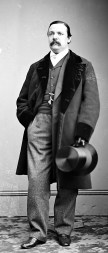
George Augustus Sala

Sala c. 1855-65, by Mathew Brady (Public Domain via Wikipedia)

But, who was this Sala? Aussies will be interested to know that it was he who coined the still-used description “Marvellous Melbourne” when he visited Australia in 1885. He was born in 1828, and is described in LOA’s notes as a “prolific and flamboyant journalist”. He “found fame” as an acolyte of Charles Dickens, and was a regular contributor to Dickens’ journal, Household Words (about which I’ve written before). However, LOA continues, it was public praise from William Makepeace Thackeray which really launched his career. Unfortunately, although Sala published much and earned good money from writing for The Daily Telegraph, he was a spendthrift who was also often drunk, and “died virtually penniless”.

Now, the piece. It comes from his second trip to the States. His first trip was in 1863 during the Civil War, and while he was critical of much he did like American humour. He wrote, says LOA, a three-book series of anthologies, Yankee Drolleries (1866–1870), which introduced British readers to established authors like Oliver Wendell Holmes (whom I wrote about recently) and the up-and-coming writer, Mark Twain.

During his second trip, which resulted in his book America revisited, he found an improved America. LOA quotes this:

The truth is, that in New York there is room enough for Everybody, whereas in London, huge as it is, there is not sufficient room for Anybody.

By the late 1870s, we’re told, Manhattan had become a popular travel destination for the European upper class.

Sala, LOA also says “had a lot to say about American food. His comments range from despair and scorn to grudging, if infrequent, admiration”.  He apparently approved of New York, because its food and accommodation were “what Europeans usually consider to be refinement and comfort.” But on leaving New York, “you must expect nothing better than pork and beans and Indian pudding, or hog and hominy if you go South; the whole washed down by rough cider or molasses and water.” His short “The tyranny of pie” piece appears as a digression in his America revisited chapter about a train trip to Baltimore.

I’m sure you all know the phrase “as American as apple pie”. The Huffington Post provides some background to this in an article titled “Why are we ‘As American as Apple Pie’?” The pie was an English tradition, and brought to American by the Pilgrims, but by 1860, well before Sala’s second visit, the phrase was already in use. Novelist Harriet Beecher Stowe wrote, says Huffington’s Kimberly Kohatsu, that “the pie is an English tradition, which, planted on American soil, forthwith ran rampant and burst forth into an untold variety of genera and species.”

It is partly this variety which captures Sala’s eye. He commences, though, by praising signs of “improvement and reform” in America – in

everything except Pie. The national manners have become softened—the men folk chew less, expectorate less, curse less; the newspapers are not half so scurrilous as our own; the Art idea is becoming rapidly developed; culture is made more and more manifest; even “intensity” in æsthetics is beginning to be heard of and Agnosticism and other “isms” too numerous to mention find exponents in “Society,” and the one absorbing and sickening topic of conversation is no longer the Almighty Dollar—but to the tyranny of Pie there is no surcease.

What is all this about we readers wonder? Soon he writes:

The day before we left New York one of the ripest scholars, the most influential journalists (on the Democratic side) the brightest wits and most genial companions in the States lunched with us. He would drink naught but Château Yquem; but he partook twice, and in amazing profusion of Pumpkin Pie.

Ah, I was thinking, he’s like me. He doesn’t like Pumpkin Pie, and wonders about the taste of this Château Yquem drinker … but, I was disappointed because, within a couple of sentences he writes:

The worst of this dreadful pie—be it of apple, of pumpkin, of mulberry, or of cranberry—is that it is so very nice. It is made delusively flat and thin, so that you can cut it into conveniently-sized triangular wedges, which slip down easily.

He then suggests that the pie is “as important a factor in American civilisation as the pot-au-feu does in France” but that England has nothing equivalent. The closest England has to a dish “by which we nationally stand or fall” is “the roast beef of Old England” but it is expensive and

there are hundreds of thousands of labouring English people who never taste roast beef from year’s end to year’s end—save when they happen to get into gaol or into the workhouse at Christmastide.

This is where his little piece ends. I did enjoy its cheeky humour, and this pointed conclusion.

George Augustus Sala
“The tyranny of pie”
First published in: America revisited: from the Bay of New York to the Gulf of Mexico, 1882.
Available: Online at the Library of America

Oliver Wendell Holmes, The deacon’s masterpiece: Or the wonderful “one-hoss-shay” (Review)

Oliver Wendell Holmes 1879

C1879, By Armstrong & Co. (Boston, Mass.), Public domain, via Wikimedia Commons

Oliver Wendell Holmes is one of those wonderful names that, once you hear it, you can’t really forget it – at least, I can’t. But, the thing is, I often hear wonderful names of people who’ve “done things” without actually knowing what they’ve done. Oliver Wendell Holmes is one of these, and so when he popped up in the Library of America’s Story of the Week series a few months ago I made a note to check it out. The story – actually a narrative poem – has the title heading this post, with the additional subtitle, “A logical story”.

Holmes Sr – his son, Oliver Wendell Holmes Jr, became a Supreme Court judge – was one of those multi-talented men. Wikipedia says that he was a “physician, poet, professor, lecturer, and author” and that “his peers acclaimed him as one of the best writers of the day.” His friends included Ralph Waldo Emerson and Henry Wadsworth Longfellow, which helps me put him into perspective. He was a medical reformer, and was dean of the Harvard Medical School. Indeed, Wikipedia reports that “his essay on puerperal fever has been deemed ‘the most important contribution made in America to the advancement of medicine'”. With this focus on medicine, there was a big gap between his early published writings in early to mid 1830s and his return to writing in the late 1850s, but he returned to it with vigour, so much so that, as Wikipedia says, he is now best known as “a humorist and poet”.

So now let’s get to the post’s topic. He returned to writing around the age of 50, encouraged by a friend to become a founding contributor to a new magazine, The Atlantic Monthly. He wrote a monthly column reviving his earlier creation, Autocrat of the Breakfast-Table. LOA’s notes describe the column:

each piece is written as a table conversation monopolized by the unnamed Autocrat, with interruptions (including poetry, stories, and jokes) from other residents—including the Professor, the Landlady’s Daughter, the Schoolmistress, the Poet, the Old Gentleman, the Divinity-Student, “the young fellow called John,” and others. The new and improved “Autocrat of the Breakfast-Table” appeared in the debut issue of The Atlantic (November 1857) and immediately became the most popular feature in a magazine that boasted works by such celebrities as Emerson, Whittier, and Longfellow.

The eleventh column is the one the LOA published as their story of the week. It describes a “one-horse chaise” (the “one-hoss shay”) that is built to last. The poem became so popular, apparently, that it was published separately in 1892 as an illustrated book.

As the story goes, a deacon builds a one-hoss shay “in such a logical way” to ensure it would not break down. He uses the very best of materials – “the strongest oak/that couldn’t be split or bent or broke” – and makes sure there is no weak spot. The shay lasts for a hundred years:

Colts grew horses, beards turned grey,
Deacon and deaconess dropped away,
Children and grandchildren–where were they?
But there stood the stout old one-hoss-shay
As fresh as on Lisbon earthquake-day!

Built, then, on the day of the Lisbon earthquake, 1 November 1755, it breaks down while being ridden by the current parson on 1 November 1855:

How it went to pieces, all at once,–
All at once, and nothing first,–
Just as bubbles do when they first.

It is a delightful read in terms of tone, voice and rhyme. I particularly love that the rhyming pattern varies, which helps keep it fresh and the reader interested, and prevents it, I think, from reading like doggerel.

Conceptually, though, it’s also interesting: this idea that you could logically work out how to build something that won’t break. You find, as Holmes describes in his introduction to the illustrated edition, “what point any particular mechanism is likely to give way” and make sure that part/point doesn’t. Then you “find the next vulnerable place, and so on”, until you arrive “logically at the perfect result attained by the deacon”.

LOA describes the work as a “semi-farcical ode to Yankee ingenuity and New World rationality”, but also says it’s been seen “as an allegory on the demise of Calvinism”. LOA also says that “the poem’s fame was such that one-hoss shay became a term used in economics and statistics, designating ‘a capital asset that exhibits neither input decay nor output decay during its lifetime’.” However, in terms of economics, I can’t help thinking about his image of what “bubbles do when they burst”.

Describing his old age, and the fact that his friends – like Emerson, Longfellow and Nathaniel Hawthorne – predeceased him, he apparently said “I feel like my own survivor … We were on deck together as we began the voyage of life … Then the craft which held us began going to pieces.” I wonder if in saying this he thought about his “one-hoss shay”!

Oliver Wendell Holmes
“The deacon’s masterpiece: Or the wonderful ‘one-hoss-shay’”
First published: The Atlantic Monthly, September 1858.
Available: Online at the Library of America

Willa Cather, The enchanted bluff (#Review)

I’ve reviewed a few Willa Cather stories on this blog now, as well as her gorgeous novel, My Antonia, but as I love her stories, I can’t resist reviewing the latest to have been shared by the Library of America (LOA), albeit that was a couple of months ago now. The story is titled “The enchanted bluff” and was published in 1909, making it the latest of the stories I’ve reviewed to date. Between the previous latest story, “A Wagner matinee” published in 1904, and this one, Cather had moved to New York and started working for, writes LOA, “the notoriously difficult” editor, S.S. McClure, at the eponymously named McClure’s.

LOA explains that her years working there were “both rewarding and gruelling”, but that she “proved a perfect foil to her boss’s temperament and was even ghostwriter of his 1914 autobiography. McClure praised her as “the best magazine executive I know”. However, the downside was that she had little time left for her own writing. A common author-problem eh? The work you do to keep you alive takes you away from the work for which you live!

Enchanted Mesa
Enchanted Mesa, By Ethan (orig. posted to Flickr as Enchanted Mesa) using CC BY-SA 2.0, via Wikimedia Commons

She did though manage to write several short stories, of which “The enchanted bluff” is regarded the best. It appealed to me, not just because it is a Cather story and is imbued with her wonderful description of place and landscape, but because its focus is the legend of the lost tribe of the Enchanted mesa, a high sandstone butte in New Mexico. LOA tells us that “like the boys in her story, Cather had been fascinated by the legend” since childhood but had never been there (at least not by the time she wrote this story). Now, I’ve been to New Mexico and fell in love with its culture and landscape, so reading this story took me back to a most enjoyable time in my life …

“Enchanted bluff” feels a bit different from many of Cather’s stories. It has the nostalgic or melancholic tone common to many, and it has what I’ve described before as “her evocative, careful use of landscape and nature”, but it is more reflection than even a character-driven story. This however didn’t bother me because it does what I most like: it presents a bunch of ordinary people (in this case 6 boys and young men) going about their ordinary lives (in this case a last summer camping trip before they all head back to school.)

Camping trip, do I hear you say? Surely something dramatic happens there? Well, no, not really. The six boys, ranging in age from around 10 to 17, swim, cook their supper, and sit around the campfire talking. There’s an “angry” moon, and the loud “scream” of a whooping-crane, but nothing untoward happens. However, there is a point, to which I’ll come soon.

Cather starts her story by setting a rather idyllic scene. It’s Nebraska, where many of her stories are set, and the “brown and sluggish river”, contains little sand islands created during spring turbulence:

It was on such an island, in the third summer of its yellow green, that we built our watch-fire; not in the thicket of dancing willow wands, but on the level terrace of fine sand which had been added that spring; a little new bit of world, beautifully ridged with ripple marks, and strewn with the tiny skeletons of turtles and fish, all as white and dry as if they had been expertly cured. We had been careful not to mar the freshness of the place, although we often swam out to it on summer evenings and lay on the sand to rest.

You can feel the boys’ love of and joy in the place can’t you?

Anyhow, having set the scene, Cather then describes the boys – brothers Fritz and Otto, sons of the German tailor, and the youngest in the group at 10 and 12; fat Percy Pound who loved to read detective novels; hard-working Tip Smith, the “buffoon” in their games; tall 17-year-old Arthur Adams whose “fine hazel eyes … were almost too reflective and sympathetic for a boy”; and our narrator who would soon be leaving “to teach my first country school in the Norwegian district”. Quite a diverse group, but this is common perhaps in small country towns.

Having set the physical scene, and described her boys, Cather then shares their conversation. We soon realise that this is a story – as many of Cather’s are – being told about the past. Our narrator, in other words, is reminiscing about this last summer camp. And here is where the point starts to become apparent, because after general talk, including discussing the mystery of where the river goes after leaving their area, they start to talk about where they’d like to go. Tip tells them about Enchanted Bluff. They are all fascinated by its “dolorous legend” and discuss, as boys do, various possibilities. All are intrigued and would like to visit it, so agree that whoever “gets to the Bluff first” must tell the rest “exactly what he finds”. The summer ends, the following Christmas the boys catch up and renew their resolution, and then it’s twenty years later, from when the narrator is telling this story. None of them, he tells us, had climbed the Enchanted Bluff. Instead …

It’s a beautifully rendered story about the dreams of youth and the reality of adulthood. There’s a nostalgic glow, a sense of “enchanted youth”, but it’s offset by the reality of what happened to the boys. And this is supported by the language in which warmth and beauty are counterpointed by hints of other forces, not malevolent ones but ones which remind us that few things are as they seem or turn out the way we might dream. A good read.

Willa Cather
“The enchanted bluff”
First published: Harper’s Magazine, April 1909.
Available: Online at the Library of America