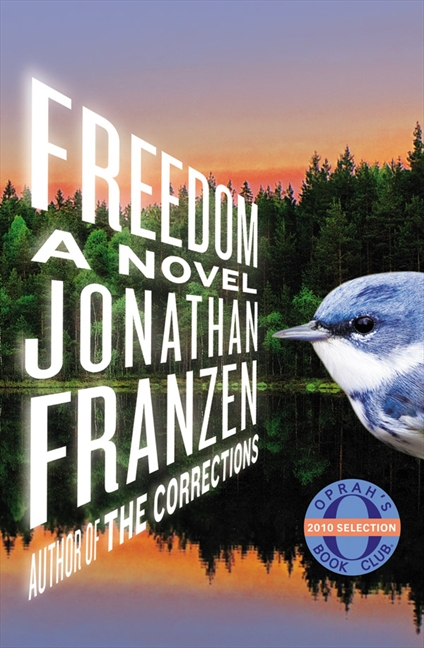
Freedom bookcover (Courtesy: HarperCollins Australia)
Hmm … where to start? Half way through this book I was tiring. I wanted to say to Franzen “Enough already” (which, if you’ve read the book, has a certain appositeness). I also started to think of those song lines, so well-known to my generation:
Freedom’s just another word for nothing left to lose.
In fact, I thought of starting this post with that quote, but decided it would be just a little too twee – but somehow it ended up in the first paragraph nonetheless.
In some ways, Jonathan Franzen‘s latest novel, Freedom – which I must be the last blogger to read – is an interesting companion piece to Peter Carey‘s Parrot Olivier in America. They are wildly different in tone, style and historical setting but both explore the foundation upon which America is based, that of freedom of the individual. America tends to parlay this word about a little too, shall I say, freely, a little too unaware at times that freedom is not a simple concept but one that needs to be modified by a few “ifs” and “buts”. It’s these “ifs” and “buts” that confront Franzen’s characters, and that are recognised in those now immortal song lines. In other words, what Franzen’s characters find is that freedom in and of itself is no great shakes. It cannot exist in a vacuum …
But first, the plot. It chronicles the relationship of nice-guy Walter and mixed-up Patty Berglund (and, along the way, their family and friends). The opening paragraph starts around the middle of the chronology, with a rather teasing statement that Walter “had made a mess of his professional life” and then tracks back a few years to the early years of Walter and Patty’s marriage, before tracking back further to their youth and courtship, and then returns to the starting point and on to their future. Through this journey, Walter and Patty, residents of the Twin Cities, grow up, get married, have children, move east, get into a range of “pickles”, and … but that would be telling so I’ll leave the plot there.
It’s a rather complicated structure that owes a lot to postmodernism with its forwards-backwards movement, stories within a story (that is, Patty’s autobiography, told third person, in two distinct parts), a certain intratextuality (such as Patty’s autobiography being read by characters in the novel), the odd font change, and shifting points-of-view. It’s not, however, postmodern in its concerns – and is instead rather earnest, which is part of its problem. I’m not saying that it needs to be postmodern – we don’t need more self-conscious irony and clever playing with the idea of fiction – but it needs something fresh and challenging in characterisation, language and/or tone to carry it right through its 560 pages. Instead, it gets bogged down in too much earnest detail about life in modern America. It’s as though Franzen had a lot of things he wanted to say – about middle-class life, parenting, education, the environment, gentrification, politics, and music – and he was darned sure he was going to say them. We get, therefore, references to 9/11, Cheney and Bush, the war in Iraq, Obama, hints about the GFC, and so on. It’s a bit like Dickens, but without the sustained satire.
That said, there are some funny set pieces, such as the interview Richard (Walter’s friend and rival, and also lately successful rock star) gives to a young fan who wants to use Richard to attract a girl. Richard likens rock music to making chiclets, to being part of not against corporate, capitalist America. And I did love the description of why Walter preferred the aggressive driving of his young assistant, Lalitha, to driving himself:
Walter had come to prefer the anxiety of being her passenger to the judgmental anger that consumed him when he was at the wheel – the seemingly inescapable sense that, of all the drivers on the road, only he was traveling at the right speed, only he … [and on it goes for a page of road-rage inducing complaints].
But, getting back to the main game, what is this “freedom” all about? Most of the characters yearn for and/or experience freedom of one sort or another – they want to live their own lives their way. This can include not working, following one’s own heart regardless of the needs of those around you, having sex with whomever whenever you please, not being responsible for others, not doing the hard yards. And most find that the end result is not a satisfying one.
Walter, whom I presume is Franzen’s main mouthpiece, says:
The reason the system can’t be overthrown in this country … is all about freedom. The reason the free market in Europe is tempered by socialism is that they’re not so hung up on personal liberties … The Europeans are all-round more rational, basically. And the conversations about rights in this country isn’t rational. It’s taking place on the level of emotion, and class resentments, which is why the right is so good at exploiting it ..
This makes sense to me … but, the thing is that there are so many references to freedom that it is hard to locate the main message. This one is political. There are also more personal messages. Here is a description of Walter’s grandfather:
(The personality susceptible to the dream of limitless freedom is a personality also prone to, should the dream ever sour, to misanthropy and rage.)
And of Walter’s father:
He hated the blacks, the Indians, the well-educated, the hoity-toity, and especially, the federal government, and he loved his freedoms (to drink, to smoke, to hole up with his buddies in an ice-fishing hut) the more intensely for their being so modest.
We see parents giving children a “free pass” only to find those children, such as Walter’s brother Mitch, being a “free man” in the sense that he has no home, no secure job, no responsibilities. We see men, like Richard and Joey, thinking the freedom to have sex with anyone anytime will make them happy, but Joey, for example, after an amusing (to the reader!) scene in which he tries to live his fantasy, discovers who he really is:
This wasn’t the person he thought he was, or would have chosen to be if he’d been free to choose, but there was something comforting about being an actual definite sometime …
And at this point he starts to grow up …
There is a lot to enjoy about this book, despite its bagginess. The characters do engage, flaws and all, and Franzen’s heart is, for me, in the right place. When I got to the end, I smiled and felt that Franzen had achieved something, even if it is simply to show that Freedom is a far more complicated concept than people like to think.
Jonathan Franzen
Freedom
London: Fourth Estate, 2010
562pp.
ISBN: 9780007318520
 Whispering Gums