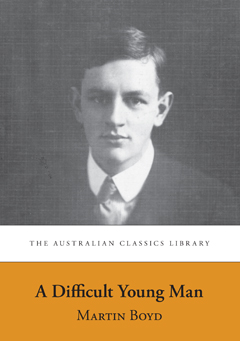
Martin Boyd, A difficult young man

Martin Boyd's A difficult young man
Difficult but handsome (Courtesy: Sydney University Press)

I’m not sure what I was expecting, but I certainly wasn’t expecting the delightful sly wit I found in Martin Boyd’s A difficult young man, which, I understand, is the second book in the “Langton Quartet”. This novel though can clearly stand on its own – otherwise, why would Sydney University Press publish it alone as part of its Australian Classics Library? Is it the best written of the four? The most readable? The one most commonly studied (which goes back to the original question anyhow)? Or was it simple a case of eeny-meeny-miny-moe? (Even “eeny meeny miny moe” has a Wikipedia article – how great is that?) Whatever  the reason, my appetite has been whetted, and the first book, A cardboard crown, will now be promoted in my TBR pile.

Anyhow, back to the serious stuff. I know it was written in a completely different place and oh, nearly a sesquicentenary later, but there’s more than a whisper of Jane Austen about Boyd’s book. Superficially, this book and Austen’s works are very different: this is not a romance – but then neither is that Jane Austen’s focus either; its main characters are male rather than female; it has an autobiographical thread which none of Austen’s novels do; and it uses first person rather than Austen’s omniscient third person narrator. The similarities are, rather, in language (their wit and irony) and form (both write what can be described as social satire). I may be the first person to have put these two authors in the same sentence, but, well, that’s the fun of being a blogger: you can say it as you see it! And what I see is that both writers make me chuckle with their observations on human nature.

So what is the plot? The story is narrated by Guy Langton (a veiled Martin), who is the fourth son of Steven and Laura Langton. He focuses on the late adolescence-early adulthood of the eldest living son, Dominic (inspired by – but not – Merric), the “difficult young man” of the title, who, as the story progresses, manages to fail in, or otherwise mess up, pretty well everything he does. Through the course of the book the family moves from Australia (Melbourne and environs) to the family seat in England and back to Australia again. The book chronicles a number of domestic crises, at the root of which is usually Dominic who somehow undermines “the various attempts to fit him into some place in the world”.  In many ways though, the book is just as much about Guy who, through the process of narration, works to find a balance between “the unaltered impression” of “my childish mind” and “the glaze of adult knowledge”. This is a clever book which reads like, but is not, an autobiography.

It’s an engaging story – not so much for its rather episodic plot as for its array of wonderful and mostly eccentric characters, from the social-climbing arriviste Aunt Baba (who thinks anyone who does “a kindness from which they received no benefit” is silly) to the gentle, wise but somewhat ingenuous father, Steven. My favourite aspect of the book though is its style. I usually enjoy self-conscious narrators, and Guy is definitely that. He regularly addresses the reader directly, reminding us that he can use “the mask of a character in the story” and advising us of which “glaze” he is applying at the time. In this way he lets us know which parts might be more suspect than others in terms of the “facts”, which he recognises as being different from the “truth”:

..but the reader must take certain wild statements as intended for fun, though they contain an element of truth too subtle to be confined within the limits of accurate definition. One can make exact statements of fact, but not of truth, which is why the scientist is forever inferior to the artist.

And this brings us to another concern of the novel – the importance of the imagination. In many ways the book is a hymn to the creative life, a statement of the Boyds’ belief that a life lived without imagination is probably a life not worth living. It also makes a plea for humane values, for peace not war, for gentle not brutal discipline of children, for education that is not conformist. The book is set in the years leading up to World War 1 and the point is made that life before the war – the “secure civilisation” – was to change irrevocably after.

In addition to irony, Boyd uses a wide range of literary techniques rather effectively, such as foreshadowing (which teases us while at the same time directing our understanding), analogies, contradiction, and allusions (particularly to art and literature). All of these imbue the book with a reflectiveness that undermines a focus on plot.

There are so many strands to this novel – its style, diverse subject matter, and characterisation – that would be fun to explore, but that would leave nothing for the rest of you to talk about, so I will finish with a statement made by the narrator towards the end of the novel:

This is really what I am seeking for throughout this novel, the Memlinc in the cellar, the beautiful portrait of the human face, lost in the dissolution of our family and our religion.

I am doubtless romanticising the Bynghams [maternal ancestors], but there is an element of truth in what I write, which is all I ever claim. Also everyone romanticises what interests him.

As he does so often in the novel, he says one thing here and then undermines it immediately after. But it works, and it works because life is messy and contradictory and yet out of this mess and contradiction comes a vision of something that is real and enduring – and that is the transcendence of family, and the importance of imagination.

Martin Boyd
A difficult young man
Sydney: Sydney University Press, 2009 (orig. pub. 1955)
223pp.
ISBN: 9781920898960

(Review copy supplied by Sydney University Press. This is the last of 12 books that my friend Lisa (aka ANZLitLovers) and I received to review. We believe more will be published in this series: if these 12 are anything to go by we are in for a real treat – and the cause of Australian literature can only profit from that.)

On outdated books

Most readers at some time or other confront the issue of “datedness” in literature. This book is “dated”, we say. The funny thing is that what seems dated to one person is often not so to another. So, what do we mean when we say a book is dated?

The writer Fran Lebowitz is very clear about what she means by it. In a short documentary titled The divine Jane:  Reflections on Jane Austen that was produced last year for The Morgan Library and Museum’s exhibition A woman’s wit: Jane Austen’s life and legacy, she says:

Any artist who has that quality of timelessness has that quality because they tell the truth. Jane Austen’s perceptions don’t date because they are correct, and they will remain that way until human beings improve themselves intrinsically, and this will not happen.

She argues that those works which date do so because “their ideas are wrong” not because the details date. All details date she says. This has got me pondering. How often do we argue that a book is dated because of the “details” – because of their language, or lifestyles, or values?

Old books

Old books (Courtesy: OCAL @ clker.com)

It’s easy with non-fiction to identify datedness: look at this blog with its “hilariously outdated books of the week” posts. With non-fiction it really is mostly a case of the details – in some way – being wrong. The website, Education World, discusses outdated books and reports on one librarian’s “shelf of shame”. This librarian, and others, would rather have no books than outdated books. “Outdated books”, they say, “give children misinformation … we betray children when we put outdated information on our shelves”. “Outdated books keep stereotypes alive”, they say. All this is largely true, but – and here is the rub – they also say:

If you don’t have nice new books that kids want to read, they won’t read. We’re trying to get children to read more.

This feeds into other notions of being outdated, doesn’t it? Today’s children for example may not want to read my old version of The lion, the witch and the wardrobe because it “looks” old, it doesn’t accord with modern book design. They will however read a new edition, one that looks like books of their generation. I wonder if it was always thus? Once upon a time books were so precious, people read whatever version/edition that was available. But, perhaps, these people were readers anyhow, perhaps back then there were many who didn’t read and these are the people today’s librarians are trying to reach?

Enough digression, back to Lebowitz. I think about CJ Dennis’ The moods of Ginger Mick which I recently reviewed. I was initially not very keen to read it because it has, I admit it, always seemed old-fashioned, dated, to me. Its language is certainly dated – in the way that slang quickly becomes so – and the life it chronicles is certainly dated. Some of its values are too – its style of blokiness, its general attitude to race and gender – and yet despite all this it is I think also timeless. It’s timeless because it deals with humanity – with fear and bravery, with our misconceptions about each other based on superficial things (such as class) and our realisation that underneath these superficialities is what really makes a person worth knowing (such as loyalty and “grit”), with, in fact, our discovery of self. As Ginger Mick says in one of the poems:

Sometimes a bloke gits glimpses uv the truth.

Isn’t this why most of us read?

So, what do others think about datedness in literature? Is it enough to “tell the truth” as Lebowitz says – or can a truth-telling book be dated?

My first book for Christmas

I know that Christmas is still over a week away but last night I received my first book of the season…and that, I think, is a litblog-worthy event!

Actually, I tell a bit of a lie, because last week I was sent, by a very kind internet bookgroup friend who knows my likes, the British Library Jane Austen appointment diary for 2010. It is gorgeous, containing Regency era images, silhouette images, and quotes from Jane Austen (from her books and letters). Being an appointment diary it notes standard public holiday dates, but being a Jane Austen appointment diary it also records dates important to Austen’s life – such as the poignant (possibly!):

January 15: I am to flirt my last with Tom Lefroy (from letter to Cassandra)

It is a lovely diary and I shall treasure it way past its expiry date (that is, past December 31, 2010).

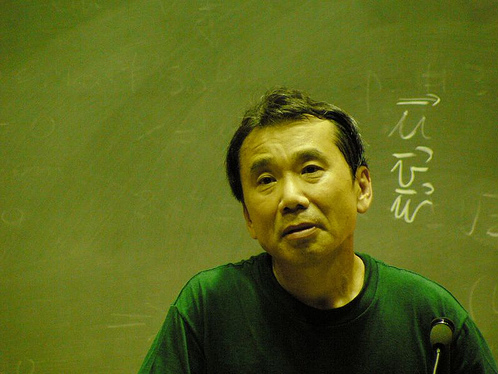
Haruki Murakami (Photo by Wakarimasita, Wikipedia, under Creative Commons Attribution ShareAlike 3.0)

And now to the book I received last night. It is Birthday stories, an anthology of thirteen short stories “selected and introduced by Haruki Murakami“. (The givers knew that I like Murakami.) The book was originally published in Japanese, Murakami having both selected and translated the stories from English, but was later published in English with “a specially written introduction”. The stories all deal with birthdays and are by such luminaries as Raymond CarverDavid Foster WallacePaul Theroux, and William Trevor – as well as by Murakami himself. Each story has a brief – and delightfully personal – introduction by Murakami.

In his introduction to the anthology, Murakami writes that his inspiration for compiling the anthology:

was my consecutive reading of two outstanding stories that happened to be based on the theme of birthday: “Timothy’s birthday” by William Trevor and “The Moor” by Russell Banks. … Both stories left me feeling haunted.

I imagine that there will be various interpretations of “birthday” from the day of one’s birth to those days in which we celebrate our own or the births of others. I rather like themed collections of short stories, and so am looking forward to reading this book – perhaps by dipping into it over time rather than reading it all at once, so you’ll probably hear about it as I go.

Meanwhile, I’m thinking that if these are the sorts of gifts arriving before Christmas, some wonderful delights must be in store for me when the day itself arrives! After all, you can never receive too many books for Christmas – can you?

Haruki Murakami (ed)
Birthday stories
London: Vintage Books, 2004
206pp.
ISBN: 0099481553

Jennifer Forest, Jane Austen’s sewing box

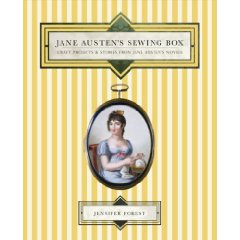
…and so the current Jane Austen juggernaut rolls on. The latest that has come to my attention is Canberra writer Jennifer Forest’s book Jane Austen’s sewing box. Must admit that I was a little sceptical when I first heard of it, but I saw it, bought it, and was pretty impressed. It’s a nicely produced book and represents a genuine attempt to look at the “crafts” of Jane Austen’s time – as well as being a “how to” book.

Jane Austen Sewing Box, by Jennifer Forest, Book cover

Cover from http://www.jennifer-forest.com/sewing-box.php, using Fair Dealing (I think)

The first thing to note, said the author when she attended my Jane Austen group’s monthly meeting last weekend, is that these are not all simply “crafts”. Many are, in fact, women’s work. Women made clothes, including men’s shirts and cravats, bags and purses, bonnets and so on. There was, in fact, a clear divide between “decorative” work and “useful” work and most women, including Jane Austen herself, did both. In fact, Penny Gay, writing in Cambridge University Press’s Jane Austen in context wrote:

Most houses had several sitting-rooms, in one of which the ladies of the household would gather after breakfast to ‘work’. By this is meant needlework, an accomplishment which was both useful and artistic, and which was considered a necessity for women of all social classes. Jane Austen herself was a fine needlewoman… If visitors called, it was often considered more genteel to continue with one’s ‘fancywork’ rather than ‘plain’ shirt-making or mending.

Forest also talked a little about how Jane Austen uses knowledge and skill in this work as part of her characterisation. In Mansfield Park, for instance, the work of the Bertram sisters is deemed not good enough for display in the public rooms (“a faded footstool of Julia’s work, too ill-done for display in the drawing room”) of the house – a clear indication that these girls are not to be admired. On the contrary, Henry Tilney in Northanger Abbey shows himself to be a solid young man and a loving brother by his knowledge of muslin. He could even be seen, many of us think, as the fore-runner of the SNAG (aka Sensitive New Age Guy)!

Forest introduced her talk with the quote that set her thinking about crafts in Jane Austen. It comes from the famous Netherfield scene in Pride and Prejudice in which Elizabeth Bennet, Mr Darcy, and Caroline and Charles Bingley discuss women’s accomplishments. The aways generous Charles Bingley believes all women are accomplished:

Yes, all of them I think. They all paint tables, cover screens and net purses.

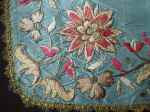
CrewelWiki

Crewel embroidery (from Wikipedia using Creative Commons CC-BY-SA)

Forest went on to describe these three “accomplishments” and more, such as crewel work, tambour work, and knotting. She also brought along a “show and tell” of the objects she had made in the course of writing the book. There is nothing like seeing and touching a hand-made bonnet or a netted purse to understand just how these women spent so much of their time. I am so glad I was born in the time of labour-saving devices!

This might not be a book for everyone. It is not academic but is nicely researched; and it is gorgeously produced with lovely period illustrations. I do have a quibble though – one that is, to me, quite serious – and that is its index. Why have a Table of Contents listing for “Muff and Tippett” and then have an Index listing for the same. If you want to find out what a Tippett is, you will not find it under T. Try M instead. How silly is that? Overall, the index is idiosyncratic and needs to at least double its existing size to be truly useful. That said, even if, like me, you are unlikely to make the 18  items described, take a look. Its readable discussion of “the accomplishments” of the period nicely illuminates the context of the novels – and this can only enhance our enjoyment of them.

Jennifer Forest
Jane Austen’s sewing box: Craft projects and stories from Jane Austen’s novels
Miller’s Point: Murdoch Books, 2009
224pp.
ISBN: 9781741963748

George Orwell, Bookshop memories

I do like to read a bit of Orwell every now and then – and for that reason, though I have other books of his to read in my TBR pile, I recently bought his essay collection, Books v. cigarettes, in Penguin’s delightful Great Ideas series. I blogged about the first essay a couple of months ago. Tonight I decided to read the second essay, “Bookshop memories”, in which he draws on his experience of working in a second-hand bookshop. It was published in 1936.

There’s a nice little Wikipedia article about the essay, giving the background to his writing it and a brief summary of its content, so I won’t repeat all that again here. Rather, I’ll just comment on a couple of observations he makes that tickled my fancy, and these relate to one of the sidelines of the bookshop: its lending library. He says that in a lending library “you see people’s real tastes and not their pretended (my emphasis) ones, and so, he notes that:

  • “classical English novelists have dropped out of favour. It is simply useless to put Dickens, Thackeray, Jane Austen*, Trollope etc into the ordinary lending library; nobody takes them out”. Dickens, he says, “is one of those authors people are ‘always meaning to read'”
  • there is a growing unpopularity of American books (but he doesn’t give any reason for this)
  • people don’t like short stories because, for some, “it is too much fag to get used to a new set of characters with every story”. Orwell says on this one that the blame lies as much with the writers as the readers: “Most modern short stories, English and American”, he says, “are utterly lifeless and worthless”. Those that “are stories”, such as by D.H. Lawrence, are, he says, “popular enough”.

I don’t think the second point is true today (at least in Australia), but I suspect that the first and third still have some credence. Again and again I hear in bookgroups, “let’s not do a classic” and “I don’t like short stories”. Of course, there are exceptions (my bookgroup, for example, likes to do a classic a year!) but I think the rule still applies. Will it be ever thus?

* Have you noticed how Jane Austen is more often than not referred to with both her names while the fellas often aren’t? We comfortably talk about Shakespeare, Dickens, and Wordsworth, but far less so of Austen. Chivalry? Sexism? Odd isn’t it?

BookSeer – is it for you?

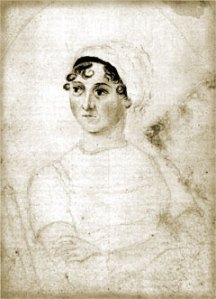
Jane Austen (surely public domain!)

Jane Austen (surely public domain!)

What do Jane Austen’s Pride and prejudice and Cormac McCarthy’s The road have in common (besides the fact that I mentioned both authors in a recent post that is)? Nothing much, really, except that Amazon.com suggests that if you’ve read Pride and prejudice you may like to read The road. See, I was onto something when I said that Jane Austen could to some degree be described as a spare writer! But, truly, I don’t think that’s what Amazon was saying.

The site at which I saw this suggestion was not the Amazon site, but BookSeer. BookSeer is, apparently, “another literary web project by APT Labs”. What it does is present suggestions for reading based on what you’ve just read. The home page poses the simple question:

You there! I’ve just finished reading …….. by …….. . What should I read next?

When you enter your last read and then click the arrow you get suggestions from Amazon, the Book Army and LibraryThing. I hate to say it, but the algorithms for generating the suggestions leave a lot to be desired. To test it out I said that I had just read Pride and prejudice. Following are the first three recommendations from BookSeer’s sites.

Amazon:

  • Let the right one in, by John Ajvide Lindqvist
  • The Zombie survival guide: Complete protection from the Living Dead, by Max Brooks
  • World War Z, by Max Brooks

Do these selections look a bit odd to you? Well, the reason is that although I typed Pride and prejudice by Jane Austen into BookSeer.com, Amazon decided that what I was really interested in (had read even) was Pride and prejudice and zombies. As my American cousins would say, Go figure! (BTW The road was number 6 in the list).

BookArmy:

  • Mansfield Park, by Jane Austen
  • Persuasion, by Jane Austen
  • The power that preserves, by Stephen Donaldson

Now this looks a little more appropriate, doesn’t it?

LibraryThing:

  • Sense and sensibility (Penguin Classics), by Jane Austen
  • Persuasion (Penguin Classics), by Jane Austen
  • Emma (Penguin Classics), by Jane Austen

Now, this is SO sensible it is perhaps a little boring – after all if you’ve read Pride and prejudice you probably know of and already want to read her other 5 novels!

BookSeer then is an intriguing idea, but until the algorithms used by the sites they draw on are a little more sophisticated – and until I get through my TBR (To Be Read) list – I don’t think I will be a regular visitor to the site. What about you?

What do I mean by spare?

If you asked my kids what my favourite mantras are, they would probably include “less is more” as one of them. This is not to say that I don’t enjoy flamboyance and “over-the-topness”, because I most certainly do, but it is true that I am more often drawn to what I would call “the spare”.

Claypan in Wurre (Rainbow Valley), south of Alice Springs

Claypan in Wurre (Rainbow Valley), south of Alice Springs

As we drove recently through Central Australian desert country, I started thinking about why it is that I love deserts, why I am drawn to them – and it suddenly occurred to me that my love of deserts can probably be equated with my love of spare writing. There are similarities: deserts and spare writing look deceptively simple and even, at times, empty on the surface but, hidden beneath this surface is a complexity that you can only find by looking and, particularly, by knowing what to look for. Conversely, in say a rainforest or a big fat nineteenth century novel, you are confronted with an embarrassment of riches. This is not to say that they, too, don’t have their complexities, but the “wow factor” is in your face!

And so what exactly is spare writing? I realised that I have often called something spare but this has been an intuitive thing – I’ve never actually sat down and defined what I mean by it. I’m going to now – for my benefit even if not for anyone else’s!

What typifies spare writing?

Of course, nothing that I write below is exclusive or absolute – there are, as they say, exceptions to every rule, but there are too, I think, some generalities we can identify:

  • preponderance of short sentences
  • minimal use of adjectives and adverbs
  • apparent focus on the concrete rather than the abstract
  • simple dialogue
  • repetition
  • strong (often more staccato like) rhythm
  • short paragraphs and more white space on the page

By excluding anything that could be seen to be superfluous to the intent, the author can cut to the chase…and the chase is often the most elemental, the most intense of experience or emotion. In this sense spare prose is reminiscent of poetry – and in fact can often feel and sound poetic. Spare writing, though, can also be its own worst enemy: it can be so pared down, so concise, that it becomes elliptical; so non-florid, so unsentimental, that it can seem cold. But then, this is no different from any other style is it? There are those who use a style effectively and those who don’t. Used well, a spare style can grip me quickly and, often, viscerally.

Some proponents of the style

While Ernest Hemingway is the writer most often cited, I think, as a spare writer, I have read little of his work – something I would like to rectify. Albert Camus, particularly in works like The outsider, is spare: the protagonist Meursault explains little leaving it to the reader to untangle who he is and what he feels and believes (or not as the case may be!). JM Coetzee’s Disgrace is another rather spare work, exemplified by its detached tone, by the refusal of the main character to explain himself, and by its matter-of-fact description of fear and horror.

A recent very obvious example is Cormac McCarthy’s The road. This book is elemental in more ways than one: everything is pared down to the minimal – the landscape, the characters, the language. It is in fact about the struggle for life – literally and spiritually. The spare style – with its rhythmic repetitions – makes sure that we see that! And guess what? Its landscape, while not originally a desert has been made so by cataclysm. This is one of the sparest books I’ve read – and also one of the most mesmerising.

An observation

Have you noticed something about the above? All the examples are male. Is a spare style more suited to the male psyche? While I can’t think of any specific examples of women writing quite like the male writers I’ve described, I’d suggest that writers like – yes, I admit it, my favourites, Jane Austen and Elizabeth Jolley – are closer to the spare end of the writing spectrum. Austen, for example, is quite out of step with her female contemporaries, most of whom were writing Gothic or so-called sentimental novels. She is more rational, witty and ironic than descriptive and emotional…which is why, really, Charlotte Bronte, child of the Romantic age, didn’t much like her!

And here, in the interests of following my own “less is more” mantra, I shall close! I would though love to hear others’ thoughts on the matter.

The challenge of the biopic

I do love a biopic – essentially, a movie dramatisation of the life of a real person – but I also know that I must always keep in mind that it is a dramatisation. That is, it is not a biography but more like a biographical novel. The challenge with this is that when I know the subject well – such as Jane Austen (have I told you I’m a fan?!) – I can tell where poetic licence has been taken in order to tell a good story. But, when I don’t know the subject well, I can walk away believing that what I have just seen are the facts.

A year or so ago, I saw the film Becoming Jane. It created quite a stir among Janeites because it took great liberties with her life: it took what our sources can only confirm as an attraction (possibly an intense one, but one that was quickly nipped in the bud) and created a highly romantic story that included a near-elopement. To the purists this took too great a liberty with her life. To the feminists it was “corrupt” in its implication that it was only as a result of this “romance” that Austen was able to write the love stories that she did. To the general public though it was a lovely period piece about someone who has become one of the century’s icons. Me? I thought it was a very entertaining movie – but it was not my Jane!

Coco Avant Chanel

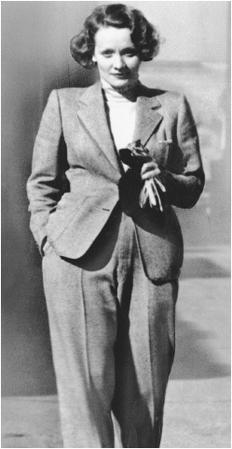
Coco Chanel, 1920s
Coco Chanel, 1920s (Presumed public domain)

Anyhow, this brings me to the film I saw today, Coco Avant Chanel. I know next to nothing about Coco Chanel’s life and so I could easily walk away from this film believing that I know exactly how she got to be the fashion doyenne that she was, and exactly what role was played by two men – the Frenchman Balsan and the Englishman Arthur “Boy” Capel – in the development of her early career. That would, though, be a bit naive of me. And the film itself should clue me into that through the way it clearly skirted around some parts of her story. For example, at one point it showed Balsan treating her almost as a whore (or kept woman – “my geisha”) and then suddenly accepting her into his rather wild “fold”. It showed “Boy” as her first great love but glossed over the financial arrangement between them, something which the film implies compromised Coco’s sense of independence. It teased us with a close relationship with a sister but didn’t resolve that.

However, I did enjoy the movie. I liked the transition from 10-year-old Coco (then called Gabrielle) to the young woman peering through the curtains before going on to perform in a cabaret-style bar. It neatly gave us the sense that she was an outsider, watching and waiting to join in. The “outsider” idea is certainly one of the themes of her story as told in this film. Oh, and I loved the way it showed her subversive attitude to fashion – her blending of comfort (no corsets, looser fit, androgynous look) with style and elegance. A woman after my own heart, though I must admit that comfort rather than style is what I mostly achieve!

Co-producer of Becoming JaneGraham Broadbent, says of his film that ‘There are documented facts and we’ve joined the dots in our own Austenesque landscape.’ Should we care – does it matter – that we can’t all see the joins between the dots when we see a biopic?

Jane Austen Regency Feast

I’m going to have my dinner after which I shan’t be thinner (Jane Austen, Juvenilia)

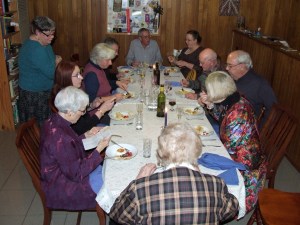
Last night was my local Jane Austen Society’s eighth annual midwinter feast. We started off small in 2002 as a lunch for members only but, in the last few years, we have expanded it to a night event including members’ partners, resulting in some very convivial nights. We are a small group and not everyone can make the chosen date, so our numbers vary. Last night we were 13.

This year's feasters tuck into dessert

This year's feasters tuck into dessert

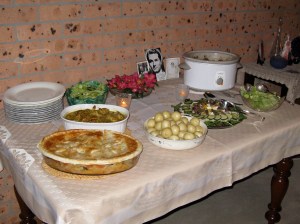
Regency Feast Main Courses

Regency Feast Main Courses

Every member brings a dish chosen from the Regency era, though not all dishes are perfectly authentic: some ingredients are hard to get, some cooking techniques are not those we use now, and sometimes we just don’t exactly know how it was done. Our main sources are the Jane Austen Centre’s online magazine and Maggie Black and Deirdre Le Faye’s The Jane Austen cookbook (which presents the recipes used by  Martha Lloyd – Jane’s closest friend and confidante after her sister, Cassandra). This year our main courses were:

  • Beef and roasted vegetable ragout
  • Chicken curry in the Indian manner
  • Vegetable pie
  • Salmagundy/Salamongundy
  • Potatoes
  • Salad of greens with cucumber

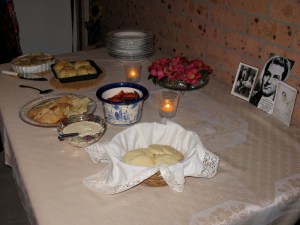
Regency Feast Dessert Table

Regency Feast Dessert Table

We are slowly building up quite a repertoire: each year there are some old favourites and some new experiments. Our members enter wonderfully into the spirit and regularly give something new a try, and so each year some very nervous chefs arrive with their dishes – and each year their anxieties are proved unfounded as we dig into their dishes with relish. Past main meal dishes have included Fish in corbullion, Broiled salmon, Roast pork, and Beef-steak pudding. We haven’t yet quite got into goose and partridge but I reckon we will!

Desserts are usually trickier as original recipes often assume a lot that has now been lost – or require highly time consuming processes that most of us can’t quite commit to. However, many Regency enthusiasts have interpreted and translated recipes and we are gradually sussing them out. Past desserts have included Black Caps (aka Baked Apples Miss Bates – from Emma, you know! – style), Whipt Syllabub and Cranberry Jelly (first make your “isinglass jelly”). This year we were tempted by:

We don’t, as you can see, go hungry – and neither are we bored as we spend a few hours talking, eating, laughing and, yes, drinking. As Jane wrote (though I have to admit that these words in this particular character’s mouth have an ironic edge):

Give me but a little cheerful company, let me have only the company of the people I love, let me only be where I like and with whom I like, and the devil take the rest, say I. (Jane Austen, Northanger Abbey)

Toni Jordan, Addition

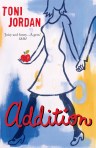
Addition Pb cover, Courtesy Text Publishing

Addition Pb cover, Courtesy Text Publishing

(SPOILERS: FOR WHAT IT’S WORTH)

Looks like, feels like, is it? Chick lit, that is. Toni Jordan’s first novel Addition has all the hallmarks of chick lit. The cover design with its line drawing of a female form invokes chick lit – albeit chick lit with an edge as the heels aren’t quite high enough and the colours not quite girly enough. The plot though is pure rom com and pretty much standard chick-lit: girl meets boy, girl loses (kicks out) boy, girl gets boy back. So why has this book garnered more attention and positive critical response than its sisters?

Well, Jordan is no Jane Austen (who is sometimes called the mother of chick lit) but she has produced something a little fresh. Her heroine, Grace, is not quite the standard chick lit heroine. She has had a breakdown, she is not in employment, she is not upwardly mobile and she is not focused on fashion and appearance (though it has to be said that she’s not oblivious to these latter either). Instead, she’s an ex-primary school teacher (not the most fashionable career, anyhow, in the world of chick lit) and she suffers from an obsessive compulsive disorder that results in her need to count, anything and everything, in order to maintain control over her life. And her hero, Seamus, a happy, ordinary dresser in an ordinary go-nowhere job, is “average”. Fortunately, though, with the help of her smart young niece, Grace realises at the end “that average can actually be unique”.

Grace’s voice is chick-lit-sassy and the book is genuinely funny a lot of the time, but there are also times when it is forced and tips over into being smart-alecky, such as her reactions to the psychiatrist and therapist. Her other hero is Nikola Tesla, the not-properly recognised famous inventor of many things electrical, who also had an obsessive compulsive disorder relating to numbers. It is the presence of Nikola in Grace’s life which sustains her at the beginning, helps ground her at the end and gives the book its real hook – that is, that being different is to be cherished and encouraged, as long as it doesn’t drag you down.

Jordan has a nice flair for language too. I liked the change in tone and pace when Grace’s panic rises, and a similar change in Jill’s speech to Grace when they are in hospital discussing their mother’s future. She’s lightly ironic in places and includes the odd bit of wordplay. It will be interesting to see where she goes next.

In addition (excusez-moi!) to its trying sometimes to be a bit too funny and its somewhat preachy ending (“Listen … Life is ..”), the book’s main problem is it’s too close adherence to the formula. You know she is going to lose him and you know she is going to get him back. It’s just a matter of how. Some level this same criticism at that favourite author of mine, Jane Austen, but her books encompass way more than plot to say some fundamental things about the human condition. I can read her again and again and see something new, or take away another perspective. I can’t see anything in Addition, as delightful as it is, that would afford me that pleasure on multiple readings.

So, read it, enjoy it – as I did – but if you want something a little more sustaining, try Jane.