Jane Austen, Emma Vol 3 (continuing thoughts)

I’ve now finished my re-read of Emma, and found that the theme of friendship, which I discussed in my Volumes 1 and 2 posts, did continue to play out in the last volume. In those previous posts, I suggested that Austen was presenting friendship as having both personal and social value, and I gave examples of different acts of friendship, some generous, others more questionable if not down-right self-serving.

Now, having finished the novel, I’d like to identify the different sorts of friendships which Austen presents to her readers:

  • neighbourly/kind friendship
  • “general” friendship
  • self-serving friendship
  • “true” friendship

Since I touched on some of these in previous posts, I will just expand a little more here. Neighbourly or kind friendship encompasses giving mostly practical support to others. In Emma this includes, for example, providing transport or food to poorer women in the neighbourhood. Many characters offer this sort of friendship, including, even, the unpopular Mrs Elton.

General friendship, on the other hand, is the sort of hail-fellow-well-met tolerance/acceptance of other people, with little regard to substance. Mr Weston is a perfect example of this. He’s “straight-forward, open-hearted”. He doesn’t discriminate against people on the basis of, say, class, but neither does he discern between sincerity and superficiality. And he’s inclined to gossip rather than hold his counsel. Here’s Emma on Mr Weston at the Crown where he is hosting a dance. He’d invited her to arrive early to pronounce on whether everything is in order, but she finds that he had similarly invited many other “friends”:

Emma perceived that her taste was not the only taste on which Mr. Weston depended, and felt, that to be the favourite and intimate of a man who had so many intimates and confidants, was not the very first distinction in the scale of vanity. She liked his open manners, but a little less of open-heartedness would have made him a higher character.—General benevolence, but not general friendship, made a man what he ought to be.—She could fancy such a man.

Such a man is, of course, Mr Knightley. Emma is, admittedly, a bit of a snob and likes to be recognised for her “place” in Highbury, but nonetheless, Mr Weston is presented to us as someone who “takes things as he finds them, and makes enjoyment of them somehow or other” rather than one who can be relied upon, for example, to make good judgement about character. He’s an appealing character, but not the ideal man.

Self-serving (or self-aggrandising) friendship is epitomised by the execrable Mrs Elton whose protestations of friendship, particularly towards Jane Fairfax, belie her real motivations, which are to look good and to spite Emma. She chooses her friendships on the basis of what they do for her.

And then there’s “true” friendship, the sort of friendship which is not swayed by superficial concerns, which is not scared to speak the truth, and which quietly works for the benefit of others without looking for praise or recognition. This is the sort of friendship offered by Mr Knightley, who tells Emma when he feels she’s behaved rudely or improperly, who consistently judges people correctly, and who is prepared to make sacrifices for the benefit of others.

There are readers who find the relationship between 21-year-old Emma and 38-year-old Mr Knightley a little paternalistic, if not creepy, but I’d argue these were different times with different expectations and mores. Emma is not a push-over and it’s clear that Austen sees their relationship as one built on love and “true” friendship. The last lines of the novel are:

The wedding was very much like other weddings, where the parties have no taste for finery or parade; and Mrs. Elton, from the particulars detailed by her husband, thought it all extremely shabby, and very inferior to her own. “Very little white satin, very few lace veils; a most pitiful business! Selina* would stare when she heard of it.” But, in spite of these deficiencies, the wishes, the hopes, the confidence, the predictions of the small band of true friends who witnessed the ceremony, were fully answered in the perfect happiness of the union.

Before I leave this topic of friendship, I want to mention a somewhat related topic – that of civil falsehoods. Austen introduces the term through Frank Churchill who, on being encouraged by Emma to go hear Jane Fairfax play the pianoforte, expresses an inability to pretend to like it if the instrument’s tone is poor. He says “I am the wretchedest being in the world at a civil falsehood”. The irony, of course, is that he is being false to Emma. Emma, though, blithely unaware, tells him that “I am persuaded that you can be as insincere, as your neighbours, when it is necessary”.

Emma, more than any of Austen’s novels, deals with a whole community. Austen teases out the idea that communities survive on the basis of “civil falsehoods”, that these falsehoods are at times “necessary”. On another occasion, when Mr Weston invites Mrs Elton to the Box Hill picnic, stating that “she is a good-natured woman”, a disappointed

Emma denied none of it aloud, and agreed to none of it in private.

Emma, in other words, does the polite thing and holds her tongue. But Austen knows there are costs, and that there is a place for “civil falsehoods” and a place for honesty. Falsehoods, even civil ones, Austen argues need to be handled with care. By the end of the novel, it’s clear that she, like Emma, would always prefer “openness” to concealment. I wonder if this is why she, known for her sharp tongue, felt Emma would be a heroine that only she would like!

Re-reading

Noticing this friendship theme is just one of the delights I’ve had in this re-reading of Emma. Each time I read it, I notice more – both in terms of Austen’s concerns and her technique.
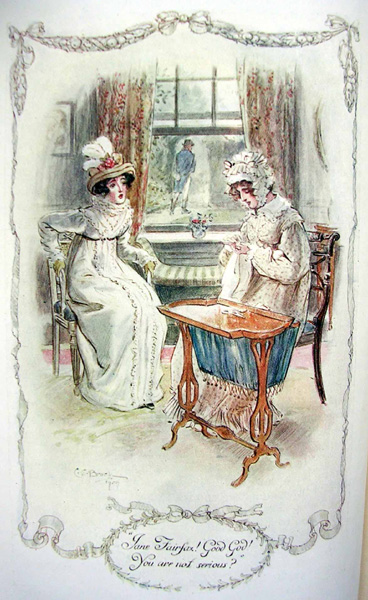
Illustration, Emma and Mrs Weston

“Jane Fairfax. Good God! You are not serious!” (Illus, by CE Brock)

One feature that interested me this read is the way she shows characters’ real love interests by whom they are watching (out for). It’s subtle and can be missed on early reads but it’s there. For example, while everyone thinks Frank Churchill is interested in Emma, Frank is watching out for Jane Fairfax. When Jane arrives at the Crown with her aunt, Miss Bates, it looks as though it’s Miss Bates whom Frank tends – “Miss Bates must not be forgotten” he says to his father as he rushes out to make sure they don’t get wet. But Miss Bates, in her chatter, lets drop his real interest:

My dear Jane, are you sure you did not wet your feet? It was but a drop or two, but I am so afraid: but Mr. Frank Churchill was so extremely—and there was a mat to step upon. I shall never forget his extreme politeness.

Similarly, when Emma and Harriet discuss a past occasion when they were with Mr Knightley and Mr Elton, Emma remembers where Mr Knightley had been standing, while Harriet only remembers Mr Elton:

“Stop; Mr. Knightley was standing just here, was not he? I have an idea he was standing just here.”

“Ah! I do not know. I cannot recollect. It is very odd, but I cannot recollect. Mr. Elton was sitting here, I remember, much about where I am now.”

Absolutely delicious. By the time this occurs, Harriet is over Mr Elton, and Emma is still unaware of her love for Mr Knightley, all of which adds to our delight in reading this scene.

Another technique which struck me was how often characters mis-read clues, how often they assume the wrong reason for an occurrence. Near the end, Mr Knightley holds Emma’s hand and is “on the point of carrying it to his lips—when, from some fancy or other, he suddenly let it go”. Emma doesn’t read this as love but as a sign of “perfect amity”. And when Frank, on his return to Highbury, visits Emma but doesn’t stay long, she assumes “it implied a dread of her returning power, and a discreet resolution of not trusting himself with her long”. However, the real truth, we realise on subsequent readings if not our first, is that he wants to visit Jane.

I could, in fact write three times this and more, on Emma, but I’d rather not. I’d much prefer it if these little tidbits encouraged you to read it (again!). At 200 years old, and despite its dated snobbery, this is a book that still has much to offer about human nature – and about skilful writing. I’m sure to read it again.

* Selina is Mrs Elton’s sister whom she sees as the arbiter of all things impressive.
Jane Austen, Emma Vol 2 (continuing thoughts)

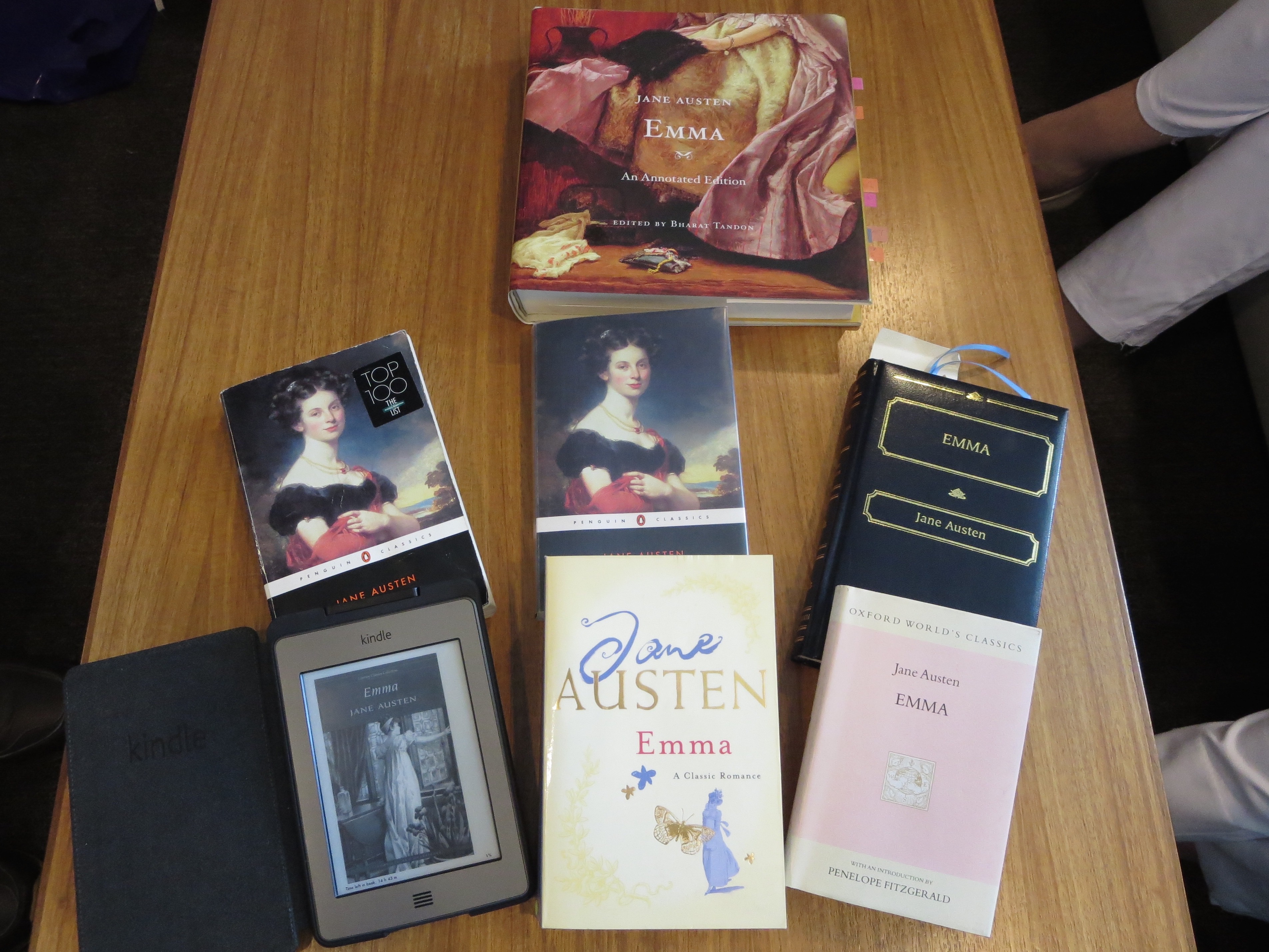
EmmaCoversThe friendship plot – that theme I discussed in my post on Volume 1 of Emma – thickens in Volume 2. Several “new” friendships are presented, as Austen continues to deepen our understanding of what constitutes community via the little village of Highbury. For Jane Austen, I think we are going to realise, friendship is both a deeply personal thing as well as something that underpins society.

In Volume 2, three people are introduced to Highbury – Jane Fairfax and Frank Churchill, about whom we’d heard heard in Volume 1, and Mrs Elton, the new bride of Highbury’s minister, Mr Elton. Through them, and the previously introduced characters, we are introduced to several facets of “friendship”. Positive examples include:

  • Colonel Campbell’s generous act of friendship to Jane Fairfax’s late father by taking Jane into his household and educating her along with his daughter;
  • Mr Knightley’s neighbourly style of friendship in providing food from his estate to the Bates and transport for them to a wintry evening dinner-dance;
  • Emma’s similarly neighbourly friendship in providing food to the Bates;
  • Miss Campbell’s open-hearted, trusting acceptance of her fiancé’s preference for her friend Jane Fairfax’s piano playing over her own; and even
  • Mr Woodhouse’s entertaining some of the older women in the town.

More questionable ones include:

  • Mrs Elton’s profusions of friendship to Jane Fairfax but in fact interfering with Jane’s wishes; and
  • Emma’s inability to befriend Jane Fairfax.

In Volume 1, Austen explored the role (and value) of friends in providing advice and emotional support to each other, what we could call perhaps the more “personal” side of friendship. In Volume 2, there is I think a slight shift of emphasis to more practical, or societal, aspects such as the provision of material comforts and company. Through all these manifestations of “friendship”, Austen seems to be building a rich picture of human relationships, of what we need from, and can do for, each other.

There is also in this volume a discussion of what Emma doesn’t like in a friendship: it’s the “coldness and reserve” that she sees in Jane Fairfax, with whom everyone, including Mr Knightley, expected and still expects her to be intimate. She says of not looking to Jane for friendship:

But I must be more in want of a friend, or an agreeable companion, than I have yet been, to take the trouble of conquering any body’s reserve to procure one.

An additional impediment to Emma’s willingness to befriend Jane Fairfax is fact that Jane is lauded for skills in areas in which Emma is less accomplished (through, it seems, lack of application!) Interestingly, late in the volume, Mr Knightley, responding to suggestions that he might be thinking of marrying Jane Fairfax, says he is not interested:

She is reserved; more reserved, I think, than she used to be: and I love an open temper.

It will be interesting to see whether the issue of love and its relationship to friendship is teased out in Volume 3.

Jane Austen – protofeminist?

Just how “feminist” you see Jane Austen depends somewhat on your definition of feminism, but for me she demonstrates a clear recognition of the (economic) inequalities that affect women’s lives and of the (societal) factors that hold them back. She demonstrates this in Emma by presenting a heroine who is independently wealthy and who therefore has no economic need to marry. Emma recognises this and says early in the novel, in volume 1 in fact, that she won’t marry:

“I have none of the usual inducements of women to marry …  without love, I am sure I should be a fool to change such a situation as mine. Fortune I do not want; employment I do not want; consequence I do not want: I believe few married women are half as much mistress of their husband’s house as I am of Hartfield; and never, never could I expect to be so truly beloved and important; so always first and always right in any man’s eyes as I am in my father’s.”

Part of the trajectory in Emma is for her to learn that there are other reasons to marry besides those of money and consequence. By contrast, her foil/double, Jane Fairfax has no independent wealth. The most likely course of life for her is to be a governess, but it’s not a cheery thought:

“I did not mean, I was not thinking of the slave-trade,” replied Jane; “governess-trade, I assure you, was all that I had in view; widely different certainly as to the guilt of those who carry it on; but as to the greater misery of the victims, I do not know where it lies…”

For Jane Fairfax, a good marriage would save her from what she sees as a pretty devastating fate.

Contrasting these two quite different situations is Mrs Elton. In Austen, as in most authors, you need to be aware of who is speaking when assessing what they say. Mrs Elton is a figure of ridicule in Emma, rather like Mr Collins in Pride and prejudice. She’s the upstart who “has a horror of upstarts”. Her idea of standing up for women involves counteracting Mr Weston’s statement that “delicate ladies have very extraordinary constitutions”. She says:

I always take the part of my own sex; I do indeed. I give you notice, you will find me a formidable antagonist on that point. I always stand up for women; and I assure you, if you knew how Selina feels with respect to sleeping at an inn, you would not wonder at Mrs. Churchill’s making incredible exertions to avoid it. Selina says it is quite horror to her; and I believe I have caught a little of her nicety. She always travels with her own sheets; an excellent precaution.

The satire here is multi-layered, but includes ridiculing Mrs Elton’s notion of standing up for women by asserting their focus on niceties!

More …

There’s a lot more I could discuss about this volume, such as its perfect plotting in which very little happens, or is said, that doesn’t move the plot forward, but that does it in such sly ways that we are barely aware it’s happening. However, I think I’ve made the main points here that particularly caught my attention during this re-read … so, onto volume 3 in April.

Jane Austen, Emma Vol 1 (Review, or perhaps just thoughts)

EmmaCovers

Every now and then my local Jane Austen group does a slow read of one of Austen’s novels. With 2015 being the 200th anniversary of the publication of Emma, we decided it was the logical choice for our next slow read. I love this activity because what happens when I re-read an Austen novel – particularly when I take part in a slow read – is that I “see” something new in the novel, something new to me that is, because it’s hard to think that anyone could come up with something totally new about Austen.

So, last time I re-read Emma, the thing that stood out for me was how beautifully plotted it is. There isn’t a word or action that doesn’t imply or lead to something telling, even if we don’t know it at the time. This read, with the plotting firmly in my brain, I’m finding that the aspect is flying a little under the radar. Instead, I’m noticing how often the word “friend” or notion of “friendship” is appearing. The novel, in fact, starts with Emma losing her ex-governess-then-companion Miss Taylor to marriage. They’ll remain friends but … so Emma, alone in a big house with her fussy, demanding, albeit gentle father, develops a friendship with Harriet, “the natural daughter of Somebody … [who] had no visible friends but what had been acquired at Highbury”.

This, though, is not the only friendship involving Emma to appear in Volume 1. Mr John Knightley, Emma’s brother-in-law, advises Emma “as a friend” that Mr Elton’s attentions are more than friendly, but Emma believes that she and Mr Elton “are very good friends, and nothing more”. Emma and her long-standing friend and neighbour, Mr Knightley, decide to “be friends again” after one of their quarrels. Meanwhile, we, like Mr Knightley, wonder whether Emma’s friendship is helpful to Harriet or not.

In the third paragraph of the novel, Austen suggests what she sees friendship to entail:

Sixteen years had Miss Taylor been in Mr. Woodhouse’s family, less as a governess than as a friend, very fond of both daughters, but particularly of Emma.  Between them it was more the intimacy of sisters.  Even before Miss Taylor had ceased to hold the nominal office of governess, the mildness of her temper had hardly allowed her to impose any restraint; and the shadow of authority being now long passed away, they had been living together as friend and friend, very mutually attached, and Emma doing just what she liked; esteeming Miss Taylor’s judgment, but directed chiefly by her own.

I’m talking about the words “and Emma doing just what she liked”. Miss Taylor/Mrs Weston, as Mr Knightley says to her later, had been a good companion to Emma but had also been better at submitting her will to Emma than in giving Emma the “complete education” he thinks she needed. Mr Knightley’s view of friendship encompasses providing honest, wise advice. He’s therefore severely angry with Emma when she encourages Harriet not to accept Robert Martin’s proposal:

 You have been no friend to Harriet Smith, Emma.

There are other friendships in the novel that don’t directly involve Emma, some with and between neighbours, and some within families. Her father, Mr Woodhouse, may be “no companion” for Emma, but we learn in Chapter 3 that he “liked very much to have his friends come and see him”. One of those visiting friends is Miss Bates who feels fortunate to be “surrounded with blessings in such an excellent mother and so many good neighbours and friends”. And one of these “good neighbours and friends” is Mr Knightley who supplies the low-income Bates’ women with apples and other produce from his estate. Emma’s friend Harriet, herself, has friends who invite her to visit, the Martin family who manage a farm on Mr Knightley’s estate. See what’s happening? An intricate set-up of all sorts of friendships. Austen must be on about something.

Emma more than any of Austen’s six novels paints a fairly in-depth picture of a diverse community. There are the Westons, Mrs and Miss Bates, and their niece Jane Fairfax, Mr Knightley and his estate, Mr Elton the minister and his wife, Mrs Goddard and other members of her school, the new-money Coles, and various other members of the community who appear briefly, including the poor and gypsies. This is a more complete “Country Village” than we find in the other novels, even though her focus here is still her favourite, that is, “3 or 4 families” (Letter to her niece, Anna, 9 September 1814). It’s not surprising, then, that with such a wide and diverse group that friendship would feature more significantly. I look forward to watching and thinking about how she develops this concept over the next two volumes. Watch this space …

Not the Usual Monday Musings

Sense and sensibility book covers

Printed and eBooks for Jane Austen’s Sense and sensibility

Just for a change – and because I couldn’t resist it – I’m sharing an ad from ABE Books for a first edition 3-volume set of Jane Austen’s Sense and sensibility, which was first published in 1811. In case you are interested, the inventory number for the book is #ABE-11685473745.

I’m going to quote the ad in full on the assumption that this doesn’t break copyright. Surely one ad does not represent a significant portion of ABE Books’ intellectual content, and anyhow, as sellers, they presumably want their message to be out and about.

As the person who brought the ad to my attention said, this is a seller with attitude. Here goes:

3 vols. 1st edition, whispering in a voice quieter than decency, that the days that make us happy are the days that set us free. 19th century 3/4 morocco. A fine set, cleaner than fresh air, and it’s a complete one too with all 3 genuine half-titles, and though this 1st edition is regularly stalked by all collectors, it has a history of amplified appeal to those who are women, so heed this ladies: Buying a 1st edition of Sense and Sensibility without authentic half-titles is more dangerous than open-knife night at the blow fish bar, and more naïve than sexting your face and your kitty in the same picture. Ex-3 significant women collectors (bookplates) of élan who deserve snaps, Dorothy Stewart, Pamela Kingzett, and Sarah Peter, the last named of the 3, a modern goddess who gathered her 1st editions of fiction in English by women, 1 book at a time, and now stands tall with the greatest collection of them ever assembled. By anyone. Anywhere.

Austen invented modern romantic comedy beginning with Sense and Sensibility, and started schooling 7 generations of readers about the intricate convolutions of affection. What they learned from it right away is that all tests of love end badly, that excitement and familiarity are hard to find in one person, that the first duty of love is to listen, and that when the heart speaks, the mind should know it’s tacky to object. In the 20th century they came to understand that the only real proof of love is trust, that sometimes there are more differences within the genders than between them, that love must be transformed from the flame at first into the light that lasts, and that all men fall somewhere between apes and gods, and the best a wise woman can hope to do, is pick one that’s traveling in the right direction. Now we’re in the 21st century and a new generation of readers just balance Austen’s charm against the realities of daily life, appreciating that “desperate” is not a sexual preference, that the fastest way to improve a relationship is to see love as a verb rather than a feeling, and that a woman can find a blunt equality with men by going to therapy, where she can talk about herself for an hour, just like a guy on a date

.
Don’t you love this  – particularly the ad writer’s understanding of what Austen was (is) about? I reckon Jane Austen would have.

Jane Austen, Lady Susan (Review)

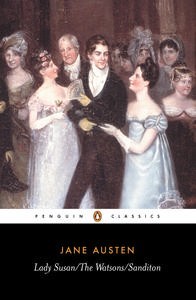
AustenLadySusanPenguinIt is a truth universally acknowledged – I know this is a tired old joke but I seem programmed to do it – that Jane Austen fans will collect multiple editions of her works. There are many reasons for this behaviour, but one of them is our interest in different introductions. And so, although I already had a copy of Lady Susan, in the Minor works volume of R.W. Chapman’s The Oxford Illustrated Jane Austen, I bought the Penguin edition for my Kindle because it had an introduction by Margaret Drabble. And I have a second confession to make: this is a rereading, but my reason for rereading has little to do with the reasons I gave in my recent post on Flanagan. The reason is simple – my local Jane Austen group decided to schedule it for our October meeting. I was happy with that. As far as I’m concerned all bets are off my usual “rules” when it comes to Jane Austen.

If you’re not an Austen fan, you may not have heard of Lady Susan. It is a complete novella that sits between her Juvenilia and her adult novels. It was written, we believe, in 1793/4 when Austen would have been 18-19 years old, but was not published until 1871, well after her death, when her nephew James Edward Austen-Leigh included it in his memoir of her.  It is epistolary in form, something she tried again with Elinor and Marianne. While this latter one she rewrote in her well-known third person omniscient voice, retitling it Sense and sensibility, for some reason she didn’t go back to Lady Susan. One reason might have been its subject matter.

 “the most accomplished coquette in England” (Reginald of Lady Susan)

Lady Susan is a beautiful, 35-year-old widow of four months, who is already on the prowl for a new, wealthy husband. The novel opens with her needing to leave Langford, where she’d been staying with the Manwarings, because she was having an affair with the married man of the house, and had seduced his sister’s suitor, Sir James Martin. She goes to stay with her brother-in-law Charles Vernon and his wife Catherine, whom she’d done her best to dissuade him from marrying. She’s not long there before Reginald, Catherine’s brother, arrives to check her out because, from what he’s heard,

Lady Susan possesses a degree of captivating deceit which must be pleasing to witness and detect.

Of course, the inevitable happens and the artful Lady Susan captivates him. Meanwhile, Lady Susan wants her 16-year-old daughter, Frederica, to marry Sir James, the man she’d seduced away from Miss Manwaring – but sweet, sensible Frederica wants none of this weak “rattle” of a man.

You’ve probably worked out by now that this is not Austen’s usual fare. Lady Susan belongs to the 18th century tradition of wickedness, lasciviousness and adultery, forced marriages, and moralistic resolutions. The novel’s characters tend to be types rather than complex beings, and it is racily written, with a broad brush rather than a fine pen. And yet …

“Lady Susan is not wholly a villain” (Margaret Drabble)

This is also where Austen’s mature touch starts to appear. For all Lady Susan’s self-centred “bewitching” machinations, she is also, as Drabble says, “witty, energetic, intelligent and charming”. Drabble and other critics argue that Lady Susan’s spirit can be seen in characters like Elizabeth Bennet, Emma Woodhouse and, particularly, Mary Crawford who, like Lady Susan, comes from London where she moved in “fast” circles. How could a teenaged country parson’s daughter imagine into being such a duplicitous character? Austen was, we know, a great reader and read the gothic novels of her day. She also knew the behaviour of Mrs Craven, the mother of her neighbour Mrs Lloyd. According to Drabble, Mrs Craven “had treated her daughters shockingly, locking them up, beating them and starving them, until they ran away from home …” just as Lady Susan’s daughter ran away from school. And, as her letters demonstrate, Austen was capable of bite.

We don’t know why Austen didn’t pursue this book, besides making a good copy of it in 1805, or why she didn’t try again to write about a beautiful 35-year-old widow.

Hints of what’s to come

All this is well and good, and I loved the read, but my main reason for reading these early Austens is their insight into the writer to come – her wit and irony, and her commentary on human nature. Lady Susan, having been written on the cusp of her maturity, is particularly interesting in this context. The melodrama, for example, is toned down, compared with the books Austen would have been reading. Frederica isn’t locked up as she might have been in Walpole’s Castle of Otranto (my review), there are no rapes as we see in Richardson’s Clarissa. Austen is moving, in other words, towards the naturalism of her favourite topic, “3 or 4 families in a Country Village”.

I love Austen’s irony, and there’s plenty in evidence here. A good example is when Reginald, completely convinced by Lady Susan, writes to his father of how she has been misrepresented, saying that this

may also convince us how little the general report of any one ought to be credited … I blame myself severely for having so easily believed the scandalous tales invented.

The joke is on him because, of course, he should believe these “scandalous tales”. One of the complexities of the novel is this issue of gossip – who should believe what and whom? As Austen readers know, gossip plays a significant role in her characterisation and plots.

Other ideas and themes that we see in later novels also appear in Lady Susan. Bad mothering is one. Another, more specific, is this delightful comment on accomplishments, reminding us of the discussion between Mr Darcy, Miss Bingley and Elizabeth at Netherfield. Lady Susan writes to her equally scheming friend Alicia Johnson:

Not that I am an advocate for the prevailing fashion of acquiring a perfect knowledge in all the languages arts and sciences; it is throwing time away; to be mistress of French, Italian, German, music, singing, drawing etc., will gain a woman some applause, but will not add one lover to her list.

And then there’s that main reason I love Austen – her terse, pithy commentary on human behaviour. There’s much in Lady Susan, including

but where there is a disposition to dislike a motive will never be wanting

and

Silly woman, to expect constancy from so charming a man!

Have I convinced you to give it a go? I do hope so.

Jane Austen
“Lady Susan”
in Lady Susan, The Watsons, Sanditon
London: Penguin Books, 2003
Kindle Edition EISBN: 9780141907901

Available in e-text.

Roslyn Russell, Maria returns: Barbados to Mansfield Park (Review)

A week or so ago my local Jane Austen group had a guest speaker at our meeting, Roslyn Russell, the author of Maria returns: Barbados to Mansfield Park. Russell is a local historian who has written this historical novel based on Jane Austen’s novel, Mansfield Park. She is also a lapsed member of our group, so of course we had to ask her to come and talk to us about it. Most of this post draws from my report of her talk, which she titled Maria returns: Barbados to Mansfield Park: Fictionalising the legacy of slavery in Mansfield Park.

Regular readers probably know that I’m not a fan of fan-fiction or sequels of well-known works. In fact, I probably wouldn’t have read any if it hadn’t been for belonging to the Jane Austen Society of Australia. However, having read Deidre Shauna Lynch’s essay, “Sequels” in Jane Austen in context, edited by Janet Todd, I decided that I should relax my “rule”. Lynch convinced me that these books are an important part of our understanding of Austen as a literary and cultural icon. Consequently, I have now read PD James’ crime novel Death comes to Pemberley (my review) and Jo Baker’s Longbourn (my review). Roslyn Russell’s historical novel is my third. In it, she imagines that some ten years after being banished to the country, and upon the death of her companion Aunt Norris, Maria Bertram goes to Barbados and learns about slavery and the abolition movement.

There are, I’m gathering, many different reasons why writers want to write sequels or fan fiction works. For Russell, it was, as she writes in her author’s note, inspired by two passions: her love of Jane Austen and of Barbados. Barbados? How many Australians have been to, let alone developed a passion for, Barbados? Not many, I expect. It was her museum work, in fact, which took Russell to Barbados and there, its history – and particularly the history of its plantations and the practice of slavery – reminded her of Jane Austen’s Mansfield Park in which the leading family, the Bertrams, draw their prime income from their plantation in Antigua.

Jane Austen, Mansfield Park and Slavery

Russell commenced by telling us that although most of the characters in her novel are fictional, some are based on real people. Before discussing this further, however, she read the excerpt from Mansfield Park which contains the only reference to slavery:

“But I do talk to him more than I used. I am sure I do. Did not you hear me ask him about the slave–trade last night?”

“I did—and was in hopes the question would be followed up by others. It would have pleased your uncle to be inquired of farther.”

“And I longed to do it—but there was such a dead silence! And while my cousins were sitting by without speaking a word, or seeming at all interested in the subject, I did not like— I thought it would appear as if I wanted to set myself off at their expense, by shewing a curiosity and pleasure in his information which he must wish his own daughters to feel.” (MP)

She noted that this shows Maria and Julia’s lack of interest in the source of their family’s income. She then referred to cultural theorist Edward Said’s discussion of the novel and his statement that it is not appropriate “to expect Jane Austen to treat slavery with anything like the passion of an abolitionist or a newly liberated slave”. Said, she told us, did not apply 21st century attitudes to his assessment of Austen, but suggested that her work, as that of an author who belonged to a slave-owning society, should be analysed in context and in terms of what she does and doesn’t say rather than simply attacked as being complicit.

Ros then briefly outlined some of Austen’s known or probable connections with plantations:

  • the family’s close relationship with her father’s friend, the plantocrat James Langford Nibbs who was also Austen brother’s godfather. Nibbs apparently took his son out to his plantations in Antigua to settle down his unruly behaviour, which rather mirrors Sir Thomas’ taking Tom out to his plantation.
  • Austen’s aunt-by-marriage, Jane Leigh-Perrot, who was born in Barbados, though went to school in England.
  • Mrs Skeet who is mentioned in Austen’s letters. Skeet is a common name in Barbados, suggesting she had a connection to slavery*.
  • the Holder family of Ashe Park, also friends of the Austens. Holder, too, is a common name in the Caribbean.

The title Mansfield Park, itself, could also reflect Austen’s awareness of the slavery issue, as it may have been inspired by Lord Mansfield who was famous for adjudications which contributed significantly to the eventual abolition of the slave trade. (This is the Lord Mansfield who became guardian of his mulatto niece Dido, fictionalised in the recent film, Belle).

Barbados and Maria Returns

Russell then turned to her own book, first addressing the question of why she had set it in Barbados and not Antigua, where the Bertrams’ plantation was. Firstly, she has been to Barbados several times and knows its history. She couldn’t, she said, write about a place she didn’t know. Secondly, Barbados is also the location of a historical event she uses in her novel.

Mansfield Park was written 20 years before emancipation (i.e. the formal abolition of slavery) in 1834. Maria Returns is set about 15 years after MP, and so during the time when the abolition movement was becoming more vocal. Ros explained that the abolition of the slave trade in 1807 did not seriously affect the Caribbean plantations: they were “breeding” their own slaves and were essentially self-sufficient. However, the abolition of slavery represented a major threat to their livelihoods, and the plantation families were deeply concerned. By the 1820s the abolition movement was becoming active – mostly among Evangelical Anglicans, Methodists and Quakers.

Ros discussed the historical basis of her fiction. For example, at the dinner party in the English village where Maria first meets abolitionist John Simpson, he talks of a trial in Barbados in which slaves were apparently unjustly convicted of and executed for a murder. This trial did occur and is a reason Russell chose Barbados for her setting. The trial was witnessed by James Stephen** who, though he lived a little earlier than our fictional Simpson, is Russell’s model for her character.

Simpson also talks at this dinner about a slave rebellion, led by African-slave Bussa, that occurred in Barbados in 1816. Bussa was killed in the rebellion. Such slave rebellions resulted in plantation owners becoming harsher. Simpson makes it clear which side he is on. This is a wake up call for Maria who:

had not been aware of the strength of feeling in the wider community against the institution of slavery, from which her own family had benefitted so materially. (MR)

After Maria arrives in Bridgetown she meets or hears of other abolitionists, such as the historically real free coloured man, Sam Prescod (who, with Bussa, is now a national hero) and plantation owner Josiah Thompson. Thompson is fictional but, as a former owner who had downsized his estate and treated his slaves-now-servants well, he has historical antecedents. Men who behaved like he did faced hostility from other Barbadians – and so, in the novel, Thompson is a lonely man who is keen to host Maria and her friends at his home. His willingness to import a teacher from England to teach his slaves also has precedents. Maria realises again that she’d never wondered about her father’s plantations, but she begins now to wonder what her father might think about the people she’s meeting.

Ros then spoke about the treatment of slave women by their white owners, particularly in relation to sexual predation. This forms an important part of the story – but I won’t spoil it here. However, she again spoke of historical precedents – not that we really needed any for this one!  We weren’t, though, quite prepared for the example she gave us, one Thomas Thistlewood who kept a diary of his plantation life. Wikipedia confirms what Ros told us: his diary chronicled “3,852 acts of sexual intercourse and/or rape with 138 women, nearly all of whom were black slaves”.

Roslyn Russell, Maria Returns Ros illustrated her talk with some wonderful illustrations, including the painting used on the cover of her book, Agostino Brunias’ The Barbadoes Mulatto Girl. She also mentioned some of the sources she used in her research, like Andrea Stuart’s Sugar in the blood: A family’s story of slavery and empire.

So, the novel

I enjoyed the read. It is pretty much genre historical fiction rather than literary fiction, so not my usual fare. Russell doesn’t try to emulate Austen, and while her writing is clear, her dialogue can be a little too formal and uniform at times. She includes a lot of information about life at the time, information that Austen herself would not have needed to, and indeed did not, supply. But, of course, this is historical fiction, and modern audiences need background that Austen’s contemporaries didn’t.

Russell spins a credible story, both in terms of the plot she creates and how she develops the characters she draws from Mansfield Park. Maria does change significantly, but Russell convinces us that she could. However, this is historical, romantic fiction, not a fierce novel, so Russell’s more culpable characters, in particular Bertram father and son, are let off more lightly than they deserve. This perhaps mirrors the political reality: after emancipation, the Caribbean plantation owners received in total £20 million compensation, while the slaves received nothing.

What did Austen know and feel about slavery? We’re unlikely to ever know, but in Maria returns Russell has given us some insight into the darker side of life that Austen only hints at.

* Names that are common in slave areas are usually so because slaves tended to take on the surnames of their masters.

** Wikipedia tells that Stephen was great-grandfather of Virginia Woolf.

awwchallenge2014

Roslyn Russell
Maria returns: Barbados to Mansfield Park
Flynn: Bobby Graham Publishers, 2014
(Kindle ed.)

Mansfield Park Symposium, Jane Austen Festival Australia, 2014 (Part 2)

WORDPRESS GREMLIN: Those of you who subscribe to my blog will have received two notifications yesterday of my Part 1 post – as the result of what was rather a nightmare. I published the post. Up popped WordPress’s successfully published screen as usual, and then POOF it all disappeared. It was nowhere to be seen – not publicly, not administratively. It still isn’t anywhere that I can see, though I gather when you click on that first notification, you are taken to a page. Fortunately, I had previewed it not long prior to publishing and still had the preview tab opened, so I was able to copy and past that content and republish! Phew, I was planning to use the two posts as preparation for my Jane Austen meeting this month so would have been devastated (relatively speaking) had I lost it!

Continued from my previous post covering the first two speakers at the Mansfield Park Symposium.

Gillian Dooley, No moral effect on the mind: music and education in Mansfield Park

Dooley, from Flinders University, focused on music, making the point that music played big part in Jane Austen’s own life. She argued that Jane Austen seems to share John Locke’s view that learning (education, I presume she meant) is subservient to qualities developed through upbringing and experience.

Like Neilson, she sees Mansfield Park as being about education, particularly women’s education. She reminded us of Mary Wollstonecraft’s Vindication of the rights of women which was published in 1792, when Austen was 17 years old*. Austen, she said, shows the “larger” passions in Fanny that develop in her along lines of Wollstonecraft. Fanny is not a musician. Her cousins, Maria and Julia, say she doesn’t want to learn music and drawing, but Dooley suggests Austen is showing Fanny’s resilience, determination and her desire not to be showy. Fanny has noticed, Dooley said, that such skills haven’t made them better people and she would not went to emulate them.

Despite their accomplishments, in fact, Maria and Julia are not shown to have much feeling for music. Sir Thomas realises, too late, that “to be distinguished for elegance and accomplishments, the authorised object of their youth, could have had … no moral effect on the mind”. In Chapter 20, just after Sir Thomas has returned home and discovered, to his horror, the acting scheme, emotions are running amok. Music is used ironically it seems to cover up the lack of harmony:

and the music which Sir Thomas called for from his daughters helped to conceal the want of real harmony.

For the Bertram girls, and for Mary Crawford, Dooley said, there is a dependence on material trappings and external appearances, on female trappings, that betrays their lack of the moral character we see in Fanny.

For Mary Crawford, musicality is an important part of a woman’s armoury. Jealously, she asks if the Owen sisters, whom Edmund is visiting, are musical:

“That is the first question, you know,” said Miss Crawford, trying to appear gay and unconcerned, “which every woman who plays herself is sure to ask about another…”

Mary certainly uses music as part of her armoury, Dooley explained. Mary’s appeal is increased when she plays the harp, and she sets out to charm Edmund. As Austen writes:

A young woman, pretty, lively, with a harp as elegant as herself, and both placed near a window, cut down to the ground, and opening on a little lawn, surrounded by shrubs in the rich foliage of summer, was enough to catch any man’s heart.

Dooley argued that the harp symbolises fashionable modernity and wealth. (It comes up in Emma, too, where Mrs Elton suggests Jane Fairfax would be better if she played a harp as well as piano.)

The saga of harp’s arrival tells, Dooley said, of Mary’s belief in the London maxim that everything can be “got” with money, including marriage. She is surprised when country values see her priorities rather differently. But Mary, as Fanny puts it, has “a mind led astray”. She, aligned with city values, is careless as a woman and a friend.

Fanny, on the other hand, is aligned with things country and natural. Early in the novel, she stands at a window looking out into the night, after Mary Crawford has left them to join a glee, and is joined by Edmund:

 “Here’s harmony!” said she; “here’s repose! Here’s what may leave all painting and all music behind, and what poetry only can attempt to describe! Here’s what may tranquillise every care, and lift the heart to rapture! When I look out on such a night as this, I feel as if there could be neither wickedness nor sorrow in the world; and there certainly would be less of both if the sublimity of Nature were more attended to, and people were carried more out of themselves by contemplating such a scene.”

Scenes like this point to Austen’s being on the threshold of Romantic era.

Anyhow, at the end of this scene, Edmund moves towards Mary taking part in the glee, leaving Fanny to her musings..

Austen, Dooley said, is not black-and-white on the issue of music. Mary Crawford truly enjoys music, is not just a coquette, and, while Fanny prefers reading, she also appreciates and enjoy music and dancing. Austen is however critical of the place of music in education. The musicians in this scene are judged as having wasted their time in developing their music skills. Fanny, in fact, says Mary’s faults come from her education. Fanny’s education, on the other hand, had been directed by Edmund (which ties neatly with Neilson’s thesis about “good” education).

At the end of the novel, Austen, through Sir Thomas, praises the effects of the Price family’s hardship – “the advantages of early hardship and discipline, and the consciousness of being born to struggle and endure” – but during the novel we see that much about the Price family is not admirable. Dooley suggests that Austen’s point is probably that the Price family does not value decorative accomplishments. Musicianship, in other words, isn’t condemned but neither is it seen as necessary for a girl.

This paper is, apparently, adapted from her article in the June 2006 issue of Sensibilities.

* We don’t have evidence that Austen read Wollstonecraft, but we know from her extant letters, which start in 1796, that she was a prolific and wide reader. It’s hard to imagine she was not well aware of Wollstonecraft’s work and ideas, whether or not she had actually read the book.

Dr Christine Alexander, The genius of place: Mansfield Park and the genius of place

Alexander, from the University of New South Wales, focused on place, and how it relates to aesthetics and moral values. She commenced by suggesting there are three critical questions to ask:

  • Why is Mansfield Park set in countryside on an estate?
  • Why is the visit to Sotherton important?
  • How does all this relate to Fanny?

The country estate setting, she said, facilitates exploration of the city-country clash. Austen is following here the classical tradition in terms of the town versus country debate, which had flourished in the 18th century. This clash had cultural and aesthetic implications. Changes in agriculture, like that depicted in Downton Abbey (albeit a century or so later), were resulting in the collapse of rural patterns of life.

At the same time, cities were growing. An increase in trade brought wealth to the cities. But, contemporary attitudes were ambivalent. Cities represented art, culture, luxury but they were also characterised by sewers and filth. William Cowper’s most significant work, “The Task” praises country values over what he saw as the dehumanisation of industrialisation in the cities. Dr Johnson said of London that it “sucks in the dregs of each corrupted state”. And so, the Crawfords are seen as bringing to Mansfield Park their contaminated city values. The harp saga epitomises this clash: the harvest takes precedence, rather to Mary’s surprise, over the transport of her harp. Mary’s faith in “the true London maxim, that everything is to be got with money” is tested by “the sturdy independence of your country customs”!

Alexander reminded us of Sense and sensibility, and Marianne’s “feeling all the happy privilege of country liberty, of wandering from place to place in free and luxurious solitude”.  There is a sense here of returning to nature for moral insights and virtue. Similarly, Fanny’s response to sublimity is that nature can inspire virtues, reflecting a Wordsworthian view! Alexander suggested that in the scene in which Fanny and Mary sit in the shrubbery we see the superficial improvement of a woman set against real moral intelligence.

Yet Austen, she said, is not naive about country. The Crawfords reflect the variety and excitement of the city lifestyle, of the temptations of an undefined and unconstructed social space where people can live out their more “dubious inclinations”. The city is also where people acquire aesthetic sensibilities. Generally, in Austen’s novels, the influence of London is regretted while the country house ideal. She quoted Pope and his promotion of the “right use of riches”, of a “life of rural simplicity”. Ostentation, typical of the city, satisfies vanity and pride, in contrast to unpretentious plainness.

Fancy homes, she suggested, often disregard “the genius of the place”, a phrase used by Pope to mean the need to respond to/draw from nature and the inherent sense of a place. But this was a time of absurd grandeur, of conspicuous consumption by Whig magnates. The Mansfield Park community, by contrast, still fulfils country traditions even if some of the behaviours within run counter to those traditions. Sotherton, however, is in more upheaval under its new owner. Rushworth is overturning his mother’s traditions, manifesting the contemporary fashion for improvement.

In fact, Alexander argues, the idea of improvement is a significant part of the novel’s plot and moral structure. Austen uses the characters’ attitudes regarding aesthetic values and improvement to identify their moral values. In Chapter 6, Fanny listens to Rushworth on Sotherton and says nothing until he talks of chopping down trees, at which point she says:

“Cut* down an avenue! What a pity! Does it not make you think of Cowper? ‘Ye fallen avenues, once more I mourn your fate unmerited.’”

Alexander suggested that contemporary readers would have recognised the reference to Cowper’s “The task”. Most readers would have known the next lines: “once more rejoice/That yet a remnant of your race survives.” Edmund’s reaction that:

“… had I a place to new fashion, I should not put myself into the hands of an improver. I would rather have an inferior degree of beauty, of my own choice, and acquired progressively. I would rather abide by my own blunders than by his.”

shows him to be the perfect partner for Fanny.

Jane Austen, we know, approved picturesque views and approves judicious improvement (such as that at Pemberley in Pride and prejudice) and the creation of social spaces (such as Catherine’s bower). But, said Alexander, Austen, like landscaper Uvedale Price, disapproved the cutting down of ancient trees. Note, she said, that Fanny has same surname! In other words, Austen ridicules excessive improvement that fails to account for “the genius of the place”. In Mansfield Park, Rushworth on Sotherton and Henry Crawford on Edmund’s parsonage at Thornton Lacey, reflect this rush to improve. Henry suggests cutting down the trees, and altering the stream, so:

you may give it a higher character. You may raise it into a place. From being the mere gentleman’s residence, it becomes, by judicious improvement, the residence of a man of education, taste, modern manners, good connexions.

Henry’s improvements are not appropriate to Edmund’s role and, thus, argued Alexander, in vey bad taste.

Austen, Alexander suggested, is critical of the changing relationship between nature and artifice. In the visit to Sotherton, Fanny retires to shady trees, after being being sorry to see the dilapidated state of the chapel. Mansfield Park promotes the value of natural process and growth, of necessary improvements made judiciously over time. Alexander suggests that this process applies not just to the landscape, but to Fanny herself.

It’s important to note, though, Alexander said, that the word “improvement” is used contradictorily throughout the novel. You need to notice who is using it or in what context it is being used.

When Fanny returns to Mansfield Park after Portsmouth, she looks at the landscape again. These nature passages, Anderson argued, suggest growth and deepening of Fanny’s character, and reflect both traditional and romantic values. Fanny needs needs nature to recover. The old estate is suffering from spiritual impoverishment. It is not rich in the spiritual or moral values that Fanny is rich in. Fanny acts, she said, by refusing to act – and could be seen as “the genius of the place”. She assumes role of an improver, when she returns: she takes the place of the daughters, she is the faithful remnant of the older order and value system. But, Alexander said, appropriating the past does not mean being dominated by it. It means incorporating the best values as you change over time.

And so, she concluded, Mansfield Park‘s values are conservative, but Austen was trying to engage in a serious discussion about the state of the nation. Emphasising traditional values is part of her moral purpose. This is a conservative Austen “but with promise”. Fanny is open to change, to the romantic aspect of nature and natural beauty, but her idea of change is one attuned to “the genius of the place”, to what is appropriate, perhaps, for the context.

QUESTION: There was a question regarding Austen’s statement that she was writing a novel about ordination. Alexander replied that it is very much about Edmund’s ordination. Sotherton chapel’s dilapidation suggests that it no longer represents the spiritual heart of the estate. Mansfield Park explores, perhaps, where the church stands in relationship to changing values.

* During the Q&A at the end, the point was made that in the movie The King’s Speech reference was made to Wallis Simpson cutting down 700-year-old trees.

Mansfield Park Symposium, Jane Austen Festival Australia, 2014 (Part 1)

The seventh annual Jane Austen Festival Australia, which was held in early April, is establishing itself as a comprehensive affair. Originally focusing primarily on Regency times and activities, it has gradually increased its literary content. This year it introduced a new feature, a half-day literary symposium dedicated to in-depth discussion of the year’s feature novel, Mansfield Park. It hasn’t been given the publicity that Pride and prejudice garnered last year, but 2014 marks the novel’s 200th anniversary.

Six speakers were originally scheduled to speak, but the two male speakers – for family and health reasons – had to withdraw at late notice. That probably didn’t hurt in the end, much as I looked forward to hearing the absent speakers, as the four remaining speakers provided more than enough thoughtful content for a morning.

I’ll report, as best as I can, on the speakers in order … covering the first two in this post, and the second two in a follow-up post.

Janet Lee, Addicted to letter-writing

Lee is a doctoral student at the University of the Sunshine Coast. Her thesis is that sister Cassandra was Austen’s muse. Austen, as many of you know, was a keen letter-writer and most of the letters she wrote were to Cassandra. Consequently, Lee chose letters as the subject of her paper.

Given the importance of letters to Austen, it’s not surprising that she used them in her novels. Indeed, we believe that Pride and prejudice and Sense and sensibility started as epistolary novels. Lee argued that letters drive Mansfield Park. Letters, in fact, are strategic turning points in most if not all of Austen’s novels. Remember Darcy’s letter to Elizabeth after she rejects his proposal?

Back, though, to Mansfield Park, in which letters feature consistently – and touch pretty much all the main characters. Austen uses letters to further the plot, but she also tells us about the politics of letter-writing and their use at the time. Letters, Lee reminded us, are critical in the opening paragraphs of the novel. Angry letters between Mrs Norris and Mrs Price (Fanny’s mother) on the occasion of the latter’s marriage set up a distance between the three sisters and their families that lasts until, many years later, Mrs Price writes another letter requesting the Bertrams take one of her children. This results in the re-opening of relationship between the families. In this way, said Lee, Austen “anchors and orients the novel with letters”.

And so it’s letters, for example, which carry much of the plot development when Fanny is in Portsmouth, bored and waiting for news. It is how she, and we, mostly learn about what is happening at Mansfield Park – but again, Lee demonstrated, we also learn about the art and politics of letter writing. For instance, Fanny receives a letter from Edmund in which he rather off-handedly passes on, at the end, his mother’s gossip about the Grants:

Everybody at all addicted to letter–writing, without having much to say, which will include a large proportion of the female world at least, must feel with Lady Bertram that she was out of luck in having such a capital piece of Mansfield news as the certainty of the Grants going to Bath, occur at a time when she could make no advantage of it, and will admit that it must have been very mortifying to her to see it fall to the share of her thankless son, and treated as concisely as possible at the end of a long letter, instead of having it to spread over the largest part of a page of her own.

This letter, though, conveys unpleasant news for Fanny – Edmund’s continuing fascination with Mary Crawford – so unpleasant that Fanny, who had been pining for a letter from Edmund, thinks “I shall never again wish for a letter to arrive”.

For Lady Bertram, though, things look up because, in the same chapter, she, who Austen tells us “rather shone in the epistolary line”, does get to write a letter of importance – about the illness of her eldest son Tom!

Early in the novel, Edmund talks to Fanny about her writing home and discovers Fanny has no paper. Not only does he furnish her with paper and pen, but tells her that her uncle (his father) will “frank it”. Readers of the time would know that in those days it was normally the receiver who paid for the postage. Edmund’s offer is kind, but it also subtly shows his rank and his power over a poor relation.

In Chapter 6, Mary complains that men, referring primarily to her brother, write poor letters in which all is told “in the fewest possible words”. But Fanny’s brother, William, is quite the opposite, and thus Austen conveys the depth of Fanny’s relationship with her brother versus that between Mary and Henry. And yet, Lee said, Henry Crawford is adept at letters, when he wants to be, and uses them as power over women.

Lee also spoke of Austen’s own letters written at the time she was writing the novel. They show her researching facts regarding ships (to her naval brother), houses, gardens (to Cassandra, about hedgerows). She also reports in her letters some pre- and post-publication responses to the novel, and asks her niece in one “to make everyone at Hendon admire Mansfield Park”.

Lee concluded by referring us to the Jane Austen Fiction Manuscripts website, which includes Austen’s record of people’s reaction to the novel. If you’ve never read them before, do. They make interesting reading, particularly in the light of the ongoing mixed reactions to the novel.

Dr Heather Neilson, Mansfield Park and education

Neilson, from the University of New South Wales in Canberra (aka the Australian Defence Force Academy), commenced by apologising that she had the least experience in the room of Mansfield Park, and had in fact only read it for the first time in the last year.

She began by talking about her own education in Mansfield Park – about reading Edward Said and his critique regarding the significance of Sir Thomas Bertram’s plantation in Antigua, and about her view that Patricia Rozema’s film of Mansfield Park may not be an exact adaptation but is “faithful in concept” (Hear, hear, I said under my breath!).

Neilson’s talk was fascinating and I hope, given the time that has elapsed, that I have managed to remember her main arguments (from my sketchy notes at the time). One of her main points concerned Sir Thomas Bertram’s own education – about his poor education of his daughters. It occurs in the last chapter (48) of the novel. The people who must change the most, Neilson said, are Sir Thomas and Edmund. Like Mr Bennet in Pride and prejudice, Sir Thomas had not done well by his daughters. Neilson argued that his “enlightenment is complete”, that he will live with his regrets for the rest of his life. He has been educated, she said, by the scandalous behaviour of his own children:

Too late he became aware how unfavourable to the character of any young people must be the totally opposite treatment which Maria and Julia had been always experiencing at home, where the excessive indulgence and flattery of their aunt had been continually contrasted with his own severity. He saw how ill he had judged, in expecting to counteract what was wrong in Mrs. Norris by its reverse in himself; clearly saw that he had but increased the evil by teaching them to repress their spirits in his presence so as to make their real disposition unknown to him, and sending them for all their indulgences to a person who had been able to attach them only by the blindness of her affection, and the excess of her praise.

Here had been grievous mismanagement; but, bad as it was, he gradually grew to feel that it had not been the most direful mistake in his plan of education. Something must have been wanting within, or time would have worn away much of its ill effect. He feared that principle, active principle, had been wanting; that they had never been properly taught to govern their inclinations and tempers by that sense of duty which can alone suffice. They had been instructed theoretically in their religion, but never required to bring it into daily practice. To be distinguished for elegance and accomplishments, the authorised object of their youth, could have had no useful influence that way, no moral effect on the mind. He had meant them to be good, but his cares had been directed to the understanding and manners, not the disposition; and of the necessity of self–denial and humility, he feared they had never heard from any lips that could profit them.

Bitterly did he deplore a deficiency which now he could scarcely comprehend to have been possible. Wretchedly did he feel, that with all the cost and care of an anxious and expensive education, he had brought up his daughters without their understanding their first duties, or his being acquainted with their character and temper.

Neilson argued that Austen distinguishes cleverness from moral intelligence, and that Fanny is shown to be guiding her sister Susan with affection in contrast to the way Sir Thomas had brought up his girls. She also referred to Mary Crawford’s less-than-happy upbringing. When Mary’s aunt (and guardian) dies, Austen writes that:

Admiral Crawford was a man of vicious conduct, who chose, instead of retaining his niece, to bring his mistress under his own roof.

Neilson wondered what Mary might have witnessed or even experienced with such a man! Critic Lionel Trilling argues that Mary impersonated the women she thinks she wants to be. She could have been educated by Edmund, but it’s too late. Her past experiences have set her.

Henry, Neilson suggests, is plausible. His devotion to his sister is creditable, he has talent for reading, is intelligent, and wealthy. Mrs Norris and Mary both blame Fanny for the Maria-Henry catastrophe. Neilson argued that we could discount these assessments on the basis of their sources but, she said, even the narrator suggests at the end that Henry would have been better had he succeeded with Fanny. He needed to be more patient, Neilson said – but of course, that’s the very point, he wasn’t. He was, rather, “ruined by early independence and bad domestic example” (like his sister).

Neilson said that Austen makes clear that Henry loves Fanny, but that we are warned against Henry. His reading of Shakespeare “was capital”, but it was from Henry VIII, which could be Austen’s code that he’s an unsafe husband. The novel’s unanswered question is whether a woman like Fanny could reform (educate?) him.

Neilson briefly discussed Austen’s narrative technique. John Wiltshire, she said, argues that in this novel in particular, the narrative moves between the consciousness of the characters. When you are in a character’s head you are more likely to have sympathy for them. Consequently, the fact that we are often privy to Mary’s private thoughts can make us feel at times that she is the heroine. (This adds, methinks, to the complexity of this novel and the fun to be had in discussing it!)

Neilson made some comparisons with Jane Eyre which is also a Cinderella story with two suitors. Both Jane and Fanny move from fringe to the centre but Bronte inverts the Mansfield Park story: Jane Eyre does not end up with her cousin. In fact, Neilson argues, in Mansfield Park the best possible marriages (from an education/reform point of view?) are perverted.

Finally, she briefly referred to Canberran Ros Russell’s recently published sequel/fan fiction novel, Maria returns. She suggested Russell had taken to heart Said’s theory regarding the relationship between Mansfield Park and the Bertrams’ plantations in Antigua, and the implications for British values. I don’t generally read fan-fiction, but Ros will be addressing my local group’s meeting in July, so I will read it for that.

To be continued …

Preparing to visit friends, Jane Austen style

One of the things we learn through Jane Austen’s letters – and indeed through her novels – is how much visiting and travelling people did in the early eighteenth century. They travelled to stay with or help out friends and family; they travelled for health purposes (such as to take the Waters at Bath); they travelled to see sights; and they travelled for business. Since we are currently on a brief trip to North America to visit friends and family, it seems appropriate to share some words from my favourite wise writer, Jane Austen.

In late 1800, Jane Austen was preparing to stay with her dear friend Martha Lloyd*. Here is a letter she wrote to Martha regarding that visit:

You distress me cruelly by your request for Books; I cannot think of any to bring with me, nor have I any idea of wanting them. I come to you to be talked to, not to read or hear reading. I can do THAT at home; & indeed am now laying in a stock of intelligence to pour out on you as MY share of Conversation.  – I am reading Henry’s History of England, which I will repeat to you in any manner you may prefer, either in a loose, disultary, unconnected strain, or dividing my recital as the Historian divides it himself, into seven parts, The Civil & Military – Religion – Constitution – Learning & Learned Men – Arts & Sciences – Commerce Coins & Shipping – & Manners; – so that for every evening of the week there will be a different subject; The friday’s lot, Commerce, Coin & Shipping, You will find the least entertaining; but the next Eveng:’s portion will make amends. – With such a provision on my part, if you will do your’s by repeating the French Grammar, & Mrs** Stent will now & then ejaculate some wonder about the Cocks & Hens, what can we want? (Letter 26, 12 November, 1800, to Martha Lloyd)

This tells us quite a lot about Jane and her friend, about their relationship and how they liked to spend their time together. It gives us insight into Austen’s cheeky humour and her comfort in teasing her friend. It also tells us about her times, the books people read and how they read them. And, it shows us that deciding what books to take with you on your holiday is not a new problem – even though on this occasion Austen plans to eschew books in favour of conversation with her friend!

Now, what books shall I find time to read while away … you’ll have to watch this blog to find out.

* Martha Lloyd is a significant person in Jane Austen’s life (and therefore biography). She was a long-standing friend whom Jane saw as a second sister. She later came to live with Jane, her mother and sister when they moved to Chawton and, many years after Jane’s death, she married Jane’s brother, Frank, after his wife had died. Her recipes form the basis of The Jane Austen Cookbook, compiled by Maggie Black and Deirdre Le Faye. Martha Lloyd’s chicken curry is a regular presence at my Jane Austen group’s Regency potluck get togethers.

NOTE: The asterisks in the letter are not footnote-related but are some sort of artefact in the University of Virginia e-text edition of the letters I used .

Jo Baker, Longbourn (Review)

Jo Baker, Longbourn

Used by permission of The Random House Group Ltd

“Never say never” is one of my favourite mottos, though I must admit there are some things I never will do, such as climb Mt Everest, say, or even write a novel. However, when it comes to reading choices, there are certain types of books that are not my preference, such as crime and Jane Austen sequels, but as regular readers will have seen over the years I can be persuaded. And so, I was persuaded to read Jo Baker’s Longbourn: Pride and prejudice, the servants’ story, a Pride and prejudice spin-off, for my local Jane Austen group’s monthly meeting. I can’t say I loved the book, but it did interest me.

So, what’s it about? As the title suggests, it concerns the “downstairs” staff, the servants, at Longbourn, the residence of the Bennet family of Pride and prejudice. These servants appear, either directly or by indirect mentions, in Austen’s novel, but of course we know nothing about their lives. Baker rectifies that in her story by exploring who they are, how they got there, and what their aims and ambitions are. There’s Mr and Mrs Hill (butler and housekeeper/cook), Sarah and Polly (housemaids) and, for a short time, James the footman. The “heroine”, if a poor orphan housemaid with bleeding, chill-blained, “pruney” hands can be called that, is housemaid Sarah. The plot, particularly concerning James and his relationship to Longbourn, is a little melodramatic and the romantic resolution a little predictable for my tastes but it is probably traditional historical fiction fare. The book is well-written, the characters realistic and engaging, and the plot well-paced. I’m no expert in the genre but it is, I’d say, a perfectly fine example.

Baker nicely handles the relationship with the “parent” novel. The downstairs staff are privy, of course, to what happens to the Bennets, so we see many of the scenes, such as Mr Collins’ proposal to Elizabeth and Lydia’s “elopement” with Wickham, through their eyes. They have their own views on the characters and their own reactions to the events. Baker’s imagination of these is completely believable. Mrs Hill, for example, is sympathetic to Mrs Bennet, understanding that much of her behaviour stems from Mr Bennet’s lack of love and respect for her. She is also very aware of the precariousness of the servants’ situation. What will happen when Mr Bennet dies and the estate falls into Mr Collins’ hands? Will there be enough work for them all as the young misses marry and leave Longbourn?

All this was interesting enough, and the story wasn’t so melodramatic that I was turned off, but what mostly captured my attention was Baker’s evocation of the life of servants in Regency/Georgian times. They work hard, and over long hours, sometimes from 4.30am to 11pm. Baker describes in some detail their duties such as laundering and the hand-ruining scrubbing needed to remove stains, the emptying of chamber pots, and the making of soap and other products such as dubbin. Their needs and feelings are rarely considered. Even “kind” employers’ like the Bennets tend to be oblivious of their servants’ lives, just as the thoughtful Anne Elliot in Persuasion doesn’t notice her sick friend Mrs Smith’s nurse. Their living quarters are cramped, in uncomfortable parts of houses, with housemaids often sharing a bed. Through James, the footman, we learn about the awful lives of young men who “take the King’s shilling” and end up fighting in harsh conditions, treated like fodder and at the mercy of corrupt superiors. James realises:

I had handed my freedom right over. I signed it clean away. I sold myself.

In addition to these rather era-specific aspects of the book were references to behaviours that are more universal to relationships involving disempowered people. One relates to naming. There are two such situations in Longbourn. There’s housemaid Polly whose real name is Mary, but

It’s only ‘cos she’s the Miss and I imnt, that she got to be called Mary, and I had to  be changed to Polly, even though my christened name is Mary too.

This practice, we know, wasn’t limited to English servants. It happened regularly, for example, with indigenous people, as Kim Scott tells us regarding the naming of Bobby in That deadman dance (my review), and Eleanor Catton regarding her Maori character in The luminaries (my review). Then there’s Bingley’s footman, the mulatto Ptolemy Bingley. When Sarah questions his last name, he says:

If you’re off his estate, that’s your name, that’s how it works.

The other issue that struck me was the way servants watch their masters/employers. I’ve already noted that the employers often didn’t notice their servants, but the servants sure noticed them – and more than was simply required for the work they were employed to do. Servants needed to watch because their lives were closely attached to the fortunes of their masters. Similarly, I’ve read that indigenous Australians watch and know non-indigenous Australians way better than we know them. As indigenous activist Lee says in Margaret Merrilees’ The first week (my review):

You think we can’t see you? You think we haven’t been watching you for two hundred years? We’ve had to find out everything there is to know about you.

These sorts of insights are, for me, one of the prime values of reading historical fiction – the lessons learned about how we’ve been and behaved, and the historical continuities between people and times. It’s for these reasons, in particular, that I’m not sorry I devoted some precious reading hours to reading Longbourn.

Jo Baker
Longbourn: Pride and prejudice, the servants’ story
London: Doubleday, 2013
365pp.
Design: Clare Ward
ISBN: 9780857522023