Apologies for those of you expecting a Monday Musings. I did think about it, as this conversation turned out to be a bit of a Chris Hammer retrospective so it could have worked as one of my Monday Musings spotlight-on-an-author post. However, after considering my options, I decided to call this post what it is, a report of an author event. It was held at the wonderful Muse Canberra, a restaurant-cum-bookshop or vice versa, where co-owner Dan did the introductions before passing the baton to Jack Heath to conduct the conversation.
The participants
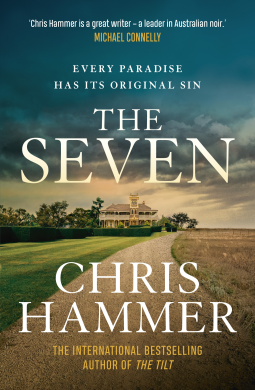
Chris Hammer is a multi-award-winning local Canberra author, who worked for 30 years as a journalist, during which he also published two nonfiction books. Since 2018, when he was 58, he has written six bestselling crime novels. (If he’d been around when I wrote my Late Bloomers post in 2011, he would have qualified – as the only man!) His first three novels (Scrublands, Silver, and Trust) feature the journalist Martin Scarsden, with the next three (Treasure and dirt, The tilt, and The seven) featuring a detective duo, Ivan Lucic and Nell Buchanan. The seven was the official subject of the conversation.
Jack Heath is also a local writer – of fiction for children/young adults and adults. He is definitely not a late bloomer, having published his debut novel, The lab, in 2006, when he was 20. Since then he has written around 40 science fiction and crime novels. His new book, Kill your husbands, is coming out now.
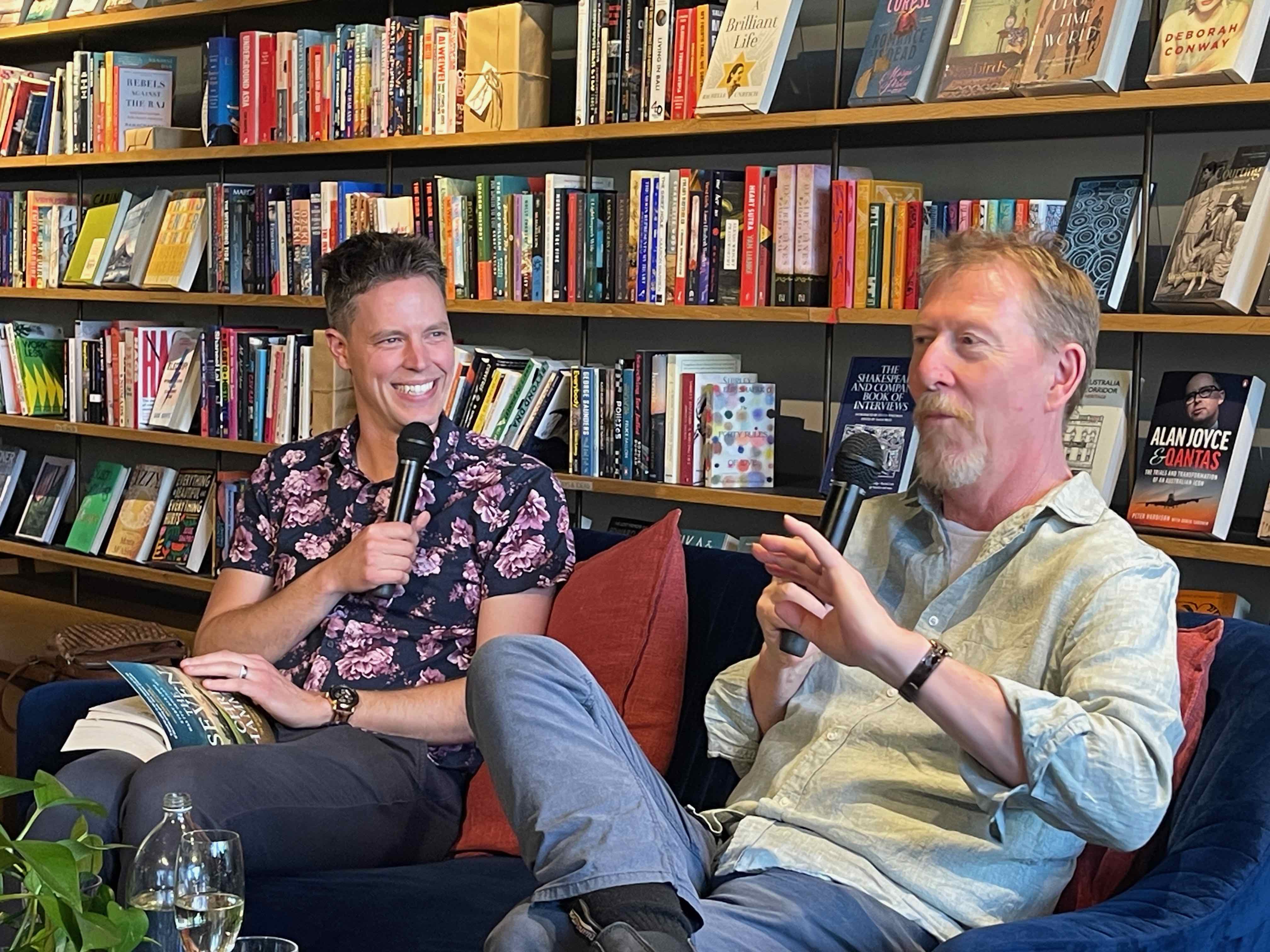
From these intros, I think you’ll be able to work out who’s who in the pic!
The conversation
I loved that Jack launched straight in, with little of the usual pleasantries. It was clear that they were comfortable with each other, which is probably not surprising, both being Canberra-based crime writers.
On moving from nonfiction to fiction
Although his first novel only came out five years ago, Chris said that fiction had always been a passion. Like many writers, he has in his drawer a very bad one he wrote in his 20s (that will never see the light of day – unless, joked Jack, you don’t destroy it and your literary executor thinks otherwise! We all know some of those examples.) Chris said he didn’t have the talent or attention span for fiction when he was young, so he turned to journalism, but persistence pays off.
On dramatic openings
The seven starts with a bizarre death. Is this his modus operandi, Jack wondered. Chris’s answers to this and the next question were fantastic, taking us through his novels, and, at the same time, his development as a writer. I’m not sure I’ve ever attended such a lucid discussion of a writer’s oeuvre in one session before.

After giving a sly little plug to the premiere of the Scrublands TV series on Stan later this week, Chris said not all start like that, but most, including Scrublands, do. He finds it works effectively.
However, Scrublands did not start like that. He was six or seven drafts in before he decided to start with a prologue describing the murder. He was learning on the job, he said. The narrative then jumps a year with his journalist investigating the murder on its first anniversary.
With The Seven, the dramatic opening death marks the start of a contemporary story. The homicide detectives arrive. (The murder victim is an accountant. They are good victims, Chris said, because they have secrets. That got a laugh.) Anyhow, the killer is still on loose, so the detectives are in a race against time. But, there are two other storylines: a university student in the 1990s who decides to do his thesis on the history of irrigation (during which he finds some skeletons); letters from an Indigenous girl from 1913. The connection between them all is not clear until near the end.
On his voices
All Chris’ novels are set in Australia, and all but one are rural. Will this always be the case? Further, Scrublands, his debut novel, features a journalist, a bit like himself. It is set in the present, but gradually, through his later books, he has been moving back in time, and diversifying his characters. How did he get into voices that aren’t a middle-aged ex-journalist?
Chris described his development beautifully:
- Scrublands, the first of his journalist series, has a simple structure, and is told completely chronologically.
- Silver, the second in the series, has similar trajectory but there are flashbacks.
- Trust, the third (and currently final) in the series, has two alternating points-of-view.
- Treasure and dirt, the first of his detective duo (Ivan-Nell) series, has a dramatic prologue (like Scrublands) and alternating points-of-view. The duo start finding crimes in the past, and this got him into some exposition. However, writers are always told to show-not-tell, so in ….
- The tilt, the second Ivan-Nell book, he decided not to use exposition, which meant needing to create voices from the past. The 1973 voice wasn’t a big stretch since he was alive then, but the 11-year-old boy from World War 2 was a challenge, so he created an old man looking back on his time as an 11-year-old. This novel has multiple (four, I think) points-of-view.
- The Seven, the third Ivan-Nell book, also has multiple points-of-view from different times, but they include a 15 to 16-year-old Indigenous girl. Before I or anyone could ask the question, Chris said that we need diverse – including Indigenous – characters in books, otherwise it’s terra nullius all over again. But there’s the issue of appropriation, so he decided to tell her story through letters, which, he said, can be unreliable, given people “present” themselves through letters.
Each book, he told us, has built on the experience of the previous books, with the latest ones being “more accomplished”. This doesn’t necessarily mean they are better stories! Jack interrupted, though, with the comment that Chris just keeps getting better and better.
By this point in the session, I felt we were getting gold.
On second-guessing issues of the day
Jack noted that many of his books seem to have second-guessed coming issues of the day (such as reference to Afghanistan war crimes in 2018’s Scrublands, and irrigation corruption in The seven). How did he do it?
Some has been luck, some has come from keeping his ear to the ground (with his journalist friends). For example, rumours were just starting to appear regarding the SAS-Afghanistan war crimes when he was writing Scrublands, so he included that. Given it’s fiction, he didn’t have to be factual. Most of his books are set in rural Australia, where ongoing concerns are climate change and Indigenous dispossession. These are part of The seven. It’s not hard to write his stories, he said, because, given its history, “the Australian continent is a crime scene”. Touché. He added that “Crime writers often touch on matters of societal concern”.
However, the opal mines’ skulduggery in Treasure and dirt he made up, only to be told later that what he’d described really does happen.
On changing his setting
Most of his novels, except for Trust, are set in dying country towns, but The seven’s setting is a beautiful, tidy town. Was he playing against his “type”?
The answer in a single word was No – but he was looking for something new. An earlier novel had featured a lot of water, and he thought water-trading would be good to explore, but not in that book. The town in The seven is fictional, but is based on Leeton, which was planned by Canberra’s Griffins. It has circular layouts and lovely art deco buildings.
On being a nice guy!
Finally, Jack, saying what a nice guy Chris was, offered four reasons: 1. he’s not really nice, but is a villain; 2. he’s so successful, he can afford to be generous; 3. he came to success late, so he realises how lucky he is; and 4. he’s just always been very nice!
Having learnt from his two nonfiction books how hard it is to make a living from writing, Chris considers himself fortunate to be “living the dream”. Scrublands was life-changing, and he is very grateful. He is financially secure and doesn’t have to struggle for that work-life-writing balance that most writers do. Also, Australian crime writers are welcoming and collegial, and – unlike many journalists – have their egos under control!
Q & A
There was a brief Q&A, some of which required knowledge about Hammer’s earlier books.
- On whether there will be more Ivan and Nell books, or a new tortured detective: The next book is another Ivan one, but he is thinking of bringing journalist Martin back. (The way this questioner started her question made Jack and Chris palpably nervous about spoilers!)
- On whether he plots carefully: As I’ve heard authors say before, Chris said there are the “plotters” (like Jane Harper) and the “pantsers” (like himself). He has a setting, an idea, and a few plot lines, and then sees how it goes. If he doesn’t know where the plot is going, how can the reader, the implication being this is good in crime writing. He also wants his main character/s to have “skin in the game”. There is usually an emotional storyline, whose trajectory he knows, but the crime plotting is done constantly as he goes.
- On his “silly” character names, which critics have commented on: If I understood correctly, he said that as he was writing Scrublands, he got a bit bored and created fun names. He feels sheepish about them now as he is stuck with them, the reason being he has many recurring characters, and can’t really have recurring characters with exotic names alongside new ones with plain names. Also, his editors didn’t complain, which they’d do if they disapproved. And, one reader told him that the distinctive names helped her keep track of who’s who.
A wonderfully lively session, one enjoyed also by Mr Gums who has read three of the novels, and bought a fourth from Muse.
Chris Hammer in conversation with Jack Heath
Muse (Food Wine Books)
Sunday, 12 November 2023, 3-4pm
 For some reason that I can’t quite explain – a sudden rush to the head methinks – I agreed to be part of a panel being organised by the ACT Writers Centre for this year’s
  Whispering Gums