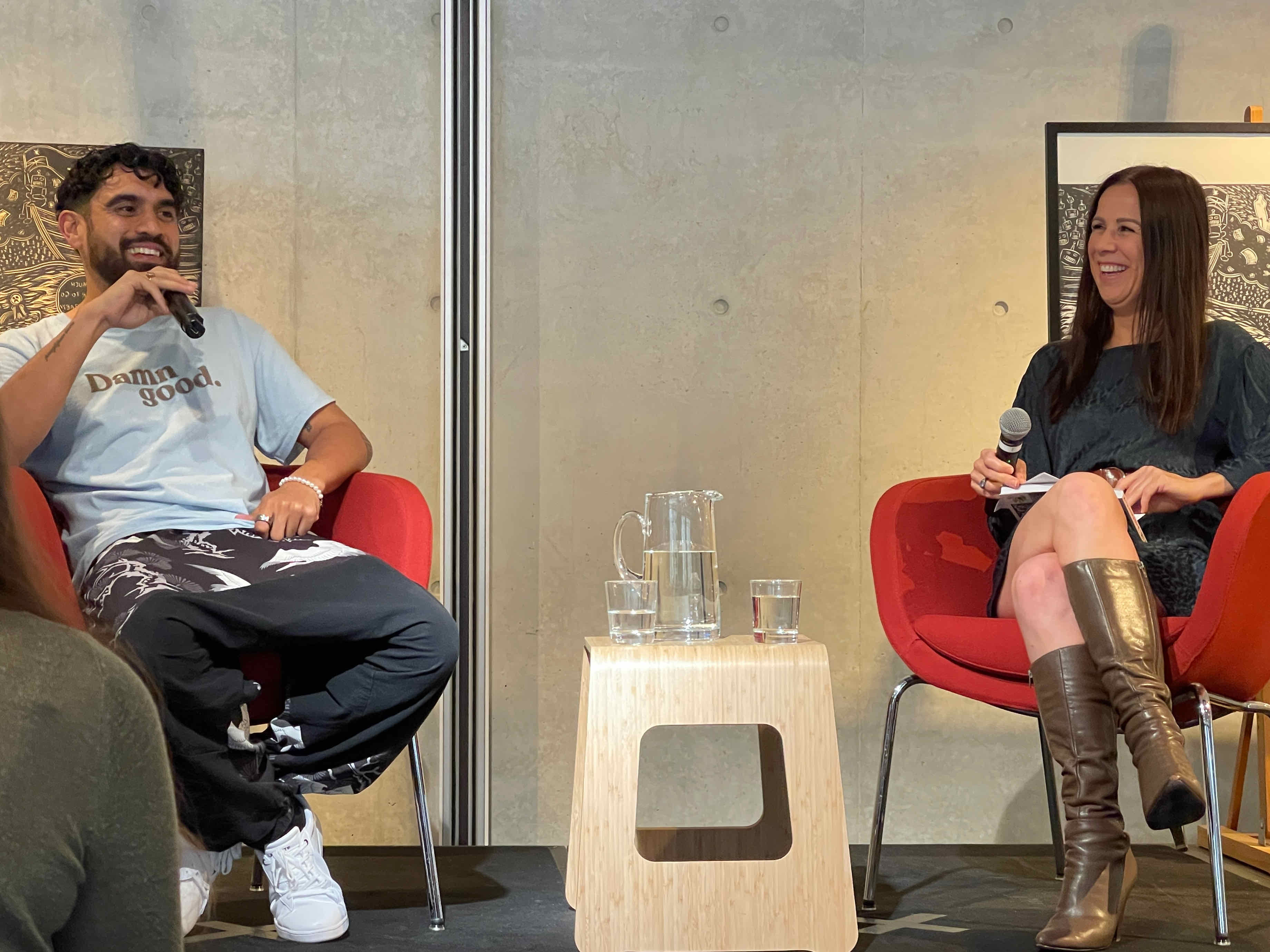
Irma Gold in conversation with Karen Viggers

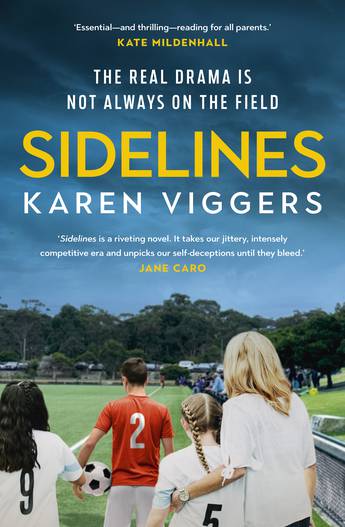
The Canberra launch of Irma Gold’s latest book, her second novel Shift (my review), was a joyful affair that reminded me of other launches of books by Canberra writers, such as Karen Viggers’ Sidelines and Nigel Featherstone’s My heart is a little wild thing. Canberra is a comparatively small jurisdiction so when one of our own launches a book, local authors, booksellers, publishers, editors, critics, reviewers and readers turn out to cheer them on. Such was the case tonight when Irma Gold came to town to launch Shift. She now lives in Naarm/Melbourne, but was active in the Canberra literary community for over a decade.

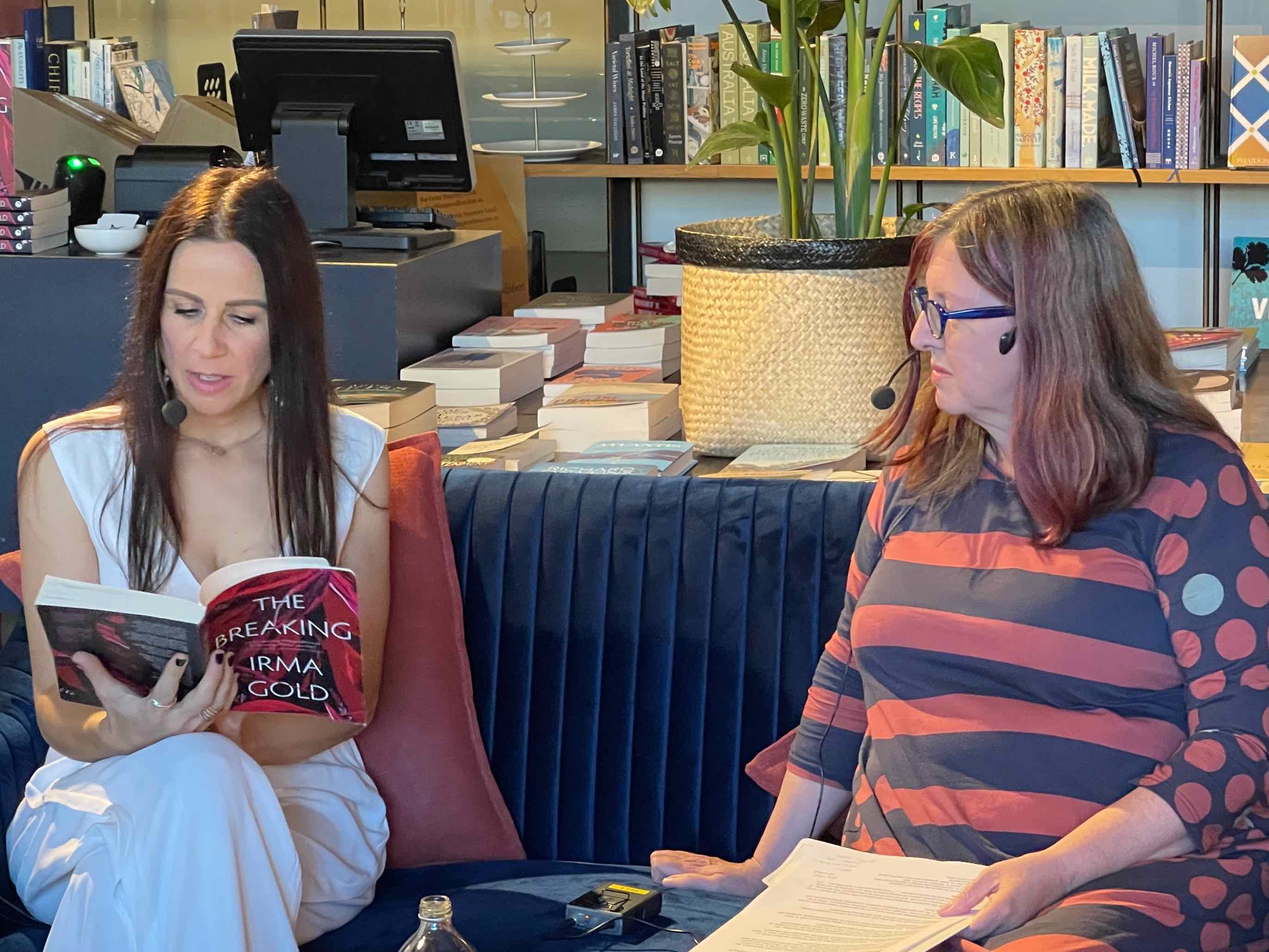
Both Irma Gold and Karen Viggers have appeared many times in my blog, so I won’t introduce them again, but I will remind you that they now jointly produce the Secrets from the Green Room podcast. They are clearly simpatico, and the conversation, as a result, flowed easily while still covering meaningful ground.

The conversation
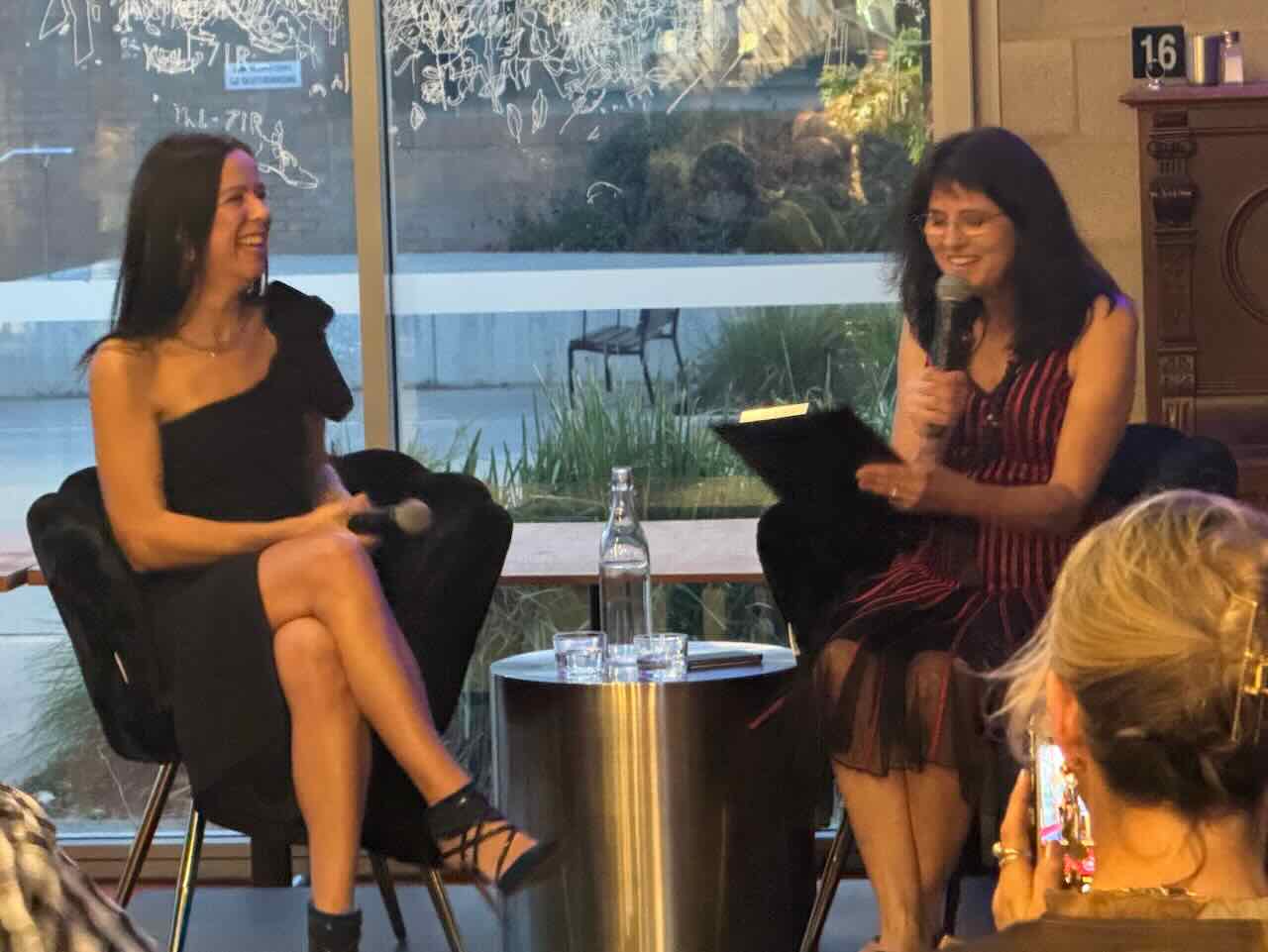
Karen commenced with an acknowledgement of country and a rundown of Irma’s many achievements, and then led into the conversation with a cheeky question …

Had the several outstanding reviews she’d received in the first month after publication gone to her head? It has been a dream response, admitted Irma, but what means most to her are the supportive messages she’s received from her friends in Soweto.

Karen then briefly summarised the book. It’s about portrait photographer Arlie who goes to Kliptown, in Soweto, partly because his South African mother refuses to talk about it. The sensitive and somewhat lost Arlie needs to know more, to understand his mother, and, he’d like to prove himself to his father. Karen said she found the ending deeply moving.

Why South Africa? Irma’s father was born there, so she’s always been interested. This was further sparked in her teens when she read Biko, resulting in her reading more about freedom fighters and South Africa more widely. She didn’t get to South Africa until her 40s, when she went with her youngest brother. Through a chance meeting, they were introduced to Kliptown, a community with no electricity, school or sewerage, among other things. A seed was sown then. She visited again, with another brother (a trip which I followed through Irma’s Instagram account. It was fascinating, if I can use such a shallow-sounding word for such a poorly supported community.) Karen then asked how dangerous it was. Irma felt safer in Kliptown, despite its reputation for violence, than in other parts of South Africa, mainly because she and her brother were working in and for the community.

On the haves vs have-nots. Karen spoke of how well Irma had illustrated the gap between the haves and have-nots; how she’d shown Arlie displaying his privilege without always being aware of it, while other times he’d catch, and be embarrassed by, his stumbles in this regard. Irma shared an anecdote about giving money to someone who had been their guide, and the difference it had made for him. She felt guilty all the time. As she was writing the novel she reflected constantly on how, by virtue of birth, she lives here in privilege and they live there.

On creating a great sense of place. Irma kept notebooks, and took lots of phots and videos. Watching the videos would take her right back there, and she’d remember more including things she hadn’t written down. People didn’t mind her taking photos. In fact they loved it, but she was working with the community.

On the characters and their names. Irma has no idea where Arlie came from. He was in her head when she made her first trip to South Africa. Also, she didn’t specifically choose photography for him but in retrospect, she realises it’s the perfect choice, because photography is all about different ways of seeing things. She’s always loved photography, but she did have expert advice from a photographer in the Canberra writing community. Jigs, Arlie’s brother’s fiancee, also just came to her, but the spark for Glory came from seeing a gorgeous young woman in a local gospel group. As for her African characters’ lively names, many of the Africans she met know what their names mean, why they were given their names. Being an “over-sharer” herself, she loves their openness and willingness to tell their stories.

On Mandela. Irma was shocked to find that Mandela was not the hero in young Africans’ eyes as he was in hers. They feel they’ve been sold a “broken dream”, that things have not improved as they were promised. Bob Nameng of SKY (Soweto Kliptown Youth) kept telling her that she had to write about the situation because no one is listening, nothing changes. This is not to say that Kliptown is all tragedy. There is also a lot of joy. She saw so much art and music in the community, and an overall “lust for life”.

On relationships. Karen was particularly interested in what Irma was trying to show in Arlie’s difficult relationship with his father. Irma said that Arlie judges his father harshly, but Glory suggests to him other ways of looking at the situation. Forgiveness and openness are important in relationships.

What is she asking of her readers? Irma liked the idea that she was “making the invisible visible”. She grew up in a family that had strong feelings about injustice. Ultimately, the book is about people. They are the most important thing to her. Kliptown is its people. She also likes Charlotte Wood’s idea of following “wherever the heat is”.

Q & A

On the title: It was a complicated process. Her original title was either disliked or deemed forgettable. In the end she produced a list, from which the publisher made a selection, and she chose one of those! She now likes her title.

On being published in South Africa. Currently only Australia-New Zealand rights have been sold. It’s difficult getting books into other jurisdictions.

Karen concluded by asking whether there was a “drive for change” in the novel. Although Irma had said that people and relationships are her over-riding interest, she admitted that change is also part of what it is about. Yes! I remember that Irma also said her first novel The breaking was primarily about the relationships. However, it too is about an issue – elephant tourism – that she would like to see changed. The way I see it is that her novels are inspired by justice-related issues that she would like to see changed, but that relationships are what fascinate her. In truth, you probably can’t solve big issues without having good relationships. Combining a passion for driving change and for good relationships between people makes, I’d argue, for good reading.

Thanks

The evening concluded with Irma thanking many in the Canberra community who had helped her, including of course Karen Viggers, but also John Clanchy who had read many drafts and whose honest feedback was instrumental in the book’s coming into being, Dylan Jones for being her photography consultant, the wonderfully supportive Canberra writing community, ArtsACT for helping her with some funding (again), and the Street Theatre for hosting the event.

Irma Gold – Shift: Book Launch
The Street Theatre, Canberra
9 April 2025
Irma Gold, Shift (#BookReview)

If Australian writer Irma Gold suffered from Second Book Syndrome while writing her second novel, it certainly doesn’t show. Her debut novel, The breaking (my review), is well-written and a great read. However, in Shift, I sense a writer who has reached another level of confidence in fusing her writing, story-telling, and the ideals and beliefs the drive her. She is passionate about her subject matter, as she was in The breaking, but in Shift she ups the ante to encompass wider themes about art. The result is a strong read that offers much for its readers to think about.

Shift is not the first novel I’ve reviewed about post-apartheid South Africa, but it is my first by an Australian author. Published, says MidnightSun (linked below), in the 70th anniversary year of the Freedom Charter, which outlined the principles of democracy and freedom in South Africa, Shift is set in Kliptown, where this charter was signed. Protagonist, Arlie, is a thirty-something art photographer who has just sold his first work to a significant gallery. It’s potentially career-changing and he should be happy, but he can’t “get his shit together”. He can’t keep girlfriends and while he gets on well with his happily established brother, his relationship with his parents is fraught. He feels his successful architect father has expectations he can’t (or doesn’t want to) meet, and his mother refuses to talk about her South African upbringing. But, Arlie wants to know.

So, after yet another relationship break-up, Arlie decides to go to South Africa, and ends up in Kliptown, in Soweto. He becomes immersed in its life, mixing with visionary choirmaster Rufaro, singer Glory and her younger brother Samson, and other locals such as his favourite photographic subject, the 80-something, “sassy as hell” Queenie. Can he create an exhibition out of his experience? Rufaro would like that …

“sold a dream”

The bulk of the novel comprises Arlie’s experiences in Kliptown, where he is the only white person. Through his eyes, we see the dire situation the people find themselves in. Early in the novel, he goes on a date with Glory to a spoken word evening at Soweto Theatre, where he hears some truths:

The people here had been sold a dream and yet more than two decades on they found themselves still in the same relentless poverty. Mandela was the broker of broken freedom.

Which is not, necessarily, to say that Mandela achieved nothing, but that life is far more complex than a “god”, as Mandela was to Arlie’s mother, can ever be. What Arlie sees, then, is poverty, drug addiction, violence and hopelessness. He sees young people, like Samson, not believing there’s any point to school. He sees a settlement without proper sewerage, electricity, or running water to their homes, not to mention with “asbestos sheeting everywhere”. However, on the flip side, he also sees community, hard work and hope.

So, back to my opening claim about Gold and her second novel. Taking the writing and the storytelling first, the writing is tight. It has the confidence of an editor, which Gold is, but mostly of one who is passionate about her material. The descriptions are fresh and vivid. We can visualise the place, with, for example, its “ramshackle tapestry of shacks constructed from discarded materials, each one rippling into the next”. The characters – who are drawn from Gold’s travels to the region (see here) – feel authentic. They are not stereotypes, but breathe life into the story with their thoughts, worries, fears and hopes. Arlie questions his actions, are they that of “a white saviour”? The colourful Glory, with her orange hair and fake orange nails, doesn’t “try to please”. She has her own views, and “plays her own game … take it or leave it”. The visionary Rufaro is passionate about the power of singing. It shows everyone, he says, who they are, that “we will be more … we are more”. Samson is a boy on the cusp of manhood, exuding bravado one moment, begging to play soccer the next.

The novel, too, is well structured. It opens with a shocking event to which we return at the end, and then follows a chronological arc from Arlie’s personal crisis and his decision to go to South Africa, through his time there, to his ultimate return home. There is drama along the way. Arlie’s father Harris visits, and Gold perfectly captures the discomfort between them alongside their unspoken love for each other. There is no simple resolution, just, perhaps, another step along the way to understanding. There is also love, violence and tragedy, but I won’t spoil those.

“make the invisible visible”

Shift is a story about a forgotten, if not betrayed, community, but one that survives all the same. It’s about a man who cannot keep a girlfriend, who is at odds with his father and distanced from his troubled mother, but who wants better relationships. It is a multi-layered love story – to a community and its people, and between Arlie and the people he cares for. But, most of all, it is a story about the power of art – or, if not that, at least about hope for art’s power. From first meeting Arlie, Rufaro has a dream that he will create “an exhibition that will show the world the truth about Kliptown”. He tells his choristers that Arlie

is going to expose what the government is doing here. That they have forgotten us. The pressure must come from outside, because our government does not listen to us.

Arlie, Gold writes later in the novel, “had always believed that art could change minds, that if enough minds were changed then the world changed” but, when it comes to it, he wonders “what could his photos possible achieve?” Can he “make the invisible visible”?

This brings me back to my opening paragraph and Gold’s wider themes. Shift is a strong, moving novel about a struggling community that has been left behind, for all the promises of freedom. However, it is also a novel that believes art can expose truths and, through that, shift our thinking and thus nudge the world towards being a better place. Gold has written her heart out in this novel to “make the invisible visible” – and to make room for hope. The next move is ours.

Irma Gold
Shift
Rundle Mall, SA: MidnightSun, 2025
269pp.
ISBN: 9781922858566

(Review copy courtesy MidnightSun Publishing)

Monday musings on Australian literature: Secrets from the Green Room

I have planned to write about the Secrets from the Green Room podcast series pretty much since it started in late 2020, but for one reason or another time has got away from me and here we are, some four years later … and I’m finally there. The good thing is that it is still going so, you know, better late than never.

Book cover

This podcast series was created by two (then) Canberra-based writers, Irma Gold and Craig Cormick (links on their names go to my posts featuring them), and first went to air, mid-pandemic, in November 2020. The latest episode, no. 40, went live just a week ago, on 30 January. During this time, Irma Gold moved to Melbourne, and Craig Cormick handed over his baton to another Canberra author, Karen Viggers, but, the show went on …

As I’m sure you all know, there are thousands of literary podcasts out there. I don’t listen to many because, despite my enthusiasm for literary matters, when I get a spare moment I tend to go for quiet. You just can’t do everything. But, for podcast lovers, it can be hard to track down what to listen to. Early this year The Conversation shared “15 literary podcasts to make you laugh, learn and join conversations about books”. The article’s writer, Amber Gwynne, quotes another writer Tom McCallister who claims that ‘while traditional reviews may be in decline, literary podcasts are not just “filling the void”. They’re “fracturing and reshaping” the “world of book discussion”’.

Gwynne adds that

like community reviews and the more recent surge of #BookTok and #Bookstagram content on social media, literary podcasts feed the rich social networks that form around books. They transform what’s often a solitary activity – reading – into a widely (but intimately) shared experience.

These networks are what keep most of us bloggers involved in social media, aren’t they? But, back to Gwynne. She explains that the format’s mainstays are author interviews and criticism that ranges from comprehensive reviews to casual banter, with the end result being that they “invite audiences to engage with books and writing in all kinds of ways”.

Some podcasts work primarily for readers. They introduce us to loved authors or to new authors; they show us other ways of finding out about the literary landscape; and they offer us options to focus narrowly on specific genres or to cast our nets more widely. Whatever your reading interest, there is likely to be a podcast out there. Many of these podcasts have a side-benefit for authors. By providing opportunities for writers to do readings and/or engage in conversations, podcasts can help promote authors. Indeed, as Gwynne says, podcasts “can be a valuable platform for emerging authors, providing exposure and amplifying diverse voices.”

Other podcasts, though, focus specifically on the writers. Their aim is to support writers and help them develop their craft. This latter is where Secrets from the Green Room primarily slots. The title, in fact, gives that away. Promotion for the series explains that in each episode the hosts

chat with a writer about their experience of the writing and publishing process in honest green room-style, uncovering some of the plain and simple truths, as well as some of the secrets — whether they be mundane or salubrious — and having a lot of fun in the process.

The episodes usually start with the hosts chatting about their own practices and experiences – such as whether they find writers’ retreats useful, or how much (or whether) they plot out their stories in advance, or whether they take notes and if so how, and so on. Then they move onto, mostly, a conversation with a single author, who is drawn from across the spectrum (literary, crime, cli-fi, to name a few). The conversation focuses on the craft aspect – how do they write, how did they get published, how did they find the editing process, and so on. But, there are also episodes devoted to other aspects of the trade that could be useful to writers, such as conversations with booksellers, a sales rep and a festival director. Again, the focus is on what writers need to know about these activities and functions. Should writers, for example, turn up at a bookshop offering to promote their book? Are there right and wrong ways to go about approaching a bookshop? This must surely be gold (excuse the pun) for writers, but for readers like me who are interested in – nay fascinated by – the wider literary landscape, this “stuff” is just wonderful to hear.

Book cover

Gwynne’s The Conversation article starts with Australian podcasts, and has Secrets from the Green Room second in the list. Her description is that Irma and Karen “invite guests to candidly share their own experiences navigating the world of publication, landing on topics as varied as ghostwriting [Aaron Faaso and Michell Scott Tucker], the “creep” of imposter syndrome [Nikki Gemmell], and the challenges of teaching writing at university [Tony Birch]”.

Secrets from the Green Room is available, free of charge and from multiple platforms, like most podcasts that I know, but here is the Spotify entry with list of episodes.

Do you listen to literary podcasts, and, if so, care to make a recommendation or two?

In conversation with Craig Silvey

I understand that literary conversation events in Canberra go best when the subject is political. I guess it’s the nature of the beast – that is, of living in the national capital. But for me, it’s the fiction writers that I want to see, and we do get some interspersed amongst the run of historians and journalists that we get. Even so, it’s been three years since I attended an ANU/Canberra Times Meet the Author event, due partly to the pandemic which halted the program for a while and partly because I have a pretty full dance card. However, Mondays are often free, so Mr Gums and decided to check out Craig Silvey. I’ve only read his best-selling Jasper Jones (my review) but that’s because you can’t read everything. I would like have read Honeybee. Tonight’s focus, though, was his latest novel, Runt.

The conversation was conducted by local author Irma Gold, who is no stranger to this blog. She’s always good in the interviewer’s chair, being both warm in manner and astute about writing – and so it proved again tonight.

The conversation

After MC Colin Steele did the usual introductions, Irma took over and introduced Silvey and the book we were there to hear about. Runt is, she said, a middle-grade children’t book. It features a solitary girl, Annie, with a penchant for fixing things, and the dog, Runt that she befriends. Irma found Runt a heart-warming book, which was lovely to read to her 11-year-old son. She believes it is destined to become a children’s classic. It would, both she and Colin Steele said, make an excellent Christmas gift. What a shame our grandson is only 4.

Irma Gold and Craig Silvey, 2022, ANU

After some light-hearted banter with Craig about a Fremantle biscuit artist – who knew? – Irma got down to business. Noting that Runt represents a new audience for Craig – that middle-grade age – she asked what his favourite book/s had been as a child. Craig replied that he’d been a voracious reader as a child. (Show me an author who wasn’t!) He loved a range of books, including those traditional classics like Lord of the Rings and the Narnia books, but then he made some points that were specific to him. For example, he liked books that made him feel things, and named a short story by Paul Jennings titled “Busker”. It was the first story, he said, that made him cry. Another favourite was Goodnight Mr Tom, which elicited sounds of agreement from the audience, and which, he later realised, might have partly inspired Honeybee.

He also liked books that made him laugh, and he mentioned Roald Dahl, Paul Jennings again, and the James Herriot vet series.

After this, there was some discussion of Runt, which is set in the perfectly named country town of Upson Downs. There are Annie and Runt of course, and some villains, including the farmer, Earl, who is also a collector. One of the things he collects is water! Earl is buying up farms to get the water, and wants Annie’s family’s farm. The plot revolves around Annie’s plans to save the farm. There was more chat about the story and the characters, which include the wonderfully named 13-year-old Fergus Fink, and then we moved onto setting and themes.

Irma noted that Craig had grown up on an orchard in a small country town, and asked whether this had inspired Runt. Craig responded that the novel was an “affectionate love letter to country life“. He loves country people – their use of understatement, and their dry humour – and the country makes for great fiction settings because it is “exposed to the whims of elemental forces”.

This led to a discussion about the relevance of climate change to the book. Craig observed that water policy and climate change are putting people under pressure, and that villain Earl’s avarice is boundless. There are subtle messages in the book, including the fact that people are more important than hoarding/collecting things!

Irma commented that Runt is very different to Honeybee, but it does encompass diversity. Craig responded that he writes about Australians in Australia, and that we are a diverse country. Irma then said that the book had a contemporary setting but a very classic feel. Craig replied that he wanted classical elements underpinning his text but that, for example, a 13-year-old boy’s aspiration now would be to be a YouTube star. Of course!

From here Irma turned to screenplays, because each of Craig’s books have or are being adapted to film, with Craig also writing the screenplays. There was discussion about the screenplay writing process, and how Craig, “wrote them sort of together”. Film development for Runt is already underway, with production possibly starting next year.

Craig had some interesting things to say about writing screenplays versus novels. There are rigidities to screenwriting that you don’t have in novel writing, he said. The screenplay format can be too restrictive to let your creativity fly, so he enjoys novel writing, but, conversely, writing screenplays reins him in as a novelist, which has benefits.

Irma’s next question concerned publishing and the fact that Craig has been published for 20 years now. How has publishing changed? Interesting question, responded Craig. For him, the biggest change is in the post-publishing aspect. Back in 2004 when his first novel, Rhubarb, was published, we were not as “connected” so you had no idea what was happening with your book. Now, with social media, you get immediate recognition and can see what is happening. Reviewing is democratised and it is “a really beautiful thing”, he said. (As a blogger, I appreciated this.)

Publishing, itself, though is still painful. You take this tender part of yourself and you expose it to the world. So, while his success means that he no longer has to do the “shitty jobs” he had to do when he was 19 and writing Rhubarb, in terms of writing, he still faces the blank page with the same uncertainty. This is essential, though, to being a writer: you need to “straddle the pain and struggle” but you need also to balance it with hope and pride. Such a mentally healthy attitude.

On whether he was always going to be a writer, Craig talked about meeting his first writer, Glyn Parry, at school, when he was 14. He realised, suddenly that writers were human beings and it could be a vocation. He wrote to Parry, and got some great advice: “Don’t become a writer, be a writer”. Craig didn’t go to university. Instead, he did menial jobs and read and read – and “forensically examined novels.”

After a delightful little interlude discussing his career as an electric ukelele player in a band called the Nancy Sykes (inspired by Dickens, of course). During the band’s short life, they apparently played Shaun Tan’s bride down the aisle! A little later in the interview there was another fun interlude, this time about his being a finalist in Cleo’s Bachelor of the Year contest and being described as “the thinking woman’s buttered crumpet”. It was an entertaining story, but I’m not going to spoil it just in case you get to a launch and hear it yourself. Instead, back to the writerly life.

Irma asked Craig whether he enjoyed book tours, and the response was immediate. He loves it and is deeply grateful to anyone who comes out to hear him. Novelists lead bifurcated lives. They tease stories out of themselves, then release them to the audience at which point they become each reader’s to appreciate and define. He said most authors, like himself, feel profoundly empty when they finish a book, but engaging with readers fills him back up again.

Q&A

These sessions are always well-run, resulting, always, in time for a Q&A. There were some excellent questions. Canberra didn’t let Irma down!

On getting the voice of a teenager, and whether he sees hope in younger people: Craig said that he has gravitated to teenage protagonists (though Annie is I think pre-teen), because everything is amplified at that age. The bubble your parents keep you in is pierced and you start to recognise the truth of things. It’s a time of profound change, when you start to define who you are, where you’re going. He likes to pair his protagonist with something opposite that can provide the catalyst for change. As for hope, he said that Runt‘s protagonist Annie’s hope is infectious. She inspires change, kindness, generosity, hope.

On diversity and the challenge of writing characters outside his own experience: (This would have been my question if I hadn’t been taking notes and had to get up and go to a microphone!) Craig responded that the further his character is from his own experience, the more responsible he feels. His practice is to connect with the appropriate community, as he did with the trans community for Honeybee. I loved Craig’s response to this question. He had three rules of thumb for writing ethically: do no harm; your purpose must have merit; and execute properly. Ethical writing is something we must discuss, he said. Responding to a follow-up question on Honeybee, he said that while the trans character doesn’t announce herself at the beginning, it was clear to all audiences that she was trans. His writing was informed by the trans community. The risks trans people take in disclosing themselves means that his character would not have announced their trans nature immediately. His character Sam is slow to trust, which is true.

On film adaptations and how he feels about giving over control: Craig said that he has screenwriter all his novels which partly answers the question! However, filmmaking, he continued, is a vastly collaborative process which is the opposite of writing a novel. He said that seeing Jasper Jones brought the screen was one of the most extraordinary moments of his life. It’s a communal artistic pursuit, and the result can be something larger than you are capable of conceiving on your own.

Irma closed by reiterating that Runt was a “really beautiful book” and that Craig had been compared to Roald Dahl. That is an accolade worth having. Having not read the book, I can’t say whether I agree or not, but I can say that Craig came across as a genuinely positive yet thoughtful and serious-minded person, and that Irma did a great job of bringing it all out. Thoroughly enjoyable – and there should have been more people there!

ANU/The Canberra Times Meet the Author
MC: Colin Steele
Australian National University
10 October 2022
Podcast available at SoundCloud

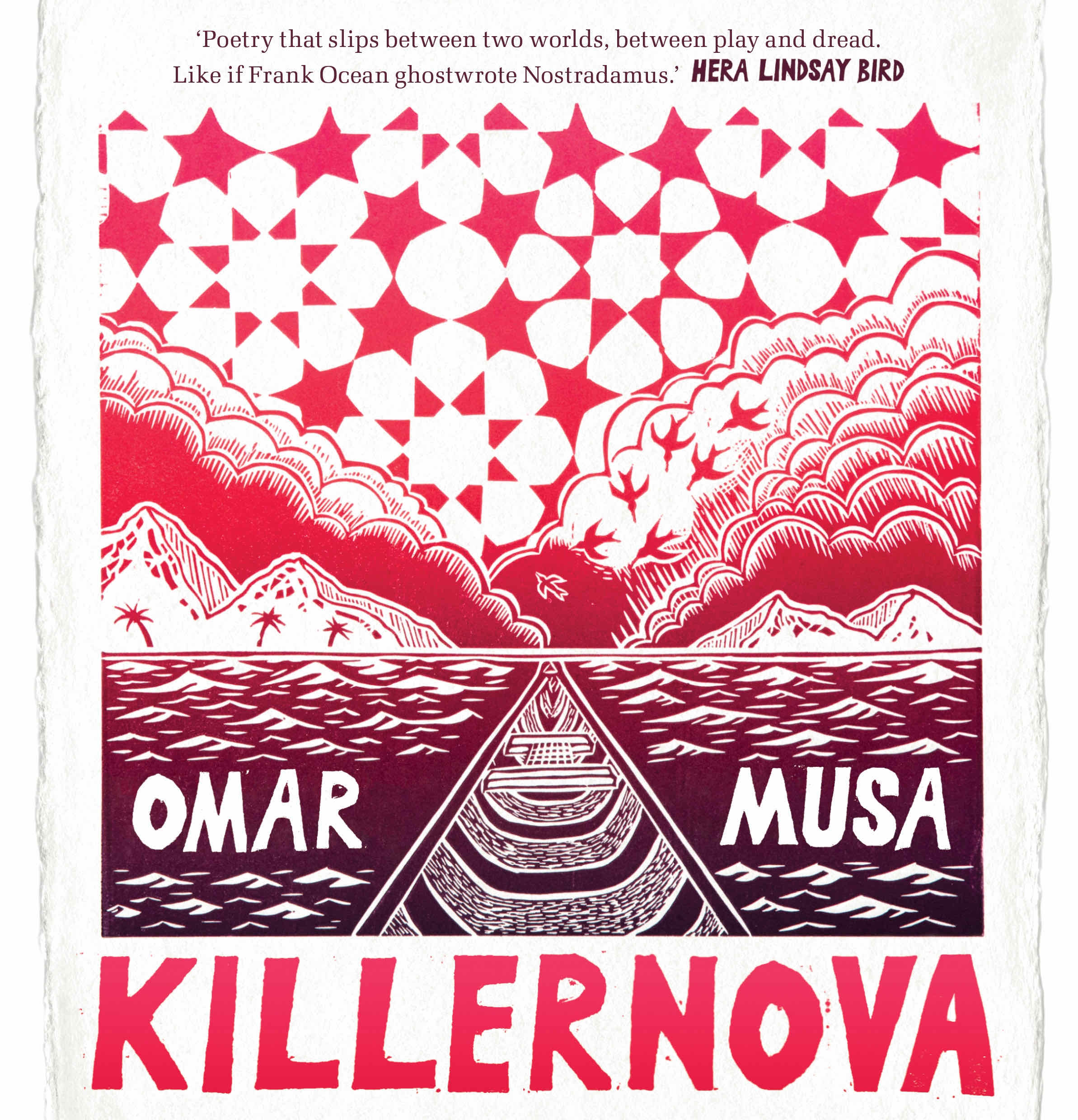
Omar Musa’s Killernova book launch, with Irma Gold

Local performance poet-novelist-artist Omar Musa’s latest book, Killernova, had two launches in Canberra this weekend, one with Polly Hemming and the other with Irma Gold. Being Gold fans, Mr Gums and I booked her session, and it was both engaging and illuminating, but I have it on good authority that Polly Hemming’s session, though different, was also well worth attending.

Omar Musa has three poetry collections, a Miles Franklin Award longlisted novel (Here come the dogs), and a play to his name. He has also released solo hip hop records. And now, he has turned his hand to woodcuts and woodcut printing. He is, you’d have to say, multi-talented – and it comes, I think, not only from a curiosity about the world, but a desire to find his place, to engage with it, and to explore ways of expressing the things that he feels strongly about.

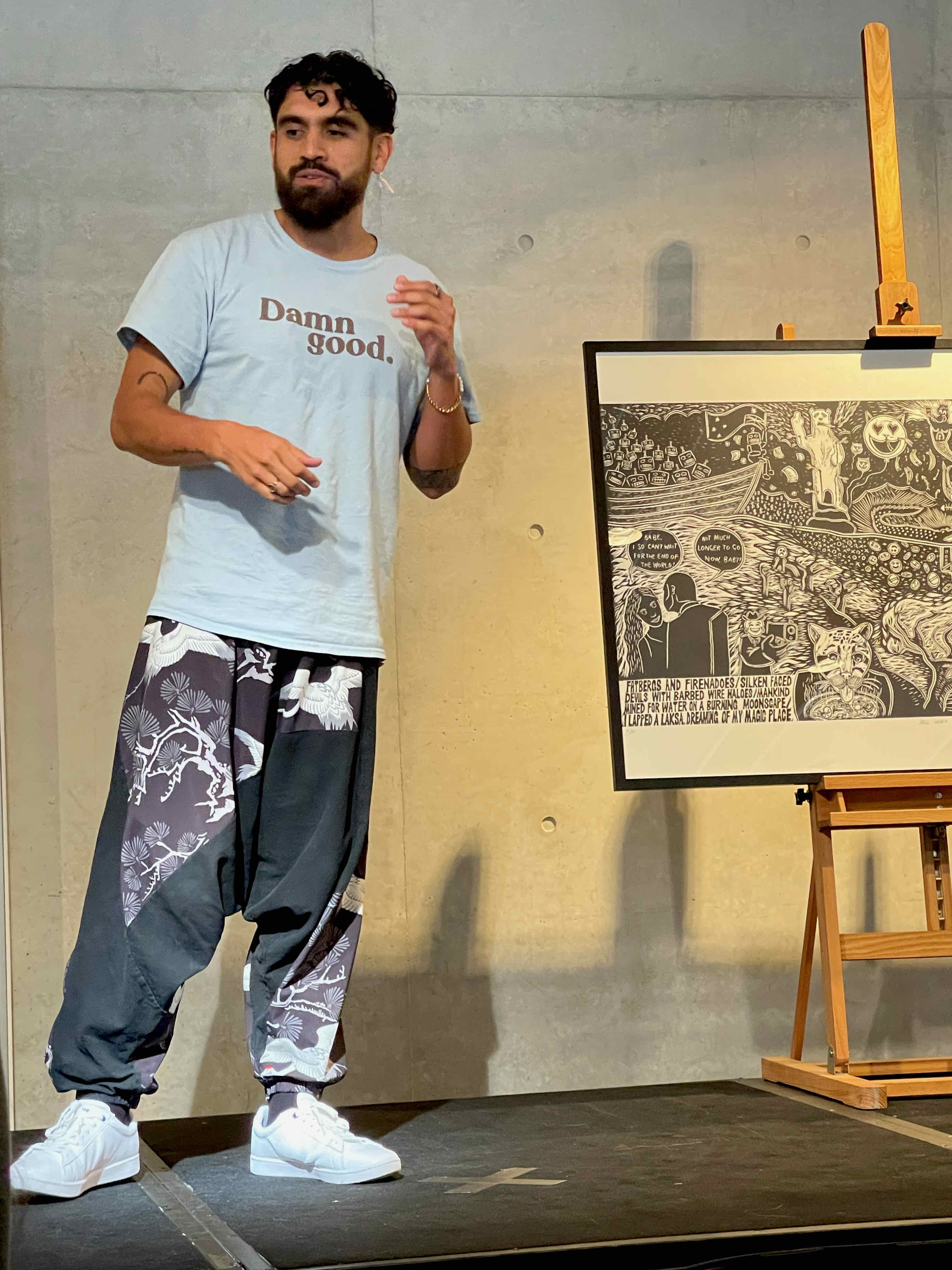
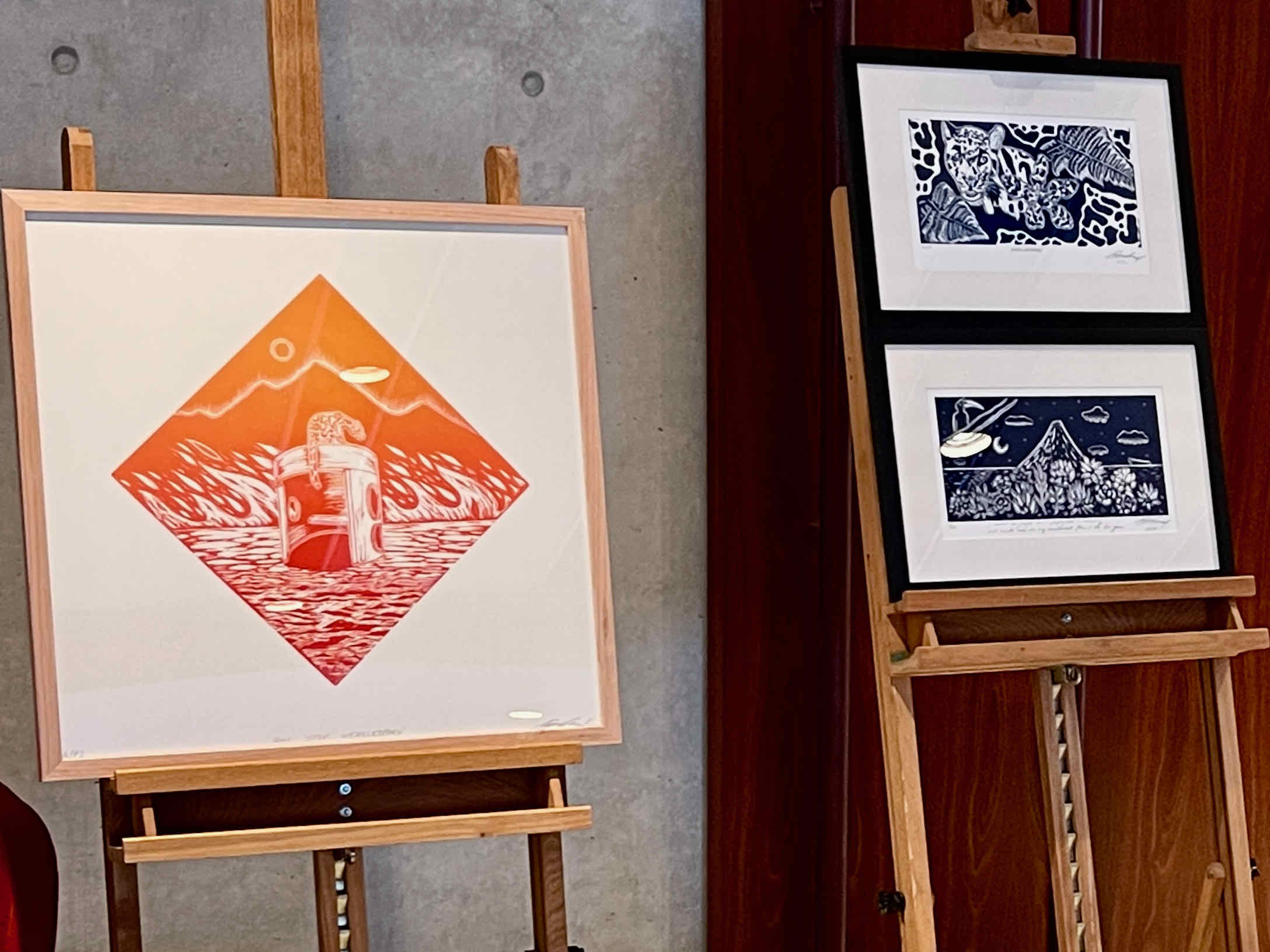
Not surprisingly, then, this was not your usual “in conversation” launch. It started with Musa performing some of his poetry, and a song. There’s nothing better, really, than hearing a poet read or perform their own writing, and Musa is a polished performer. So there was that. Then there was a display of his woodcuts, most of which appear in his book, and home-made sambal for sale, along with the book, not to mention the conversation with Irma Gold.

The performance

It was such a treat to have Musa perform some poems. I’ve heard him before, and love his heart and his ability to convey it so expressively through words and voice. His poetry is personal but also political, carefully crafted yet fresh too. Here’s what he performed:

l am a homeland: Musa, who has Malaysian and Australian heritage, started with this poem that explores home and belonging, when you don’t have one place, and got some audience participation going, asking us to breathe in its meditation-inspired refrain, “inhale”, “exhale”:

Inhale – I am singular
Exhale – I appear in many places

UnAustralia: Musa explained that he is often criticised as being UnAustralian because he (dares to) criticise Australia. This poem is his answer to that, and perfectly examplifies his satirical way with words:

Come watch the parade!
In UnAustralia
Land of the fair-skinned.
Fairy Bread.
Fair Go.

Rose gold lover: this one was a song – part ballad, part rap, and beautiful for that. (You can hear it performed with Sarah Corry on LYRNOW)

Hello brother: Musa dedicated this poem to Haji-Daoud Nabi, who, with the words “Hello, brother”, warmly welcomed to Christchurch’s Al Noor mosque, the shooter who went on to kill him and 50 other people.

Flannel flowers: Musa introduced us to a rare pink flannel flower that grows in the Blue Mountains. It flowers only when “specific conditions … are met … fire and smoke, followed by rainfall”, making it bitter-sweet – and an opportunity to contemplate both the environment and our mortality.

The conversation

So, I’ve introduced Musa, and Irma Gold needs no introduction, as she has appeared many times on this blog, including for her debut novel, The breaking (my review). Click on my tag for her to see how active she is. Irma is also a professional editor, and co-produces the podcast Secrets from the Green Room.

Musa and Gold, National Portrait Gallery, 27 November 2021.

Gold commenced by introducing Musa as a multi-talented artist, poet, rapper. She also praised, as an editor, the book being launched, Killernova. It’s a collection of diverse poems and woodcuts, and yet flows seamlessly, she said.

It was a thoroughly enjoyable conversation that, with Gold’s warm and thoughtful questioning, covered a lot of relevant ground.

The woodcuts

Given woodcuts feature strongly in the book, and are a “new” art for Musa, Irma started with how he got into woodcutting. He explained how he’d been in a dark place – had started to hate what he was supposed to love, writing and performing – so was visiting his father in Borneo, when he came across Aerick LostControl running a woodcut workshop, and joined in.

He spoke of the leopard which appears – often playfully – in his woodcuts (including one on top of Canberra’s iconic bustop.) So much of his writing, he said, focused on the ugliness of humanity, on racism, depression, so he wanted to do something beautiful. His first woodcut depicted the local small leopard (Sunda clouded leopard, I think). Although he felt it was “childish”, his teacher saw talent – what a surprise! – and a new form of expression for Musa was born.

Gold also asked him about the practice of “stamping the spirit into the works”. This is, Musa said, the traditional Southeast Asian way of printing woodcuts, and is still used, I think he said, by Indonesian protest poster-makers.

Musa then talked about taking the craft of writing so seriously it can lead to paralysis. Language is so imprecise you can just keep going, tweaking, tweaking the words. In woodcutting, if you make a mistake, you have to move on, as what is done is done. To make art, you have to take risk. He’d been taking himself too seriously, he felt, so wanted (needed, too, I felt he was saying) to be playful.

At the end of the conversation, but I’m popping it in here, Gold asked about how woodcarving deepened his connection with heritage. Musa said that he “would like to say it felt like homecoming but it felt more like tourism”. Some of this tension is conveyed, he said, in the first poem he performed, “I am a homeland”. It explores how we can inhabit different identities. A box limits you, he said. He prefers fluid identities.

The writing process

Gold asked whether, given he’s a performance poet, he reads aloud when he is writing? Musa said he writes in a “trancelike state” then “sculpts” his work. “Write in passion, edit in cold blood” is his practice. He also shared the philosophy of his favourite poet, Elizabeth Bishop – write with “spontaneity, accuracy, mystery”.

On whether he ever edited a poem further after performing, I think he said yes! (Given I sometimes post-edit my blog posts – because I can – I say, why not?)

Art and creativity

Gold referred to the poem, “Poetry”, because she related to its ideas. In it, he plays with the traditional recommendation to “write what you know”, shifting it, first, to “write what you know about what you don’t know”, then rephrasing it to “write what you don’t know about what you know”, before finally getting to the crux – and I like this – “write a question”.

The best art, he said, makes us ask questions about the world around us, but he likes to start with a question about self, with something that tests one’s preconceptions. Art, he believes, does not have to provide answers, just ask questions. Yes.

Gold then asked him about the role of alcohol and drugs in creativity, something Musa has spoken about. Killernova, he responded, is partly about undercutting mythologies in the art scene. One is the singular genius writer or artist. It’s b***s***, he said. All artists are products of their environment, so, this book includes collaborative poems. Another concerns the “addict musician, drunk poet” which he had bought into, but this book was “written when clean”.

The environment

Gold noted that concern with desecration of the environment runs through book, and asked Musa about the role he saw for art. Art, Musa believes, both holds a mirror up to world as it is and as it can be.

There is a Utopia in Killernova, Leopard Beach. Are Utopias dangerous, childish ideas that distract us OR could they project the world as it could be? he asked. Good question. He described a successful turtle sanctuary in Borneo, which was the result of someone’s dream. Through art, we can reimagine the world, and make us feel less alone.

Can art change people’s minds?

Musa responded that Werner Herzog said no, but he thinks it can, through asking questions. However, this needs to go hand-in-hand with collective action.

The end

Musa gave us one more performance to end with. It was a collaborative poem (“after” Inua Elliams) about pandemic, F***/Batman. Loved it, with its wordplay on masks (“we could finally drop our masks”) and references to toilet paper, Zoom, jigsaws; its exploration of the positives, negatives, and potential contained in the pandemic; and the idea that we “grew madder yet clearer headed”. What will we do with this, though, is the question. A provocative end to a great launch.

Omar Musa’s Killernova book launch with Irma Gold
National Portrait Gallery
Saturday 27 November 2021, 3-4pm

Irma Gold and Susannah Crispe, Where the heart is (#BookReview)

I don’t normally review children’s books, particularly children’s picture books, but I do make exceptions, one being Irma Gold. I have multiple reasons for this. Irma Gold is local; she is one of the Ambassadors for the ACT Chief Minister’s Reading Challenge; she writes across multiple forms (including, novels, short stories and children’s books, in all of which I’ve reviewed her); and, if you click my tag for her, you will get a sense of just how active she is as a writer, editor and supporter of literary culture, particularly in the ACT. Hence this exception!

But, there is another reason too, which is that Where the heart is not only a delightful book but it slots very nicely into her growing oeuvre. Before I discuss that, though, I’ll describe this, which is her most recent book. Gold explains on its opening page that it was inspired by the true story of Dindim, a Magellanic penguin which, in 2011, was washed up on an island village outside Rio de Janeiro. The bird had been caught up in an oil spill. The fisherman who found him, Joao, cleaned and cared for him until Dindim returned to the wild. However, ever since then, Dindim has returned, annually, to Joao to spend several months of the year with him. There are questions about where he goes, but in Gold’s story it is Patagonia. Patagonia is one of the theories, because it is a major breeding ground for these penguins.

This sort of detail, however, is not critical to the story. It is fiction after all. What is critical to the story is that it tells of the potentially disastrous impact of oil spills on animals. It also tells of the importance of wild animals being free. This is what Joao believed. He brought the penguin back to health and set him free. It’s just that the penguin had other ideas. It also tells of the friendship that can develop between humans and wild animals.

What makes this a gorgeous book is the way Gold tells the story. It’s simply told but the language is not condescending, and it naturally incorporates local culture. Joao and the penguin mend nets, eat sardine sandwiches, and go shopping together, with this “shopping” being at a village market stall. It’s also warm-hearted. It encourages us to think about kindness, tenderness and loyalty, making it a feel-good read. Yet, there is also a narrative arc that encompasses a variety of emotions, including a sense of fear and drama as Dindim journeys back.

Not far from Joao’s beach, the sky swelled and lightning jagged. Dindim rode waves and wondered if he would make it. He was exhausted.

A little bit of drama makes it fun to read aloud to littlies, which I look forward to doing when lockdowns end and I’m able to see our little grandson again!

However, this is a picture book, so for it to succeed the illustrations have to be good as well. Fortunately, they are. I think this is illustrator Susannah Crispe’s first book, though she has another coming out this year. I’m not surprised she has, because she has done a beautiful job with this one. The colours are bright and inviting, but are conveyed with a warmth and softness that support the story. This is nowhere more obvious than in the two facing pages that contain only penguins. The expected intense black-and-white of the penguins is there, yet muted, and the white space surrounding Dindim visually conveys the text’s description of the “ache” in Dindim’s heart. Crispe also incorporates lovely little details from nature in her illustrations, like hummingbirds, butterflies, turtles and albatrosses. These all support the story by adding to its sense of place, but they also create interest when reading to littlies. “Can you find the turtle”, etc!

What I’m saying, in other words, is that this picture book is just the right package.

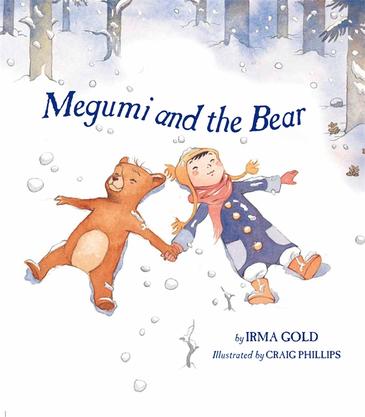
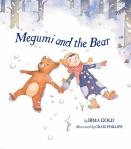
Irma Gold Craig Phillips Megumi and the bear book cover

And there I’ll leave it to return to my opening comment on Gold’s oeuvre, because I am seeing a pattern. The obvious one – from her previous picture book Megumi and the bear (my review) and The breaking (my review) – is her interest in wild animals, and in the relationship between humans and animals. Closely related to this is an interest in conservation, animal rights and the environment. And then – yes, there’s more – overlaying all of this is the importance of friendship, between humans, and between animals and humans. There’s a quiet joy in this, which is something Gold said, in a recent conversation, that she wanted to convey. I believe she has, and look forward to what comes next.

Challenge logo

Irma Gold and Susannah Crispe (illus.)
Where the heart is
Chatswood: EK Books, 2021
[32pp.]
ISBN: 9781925820874

F*ck Covid: An Online Literary Affair (1)

An initiative of the ACT Writers Centre and its Creative Producer Nigel Featherstone, F*CK COVID, was an online-only event. It comprised two panel discussions, featuring “four of Australia’s most exciting literary voices”, one focused on fiction, and the other non-fiction. I will report on these in separate posts.

Both sessions included the authors reading from their books for a few minutes, which, as always, was a treasure.

Hard truths; Risky fiction, with Irma Gold and Mark Brandi

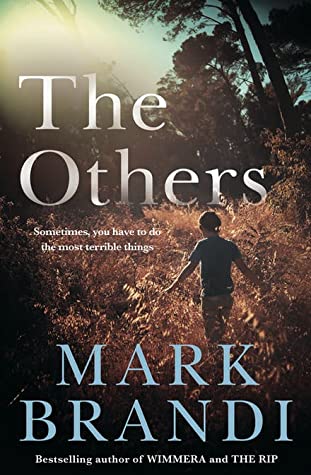
After introducing the authors and their latest books, Irma Gold (The breaking, my review) and Mark Brandi (The others), Featherstone launched into his gently probing questions, which resulted in some great insights, for readers and writers. We started with Gold and Brandi describing their books, but you can find that info elsewhere if you haven’t read the books! You can also read more about Irma on her novel in my report of a conversation in May.

On their inspirations

Interestingly, both authors’ novels started as short stories.

Book cover

Gold’s started as a story that is now, essentially, her first chapter. It was not initially about elephants and animal cruelty. She feels that if she’d started with that idea the novel would have been more issues-driven that the character-driven story it is. The two characters appeared to her fully-formed she said. She also said that her stories are usually dark, but she wanted to write something more joyful.

Brandi’s novel started as a short story (published in Meanjin in 2016). Unlike Gold’s non-autobiographical novel, Brandi’s story was based on a childhood experience that gave him his first insight into the complexity and contradictions of the adult world. However, he said that as he has talked about the novel post-publication, he has realised that the story was more inspired by his father’s life with his father’s father. It’s about nature versus nurture, and how events affect us later in life.

On challenges they faced writing difficult sections

For Irma, this was writing the animal cruelty scenes. One scene in particular was “very hard” to write. She wanted to not make the book so harrowing that people would not want to read it. Her aim was to give enough for people to understand the situation. Even so, one agent and some publishers found her story “too risky” and did not want to take it on. Gold said what she loves about writing is “seeing the world through other perspectives”, which is just what we readers like too, eh?

For Mark, the whole thing was challenging! He also likes “seeing world though other eyes”. The discussion focused mainly on writing difficult material through a child’s eyes. Brandi spoke about trusting readers. He believes that the reader’s imagination can do a better job than the author, so he creates the prompt to allow readers “to go to the dark place if they are brave enough to”. People, he said, can tolerate cruelty to humans more than to animals. (Why is that?) He also said he’s happy to read “dark stuff”, that it doesn’t give him a negative world view (which I relate to).

Nigel complimented Australia’s publishing landscape, believing we have publishers prepared to take risks.

On style

Nigel asked Mark about his “pared back” style, in which there’s barely a sentence that is exposition or description. Mark responded that this is what he likes to read. He likes to be trusted, respected as a reader. He wants his readers to bring themselves to the work, and to “paint the picture themselves”. Reading, he said, is a “dance between reader and writer”.

This led to a discussion about dialogue. Brandi tries to use dialogue sparingly. It must have meaning. Nigel quoted Francine Prose (Reading like a writer) who wrote that “good dialogue is when character’s thoughts are louder on the page”. Irma concurred, saying that every line of dialogue has to have a reason for being there.

On themes and perspectives

Nigel suggested that Irma’s overall theme was Hannah’s yearning to do the right thing and to find love. Irma replied that she wasn’t consciously thinking of these, but she has later realised that Hannah came from her observation of 20-something tourists she’d seen in Thailand. Their freedom looked “so delicious and wonderful” but she’d realised that, at her age, she had the benefit of knowing who she was, and where she was going. Uncertain Hannah came from this recognition! It’s interesting to explore a character like Hannah, particularly when you throw in someone like Deven who tests and challenges. Nigel commented that in good novels, the DNA is in the opening, and that The Breaking opens with a sense of tension, darkness, and humour.

For Mark, Nigel returned to the issue of writing from the perspective of an 11-year-old (Jacob). Mark confessed that the inner child is “close to the surface for him”! Then, turning serious, he identified the two main issues: a child’s limited understanding of the world, particularly when that world is closely mediated through his father; a child’s language and narrow “vocabulary palette”. He used Jacob’s imagination to convey things a boy’s language couldn’t.

Here a William Faulkner quote was paraphrased, as it seemed to apply to both Irma and Mark. The original is:

“It begins with a character, usually, and once he stands up on his feet and begins to move, all I can do is trot along behind him with a paper and pencil trying to keep up long enough to put down what he says and does.”

On bringing together character, plot and story

Nigel asked about their writing process, regarding how and when they bring all the elements together.

Irma said that for her character and place go together. She also talked about how her work as an editor has given her an insight, particularly, into pacing. She said that her first draft is very much character-based, with plot and pacing honed during editing.

Mark’s response somewhat echoed Irma’s in that he’s very dependent on his editor and publisher for help with plotting. Again, his style of reading aligned with mine, when he said that he doesn’t pay much attention to plot in his own reading, and that he “will stay with good characters through whatever harebrained plot the author throws up“. I loved this, because I don’t care about plot holes. I care about characters and ideas.

Anyhow, he said that he leaves a couple of months after his draft, and will often see plot deficiencies when he returns to it, but there are always more when the book gets to publisher.

Q&A

  • On their writing sessions: Both writers said you need a routine, and described their own. Mark drafts 2-3 hours every day because “voice and character are crucial” and he needs to stay with them. Irma said her process/routine varies for each project depending on what’s happening in her life (as she works full-time and has three children). With The breaking, she could only allocate two three-hour sessions a week, but her subconscious worked away in between, making those sessions productive.
  • On writing violence, and how to dial it back when the subject matter is violent. Irma suggested that people tolerate more violence against humans so it may not be a big problem, while Mark says that you give the reader enough details, then trust them to imagine. The question is, he said: What are the violent scenes in service of? Are they to convey what it’s like day to day, to support characterisation, or? Answering these will help avoid gratuitous violence.
  • On titles, which comes first, the story or the title: For both it was clearly the story, but Mark said that The others came to him very early while The rip started as something else. Irma said The breaking came to her after the book had gone to the publisher.

Tips for writing through the pandemic

Mark said routine and ritual and hard work – and giving it your whole being and heart.

Irma admitted that, until now, we Canberrans hadn’t been greatly affected, but she agreed that routine is important. Now she is in lockdown, and has more time, she plans to grab that! Find your time and your routine, was her advice.

Live events are the best, but online ones like this can be just as good in terms of both content and warmth. Watch for session two’s report …

Irma Gold in conversation with Sarah St Vincent Welch

Like many bookshops, Muse Canberra offers a wonderful program of book events. Unfortunately, I get to very few, but I did get to this weekend’s conversation between local poet (among other things) Sarah St Vincent Welch and Irma Gold about Gold’s debut novel The breaking (my review).

Irma Gold, reading from her novel The breaking, with Sarah St Vincent Welch, Muse, 23/5/2021

The participants

Irma Gold has appeared a few times on this blog, including for her collection of short stories, Two steps forward (my review), her children’s picture book, Megumi and the bear (my review), the Canberra centenary anthology she edited, The invisible thread (my review), and now, of course, The breaking. Irma is also a professional editor, and co-produces the podcast Secrets from the Green Room.

Sarah St Vincent Welch has also appeared in this blog, though more subtly. Besides having a piece included in The invisible thread, Sarah, a lovely past work colleague of mine, was the person behind my taking part in a public reading of Behrooz Boochani’s No friend but the mountains in March 2019. Sarah is a published poet and organises various arts events in Canberra, including a weekly poetry event, That Poetry Thing That Is On At Smiths Every Monday.

The conversation

Irma and Sarah know each other well – not just because they are both actively involved in Canberra’s literary scene but because they had been in the same short fiction writing group. This, I’m sure, helped make the conversation seem so effortless, but only partly, because Sarah’s natural warmth and Irma’s relaxed, thoughtful engagement with the questions made the conversation a delight. It covered a lot of ground, so I am going to use headings for the main questions Sarah asked. It started with a brief reading from the book.

Character or issue-led?

Book cover

Nothing like getting straight into the nitty-gritty, and that’s what Sarah did with her opening question. Character-led, said Irma, not the elephant cruelty issue. Indeed, she said, she didn’t know at the start that the book was going to be about elephants. It started with the two characters, Deven and Hannah, who arrived fully formed on the page. But, here’s the thing – it also started as a short story, which, with interest from her writers’ group, became two linked short stories. At this point, John Clanchy (whose writing I love) suggested that she was writing a novel. Irma said she’s glad it was the characters who drove the book, because if it had been the elephants, it would have been more polemical. (That was one of my potential questions gone!)

Can a novel effect change?

Another great to-the-point question. Irma, who admitted she loves fiction best anyhow, said she believes fiction can investigate complex issues in a way that non-fiction can’t. Readers can be put in the shoes of characters to “see” the issues. Through characters, fiction can explore complex issues, like the elephant situation, without offering answers.

Irma hopes that what her book (and fiction like it) can do is lead people to make different decisions, which, in this case, means not buying into the elephant tourism – not riding elephants, not attending elephant shows, etc. She feels that her novel is timely, because the current hiatus in travel gives us the opportunity to consider our travel decisions, and how we engage with another culture. This includes the practice of westerners volunteering (as she herself did). Are we helping or interfering? She mentioned the Instagram selfie culture, in which tourists take selfies with elephants, not seeing what’s going on behind them to keep that elephant in check.

Irma talked a little about the cruelty practised on elephants, but I won’t repeat that here. It is in the book, and is not pleasant reading, but is necessary knowledge, particularly for tourists to Asia. She also talked about how her love of elephants started in childhood.

Surpises as a debut novelist?

The best surprise has been the positive feedback, she said, as she’d steeled herself for criticism. She was particularly thrilled with an email from a long term Thai resident who thanked her for getting Thailand right, for avoiding cliches.

This led to a discussion about the work involved in writing the novel, because while she’d been to Thailand and worked in elephant rescue, she hasn’t lived there. She worked hard to get Thai life and culture right. She talked about working in the elephant sanctuaries where the two main groups of volunteers were young people in their 20s who have no strong sense of where their lives are going, and those in their 50s and 6Os.

On writing short stories versus novels

As a lover of both forms, I appreciated Irma’s practical responses. First, she said, you can hold all of a short story in head at one time. This is harder with a novel, so you need concentrated time, which she organised for herself. Then, she said, pacing is different in a novel, and, of course, a novel involves longer-term character development.

Place of her novel in the literary landscape

Another question up my alley! Irma said more novels are engaging with this sort of thing. She commented that one reader had asked her if her book was like We are all completely beside ourselves. She was surprised because it’s a very different book, but it was in fact an inspiration for her novel.

More books, she added, are engaging with animal rights. There’s a growing awareness she said, but she hopes, too, that the book is an enjoyable read.

Joy

Sarah ended by saying that as well as being about elephants, the novel is about madcap behaviour and the joy of love and life. Irma agreed, saying that everyone wants to talk about elephants, but she wanted to write about joy. She loved writing Deven she said.

Q & A

There was quite an engaged Q&A, but I will keep it brief:

  • On the aspect of the book most difficult to confront in herself: Irma likes to write from what she knows to doesn’t know, believing there is no black and white, but the most difficult thing was watching the “breaking”/phajaan videos.
  • On writing about “delicate” things: Irma understood the questioner’s not wanting to give plot points away, so let’s just say that she talked about how fiction, by definition, will involve writing about things that are not your lived experience, and that you have to consult.
  • On whether there is more Hannah or Deven in her: Irma is drawn to confident, intense people like Deven, so she has probably come out of that. However, she feels these characters came from nowhere, or, from the girls she saw at the sanctuary
  • On what we can do given the complexity of the problem: Irma said that the elephant industry only exists because of tourists, so the main answer is awareness! She hopes that not only will readers of her book become aware, but will talk to others. Tourists, though, need to make choices consciously and carefully because places will pretend to be what they are not. The Save Elephant Foundation is a good place to start.
  • On the editing process: There was quite a bit of talk about this. Irma, as an editor herself enjoyed the process – for the help it gave her book, and what it taught her about her own work as an editor. (I loved her comment about authors having “go to” words – bloggers do too – and the need to get those out!) Irma concluded by acknowledging John Clanchy for the immense help he gave her.

Irma Gold in conversation with Sarah St Vincent Welch
Muse (Food Wine Books)
Sunday 23 May 2021, 3-4pm

Irma Gold, The breaking (#BookReview)

Book cover

I have broken a golden rule! That is, I am reviewing Irma Gold’s debut novel, The breaking, out of the order in which I received it for review, which is something I (almost) never do! But, I am attending an author event on this book this weekend, and I really wanted to have read it before that conversation.

The breaking is an example of a growing “genre” of literature, eco-literature. This literature encompasses cli-fi, and focuses on human activities that endanger the environment in some way. It’s a broad church, covering climate, water and the land, deforestation, animal rights, and more. Books in this genre are often inspired by their writer’s passions. They tend to have a strong plot because the author wants to engage the reader in an issue: how better to do this than with an engaging plot. However, the plot is, largely, subservient to the issue, because at heart these are political novels, often in the “personal-is-the-political” sense.

So, some examples? Heather Rose’s Bruny (my review), which is deeply concerned about the future of Tasmania, Angela Savage’s crime novel The dying beach (my review), which explores the impact of shrimp-farming on the environment, and Karen Viggers’ novels, like The orchardist’s daughter (my review) which addresses deforestation, are three. These could be called “passion project” books. Critics often find this sort of writing difficult to asses. If it sells well, if it’s popular, is it good?

I’m going to sidestep the implication of that concern, and simply say that of course something popular can be good. If it’s well-plotted, well-written, has engaging characters – and deals intelligently with something relevant or important – then it’s good.

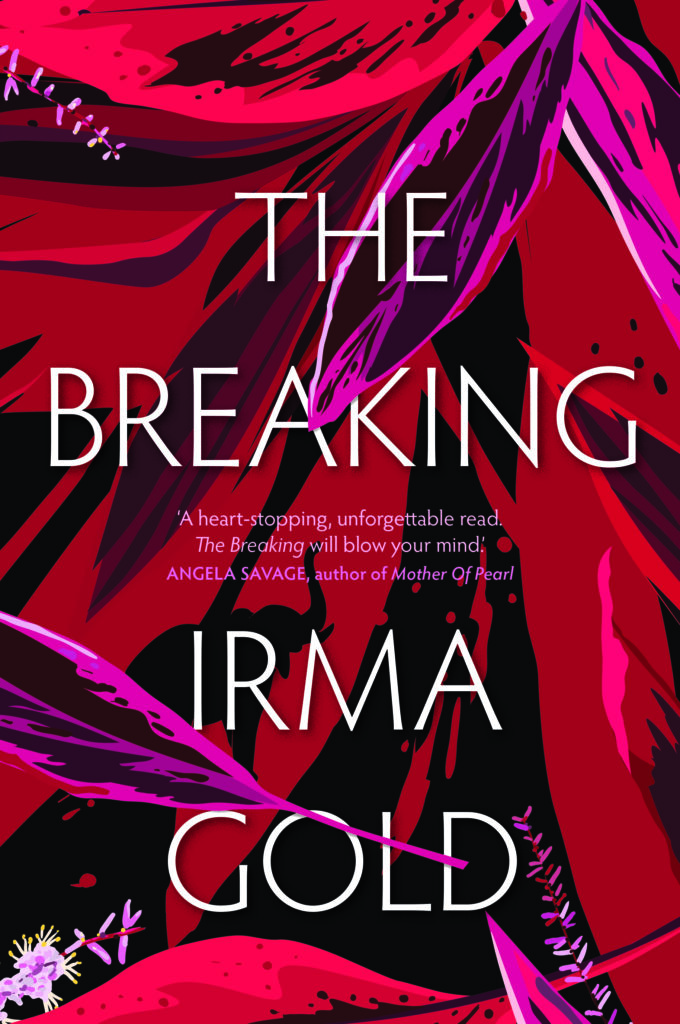
All of this is a very long introduction to Irma Gold’s book, but relevant, I hope. So, The breaking? The title doesn’t give away its passion, though if you look carefully at the gorgeous cover you might see it. It’s the plight or exploitation of elephants in Thailand. Gold, as she explains in the Afterword – I love an Afterword – has been to Thailand, and worked with elephant rescue projects, so she knows whereof she speaks. (I hope to have more to share after the weekend!)

It’s a grim situation, as I’m sure you know, and, like many grim situations in developing nations, it’s complicated by the fight for survival. For many Thais, elephants are their bread-and-butter, both as beasts of burden and, more, for their tourist potential. Gold addresses this dilemma in her novel without being overtly didactic, by having her characters see the situation with their own eyes, discussing it with each other, and weighing up the options.

“Be brave” (Deven)

The breaking is about two young Australian women, Hannah Bird, who has just arrived in Thailand as a tourist, unsettled and insecure because she’s lost her job, and Deven, who has been living there for some time and is involved in elephant rescue projects. They meet in a hostel lobby, as tourists do, and the experienced Deven invites Hannah to go to the night markets with her. From there, a friendship – and eventually something more – develops as the somewhat naive Hannah is drawn into the more experienced and confident Deven’s passions and views of the world. It’s not long before we discover the layers in the title as Hannah is introduced to the cruel practice of phajaan.

We follow their trajectory – told in Hannah’s first person voice – as they tread an activist’s path. It starts with involvement in organised, legal rescue projects that aren’t going to change the world quickly. However, as often happens to those who stay the course, they find themselves confronted with the ultimate activist’s dilemma of “how far will you go” for the cause you believe in? Always, it is Hannah following Deven, deeper and deeper into both political and personal engagement. Deven is driven to save those elephants, while Hannah, who believes in the cause, is more cautious, but, she’s falling for Deven, so, where Deven goes … the ending is powerful, confronting us head on with what can happen if you let passion rule your brain.

“We have to change the culture” (Deven)

Throughout all this Gold takes us on a journey through Thailand, showing it through the eyes of wide-eyed oblivious tourists, like Hannah, and those of the more experienced, aware Deven, who rejects the tourist path, the ladyboy shows, the elephant rides, and so on. Gold shares the food and culture of Thailand, using local words with little attempt to translate. She addresses this in her Afterword, explaining that although it is traditional to italicise foreign words, she “made a deliberate decision not to” do so here. Italics, she says, makes it easy for readers to “skim over foreign words” but she “wanted to encourage readers to engage with Thai language in the way that the Australian characters attempt to”. Gold’s solution is deft, because we readers puzzle and feel our way along with narrator Hannah, who is guided but not spoon-fed by Deven. Deven can be tender and caring, but she doesn’t mollycoddle!

However, if I have given you the impression that Hannah is all follower and Deven all leader, then you’ll have the wrong impression. Deven, alienated from her parents, has her own demons, and Hannah is not a push-over. As the novel progresses she takes in what Deven says but processes it in her own way. She sees “it’s not that simple; it’s not that black and white”, while for Deven it is simple. The denouement suggests where Gold lies, but the question remains for each reader, where do you lie? And, beyond that, whose rights should prevail?

Irma Gold’s The breaking reminded me somewhat of Madeleine Dickie’s Troppo (my review), which also explores the experience of young Australians caught up in unfamiliar lives and cultures, and who must forge their own way, morally and ethically, in places where the usual signposts are missing. Like Troppo, The breaking is an engaging debut novel that encourages us to consider some of the critical questions of our time.

Challenge logo

Irma Gold
The breaking
Rundle Mall, MidnightSun, 2021
271pp.
ISBN: 9781925227819

(Review copy courtesy MidnightSun Publishing via Brendan Fredericks)

Monday musings on Australian literature: Author blogs on the publishing journey

Most readers, not to mention aspiring authors, love hearing about the writing and publishing process authors go through. What inspired their book? How did they go about writing it and were there any hiccoughs along the way? How hard was it to get an agent and/or publisher? What role did the publisher/editor have in shaping the final product? And, once the book is out, how did the marketing/promotion journey go? How did they feel about reviews, positive and negative? These sorts of issues are often covered in book launches, and on panels and “in conversation” events at writers’ festivals, but some writers go a step further and share them via their personal blogs.

So, today, I’ve decided to share a select few of these, given I can’t possibly capture them all (even if I knew them all, or could remember all those I’ve come across!) All these authors have had books published, and all have written more posts on writing than the posts I’m featuring here. In other words, I’m brazenly inviting you to explore their blogs beyond the posts I’m highlighting below.

Book coverLouise Allan

Louise, whose debut novel The sisters’ song was published in 2018, has a series on her blog called Writers in the Attic. Here she publishes guest posts from Australian authors on what it’s like to be an author. Her guests include authors well-known to me like Heather Rose (A few thoughts about writing), Favel Parrett (When fiction becomes truth), and Robyn Cadwallader (The angel among the chaos). Introducing Robyn’s post, Louise writes:

I’m always deeply grateful to the writers who contribute to Writers in the Attic. Their words never fail to give me something to think about, or bestow a nugget of wisdom or just make me feel less lonely on this torturous journey to a novel.

Book coverAmanda Curtin

Amanda, like Louise (above) and Annabel (below), is a Western Australian writer, and has published a few books, including novels Elemental and The sinkings. She has a couple of special series of posts about writing on her blog, looking up/looking down. One is called Writers ask writers (with topics like early inspirations and tools of the trade), and the other is 2, 2 and 2 (writers + new books) in which writers discuss two things about each of three aspects or ideas relevant to their new book. Two of these aspects are set – things that inspired their book and places connected with it – while the third is chosen by the author. So, for example, Brooke Davis, writing about her novel Lost and found (my review) chose 2 of her favourite secondary characters in her book, while Jenny Ackland talking about The secret son (my review) chose 2 favourite things connect with her book.

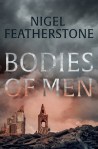
Nigel Featherstone, Bodies of menNigel Featherstone

Local author Nigel has been documenting his writing life on and off since 2009 in his creatively named blog, Under the Counter or a Flutter in the Dovecote. However, he has written a special series documenting the course of his latest novel, Bodies of men (my review). The series, called Diary of bodies, takes us from its original inspiration to his feelings about reviews and, woo hoo, being shortlisted for an award. Nigel, like many of the authors in this post, shares not only the practical, factual things about writing and publishing his book, but also his emotional journey. Nigel, a local author, has appeared several times on my blog.

Irma Gold Craig Phillips Megumi and the bear book coverIrma Gold

Irma is also local author who has appeared several times on my blog. She is a professional freelance editor who also teaches editing. She has edited an anthology, and has had a collection of short stories and children’s picture books published. She discusses all this, and many other topics related to the writer’s life on her blog. Like some of the other writers listed here, she has included in some of these posts input from other writers, such as this post on rejections, in which Anna Spargo-Ryan, Sheryl Gwyther and Ben Hobson discuss their feelings about rejections. Hobson, author of To become a whale, writes:

It sucks. But I’m saying to you: you can persevere. You’re a writer, damn it. Get off the floor and clench your fists and edit and send it out once more. You can endure. You are being refined. Collect rejections like UFC fighters collect scars; each one of those things is a mark that has created this warrior you’re becoming. Be proud. And send it out again.

Annabel Smith and Jane Rawson

Annabel Smith (from Perth) and Jane Rawson (from Melbourne) have both appeared on this blog before (see Annabel and Jane). Together, they created in 2017 a series of posts they titled What to expect, which they ran on both their blogs, Annabel and Jane. Their aim was to “dish the dirt on what happens just before, during and after your book is released”. In these posts, Annabel and Jane give their opinion – on, say, prizes or book launches – and then, mostly, also invite another author or two to contribute.

Annabel is a member of the Writers Ask Writers series of posts that Amanda also posts. She also has an Author Q&A series in which she asks writers “to answer some questions about writing and publication” and a series on How Writers Earn Money.

Book coverMichelle Scott Tucker

Michelle, like Nigel, has maintained a general litblog for many years. However, also like Nigel, she has a specific series of posts focused on her biography, Elizabeth Macarthur: A life at the edge of the world (my review). In this series, she shares both her writing and publishing journey and her post-publication experiences and events, including being shortlisted for awards.

How generous and open-hearted are these writers to share their knowledge, and to go to so much trouble to do so. I dips me lid to them. But, they are just a start. Many other authors have blogs too, offering us all sorts of delights. I plan to share more of them during 2020.

Have you read any of the blogs, or blogs like them? If so, do you enjoy them and why?