Geraldine Brooks, Caleb’s crossing

Geraldine Brooks, Caleb's Crossing

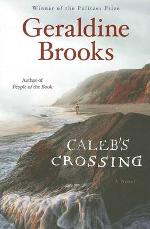
Caleb’s crossing book cover (Courtesy: HarperCollins Australia)

In the Afterword to her latest novel, Caleb’s crossing, which was inspired by the first Native American to graduate from Harvard College, Geraldine Brooks describes the reactions of members of the Wampanoag Tribe:

Individual tribal members have been encouraging and generous in sharing information and insights and in reading early drafts. Others have been frank in sharing reservations about an undertaking that fictionalises the life of a beloved figure and sets down an imagined version of that life that may be interpreted as factual. This afterword attempts to address those reservations somewhat by distinguishing scant fact from rampant invention.

This concern – “an imagined version … that may be interpreted as factual” – should by now be familiar to readers of Whispering Gums. In fact, this book has several synchronicities with my recent and current reads. There must be something in the water! Firstly, the issue of fictionalising the life of a historical figure is something I have raised a few times, but most recently in my review of Tansley’s A break in the chain. And then there’s Scott’s That deadman dance which explores early contact in Australia between white settlers and indigenous people. Very different stories and yet several similar concerns and issues, such as those regarding land, education, and cultural attitudes to material possession and to hunting. And there’s more! My next review will probably be Leslie Cannold‘s The book of Rachael which is set in biblical times and features a fictional woman who loves learning and rebels against the strictures of her gender.

I love it when my reading interacts closely like this, when books enable me to explore and play off ideas against each other – so I thought, given this and the fact that there are already many reviews out there, that I’d tease these out a little instead of my more usual review. But first a brief outline of the plot, which provides a mostly imagined backstory to the real Caleb Cheeshahteaumauk through the eyes (journals) of the fictional white girl/woman Bethia Mayfield. The book starts in 1660 when Bethia is 15 years old, but it quickly flashes back a few years to when she met Caleb while out clamming and it describes the friendship which developed between them, forged by a mutual interest in learning about each other’s culture. Idyllic really, but of course it doesn’t last. Caleb is noticed as a young man with the potential to achieve in the white world and comes to live with Bethia’s family, so he can be taught by her father. Eventually, Caleb and another indigenous student, Joel Iacoomis, go to school and then Harvard along with Bethia’s not particularly clever brother, Makepeace. By a cruel twist of fate, Bethia goes with them as an indentured servant. She’s not too disappointed about this because she hopes to surreptitiously acquire a bit of learning too. That’s the gist of the story … and if you know the history, you’ll also know roughly how it all ends, but I won’t spoil that here.

And so to the first issue, fictionalising a historical figure. Brooks is upfront in saying hers is “rampant invention” inspired by “scant fact”. Like Grenville in The secret river, Brooks uses a real figure to explore how and why it might have been, though, unlike Grenville, she retains the name of her inspiration. This muddies the water for the unwary reader but it is common to historical fiction. How many novels have been written about, for example, Anne Boleyn? I have no problem with this. She and Grenville, unlike Tansley, are very clear about their fiction and are not afraid to imagine where there are gaps. Her Caleb may not be the Caleb of history but he is a Caleb whose motivations makes sense:

You will pour across the land, and we will be smothered … We must find favor with your God, or die.

And this brings me to the second synchronicity, that concerning early contact between white settlers and indigenous inhabitants. Brooks (a white Australian author based in the USA) and Kim Scott (a Noongar author from Western Australia) explore similar territory but from different points of view: hers is told in the voice of a white woman, and Scott’s has a more complex narrative voice but from an indigenous perspective. Both explore the complexity in motivations. In white society, we see the whole gamut from altruism through attempts to “get along”/cooperate to arrogance, cruelty and greed. And we see an equally complex response from the indigenous people, from Caleb’s “if you can’t beat ’em join ’em” to Tequamuck’s anger and aggression. The end result, as history shows us, is the same … and neither book (nor Grenville’s) is anything other than realistic about it.

Finally, there’s the gender issue. This – like Grenville’s writing about colonial attitudes to indigenous people – is where writers are often criticised for being anachronistic, for putting modern attitudes into the mouths of historical people. It’s a criticism I tend not to share (providing the character is coherent within the text). “New” ideas do not pop out of nowhere. They grow and develop over time, and they grow from exceptional people – not necessarily well-known people, but people who thought ahead of their times – and novelists, almost by definition, tend to explore the “exceptional”. I have no problem believing that a “Bethia” or a “Rachael” lived in their times … just as I have no problem with what some critics have called Thornhill’s “anachronistic sensitivites” in The secret river.

Enough rambling, back to the book! Did I enjoy it? Yes. Did I think it worked? Partly. Geraldine Brooks is a good storyteller and I read this book in quicksmart time. I was interested in the characters and I wanted to know what happened to them. Brooks evokes the era well, using enough vocabulary and phrasing of the period to immerse you in the time and place. Her physical descriptions are beautiful. You know exactly why Bethia would prefer her island home to the streets of Cambridge. The themes – colonial cross-cultural conflict, gender roles, coping with loss – are valid and clear. And her wide cast of characters realistically cover the gamut of attitudes you’d expect.

And yet, I’m not sure she quite pulls it off. My concern is not so much with her vision, with the ideas she puts in the mouths of her characters, but with her mode of telling. She is rather heavy-handed with the foreshadowing. It’s a valid technique given the story is told in retrospect but it feels overused, which somewhat devalues its dramatic impact. I also wonder whether telling Caleb’s story through Bethia’s eyes means we don’t get to know Caleb well enough, resulting in our not being as emotionally engaged with him as we could be. There are hints of sexual tension between Bethia and Caleb but they are never played out. Perhaps doing so would have turned it to melodrama and yet, once hinted, it needed some resolution. I tend to like first person stories and the immediacy they provide, but maybe a different narrative voice (even multiple points of view) would have been better here.

All that said, it’s an enjoyable read. Reasonably early in the book, Bethia writes:

this truth my mother had voiced … that it could not go on, this crossing out of one world and into another.

Near the end she wonders:

If I had turned away from that boy … and ridden back to my own world and left him in peace with his gods and his spirits, would it have been better?

Would it? Now there’s the million dollar question!

Geraldine Brooks
Caleb’s crossing
London: Fourth Estate, 2011
306pp.
ISBN: 9780007367474

Tangea Tansley, A break in the chain: The early Kozminskys

Bookcover for Tansley's A break in the Chain

Book cover* (Courtesy: Affirm Press)

In the postscript to her novel A break in the chain, Tangea Tansley quotes Doris Lessing‘s statement that ‘fiction is better at “the truth” than a factual record’. This gets to the nub of my challenge with this book, which is a fictionalised account of three generations of the author’s family, particularly her great grandparents and grandparents. As I was reading it I was reminded of Kate Grenville‘s discussion in Searching for the secret river on how she commenced writing The secret river as nonfiction and ended up writing fiction. But more on that anon.

There’s a lot to like about this book, particularly if you are interested in Australian social history. It starts in Prussia in 1856 with a young man, Simon Kosmanske (later Kozminsky), playing violin to the cows on his father’s dairy farm. His father, Moses, does not think Simon is taking his work seriously enough, and so orders him to “Go to Australia and make an old man proud”. Australia, at the time, was of course at the height of the gold rush and was many a man’s destination. Simon, though, didn’t want to go, but go he did – and he eventually established Kozminsky, the fine jewellery and objet d’art store that still operates in Melbourne.

The novel chronicles in five parts the story of Simon, his marriage to Emma, and of his son Israel and his marriage. The first part which describes Simon’s trip to Australia and his first years in the colony as he tries to establish himself is fascinating. And then the story moves into the main drama which gives rise to the title. This drama centres on Judaism, its observance, and decisions made to marry within or outside of the faith. It is an intriguing story with some strong and interesting characters. However, as Tansley explains in her enlightening postscript, there are many gaps in knowledge about some of the key characters, particularly Emma. She writes:

For a family of journalists and writers, my family has left behind a sad lack of primary source material: no journals or diaries or letters and a dearth of documents of any kind. This meant that what was originally planned as a documented biographical work became instead a hybrid – a family memoir laced with fiction.

Those of you who know the Kate Grenville saga regarding The secret river will see why I was thinking of it as I read this book. I’m not sure that Tansley has pulled it off quite as well as Grenville. I wonder whether, in fact, she kept too close to the “facts” while aiming to write fiction. She writes, again in the postscript:

I resisted the temptation to write Emma into a fictional background, although Kozminsky family stories present a number of alternative lives for Emma.

Grenville, on the other hand, moved more thoroughly into fiction, changing the name of her protagonist from that of her ancestor, which freed her to explore more creatively just what might have happened in the lives of settlers like her ancestor. She did this because she found her factual account wasn’t working. Grenville says:

I was determined to write a book of non-fiction, but the only parts of this ‘assembly’ that were interesting were the ‘flights of fancy’ where I’d created the flesh to put on the bones of research. Where, in a word, I’d written fiction.

Grenville started off researching Solomon Wiseman because she “needed to know” what had happened in the early settlement, particularly between the settlers and the indigenous inhabitants. Tansley wrote her book to search out the “truth”, for past and future generations of her family but also “to fill what I see as a gap in the settler history of Victoria”. These goals she achieves pretty well, particularly the latter one, but I think she has used the story-telling mode of fiction to give us the “facts” rather than get to those larger “truths” that we can find in fiction. And this is probably because the story’s drama is hampered by her decision to not tackle the central mystery: what was Emma’s past that affected her so, and why, without giving anything away, did the family react as they did to Israel’s marriage? It is in this, I think, that the “truths” can be found. Without them, we have an interesting story, a good social history, but we don’t understand the real “truth” behind the “break in the chain”.

Overall, though, Tansley’s style is sure. She uses a chronological narrative structure, with a third person point of view in which the perspective shifts occasionally from character to character. These work well for the story she wants to tell. While there’s the occasional misstep in the writing (a forced image, or a too-obvious statement), she also writes some lovely descriptions particularly as the novel progresses and she warms to her story. Take this for example:

Bending to the ground he pulled at a shoot of grass only to find  that an entire yard of runner came loose with it. He flung it away. Damned rhizomes. They had a lot in common with extended families. Not much to be seen on the surface, but underneath you could be sure there was a vast network of tentacles working away in their subterranean hideout, linked for the term of their natural lives in dark and closeted conspiracy.

My final assessment? Well, it’s interesting for its social history. It’s also engaging for Tansley’s generosity towards her characters despite their flaws and the mistakes they make. And I enjoyed the opportunity it has given me to further tease out my response to the history-as-fiction question. I’ll conclude though on another question. Emma says to Israel that “the past is only good for the experience it provides”. Does this imply a duty to share the past (something Emma herself doesn’t do)?

Tangea Tansley
A break in the chain: The early Kozminskys
Mulgrave: Affirm Press, 2011
315pp.
ISBN: 9780980790467

Review copy supplied by Affirm Press

* The cover image is a detail from Frederick McCubbin‘s Study in blue and gold. The subject is Eileen Kozminsky, Tansley’s grandmother.

Kim Scott, That deadman dance

Kim Scott That Deadman Dance
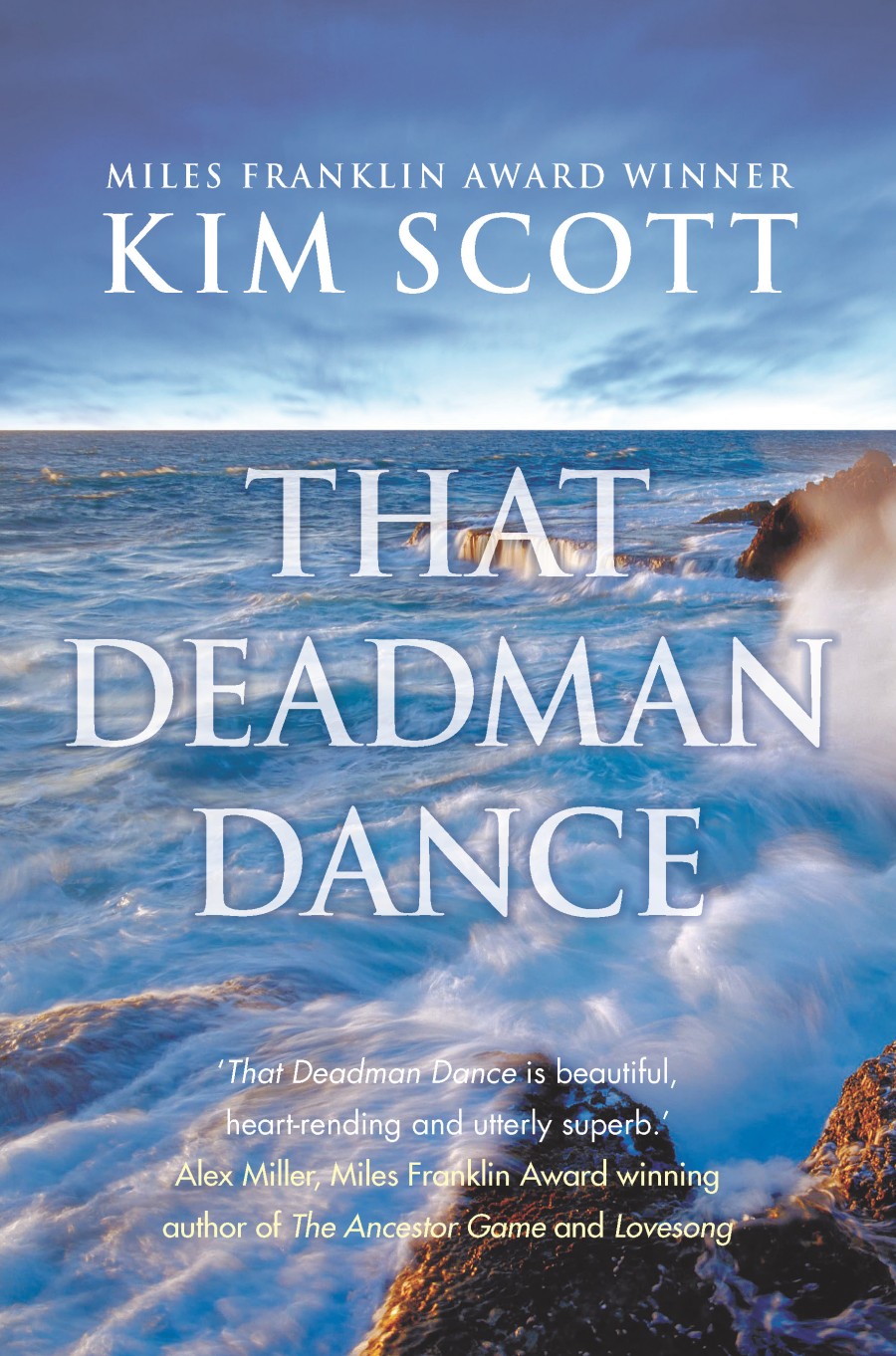
(Image courtesy Picador Australia)

About a third of the way into Kim Scott‘s novel That deadman dance is this:

We thought making friends was the best thing, and never knew that when we took your flour and sugar and tea and blankets that we’d lose everything of ours. We learned your words and songs and stories, and never knew you didn’t want to hear ours.

And, it just about says it all. In fact, I could almost finish the post here … but I won’t.

That deadman dance is the first Indigenous Australian novel I’ve read about the first contact between indigenous people and the British settlers. I’ve read non-Indigenous Australian authors on early contact, such as Kate Grenville‘s The secret river, and I’ve read Indigenous authors on other aspects of indigenous experience such as Alexis Wright‘s Carpentaria and Marie Munkara’s Every secret thing. Kim Scott adds another perspective … and does it oh so cleverly.

The plot is pretty straightforward. There are the Noongar, the original inhabitants of southwest Western Australia, and into their home/land/country arrive the British. First, the sensitive and respectful Dr Cross, and then a motley group including the entrepreneurial Chaine and his family, the ex-Sergeant Killam, the soon-to-be-free convict Skelly, the escaped sailor Jak Tar, and Governor Spender and his family. The novel tracks the first years of this little colony, from 1826 to 1844.

That sounds straightforward doesn’t it? And it is, but it’s the telling that is clever. The point of view shifts fluidly from person to person, though there is one main voice, and that is the young Noongar boy (later man), Bobby Wabalanginy. The chronology also shifts somewhat. The novel starts with a prologue (in Bobby’s voice) and then progresses through four parts: Part 1, 1833-1836; Part 2, 1826-1830; Part 3, 1836-1838; and Part 4, 1841-44. And within this not quite straight chronology are some foreshadowings which mix up the chronology just that little bit more. The foreshadowings remind us that this is an historical novel: the ending is not going to be fairytale and the Indigenous people will end up the losers. But they don’t spoil the story because the characters are strong and, while you know (essentially) what will happen, you want to know how the story pans out and why it pans out that way.

What I found really clever – and beautiful – about the book is the language and how Scott plays with words and images to tell a story about land, place and home, and what it means for the various characters. His language clues us immediately into the cross-cultural theme underpinning the book. Take, for example, the words “roze a wail” on the first page:

“Boby Wablngn” wrote “roze a wail”.
But there was no whale. Bobby was remembering …
“Rite wail”.
Bobby already knew what it was to  be up close beside a right whale …

Whoa, I thought, there’s a lot going on here and I think I’m going to enjoy it. Although Bobby’s is not the only perspective we hear in the book, he is our guide. He is lively and intelligent, and crosses the two cultures with relative ease: just right for readers venturing into unfamiliar territory. He’s a great mimic, and creates dances and songs. The Dead Man Dance is the prime example. It’s inspired by the first white people (the “horizon people”) and evokes their regimented drills with rifles and their stiff-legged marching. There’s an irony to this dance of course: its name foretells while the dance itself conveys the willingness of the Noongar to incorporate (and enjoy) new ideas into their culture.

In fact there’s a lot of irony in the novel. Here is ex-Sergeant Killam:

Mr Killam was learning what it was to have someone move in on what you thought was your very own home. He thought that was the last straw. The very last.

And who was taking his land? Not the Noongar of course, but the Governor … and so power, as usual, wins.

The novel reiterates throughout the willingness – a willingness supported, I understand, by historical texts – of the Noongar to cooperate and adapt to new things in their land:

Bobby’s family knew one story of this place, and as deep as it is, it can accept such variations.

But, in the time-old story of colonisation, it was not to be. Even the respectful Dr Cross had his blinkers – “I’ve taken this land, Cross said. My land”. And so as the colony grew, women were taken, men were shot, kangaroos killed, waters fouled, whales whaled out, and so on. You know the story. When the Noongar took something in return such as flour, sheep, sugar, they were chased away, imprisoned, and worse.

I’d love to share some of the gorgeous descriptions in the book but I’ve probably written enough for now. You will, though, see some Delicious Descriptions in coming weeks from this book. I’ll finish with one final example of how Scott shows – without telling – cultural difference. It comes from a scene during an expedition led by Chaine to find land. They come across evidence of a campsite:

You could see where people camped – there was an old fire, diggings, even a faint path. Bobby was glad they’d left; he didn’t want to come across them without signalling their own presence first, but Chaine said, No, if we meet them we’ll deal with them, but no need to attract attention yet.

Need I say more*?

The book has garnered several awards and some excellent reviews, including those from my favourite Aussie bloggers: Lisa (ANZLitLovers), the Resident Judge, the Literary Dilettante, and Matt (A Novel Approach). Our reviews differ in approach – we are students, teachers, historians, and librarian/archivists – but we all agree that this is a book that’s a must to read.

Kim Scott
That deadman dance
Sydney: Picador, 2010
400pp.
ISBN:  9780330404235

* I should add, in case I have misled, that for all the truths this novel conveys about colonisation, it is not without vision and hope. It’s all in the way you read it.

Alan Gould, The lakewoman: A romance

Alan Gould, The lakewoman

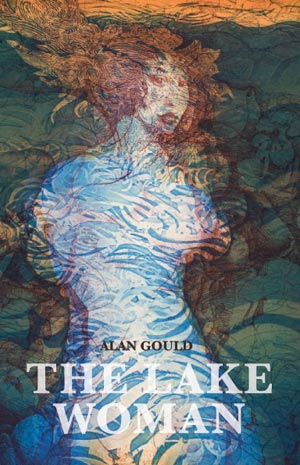
Book cover (Courtesy: Australian Scholarly Publishing P/L)

I’m a little embarrassed to say that until The lakewoman was shortlisted in the 2010 Prime Minister’s Literary Awards, I only knew of Alan Gould as a poet. Turns out, though, that he has written several novels, of which this one is his most recent. It is, ostensibly, a war novel, in that much of it is set in or around World War 2, but it is not in fact about the war.

It’s an intriguing book that slides literally and metaphorically between the solidity of the earth and the fluidity of water, between pragmatism and magic (or enchantment). It tells the story of Alec Dearborn, an Australian grazier’s son who was born in 1918. He goes to Cambridge in England and, when the war starts, decides to join up with the British Army rather than return home. The novel starts with his having landed in a lake, after parachuting from a plane for the D-Day Invasion. He is drowning, dragged down by his weapons bag and parachute, but is rescued by – yes – a lady in a lake. Ha! Now you see why it is called a “romance” because, while it contains “a” romance, it also hearkens back to the “romances” of yore, like the Arthurian legend. Here is the set up, pp. 2-3:

As he vomited he also wondered why this sudden young Mamzelle happened to be present at the exact, unlikely spot in France where his foolish body had come to earth. It was a question that would usefully occupy his mind later, when he was behind the wire with the austere leisure to brood on the magic that settled into his life following this, his fluky rescue. Magic? He was not a fellow given to outlandish notions, and would interrogate the dubious word, looking for its sense, not in mumbo jumbo, but as some friable quantity existing within the very crevices of everyday occasions.

In this passage, we see how carefully Gould has laid out his novel. He introduces us to the ideas of coincidence (fluke) and magic versus the everyday business of living, and he uses foreshadowing to distract us from plot issues (what will happen next) towards more interior ones (what is the meaning of what happens). As the novel progresses, this fellow who is not given “to outlandish notions” finds himself drawn, almost telepathically (it seems), to his rescuer. She , Viva, rather like the Arthurian lady-in-the-lake, frames the rest of his life, one way or another.

What happens on the surface of the novel is fairly matter-of-fact. Alec’s life runs its course in a mostly unremarkable way. One of the central questions of the book is that which Alec poses to his sister, Bell, a little while after he returns to Australia:

What I can’t work out is […] Well, how a person knows whether the existence he’s been given has been of value to anyone else.

This is Alec’s conundrum. He does not fulfil the traditional expectations of a grazier’s son (“Dearborn”, after all), despite his “prospects” : he’s intelligent, sensitive, and physically capable (“the dynamism in balance with the dreaminess”). Much of this failure stems from his being “disarmed” on June 6, 1944, by Viva. There are some lovely, appropriate wordplays in the novel, and one of these centres on the idea of disarming/arming, which works beautifully against the novel’s military background:

‘If you think about me, then, when you are gone, I will be arming you still,’ she assured him, mysteriously.

Soon after he leaves her, he ponders what has occurred:

‘I feel distress at having relinquished you,’ he supplied on consideration. For it was distress, he recognised, to be walking away from this sudden new claim on his life. ‘It is this that has disarmed me, I reckon,’ he explained for her.

I will be arming you, she reminded.

It is difficult with this WordPress theme to get the formatting right: this last statement by her is in italics in the novel and suggests either his memory of her words or an actual telepathic communication. Which one it is, is one of the lasting ambiguities of the novel. Italics are used throughout the novel for “communications” like this and for interior monologues/reflections, usually Alec’s, since this is a third person narrative, told mostly from Alec’s point of view.

By now you may be thinking that this novel is a fantasy, even a romantic fantasy, but not so. Neither is it magical realist. It’s simply that there is a sense that slightly mystical things may be happening, things that make sense psychologically but that also convey another plane of human thought and behaviour. It reminded me, at times, of Patrick White‘s Voss, but to suggest more than that would be to do it a disservice because it is not at all derivative. Rather, it is simply that the story focuses on a dimension of experience that can’t always be logically explained but that is nonetheless very real. Gould has, I think, pulled this dichotomy off, by careful manipulation of tone: through language that is poetic but not overdone; a pacing that is meditatively slow at the beginning and pragmatically faster at the end; evocative chapter titles (such as “To Fling the Lovely Foolish Body”, “Had You Down Dead”); the occasional light touch (“‘You are the invasion?’, she asked”); and timing that foreshadows just enough to make sure we stay focused on the ideas and not the facts.

And for me, the main idea (the one that provides an “undercurrent” to all the others) is that of completing the self, which is something Alec struggles  to do. In the end though:

…the joy, the completion was her presence, and the talk was strangely superfluous. Yet by convention they did talk from some region of the mind where the words did not especially matter but the proximity of the person created an entirety of being.

This is a rather melancholic, but by no means sentimental, book – and it moved me deeply.

Alan Gould
The lakewoman
North Melbourne: Arcadia, 2009
296pp.
ISBN: 9781921509346

Mario Vargas Llosa, The feast of the Goat

Mario Vargas Llosa, signing books

Mario Vargas Llosa signing books in 2010 (Courtesty: Daniele Devoti, via Wikipedia, using CC-BY-2.0)

If Nobel Laureate Mario Vargas Llosa‘s The feast of the goat had been a traditional historical novel, chances are it would have started with the assassins concocting their plan and then worked chronologically to its logical conclusion. But, it is not a traditional historical novel, as is reflected in the structure Vargas Llosa has chosen to tell his story.

Before we get to that though, the plot. The central story revolves around the dying (literally) days of the 30-year Trujillo (“the Goat”, “the Benefactor”, “the devil”) regime in the Dominican Republic. This means the main action takes place in 1961. However, overlaying this is the perspective of Urania, the daughter of one of Trujillo’s head honchos. She’d left the country days before the regime ended and cut herself completely off from her father – for thirty-five years, until her sudden return at the novel’s start. The novel is told from these two time perspectives – 1960/61 and 1996 – and from multiple points-of-view*, the main ones being:

  • Urania
  • Trujillo
  • The conspirators/assassins

But this isn’t all there is to this novel’s structure and narrative style. I’m not quite sure how Vargas Llosa gets away with it, but he has written a book that is very accessible (once you get across the intricacies of Latin American names) and yet also rather complex. This complexity is found, primarily, in the structure. The book can, essentially, be divided into two parts. Chapters 1-16 proceed pretty systematically, cycling through, in turn, the stories of Urania, Trujillo (usually with one of his offsiders), and the Conspirators (usually focusing on one of them in particular). By Chapter 16 the two major crises of the book have occurred or been introduced. The last 8 chapters continue to cycle through different points-of-view but not in the same systematic order. In other words, the narrative structure becomes erratic and the rhythm more urgent, as chaos and uncertainty take over.

And yet, there’s more. For example, the novel is told primarily in third person, with the point-of-view changing chapter to chapter. But, every now and then, for just a sentence or two, or maybe a paragraph, the voice lapses into second person. This happens most often with Urania and conveys the sense that there has been some trauma that she hasn’t been able to fully integrate/recover from. We discover the origins of this trauma in Chapter 16, but it is not fully revealed until the last chapter.

… You were still a girl, when being a girl meant being totally innocent about certain things that had to do with desire, instincts, power, and the infinite excesses and bestialities that a combination of those things could mean in a country shaped by Trujillo. She was a bright girl … (Chapter 16)

This little slip into second person in Urania’s story is telling.

Okay, so this is the architecture, the behind-the-scenes technical stuff, but why write it this way? Well, the reasons are intellectual and emotional. Intellectual in that the multiple alternating points-of-view enable us to get a number of “stories” first hand. Through the eyes of the perpetrators and the disaffected, we explore the regime, and how, as happens so often with dictatorships, the early benefits are gradually (but surely) overshadowed by the corruption and violence perpetrated to maintain power, and how this leads to the assassination conspiracy. And emotional in that the constant shifting in perspective, particularly from people we can trust to those we can’t (to the best of our knowledge), and back again, unsettles and discomforts us … just as those who lived through the regime were kept on edge.

It’s impossible, without writing a thesis, to cover all the angles in this book, so I’m just going to look at one more – the characterisation of Trujillo himself. A historical novelist (rather like a biographer) has to choose what to include and what to exclude when describing a person. Vargas Llosa was lucky, really, that Trujillo had some traits that made this choice rather easy, traits that work on both the literal level and the ironic and metaphoric. Fairly early in the novel is this description of Trujillo

…that master manipulator of innocents, fools, and imbeciles, that astute exploiter of men’s vanity, greed and stupidity.

Fairly typical, wouldn’t you say, of a dictator? But, Trujillo was also fastidious about cleanliness and appearance, believing that

Appearance is the mirror of the soul.

If that’s so, then Trujillo’s “soul” is a very superficial thing because his disdain for the rights and feelings of others is palpable. Throughout the novel, Vargas Llosa sets Trujillo’s obsession with personal care (“the man who did not sweat, did not sleep, never had a wrinkle on his uniform, his tuxedo, or his street clothes”) against the coldness of his mind. That his mind is cold is made perfectly clear through his attitude to his offsiders (whom he liked to scare – “it cheered him to imagine the sizzling questions, suppositions, fears, suspicions he put into the head of that asshole who was the Minister of the Armed Forces”) and to women. This regime values machismo above all: it’s brutal to those those less powerful, and has careless disregard for the innocent. Women, of course, bear the brunt:

Again the memory of the girl at Mahogany House crossed his mind. An unpleasant episode. Would it have been better to shoot her on the spot, while she was looking at him with those eyes? Nonsense. He had never fired a gun gratuitously, least of all for things in bed. Only when there was no alternative, when it was absolutely necessary to move this country forward, or to wash away an insult.

Trujillo was nothing if not a master of self-justification.

How it all falls out, what happens after Chapter 16, is both expected and unexpected as those involved do or don’t do what they’d committed to. The end result is a devastating portrayal of how the political becomes the personal! Not a new message, perhaps, but The feast of the Goat is a compelling read that engaged my heart and mind. I recommend it.

Mario Vargas Llosa
(Trans. by Edith Grossman)
The feast of the goat
London: Faber and Faber, 2002
475pp.
ISBN: 9780571207763

* As in most historical fiction, the novel is peopled with historical characters and fictional ones. Most, in fact, are historical but Urania and her father, though based, I understand, on real people, are fictional.

Katharine Susannah Prichard, The pioneers


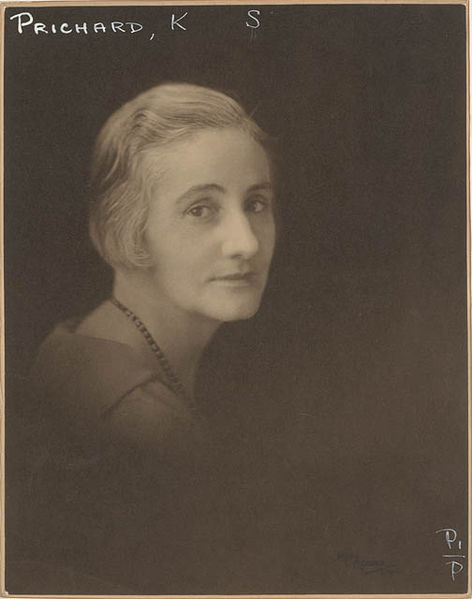
Katharine Susannah Prichard

Prichard, 1927/8, by May Moore (Courtesy: State Library of NSW, via Wikimedia Commons)

Katharine Susannah Prichard (1883-1969) is probably not as well-known in Australia, let alone internationally, as she should be. She was born in Fiji, but grew up in Tasmania and Melbourne, travelled overseas and in other parts of Australia, before settling in Western Australia in 1919. She was a founding member of the Australian Communist Party (1920) and also of the Western Australian branch of the Fellowship of Australian Writers. Politics and literature, then, were the twin passions of her life. Her most famous novel and the only one I’d read until now, Coonardoo (1929), was remarkable in its time for its exploration of the relationship between white men and black women.

I don’t usually commence a review with a biography, but it felt appropriate in this case – partly because she is so little known despite her significance and partly because her politics were an intrinsic part of her literature. In the foreword to my new edition of the book, her granddaughter describes Prichard’s values as:

a huge love of and respect for the bush; the importance of living your life with integrity; of caring and fighting for the underdog; of holding strong principles and remaining true to them; and of embracing life with passion.

These values are evident in The pioneers, her first novel which won the Hodder and Stoughton All Empire Literature Prize for Australasia in 1915. She went on to write over thirty works, including novels, plays, short stories and poetry. But, perhaps that’s enough prelude for now – on with the book.

It’s a simple tale really, plot-wise. It starts with a couple, Donald and Mary Cameron, arriving by wagon in an unsettled area of Gippsland (in eastern Victoria) in the early-mid nineteenth century. They clear the land, build a home and establish a successful farm. Very early in the story, while Donald is away getting supplies, Mary is “visited” by two desperate men, Dan Farrell and Steve. A tricky situation for a woman on her own but she manages to win them over and they leave her, unharmed. The novel tells the story of these people – and the others who move into the district – over the next two decades or so, as they work to make lives for themselves, some honestly and some not so.  There are archetypal characters here – the hard-working, tough, taciturn farmer; the loving, but wise and stoical wife; the loyal but unappreciated-by-his-father son; and more. There are escaped convicts, cattle rustlers, and a thoroughly bad man.

This may all make it sound rather typical and a bit melodramatic. And, in fact, it does have its melodrama. But the book is more than this. Its overriding style, or approach, is social realism, as Prichard explores the hopes and wishes of a new country struggling to come to terms with its origins and forge a more positive future. Her style is not particularly innovative and, while the combination of social realism and melodrama is appropriate for a novel set in the nineteenth century, the melodrama was a little discordant to my modern ears.  Take this, for example:

It was as if that encounter in the valley of shadows had brushed all misunderstandings from the love that was like the sun between them. Deirdre had wrestled with death for possession of him.

A contemporary review suggested that the romance – which drives most of the melodrama – was included primarily to attract readers who may not be interested in the history. This could very well be so.

Despite not being particularly innovative, Prichard’s writing is sure and shows that while this was her first novel she’d been honing her craft for some time. I particularly loved her language. It is gorgeously descriptive. She perfectly captures the paradox of a place that is both beautiful and harsh – and effectively conveys the physical and emotional impact of the landscape:

The bright hours were rent by the momentary screeching and chatter of parroquets, as they flew, spreading the red, green and yellow of their breasts against the blue sky. At sunset and dawn there were merry melodious flutings, long, sweet, mating-calls, carollings and bursts of husky, gnomish laughter. Yet the silence remained, hovering and swallowing insatiably every sound.

The plot, as I’ve suggested, is a little melodramatic and fairly predictable but it’s a well-told tale, nonetheless, of good forces fighting bad, of compromises that are sometimes made, and of bad judgement calls that come back to bite you. The characters, while tending to archetype, are nonetheless real so that you believe them and their various plights. There is, I think, something reminiscent of Dickens here.

The themes reflect very much the values identified by her granddaughter in the foreword. The main characters are imbued with a strong sense of principles that they try to live by. When Mary meets the convicts early in the novel, she says:

But if you will believe the truth it is this: My heart is with you and all like you.

In her twenties, Prichard apparently met the Austrian sociologist, Rudolph Broda, who introduced her to the ideas of socialism and suggested that, as a new country, Australia was leading the world in social legislation. This idea is reflected in the novel. Early on, Mary says to Donald:

It’s a new country and a new people we’re making, they said at home, and I’m realising what they meant now.

Little did she know, then, what this “making” would really involve but defining “a new country” is clearly the goal Prichard set for herself. The novel concludes by suggesting that the new generation will

be a pioneer of paths that will make the world a better, happier place for everyone to live in.

Corny? Or aspirational? Take your pick … but whichever way you see it, this novel makes a significant contribution to the development of the Australian psyche, to our transition from colonial convict-fearing past to an independent self-realised future. I am glad it has been re-released and hope that more people read it.

Katharine Susannah Prichard
The pioneers
Singapore: Monsoon Books, 2010 [first ed. 1915]
272pp.
ISBN: 9789810848804

NOTE: An ebook version of the novel is available at Project Gutenberg.

Tracy Chevalier, Remarkable creatures

Bookcover

Cover image courtesy HarperCollins Australia

Most readers experience, I think, periods of reading synchronicity when we read books in close succession that are related in some way. I am experiencing such a period now as Tracy Chevalier‘s Remarkable creatures is the third book I’ve read recently to deal in some way with the first decades of the 19th century. The others are David Mitchell’s The thousand autumns of Jacob de Zoet and Peter Carey’s Parrot and Olivier in America.

Tracy Chevalier would not normally be high priority for me, but this book intrigued me because of its period and setting. You see, it is set in Lyme Regis in the early 1800s, and that rings a special bell for me! Yes, it’s to do with Jane Austen. Not only did she visit Lyme Regis, but she set a significant scene in Persuasion there*. So, my appetite was whetted.

But, I must say, I was somewhat disappointed. It’s not that I expected a lot, really, but I did expect a little more than I got. In other words, I didn’t expect exciting or innovative prose, but I did expect writing that wouldn’t bother me. However, it did, and this was mostly due to a lack of subtlety. The best writing shows, not tells, but there was way too much telling in this book, and it falls into two main types:

  • Giving “facts” that we should know. Here is Elizabeth over-explaining Mary’s calling her “Ma’am”, when she’d previously called her “Miss”:

And she was calling me “ma-am” now. Spinster or not, I had outgrown “miss”. Ladies were called “miss” while they still had a chance of marrying.

  • Describing something, such as a character’s emotions, when it should be (and usually is) apparent. Here is a bit of petulance that sounds rather silly in the first person voice of a supposedly mature Elizabeth:

As angry as I sounded, I was also secretly pleased that Colonel Birch had discovered the value of my fish enough to want one for himself.

(For a humorous review of an unsubtle book, do read Kerry, aka Hungry Like the Wolf, on Ken Follett’s The pillars of the earth.)

There are also a couple of rather gratuitous references to Jane Austen and her novels, gratuitous because the main characters don’t read novels and the reference to Austen adds nothing significant in terms of plot or characterisation. It’s as if Chevalier knew Austen went there and decided to draw on Austen’s current popularity by making the connection:

One of Miss Austen’s books had even featured Lyme Regis, but I did not read fiction and could not be persuaded to try it. Life itself was far messier, and did not end so tidily, with the heroine making the right match. We Philpot sisters were the very embodiment of that frayed life. I did not need novels to remind me of what I had missed.

Enough of all that, however. Let me give a quick rundown of the plot. It tells the story of two women who were fossil hunters in Lyme Regis in the first half of the nineteenth century. They were Mary Anning (1799-1847), a poor working class woman whose fossil finds helped change the course of paleontology, and Elizabeth Philpot (1780-1857), a gentlewoman who befriended Anning and who was particularly interested in fossil fish. Using known facts and novelistic licence, Chevalier has written an engaging story that focuses not only on the fossils and their impact on scientific and religious thinking of the time but also on the difficulties faced by women, particularly those unmarried like Philpot or unmarried and uneducated like Anning. Philpot says early in the novel that

… I had to find a passion: I was twenty-five years old, unlikely ever to marry, and in need of a hobby to fill my days. It is tedious being a lady sometimes.

Chevalier shows the financial precariousness of women, their lack of power, and how easily they can be exploited. Women, for example, were unable to belong to the Geological Society of London, and Mary’s collections (in particular) were written up in scientific journals by men, often with no credit given to her contribution. This is the real story of the novel and Chevalier captures well the circumscribed lives of women, and the challenges they faced in living independently. And yet, she undermines this by fabricating a jealous falling out between Elizabeth and Mary over a man. Did Chevalier really need to do this to make the story exciting?

That said, the characterisation is effective overall. She differentiates the two main characters not only by their very different voices, but also by creating a conceit for each of them. For Elizabeth it is her describing what people “lead with”. The forthright Mary, for example, leads with her eyes, while one of the foppish male characters leads, she says, with his hair. Good one, I thought! Mary’s conceit is being the “lightning girl”. The book begins with her being struck, but not killed, by lightning when she was a young girl. Lightning thereafter becomes a motif in her life for surprising or lucky events and for strong feelings.

Chevalier also writes some lovely descriptions – of people and landscapes:

While I accommodated her absence, a dull ache in my heart remained, like a fracture that, though healed, ever flares up during damp weather.

and

Lyme Regis is a town that has submitted to its geography rather than forced the land to submit to it …It is not planned, like Bath or Cheltenham or Brighton, but wriggles this way and that, as if trying to escape the hills and sea, and failing.

This is an enjoyable book for the glimpse it gives into the lives of two interesting and little known women, but the writing, for me, doesn’t quite do the story justice. For a more positive review, you may like to read Lisa’s at ANZLitLovers.

Tracy Chevalier
Remarkable creatures
London, HarperCollins, 2010
352pp.
ISBN: 9780007178384

*It is also the setting, of course, of John FowlesThe French lieutenant’s woman.

Peter Carey, Parrot and Olivier in America

Alexis de Tocqueville.

Alexis de Tocqueville (Presumed Public Domain, via Wikipedia)

It’s not surprising, really, that after living in America for two decades Peter Carey should turn his pen to it. Having lived in the US twice myself, I well understand the fascination of trying to understand that large and paradoxical country. In Parrot and Olivier in America, then, Carey sets out to explore America through the eyes of two men from early nineteenth century Europe: Olivier Jean-Baptiste de Clarel de Barfleur de Garmont, a French aristocrat whose parents had barely survived the French Revolution, and John ‘Parrot’ Larrit, a poor Englishman who had been brought to France as a boy by another French aristocrat.

Olivier was born in 1805, the same year that French writer and historian Alexis de Tocqueville was born. This is not a coincidence as the novel is Carey’s loose re-imagining of Tocqueville’s trip to America, with a friend, to study American prisons. Like Tocqueville, Olivier undertakes his trip with the support of the July monarchy, but Oliver’s companion is not an equal. Rather it is Parrot, servant-class and twice Olivier’s age. An unlikely pair, really, but perfect for Carey’s purposes …

… which are to pry into, poke at, and peer under that great American experiment, Democracy. Through having two protagonists of such diverse backgrounds and perspectives, Carey is able to explore the issues from different angles, that of master and servant. And through choosing the picaresque as his form (or style), he is able to do so without being ponderous. In other words, the tone is comic, as befits a picaresque novel, and the narrative comprises a series of adventures in which our “heroes”, Parrot and Olivier, meet a range of characters along the way who test them and their ideas. The novel is told in alternating, and well-differentiated, first person voices – starting with Olivier and ending, very even-handedly, with Parrot. It is basically chronological, but there are flashbacks to fill in gaps and frequent overlaps caused by one telling a story followed by the other giving his version.

That’s the nuts and bolts of it, but how does it come across? Well, in a word, exuberantly. That’s not to say it doesn’t have its serious side, but just that it’s rather fun to read. At least, it was for me, though that could be because of my personal history with America. Here, for example, are some of the observations which caught my attention:

On not needing government (Parrot talking with a tradesman):

‘When there is enough for all,’ the nail-maker said, ‘there is no need for government.’
‘But what of the poor.’
‘No man who will work can be poor.’

A little myopic methinks – but an idea that seems to be still entrenched in America?

On the focus on money and trade (Olivier):

No matter how strong their religious sentiments, or their passion about the reform of criminals, the Americans quickly revealed themselves to be obsessed with trade and money … They had got their hands on a mighty continent from which the least of them could, by dint of some effort, extract unlimited wealth. There being so much to be extracted it scarcely mattered how they were governed, because there is no need to argue when there is plenty for all.

For all, that is, if you are able to work, are not black and not indigenous! Even aristocratic Olivier noticed some of these contradictions.

On the ability to be self-made (Peek, the banker, to Olivier):

‘Experiment,’ he cried, laughing too violently for my taste. ‘There is no experiment. We make this transformation every day. It is called rags-to-riches …’

And on the possibility of art and culture in a democracy (Olivier):

… They [paintings in Philadelphia] made me think that the taste for ideal beauty – and the pleasure of seeing it depicted – can never be as intense or widespread among a democratic as an aristocratic people.

Hmm…Peter Carey is on record as expressing concern for the survival of culture. He said in his closing address at this year’s Sydney Writers’ Festival that ‘We have yet to grasp the fact that consuming cultural junk … is completely destructive of democracy’. In other words, Olivier/Carey question whether “high” art and “total” democracy are mutually exclusive? Somewhat related to this is Carey’s ongoing interest (see My life as a fake, and Theft: a love story) in authenticity in art. He explores it here through Olivier’s love of art, and the artistic endeavours of several characters, including Parrot and his mistress.

As for the story itself, there is a lot to enjoy. Olivier and Parrot have a complex relationship that develops from mutual disdain to a cautious friendship as the novel progresses. For all his attempts to be open-minded, Olivier never totally accepts the notion of equality between “men”, but Parrot, from both his early training and a generous nature, manages to tolerate and even accommodate this. Besides these two, there are characters from all strata of society: aristocrats, printers, bankers, land-owners, artists, actors, and so on. And, of course, there are romances, with Olivier’s playing out to a rather ironic conclusion.

One little demur, though. The book did not really engage me emotionally – something I tend to expect in longer novels – and I wonder whether this is partly due to the picaresque genre whose episodic and comic nature can have a distancing effect. Is this a failing? I think not, but it was noticeable, and means that the writing and ideas have to be powerful enough to carry the reader along. And mostly they do here, largely due to the novel’s pacing.

So, what is Carey’s conclusion? Well, it’s pretty even-handed, with both the aristocrat and the servant summing up their experience of America. But, in a twist on Tocqueville, the last words are Parrot’s. As a reader who always looks to see if structure informs the meaning, I wonder if this tells us something. Then again, there could be an element of irony in it. However you read it, there is no real answer to the question in the epigraph:

Can it be believed that the democracy which had overthrown the feudal system and vanquished kings will retreat before tradesmen and capitalists? (Alexis de Tocqueville)

Prophetic words, eh.

Peter Carey
Parrot and Olivier in America
London: Faber and Faber, 2010
578pp
ISBN: 9780571253319

David Mitchell, The thousand autumns of Jacob de Zoet

‘Oh I found ways to live to tell the tale. It’s my chief hobby-hawk is the noble art of survivin’.’

‘Loyalty looks simple,’ Grote tells him, ‘but it isn’t.’

‘…Expensive habit is honesty. Loyalty ain’t a simple matter, Di’nt I warn yer…’

It’s interesting that some of the main themes of David Mitchell‘s The thousand autumns of Jacob de Zoet are conveyed by one of its lesser (in terms of status) and more questionable (in terms of morality) characters, the Dutch cook, Arie Grote. Interesting because such a slippery and relatively minor character expresses some critical themes and because Mitchell’s making this choice provides a clue to the book’s tone and style. It has, in other words, a rather wry undertone.

Dejima model, Nagasaki

Model of Dejima, at Dejima Wharf, Nagasaki

So, what is its plot? Broadly, it is about the Dutch East India Company‘s activities on Dejima, a walled island in Nagasaki harbour, during Japan’s isolationist (or, “Cloistered Empire”) period, with most of the action taking place between 1799 and 1800. It follows Jacob de Zoet, a young man who arrives in 1799 to work as a clerk (and to make his fortune so he can return home to marry his love, Anna). What he finds is a multicultural community comprising Dutch, Japanese, a Prussian, an Irishman and others including Malay slaves, living and working within a complex web of ambitions, animosities and allegiances. He discovers pretty quickly that he’s going to need good survival skills to make it through. The question is: will he make it through, and will he do it with his integrity intact?

There is a love triangle of sorts, involving a young Japanese midwife named Orito. And there’s a drama centred on her “abduction” to a horrifying (invoking, for me, Margaret Atwood‘s The handmaid’s tale) monastery/nunnery called Mt Shiranui, which is overseen by the evil lord/abbot, Enomoto. This sounds, I admit, a bit melodramatic and in a way it is, but it seems to work, largely because of the characterisation.

The novel has a huge cast of characters, as this Character List (source unknown) shows and, over the course of 450+ pages, Mitchell gives us the backstories to many of them. At times I felt there was too much detail – as in “why do I need to know all this?” – but the stories were so interesting that I didn’t really mind. Mitchell is not, I have to say, a taker-outer and so, if you like your stories to move along at a fast clip, this is not for you. Many of the characters, from bottom to top of the hierarchy, are corrupt, as they scheme, bribe and manipulate for money, power and/or prestige, but not all are. Some of the most interesting characters are those who are not corrupt but are not perfect either. They include Jacob; the doctor/scientist, Dr Marinus, who tests Jacob somewhat cruelly; the young interpreter, Ogawa Uzaemon, who overlooks Jacob’s illegal importation of his Christian psalter; and John Penhaligon, the gout-ridden English captain who makes a play for Dejima late in the novel.

Having read and enjoyed Cloud atlas, I must say I kept expecting some, shall we call it, literary “tricksiness” but it never really appeared. This is historical fiction told in a linear fashion, albeit with the odd digression and some shifting perspectives. In fact, while not particularly “tricksy”, the style is not simple. There is a lot of variety in the telling:

  • dialogue (and italicised thoughts of characters, as conversations or action occur);
  • backstories;
  • set-ups that don’t always follow through as you would expect (such as that concerning Jacob’s hidden psalter);
  • scenes in which the main action is interspersed by something else going on (such as Cutlip preparing his boiled egg while Penhaligon negotiates with the slippery Prussian, Fischer);
  • action and adventure; and
  • a good deal of humour (including the scene in which a Japanese translator tries to translate a scientific lecture being given by Dr Marinus).

The language is similarly diverse. Mitchell uses irony, metaphor and symbolism, wordplay, and repetition, to name just a few techniques. Here, for example, is a rather lovely oxymoron:

The creeds of Enomoto’s order shine darkness on all things.

And here is a moving description related to an honourable death (without naming names):

An inch away is a go clamshell stone, perfect and smooth …
… a black butterfly lands on the white stone, and unfolds its wings.

I was impressed by the array of literary devices he used and how it never felt overdone. It was his language and characterisation, more than anything else, that kept me engaged.

The book does suffer a little, though, from the breadth of its concerns. I flicked through the book to jot down its themes and ran out of space on my page! So, I grouped them:

  • Political/historical: commerce, nationalism, colonialism and slavery
  • Philosophical: fate, faith and belief, truth
  • Social: education, oppression of women, science and enlightenment
  • Personal/psychological: loyalty and betrayal, honesty, love and integrity, survival

That’s a pretty broad church and, although some naturally overlap, the effect is to dilute the book’s impact somewhat.

So, how would I encapsulate it? Well, I’d sum it up as being about “imprisonment”, both literal and metaphorical. The Dutch are imprisoned on Dejima, the Japanese are imprisoned within their self-imposed isolationist policy, Orito and her “sisters” are imprisoned at Mt Shiranui. And people are imprisoned by their roles and/or culture. For example, women’s options are restricted, slaves have little control over their lives, and many of the characters, including Jacob, are imprisoned by their lack of economic resources that would enable them to freely choose their lives.

This is one of those rather unwieldy books that is hard to pin down but, despite this, I did rather enjoy watching Jacob and co. going about “the noble art of survivin'” in an intriguing place and time.

Ruth Park, Missus

Missus was the last written in Ruth Park‘s Harp in the South trilogy, but is the first in terms of chronology. The first two novels, Harp in the South and Poor man’s orange, were published in 1948 and 1949 respectively, while Missus was not published until 1985.

These first novels, which met with some controversy on publication, are set in early post-war Sydney, the tenements of Surry Hills, and deal with the lives of Mumma and Hughie Darcy and their daughters. Missus is set in the 1920s, in country New South Wales, and relates Mumma and Hughie’s youth and courting days. I have only just read Missus, partly because I read the first two in my teens which was, I have to admit, before Missus appeared on the scene.

You can tell that the writer of Missus is the writer of Swords and crowns and rings (1977). The latter is larger scale – and deals more consciously with its historical time-frame. That is, it more specifically addresses the wars and the Depression, and their impact on the main characters. However, the First World War and the coming Depression do provide the backdrop to Missus. Both books depict rural life and characters with convincing realism.

WARNING: SPOILER, IF YOU’VE NOT READ HARP IN THE SOUTH

Now, the plot. For those who’ve read the first two novels, the interest here is not whether Mumma (Margaret Kilker) and Hughie get together but how they get together and who they are. The first chapter – after a brief introduction to the town of Trafalgar including how the early settlers cruelly despatched the Indigenous inhabitants – introduces us to Hughie and his family. We meet his brother Jer (Jeremiah), who is born with “his feet back to front”, and we learn of the failure of his parents marriage, his mother’s early death and his being turfed out by his father when he was around 14 years old. Jer goes with him, and becomes both millstone and support from then on.

In Chapter 2, we are properly introduced to Margaret (who makes a brief appearance in the first chapter) and her family. Unlike Hughie, she grew up in a large, loving family, though not one without its stresses and losses. Margaret, we learn, has taken a shine to Hughie, much to her mother’s concern, because she sees Hughie for what he is, “a wild goose of a boy … [who’s] got flighty feet”, a “shifty article”. This mother (Rowena) is, in fact, a powerful presence. I love this description of Rowena after she decided to give up on (“on” being the operative word) her first true love:

Her chest ached as if it had a skewer stuck in it, but she tossed her head more often than she hung it.

From here on the story progresses chronologically as Hughie moves around the countryside obtaining and losing or leaving jobs, while Margaret stays at home waiting for Hughie’s occasional visits. The characters of our characters, if you know what I mean, are illuminated by the actions of, or their interactions with, other characters. Margaret’s younger sister, the jealous Josie, provides an interesting foil for Margaret as well as an opportunity for Park to explore women’s lack of rights. Josie marries young – for the wrong reason to the wrong man – and the marriage fails. She’s intelligent and manages to obtain accountant qualifications, but her attempt to set herself up as an accountant in the town fails because no-one will use a woman accountant. Other characters include Alf, Margaret’s long-suffering but sensible aunt who works as a housekeeper for the local priest and who, at different times, provides shelter and monetary support for Josie and Jer; the Biddles (the mustard-gas damaged Joe and his common law wife) who take in Hughie and then Jer at one time in their lives; and the redoubtable Bids Tookey who … but that might give away what little plot there is.

Sunday Creek, near Rutherglen

Australian country creek, lined by eucalypts

In just 250 pages Park paints a rich picture of 1920s life in rural Australia while at the same time developing Hughie and Margaret’s characters. Her characters are all flawed, some more than others, but she draws them with a clear-eyed warmth. She sees them for who they are but she respects them nonetheless. There’s no sentimentality here, but neither is it cynical or bitter. Her themes are universal ones: innocence and experience, familial and romantic love, deception and loyalty, most of it overlaid with that pragmatism that is necessary for survival in a hard place in hard times. As I wrote in this week’s Monday Musings, it’s not surprising that these books still resonate.

Finally, the language is lovely – simple, direct and evocative. Read this from the last few pages of the novel:

In the unkempt garden bloomed freesias and grape hyacinths. The eucalypt twig flushed red, the four creeks overflowed, lambs appeared on the hills, white as mushrooms and as sudden.

‘Them two had better wed quick,’ said Eny ominously, ‘or I won’t answer for Margaret’.

Ha! I think I’ll leave it there – pregnant with possibility …

Ruth Park
Missus
Ringwood: Penguin Books, 1985
247pp.
ISBN: 0140089438