Louis Nowra, Into that forest (Review)

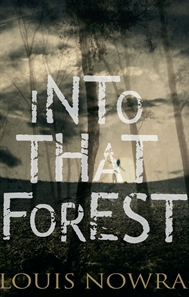
Louis Nowra, Into that forest

Courtesy: Allen & Unwin

Louis Nowra is one versatile and prolific writer, having written novels, non-fiction, plays and screenplays, essays and even libretti. Into that forest is his latest work. It was shortlisted for the Young Adult Novel prize in the 2012 Aurealis awards and the Ethel Turner Young People’s Literature prize in this year’s NSW Premier’s Literary Awards. I read this for my reading group. We don’t often do youth literature but every now and then one pops up that we think might interest us … such as a book by Nowra.

The first thing to say is that the novel is written in a unique voice. Here is its opening:

Me name be Hannah O’Brien and I be seventy-six years old. Me first thing is an apology me language is bad cos I lost it and had to learn it again. But here’s me story and I glad to tell it before I hop the twig.

And what a story it is … this novel feeds into several Australian, and wider, literary traditions. There’s the lost child and the feral child motifs (reminding me of Dog boy). There’s Tasmanian Gothic, and there’s also a bit of the fairy-tale about it. Subject-wise it covers some significant ground: environmental issues (involving both the extinct Tasmanian tiger and the whaling industry) and what we’d now call Post Traumatic Stress Disorder. This might sound rather mechanistic, but there’s no sense of “ticking off”. It’s not didactic, and it’s all logical within the framework of the book.

Set in the late 19th century, it tells the story of two young girls, Hannah (then 6) and Becky (7) who find themselves lost in the bush (oops, forest!) after their boat capsizes in a storm and Hannah’s parents drown. They are taken in by a Tasmanian Tiger pair, and live with them for four years. Meanwhile, Becky’s father, Mr Carsons, is out looking for her. Eventually they are found, but the process of re-integration is not easy. The novel has a small cast of characters, which keeps it tightly focused. Besides Hannah’s parents who die near the beginning, there’s our two young protagonists, Becky’s father, his friend Ernie, the “tiger man”, a few other minor characters – and of course, the tigers, named Dave and Corinna by Hannah.

As in Dog boy, the description of life with the tigers is pretty visceral. At first Becky resists living like a tiger – perhaps because she still has a father whom she hopes will find her – but eventually she too succumbs, if succumb is the word. It is, after all, a matter of survival. And so they shed their clothes, start to move mostly on all fours, and develop keen animal instincts (of sight, hearing and smell). They also develop a taste for raw food and become adept at hunting. The descriptions of killing and eating the prey are not for the squeamish – “I were starving and the taste of blood made me feel even more hungry” and “What were ever in that shiny pink gristle surged through me in waves of ecstasy” – but they are important to our understanding of what their lives had become. Hannah says:

God knows where me sense of survival came from. Maybe it’s natural cos humans are just animals too.

There is a bogey man here – the tiger man or bounty hunter, whom Hannah had met before, through her parents. To the girls he is more brutal than the tigers. He’s “evil”, kills tiger pups, does “stuff to himself that were rude”. But, perhaps, he’s just another survivor, albeit a not very pleasant one?

While Hannah is the narrator, Becky’s character is the more complex one. She struggles more with the change forced upon them:

She didn’t want to forget. Me? I thought it were stupid to try and remember like Becky did. I didn’t see any use for it. Me English started to shrivel up, like an old dry skin a snake gets rid of. It just lies there in the grass rotting away and then vanishes with the wind. I took to talking in grunts, coughs and hoarse barks like the tigers. This annoyed Becky no end. But it were simple – the tigers understood me. Becky warned I were making a mistake. You will forget your language. You will forget your parents. You are becoming an animal, she’d say. Why argue with her? She were right on every level.

Becky initially fights against the brutality of the hunt – there’s a horrific description of the tigers attacking seals – but then surprises Hannah by rather fearlessly exerting some dominance in the pack. She was of course desperately hungry by then, but it shows Hannah that:

she were really stubborn if she wanted something. She were brave, she were stubborn, she were smart, she were tough.

Unfortunately, Becky is not as tough – or as adaptable – as Hannah thought, and consequently precipitates the novel’s rather shocking conclusion.

It’s a pretty bold novel – but less so than, say, Lord of the flies. There’s plenty to discuss, particularly regarding the subjects I suggested at the beginning of the post. The big theme, though, the one common to feral children books, has to do with defining our nature. What separates human from animal? What would you do to survive – and what would that say about the essence of humanity? Good stuff for young adults, and a gripping read too for we older readers.

Louis Nowra
Into that forest
Crow’s Nest: Allen & Unwin, 2012
ISBN: 9781743311646 (Kindle ed.)

Courtney Collins, The burial (Review)

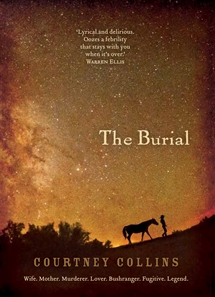
Book cover (Courtesy: Allen & Unwin)

Book cover (Courtesy: Allen & Unwin)

I became aware of Courtney Collins’ The burial when it was longlisted for the Stella Prize. It has since been shortlisted for the Stella, shortlisted for the new writing award in the NSW Premier’s Literary Awards, and longlisted for the Dobbie Literary Award for new writing. It had previously been shortlisted for the 2009 Australian/Vogel Award for Unpublished Manuscripts. This is one impressive debut. While I’m attracted to several of the books longlisted for the Stella, I particularly wanted to read this one because of its subject matter; it is inspired by the life of Jessie Hickman, an Australian woman bushranger. I hadn’t heard of her before and thought this would be an interesting introduction. I wasn’t wrong. The burial is no ordinary historical fiction.

The bulk of the novel takes place in 1921 when 27-year-old Jessie, having had a gutful of her abusive, horse rustling husband Fitz, takes off, having first … well, let’s just say, done to him what she’d been wanting to do for a long time. In other words, she’s on the run. Now Jessie is no saint. She’s already been in prison for rustling, but she didn’t deserve the treatment she got at the hands of Fitz. The novel chronicles Jessie’s escape, and the story of the two men looking for her, Jack Brown, her lover and co-horse rustler for Fitz, and Sergeant Barlow, who has a story of his own. Escape is, we discover, Jessie’s speciality. It’s not for nothing that the book starts with a story of Houdini, or that Jessie’s horse is named for him.

As I read, I was reminded of two American writers – Toni Morrison and her powerful, gut-wrenching novel Beloved, and Cormac McCarthy and his western novels – for pretty obvious reasons. The burial is narrated by Jessie’s prematurely born daughter whom she kills and buries at the start of the novel, reminiscent of Sethe’s daughter Beloved, despite their different behaviours. And the elemental, evocative language along with the themes – human against human, human against nature, in a forbidding and lawless environment – immediately bring Cormac McCarthy to mind.

What is particularly impressive about this debut is Collins’ handling of the narrative voice and structure. The baby’s voice is generous and wise, not maudlin or pathetic. She cares about this mother of hers, and is a bit like a guardian spirit, albeit one without any power. Somehow, despite what Jessie did to her, she humanises Jessie and encourages us to feel sympathy rather than horror. Collins is light-handed in her use of this trope. As the novel progresses, it feels like a third person story, which it is, really, because it is not about the narrator but is her story of her mother. Every now and then, though, we are reminded of our narrator when she says “my mother”.  As for the structure, the narrative alternates, loosely rather than rigorously, between Jessie’s story and that of Brown and Barlow. It’s basically chronological but there are flashbacks to fill us in on Jessie’s origins as we follow her escape.

Back now to the story. Early in the novel, Jessie is released from jail to be an apprentice horse-breaker and domestic help to Fitz, and pretty soon we are told all we need to know:

Her hope was that her employer was a good man. But he was not.

I love the way Collins’ language flows – from lyrical description to the plain and straight.

Fortunately, Jessie, while fearful of this man who beats her, is also spunky and “found freedom in the ways she defied him”. There is a bit of the picaresque in the novel, as we follow Jessie’s escape and the various people she meets, but it has none of the lightness of that form. A better description is probably gothic. It’s a tough world Jessie finds herself in – one that is particularly cruel to women and children. She spends time, for example, with an old couple. The woman wants her because “All of these years in this miserable place I have prayed for the company of someone other than you and here she is. I am taking her”. The man’s response?  “She’s of no value”!

The brightest spot in the novel occurs when Jessie meets a gang of young rustlers led by the 16-year-old Joe in a spirit of mutual support and cooperation. She joins them and helps them in a well-planned heist in which they manage to steal 100 cattle, sell them at saleyards and return to the hills before the owner notices the loss. It is remote country, after all. However, the theft is discovered and a bounty is put on Jessie’s head – for the cattle they believe she’s stolen and for the rumoured murder of Fitz. And so the final hunt begins involving a bunch of men who are after the bounty, and Brown and Barlow who hope to get to her first.

For a while the gang stays hidden but, eventually, some of the hunters get close:

That’s the sound of desperate men, said Joe. I know this type of man, said Bill. He has no god. And he is all the more dangerous to us because, worse than that, he has no law in him or myth to live by.

Jessie, at her insistence, heads off alone, setting up the climax which is not totally unpredictable – after all, one can’t stay on the run forever – but which contains its surprises.

This is a novel about a hard world in which

A man can rape or kill and expect no consequence except his own consequence. You mean conscience? Consequence is what I said and what I mean to say!

But it is also about love and forgiveness, magic and myth, resilience and resourcefulness … I’ll not forget it quickly.

Courtney Collins
The burial
Sydney: Allen & Unwin, 2012
ISBN: 9781743311875 (Kindle ed.)

Read for Australian Women Writers’ Challenge and Reading Matters’ Australian Literature Month.

Frank Moorhouse, Cold light (Review)

As I reached around the two-thirds point in Frank Moorhouse‘s Cold light, the third tome in his Edith trilogy, I wanted to cry out “Enough already”! It’s not that I wasn’t enjoying (most of) it, and it’s not that it’s a bad book, but it does go on – and on. It’s a book, I think, that could do with a severe prune. But perhaps that’s just li’l ol’ novella loving me talking!

For those not familiar with Frank Moorhouse’s Edith Trilogy, a little summation. The first book, Grand days (1993) sees Edith Campbell Berry join the League of Nations as an enthusiastic, idealistic ingénue. She’s “plucky”, as most reviewers point out, which she needs to be because she wants to change the world. It was, as I recollect, a thoroughly engrossing  a thoughtful insight into Europe at that time. The second book, Dark palace (2000), I haven’t read, though it is in the TBR. Embarrassing eh? It won the Miles Franklin Award after Grand days had been controversially rejected for not being, according to the judges’ interpretation of the award conditions, “Australian enough”. Dark palace chronicles the failure of the League and, with it, of the ideal of internationalism. This ideal, or at least her desire to make the world better, is something that Edith still hankers for at the start of Cold light. Unlike the first two novels, which are set in Europe, Cold light is, until the last few chapters, set in Canberra. That of course gave it added interest for me.

The three novels cover the middle half of the twentieth century – from the early 1920s to the early 1970s – with Cold light “doing” 1950 to 1973. Edith must be in her 40s when the novel opens and is well into her 60s by its close. This can be a challenging time of life for a woman and Frank Moorhouse’s exploration of the issues women face – biologically, socially, and intellectually – is sensitively and authentically done. Edith’s challenges are compounded by the fact that she wants to work – in the public sphere – but in 1950s Australia married women, as she was, were not entitled to work for the government. Edith does manage to get around this in various ways, mostly by being employed under honorariums and the like. Not very satisfactory, but better than nothing.

What I most enjoyed about the novel was its coverage of some of the big issues of its time, particularly in relation to Australia: the planning of Canberra which was still in its infancy, the Cold War and the attempts to ban the Communist Party of Australia, and nuclear energy. One way or another, Edith becomes involved in each of these issues and serves as our guide. I particularly liked the discussions about Canberra and what sort of city it should be. Early in the novel it is described as a “toy city”, a “make-believe city”, an “unfinished city”, “a city that is not a city”. Some of those criticisms still hang over it now, though less so I hope. Certainly, Edith begins to warm to it and enthusiastically works for a few years with the Town Planning section. She initially envisions it as a place of “communal memory”, as “the living memory of the nation”. Fifteen years on, as the will-we-won’t-we-will-we-won’t-we artificial lake is finally “opened”, her thinking has moved on. She would like to see Canberra as a “social laboratory”, which would “try out all sorts of ideas for good living”, and as a “place for citizens to ask questions”. Moorhouse’s thorough research into Canberra’s planning shows through here, as it does in the other topics he covers in the book.

I also enjoyed much of his characterisation. The novel has a large cast of characters, so his list of “Who is who in the book” at the end, with the “real” people asterisked, is very useful. But, beware, because if you read Edith’s entry, you’ll find a potential spoiler. The best drawn characters are the fictional ones: Edith, her cross-dressing “lavender husband” Ambrose, and to a less extent her brother and Communist Party official Frederick, and his girl-friend-partner, Janice, for whom Edith has some confused feelings.

Edith is, of course, the focal character. The novel’s voice is third person subjective, that is, it is told through Edith’s eyes, her perspective. And Moorhouse does it well. Edith’s a living, breathing, believable human being – but there’s just too much of her. We spend too long with her questioning and ruminating on just about everything she confronts. She ponders, and wonders, she asks herself multiple questions – and it is all just too much. And yet, and I know I’m being contradictory, she’s an engaging character. But not “plucky”. Surely that’s a bit twee for a professional woman? I’d use the words resourceful and confident. Even when she doesn’t feel confident, she knows how to put on a show. Despite this, by the book’s end, she wonders if she’s “bungled” her life. She wonders, in fact, for many pages, and asks many questions (have I said that before?) in the process. She tries to recast her life as “a journey” rather than as a failure to achieve goals, which seems fair enough to me. She’s most concerned, at this point, with her personal rather than her professional life, and the fact that she’s had three husbands. Alluding to Othello, she concludes:

She had loved not too wisely, nor too well. But she had tried with all her might.

She sure had.

I also enjoyed the themes of the novel. There are many of them, in fact, but the two that interested me most are the failure of idealism and the challenges of aging. As the book draws to a close she wonders:

Perhaps she was wrong to assume that evolution was moving towards some humanistic paradise.

But she still believes that

Safety lay in candour – the open personality in an open society.

And I love her for it.

Finally, I liked the fact that this novel of uncertainties has a very certain end. Moorhouse was clearly determined to end with a bang, not a whimper. Overall though, I would have like some zing, some wit, or alternatively, something to wrench my guts. Instead, it was just a little too laboured for me to feel the “wow” that I’d hoped for. A good read? Yes. An interesting read? Definitely. But a great read? Not quite.

For a thorough and totally positive review, check out Lisa’s at ANZLitLovers.

Frank Moorhouse
Cold light
North Sydney: Vintage Books, 2011
719pp.
ISBN: 9781741661262

Kate Grenville, The lieutenant (Review)

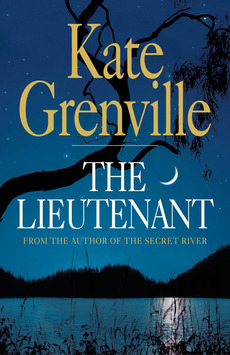
Kate Grenville, The lieutenant book cover

Bookcover (Courtesy: Text Publishing)

I first came across William Dawes, the inspiration for Kate Grenville’s The lieutenant, in Inga Clendinnen’s award-winning history, Dancing with strangers (2003). But this is not the only book that Grenville’s novel brought to mind, as it also reminded me of Kim Scott’s That deadman dance. (Intriguing that both these books use a dance motif, but it’s an historically valid one).

However, before I talk more about these connections and their relevance, I should briefly describe the plot. The novel is set during the first years of the white settlement of Australia. (The very fact that I write the “white” settlement says something about how far we have come in the last two centuries, though we still have some way to go). Daniel Rooke, the protagonist, is a young astronomer. He has been chosen for the First Fleet on the recommendation of the Astronomer Royal who believes that a significant comet will appear in the southern hemisphere in late 1788-early 1789. With this role in mind, Rooke manages to largely separate himself from the day-to-day hurly burly of the first year or two of settlement by creating an observatory, of sorts, for himself, on a hill (now called Dawes Point) overlooking Sydney Cove. Here, in his isolation, he is visited by a group of indigenous people, mostly women and children, and develops a particular relationship with the young 12-13 year old girl, Tagaran. They learn each other’s language, which Rooke chronicles in his journals. All this generally reflects the story of William Dawes whose journals Grenville (and Clendinnen) read, but, as Grenville writes in her author’s note:

Although I made use of historical sources, I departed from them in various ways. This is a novel; it should not be mistaken for history.

Meanwhile, back in 2003, Clendinnen wrote of Dawes, bemoaning his earlier-than-wished-for departure from the colony:

His departure cost us access to the local language as it was spoken at the time of contact. It possibly also cost us a brilliant ethnography, although his tender conscience  might not have allowed him to open the people to easier communication, and to more disruptive exploitation.

Grenville does a good job of imagining the Dawes described by Clendinnen as an “introspective, scholarly type” in her characterisation of Daniel Rooke. She introduces him as a socially awkward but sensitive and thoughtful young man who joined the military not for love of war but because it provided the best chance for a poor young man to make a life for himself. From this supposition she develops a credible character whose final actions in the book pretty closely mirror what we know of Dawes.

I will leave Rooke here for a moment, though, to talk a little more about the conjunction between the three books I mentioned in my introductory paragraph. The significant point they all make is what Clendinnen calls “acts of kindness” by the indigenous Australians in the early days of settlement (in the east, in the case of Grenville and Clendinnen, and the west in the case of Scott). All three writers describe a willingness to be generous that was not recognised or accepted by the colonial invaders. Now, I know that here I am speaking of history and fiction in the one breath and I know that, as Grenville wrote, novels should not be mistaken for history. However, modern readers can, I think, glean the truths, regardless of form or genre, if the writers provide the appopriate signposts.

Take The lieutenant. In it, Grenville is still smarting I think from the criticism she received from historians regarding her claims about the historical value of The secret river. The book contains many rather sly allusions to facts, reality and truths. I particularly liked Rooke’s contemplation about the value of his journals in which, as well as documenting the language he was learning, he described his interactions with indigenous Australians, telling stories that actually happened but whose meaning, he discovered, could be distorted. He considers omitting all but the dry documenting of language, but then realises:

Making an expurgated version of the notebooks would kill them. Like a stuffed parrot, they would be real, but not true.

With a little sleight of hand, Grenville uses a fictional character and his fictional journal to talk about the use of historical sources and the telling of stories from them. Do you simply present the “facts” or do you tell a story –  either factual as in history or fictional as in novels – from those facts in which you aim to draw out the truths as best you see them. Am I drawing too long a bow? I don’t think I am.

And so, as you can probably tell, I enjoyed the novel. It suffers from a little earnestness in tone but that doesn’t get too much in the way of a good story about how first contact in the first settlement played out. It’s not the only story about first contact but it is a valid one – and it helps us understand how an all too human inability to walk in the shoes of the other resulted in a catastrophe of major proportions that we are still working through today.

Kate Grenville
The lieutenant
Melbourne: Text Publishing, 2008
307pp.
ISBN: 9781921656767

(Review copy supplied by Text Publishing. An unsolicited review copy received in 2010 so I’m afraid I’ve taken my time to get to it.)

Elliot Perlman, The street sweeper (Review)

Elliot Perlman‘s latest novel, The street sweeper, is a complex book with a pretty simple message. It’s complex because of its multiple interconnecting storylines that move back and forth between World War II, the American Civil Rights era, and contemporary times. It has multiple themes, about which I’ll write further, but the underlying message is simply this: history is important. Related to this is the idea that all things are connected. Let me explain …

The original characters in the novel, those from whom the connections flow, are two lawyers, the Jewish Jake Zignelik and African-American William McCay. Both were active in civil rights in the 1960s. However, as the novel starts, Jake has been dead for some time, and William is in his 80s. The baton, in a way, has been passed to their sons, Charlie and Adam who are historians at Columbia University. It is around 2008, and both men have lost their way somewhat. Charlie is a successful academic, so successful that his administrative duties are not only tearing him away from his main love, research, but also from the important relationships in his life, those with his father, wife and teenage daughter. Adam’s problem is different. His career has stalled. He hasn’t published anything for so long that he will not get tenure – and Charlie, who has been his mentor, but who has let that relationship slide too, can’t help. Adam, believing it’s the honourable thing to do, breaks up with his long-standing girlfriend, Diana, on the basis that he’s unable to be the husband and father that he believes she wants.

None of these characters, though, is the street sweeper of the title, because there is another significant character, the one who opens the novel. This is Lamont Williams, an African-American who has just started work as a janitor at a cancer hospital in a pilot program for ex-convicts. He, like Adam, is close to 40 years old. Lamont, we soon learn, is a good man to whom bad things happen, just like the hero in Perlman’s first novel, Three dollars. He is, in fact, innocent of the crime that put him in jail but his colour and poverty meant he didn’t have a chance – just like the Jews in war-time Europe.

The novel focus primarily on these two men – Adam and Lamont – as they struggle to get their lives on track. Lamont’s story sees him getting to know hospital patient and Holocaust survivor Henryk Mandelbrot who tells Lamont over a period of nearly 6 months of his experience under Nazism, particularly in Auschwitz. Mandelbrot wants his story known, and insists that Lamont learns and remembers it. Meanwhile, Adam, initially reluctantly, looks into a research project suggested by Charlie’s father William, one that sees him also learning about the horrors of the Holocaust. As the novel progresses, and more characters – from the past and present – are introduced, the connections and links between people multiply, rather like a Dickensian novel. There is, though, a point to these connections. Early in the novel, Perlman writes that

you never know the connections between things, people, places, ideas. But there are connections.

And these connections, whether we know it or not, can direct the trajectory of our lives – as they do for the characters in The street sweeper. There is also a central ideological connection in the book, and this is that there are “parallels between the situation of blacks in the United States and the Jews in Germany”.

A major theme of the novel – one of Perlman’s pet themes in fact – is that of moral responsibility, of what makes a “good” person. As so often happens, those who have the least but, paradoxically, the most to lose, are quickest to take the moral path. Early in the novel, and four days into his 6 months probation, Lamont is accosted by Mandelbrot who asks a favour. This favour is something Lamont is not supposed to do – it’s not his job – but, seeing the old man’s distress, he risks losing his job to do the right, the moral, thing. Late in the novel, a professional woman who has nothing to lose but a bit of her time is asked to do a moral thing. She experiences a jolt when, after a passage of time, she realises that she’d been prevaricating about an issue of justice. Not all characters though come to this realisation regarding their moral duty.

I said in my opening paragraph that the underlying message of the novel is that history matters. This is conveyed throughout the book by discussions about history and the role of historians, by showing historians going about their business, by reference to the “long causal chain” and to the importance of remembering, and most of all, by the refrain, “tell everyone what happened here”. You won’t be surprised to know that I loved the fact that Perlman explicitly and implicitly explores the theory and practice of history here, but it deserves a post of its own so watch this space … I’ll simply say now that Perlman explains in his author’s note which characters are based on “real” historical figures, and he provides an extensive list of the sources he used.

The question I always ask when reading historical fiction is why has the author decided to tell this story from the past? In Perlman’s case the answers are obvious. First it’s the one made explicitly in the novel, and that is to “tell everyone what happened here”. Then there’s the more implicit one to do with why we need to know what happened, and that is to ensure that the horrors visited upon the Jews in the Holocaust and the African-Americans in the US don’t happen again. And finally it’s to remind us of our basic moral responsibility which is, as William says to his son, to “Do what’s right here, Charlie”.

I could pick some holes in the novel. It’s big and a little baggy around the edges. It can verge on didacticism at times. And, to make the necessary connections, Perlman relies a lot on coincidence, which could seem contrived if you haven’t bought into the story. But, here’s the thing. I have read many good, even excellent, books this year. However, The street sweeper, like Rohinton Mistry‘s A fine balance and Margaret Atwood‘s The handmaid’s tale, is one that will stay with me long after I’ve forgotten the name of the characters, long, even, after I’ve forgotten how the plot falls out. And that, for me, is the best sort of read.

Lisa of ANZLitLovers also liked this novel.

Elliot Perlman
The street sweeper
Kindle edition
Random House, 2011
ASIN: B005LV7O4S

Monday musings on Australian literature: Guest post from Marilyn of Me, You and Books

I first “met” Marilyn earlier this year when she decided to take part in the Australian Women Writers Challenge 2012. There aren’t many non-Australians who have signed up for this challenge so Texas-resident Marilyn stood out. She is a retired professor of a small liberal arts school in the USA, where she taught women’s history, black history, US social history, and women’s studies. We started “talking” about the similarities and differences in our respective settler nations, and discovered that we share some interests in the intersection between literature and history. She seemed a perfect person to ask to do a Guest Post for Monday Musings. Luckily for me she said yes … thanks Marilyn! Here is her post:

Writing about Indigenous Peoples: Grenville and Clendinnen

I never set out to become a critic of Australian writers. When I started blogging last January, I joined the Australian Women Writers challenge because I wanted to read more globally. Then I read Anita Heiss’s guest post on Australian Indigenous Women Writers and started reading books by and about Indigenous women. I was hooked.

In the past, as a white scholar, I have researched and taught about African American, Native American, and Hispanic peoples in US history. In Women’s Studies, I also have explored the differences between the stories that women and men typically tell about women. With an African American colleague I researched and wrote about Black Women’s Clubs in Kansas. In my own mind, I have played with questions of how those from the dominant culture can write with authenticity about those our culture has defined as Other. Reading books by and about Australian Aboriginals put me back into those issues.

Kate Grenville and Inga Clendinnen have both written about the original encounter between British settlers and Australian Aboriginals. Both have strong views about how to approach the subject. In 2006, after the publication of Grenville’s The Secret River and in the context of the Australian “History Wars,” the two publicly debated their different viewpoints. Having recently read several books by each, I see their debate as crystallizing the issues for all of us who seek to read and write those who are different from us in essential ways.

Grenville writes as a novelist and Clendinnen as an historian, making some of the differences between their writing predictable. As an historian, I may be biased in favor of Clendinnen. But their initial perspectives on Indigenous people are even more divergent and more critical. Clendinnen speculates equally about the British and the people they found in Australia. Grenville explicitly immerses herself in the characters based on her ancestors and views the Indigenous people as “too different” to attempt to understand.

As many of you know, Grenville is a superb writer, in part because she literally puts herself into the landscapes and characters of her stories. For her Thornhill books, she sailed along the rough Australian coast and stepped into the wilderness just off the path to try and discover how her ancestors would have experienced those places. And she is able to convey what she has experienced to her readers. In part, her method works because people, past and present, share basic human thoughts and feelings. Clendinnen points out, however, that the British whose experiences Grenville seeks to know and describe are really not like those of us who read her novels today. Grenville is able to make people from the past seem real, but she can not know them more accurately than historians, as she may have claimed to do. She later retracted comments which implied that fiction was superior in telling what really happened. It may indeed be better at conveying the feelings, but it cannot prove their reality.

Clendinnen is very aware of the rules that historians agree to follow in their writing. She sometimes chaffs at those rules, describing herself as Gulliver held down by all the little ropes of the Lilliputians. Historians are limited by the “evidence.” They don’t write oral dialogue into their books, and they state the sources of their information, for example. In the end, Clendinnen accepts her identity as an historian. But her discipline is changing as historians, like others, face the implications of shifting understandings of “memory” and “truth.” With some assistance from anthropology, Clendinnen seeks to squeeze out clues to the larger cultural significance of human actions, and she is more willing to speculate than historians have traditionally been willing to do. Looking very carefully at the accounts written by British officials about their first contact with the Australian Aboriginals, she analyzes both groups and the values held by each, revealing both the cultural misunderstandings and the confusion on both sides. She points out how initially both groups were hopeful, even willing to “dance with the strangers.” Gradually, however, each side misread the other and tension between them grew. The British could not conceive of the rituals the Australians were enacting, and the Australians could not grasp why the British lashed and hung members of their own community.

What is unusual here, and in sharp contrast to Grenville’s first and third Thornhill novels, is that Clendinnen explicitly gives the Australian Aboriginals and the British equal treatment. Deeply aware that societies define “truth” differently, she sees both groups as equally human. She explicitly rejects any assumptions that the British accounts are objective rather than filled with their own value judgments. In contrast, Grenville stops at the surface of the Indigenous people, portraying them as if they were objects, not as she treats her fully developed Anglo characters. In doing so, she does recreate her own ancestors’ probable perception of them. However, this approach encourages her readers to go on thinking of Aboriginals as silent and thus less than human.

In The Lieutenant, the second of the Thornhill books, Grenville is able to write with an authenticity and feeling about the Indigenous people not present in the other books. Grenville does a fine job of using history as a starting point for this novel. She uses some of the same source material that Clendinnen used in her historical work, Dancing with Strangers, but she goes in a difference direction. First, she creates the character, Daniel Rooke, the fictional version of William Dawes, who kept the notebooks which Grenville used in researching the novel. She envisions him as a boy and young man with a prodigious mathematical ability but no social skills. When Rooke comes to Australia as the astronomer for the First Fleet, one of task he sets himself is that of learning the language of the people already living there. He realizes that learning individual words, as others are doing, is not enough. He wants to grasp the structure and feel of the language. A bright, young Indigenous girl agrees to help him learn in exchange for his teaching her English. Grenville says she is ten or twelve years old, the age that Rooke remembers his dearly loved sister as being. A delightful exchange develops between the two, not romance but the shared excitement of discovery and learning which Grenville describes wonderfully. In the process, Rooke becomes sharply aware of the native peoples’ humanity and, with joy and pain, of his own. As events unfold, he is forced to realize that these human bonds conflict with his duties as a military officer.

Despite their previous disagreements, Grenville follows Clendinnen’s approach to conceptualizing Indigenous people in The Lieutenant. Her major character is British and his changing thoughts and feelings are the focus of the book. When he gets to Australia and begins to work with the people there to learn their language, however, he is increasingly aware of them as real people, not as the silent shadow figures that appear in her other books. Native and British are equals; in fact he realizes that at times the girl is quicker than he is to figure things out. Perhaps Grenville is capable of doing this in this particular book because she stayed so closely to the actual words written in Lawson’s notebooks. She notes, in something approaching a footnote, that the conversations between Rooke and he young girl were not imagined but taken directly from the notebook. She only creates the feelings and thoughts that might have accompanied those words. Clendinnen and any other historians would be impressed. As I read, I didn’t care whether or not Grenville’s descriptions had actually happened because she stayed so close to what we can know in her imagining.

Grenville shows us in The Lieutenant that an author need not be Indigenous to write authentically about them. Using the notebooks left by William Dawes seems to have helped her achieve this. Sadly, she was not able to do the same thing in her next novel where the documents she used were written by those who did not honor and listen to those unlike themselves. Perhaps listening is the key; listening to documents, listening to voices that are unfamiliar. It is hard work, however, for an author to understand and write from the perspective of the Other. But it can be done, as Grenville shows us in The Lieutenant.

I agree that is easy to expect too much of novelists who write historical fiction. But I believe that the most basic requirement of the genre is that authors not treat any group of characters in their books as empty stereotypes. For years male authors treated women in this way until, finally, women began to introduce women characters that were as fully human as their male ones. Now we seeing fuller and more authentic women in men’s writings as well as women’s. We need to make the same change in how we write about other groups which have been subordinated in the past. That is what it means to move beyond colonization and assumptions of white superiority.

Relevant writings. Links to my reviews and online articles.

Grenville, Kate. The Secret River (2006), The Lieutenant (2008), Sarah Thornhill (2012) and “Unsettling the Settlers.” I tried to obtain her Searching for the Secret River, but no libraries in the US have a copy to loan.

Clendinnen, Inga. Tiger’s Eye (2001), Dancing with Strangers (2005), and her online essay, “The History Question: Who Owns the Past” (2006).

And now Marilyn and I would love to hear your thoughts on the books and/or issues she raises here.

Nancy Cato, All the rivers run, Book 1 (Review)

It’s been a long time since I reviewed an audiobook or, more accurately, reviewed a book via its audiobook version. As I’ve said before, I don’t listen often to audiobooks, but last month Mr Gums and I did a long drive and so decided to listen to Nancy Cato‘s All the rivers run. I referred to this novel a few Monday Musings ago, because it was one of Australia’s early, successful adaptations for television.

Enough introduction though, time to talk about the book. Our audiobook contained the first book* of Philadelphia (Delie) Gordon’s saga. It starts her story when, in 1890 at the age of 13 she is orphaned in a shipwreck off the coast of Victoria. She is taken in by her dour aunt and more welcoming uncle who lead a spartan prospecting life at Kiandra in the Australian Alps. When her uncle Charles strikes it rich – that is he finds a large nugget of gold – the family (with her cousin, Adam, who is three years older than she) move to a sheep farm on the Murray River not far from Echuca. This first book, which is pretty much a coming-of-age story, finishes when Deli (as she prefers to be called) leaves home at the age of 17, after a tragedy has struck the family.

This is not really the sort of book I would normally read, though it is the sort of book I’d listen to on audiobook. Why so? Well, at the risk of being called a literary snob, I tend not to read sagas (whether they be historical fiction, fantasy or whatever). This is because their focus tends to be plot rather than style, structure, theme and, even perhaps, character development, though I know aficionados will argue with me and they will probably be right (to a degree!). Anyhow, there’s nothing wrong with that, it’s just not what I prefer to read. However, such stories are perfect for listening to in the car. Literature requiring intense concentration is not a safe bet when you are driving (or even when you are navigating). Horses for courses, as they say.

Cato’s book, like good historical fiction, captures the social history of the era well, particularly the tail end of the gold rush, the 1890s depression, life along the Murray River for the pastoralists and paddle steamers, the challenges faced by women in a male dominated society. She also touches on the dispossession of the indigenous people, showing the women working as “house-girls” for the pastoralists and their all too often descent into prostitution, often as the result of being used by and bearing the children of their white male bosses. Cato was, apparently, an active campaigner for indigenous land rights as well as for conservation.

I enjoyed Cato’s vivid descriptions of the landscape. The plot is a little predictable and the characters are somewhat stereotypical – the welcoming, easy-going farmer, the tough wife, the handsome son champing at the parental bit – but not so much that they don’t engage. Delie in this first book, for example, is a believable young girl, orphaned and taken in essentially by strangers and then experiencing her first love. She’s bright but not brash, independent but not without uncertainties.

I enjoyed one little description in particular. At a moment when things are going wrong for Deli, Cato writes that “a pair of kookaburras laughed sardonically”. I liked this description because only recently I’d been thinking about the first white settlers in Australia and what they made of the birds here, many of whom can sound pretty raucous. I wondered, in particular, what they thought when they first heard a kookaburra’s “laugh” as we describe it. Sardonic, is a very good description of it!

Overall then, it’s an enjoyable read, if you enjoy historical sagas, are interested in life in country Australia in the 1890s – and particularly if you have a long drive ahead of you! You could do way worse …

Nancy Cato
All the rivers run: A river not yet tamed (Audio CD)
Read by Kate Hosking
Bolinda Classics
6 hrs 15 mins on 5 discs
ISBN: 9781742336732

* Note: As far as I understand it, the three books in the trilogy were originally separately published as: All the rivers run (1958); Time, flow softly (1959); and But still the stream (1962). Recent editions, however, combine the three novels into one volume titled All the rivers run. I am not sure where the title A river not yet tamed comes from, but it looks like it might be Bolinda’s title for the first part of their recording of the trilogy.

Toni Jordan, Nine days (Review)

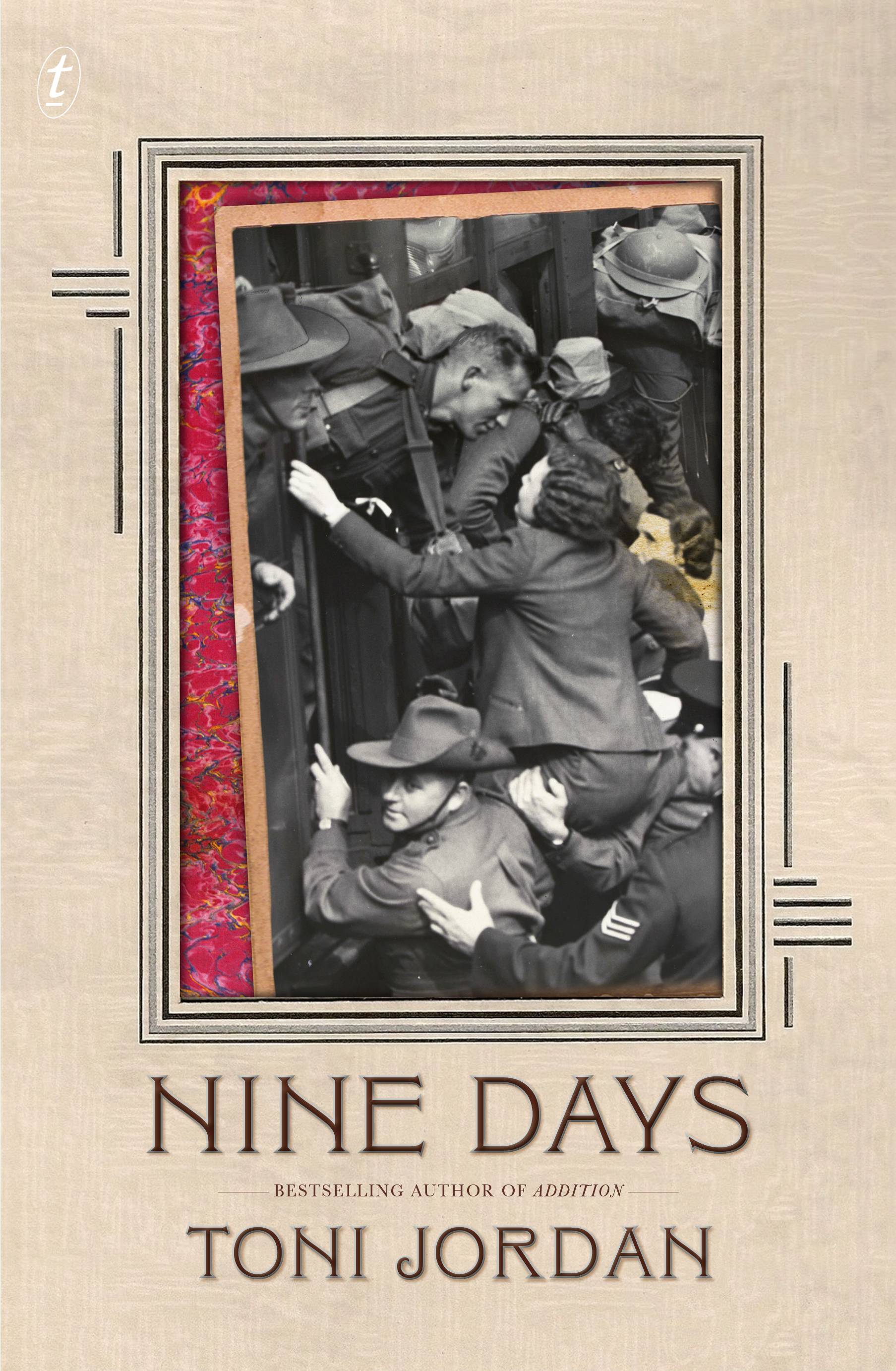
Jordan's Nine Days

Book cover (Courtesy: Text Publishing)

Toni Jordan’s latest novel, Nine days, is somewhat of a departure from her first two novels which are more in the chicklit vein, albeit chicklit with a difference. The thing is, I don’t generally read chicklit, but I did enjoy Addition and Fall girl, so I was more than willing to read Jordan’s next offering. I was not disappointed.

Nine days was, according to the Author’s note, inspired by a photograph from the State Library of Victoria’s Argus collection. The photograph forms the cover of the book’s first edition: it depicts an unidentified soldier leaning out of a train window to kiss an also unidentified young woman. Jordan has woven around this photo a multi-generational story that spans six decades or so from the eve of world war 2 to the present. The title refers to the nine days upon which the book’s nine chapters are built – with an added complexity. This is a multiple point of view novel like, say, Christos TsiolkasThe slap and Elliot Perlman‘s Seven types of ambiguity, but while those two novels progressed their narratives in a linear chronology via the changing voices, Jordan’s chronology jumps around in a seemingly chaotic manner. However, there is method to it, because careful reading reveals thematic or structural connections, even if not chronological ones, between each chapter.

That’s the basic structure, but the real interest of course is in what the novel’s about. How, though, to describe the plot of such a novel succinctly? The best way is to simply say that the novel tells the story of three generations of one family, which is, by the way, an impressive thing to attempt in 250 pages. There is a central mystery – for the reader and for the family though they aren’t necessarily aware of it – to do with the two figures in the photograph. Each chapter is named simply for the character in whose first person voice it is told. The first is Kip, a nearly 15-year-old boy in 1939, who has just had to leave school and go to work because of the recent death of his father. Other chapters are told by his twin brother Francis/Frank (who gets to stay at school), his mother Jean, and his much loved big sister Connie. Interspersed with their stories are those told by Kip’s wife, Jack who lives next door, Kip’s twin daughters, and even his grandson. For each person something happens – some choice must be, or is, made – in the particular day they describe, which impacts their life’s direction.

It’s an ambitious structure, but Jordan succeeds, for a few reasons. A big one is her ability to create strong, believable characters who are likable despite their faults. It helps that the first character, Kip, is particularly engaging. He’s easy-going and generous-hearted, but is also endowed with a good dose of wits and common-sense. He plays an important role in the denouement. His daughters, the overweight, rather uptight Stanzi, and the hippy-alternative-eco-warrior Charlotte, are clearly differentiated and provide a touch of humour with their (mostly) good-natured sibling bickering and point-scoring. Most contemporary female readers will see bits of themselves or people they know in these two. And, while I’m speaking of women, I can’t resist quoting Kip’s young, restless sixteen-year old grandson Alec:

I’ve wasted my whole entire existence up to now. I’ve done absolutely nothing with it. I’ve just been counting down the months of my life. Sixteen years, totally useless. I live with three women. A big night at my place is when the ABC runs a Jane Austen marathon. God I hate that Bennet chick. Marry him already, and spare us the drama.

Another reason the book works is that Jordan manages place and time well. Counterbalancing the seemingly erratic chronology is the fact that place is kept simple. The whole novel occurs pretty much in one suburb in working class Melbourne. This helps keep we readers grounded, as do two little motifs – a “lucky” shilling and a purple pendant – which appear on and off throughout the novel. I was initially concerned, after the first couple of chapters, that the shilling was going to be a little heavy-handed or mechanistic – particularly given the shilling graphic commencing each chapter – but it’s not. Like the pendant, it appears in some, but not other, chapters, and in so doing helps keep us focused without irritating us.

In other words, the book is handled very well technically. But, that’s not what makes a book, in the end, is it? What makes a book good is its heart – and the heart of this book is warm but real. Its particular subjects are war, abortion, religious and class difference, social conscience and social mobility, but it is also a universal tale about how love (marital, romantic, sibling, parental, and so on) forms the glue that keeps us going. This might sound corny, but that’s not how it comes across. The novel has its share of grittiness; and relationships have their tensions, conveying the message that love (whether marital, sibling or parental) is not a simple endpoint but something to be worked at.

This may not be the book for readers who like long family sagas they can lose themselves in, but for those like me who enjoy works which tease and leave ties undone, much like life really, Nine days has plenty to offer.

Toni Jordan
Nine days
Melbourne: Text Publishing, 2012
245pp.
ISBN: 9781921922831

(Review copy supplied by Text Publishing)

Amitav Ghosh, River of smoke (Review for the Shadow Man Asian Literary Prize, 2011)

I’m rather sorry that I haven’t read Amitav Ghosh‘s Sea of poppies because, while River of smoke does work on its own, I think my experience would have been richer had I read the beginning of the trilogy. This shouldn’t affect its Man Asian Literary Prize chances, but you never know.

Giant water lilies, Pamplemousses

Giant water lilies, Pamplemousses Botanical Garden

I loved that the book starts in the gorgeous island of Mauritius which I visited for a couple of weeks in 2004. Pamplemousses Botanical Garden was one of the first sights we visited. It is full of wonderful exotic plants, particularly spices, that we hadn’t seen before. This sounds a bit nostalgic but it is relevant to a book that is, as the artist Robin Chinnery writes, about “flowers and opium, opium and flowers”.

Let me explain. The story centres on three boats – the Ibis, the Anahita and the Redruth. The first two are involved in the opium trade – one English owned, one Indian owned – while the Redruth is involved in plant collecting and trading. The novel is primarily set in Canton in the lead up to the first Opium War of 1839-1842. At the time of the novel, the Chinese are in the process of trying to ban the opium trade and consequently have forbidden foreign ships to enter the port. The result is that the traders are all in Fanqui-town (Canton’s foreign enclave) waiting for the situation to resolve in their favour, while their boats are moored in the Hong Kong-Macau area. The novel reminded me a little of Dickens, not just because of its length but also because of its large cast of characters, its plot encompassing nefarious deeds, conspiracies and adventures, the comic relief, and its socio-political themes. There is also colourful language, satire and irony. Of course, Ghosh is writing historically while Dickens was exploring his own place and time, but that’s a minor difference.

The story is told from two main points of view. One is a traditional third person story of the opium traders, seen mainly (but not only) through the life (and eyes) of the Indian opium trader, Bahram Modi. The other combines the opium story with the plant story, through letters written from a young gay artist in Fanqui-town to his botanist friend, Paulette and her employer Mr Fitcher, on Redruth. He, Robin Chinnery, describes the hunt for the elusive golden camellia, while also providing a (semi)outsider’s perspective on the unfolding events in the opium trade crisis. I enjoyed Robin’s generally cheery voice and his colourful descriptions of life in Fanqui-town but I wonder whether the novel needed this extra layer to provide this added perspective? Paulette, the recipient of his letters, is largely silent and seems to add little to the narrative.

When a novelist writes a work of historical fiction, I wonder s/he has chosen to set a story in a past time – and look to see whether there is some application to the story in the novelist’s own time. In this case there is, for Ghosh’s target is the complexities of international trade, and the hypocrisies and fallacies that are still evident in the notion of “free trade”. He shows that “free trade” is rarely free or equal to all parties. The opium trade (and the British East India Company’s involvement in it) is perfect for this with its additional moral problem involving trading (or is it smuggling – the line is a fine one) a product that is injurious and that was, in fact, banned in England. Towards the end of the novel, the traders discuss their response to the Chinese Commissioner Lin’s demand that they give up their opium cargoes. The American Charles King appeals to their “better” natures:

‘ … Are you not aware that with every shipment you are condemning hundreds, maybe thousands of people to death? Do you see nothing monstrous in your actions?’

‘No, sir,’ answered Mr Burnham coolly. ‘Because it is not my hand that passes sentence upon those who choose the indulgence of opium. It is the work of another, invisible, omnipotent: it is the hand of freedom, of the market, of the spirit of liberty itself, which is none other than the breath of God’.

Guess who wins the argument?

Shadow Man Asian Literary Prize 2011 Badge

Image by Matt Todd of A Novel Approach

The most interesting character in the book is Bahram, the Indian opium trader who is only just accepted by the British traders. He is a complex character whose nature, motivations and flaws we come to know well. His flaws as a husband, father and businessman are many, but so are his strengths as an employer and friend. We  feel for him as he has to make a difficult decision and wish he were a little braver, a little wiser. He is testament to Ghosh’s ability to draw a flawed but sympathetic character.

A major pleasure in the book is the writing. Ghosh is a versatile writer who can slip from the breezy, colloquial vernacular of Robin to the formal tones of the English merchants. His grasp of the period is breathtaking. I gave up “Googling” the unfamiliar words and just let them flow over me, because the context made them clear:

On reaching the enclave the lascars and lime-juicers had gone, as was their custom, straight to the shamshoo-shacks of Hog Lane, so as to get scammered as quickly as possible.

In other words, as soon as they got off the boats, the sailors went to the pubs and got drunk (by drinking too much “stagger juice”).

There were, though, occasional lapses into didacticism. They were rare but they jarred when they occurred. An example is a little aside describing the Spanish silver dollar.  Mostly, though, Ghosh does show rather than tell and the novel is full of colourful detail about food and dining, art, plants, boats and business.

River of smoke is not a perfect novel but is a great read – for its description of a fascinating period in history, for its lively portrayal of characters you would recognise today, and for its exploration of issues (still) relevant now. My overall assessment? Read it.

For reviews by other team members, please see my Shadow Man Asian Literary Prize 2011 page.

Amitav Ghosh
River of smoke
London: John Murray, 2011
522pp.
ISBN: 9780719568992

Leslie Cannold, The book of Rachael

Bookcover Leslie Cannold The book of Rachael

The book of Rachael (Cover image: Courtesy Text Publishing)

For someone who doesn’t seek out historical fiction, I seem to have read a lot of it lately. Leslie Cannold’s The book of Rachael is the third historical novel I’ve read in succession – and it’s the third with an author’s afterword/postscript, which suggests to me some uncertainty in the writers about historical fiction. Tansley quoted Doris Lessing’s statement that fiction is “better at” the truth than the factual record. Brooks addressed concerns that the imagined record might be interpreted as fact. Cannold takes a different tack. Her book, like Brooks’, involves an imagined heroine telling a story about some “real” historical people, in her case Joshua (Jesus) and Judah (Judas). Cannold writes:

I wonder now whether it really makes sense to call this sort of writing historical fiction. Can setting entirely fictional characters to roam in the landscape of a multi-authored, oft-redacted religious tale really be described as historical? Not if the criteria include scholarly examination of verifiable, chronologically ordered events. So, I don’t think of “The book of Rachael” as historical fiction. I think of it as the bringing to life of a fictional character by evoking the time and place in which the character’s story is set. In “The book of Rachael” I have set the fictional sisters to roam across the historicised terrain of the gospels.

Hmm … I’m not going to get into definition discussions here. It is what it is, regardless of what we call it, and in this case it’s a first person story of Rachael, the invented sister of Jesus and wife of Judas. The rest as they say is (more or less) history … at least as far as the Jesus and Judas story goes. But, of course, there’s more to it than this. Cannold creates a whole life for Rachael from her childhood in Nazareth, as the second daughter of Yosef and Miriame, to her life post-Crucifixion. She’s a girl out of her time – something even her rather hard mother recognises (“Oh Rachael … how hard the world is for you”). She chafes under the strictures of being female (learning “in no uncertain terms what it meant to be a girl”). Like Brooks’ Bethia she wants to learn and so she listens in to her brothers’ lessons when she can. Also like Brooks’ Bethia, she channels some of her intelligence and curiosity into studying to be a healer, as an apprentice of the old crone Bindy. Then she meets Judah, angry young rebel to the gentler, more humble Joshua, and the book seems to shift a little on its axis.

Leslie Cannold was named one of Australia’s top twenty public intellectuals in 2005, and this year she was named Australian Humanist of the Year. She’s an academic, activist and ethicist with particular interest in women’s rights. She wrote The book of Rachael because, she said, “what kind of world painstakingly records the names and stories of important people’s brothers but not their sisters”. She wanted, in other words, to place women in the history, much like Anita Diamant wanted to do in The red tent, but fiction is not her usual métier and I think it shows.

Don’t get me wrong: it’s an entertaining read, and her evocation of the times, her well-researched imaginings of how women’s lives went are engaging and engrossing, particularly in the first half of the novel. But, the writing is often forced. I’m never quite comfortable with first person narrators who describe their own behaviour in terms that are usually used by a third person, such as “sobbing as if my heart would break” and “hissing like a cat, I …”. The romance with Judah is also laid on a bit thick. Almost every time they meet – he is often away fighting – sex is explicitly described. I don’t think I’m prudish, but it did start to read more like a boddice-ripping romance than serious historical fiction. Here’s an example:

Judah blocked my mouth with a kiss. The sort of kiss that involved him sucking my lower lip until my breasts heaved and my skin seemed to sparkle like stars. The sort of kiss where I might forgive him almost everything.

This is just one of many episodes. “Enough already”, I wanted to cry. Yes, feminists are women too, but passion can be conveyed so much better through a little restraint. Just look at Jane Austen, whom Cannold must love, given her sneaky tribute: “It is a truth widely known that the desire of the amorously infatuated to hear their lover’s name, to speak it and hear it spoken aloud, make them tiresome company”.

There are, however, some beautiful descriptions, such as this:

Of these years, little is left to me by way of coherent memory. Instead, what I recall is like a mosaic, vividly coloured tiles affixed at different points on a large white wall: discrete scenes of colour and movement floating in a sea of empty whitewashed space.

Cannold handles the complex stories surrounding Jesus (Joshua) with a lovely subtle restraint, neither labouring their miracle aspects nor discounting them. I don’t want to give away the end – beyond what everyone knows of the biblical history. I found the conclusion for Rachael moving and redemptive but it didn’t have the feminist punch I expected from the way the novel started. Does that matter? Perhaps not. I’d love to hear what others say.

The book of Rachael
Melbourne: Text Publishing, 2011
328pp.
ISBN: 9781921758089

Review copy supplied by Text Publishing