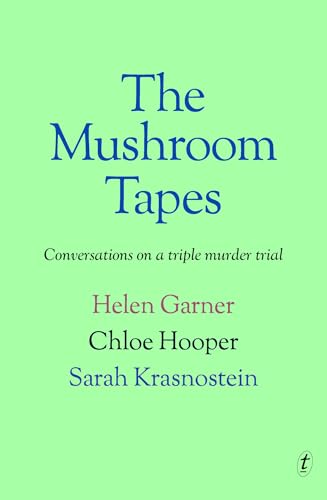
Helen Garner and Sarah Krasnostein in conversation with Beejay Silcox

Last night’s ANU/Meet-the-Author event was a sold-out affair, in a 500-seat theatre. And why not? Helen Garner, Chloe Hooper, and Sarah Krasnostein are among Australia’s top writers of narrative nonfiction, and they have just produced a book about the Leongatha mushroom murders. Indeed, it’s only because they have written about it that I am interested in reading about this case. Of course I knew about it, but I didn’t follow it intensely because these tragic criminal cases that capture the public’s attention so often become unedifying spectacles in which emotion overtakes reason in much of the public discourse. And I don’t want to go there.

As always, Colin Steele did the introductions, including explaining that Chloe Hooper had had to pull out due to her young son being sick. He referenced Jen Webb’s recent article on The mushroom tapes in The Conversation, and quoted her statement that “If I were asked to pick three people to write about this dramatic, yet banal, crime story, I’d choose them”. Yes! He then handed the floor over to Beejay Silcox.

The conversation

I was disappointed not to see Chloe Hooper because I have seen Helen and Sarah in action before, and because Kate (booksaremyfavouriteandbest) loved the event she attended with the three of them. So, Chloe’s absence created a significant hole, but Helen and Sarah filled it wonderfully – and graciously. They were open, thoughtful, and, as Kate found, still discovering new things to talk about.

Beejay started by quoting Janet Malcolm, who, she clearly knows, is a favourite of Garner’s. Malcom has argued that what journalists do is “morally indefensible” because of the way they draw in and then report on their subjects. But, continued Beejay, good journalists will overcome this risk by not rushing in, by, I think she said, applying “a tilt” to the way they look at things. And these writers are “masters of the tilt”.

On working together

The conversation covered the sorts of things you would expect for a book like this, including our complicity as readers/spectators, why this case, the need to resist easy answers, their process, their thoughts on the trial, and where the trust in each other had come in.

Sarah noted that there is no division between Helen’s work and her person, which of course is what so many of us love about her, but which has also brought her criticism. They all respected each other – not surprisingly – so had no doubts about each other’s personal processes. Helen said they were like people who had been in and survived a car crash. They were friends for life now.

Beejay referred to the fact that each had shared what their opening line would have been had they written the book alone (though they wouldn’t have, they said). Their lines (pp. 4-5) capture something about their individual approaches. Helen’s, which plays on lines by Sir Walter Scott, sounds baroque, Shakespearean. It speaks of empathy and the question of where is the line that an ordinary person crosses to commit such a crime. Chloe’s is more sociological (as in, what in society created this), while Sarah’s is more legal. As Sarah said, each had her own tone and vibe, her own interest in what they were observing.

Sarah commented on how the case had “asserted itself into public discourse with velocity”.

There was more talk about how and why they decided to write this book. They admitted to bristling at the assumption from others that it was “their story”. They found the sensationalism repellent. (In a humorous interaction, Helen dobbed Sarah and Chloe in as readers of the Daily Mail, which she eschews, but didn’t mind their passing on its news!)

It was an exhausting process, given the trial lasted 10 weeks. Helen talked of how you cope with something like this, on defending yourself against awfulness and pain of the trial, how the mind turns off. They noticed early that the journalists had formed a gang, presumably their way of coping. Beejay suggested that humour is another way, and that Helen provided some of the book’s comic relief.

On the court – and their approach to understanding it

The court is a workplace, said Sarah, so alongside extraordinary grief and distress are all the administrative aspects, such as when to have lunch, managing a juror needing a toilet break. They shared examples of humour and drama in the witness box. Sarah described their work as an “ethnography of a micro-world”, one in which they tried to capture the humanity of court.

Observing that their book is more about watching, than about the judgement, Beejay asked what was important to see, that we normally wouldn’t. Helen’s answer came quickly. It was distress and suffering. You see the survivors. Helen said they dreaded people thinking they were taking suffering lightly. Sarah agreed, adding that one of the heaviest things is that this is not a story of exceptionalism but more of “there but for the grace of god …”

They talked about emotions versus the banality, the quotidian details, such as, for Helen, Erin’s toe in the hiking sandals she would wear. She commented on being nearly undone by the domestic nature of it all, such as survivor Ian talking about having “a nice bowl of porridge” in the morning with his wife of many years, and now she’s gone.

Beejay described the book as both spectacle and literature, and quoted Helen’s comment in it that “everything could become a metaphor here“. The discussion went roundabout here, but essentially they agreed that in a case like this, metaphor must be handled carefully. In fact, Helen suggested that the urge to get metaphorical doesn’t belong in nonfiction. Sarah shared something from documentary filmmaker Ken Burns. He said that to find a detail that stands for the whole is a gold nugget, but then realised that that detail (from his Vietnam War film) represented the piece of a man’s soul that had come at great cost – so “gold nugget” was not appropriate. So, said Sarah, you must handle metaphor carefully, as you are dealing with human meaning. Helen had never heard Sarah say this. They agreed that nonfiction deals with facts you must honour, that it is chained to reality in a certain way.

On Erin

This led to a conversation about Erin, how the public had turned her into “a character”, and how information that had come up in the pre-hearings (such as probable earlier attempts on her husband’s life) was deemed inadmissible in court because there was no evidence. This decision would enrage a family, Sarah said, but is necessary to protect the presumption of innocence. (There was humour in the conversation here because Daily Mail readers knew this information, but Helen didn’t – and had felt an idiot!)

But, who was Erin? Mostly, women kill to protect, so Sarah had gone into the hearings with this understanding, but as information came out she had to reassess her thinking.

Helen found Erin a strange person, but thought the court artists’ depiction of her as evil, witch-like, was appalling. Later, they described the way the media/the public feasted on her was a form of horror.

Sarah said that when Erin started speaking on the witness stand, she was articulate, funny, recognisable, but gradually, as she was questioned, this picture melted. It was hard to separate Erin’s self from the persona. The unpalatable parts of her personality were on display. The bad-tempered teacher-like tone she used in response to the prosecutor was a misstep. It’s a middle-class story, said Helen.

Re explaining Erin’s crossing that line into murder, Helen was surprised to find that the prosecution doesn’t have to find a motive. She doesn’t have an answer. Like most humans, Erin embodied various people, mother, crabby teacher … Sarah added that Erin is not legally insane but is a deeply disordered person, so how do you apply “order” to her? We want answers, but we can often be mysterious to ourselves. Erin is recognisable as a mother, but like many of us can also harbour a primal rage.

Q & A

On how such an intelligent, well-educated woman could think she could get away with it: Helen has a theory about murderers. They have a great desire to do it, and a fantasy about how they are going to do it, but this all stops at the lethal blow because they haven’t thought about what happens next. So, for example, Erin hadn’t concealed evidence of her ownership of the dehydrator. This was astonishing,

On ethical issues they considered during the process: There were many, including the children, the community, whether they should look at sites (like the home). Are you adding to harm or does not looking do harm too? They questioned whether they were looking out of human curiosity, were they just perving? Sarah said that Helen has a view about “utility”. Courts are public, so we should understand them, we should ask questions about what they are doing. Hannah Arrendt described such crimes or behaviour as “a rent in the social fabric”. The law is being acted in our name, so we have duty to know what the law is doing. Part of the “utility” is to add complexity to our understanding, to show that the law, and these cases, are not simple.

On the role of gender in how the case played out publicly: Gender absolutely played a role. Had the crime been committed by a man it would not have held the public’s attention for so long. This was a middle class mum, set around something domestic, the serving of a meal. Her behaviour was a violent inversion of a major archetype of what women are. The gleeful mocking tone employed by some commentators was an insult to victims. (And reminiscent of how Lindy Chamberlain was “feasted upon”.)

Finally…

Beejay described the book as “a love letter to doubt”, to which Helen responded that she is a fan of ambivalence. Yes! She is not the god of all knowing consciousness; she wants readers to be there, questioning along with her. Doubt comes in different forms. At times, Helen and Sarah would be sentimental and mushy, while Chloe would remonstrate, “Guys, she’s planning to poison them”. They agreed that their essential subject matter was the preservation of doubt

Beejay concluded by asking them what they wished we all knew or felt. Sarah named the mockery, caricature, parody that was applied to the case. Why do people do this? These are people’s lives, and it affected a family and an entire community. Helen agreed, adding that “you want to preserve the tenderness in the story”. The old people who died kept disappearing from the story, but they were plain country people with faces of kindness, people who had helped Erin in need (which she recognised).

So, another excellent conversation with some meaningful takeaways encompassing how we respond to crimes like this, how we value writers who bring them to us in a considered thoughtful way, and how doubt and acknowledging complexity should be our mantras.

ANU/The Canberra Times Meet the Author
MC: Colin Steele
Lowitja O’Donoghue Cultural Centre, Australian National University
19 November 2025
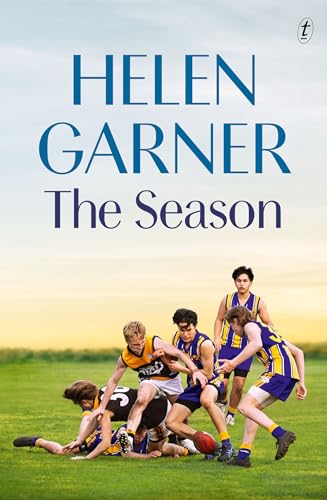
Helen Garner, The season (#BookReview)

In 2023, The New Yorker published a piece on Helen Garner. Written by Australian journalist, Helen Sullivan, its title, “The startling candor of Helen Garner”, captures exactly what I like about Garner, as does this a little further on:

Her writing is elegant but colloquial, characterized by an impulse to say and share things others might keep private.

Garner’s latest book, The season, is a gentler book than most, if not all, of her previous books, but these things – the writing and the honesty – are still in play. BeeJay Silcox, in conversation with Garner about the book, described it as “a graceful book, a love letter from a grandmother to boys and men” and suggested that it’s “not very different” from Garner’s other books as some have said. As is my wont, I take a middle ground. I did find it quieter, less contentious, but it still has her openness, her often self-deprecating honesty, and her clarity about what she is and isn’t doing.

“a nanna’s book about footy”

What Garner isn’t doing in this book, and what surprised many of those she spoke to as she was writing it, is some sort of social or societal analysis of footy. “Blokes”, for example, who’d been “formed by footy”, expected “fact and stats and names and memories”, while others, particularly women, assumed she was writing “something polemical, a critical study of football culture and its place in society” (like, say, Anna Krien’s Night games. Indeed, in my review of that book, I reference Helen Garner’s writing.) These assumptions panicked Garner somewhat. She was not writing these, but “a nanna’s book about footy”, a book

about my grandson and me. About boys at dusk. A little life-hymn. A poem. A record of a season we are spending together before he turns into a man and I die.

Pure Garner: it describes what her book is, but belies the insights and observations that lie within. However, both sides are described and hinted at in the opening pages of the book, when Garner writes about her grandchildren. She understands her granddaughter she says, but

having never raised a son, I now began to learn about boys and men from a fresh angle, to see their delicacy, their fragility, what they’re obliged to do to themselves in order to live in this world, the codes of behaviour they’ve had to develop in order discipline and sublimate their drive to violence.

During Melbourne’s extended pandemic lockdowns, Garner watched more footy, and saw it in a new light. She glimpsed “what is grand and noble, and admirable and graceful about men”.

Given all this, and the fact that Amby (Ambrose) is her youngest and last grandchild, she wanted to better know him, “before it’s too late”. She wanted to “learn what’s in his head, what drives him; to see what he’s like when he’s out in the world, when he’s away from his family, which I am part of”. She decided to follow his Under-16s football team, driving him to training and attending their matches.

“It’s boys’ business. And my job is to witness it.”

The footy season starts, and there is Garner, “a silent witness” on the sidelines, with notebook in hand. She’s the quintessential invisible woman, and happy to be so, albeit she asked Amby’s and the new 21-year-old coach’s permission first. What follows is something that reads rather like a diary. In the aforementioned conversation, Garner said she initially struggled to turn her experience into a book. She started writing it in the past, but that gave it an historical feel, so she changed to present tense, and voilà, she had her story. And she was right. It feels fresh and personal.

The book, essentially a memoir, is well-paced, partly because of the chronological drive implicit in the training-playing season, but also because of the way Garner mixes gorgeous description and small snatches of dialogue, with astute reflections and self-questioning. There are times when she loses heart: it’s cold on the sidelines; is she “trespassing on men’s territory, ignorant of their concerns and full of irrelevant observations and thin-skinned responses”; who does she think she is, “intruding on his [Amby’s] privacy, feeding off his life”. But she “slog[s] on”, because writing is what she does.

What she also does – whether it be a novel about a dying friend (The spare room) or a true crime book about the trial of a man accused of killing his children (This house of grief) – is capture life in all its messiness. If you’ve read any Garner, you will know that she understands messiness and will not shy away from it. Here, it encompasses her own aging and being a grandparent who can only ever be on the periphery; an adolescent boy’s challenge in coping with school, girls, and training; and the emotional ups and downs of football, the rigours of training, the errors that let the team down, the wins and losses.

I am not into football, but I found The season compelling. I enjoyed spending time with Garner again, but I also appreciated her insights into masculinity. Throughout, Garner asks the men and boys around her – Amby in particular, but also coaches, trainers, fathers – pertinent questions, such as why have a mullet (haircut), what is good about tackling, is he proud of his battle scars. The answers are sometimes surprising, occasionally funny, but nearly always enlightening. Amby tells why he likes tackling:

“I guess it’s basically inflicting physical harm but with no actual hard feelings. It’s just aaaaapchwoooooo and then you get up and keep playing, and then at the end you shake hands, and no one remembers anything.”

Football, Garner sees, is “a world in which a certain level of violence can be dealt with by means of ritual behaviour”. I never will understand this violence and men thing, but Garner’s sharing her time with the boys and men – particularly her willingness to ask the right questions, to listen and to reflect – did continue my education (and hers).

However, it’s not all about masculinity. There are all sorts of other observations, some self-deprecatingly humorous, such as this reflection on a match where Amby’s team “verses” a bigger, stronger team:

How quiet our team’s supporters are! We stand there like inner-city intellectuals, analysing our boys, criticising their every move, using modal verbs in knuckle-rapping tenses: should have, ought to have.

This made me laugh, but it also conveys Garner’s ability to mix tone, and to flip modes, between the grittiness of football and quiet, humorous, compassionate observations.

The season is exactly what Garner intended, a warm-hearted “life-hymn” about a season spent getting to know her youngest grandson as he transitioned from boy to man. It’s an attempt to understand what makes men tick, and the role footy can play in forming young boys into men. I find it hard to buy the “warrior” stuff that goes with male sport, as Garner seems to, but I can understand where it comes from, because there can be nobility and grandeur in sport.

If, like me, you are not a football follower, don’t let that put you off. The season is not a sporting memoir full of facts, figures and rules. Instead, it’s a nanna’s story about time spent with a loved grandson, a story with footy at its centre but that is, fundamentally, about the things Garner does best, character, drama, and emotion.

Kimbofo also loved this book. It would make a good companion to Karen Viggers’ novel about youth football (soccer), Sidelines.

Helen Garner
The season
Melbourne: Text Publishing, 2024
188pp.
ISBN: 9781922790750

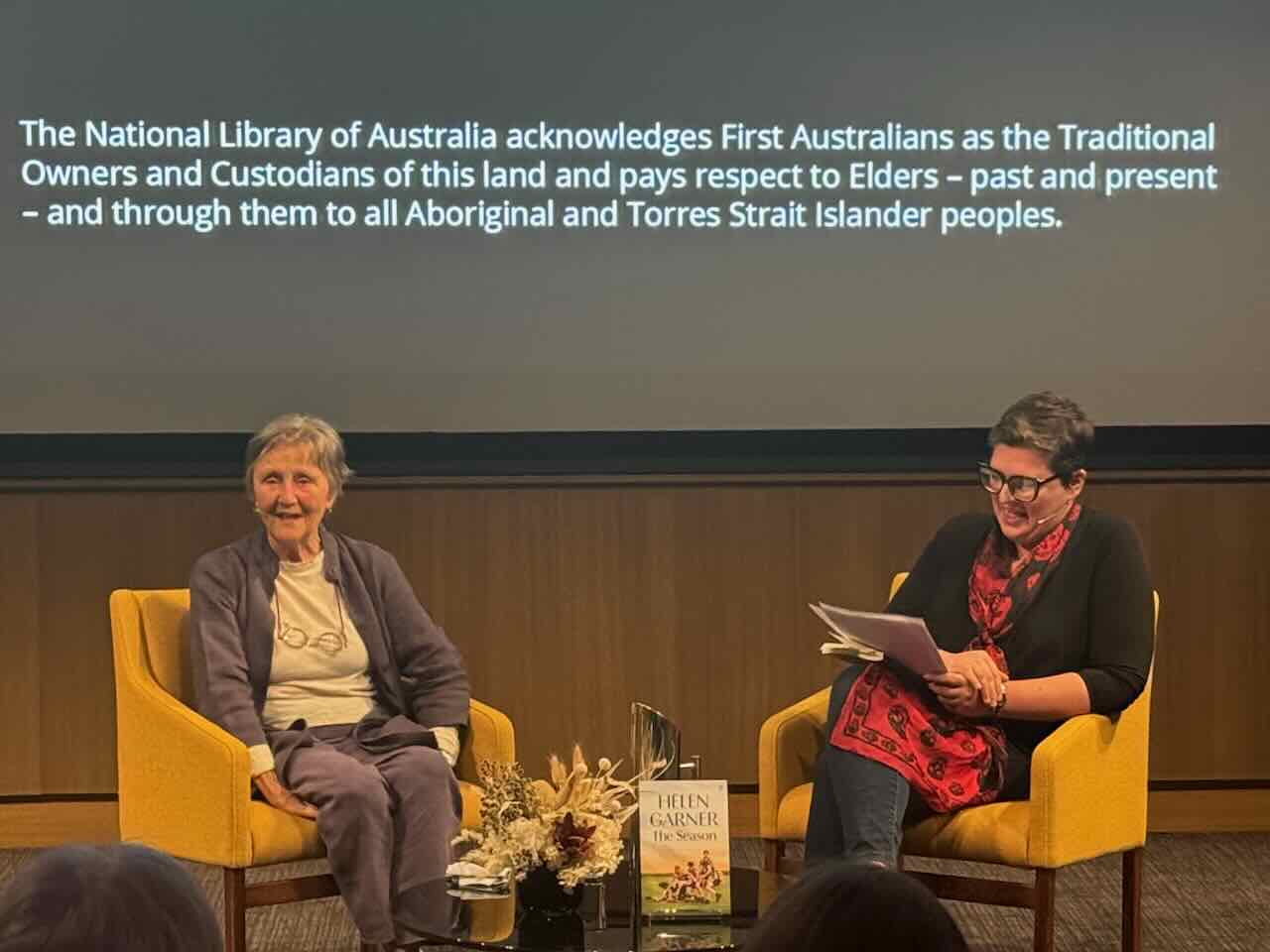
Author Talk: The season with Helen Garner

It is a measure of the love and respect readers have for Helen Garner that this event, held in the National Library of Australia’s 300-seat theatre, had a 200-strong waiting list. And, it was well worth booking early for.

The evening was emceed by Luke Hickey, the National Library’s Assistant Director-General Engagement. He started with a welcome, acknowledgement of country and an introduction of the participants, who were:

  • Helen Garner (my posts): multi-award winning author of novels, stories, screenplays and works of non-fiction.
  • Beejay Silcox: writer, literary critic and about-to-retire Artistic Director of Canberra Writers Festival.

The conversation

This was a joyful but engaged conversation that flowed easily, while gently getting to the nub of some great ideas.

Beejay started by reminding us that “Canberra” means “meeting place” and that for millennia people have met here to “talk about things that matter”. She then tried to define what Helen Garner means to us. She is a writer who destablises and discomforts us, who energises us, who provokes us but not for provocation’s sake. She’s a writer who doubts, is uncertain, and who, because of this, brings us along with her.

On writing The season

Beejay called The season a graceful book, a love letter from a grandmother to boys and men. Some see it as very different from her previous work, but Beejay was not so sure. What did Garner think?

Garner said this was the most fun writing she had done. It was an “extraordinary experience” and came at a time when she felt burnt out. Preparing her three diaries had involved many “squirmy 2ams”. She also saw it as her last chance to get close to a grandchild.

Contrary to her normal practice, which is not to ask permission, Garner had asked her grandson and his coach whether it would be ok for her to attend training sessions with a view to writing about the experience.

Beejay commented on Garner’s reference in the book to being an invisible older woman. Was it a superpower or curse. Oh, superpower, said Garner! She didn’t want to interview the players, just observe.

Garner didn’t know anything about teams, so she’d sit back, an invisible figure in her straw hat and overalls, and watch. The boys were, generally, oblivious of her presence, and had no sense of this being rude. She was fascinated by their behaviour versus that of girls, with which she is more familiar. They would dump their stuff any which way – bags, bikes, phones – and keep on walking to wherever they were going. Girls, by comparison, place their bikes, say, neatly against a tree. Women scan the territory, whereas these boys had tunnel vision, a “tremendous ability to concentrate” or focus.

She observed that during training the coach would exhort the boys to widen their field of vision. It was “thrilling to watch”. Garner conveyed such joy about watching the young men. I remember feeling the same about watching my son’s cricket team. Those boys were so enthusiastic, so sure, after getting out for a duck, that they’d hit that six next time. Their confidence was infectious.

On football, and writing about it

Garner admitted to being a Western Bulldogs fan, and talked about her love of footy. She “can’t stand it when it’s not footy season”, which drew some perhaps surprised but warm-hearted laughter from the audience.

Beejay spoke of Garner’s “narrative love of the game”, of her anchoring her writing about it in terms of writers like Blake, and Homeric epics, of her referencing “elemental” ideas like mercy, triumph, vengeance.

Garner talked about her introduction to the sport – her origin story as Beejay framed it – via the 1997 documentary Year of the dogs. It was a time of great change in the sport, and she was moved by the decisions made by some players to not chase the money.

While she knows the rules and understands the play, she will “never” understand the game, but doesn’t care. She didn’t want to take a position on football. Some expected her, for example, to take a feminist position, and explore the brutal aspects, but she wanted to glorify.

Beejay asked how hard it was to not write what people expected. Garner didn’t know how to write a polemical book about football. In fact, she struggled to turn her experience into a book. She started writing it in the past, but that gave it an historical feel. As soon as she changed to present tense, she knew she had her story.

Beejay asked her to read the opening two paragraphs:

I pull up at the kerb. I love this park they train in. I must have walked the figure-of-eight round its ovals hundreds of times, at dawn, in winter and summer, to throw the ball for Dozer, our red heeler-but he’s buried now, in the backyard, under the crepe myrtle near the chook pen.

The boy jumps out with his footy and trots away, bouncing. it. Boy? Look at him. He’s been playing with our suburban club since he was a tubby little eight-year-old; I have never paid more than token attention to his sporting life. But this year he’s in the Under-16s. The shoulders on him! He must be almost six feet tall. He’s the youngest of my three grand-children. The last, and there will be no more.

Beejay described this as a masterclass in writing. Everything is in these two paragraphs – relationships, rhythm of life, her sense of place, death.

Garner said, simply (modestly, some of us would say):

“What I’m good at is saying what happens”.

On Garner, the writer and grandmother

Garner loves being a grandmother, and got more laughs when she admitted that after three marriages she was no good at being married, but had found a place to be in the world. She sees the role of a grandmother as being “a servant”, that is, as serving the family, helping the family grow, being the backstop.

Beejay returned to her introduction of Garner as self-effacing, as a writer who doubts. In this book, she describes herself as “a bore”. Is this questioning of herself a whim, and what is the gap between the book she imagines and the one she creates.

Garner never has an idea of what her book is to be. She writes sentence by sentence. She talked about being “a small piece of shit”. While one husband told her he didn’t feel that way, she thinks most of us feel small, at least sometimes. They are valuable times; they balance “the insane moments of triumph”.

On values, lessons, manners

Garner loves football because the discipline of sport puts boundaries around the urge to fight. (She referenced the Iliad with its sense of enormous power). Garner and Beejay discussed a photo Garner loves of two footballers at a moment of defeat, with its Homeric sense of valour and duty, of intimacy, loss and pain. Garner sees these footballers as young, and perfect. She loves “noble postures of defeat” rather than Achilles-style roaring, bellowing triumph.

Garner thinks football can teach boys manners. There can be moral teaching, to not think of themselves and to trust each other .

Beejay also noted that The season is a love letter to volatile youth but is also about age. What did Garner mean by feeling envy. Was it of youth? Of boys doing things she couldn’t? Or related to the presentism of youth, and being unweighted by the past? A bit of all of this. Garner envies youth, its fearlessness. The discussion then turned to what happens to boys who are tender when young but are forced to harden when they get older. Garner hates “the clamp” that is put on emotion in boys.

For all the talk about youth envy, Garner also accepts her age. At 82, she is bothered that people try to deny her age, as in “you’re not old”!

Q & A

On boys and masculinity: a couple of questions/comments concerned this. One audience member thanked her for her “lovely writing” about boys compared to all the “toxic masculinity” talk that confronts them today. Garner hates that those two words – “toxic” and “masculinity” – are glued together, and that boys have to face it. Another questioner wondered how parents can help boys become the boys we’d like them to be. Garner shared an experience she had of Tim Winton calming his distraught 4-year-old by simply sitting with the child and repeatedly naming his feelings, “you’re so angry, you’re so sad”, rather than telling him to get over it, etc.

On Garner being a great observer of human emotions and whether she has questions in mind when she is observing. Nope! Garner just barges in! She’s no good at planning. People love it if you are interested in their work. She realises she is “completely un-bore-able”. (I can relate to this.) She quoted a French writer who said “ignorance and curiosity” form the basis of their writing.

On whether writing The season cured her feeling of burnout: Garner has signed a contract to deliver another book in December but “has nothing say”!

Conclusion

I loved this conversation, not only because Beejay asked perceptive, interesting questions and because Garner is – well, Garner – but also because Garner confirmed my own feelings about sport. It is life – it’s narrative, character, drama, emotion. It can play out so many of the big things we feel and experience.

Beejay clearly liked this too because she concluded the conversation on the idea that football is bigger than just the game. Was there one lesson we could take away from it. Garner’s response?

”Don’t turn your back on the play”!

And with that the session closed to enthusiastic and appreciative applause.

Author Talk: The season with Helen Garner
With Beejay Silcox
National Library of Australia, presented in partnership with the Canberra Writers Festival
Thursday 20 February 2025

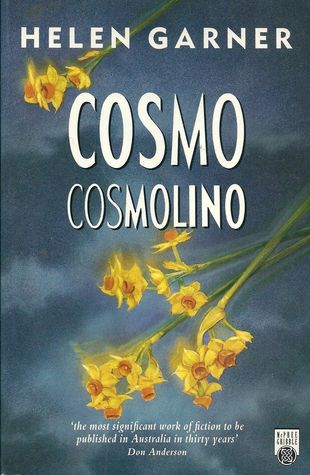
Consider Helen Garner’s Cosmo cosmolino

Helen Garner, Cosmo cosmolino

Commenting on my post on Helen Garner’s One day I’ll remember this, Bill (The Australian Legend) wrote that he’d hoped I’d mention Cosmo cosmolino (1992). It’s one of the novels Garner was writing during the period covered by these diaries, and Bill had struggled with it. I don’t blame him because, while I loved reading the novel, my own review written early in this blog is less than wonderful. Cosmo is a very different novel and I didn’t grapple at all well with its tricky themes.

Bill has, in fact, written twice about Cosmo cosmolino, his second drawing from Tegan Bennett Daylight’s essay in Reading like an Australian writer (edited by Belinda Castles). I have now read that essay too, so I am going to write a second post on Cosmo – too!

There are two main issues that are tricky with this novel, its form and its content. I’ll start with form, which derives from the fact that the book comprises three pieces/stories: “Recording angel”, “A vigil” and “Cosmo cosmolino”.

But, is it a novel?

I am forgiving (or, wishy-washy, if you prefer) when it comes to questions like this. I think form is and should be a loose thing, and that it should have room to move. Even Bill, who sometimes has strong views on things, said that “If an author, as Garner has done here, declares a collection of pieces to be a novel, then that is how I will read it. But these pieces don’t speak to each other at all. If this is a novel, then as far as I am concerned, it is a failed novel”.

So, Bill was happy, more or less, to accept it as a novel. I was certainly happy to do so because the first two pieces – “Recording angel” and “A vigil” – introduce two of the three main characters in the last story. They also introduce some of the ideas that she further develops, though I didn’t fully grasp them in my review. More on that later in this post. The point is that for me the pieces did speak to each other, albeit oddly, because, for example, the first piece is told first person in Janet’s voice, while the third is told third person with Janet as the protagonist.

Bennett Daylight discusses the form in her essay. She starts by suggesting that she would have broken down the last piece into smaller stories, and

seen the book as a whole as telling the central story through a kaleidoscope of scenes, points of view, small (and large) narratives. I’m thinking particularly of Alice Munro’s early short story collections … in which Munro builds a long narrative about her protagonists like you might a model train, adding stories like carriages until the narrative winds into the distance. The result, to my mind, can be more satisfying than the novel whose every scene is roped to a single central idea.

She then quotes Robert Dessaix who, while praising Garner as “one of our most gifted” writers, said that none of her fictional works were novels. They are “fine works of art and innovative explorations of literary approaches to nonfiction, every one of them an outstanding example of stylish reportage”. He then gets to one of the nubs, the pedestal on which novels are put. Garner writes in her diaries that she needs to free herself “from the hierarchy with the novel on top”. She needs “to devise a form that is flexible and open enough”, wants to “blow out realism while at the same time sinking deeply into what is most real”.

She also writes of “pointless struggles to work my stuff into the shape of a novel, and my determination to write only what it’s personally urgent for me to write” (p. 181). The two urges, it seems, fight each other. She says more but this gives you the gist. I love her engagement with form, though in one sense, it shouldn’t really matter – should it?

Meanwhile, Bennett Daylight is convinced that Cosmo cosmolino is a novel because “what makes a novel a novel is metaphor”, meaning that in a novel it’s “as though life looked in the mirror and saw, not just its reflection, but something behind it”.

“My strange experience”

What is this something? It’s certainly deeper than I was prepared to go in my review, because, to be honest, I was uncertain – and here is why. Bennett Daylight quotes an interview Garner had about the book with, in Garner’s words, “that hard-nosed leftie rationalist Craig McGregor”. In this interview, she was stupid enough “to blurt out my strange experience with the shadowy presence”. Afterwards, she panicked and asked him not to include that part, and while he reassured her he’d hardly mentioned it, this “mysterious visitor” is the backbone of his piece. The responses weren’t positive – “Garner’s got religion, etc”. It taught her, she told Bennett Daylight,

that in Australia you can’t write about experiences of ‘the numinous’ without opening yourself to sneering and cynical laughter. Back then, anyway.

This is the challenge I had with the book. What was the spiritual aspect about? I’ll flip to Bernadette Brennan’s book on Helen Garner, A writing life (my review). She says that the three interlinked stories all concern transformation, and are connected through recurring characters and the presence in each of various forms of angels:

The book’s structure mirrors that of a Christian pilgrimage: “Recording angel” confronts the physicality of a suffering body, “A vigil” enters the underworld to witness death head on, and “Cosmo Cosmolino” offers a sense of possible redemption, perhaps even resurrection. The structure can also be read as a meditation on the past, the present and the future.

Garner writes in her diaries that her main experience of religion is the Holy Spirit:

I don’t understand ‘God’ or even ‘Jesus’, but the Holy Spirit [the “shadowy presence”] has stood behind me on many different days, even though for a long time I was too frightened to acknowledge it or ‘call out to it’. It has visited me and comforted me and become part of me. (p. 160/161)

Bennett Daylight concludes her essay by talking about “the metaphor of belief” that underpins this novel:

Religion or belief is the attempt to impose order where there is none – and surely fiction is the same thing. In fact, from where I’m standing it’s exactly the same thing. I don’t believe in a god or gods, but I do believe in the power of fiction, the power of narrative, the power of metaphor to restore order. A great novel unsettles, then settles – it causes disorder, and then order. Order is restored in Cosmo cosmolino; the metaphor that effects this restoration is a metaphor of belief.

Let’s discuss this definition of “a great novel” another time, but it works here.

As for Garner, what does she say in the diaries? There’s quite a lot, but I’ll just choose these:

I want to write things that push down deeper roots into the archetypal. Things whose separate parts have multiple conections with their own structure. (p.140)

I got to the end of Cosmo. Where is this stuff coming from? The weird state I’m in. I have to apply my intellect but at the same time keep my instincts wide open. I need to hover between these levels. (p. 206)

and

I’m scared that with Cosmo I’ll come a cropper. (p. 217)

It would be 16 years before she wrote another novel.

For me, Cosmo cosmolino, now read so long ago, remains memorable. Janet and “Recording angel”, in particular, are still vivid. I’d willingly read it again.

Tegan Bennett Daylight
“A big sunny shack: Cosmo cosmolino by Helen Garner”
in Belinda Castles (ed), Reading like an Australian writer
Sydney: NewSouth, 2021
pp. 26-41
ISBN: 9781742236704

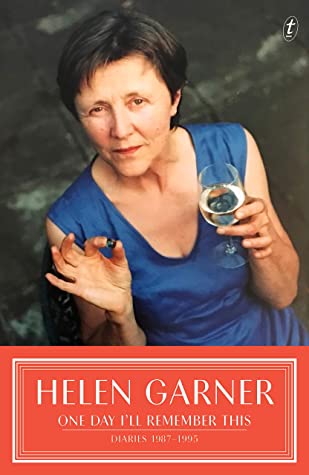
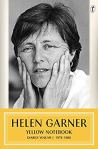
Helen Garner, One day I’ll remember this: Diaries, Volume 2, 1987-1995 (#BookReview)

Helen Garner, One day I'll remember this, book cover

I loved volume 1 of Helen Garner’s diaries, Yellow notebook (my review), last year, and equally enjoyed this second volume, One day I’ll remember this. As with my first volume post, I plan to focus on a couple of threads that particularly interested me.

First though, it’s worth situating these diaries in terms of Garner’s biography. The nine years encompass the writing of her screenplay The last days of chez nous (my review), her novel Cosmo cosmolino (my review), and her non-fiction work, The first stone (read before blogging). This time also covers the beginnings of her relationship with novelist Murray Bail (“V”) and the early years of their marriage. The trajectory of this fraught relationship gave the volume a strong narrative arc, though the volume concludes not on this relationship but her hysterectomy. Read into that what you will.

Like Yellow notebook, volume 2 offers much for Garner fans. It covers similar ground to the first: observations from life around her, snippets of conversations, occasional news items (like the fall of the Berlin Wall), thoughts about other writers, and of course reflections on her own writing. We watch the tortuous development of her relationship with Bail, and the ups and downs of some close friendships. Music and religion feature again. And, there’s a search for home, for a place of her own.

“the little scenes” and “she never invents anything” (1987)

In her preface to The last days of chez nous and Two friends, Garner characterised her writing as “the same old need to shape life’s mess into a seizable story.” Those who know Garner’s writing will know that she was, on the publication of her debut novel Monkey grip (1977), criticised for not writing fiction but just publishing her diaries. This issue of what sort of writer she is, and what sort of writer she wants to be, continues to occupy her in this volume. “My work is very minor”, she worries in 1990. She is not helped by Bail who clearly thinks that her subject matter is not worthy of her writing skills:

I asked V what he ‘really thought’ of my work. He said he thought it was very good but that I should get beyond the subject matter that limited me, ‘those households, what are they called? That you always write about?’ (1992)

So it seems did Z (who, I think, is David Malouf):

V reports Z’s ‘outburst’ against ‘women’s writing’ with its ‘domestic nuances’ which he dislikes and it not interested in. V tries to get me to pick up my upper lip but without success since he doesn’t hide the fact that he agrees with Z. (1989)

It’s not surprising that among the writers whom Garner admires is Canadian Nobel Prize for Literature Winner, Alice Munro, about whom Garner writes, immediately before the above outburst:

Alice Munro is deceptively naturalistic. All that present tense, detail of clothes, household matters, then two or three pages in there’s a gear change and everything gets deeper, more wildly resonant. She doesn’t answer the questions she makes you ask. She wants you to walk away anxious. (1989)

Bail and Malouf, like many, misread Garner if they think her writing is about unimportant stuff. Garner is interested in the sorts of things she admires in writers like Jolley and John McGahern, for example. She says of McGahern that “he goes in very deep, broaching a vast reservoir of sadness, passivity, hopelessness and despair” (1993). She is not at all interested in domesticity for domesticity’s sake but in understanding the darkness in human beings, and “what people do to each other”.

As well as content, Garner talks again about the process of writing, of the frustration when it feels “false and stiff”, “ugly, clumsy”, or exhibits “anxious perfectness”, and of the exhilaration when it all goes right:

Hours passed in big bursts and I ended up with seven pages of stuff I could never have foreseen or invented … This must be how it’s done–take your foot off the brake, unpurse the lips and see where it takes you. (1990)

These volumes offer wonderful insights into the insecurities, challenges, despair and triumphs of being a writer – and for Garner, specifically, of the struggle to find “her” mode:

I need to free myself from the hierarchy with the novel on top. I need to devise a from that is flexible and open enough to contain all my details, all my small things. If only I could blow out realism while at the same time sinking deeply into what is most real. (1989)

By the end of this volume Garner has moved from “those households” into The first stone – and from there, as we know, she took on narrative non-fiction, and produced books on her own terms in her own form. In these, she finally found a way to not only explore the “darkness” and the things “people do to each other”, but to do it with an openness that is not always pretty but that I admire immensely.

“This is what life is. It’s not for saying no” (1987)

So writes Garner about her newly developing relationship with “V”. This relationship provides the diary’s backbone. It drives, mostly, where she lives, who she sees, and how and where she works. As they move from place to place – in his Sydney and her Melbourne – Virginia Woolf’s A room of one’s own comes frequently to mind, because, wherever they are, he gets to work at home while she must find somewhere else. Even when she tries to put her foot down, she ultimately backs off and, yes, finds somewhere else. This, in many ways, epitomises their relationship – he confident in the rightness of his working where he wishes, and she uncertain about whether to compromise (again), he sure that he is “blameless”, and she, self-deprecatingly, wondering if she’s “a monster”. It’s a typical man-woman story in so many ways, and for women readers the gender issues are both illuminating and infuriating.

However, it’s not all bad. There are moments of generosity and tenderness, even of fun. There are conversations about books and reading, convivial times with friends, and trips away. But, it also seems clear from the beginning that they are the proverbial chalk and cheese. Garner is emotional – “hypersensitive, says friend R – and sociable. She loves nature, music and dancing. V, on the other hand, is reserved, austere, elitist, really. He is furious when someone criticises art that he believes (knows!) is good, while Garner is interested in the discussion.

It made for painful reading at times, but fortunately, there was always this sense, this thing she says early in the volume:

Nothing can touch me. The power of work. Art and the huge, quiet power it brings. (1987)

Amen to that, eh?

Challenge logo

Helen Garner
One day I’ll remember this: Diaries, Volume 2, 1997-1995
Melbourne: Text Publishing, 2020
297pp.
ISBN: 9781922330277

(Review copy courtesy Text Publishing)

Monday musings on Australian literature: Writers’ notebooks

If you’ve attended writers festivals, you are sure to have heard writers talk of using notebooks to jot down ideas on the run, to record conversations overheard on public transport, cafes, etc, to capture the thoughts of the writers they read, and so on. These notebooks are not works of art in themselves, but part of a writer’s toolbox for creating their art – except, of course, writers being writers can turn anything into art, if they set their minds to it.

Some time ago, an article appeared in The Guardian on writers’ notebooks. It starts by discussing:

the way notebooks seem to offer access to hidden origins, and to the creative processes by which works we value come into being. Notebooks record early versions and impulses, and though sometimes the writer has an eye to posterity, the privacy of self-communing allows things that can’t be shared with others to be said, within what Coleridge, one of the great notebook-keepers, called in 1808 a “Dear Book! Sole Confidant of a breaking Heart”. For Virginia Woolf, her notebook helped to “discover real things beneath the show”; flashes of perception, phrases, half-formed and potential ideas …

The article was written by American Professor Philip Horne, who commissioned ten authors to write new stories based on “germs” left behind by Henry James in his notebooks. That book has been published, Tales from a master’s notebook: Stories Henry James never wrote. (Anyone read it?) Apparently, Horne is also editing an edition of James’ notebooks.

I’ve digressed a little – into American writers, and third-party-edited notebooks – when I really want to focus on Australian writers. But, sorry, I’m going to digress again, this time to lithub.com staff writer, Dustin Illingworth:

Few literary artifacts remain as consistently enigmatic as the author’s journal. … The very names we employ—the aforementioned “journal,” the stuffy “diary,” the tepid “notebook”—are failures of imagination, if not outright misreadings. Staid synopses and ossified lives these are not. Rather, what we find within their pages are wild, shapeless, violent things; elegant confessions and intricate codes; portraits of anguish; topographies of mind. Prayers, experiments, lists, rivalries, and rages are all at home here, interbred, inextricable from one another. A piece of petty gossip sits astride a transcendent realization. A proclamation of self-loathing becomes a paean to literary art. News of publication shares the page with the most banal errands imaginable.

Perfect, including his reference to nomenclature – journal, diary, notebook. Writing courses specifically recommend keeping a “writers notebook”, but writers themselves – if they do it at all – keep diaries, journals, notebooks, even loose pieces of paper like backs of envelopes. Many of these eventually find their way into libraries and archives.

Here, though, my focus is those that are published – by the writers themselves, not posthumously by academics or other editors. These works are clearly part of a writer’s oeuvre – and I’m calling them “notebooks”. They tend to be highly edited and somewhat different from traditional diaries, which, of course, can also be carefully edited. But, these “notebooks” have minimal diary framework, in terms of day-by-day dear-diary accounting.

Selected Aussie writers’ notebooks

I don’t know how many writers have published the sort of “notebooks” I’m talking about, but I have three on my shelves, to get the discussion going.

The first one, chronologically in terms of publication, is the most unusual, Beverley Farmer’s A body of water (1990). I’ve had it on my TBR since it came out. How embarrassing. Luckily for you, though, Lisa has reviewed it, so do go there if you are interested. Meanwhile, I’ll just make a few comments. I bought it because I loved Farmer’s writing, and looking at it again – as I have many times over the years – I feel the urge to dive in, but, no, on with this post.

Farmer’s book takes place over a year from February 1987 to the next February. The thirteen journal chapters are named for the month, but what makes this notebook a little different is that interspersed between the months are five short stories. The content of the journal chapters, however, is very much as described in the quotes above. There are references to her life (particularly her relationship angst), to books she is reading, to her own writing, to her environment. I am, cheekily, going to quote from Lisa’s review, because – well, you’ll see why later:

Farmer reads Alice Munro, and makes notes about the structure of her stories; she goes to the Spoleto Festival (forerunner of the Melbourne Festival) and brings home the books of A.S. Byatt from which to learn.  She wishes she had the insouciance of Olga Masters, she admires the ‘spirals within spirals’ in V.S. Naipaul’s The Enigma of Arrival (p192) and she reads and re-reads cherished authors, to ‘rebuild and restore’ (p169) finding a ‘fearful symmetry and sureness of touch’ in Jessica Anderson’s Tirra Lirra by the River (p219).

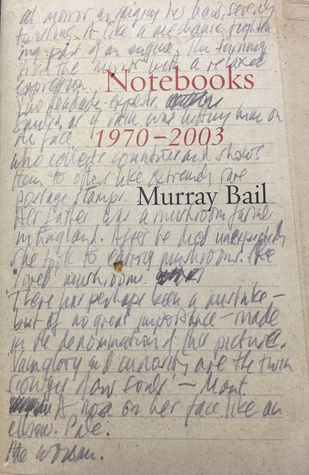
My second book is actually called a notebook – Notebooks 1970-2003 (2005) – and it’s by Murray Bail. I bought it because I like Bail and was intrigued by this notebook form, but I haven’t read it yet, either. It has just two parts: London June 1970-November 1974 and Sydney September 1988-November 2003.

It is more spare than Farmer’s and Garner’s books, but that in itself provides insight into him, as well as its content sharing what he’s observing, reading, thinking about. Here’s something quite random:

Strolling from one picture to another in art galleries, even commercial ones, I am assailed by literary ideas which beg to be resolved.

Book cover

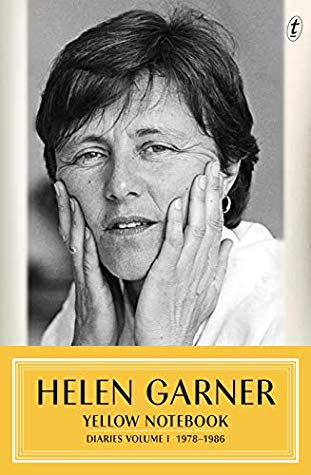
And finally, the book – or books – that inspired this post, Helen Garner’s first two volumes of her diaries, Yellow notebook: Diaries Volume I 1978–1986 (my review) and One day I’ll remember this: Diaries Volume II 1987–1995. Interestingly, the first one is called “notebook” and “diaries” while the second one is just “diaries”. I am including them here because the content, though arranged by year, looks like a collection of snippets, rather than a traditional diary.

In my review of volume 1, I focused on Garner’s writing about other writers, such as Elizabeth Jolley. In volume 2, she mentions other writers again, of course. One of these is – yes – Alice Munro, whom Lisa says Farmer also mentions. Here’s Garner:

Alice Munro is deceptively naturalistic. All that present tense, detail of clothes, household matters, then two or three pages in there’s a gear change and everything gets deeper and more wildly resonant. She doesn’t answer the questions she makes you ask. She wants you to walk away anxious.

Anyone who knows Garner and/or Bail will know that they were married (1992-2000) during the periods covered by their “notebooks”, and Bail certainly appears in Garner’s. But, more on that when I review it.

Why read these notebooks?

For me it’s because although, fundamentally, the text is the thing, I do think that understanding something about the writer can enhance what we get out of our reading.

Garner’s notebooks are a perfect example, because she writes much about what she thinks it worth writing about and what sort of writing she strives for. She wants, for example, to understand “what people do to each other”, and she writes of striving to let “the language tell the story”, and of “trying to trim adjectives without losing the sensuous detail they afford”. Of V/Bail, she admires “the bright freshness of his writing, its muscle, its dazzling turns. Carved free of cliché. Scrubbed till it hurts.”

There are many reasons for reading these notebooks, but another big one is discovering what our favourite writers read and what they think about what they are reading, as Lisa shares from Farmer. Here is Bail, being his spare self:

Emerson’s ‘Self reliance’: line by line, blow by blow.

I remained seated and immediately read through it again.

There is also just the joy of reading their writing. These notebooks are full of insights and descriptions that make you stop, but if I start sharing them, I’ll never stop. Instead, I’ll end with Farmer from near the beginning of her book. She’s writing about her “new phase of writing”:

This new writing: I want it to be an interweaving of visual images–more open, loose and rich, and free of angst. And if I keep a notebook this time …

Have you read any writer’s notebooks?

Living under COVID-19 (4)

It’s some months since I wrote a “living under COVID-19” post, as things have been pretty much pottering along here in the Australian Capital Territory, but I’ve decided it’s time to do an update (for posterity if for no other reason.)

COVID-normal

There’s been much talk about living under COVID-normal, though what that means is, I suspect, a movable feast depending on where your jurisdiction is at.

Lamsheds Restaurant, Yarralumla
Spaced tables, Lamsheds, Yarralumla

Here in the ACT, where we’ve had fewer than 10 cases since May (and only one since mid-July), COVID-normal means, primarily:

  • sanitising, everywhere
  • cleaning, particularly in cafes and restaurants after each client
  • checking-in, via QR-code apps, QR-code websites using phone cameras, or good old pencil and paper. Privacy? What privacy!
  • social distancing: public venues – shops, restaurants, etc – are currently restricted to one person per four square metres of “usable indoor space” and one person per two square metres of outdoor space rule, but larger gatherings in larger spaces are allowed (thought still with some upper limits).
  • no masks, except by personal choice or for certain health workers

We have no limits on household visits, so my reading group has been meeting in person (woo hoo) for some months. Cinemas have been open since July with strict social distancing, which the cinemas have been handling very well through allocated seating with enforced separation, and spaced scheduling creating quiet foyers.

I can visit my father in Aged Care, as long as I meet certain requirements. Visits have some limitations, but the constraints, though a little irritating, are minor. We certainly can’t complain, and our older people feel safe.

Online eventing – book launches, musical events

As I’ve written in previous posts – and something you all know – the main plus out of this pandemic has been the ability to attend remote events that we wouldn’t otherwise have been able to attend. I haven’t got to as many as I’d like because the timing frequently conflicts with other commitments. (How does that happen?) Anyhow, events I’ve “attended” since my last COVID-19 post are (in case you are interested):

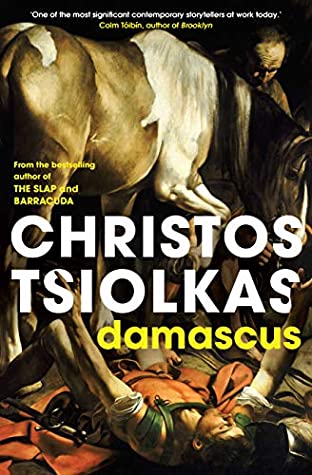
Book cover

More consolation than plus – though we’ll take it – are the streamed live performances. We’ve not attended many of these, once again due to timing and commitments, but we have enjoyed some Discover Musica Viva Concerts with accordionist James Crabb and cellist Julian Smiles, and then classical guitarist Karin Schaupp. These were short concerts, but delightful with the performers introducing their pieces. I always enjoy hearing musicians talk about the pieces they play. I was devastated to have missed my beloved Griffyn Ensemble’s event (though we paid for it).

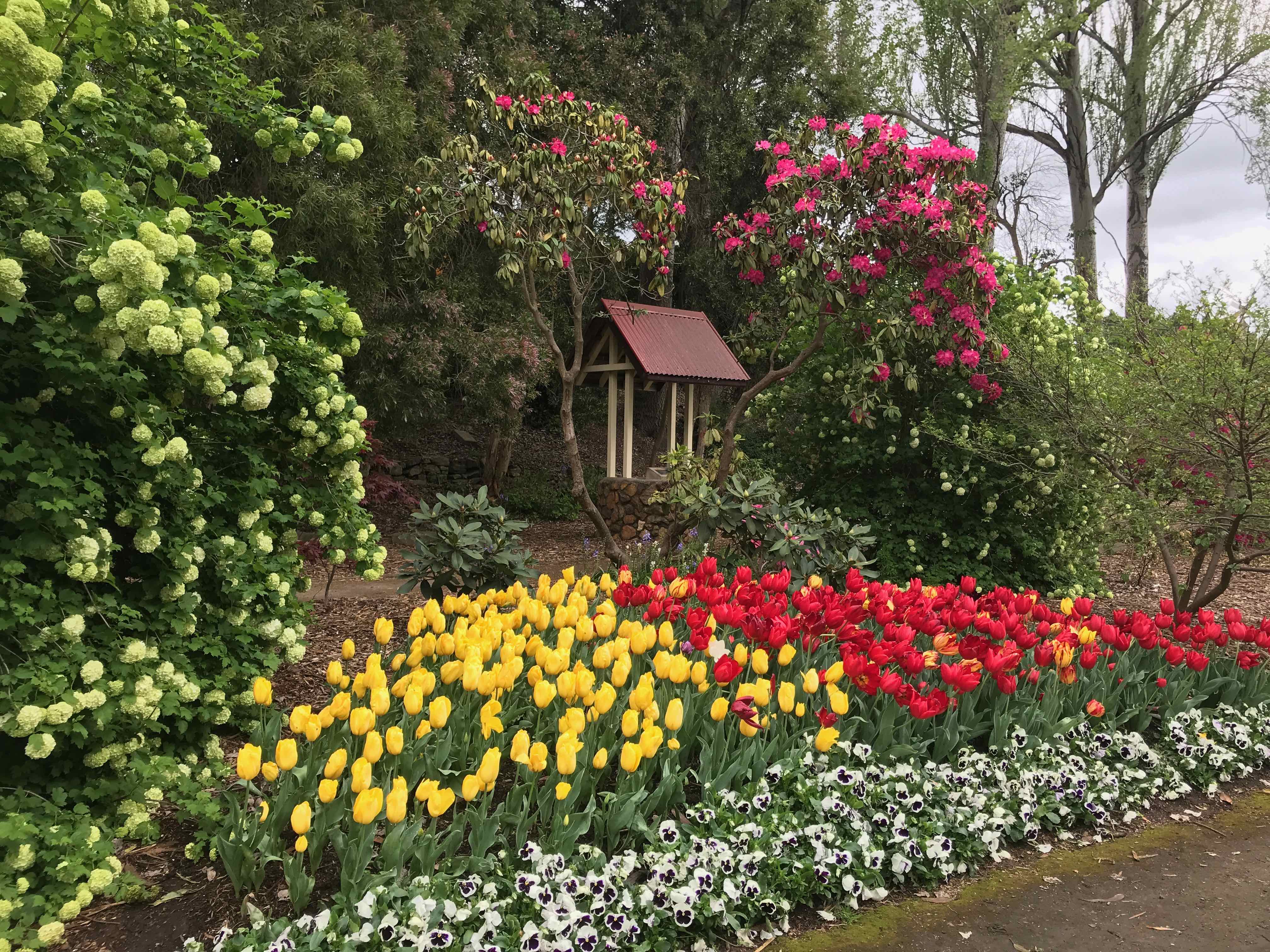
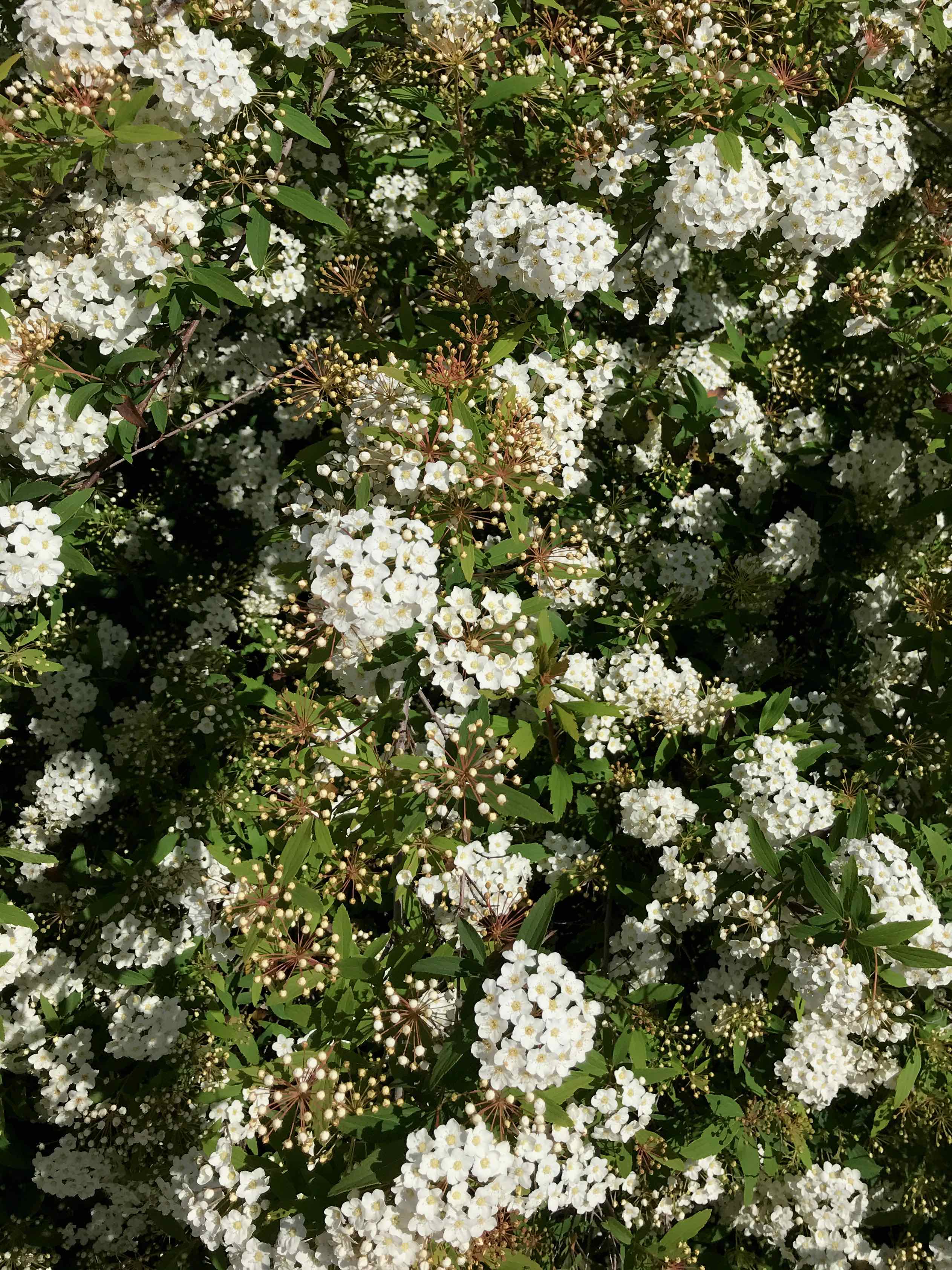
Spring has sprung – big

As if the universe knew we needed it – as if! – we have had a beautiful spring down under with enough blossoms (and flowering weeds) to cheer the saddest heart (I hope).

Need I say more? (From our garden, except the tulips, which are from Moss Vale)

Helen Garner’s lockdown diaries

Book cover

You all know how much I love Helen Garner, and how much I enjoyed the publications of volume 1 of her diaries in 2018 (my review), so I was excited to see her “lockdown diaries” in The Monthly, October xx, 2020. One of the things I enjoyed about reading this piece, besides the writing, was that I could track the trajectory from COVID-19’s earlier days in Australia to around August/September. Garner, for those who don’t know, lives in Melbourne, so her diaries include the only significant second wave lockdown we’ve had here in Australia.

We’re supposed to observe physical distancing. Everyone is to have an area of 4 square metres. “These are not suggestions,” says the chief medical officer. “These are civic duties.” The phrase “civic duty” thrills me.

I love the idea that ‘the phrase “civic duty”‘ thrills her!

Stage 3 lockdown. People over 70 are ordered to stay home for three months. A stab of stir-craziness, then, again, the stoical feeling.

This immediately brought to mind Julia Baird’s Phosphorescence (my review), and her discussion of stoicism, using the extreme example of Jim Stockdale (a POW in “Hanoi Hilton” for over 7 years).

Cadavers encased in white plastic are trolleyed out of New York hospitals and trucked in refrigerated vans to mass graves. Are they old people? Rash people who kept going to clubs? People with delivery jobs or “co-morbidities”? Who are the unlucky ones? Why are they dead, and we’re not? Is there a reason? Will we ever understand what’s happening to us?

Good questions, Ms Garner!

The old professor calls. He talks for a good 20 minutes, he can’t stop, he is flustered, agitated, distressed, veering among the wrecked shards of his mind. His sentences have no content but they are so perfectly jointed and polished that they make me dizzy with admiration. When at last he begins to peter out (…) I produce from behind my back the syringe of praise and give him a huge shot: “Your English is admirable and beautiful. Your syntax is faultless.” He becomes relaxed and sunny, like someone who’s had a hit of Valium: “I am a man. I am vain. You have entered my soul.”

This pure Garner – the interaction (with her old German neighbour, recently moved to aged care), the tone, the language. I love her description of producing from behind her back “the syringe of praise” to “give him a huge shot”.

Numbers of new cases rise and rise. Hotspots here and there. The big flats shut down. Quarantine hotels. A new lockdown, from midnight. People are refusing to be tested. How can people refuse? The world I’ve spent my life in is coming to an end. I keep myself half turned away, my eyes narrowed. On some deep level I’m terrified.

Do you feel as Helen does? And, overall, how are you faring?

Helen Garner, Yellow notebook: Diaries, Volume 1, 1978-1987 (#BookReview)

Book coverThe opening session of last November’s inaugural Broadside Festival featured Helen Garner in conversation with Sarah Krasnostein about her recently published Yellow notebook, the first volume of her edited diaries. It was an excellent, intelligent conversation. Garner came across as the forthright writer she is, one who fearlessly exposes difficult and unpleasant things, alongside joys and triumphs.

The epigraph she chose for her diaries is therefore not surprising:

We are here for this–to make mistakes and to correct ourselves, to stand the blows and hand them out. (Primo Levi, The periodic table)

Certainly, in Yellow notebook, Garner both stands some blows and hands a few out. She admits to many mistakes. She allows herself to be vulnerable. She may have cut a lot, as she told Krasnostein, but she clearly didn’t sanitise. Her aim was to select what others might find interesting. She didn’t rewrite, only changing (or adding) something if it would otherwise have been meaningless. A diary, she said, “has no voiceover, unlike a memoir”. That is, a diary contains what you did/felt at the time without the benefit of later reflection; she had to accept herself – both hurting others and being hurt – as she was at the time of writing. This gave her “fellow-feeling” with others.

She also decided not to identify people. She uses initials, such as M for her daughter, F for her husband at the time. Some of these people are, of course, easily identifiable for anyone who knows her biography, but I think there is still value in taking this approach. In this spirit, I decided not to investigate beyond what I already knew about her life.

The yellow notebook has a lot to offer Garner lovers. For what is quite a short book, its content is wide-ranging. It includes observations from life around her (as you’d expect from a writer), snippets of conversations (both overheard and her own), the occasional news item, stories from her life, thoughts about other writers, and of course reflections on her own writing. We are introduced to her love of music, and her interest in religion. We hear about her marriage break-up and her all-encompassing love of her daughter. All this reveals a messy person – someone who can be wise at times, and immature at others, who can be confident but also excruciatingly insecure, who can be unkind but also warm and generous, a person, in other words, like most of us, except most of us don’t lay the worst of ourselves quite so bare.

I could give examples of all of the above – and I should, because there’s glorious sentence after glorious sentence – but I want to focus on her writing life. For the rest, do read the book yourself.

“thinking voluptuously of the stories I’m going to write”

Part of understanding a writer is knowing who they read and admire. The writer Garner mentions most in this volume is Elizabeth Jolley. While Jolley and Garner are, in some ways, quite different writers, they have a lot in common. Both don’t shy away from some of the darker aspects of human behaviour. Sometimes Garner simply quotes Jolley – as we do when a writer reminds us of something we’re experiencing. Sometimes she shares little anecdotes about Jolley, but other times she comments on Jolley’s writing, even when referring to another writer!

‘Cod seemed a suitable dish for a rejected one and I ate it humbly without any kind of sauce or relish.’ –Barbara Pymm, Excellent women. This is Elizabeth Jolley’s tone and it made me laugh out loud.

Elizabeth Jolley makes me laugh out loud too. Garner also loves Jane Austen. She writes:

Mansfield Park. She never tells you anything about the appearance of her characters. As if they were moral forces. I love it.

You can see why I love Garner. She, Jolley and Austen all get to the heart of humans, incisively – and with wit. Garner writes about being rejected:

My short story was rejected by the Bulletin because it contained four-letter words. A letter from Geoffrey Dutton: ‘It pains me to have to knock this back … it’s you at your best.’ Thanks a lot. I suppose he’s a skilled writer of rejection letters.

Other writers Garner mentions include, randomly, Frank Moorhouse, Janet Malcolm, Joan Didion, Tim Winton, Virginia Woolf, Patrick White, DH Lawrence (who “uses the same word over and over till he makes it mean what he needs it to”), EM Forster, Katherine Mansfield, Henry James, James Joyce, Doris Lessing, Christina Stead (whom, she discovers, is “a visonary”), Randolph Stow, Rosa Capiello, and Les Murray:

The infuriating accuracy and simplicity of his images – birds that ‘trickle down through’ foliage. Of course, I think, this is what they do – why didn’t I know how to say it?

Four of Garner’s own books are published during the ten years covered by these diaries, the novels Moving out (1983) and The children’s Bach (1984) (my review), and short story collections, Honour; and Other people’s children (1980) and Postcards from Surfers (1985) (my review).

She shares many of her struggles and challenges in writing The children’s Bach, in particular:

… each morning I set out for my office weak with fear. I will never be a great writer. The best I can do is write books that are small but oblique enough to stick in people’s gullets.

AND

This flaming book is jammed again. I feel my ignorance and fear like a vast black hole.

AND

I’m scared to go into my office in case I can’t make things up.

AND

Went to work and fiddled around for half an hour, then began to properly feel it come … Delirious I ran downstairs and bought myself a pastie …

She shares her thoughts about writing, such as

About writing: meaning is in the smallest event. It doesn’t have to be put there: only revealed.

This is so Austen, too.

More broadly, she also speaks of critics, awards, and readers. It’s engaging and heart-rending all at once – and probably applicable to many writers.

Finally, she reflects on the value of art and on the creation process. Describing the experience of a painter finishing a portrait, Garner writes:

The miracle of making something that wasn’t there before. Pulling something out of thin air.

It’s that capacity that impresses someone like me. I’m sorry for the pain writers (and other creators) endure, but I’m so glad they are prepared to do it. I look forward to Volume 2, and beyond.

Challenge logoHelen Garner
Yellow notebook: Diaries, Volume 1, 1978-1987
Melbourne: Text Publishing, 2019
253pp.
ISBN: 9781922268143

(Review copy courtesy Text Publishing)

Helen Garner in conversation with Sarah Krasnostein

Garner and Krasnostein on stage

Krasnostein (L) and Garner (R), & Auslan interpreter

To say I was thrilled when Son Gums’ partner offered to buy tickets for us to see Helen Garner in conversation (last Saturday) would be an understatement. I have never seen Garner live before so that would be one bucket-list item ticked had I a bucket list! The fact that the conversation was to be conducted by Sarah Krasnostein (author of The trauma cleaner) was the icing on the proverbial cake.

This conversation was, in fact, the opening event of the Wheeler Centre’s inaugural Broadside Festival, promoted as “two days of an unapologetically feminist agenda”.

The Festival was opened by the Governor of Victoria, Linda Dessau, who referenced Barack Obama’s recent statement that “tweeting and hashtagging isn’t activism”. Festival Director Tam Zimet then started proceedings, explaining that the Festival’s purpose was “to bring conversations that are too hard or too much to Melbourne Town Hall”. She quoted Zadie Smith who was also in Melbourne for at the Festival, and who described writing as “taking the temperature of the moment”. This, of course, beautifully describes Helen Garner’s writing.

The Conversation

The conversation centred around the recent release of Garner’s Yellow notebook: Diaries, Volume 1, 1978-1987, so the conversation began by discussing both diary writing and the process of preparing them for publication. Krasnostein, who asked rather long but always thoughtful questions, talked about the role and function of diaries, suggesting they exist for their own sake but are also works in themselves. Garner’s diaries, she said, contain harvested and preserved details from the world, but also show Garner’s “fearless self-scrutiny”, plus “the things one can think but not say”. Garner said that she has always loved notebooks and pens, and how as a child she loved the peace and solitude she got from writing her diaries.

Several times through the conversation, Garner described her diary-writing as being partly about practising writing. She writes everyday, agreeing that you can’t wait “for ideal conditions”. For her, it’s all about “mother discipline”, by which she meant using the time given to you. She also commented on how much work you do when you are asleep, and referred to lessons from Marion Milner’s book, An experiment in leisure which taught her to sit quietly, with a sense of “nothingness”, to let ideas sort themselves out. This is not the same as waiting for inspiration, though. Garner, being her plainspoken self, said that “inspiration is bullshit”. Instead, “you do things little by little”. Writing, said Krasnostein a little later, is not the hard part. It’s getting to the desk.

Later in the conversation, we returned to diary-writing as stacking up the practice hours. Garner said she knows “how to put a sentence together”. (If you love Garner, like I do, you love her sentences.) But, said Garner, writers also need to know grammar. Without it, you can’t criticise your own work. The lack of grammar teaching is a “terrible loss”. Writers also need to read a lot to see how other writers do it. She bemoaned the fact that some books look like no editor has been near them. You see their “life-force leaking out of every joint”.

Krasnostein quoted Joan Didion’s statement that “style is character”, which somehow led to Virginia Woolf’s statement that you tell the truth about yourself first before you can do so about others. Krasnostein wondered whether being clear-eyed about yourself – one of Garner’s strengths, for me – was training for how to write in public. Garner took this to suggest that being honest about yourself gave you permission to write about others, but she didn’t think that would “stand up in court”! Garner suggested that memoirs can sometimes play fast and loose with other people!

Around here, Krasnostein asked whether revisiting earlier diaries – for any of us I think – shows that we are unreliable narrators of ourselves! Garner essentially agreed, saying that “memory is a creative act”. Reading one’s own diary “can be bracing” because it shows how over time you change stories, often showing yourself in a better light. There’s no way out of this, Garner believes, you just do the best you can. “Everything is fleeting, fleeting, fleeting”, she said. Writers write down stuff because they are terrified of forgetting. (I know the feeling!) “Writers are afraid of losing things”. This returned us to an idea that recurred through the conversation, that of writers preserving. Krasnostein quoted Philip Larkin’s statement that “the urge to preserve is the basis of all art”.

Of course, the process of making private diaries public was also discussed. Garner said she cut a lot. Her challenge was to decide what others might find interesting. She established certain criteria, such as she would not rewrite, and would only change (or add) something if it would otherwise be meaningless. A diary, she said, “has no voice over, unlike a memoir”, meaning that you can’t say “I did that then, but no way would I do that now, because now I’m a nicer person”. Accepting herself as she was at the time of her writing brought her to understand that she wasn’t unique, which made her feel more “comradely” with others. “We all hurt and are hurt,” she said. Krasnostein offered the idea that “the more vulnerable you are, the more you connect” to which Garner replied that this is what she hopes!

Another point Garner made was that tone is important, that “tone is character”, to which she then gave a feminist twist by saying that women have felt they’ve had to tone themselves down. She writes short books, she said, because she feels she has only a limited amount of reader’s attention.

I loved Krasnostein’s summation of the diaries as offering a new expansive view of Garner, but retaining her familiar voice, her “forensic eye for detail”, and her “lean lyricism”. I can’t wait to read my copy.

Q&A

There were several questions, but I’ll just share a couple:

  • on her daily writing practice: She rents an office, which stops her getting caught up housework! (In other words, she has “a room of her own”!) I particularly liked her point that she makes her notes about the details, say, of the court cases she attends, but, separately, she also documents her engagement with what she’s seen/heard, what she thought and felt. This material is “brightly alive … a treasure trove of information”. It doesn’t fit into the other boxes but it’s the richest when she comes to write. This is what I think is often missing from my reports of literary events. I need to do more of it.
  • on whether her views on Feminism had changed since the me-too movement: Not really seemed to be the answer. Garner, like many of us I believe, simply knows that when she discovered Feminism it changed her life: “It was like I’d been underwater and I finally put my head up and took a breath.” The me-too movement, like most movements, has been mixed, but “these things keep developing”.

Kate (booksaremyfavoaiteandbest) also wrote this up – including Garner’s comment about age freeing her to talk to random people on trams.

Helen Garner in conversation with Sarah Krasnostein
Broadside Festival 2019
Melbourne Town Hall
9 November 2019

Monday musings on Australian literature: My reading group does Garner

You are never too old to try something new – and so it was that my 30-year-old reading group tried something new for our April meeting. The idea was that we would all read Garner, but our individual choice of Garner. We’ve discussed five Garners over the years, and many had read other Garners besides those, so we thought it might be fun for us to all read what we like – from her large oeuvre of novels, short stories, screenplays, essays and other short non-fiction, and longform non-fiction – and then see what conclusions we might draw.

It worked well – I think. At least, the discussion was lively and engaged.

So, what did we read?

(Listed in publication order, with links to my reviews where I’ve reviewed them here.)

  • Monkey grip (1977) (x2)
  • The children’s Bach (1984) (x2) (my review)
  • The last days of chez nous and Two friends (1992) (my review)
  • The feel of steel (2001)
  • Everywhere I look (2016) (x2) (my review)
  • True stories (2017)
  • A writing life: Helen Garner and her work, by Bernadette Brennan (2017) (my review)

A good spread in some senses but not in others. It includes two of her five novels, her two screenplays, three collections of her short non-fiction (essays and the like), and the not-a-biography-literary-portrait. It does not include any of her short fiction (like Postcards from Surfers) (my review) or her longform non-fiction (like This house of grief) (my review). It was pretty clear, I’d say, that most didn’t want to confront the unpleasantness of books like Joe Cinque’s consolation and This house of grief, though we did discuss Joe when it came out.

Helen Garner, The children BachThe reasons we chose our books were diverse. Some of us, including me who did the screenplays, chose books we already owned. Some chose books they’d read and wanted to reassess (like Monkey Grip), while another chose Monkey Grip because she hadn’t read it and felt it was now “part of our culture.” One music-lover chose The children’s Bach because it was short and referenced music, while another chose The feel of steel because there were only two options at her secondhand books source and she didn’t want to read the other (Joe Cinque’s consolation.) One chose the 2017 compilation True stories because it represents 50 years of Garner’s short non-fiction writing. And one chose the literary portrait because she’d read a lot of Garner, and wanted to find out more about her.

What common threads did we find?

It wasn’t hard to find common threads in Garner – which is not to suggest that we think reading her is boring!

The overriding thread was that she draws heavily from her life, even for works that aren’t autobiographical. We agreed that she’s present, one way or another, in most of her writing, including her longform non-fiction works, such as Joe Cinque’s consolation.

Another thread was that she is “searingly honest”, “will have a go at everything”, “is not afraid of looking an idiot”.  This honesty, we felt, applies both to the topics she chooses and to her way of exploring them. If you’ve been reading my blog for a while, you’ll know that I’ve regularly made this “honest” comment about Garner.

The third main thread that most of us commented on was her writing. We agreed that she’s a wonderful stylist, but beautifully spare too. Spare, though, doesn’t mean plain. One put it perfectly when she praised Garner’s “word pictures”.

Over the course of the evening, excerpts were read – to show her writing skill and/or her ability to capture life (not to mention her sense of humour).

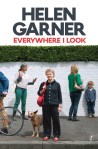
Helen Garner, Everywhere I lookHere are some that were shared:

The waiter had a face like an unchipped statue. (The children’s Bach)

He waltzed the car from lane to lane with big flourishes of the steering wheel. (The children’s Bach)

Everyone looks at her, surprised. She has quietly dropped her bundle. (The last days of chez nous)

I knew I couldn’t be the only person in the world who’s capable of forgetting the contents of a novel only minutes after having closed it. (from The feel of steel)

And long live the Lydias of this world, the slack molls who provide the grit in the engine of the marriage plot; for without them it would run so smoothly that the rest of us would fall into despair. (referencing Pride and prejudice, in “How to marry your daughters”, from Everywhere I look)

Our conclusion

Our discussion ranged rather widely, but we did try to draw it all together at the end, particularly regarding her relevance and longevity.
Questions we considered included: Is she too Melbourne-focused? Does she only appeal to people around our age? Will she still be relevant for future readers? One member reported that her daughter, who’s a keen reader, couldn’t get into Everywhere I look. The Melbournites loved her ability to describe Melbourne, but wondered if that limited her appeal.
We concluded that Garner has carved out a niche that’s unlike anyone else, and that despite her focused setting, her subject matter is universal. And, overlaying this is her writing. It’s worth reading for itself.
So, it wasn’t a contentious meeting, as sometimes discussions of Garner can be … instead it was full of delight and discovery. We’ll probably all read more Garner as we follow in her tracks, a decade or so behind her.