It’s a while since I read a story from the Library of America‘s (LOA) Story of the Week program, but when I saw Harriet Ann Jacobs’ story “The lover” appear in its list of Top 10 stories from 2013 I felt it was time to rectify my tardiness – particularly with the movie, 12 Years a Slave, about to be released here. This story is, in fact, a chapter from her memoir Incidents in the life of a slave girl.
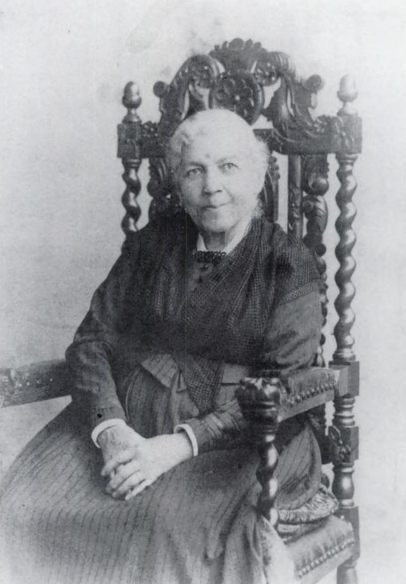
Harriet Ann Jacobs, 1894 (Presumed Public Domain, via Wikipedia)
Last year was the bicentenary of Jacobs’ birth. Her mother died when she was 6 years old, making her an orphan-slave. Her first masters, LOA says, taught her to read and write, but that mistress died when Jacobs was 12, and she was left in the will to a 3-year-old! That brought her into “a household that introduced her to the true barbarities of slavery”. Jacobs eventually escaped to the north in 1842, when she was nearly 30 years old. Her memoir was published in 1861 by best-selling author of the time Lydia Marie Child, under the pseudonym, Linda Brent. According to LOA, the book and its author enjoyed some minor celebrity in the north at the time, but disappeared pretty quickly, probably due to its being “overwhelmed by the war and later by emancipation”.
LOA goes on to say that it was then “largely forgotten”. Most academics, they say, believed it had been written by Child, suggesting that it may have been “loosely based on Jacobs’s life but ‘too melodramatic’ … to be an actual slave narrative”. However, in 1971, historian Jean Fagan Yellin uncovered the truth of its authorship. She eventually published a biography of Jacobs in 2005, Harriet Jacobs: A life.
The chapter published by LOA as “The lover” gives us a sense of Jacobs’ feisty, resilient nature. It starts with:
Why does the slave ever love? Why allow the tendrils of the heart to twine around an object which may at any moment be wrenched away by the hand of violence? When separations come by the hand of death, the pious soul can bow in resignation, and say, “Not my will, but thine be done, O Lord?” But when the ruthless hand of man strikes the blow, regardless of the misery he causes, it is hard to be submissive. I did not reason thus when I was a young girl. Youth will be youth. I loved, and I indulged the hope that the dark clouds around me would turn out a bright thing. I forgot that in the land of my birth the shadows are too dense for light to penetrate.
I love the way this paragraph confirms that the young-in-love are the same at any time, in any place. Hopeful. Optimistic. How universal. But, how not universal was the situation Jacobs found herself in! She goes on to tell how she’d fallen in love with “a young colored carpenter; a free-born man” in her neighbourhood. She loved him “with all the ardor of a young girl’s first love”. He proposed to her and wanted to buy her from her masters.
Knowing her masters, Jacobs held out little hope for his success, but writes of how “this love-dream had been my support through many trials”. So, she enlisted a sympathetic white woman to plead her case. How nice to read that there were sympathetic white people. Of course the white woman had little to lose other than perhaps the respect and friendship of her peers. I won’t tell you the rest of the story. It’s short and is more powerful in her own words. You can read it at the link below.
A decade or so after her escape (a story in itself) to the North, and over some period of time, Jacobs wrote her book. Then, in the 1860s, she began a career as an activist newspaper journalist. She also worked as a relief worker amongst refugee slaves in Alexandria (Virginia). It was tough work – not only because of the work itself, but because Alexandria, on the border between North and South, had a largely secessionist population. The terrible conditions described by Scott Korb, associate editor of The Harriet Jacob Papers, in his articles “Harriet Jacobs’s First Assignment” and “Harriet Jacobs’s War” reminded me of Geraldine Brooks’ scenes of the Washington DC area in her novel March:
All I could notice was the blight of this place: the pigs wandering the street and dead horses bloating by the roadside … Washington is flooded by the ragged remnants of slavery, contraband cast up here to eke out what existence they may. I felt a pang for the little bootblacks, crying our for trade and going without …
So, I checked. Brooks did, it seems, draw from Jacobs’ book to create her slave character. Now I feel I should read Jacobs’ whole book.
Harriet Ann Jacobs
“The lover”
First published: As Chapter VII of her book, Incidents in the Life of a Slave Girl, 1861.
Available: Online at the Library of America
 Whispering Gums