The forgotten writers I have been writing about vary greatly, and most will stay forgotten because, to be honest, their time has past and not all writing remains relevant. This is not to say, however, that they are not worth revisiting. They are, after all, part of our literary culture, and they paved ways, whether we are aware of it or not. Grace Ethel Martyr is an example. She is notable enough to have entries in AustLit and Wikipedia, and was interesting enough in her time to catch the attention of Zora Cross (who wrote about her for a series she did for The Australian Women’s Mirror.)
Martyr is another writer I have posted about on the Australian Women Writers (AWW) blog, but again, I am not including here the piece written by her that I published there. Titled “The blue jar”, its subject is domestic violence, though that term would not have been used then. It’s not typical of her best-known work. However, in the light of our own times, it is worth reading. It is told from the 1920s perspective that women just need to put up with brutal husbands and manage as best they can. They didn’t have much choice. But, in this story, a bit of luck comes the wife’s way … check it out at AWW.
Grace Ethel Martyr
Grace Ethel Martyr (1888-1934) was a Victorian-born poet, short story writer and journalist. She wrote under various permutations of her name – G. E. Martyr; E. Martyr; Ethel Martyr; Grace E. Martyr; and G. Ethel Martyr.
Born in Ballarat, she was the only daughter of James Kent and Grace Flora Martyr. She grew up in Maldon in central Victoria, but spent much of her working life in Bendigo. She apparently passed the University of Melbourne matriculation examination in 1906, but I haven’t found evidence that she went on to university. AustLit and Wikipedia both say she was employed by the Bank of New South Wales, for whom her father had worked, for four and a half years, but left due to ill-health. While working at the bank, she published a collection of patriotic war poems, Afterwards and other verses (1918), but she didn’t begin to write seriously until she had left the bank. Zora Cross (writing as Bernice May in The Australian Women’s Mirror) tells how this book was given to her to by Martyr’s cousin who wanted her assessment of it, and says it was she, Cross, who encouraged Martyr to leave the bank (though the ill-health part is also true, I believe).
The Sydney Morning Herald, 18 May 1918, commented on Afterwards and other verses, describing it as “unequal” (meaning “uneven”?) but also as
characterised by sincerity, depth of feeling, and a burning patriotism which redeems many shortcomings. Her technique, though not faultless, is usually correct, and at her best Miss Martyr can reach a high level of dignified expression.
Perth’s Western Mail, 31 May 1918, offers similarly qualified praise:
War has given inspiration to Miss Martyr’s muse, and if her verse does not reach the loftiest peaks, the level of its quality is rather beyond that common to such collections.
Writing about Martyr ten years later, Cross says that
So far, Miss Martyr’s best work has been done in verse. But her true vein is the child story and child-verse. I know of no Australian writer who has so beautifully caught the spirit of the child in verse as she has. And she is that rare writer, the one who never forgets that child-verse should also be poetry.
Martyr, then, wrote children’s poetry and fiction, including several stories serialised in The Australasian, but AusLit says that her principal literary output is the poetry she published in The Bulletin and The Australian Woman’s Mirror. In addition to this writing, Martyr also worked for The Bendigo Advertiser, where she edited the women’s columns and the children’s page, and she was Bendigo’s social correspondent for several Melbourne publications.
Cross praises much about her work, saying
She shows inner melody in her verse which is often of a very high standard. Her love of music and nature comes out in her poetry. Like all Australian writers her best work has appeared in the Bulletin.
Martyr won prizes at Ballarat’s South Street Literary Awards – in 1918 for best patriotic poem and in 1919 for best original poem. In 1920 she came second to David McKee Wright, from a field of 125 entries, in the Rupert Brooke Award, which was established by the Old Collegians’ Association of Melbourne’s Presbyterian Ladies’ College.
Martyr was also a pianist, and worked with musicians Margaret Sutherland and William James on various projects. In particular, she wrote stories and verses for the 3LO children’s hour, with James setting her verse to music. (William James is best known, to me anyhow, for the 15 Australian Christmas Carols he composed with lyricist John Wheeler. I wrote about them early in my blog.)
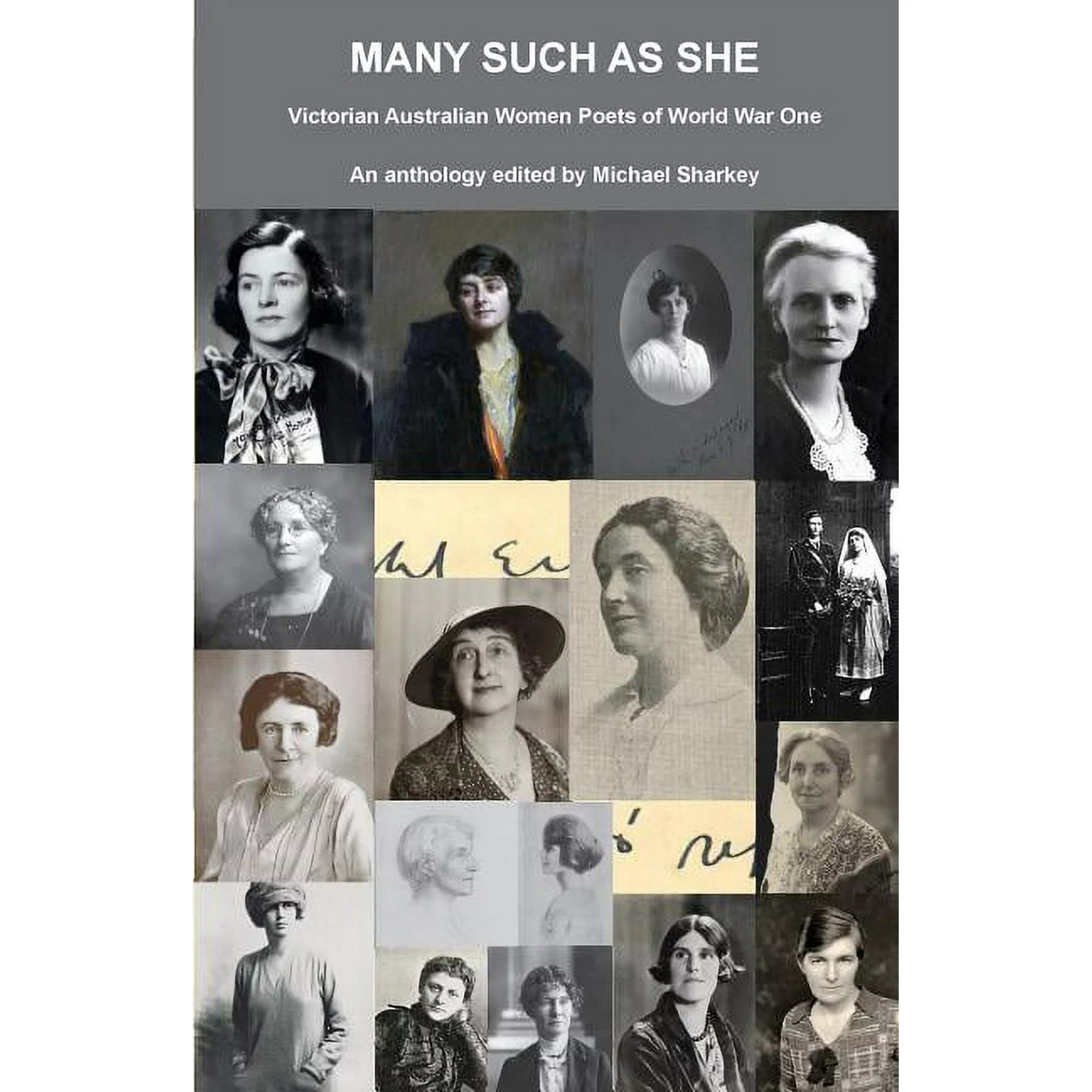
Martyr seems to be another example of a woman who managed to make a career for herself as a writer, by turning her hand to a wide variety of forms and audiences, but she also died relatively young. She was not completely forgotten, however, because five of her poems were included in Michael Sharkey’s 2018 anthology, Many such as she: Victorian women poets of World War One. An exhibition was held at Bendigo’s Soldiers Memorial Institute Military Museum in association with this book. Curator Kirsten McCay specifically mentioned Martyr, saying “Poet Grace Martyr lived locally and was a journalist for the Bendigo Advertiser. She also gave illustrated talks on famous composers at St Paul’s Cathedral, where a cross commemorates her life.”
Cross concluded her 1927 article with:
Grace Ethel Martyr’s work is always getting better, which is surely the best sign in any writer. Time, I think, will prove her to be one of the most sincere writers among us.
Six years later, at the age of 46, Martyr was dead. The report of her death, which was repeated in several Victorian newspapers, is brief but says that:
Miss Martyr’s literary gifts were apparent at an early age, and during the years that followed she established something of value to Australian literature.
I rest my case!
Sources
- G. Ethel Martyr, “The blue jar” in The Australasian, 5 April 1924
- Grace Ethel Martyr, Wikipedia [Accessed: 3 July 2024]
- Grace Ethel Martyr, AustLit [Accessed: 3 July 2024]
- Bernice May (aka Zora Cross), “Grace Ethel Martyr”, The Australian woman’s mirror, 2 August 1927 [Accessed: 22 July 2024]
- “Miss G. E. Martyr Dead”, The Sun News-Pictorial, 24 December 1934. [Accessed: 22 July 2024]
 Whispering Gums