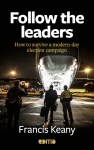
 I had a little laugh when I picked up Francis Keany’s book, Follow the leaders, about his experience as a journalist on the 2013 election campaign, because that very day our current leader Malcolm Turnbull formally announced the 2016 election. It’s all a game of course because we already knew when it was to be – the budget had been brought forward a week to accommodate the chosen date, after all – but the formalities had been held off until after said budget had been delivered. The fact that elections and electioneering are largely a game is one of the themes of Keany’s book.
Now, before I tell you more about this book, a little disclosure. Francis (or Frank) Keany is known to me. He has been my son’s friend since they met in high school in the mid-late 1990s. I’ve taken a particular interest, therefore, in following his journalistic career which has included stints in country New South Wales, Sydney and back in Canberra where we now hear his reports on ABC Radio. He’s a radio journalist, and during the 2013 election he was working for the Macquarie Radio Network.
Mr Gums and I went to the launch of the book and were interested to hear in the introductory comments by journalist James Massola that for all the books out there about politics, there are not very many about a journalist’s experience of an election campaign. He did mention one Australian book, Margo Kingston’s Off the rails about Pauline Hanson’s 1998 campaign, but this is not he said about the main campaign, the leaders. Keany’s book is particularly interesting, he continued, because it’s about modern campaigning in which social media is a significant component. As Keany writes:
the so-called 24-hour media cycle has added to the pace and tone of modern election campaigns. The mistakes that are made are amplified and exaggerated in a bid to meet the appetites of media consumers …
In this world, gaffes like Tony Abbott’s “suppository of all wisdom”, he writes, start trending immediately on Twitter. And then there are the interminable attempts by people to get selfies with the leaders, a “ridiculous aspect” of the campaign the journalists agree.
Keany’s book is not an analysis of or treatise about the process, he doesn’t have a theory to push, he simply shares the dogged day-to-day experience of being part of the press pack that accompanies the two leaders over the last 30-odd days of the campaign. Keany spent the first two weeks of the campaign following the Abbott (Leader of the Opposition) camp, and the last two weeks or so with the then Prime Minister Rudd’s camp.
I found it rather eye-opening. Of course, I’ve seen and read and heard the journalists reporting on campaign trails and I’ve comprehended that they travel in a bunch, but just how intense, not to mention exhausting, it all is, I hadn’t fully realised. Keany describes the experience of being herded onto military planes with their crude toilet facilities, of travelling on coaches, of visiting three states in a day, and of plans being changed suddenly. He describes donning hi-vis vests to traipse after a politician in a factory, sharing late night drinks with colleagues, and missing his partner Tess.
He is painfully honest about his personal experience of being a rookie campaign journalist, of the emotional toll of being separated from a partner when a little bit of support is just what you need, and of the physical toll wrought by the sheer exhaustion of the hours, not to mention by the poor nutrition as you eat on the run. Here he is at Day 16:
The tiredness has set in like a staph infection – it has become incurable. No number of power naps or snoozes can shake off the dull feeling that’s filling my head.
I can’t think clearly – I’m starting to make too many mistakes.
While his prime focus is his experience, he does provide some insights into the campaign itself. He explains – though perhaps we all know this one – that “campaigns have never been just about policy. They are about public relations”. He watches the politicians interact with the public, hears them discuss strategies, and concludes that “I don’t think politicians give the average punter enough credit for their knowledge of the outside world.” He talks of the journalists’ awareness of panic in the Rudd camp with last minute schedule changes, press conference delays, and sudden policy announcements. We glimpse the machinery behind the leaders – how political minders try to control the message by, for example, withholding press releases until the last minute. How tricky it is, we see, for journalists to keep it all together. They have to physically keep up with the leaders, tease out the key issues from the spin and try to get their questions answered, and then find time to prepare and file their stories according to the needs of their bosses.
Next time I start to rail at a journalist’s gaffe, I’ll think first about the difficulties that can be involved in “filing” one’s reports while you are on the run, and risking missing the bus to the next venue!
Keany’s writing is clear and, appropriate to his aim, is informal and chatty in style. He has a sense of humour too, which is conveyed in frequent asides, such as his description of a hotel room which “looks like it was nice back when the Raiders last won a premiership”. Even if you don’t know when that last one was, which I don’t, you get his point. But, I can’t help commenting, pedant that I am, on a recurring and irritating grammar peccadillo. It’s to do with “who” versus “whom”, as in, for example, “a mysterious pilot who we hardly ever see”. Or, is this just another grammar nicety that’s going to bite the dust?
For all the stresses and challenges, Keany is clearly passionate about his career. He writes in his Introduction that he’s aware of debates about the value of the press gallery, but says:
I firmly believe that our political system is grounded in the participation of all Australians, and that the media has a significant role to play in ensuring as much transparency as possible in that system.
I think he’s right – and I also think he has done journalism a service by providing some behind-the-scenes insight into why the media may not always be perfect, while also demonstrating that in this age of spin and control journalists are needed more than ever.
Francis Keany
Follow the leaders: How to survive a modern-day election campaign
Braddon: Editia, 2016
153pp.
ISBN: 9781942189404
 Whispering Gums