The Griffyns are on fire

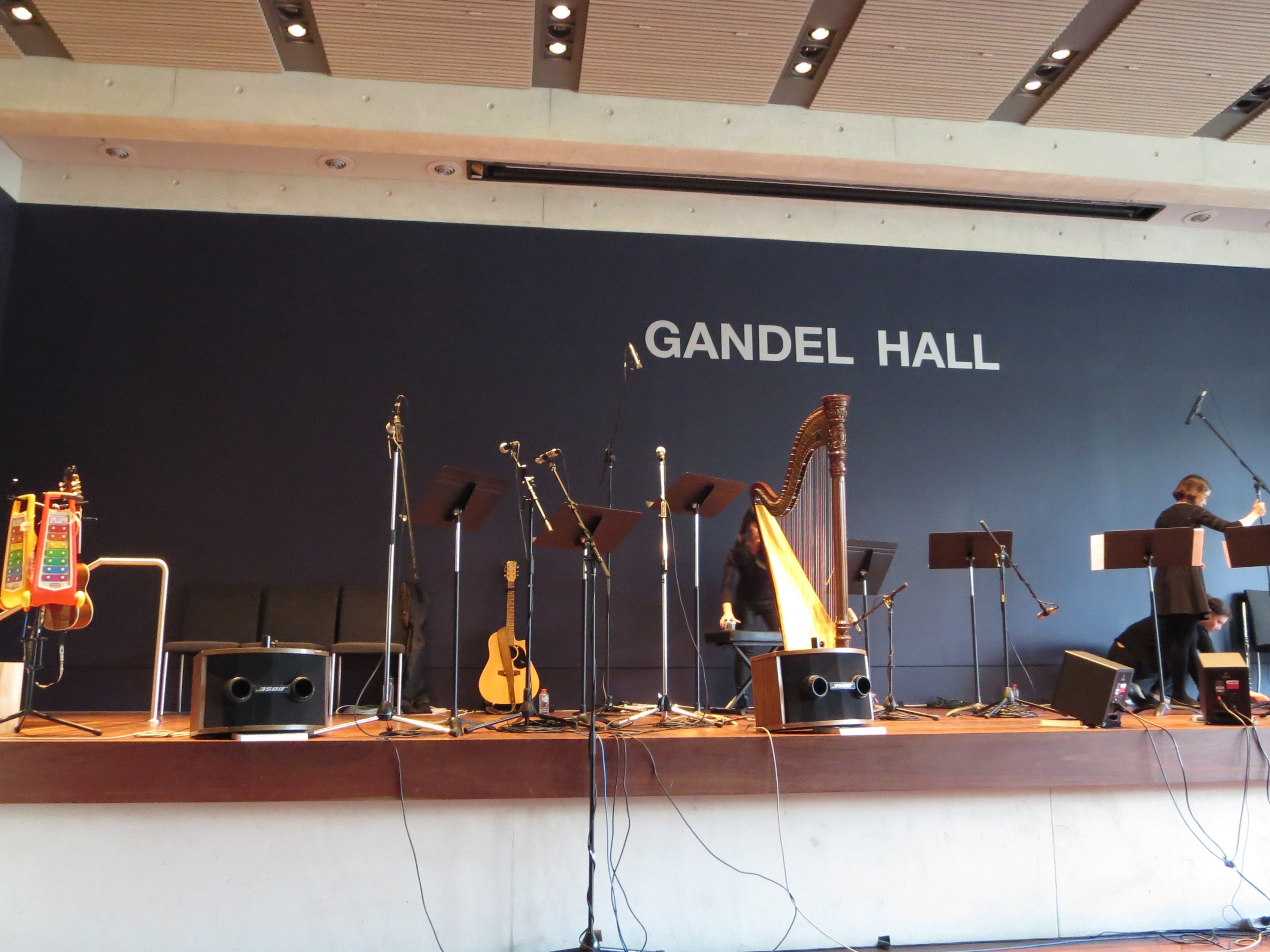
Stage, pre-show

Preshow setting up

And now for something completely different. If Griffyn Ensemble’s last concert, Do you believe? (my review)kept us on our intellectual toes from go to whoa, their third concert* of 2014, House on Fire, had our toes-a-tapping and feet-a-walking in a program that owed more to folk traditions than classical. Collaborating this time with Canberra pop-duo The Cashews (Alison Procter and Pete Lyons), they presented “a new program of original music” composed by them and The Cashews. The programme was  inspired by Arthur Boyd’s imaginative, surreal exploration of “place and identity” and was performed at the National Gallery of Australia’s Gandel Hall to coincide with the Gallery’s Arthur Boyd: Agony and Ecstasy exhibition. Mr Gums and I made a day of it. We visited the exhibition, had lunch overlooking the gorgeous sculpture garden and lake, and then went to the afternoon concert.

When I describe this program as more folk than classical, though, I don’t mean to suggest it was simple. This is the Griffyns after all, and their intent was serious even if the presentation had a lighter – and yes, probably more musically accessible – touch.

The programme opened with an empty stage and the sounds of birds which became more intense as the Griffyns took up their places on the stage and started playing music that sounded like dawn – like birds congregating around a waterhole, as the sun comes up. This segued immediately to the Cashews who performed a beautiful acknowledgement of traditional owners. It was an inspired change from the usual spoken one. “I’ll begin where you began”, they sang, “with connection to this land … I acknowledge you”, concluding with “and pause to acknowledge all that is yours”*. Truly moving.

Pete Lyons then introduced the program, and acted as emcee for the rest of the concert. This was interesting given that it was a Griffyn Ensemble concert, but it spoke beautifully to the fact that this was a real collaboration. Lyons told us that the concert would explore such ideas as belonging and unbelonging, connectedness and unconnectedness, metamorphosis, space, landscape, and silence. All of these made sense to an Australian audience, particularly when also viewed through the prism of Arthur Boyd’s complex depiction of landscape and intense relationship with the environment.

I’d love to describe the whole programme but that would take too long. Unfortunately there was no printed program so I can’t list the pieces. In fact I don’t really know the names of them all, but there were 11 or 12 interspersed with commentary, some brief interviews with Griffyn musicians, and a little walk on the outside! The program ran for nearly 2 hours without an interval, but I don’t think anyone cared.

“Moving to a discordant beat”
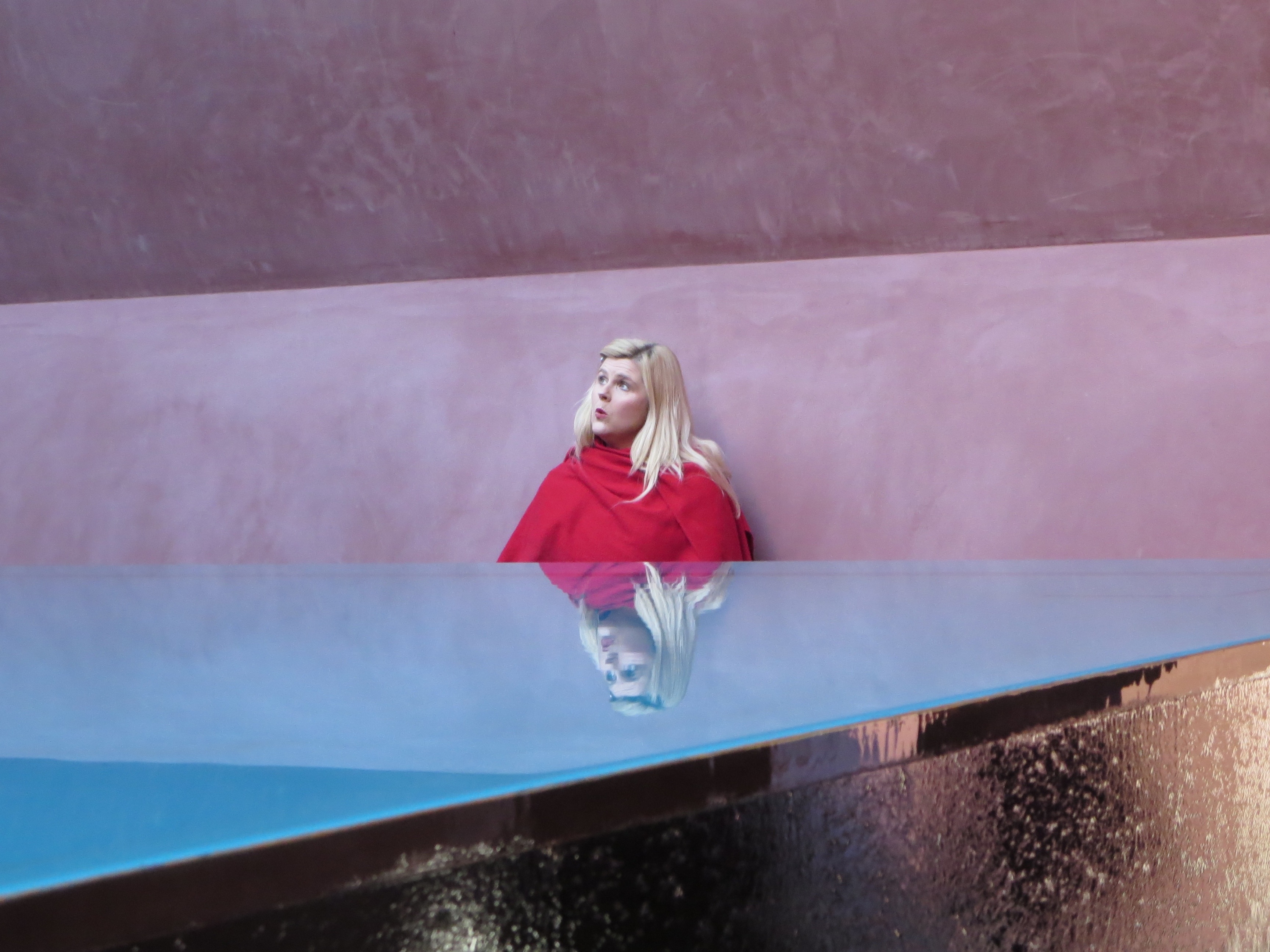
Susan Ellis singing inside "Skyspace"

Susan Ellis singing inside “Skyspace”

I did wonder how well the two sets of performers would meld their very different sounds – one folk-pop and the other contemporary classical. I needn’t have worried. These are all seasoned musicians, flexible in their ability and eclectic in their interests. It was particularly interesting to hear Susan Ellis’ classically trained voice mix with Alison Procter’s lighter one. They had (of course) practised and it worked beautifully, invoking for me the way Arthur Boyd had blended so many competing influences and tensions in his work. In several of the pieces of music, this tension was also conveyed by interspersing lyrical sections with more discordant sounds. Surprising how discordant a harp can sound when it tries – and Laura Tanata certainly tried, to great effect.

I enjoyed Holly Downes’ double bass playing in the last concert, and again in this one. Chris Stone produced some gorgeous mournful tones on his violin. A particularly moving piece was the song that expressed the concert’s theme of House on Fire. It drew on Canberra’s tragic bushfire of 2003 and the fire at Arthur Boyd’s childhood home that destroyed his father and renowned potter Merric Boyd’s kiln. The piece opened with Susan Ellis and Laura Tanata, with the whole ensemble then joining in. It conveyed, in words and music, a sense of “moving to a discordant beat”, but also recognised that there is “strength in adversity”.

The Arthur Boyd “theme” played out in various ways throughout the concert. In another piece, “Metamorphosis”, Susan Ellis, in voice, and Holly Downes’ on double bass, led the ensemble in a piece that explored Boyd’s sense of being “out of kilter”. There was a lovely melancholy in the playing here, too, particularly in the opening double bass.

“Listen … I know exactly what I’m looking at”
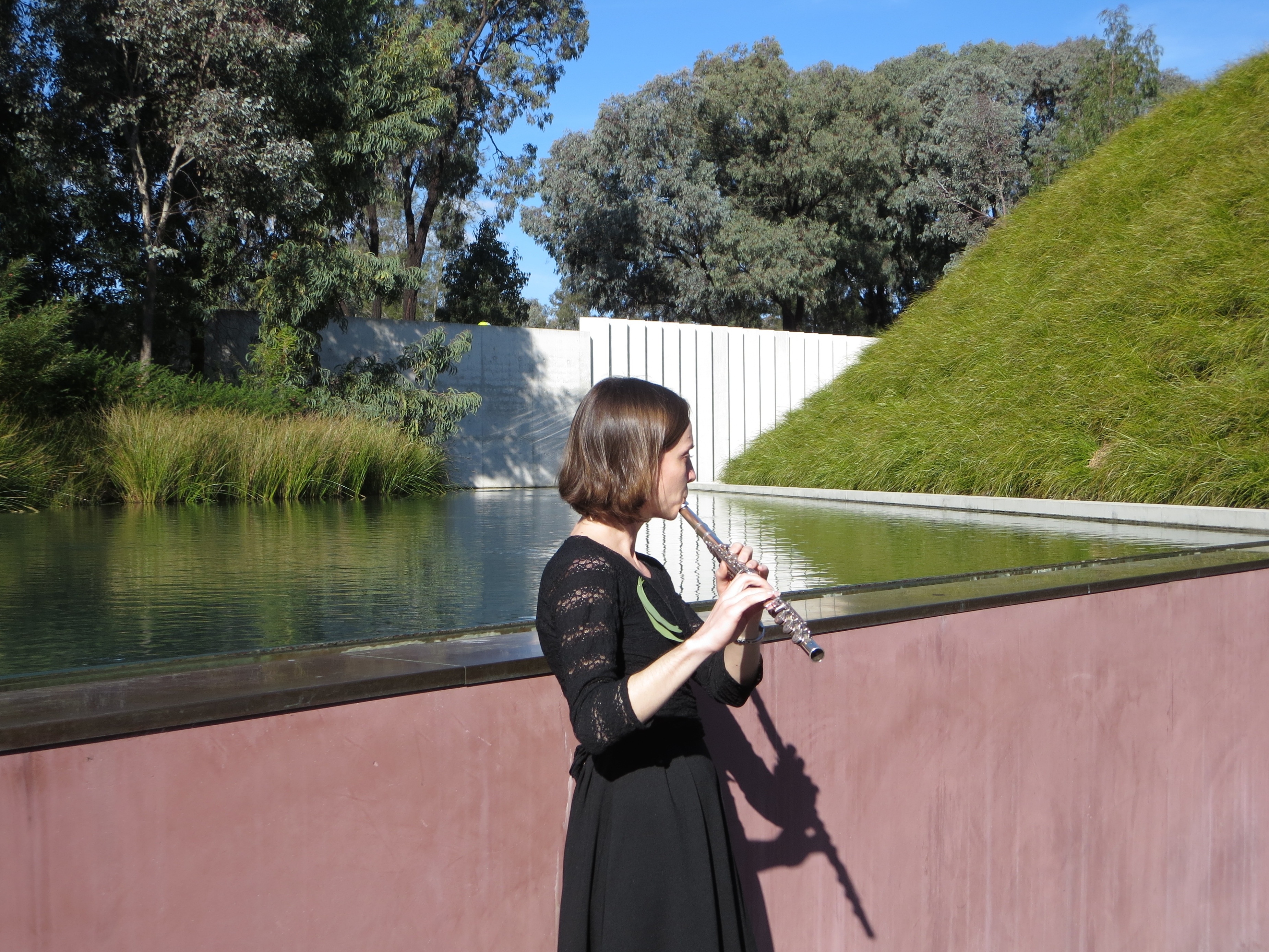
Kiri Sollis outside "Skyspace"

Kiri Sollis outside “Skyspace”

As always, Kiri Sollis shone with her flute, but we were entertained to discover in one of the little “impromptu” interviews that this concert was a departure for her. Classically-trained Sollis is used, she said, to practising lots to get what’s on the page in front of her right. However, in this show, she didn’t have much on the page in front of her and had to draw on her improvisational skills. She mentioned the sense of liberation and the terror of “not having stuff on the page”, reminding us again of Boyd and his terrors! She, like Boyd, needn’t have worried.

We were informed at the beginning that there would be silence and a walk. The silence occurred around the halfway mark, and was introduced by Pete who talked of Boyd’s silence about his work. We can understand why, agreeing with Pete’s comment that Boyd’s imagery and metaphors are complex and not easily unravelled. Best, really, for each person to make of it what they will.

The walk occurred a little later in the concert and involved the audience following Susan Ellis (emulating the Pied Piper in voice) out of the Hall, across the lawn and into James Turrell’s “Skyspace”. Once there, we filed inside the cone in small groups and found three Griffyns sitting on the bench humming/chanting into the space. It was peaceful, harmonious – and reminded Mr Gums and me of some moving “art space” experiences in Japan, particularly from the Setouchi International Art Festival.

“Come walk with me”
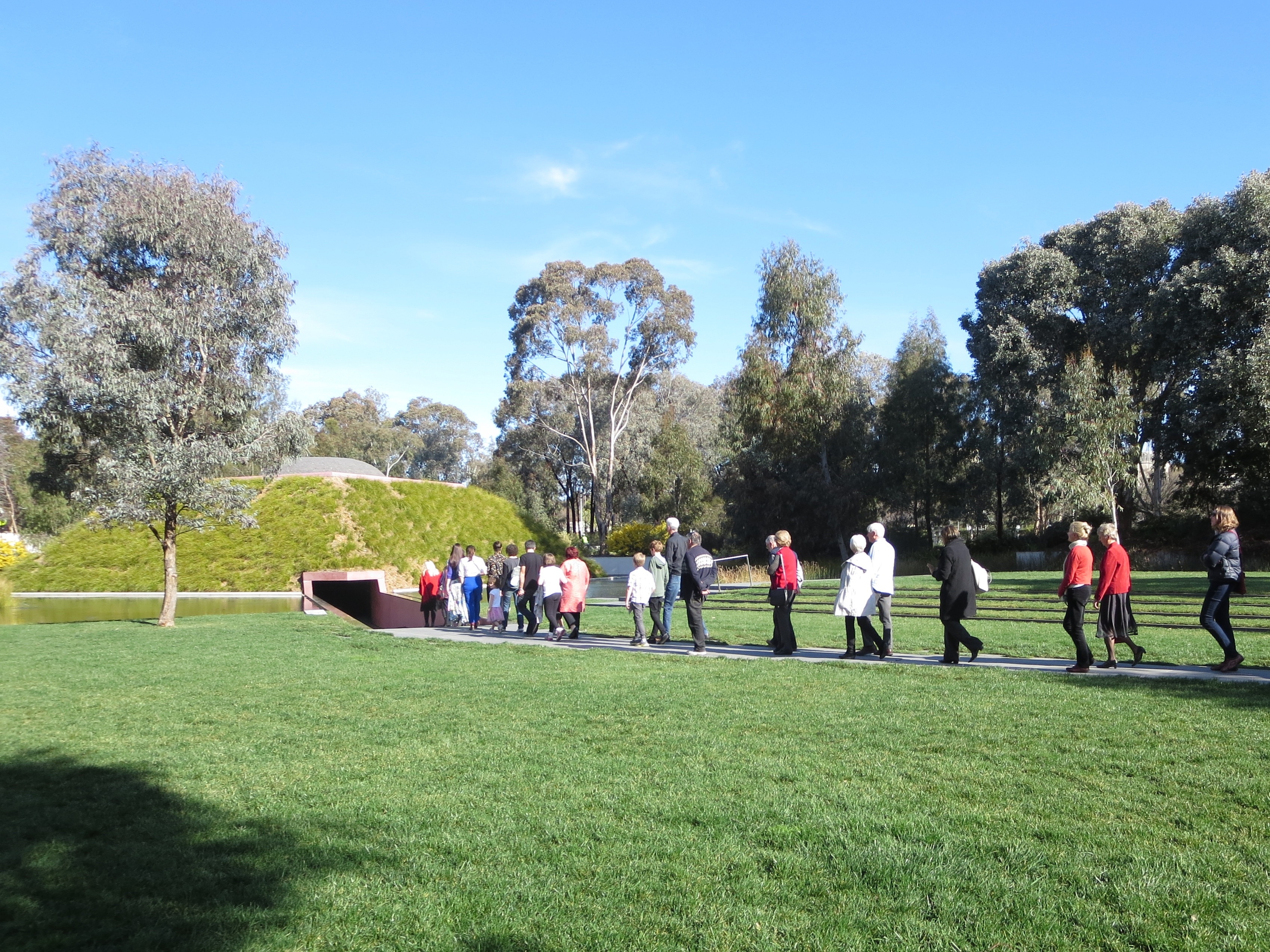
Following Susan Ellis

Following Susan Ellis

The concert/show/performance (have you noticed that I don’t quite know what to call these events?) concluded on three pieces of music: “Umbilical Link” composed by Michael Sollis, with words by Alison Procter, “Landscape Escape”, and  “Mountain Song”. “Umbilical Link” was inspired by Sollis’ walking around the suburb in which he grew up, and now lives in again. It’s about belonging, and it also connected to Boyd, to the fact that in the last two decades of his life he found a place he loved, Bundanon. In 1993 he gave Bundanon to the people of Australia because “you can’t own a landscape”.

Being Whispering Gums, I loved this line from “Umbilical Link”:

… big trees whispering moments from my histories.

“Landscape Escape”, a new song by the Cashews, referred specifically to Boyd’s finding Bundanon – “an intricate seduction on a canvas so vast”. The show then closed with an older Cashews’ work (I believe), “Mountain Song”, which neatly tied together the various themes that had been put to us – belonging, disconnection and discordance, respect for indigenous ownership, and a nurturing of the spirit. Australians will get the allusion in Lyons’ words, “the great divide is the great unification”. And with that, a few of the Griffyns picked up stones and sticks and playfully duelled with each other, percussively, before all took their well-deserved bows.

* For the second time this year, the programme was preceded by a support act, this time, appropriately, the local folk/folk-rock/hug pop group, Pocket Fox. We heard the last few songs and were impressed.
** I was trying to capture some lyrics as they were sung, so my quotations may not be exact.
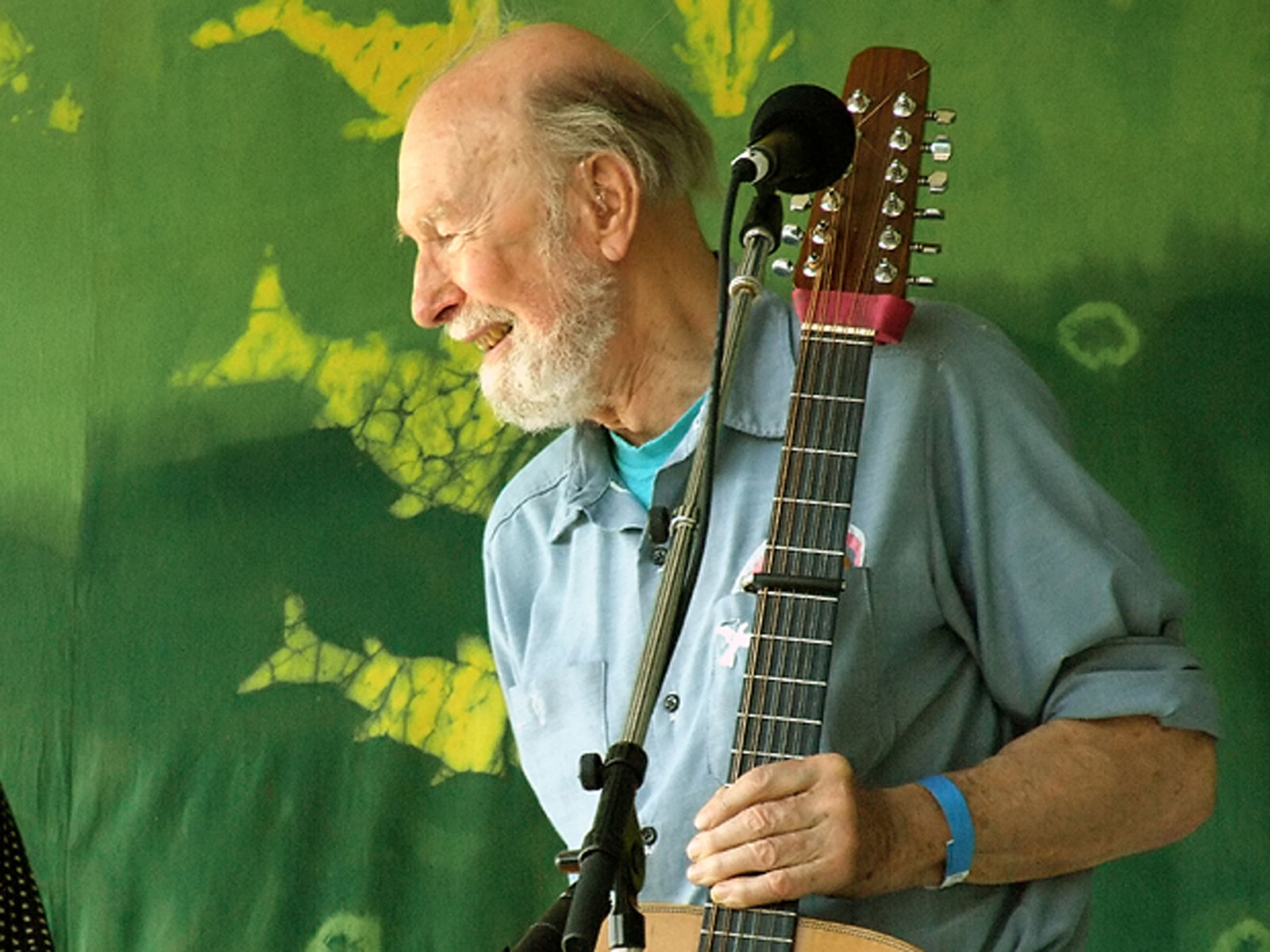
Vale Pete Seeger

Pete Seeger, 2007 (Photo: Anthony Pepitone, using CC-BY-SA 3.0, via Wikipedia)

Pete Seeger, 2007 (Photo: Anthony Pepitone, using CC-BY-SA 3.0, via Wikipedia)

If music is powerful, and words are powerful, what power can words set to music have? Pete Seeger knew, but I don’t need to tell anyone that do I? What a legacy he has left us from his 94 years on this earth!

I’m an Australian of course, but Seeger, who first came to me through Peter, Paul and Mary singing “If I had a hammer”,  introduced me to folk music, or, more specifically, to folk music as protest. Later, I got to hear Peter himself – not live, unfortunately – and others like Joan Baez, Judy Collins who sang Seeger’s songs, and were inspired by him.

Anyhow, in memory of Seeger, I thought I’d share my favourite memories:

  • singing “If I had a hammer”, “This land is your land”, and “Where have all the flowers gone”, with such feeling, in my youth;
  • choosing Ecclesiastes 3:1-8 as the bible reading at our wedding because I loved the song “Turn! Turn! Turn!“;
  • falling in love with The Weavers whose heyday was a little before my time when I saw the 1982 documentary The Weavers: Wasn’t That a Time (and then buying the CD);
  • being surprised every time I discover that yet another song I love was either written by Seeger (including those named here) or popularised by him (such as Malvina Reynolds’ “Little boxes” and the traditional hymn “We shall overcome”).

The LA Times obituary quotes Bruce Springsteen as saying that Seeger was:

a living archive of America’s music and conscience, a testament to the power of song and culture to nudge history along, to push American events towards a more humane and justified end.

Seeger himself is quoted as saying “My religion is that the world will not survive without dialogue”. I’m no Seeger expert, but everything I’ve ever heard about the man has either inspired me or made me feel good.  So, vale to Pete. His influence may have been greatest in the USA, but it sure was nice knowing he was around, singing his heart out and doing his best to make the world a better place to live in. Thank goodness we still have the songs.

Every folkie knows … Leonard Cohen

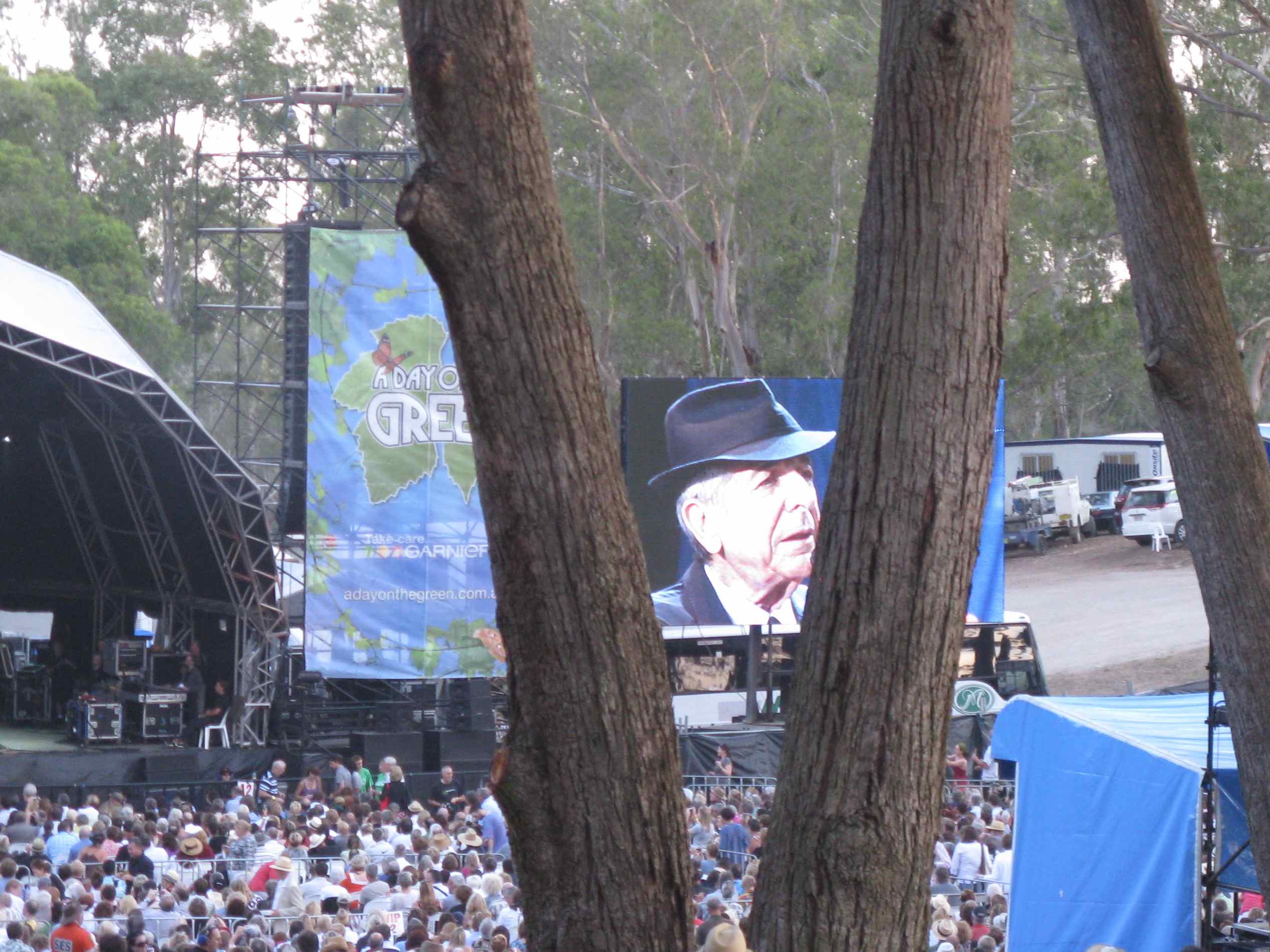
Leonard Cohen at Centennial Vineyards

Leonard Cohen at Centennial Vineyards, 2009

I recently wrote about the National Folk Festival in relation to Australian stories and history, but I can’t resist also writing a little post about “the man” because he was, it seemed, everywhere. I’m exaggerating of course but he – Leonard Cohen, of course – did seem to keep popping up.

There were performers who sang his songs, such as Ami Williamson who commenced her show with “Hallelujah”. You might think that is a little cliched but nothing about Ami is cliched … she put her own stamp on the song and got us in the mood for an energy-packed show that ranged through pop, folk, country and opera, both covers and her own original creations. Her “Daughter-in-law’s lament” is a hoot. She is a versatile gal.

Ruth Roshan, with Tango Noir, also did a Cohen song, though her choice was “Everybody knows”. The ambience was more 1930s French salon, and the dusky, sensual mood of the tango, but somehow Cohen fit right in there and Ruth pulled it off, despite her gentle voice and inviting smile.

Other performers though struck out into something different – into songs inspired by and/or featuring Cohen. Margret RoadKnight sang a whimsical song by Canadian singer songwriter, Nancy White, titled “Leonard Cohen’s never gonna bring my groceries in”. In case you don’t know it, here are a few lines to give you a flavour:

I’ve a husband and a baby, there’s another on the way.
And, like Leonard, I am aching in the place I used to play.
But really, I’m enjoying all this domesticity.
Hey, I never have to deal with Warren Beatty’s vanity.
But there is one thing I regret, and my regret is genuine.
Leonard Cohen’s never gonna bring my groceries in.

Since RoadKnight – and most of her audience – were of a certain age, this song went down very well!

And finally, it wasn’t only Australian performers who paid homage to the man. There was also (the rather lovely, I must say) English performer, Martha Tilston. She spoke of her envy of Cohen’s songwriting ability and said his line from “The stranger song”, “He was just some Joseph looking for a manger”, made her feel like hanging up her songwriting hat”. Instead though, she wrote a song about her inspiration, “Old Tom Cat”. Its opening lines are:

The tilt of your hat
Old tom cat
You wear truth like a necklace
It hangs around your poetry.

… and it includes references to Suzanne, Maryanne, Hallelujah and, of course, Joseph.

Funny how all these performers all women! That’s how it goes …

Monday musings on Australian literature: Literary Folk

Jason and Chloe Roweth perform

Local folkies Chloe and Jason Roweth, in the Trocadero venue, 2011

As I attended my 13th or 14th (losing count now), National Folk Festival* this Easter weekend, I started to think about the relationship between folk music and literature. Some folk music is purely instrumental – think Celtic fiddling and bluegrass picking, for example – but, as a reader, it’s the storytelling side of folk that most draws me in. From traditional English folk songs to bush ballads, from the love songs of singer-songwriters to protest music, folkies tell stories that are sad, romantic, tragic, funny or angry, so  I thought that for today’s Monday Musings I’d write about a very select few Aussie folk musicians whose stories I’ve enjoyed.

Eric Bogle (b. 1944)

Bogle, though Scottish born, is now one of the grand old men of Australian folk. His most famous song is the antiwar song “And the band played Waltzing Matilda“. Another antiwar song, “No man’s land” (also known as “The green fields of France”) was, he told us at this year’s Festival, described by Tony Blair as his favourite war poem. Here’s the last verse:

And I can’t help but wonder, now Willie McBride
Do all those who lie here know why they died?
Did you really believe them when they told you ‘The Cause’?
Did you really believe that this war would end wars?
Well the suffering, the sorrow, the glory, the shame
The killing, the dying, it was all done in vain,
For Willie McBride, it all happened again,
And again, and again, and again, and again.

Not all Bogle’s songs, by any means, are about war, but this seemed a particularly appropriate one for today’s Monday Musings which happens to fall on ANZAC Day.

Margret RoadKnight (b. 1943)

If Bogle is one of the grand old men of Australian folk, Margret Roadknight is a grand old dame. Each year I think I won’t go see her this time because I saw her last year and there are no many to see, but I usually find myself gravitating yet again to one of her concerts, and I’m never disappointed. The woman just keeps on keeping on the way folkies – like Bogle, Pete Seeger (with whom she’s performed), Joan Baez and ilk – do. She sings her own compositions and those of others. Like most folkies she tells stories about her songs, about why she wrote them or sings them. She’s a social justice activist, but the lyrics I’ll excerpt today come from her “big” hit of the 1970s, “Girls in our town” (written by Bob Hudson):

Girls in our town get no help from their men
No one can let them be sixteen again
Things might get better but it’s hard to say when
If they only had someone to talk to…

The Fagans

If Eric is the grand … well you get the drift … the Fagans have to be Australia’s royal family of folk. It’s a rare festival that you don’t find them together, and/or subsets thereof, performing. They regularly appear in the Union Concert so you can guess that a major theme for them is justice for workers. But, just to be perverse, I’m going to give you an excerpt from Kate Fagan’s plaintive depression era waltz, “Old station sisters”:

Another year passed, we were sweethearts by then,
The government came and they called up our men
To work in the cities, the factories and mines,
The country had no time for dancing.
With three younger sisters, parents to feed
And land that was broken from drought and disease,
Well he had no choice …

Jason and Chloe Roweth

Husband-and-wife team, Jason and Chloe Roweth are folklorists. They research and present Australian folklore, as well as perform original songs. For this year’s festival, which encompassed ANZAC Day, they reprised their show The riderless horse about the First World War. It is the result of significant research into the letters and diaries, not to mention the music and poems, of the era – and finds a good, if traditional, balance, between humour, tragedy and patriotism. The focus is the humanity of war – rather than the history and the deeds. One of the themes that runs through any stories of Australians at war is their anti-authoritarian/egalitarian stance (which was often at loggerheads with the British way of doing things). Here is an excerpt from “The army song”:

Now they give us chicken, they say it is the best,
But we get the neck and the arsehole.
The officers get the rest…

You need to have a laugh every now and then, or you’d be crying…

William Barton at the National Folk Festival, 2011

William Barton, in the Budawang, 2011

The Song Company and William Barton

The Song Company (with indigenous musician-didgeridoo player William Barton) is, really, the “odd man out” in this line-up – but they demonstrate what a wonderfully broad church the NFF is. The Song Company is a classically trained a capella group which, as their website describes, “is equally at home in medieval songs and chants, 16th-century polyphony, 20th-century classics and [which] creates innovative programs that cross the old divide between high-art and low-brow and old/new”. I’ve seen them in a few of these guises and enjoy their eclecticism (not to mention the quality of their execution). What they presented at the NFF was, I think, a version of their show Kalkadunga** Man which they toured with Barton a couple of years ago. Their program included an evocative piece, which Barton called a favourite, “Out there on the dry creek bed”, but I can’t find any lyrics online to excerpt for you. They also performed one of the best known (in white Australia) traditional Aboriginal songs, the “Maranoa Lullaby”:

Mumma warrunno
Murra wathunno,
Mumma warrunno
Murra wathunno.

You can hear a clip from a very scratchy 1950 recording sung by Australia’s first recognised classical indigenous singer, Harold Blair. This recording was among the first chosen for Sounds of Australia (the National Registry of Recorded Sound) developed and maintained by the National Film and Sound Archive …

… of course there’s more, but this seems a fitting way to conclude my little intro to the literary aspects of Folk.

*Folk is defined broadly … as I think it should be … by the National Folk Festival.
** Kalkadunga being the indigenous people from the Mt Isa region of NW Queensland.